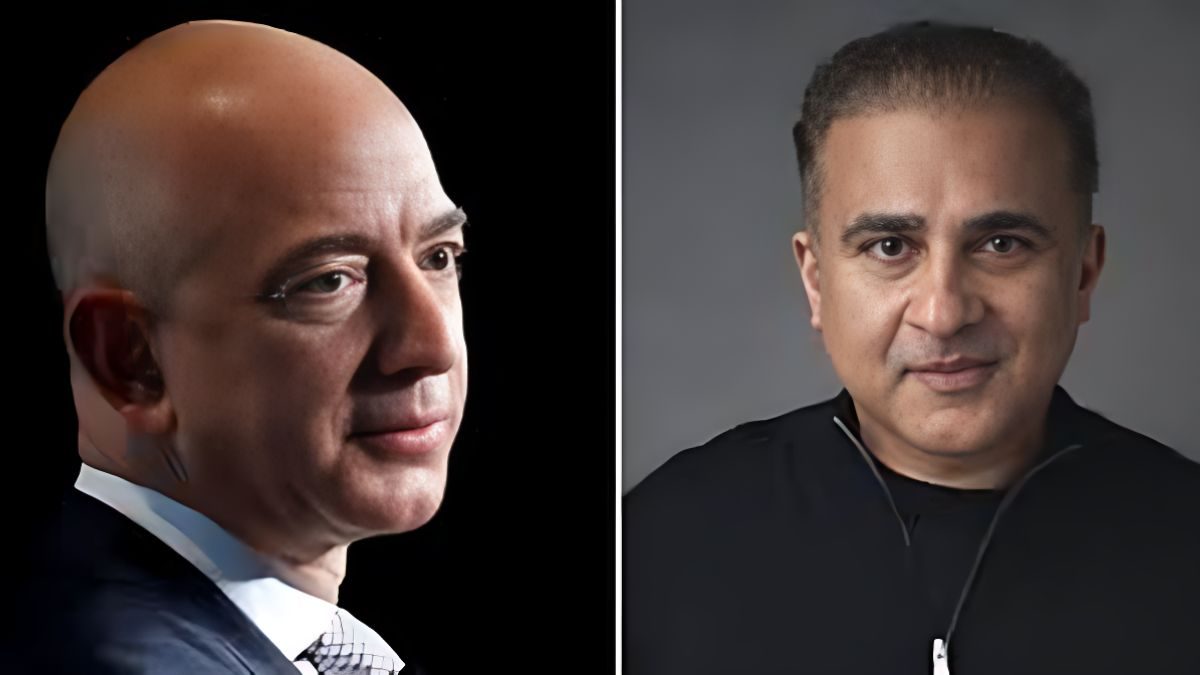
Jeff Bezos is back in the CEO’s chair with a major gamble in artificial intelligence: he’s co-leading a new AI startup called Project Prometheus, and his partner at the top is Vikram “Vik” Bajaj. According to reports, Vik Bajaj Joins Jeff Bezos’ AI Startup Project Prometheus, which has already raised around $6.2 billion, making it one of the most heavily funded early-stage AI firms globally. Bajaj, a scientist, entrepreneur, and former leader at Google X and Foresite Labs, brings deep technical expertise to the table, while Bezos contributes his capital and bold vision.
Prometheus aims to build AI for the physical economy, applying machine learning to robotics, manufacturing, scientific discovery, and drug design. The company has quietly hired nearly 100 researchers, including talent from OpenAI, DeepMind, and Meta. Although little is known about its full operations such as its office location or product roadmap—the stealthy startup has already made a big splash, thanks to its huge funding, world-class leadership, and ambitious mission.
This is also Bezos’s first formal executive role since stepping down as Amazon’s CEO in 2021. While he remains deeply involved in Blue Origin, taking up the co-CEO role signals a renewed commitment to shaping the future of technology.
1. Introduction
1.1 Background of the Announcement
Vik Bajaj Joins Jeff Bezos’ AI Startup in a move that has stirred excitement across the tech world. According to multiple sources, Bezos is not just writing a cheque, he’s taking charge. He will serve as co-CEO of Project Prometheus, sharing leadership with Bajaj, whose scientific credentials are off the charts.
While public details remain scarce, the financial backing is anything but: $6.2 billion has already been raised, partly from Bezos himself. The combined leadership of Bezos and Bajaj suggests a mix of bold entrepreneurial energy and deep technical vision.
1.2 Why This Matters
In an AI landscape dominated by tech giants like Google, Microsoft, and OpenAI, Project Prometheus is carving its own path: it wants AI to physically do things not just generate text. By focusing on robotics, manufacturing, and scientific problems, Prometheus could reshape how AI is used in the real world. Also, Bezos returning to a formal executive role after years away signals that he believes big-time in this bet.
2. Who Is Vik Bajaj?
2.1 Academic and Scientific Credentials
Vikram “Vik” Bajaj is not your typical startup CEO. He holds a PhD in Physical Chemistry from MIT, and his early education includes both a Bachelor’s and Master’s degree from the University of Pennsylvania.
He has academic stints at institutions like Stanford School of Medicine, Lawrence Berkeley National Laboratory, and UC Berkeley, showing his deep roots in scientific research.
2.2 Professional Journey
Bajaj worked at Google’s “X” moonshot factory, where he helped launch Verily, Google’s life-sciences research arm. He later co-founded Foresite Labs, an AI-focused wing of Foresite Capital, and served as its CEO.
He’s also co-founded Xaira Therapeutics, a biotech company using AI to develop drugs, and previously held a leadership role at the healthcare company GRAIL.
3. What Is Project Prometheus?
3.1 Mission & Focus
Project Prometheus is an AI startup aiming to apply artificial intelligence to the physical economy. Its ambition extends beyond software, it wants to shape robotics, scientific experiments, and advanced manufacturing in industries like aerospace, automotive, and computing.
3.2 Team & Funding
From what’s publicly known, Prometheus has hired about 100 people, including researchers who were poached from top AI firms like OpenAI, DeepMind, and Meta. The startup has raised a staggering $6.2 billion, with a portion coming from Bezos himself.
3.3 Areas of Application
Prometheus isn’t building just any AI, it’s focusing on “real-world, physical tasks.” These include:
- Robotics : smart machines that can act in the physical world.
- Drug design / scientific discovery : applying AI to accelerate research in chemistry and biology.
- Engineering & Manufacturing : using AI to optimize production in sectors like aerospace, automobiles, and computing.
4. Why This Startup Is a Bold Bet
4.1 Bezos’s Return to Operations
This marks Jeff Bezos’ first formal executive role since stepping down from Amazon in 2021. While he has stayed active with Blue Origin, co-CEO of a high-risk AI company shows he’s ready to bet on future-shaping technology again.
4.2 Strategic Vision
Bezos isn’t chasing the chatbot craze. Instead, he’s betting on “AI for the physical economy”, a vision where AI isn’t just about software but about automating real-world systems.
His earlier bets, like on Physical Intelligence (a robotics startup), reinforce his long-term play in AI + hardware.
4.3 Talent and Capabilities
Attracting top researchers from OpenAI, DeepMind, and Meta is no easy feat. Prometheus’ ability to assemble this team, along with Bajaj’s scientific leadership, gives it serious firepower.
5. Challenges & Competition
5.1 Competitive Landscape
Prometheus enters a crowded AI market. Big players like Google, Microsoft, Meta, and OpenAI dominate. But most of these are focused on digital AI (language models, recommender systems). Prometheus’ physical-world focus sets it apart.
Another startup operating in a somewhat similar space is Physical Intelligence, which builds AI software for robots. There’s also Thinking Machines Lab, which recently raised $2 billion to build “world models” that could learn physical tasks.
5.2 Technical & Execution Risk
Building AI for physical systems is much harder than for text. Robots need to perceive, act, and adapt. Manufacturing systems are complex. Scaling these solutions will require not just research but robust engineering.
Moreover, Prometheus’s stealth mode means the world knows only fragments headquarters, full product roadmap, or go-to-market strategy are not yet public. That opacity could be a challenge for trust, partnerships, and future fundraising.
6. Broader Impact & Industry Trends
6.1 AI + Manufacturing: The Next Frontier
AI is increasingly being applied to “physical economies” not just data analytics. Prometheus is at the cutting edge of this shift. If successful, it could reshape how products are built: more automation, smarter factories, and faster innovation.
6.2 Science + AI Convergence
With its emphasis on scientific discovery, Prometheus could accelerate breakthroughs in chemistry, biology, and materials science. This convergence of AI and science is poised to drive the next wave of innovation.
6.3 Leadership Significance
Bezos returning to a CEO role and choosing someone like Bajaj sends a powerful signal. It highlights that this is not a side bet, it’s a long-term, deep-tech play. Their partnership could attract even more talent, capital, and credibility to this niche.
7. Learning for Startups and Entrepreneurs
- Ambitious Vision Pays Off: Combining a moonshot vision (“AI for physical systems”) with deep pockets and strong technical leadership can mobilize talent and capital.
- Team Matters: Founders with domain expertise (like Bajaj) can add credibility and drive product focus in deep-tech startups.
- Focus on Long-Term Value: Rather than chasing short-term AI trends, Prometheus bets on infrastructure-level AI — something with real industrial impact.
- Build with Secrecy if Necessary: Operating stealthily can help protect IP, but balancing transparency is important for trust and partnerships.
About FoundLanes
At foundlanes.com is closely watching Vik Bajaj Joins Jeff Bezos’ AI Startup as a key development in the global deep-tech startup ecosystem. This story sits at the intersection of AI innovation, scientific research, and big-business ambitions. Our platform continues to track how Project Prometheus evolves from funding and hiring to product launches offering entrepreneurs, investors, and industry watchers timely insights into one of the most ambitious AI bets of the year.