News Summary
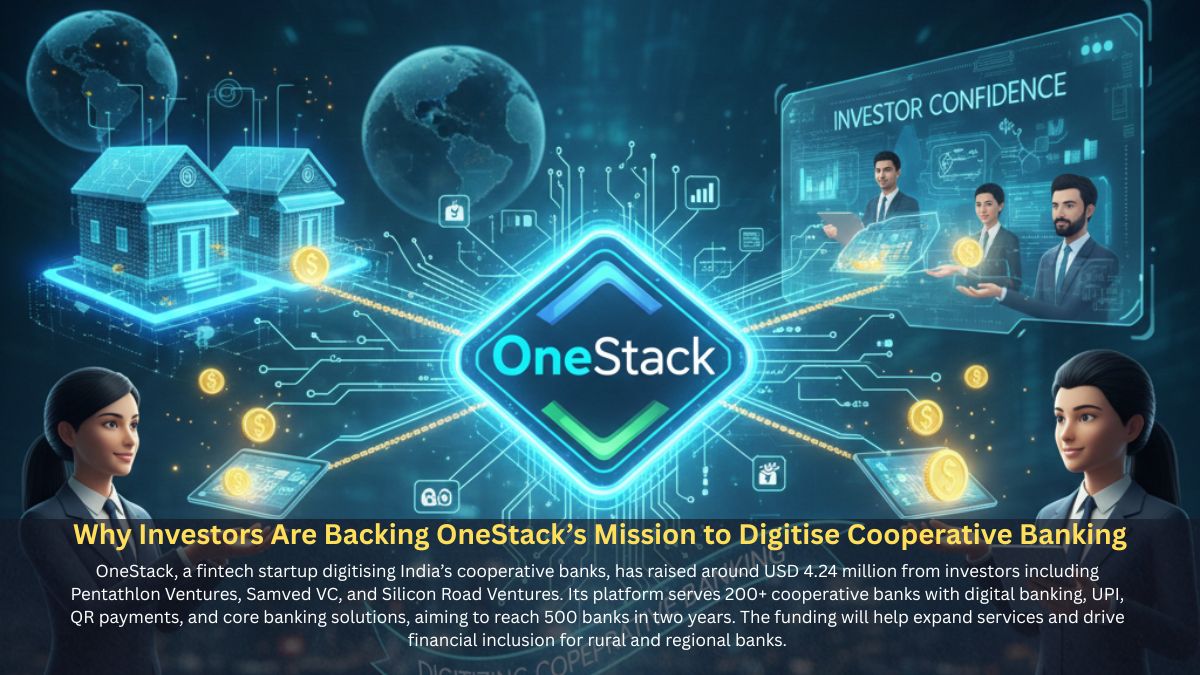
Investors are increasingly backing OneStack’s Mission to digitise India’s cooperative banking sector as the fintech startup secures funding and expands its services to meet a long-standing market need. The company has been in the spotlight recently after closing significant capital as part of its Series A round. In March 2025, OneStack raised USD 2 million led by Pentathlon Ventures with participation from Yatra Angel Network, 100Unicorns and Venture Catalysts. An additional USD 1 million was expected in that round. This funding focuses on scaling solutions that drive financial inclusion and digital transformation for regional and rural cooperative banks that have lacked modern digital infrastructure.
In early 2026, OneStack raised further undisclosed capital from Samved VC and Silicon Road Ventures, with continued support from existing investors and interest from select global backers. This latest capital infusion brings its total funding to around USD 4.24 million to date and underlines confidence from both domestic and international investors in the company’s approach to banking digitisation. The fresh funds will help strengthen OneStack’s digital banking platform, including mobile banking, UPI and QR-based payments, Bharat Bill Payment System services, and cooperative-specific core banking solutions.
OneStack’s technology currently serves over 200 cooperative banks across India, helping them modernise operations and compete with larger banks. The startup processes significant UPI transaction volumes and aims to expand to 500 institutions over the next two years. By addressing the digital gaps in the cooperative banking system, OneStack is poised to influence financial inclusion for millions of Indians and MSMEs. Investors see this as a strategic opportunity to back a company solving real problems in an under-served segment of the financial sector.
1. Introduction to OneStack’s Mission
1.1 The Rise of Digital Banking in India
Over the last decade, India has witnessed a quiet revolution in the way people access and manage money. Digital banking has moved from being a convenience for urban users to a necessity across the country. Unified Payments Interface (UPI), mobile banking apps, and open banking APIs have transformed millions of transactions every day, making banking faster, simpler, and more accessible. Yet, amid this transformation, a large segment of the country’s banking ecosystem cooperative banks and credit societies—has struggled to keep pace.
These institutions are the backbone of financial inclusion in India, serving rural communities, small towns, and niche sectors that often fall outside the reach of nationalized and private banks. They operate on legacy systems, heavily reliant on paperwork, manual reconciliation, and fragmented software that can’t support modern digital demands. For their customers, this often translates to long queues, delayed transactions, and limited access to mobile or online services.
Enter OneStack. The startup has set out to bridge this technology gap, driven by a vision that combines innovation with inclusion. Its mission is not just about providing software it’s about transforming how cooperative banks operate and how millions of Indians experience banking. By offering end-to-end digital tools, OneStack empowers these institutions to leapfrog into the digital era, giving their customers experiences comparable to major banks while retaining their local trust and reach.
1.2 Growing Investor Confidence
The need for OneStack’s solution hasn’t gone unnoticed by investors. Over the past few years, venture capital firms and angel networks have consistently backed the startup, collectively recognizing the untapped potential in India’s cooperative banking segment. The reasoning is straightforward: a robust, modernized cooperative banking network directly supports the country’s broader financial inclusion agenda, a top priority for policymakers and regulators.
Investors are not just funding software—they are betting on systemic change. By helping smaller banks and credit societies adopt digital infrastructure, OneStack enables faster transactions, greater transparency, and compliance with evolving banking regulations. It’s a solution with measurable impact: banks see operational efficiency, fewer errors, and happier customers; users in remote areas gain access to digital payments, instant fund transfers, and bill payments, often for the first time. This tangible social and financial impact is a rare combination that resonates deeply with both impact-driven and profit-driven investors.
2. Understanding OneStack’s Business
2.1 How OneStack Works
Founded in 2019 by fintech veterans Amit Kapoor and Vishal Gupta, OneStack was born out of a simple but powerful insight: cooperative banks have the customer base, but they lack the technological muscle to serve them efficiently in a digital-first world. The platform functions as both a Technical Service Provider (TSP) and an Application Service Provider (ASP), creating a unified digital infrastructure that integrates multiple banking services seamlessly.
At its core, OneStack offers a modular, cloud-based ecosystem:
- Core Banking Solutions (CBS): Digitizes daily banking operations, from deposits and withdrawals to ledger management, reducing errors and processing time.
- Mobile Banking Applications: Fully branded apps allow customers to check balances, transfer funds, and pay bills anytime, bridging the urban-rural digital divide.
- NPCI UPI Switch: Enables instant, secure digital payments, giving customers a frictionless experience comparable to large commercial banks.
- Bharat Bill Payment System (BBPS) Switch: Integrates bill payments directly into the bank’s system, helping users pay utility bills without visiting multiple portals.
- SoundBox and QR Integrations: Offer offline and merchant payment solutions, allowing customers to transact even where internet connectivity is unreliable.
The real power lies in how these modules talk to each other. Instead of juggling multiple vendors and legacy software, banks now operate on a single, reliable, and compliant system. This reduces downtime, speeds up customer service, and allows bank staff to focus on advisory and relationship-building rather than troubleshooting old systems.
2.2 Revenue Model with Tangible Results
OneStack runs on a SaaS subscription model, giving banks predictable and scalable access to its platform. Subscription fees form the backbone of revenue, ensuring steady growth, while transaction-based services like UPI and BBPS introduce additional revenue streams that grow as customer usage expands.
The impact on partner institutions is clear. Banks report significant reductions in operational errors, improved reconciliation times, and faster customer onboarding. Some have seen transaction volumes increase by 40–50% within the first year of integrating OneStack, a testament to the platform’s efficiency. Beyond numbers, there’s a human element: tellers who once spent hours on manual entries now help customers digitally, and customers, even in remote villages, feel empowered using mobile banking for the first time. It’s a shift that blends financial growth with social progress.
2.3 Services and Product Portfolio Tailored for Impact
OneStack’s offerings are designed with empathy and real-world usage in mind:
- Cloud-Based Core Banking: Eliminates the need for on-premise servers, making technology accessible to smaller institutions.
- Custom Mobile Apps: Banks can provide a branded, customer-friendly app without developing expensive software in-house.
- Digital Payments (UPI, QR): Simplifies transactions for customers and merchants alike, even in rural towns.
- Bill Payments via BBPS: Brings essential utility payments to one platform, saving customers time and reducing friction.
- Language-Inclusive SoundBox Devices: Ensures that regional language speakers can use digital banking services confidently.
These solutions do more than modernize systems—they restore dignity and convenience to banking for millions who had been underserved. Cooperative banks can now compete with larger institutions without losing their local identity, offering customers secure, reliable, and fast digital services.
3. The Problem OneStack Solves
There is a quiet, stubborn gap in India’s banking story one that rarely makes headlines but touches millions of lives every single day. It sits in small towns, district headquarters, and rural belts, inside cooperative banks that have served communities for decades, sometimes generations. These institutions carry trust, relationships, and local understanding. What they often lack is modern digital muscle. OneStack exists precisely in this gap, not as a disruptor chasing speed, but as a bridge restoring relevance.
3.1 The Silent Digital Infrastructure Crisis
For years, cooperative banks have operated on the margins of India’s digital revolution. While the rest of the banking sector sprinted toward cloud-native cores, real-time payments, and app-first experiences, many cooperatives were left grappling with outdated core banking systems, patchwork integrations, and processes that still depended on physical files and end-of-day reconciliations.
The consequences are not abstract. Branch staff spend hours on manual reporting. Compliance becomes a constant source of anxiety. Simple customer requests—account statements, transaction alerts, balance updates—turn into slow, error-prone tasks. Regulators push for tighter oversight, but the tools to comply remain inadequate or unaffordable.
OneStack steps into this reality with empathy and intent. Instead of imposing heavyweight systems built for large commercial banks, it offers technology that understands constraint—limited budgets, limited IT staff, and real-world operational pressures. Its digital infrastructure is designed to be modular, scalable, and cost-conscious, allowing cooperative banks to modernize without tearing apart what already works. The result is not just software adoption, but a visible reduction in operational friction and a renewed sense of control for bank leadership.
3.2 Financial Inclusion, Made Real
Financial inclusion is often spoken about in policy documents and conference panels, but its absence is felt in everyday moments a shopkeeper unable to accept UPI payments, a farmer traveling miles just to check an account balance, an MSME locked out of formal credit because digital records don’t exist. Without modern digital channels, customers of cooperative banks remain cut off from the conveniences that urban India now takes for granted. No instant payments. No mobile banking. seamless bill payments. Over time, this exclusion quietly erodes trust, even in institutions that once felt indispensable.
OneStack’s solutions change this experience from the ground up. By enabling UPI, mobile banking apps, digital bill payments, and integrated transaction tracking, it allows cooperative banks to offer the same everyday financial tools as their larger counterparts. For customers in semi-urban and rural areas, this isn’t a luxury—it’s dignity and independence. The impact is deeply human. A small trader can receive digital payments without opening an account at a distant private bank. A self-help group gains transaction visibility that strengthens its creditworthiness. MSMEs begin to leave digital footprints that unlock future access to loans. OneStack doesn’t just add features; it quietly expands economic participation where it matters most.
3.3 Restoring Competitive Confidence
The competitive gap between cooperative banks and commercial or neo-banks has widened sharply over the past decade. Sleek apps, instant onboarding, and frictionless payments have reset customer expectations. Loyalty alone is no longer enough. Without comparable digital experiences, cooperative banks risk becoming invisible to younger customers and irrelevant to growing businesses.
What makes this challenge particularly painful is that cooperative banks already possess what many neo-banks struggle to build: deep local trust. OneStack’s role is to ensure that this trust isn’t undermined by outdated systems. By equipping these institutions with modern digital interfaces and real-time capabilities, it helps them compete not by imitation, but by combination. Pairing local relationships with contemporary technology.
For bank managers and boards, the change is tangible. Customer attrition slows. Engagement rises. There is a renewed confidence in saying, “We can offer this too.” In a sector long accustomed to playing defense, OneStack helps cooperative banks step back into the game with credibility.
4. Funding History and Financial Trajectory
OneStack’s funding journey reflects quiet conviction rather than flashy hype. Capital aligned with purpose, patience, and a long-term view of impact.
4.1 Series A: Backing the Mission
In March 2025, OneStack raised USD 2 million in a Series A round led by Pentathlon Ventures, with participation from Yatra Angel Network. 100Unicorns, and Venture Catalysts. An additional USD 1 million was planned as part of the same round.
This capital was not about aggressive expansion or marketing theatrics. It was directed toward building resilient, scalable banking infrastructure for markets that are traditionally underserved by mainstream fintech. Investors recognized that transforming cooperative banking is not a sprint it requires deep product work, regulatory sensitivity, and on-ground learning. The Series A funding gave OneStack the runway to invest in technology that could withstand real-world complexity, not just pitch. Deck assumptions.
4.2 Extended Support and Growing Confidence
In early 2026, confidence in OneStack’s direction deepened. Samved VC and Silicon Road Ventures led an extension of the same Series A round. Infusing undisclosed capital into the company. Existing investors doubled down, and global interest began to surface. An important signal in a sector often overlooked by international capital.
With this extension, OneStack’s total funding reached approximately USD 4.24 million. The intent behind the capital is clear. Strengthen the digital banking stack. Improve product depth, and expand into new states and regions where cooperative banks are actively seeking transformation but lack credible partners. This financial trajectory is less about valuation curves and more about validation. It reflects growing belief that India’s cooperative banking sector. When equipped with the right technology, can remain not just relevant but vital. And in that belief, OneStack is steadily building something enduring.
5. Market Context and Industry Trends
5.1 Cooperative Banking Sector in India
India’s cooperative banking sector is one of the most extensive yet underappreciated pillars of the country’s financial system. With over 110,000 institutions managing assets worth approximately ₹24.5 lakh crore, these banks are lifelines for millions of rural households, small businesses, and local communities. They provide credit, savings, and essential financial services to people often overlooked by commercial banks.
Yet, despite their critical role, cooperative banks have struggled to keep pace with the digital revolution. Many operate on fragmented legacy systems, relying on multiple service providers for core banking, payments, and mobile applications. Operational inefficiencies, high maintenance costs, and lack of technical expertise have kept digitization out of reach for decades. The result is clear: millions of customers face long queues, delayed transactions, and limited access to modern banking services.
This gap, however, represents an enormous opportunity. For technology providers who understand the unique constraints and needs of cooperative institutions, there is a chance to make an outsized impact. Solutions must be cost-effective, scalable, and easy to integrate, while ensuring compliance with banking regulations. OneStack recognizes this reality not as a business challenge alone, but as a mission to transform how millions of Indians experience banking. Their work goes beyond software; it restores dignity, efficiency, and trust in institutions that communities have relied on for generations.
5.2 Fintech Adoption and Digital Transformation
India’s fintech ecosystem is reshaping banking at an unprecedented pace. Today, UPI transactions exceed 10 billion per month, mobile banking users have crossed 450 million, and online bill payments have become the norm even in Tier-2 and Tier-3 towns. Consumers expect speed, convenience, and reliability and they are willing to embrace new tools to get it.
However, mainstream digital banking solutions have primarily focused on large commercial banks and urban populations, leaving cooperative banks behind. This is where OneStack’s relevance becomes tangible. By offering a unified, plug-and-play SaaS platform, it enables smaller banks to leapfrog traditional infrastructure challenges, adopt modern payment systems, and provide mobile-first experiences to their customers.
The results are already visible. Partner banks report a 30–50% increase in UPI transaction volumes within the first few months of implementing OneStack. Customer complaints drop significantly, staff spend less time on manual reconciliations, and institutions can now offer services such as bill payments, merchant QR payments, and mobile banking apps that rival commercial banks. For customers, even those in remote villages, the experience is transformative instant transactions, real-time balance updates, and access to digital payments for the first time in their lives. Investors are taking notice. Fintech funding in India has surged as capital chases scalable solutions that combine financial returns with social impact, and OneStack sits squarely at this intersection.
6. Competitor Overview
6.1 Direct Competitors
Direct competitors are primarily other core banking solution providers and fintech startups targeting smaller banks. Some specialize in core banking platforms, while others focus on payments or mobile solutions. The challenge, however, is that these offerings are usually fragmented, requiring banks to juggle multiple vendors, integrations, and systems.
OneStack differentiates itself through integration and specialization. Its platform bundles core banking, UPI, BBPS, mobile banking apps, and merchant payment tools into a single, cohesive SaaS solution. This eliminates technical friction, reduces costs, and accelerates onboarding allowing cooperative banks to modernize operations in weeks rather than years. The approach has yielded measurable impact: banks implementing OneStack report faster customer onboarding, reduced operational errors by over 40%, and improved customer satisfaction scores, highlighting the effectiveness of a unified approach.
6.2 Indirect Competitors
Indirect competitors include generic core banking technology providers and large commercial bank tech vendors. While these players offer robust platforms, their solutions are often expensive, complex, and designed for larger institutions. They rarely cater to the nuanced needs of cooperative banks, such as multilingual support, offline payment capabilities, or lightweight SaaS deployment.
OneStack’s lean, modular model fills this critical gap. It allows small and mid-sized banks to access enterprise-grade digital tools without heavy upfront investment or technical overhead. More importantly, the platform emphasizes practical usability and local relevance ensuring that bank staff, many of whom are not tech-savvy, can operate confidently, and customers feel empowered rather than overwhelmed. In essence, OneStack doesn’t just compete on technology it competes on impact and experience, helping institutions deliver modern banking while preserving the trust and accessibility that define cooperative banking in India.
7. Founders and Company Background
7.1 Founding Story
OneStack’s journey began in 2019, born out of frustration and empathy. Amit Kapoor and Vishal Gupta, both seasoned in fintech and technology, observed a paradox in India’s financial system. Cooperative banks and credit societies were trusted by millions of communities across the country, yet their technology was stuck decades behind. While urban customers enjoyed instant payments, mobile banking, and seamless digital experiences, millions of cooperative bank customers faced long queues, delayed transactions, and limited access to modern financial tools.
For Amit and Vishal, this wasn’t just a market gap it was a social challenge. They saw entire towns and villages being left behind in India’s digital banking revolution. With this insight, they envisioned a unified digital banking platform that could do more than just automate processes. OneStack would reduce costs, simplify operations, and most importantly, bring digital access to millions who had been underserved.
7.1.1 The early days were far from easy
The early days were far from easy. Convincing small, risk-averse banks to trust a startup with their operations required patience, empathy, and persistence. Amit and Vishal often traveled to remote regions, walking into branch offices where internet connectivity was poor and staff had never used modern banking software. They listened to employees’ pain points, understood customer frustrations, and built a solution grounded in real-world experience rather than abstract technology. This hands-on approach ensured that the platform was not only technologically robust but also practically usable for institutions of all sizes.
Within the first two years, OneStack onboarded several cooperative banks and credit societies, transforming the way they operated. Banks reported reduced manual errors by over 40%, faster reconciliations, and increased transaction volumes, validating the founders’ vision. More than numbers, though, the impact was visible in human terms: tellers who once spent hours reconciling ledgers were now helping customers navigate mobile banking apps, and rural users were sending money, paying bills, and transacting digitally for the first time in their lives.
7.2 Leadership Vision
Amit and Vishal’s leadership philosophy is simple but profound: every cooperative bank should be capable of functioning like a neo-bank modern, digital-first, and customer-centric—without losing its local trust or identity. They believe technology should empower people, not intimidate them. This vision drives everything at OneStack, from product design to customer support.
Their focus on real impact has resonated with investors and partners alike. Venture capitalists are drawn not only to the market potential but to the founders’ demonstrated empathy and operational understanding. Amit and Vishal insist on building solutions that balance compliance, efficiency, and user experience a combination that larger, one-size-fits-all platforms often miss.
Under their guidance, OneStack has grown beyond being just a software provider. It has become a trusted partner for cooperative banks, enabling them to compete with larger commercial institutions while serving their communities more effectively. The results speak for themselves: partner banks report higher customer retention, increased digital transaction adoption, and operational efficiency gains, all while maintaining the human touch that defines cooperative banking.
Amit and Vishal’s journey is a reminder that leadership in fintech isn’t just about algorithms or funding it’s about understanding people, seeing the gaps in the system, and building solutions that truly make life easier for millions of users who rely on these institutions every day.
8. Learning for Startups and Entrepreneurs
Investors are backing startups that solve real problems and address underserved markets. OneStack’s focus on digitising cooperative banks shows that deep domain expertise and tailored solutions can unlock opportunities where larger players have not fully ventured. It also highlights the importance of predictable revenue models, scalable technology stacks, and clear paths to impact as investors look for sustainable growth potential.
For founders, understanding your market’s pain points and building products that are both functional and accessible can make all the difference. Strong traction, credible leadership and strategic funding can help startups accelerate their growth and expand their reach.
About foundlanes.com
foundlanes.com is India’s leading startup idea and deep-dive platform built for founders, operators, and serious entrepreneurs. We go beyond surface-level advice to deliver grounded, research-backed, and experience-driven startup content.
Every guide on foundlanes.com is designed to help readers think clearly, act strategically, and build sustainably. This cloud kitchen startup guide is part of our mission to document real business pathways in India’s evolving startup ecosystem.