News Summary
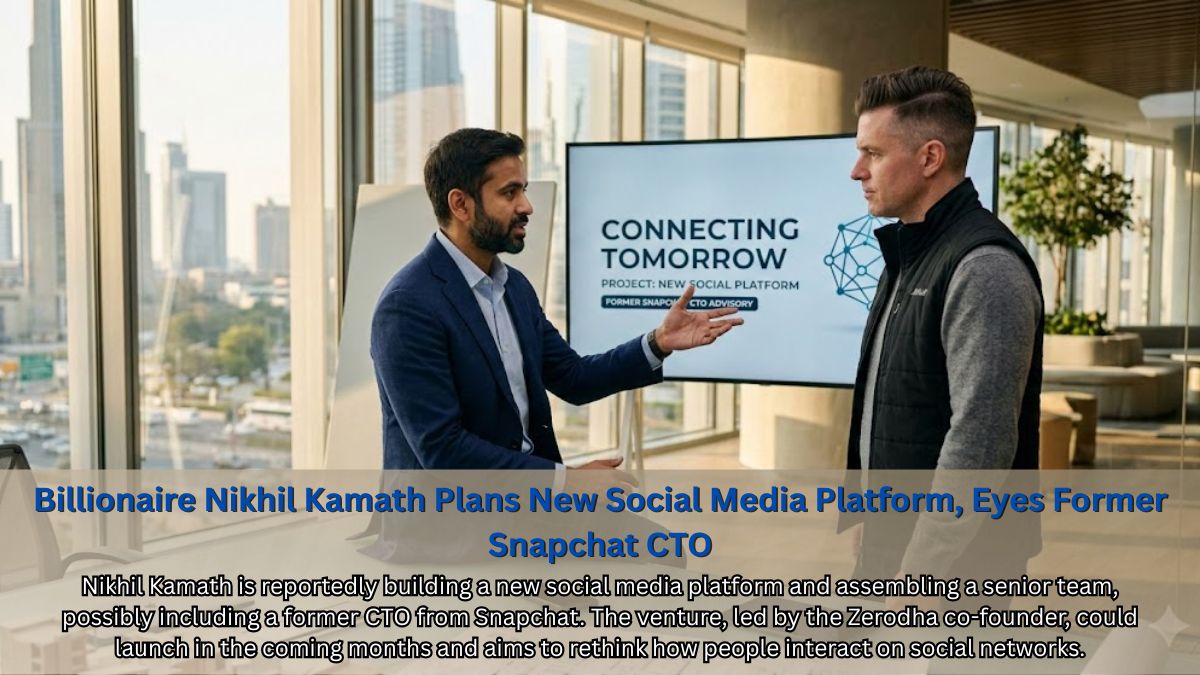
Indian billionaire entrepreneur Nikhil Kamath, co-founder of Zerodha, is reportedly planning to launch a New Social Media Platform that could challenge existing global digital networks. According to multiple media reports, Kamath has started assembling a leadership team and is exploring the possibility of hiring a former Chief Technology Officer from Snapchat to build the platform’s technology foundation. Sources familiar with the development say the entrepreneur is actively scouting senior executives who previously worked at large social media companies. These potential hires include product leaders, technology specialists, and experienced executives who understand how global digital communities scale.
While the details of the platform remain confidential, insiders suggest that the venture could launch within the next few months. The goal appears to be building a fresh digital ecosystem that reimagines how users interact online. Reports also suggest that Kamath has been discussing the future of social platforms and digital communities publicly, including conversations about social media trends with prominent technology leaders.
Kamath’s move comes at a time when the global social networking industry is experiencing rapid transformation. Concerns about user attention, algorithmic content distribution, and declining curiosity among users have triggered debates about how the next generation of social networks should function. Kamath has previously commented that the real crisis on social media is not attention span but declining curiosity among users. Given his success with Zerodha, India’s largest retail stock brokerage, Kamath’s entry into the digital networking space is drawing strong interest across the startup ecosystem, venture capital circles, and technology investors. Analysts believe that if executed well, the project could become one of the most closely watched tech innovations emerging from the Indian startup ecosystem in recent years.
1. Introduction: A New Chapter in India’s Startup Ecosystem
India’s startup ecosystem continues to expand at a remarkable pace. From fintech innovations to AI startups and global venture capital investments, the country has produced several unicorn startups and disruptive tech ventures. Now, billionaire entrepreneur Nikhil Kamath is preparing to enter the social networking industry with a New Social Media Platform.
This move has generated intense discussion across the startup news community. Many analysts see it as a bold attempt to challenge global digital giants while building a new digital community. Reports suggest that Kamath is actively recruiting top executives from leading technology firms. One major focus is hiring a former Snapchat Chief Technology Officer. The decision reflects a strategy often used by fast-growing startups. Hiring experienced leaders from established companies helps new platforms scale faster.
However, this move is also risky. Social media markets are highly competitive. Platforms like Instagram, TikTok, and X dominate user engagement worldwide. Therefore, Kamath’s venture could become one of the most ambitious Indian tech startups entering the global digital platform industry.
2. Background: The Entrepreneur Behind the Vision
2.1 Early Life and Entrepreneurial Journey
Nikhil Kamath is widely known as one of India’s youngest self-made billionaires. He was born in 1986 in Karnataka and grew up in a middle-class family. His father worked at a bank and his mother was a musician. Interestingly, Kamath dropped out of school after the tenth grade. Instead of pursuing traditional education, he focused on trading and financial markets. Over time, he developed strong knowledge of equity markets and investing strategies. This unconventional path eventually led to one of India’s most successful fintech ventures.
2.2 Building Zerodha
In 2010, Nikhil Kamath and his brother Nithin Kamath founded Zerodha. The company aimed to solve a major problem in India’s financial sector. Traditional brokerage firms charged high fees and complicated commissions. Zerodha introduced a low-cost trading model. The platform offered flat brokerage fees and simple digital trading tools.
This innovation changed India’s fintech industry. Today, Zerodha is widely regarded as India’s largest retail brokerage firm. The company serves millions of investors and has become one of the most successful bootstrapped startups in India. Because of this success, Kamath has gained credibility as one of the most influential startup founders in the country.
3. The Vision Behind the New Social Media Platform
3.1 Why Kamath Wants to Build a Social Network
Kamath has often spoken about how social media platforms influence public discourse, business trends, and global communication. However, he believes that many existing networks suffer from a deeper problem. According to him, the real issue is declining curiosity among users rather than short attention spans. Many platforms prioritize engagement algorithms rather than meaningful discussions. Therefore, Kamath’s New Social Media Platform may attempt to redesign digital interactions. The aim could be to build a space where curiosity, learning, and deeper conversations thrive.
3.2 Inspiration from Global Technology Leaders
Kamath’s conversations with global entrepreneurs have also influenced his thinking. For example, he recently interacted with technology leaders on topics related to the future of social media platforms and digital communities. Such discussions highlight how global tech leaders are rethinking social networking. Therefore, Kamath’s venture may combine ideas from global tech ecosystems with Indian startup innovation.
4. Hiring Strategy: Why Top Global Talent Matters
4.1 Recruiting Leaders from Global Tech Companies
Building a social media platform today is not simply about writing code or launching an app. It is about designing an ecosystem that can scale to millions, sometimes billions, of users while maintaining speed, safety, creativity, and trust. This is why sources close to the project suggest that Nikhil Kamath is focusing heavily on hiring senior leadership with deep experience from global technology companies. One of the most talked-about possibilities is bringing in a former Chief Technology Officer from Snap Inc., the company behind Snapchat. For early-stage startups, such hires can dramatically change the trajectory of a product. Executives who have already built large-scale platforms carry experience that cannot easily be replicated in a small team experimenting for the first time.
They understand the invisible complexity behind social platforms:
- How to design infrastructure that handles millions of real-time interactions
- How to build engineering teams that can ship new features quickly without breaking the platform
- How to manage product experimentation at scale
- How to maintain user safety while still encouraging creativity
These are lessons learned only through years of operating at massive scale. For example, a social network may look simple on the surface. A user posts content. Another user reacts. A notification appears. But behind that seemingly simple interaction sits a complex system of distributed databases, real-time messaging systems, machine learning models, and moderation frameworks. Leaders who have worked inside global tech giants already understand these systems deeply. They have seen what works and, more importantly, what fails. That experience becomes incredibly valuable for a new venture attempting to build something ambitious from scratch. If Kamath successfully brings in senior engineers or executives from companies like Snapchat, it would signal that this project is not just an experiment. It would indicate a serious long-term platform play.
4.2 Why Snapchat Experience Could Be a Game Changer
Among all modern social media platforms, Snapchat occupies a unique place in the evolution of digital communication. While many networks focused on text posts or static images, Snapchat pushed the idea that communication could be more visual, more playful, and more ephemeral. Several features that dominate social media today originated or were popularized on Snapchat.
These include:
- Stories, where content disappears after 24 hours
- Augmented reality filters that allow users to interact with digital objects
- Short-form visual messaging that prioritizes photos and videos over text
At the time these ideas were introduced, they felt experimental. Today they define how billions of people communicate online. Engineers and product leaders who helped build these innovations carry a particular mindset. They are used to asking unusual questions about digital behavior.
For instance:
- Why should online conversations feel permanent?
- What happens if communication disappears after a day?
- How can augmented reality make social interaction more expressive?
This kind of thinking often leads to entirely new product categories. If talent from Snapchat joins Kamath’s venture, it could bring similar experimentation to the platform. Instead of copying existing social networks, the team might explore entirely new ways of interacting online.
Possible directions could include:
- immersive conversation formats that blend video, voice, and text
- interactive learning environments where experts share insights visually
- community spaces where discussions feel dynamic rather than static
What matters here is not just the technology. It is the culture of innovation. Startups thrive when teams are comfortable trying ideas that initially seem unconventional. Snapchat’s early years were built on that exact philosophy. Bringing that mindset into a new Indian social media venture could lead to surprising outcomes.
5. The Potential Working Model of the Platform
5.1 A Curiosity-Driven Digital Community
While official details about the platform remain confidential, many observers believe the project will reflect Kamath’s long-standing fascination with curiosity and learning. Unlike traditional social networks that prioritize endless scrolling and entertainment content, this platform could lean toward meaningful engagement.
That difference may sound subtle, but it changes the entire design philosophy. Most current platforms optimize for attention. Algorithms prioritize content that keeps users hooked for longer periods of time. A curiosity-driven platform, on the other hand, might optimize for depth rather than distraction. Imagine logging into a social network where the feed is not dominated by viral memes or trending celebrity clips but by ideas.
Users might encounter:
- thoughtful discussions between entrepreneurs and investors
- deep dives into emerging technologies
- conversations around philosophy, science, economics, and culture
- communities built around learning and intellectual curiosity
Such a platform could become a digital gathering space for people who enjoy asking questions rather than simply consuming content. This idea aligns closely with Kamath’s personal brand. Through podcasts, interviews, and public conversations, he has often emphasized that curiosity is the foundation of innovation. In that sense, the social media venture may not simply be another app competing for screen time. It may be an attempt to reshape the nature of online conversations.
5.2 A Creator-First Content Ecosystem
Another likely pillar of the platform is a strong focus on creators. Over the past decade, social media has gradually shifted power away from traditional media companies toward individual creators. Writers, educators, analysts, and entertainers now build loyal audiences directly online. However, creators often face a frustrating reality.
They generate massive engagement for platforms but capture only a small share of the economic value. Newer digital platforms are trying to change that equation by building creator-friendly monetization tools. Kamath’s venture could adopt a similar philosophy. Instead of simply encouraging creators to post content, the platform may provide structured systems that allow them to build sustainable careers. Potential features could include:
- Creator monetization programs
Creators could earn revenue based on engagement, premium content, or community support. - Subscription communities
Experts might run paid discussion groups or learning communities where followers gain direct access to insights and mentorship. - Knowledge-driven content hubs
Instead of fragmented posts, creators could organize their content into structured knowledge spaces, almost like interactive digital libraries.
These features would naturally attract a different type of creator. Rather than focusing purely on entertainment influencers, the platform could attract educators, entrepreneurs, researchers, analysts, and professionals who want to share expertise. Over time, that could create a unique content ecosystem where learning and discussion become the primary forms of engagement.
6. Possible Revenue Model
6.1 Advertising with a Different Focus
Advertising has historically been the backbone of the social media economy. Companies like Meta Platforms and Alphabet Inc. generate billions of dollars each year by selling targeted advertising to businesses. Any new social platform entering the market will inevitably consider advertising as a core revenue stream. However, Kamath’s platform could take a more curated approach.
If the platform positions itself as a hub for thoughtful conversations, entrepreneurship, and knowledge sharing, the type of advertising that appears there may also look different. Instead of flashy consumer marketing campaigns, advertisers might include:
- financial services companies
- education platforms
- professional tools and software providers
- business learning programs
This could lead to a higher-value advertising ecosystem where brands target a highly engaged and intellectually curious audience. Such an audience often attracts premium advertisers willing to pay higher rates.
6.2 Creator Economy Revenue Streams
The creator economy has become one of the fastest-growing digital sectors in the world. Platforms increasingly recognize that empowering creators financially leads to stronger communities and longer user retention.
Kamath’s platform may integrate several creator-driven revenue streams, such as:
- Premium subscriptions
Users pay monthly fees to access exclusive content or community discussions hosted by creators. - Sponsored collaborations
Brands partner with creators to promote products in authentic, story-driven ways. - Digital product marketplaces
Creators sell courses, newsletters, templates, or digital tools directly to their audience.
This model allows the platform to generate revenue through commissions or service fees while enabling creators to build sustainable businesses.
6.3 Data and Analytics Services
Another often overlooked revenue opportunity lies in data insights. Social platforms generate enormous volumes of behavioral data about how users interact with ideas, products, and conversations. When used responsibly and ethically, these insights can help businesses understand market trends, consumer interests, and emerging conversations. A platform built around thoughtful discussions could produce particularly valuable insights.
Companies might use analytics tools to understand:
- emerging startup trends
- changing consumer interests
- innovation patterns across industries
Providing such analytics services to businesses, research firms, or marketers could create an additional revenue stream for the platform. Of course, this area requires careful attention to privacy and transparency. Users today are far more aware of how their data is used. Platforms that handle data responsibly tend to build stronger long-term trust.
7. Funding Strategy and Investment Potential
7.1 The Possibility of Self-Funding
When people discuss new tech ventures, the first question usually revolves around funding. Who is backing the company? Which venture capital firm is involved? How big is the round? In this case, the answer might begin somewhere very different. Nikhil Kamath is not entering the startup ecosystem as a first-time founder looking for seed capital. He is one of the co-founders of Zerodha, India’s largest stock brokerage platform, which fundamentally changed the way millions of Indians invest. Because Zerodha was built without traditional venture capital, Kamath already understands the power and freedom that comes from building a company on your own terms.
That experience may shape the early funding strategy of his new social media venture. Bootstrapping, or self-funding, offers something extremely valuable in the early stages of product development: time to experiment without pressure. When venture capital enters too early, startups often face intense expectations. Investors want rapid growth. They want aggressive expansion. They want metrics that prove the product is scaling quickly. But social platforms rarely succeed by rushing. Most successful networks go through long periods of quiet experimentation. Teams test ideas, discard features, rebuild interfaces, and learn how people actually behave on the platform. Bootstrapping allows founders to make those decisions patiently.
If Kamath chooses to fund the platform himself in its early phase, the team would likely have the freedom to:
- iterate on product features without chasing short-term growth
- experiment with unconventional community formats
- prioritize quality of engagement over raw user numbers
That breathing room can be incredibly powerful. Many of the world’s most influential platforms did not find their final identity immediately. They evolved through trial, error, and countless product experiments. Self-funding creates the environment where those experiments can happen without constant external pressure.
7.2 Venture Capital and Strategic Investment
However, even the most carefully built social platforms eventually reach a moment where scale becomes the next challenge. Once a platform begins attracting large numbers of users, the infrastructure requirements grow rapidly. Servers, engineering teams, moderation systems, and international expansion all require significant capital. At that stage, outside funding often becomes a strategic tool rather than a necessity.
If Kamath’s platform gains early traction, it would likely attract attention from venture capital firms around the world. Investors consistently search for the next major social network because the upside is enormous. A successful platform can evolve into a global digital ecosystem. Investors would be particularly interested if the platform demonstrates three early signals:
- Strong community engagement
If users are spending meaningful time on the platform and participating in discussions, it signals product-market fit. - Creator adoption
If influential creators, educators, or entrepreneurs begin building audiences on the platform, it suggests the ecosystem has long-term potential. - Unique product positioning
If the platform clearly offers something different from existing networks, investors see an opportunity for disruption.
At that point, venture funding could accelerate growth dramatically.
Fresh capital could help the company:
- hire world-class engineers and product designers
- expand globally across multiple markets
- invest in advanced technologies like AI-driven content discovery
- support creator monetization systems
In other words, funding would not simply be about survival. It would become fuel for expansion. And if the platform proves its value early, the investor interest could be intense.
8. Competitors in the Global Social Media Industry
8.1 Direct Competitors: The Giants of Social Networking
Entering the social media industry means stepping into one of the most competitive digital markets in the world. Today, a handful of global platforms dominate user attention, content creation, and digital advertising.
Among the most powerful players are:
- TikTok
- X
- Snapchat
Each of these platforms commands hundreds of millions, sometimes billions, of users. Their influence extends far beyond simple communication. They shape internet culture, influence political discussions, power digital marketing, and determine how information spreads online. For any new platform, competing directly with these giants is an enormous challenge.
They already possess:
- massive global user bases
- advanced recommendation algorithms
- strong creator ecosystems
- deeply integrated advertising platforms
However, history shows that even dominant networks can be disrupted. Social media evolves quickly because user behavior constantly changes. A decade ago, Facebook dominated social networking. Then visual content shifted attention toward Instagram. Later, short-form video exploded with TikTok. Every wave of innovation creates space for new platforms to emerge. If Kamath’s venture succeeds, it will likely do so not by copying existing platforms but by introducing a different type of online experience.
8.2 Indirect Competitors: Platforms Built Around Ideas
Beyond mainstream social networks, another category of platforms could also become competitors. These are platforms that focus less on viral entertainment and more on discussions, expertise, and community knowledge.
Examples include:
- Medium
Each of these platforms thrives for a specific reason. LinkedIn focuses on professional identity and career discussions. Reddit thrives on community conversations and niche interests. Medium allows writers and thinkers to share long-form ideas. If Kamath’s social media venture emphasizes curiosity, knowledge exchange, and thoughtful discussions, it may find itself operating somewhere between these ecosystems. In that sense, the real competition may not be about entertainment feeds or viral videos. It may be about who becomes the home for meaningful digital conversations. If the platform successfully attracts entrepreneurs, researchers, creators, and thinkers, it could carve out a very different kind of digital community.
9. Industry Trends Driving Social Media Innovation
9.1 The Rise of the Creator Economy
Over the past decade, one of the most powerful forces shaping the internet has been the rise of the creator economy. Millions of individuals now build audiences online through videos, podcasts, writing, education, and digital storytelling. Some creators earn modest side incomes. Others build full-scale businesses worth millions.
This shift has fundamentally changed how digital platforms operate. In the past, platforms controlled content production through media partnerships. Today, individual creators generate the majority of engagement. As a result, modern platforms increasingly compete to attract and retain creators.
They do this by offering:
- monetization tools
- audience analytics
- subscription systems
- brand partnership opportunities
If Kamath’s platform wants to build a thriving ecosystem, it will likely need to design creator tools from the very beginning. Creators are not just content producers. They are community builders. When creators feel supported, they bring audiences with them. And those audiences become the foundation of the platform’s growth.
9.2 AI Is Reshaping Content Platforms
Another powerful trend reshaping the social media industry is artificial intelligence. AI now plays a major role in how content is created, distributed, and discovered online. Recommendation systems powered by machine learning determine which posts appear in a user’s feed. AI moderation systems help identify harmful content. Creative tools allow users to generate images, videos, and text in seconds. Platforms like TikTok have demonstrated how powerful algorithmic discovery can be. Instead of relying only on follower networks, AI analyzes user behavior to recommend content that matches individual interests.
For a new platform, integrating AI thoughtfully could unlock powerful capabilities:
- personalized content feeds based on curiosity and interests
- AI-assisted moderation to maintain healthy discussions
- intelligent discovery systems that help small creators reach large audiences
But AI must be implemented carefully. If algorithms optimize only for engagement, platforms risk amplifying sensational content rather than thoughtful conversations. The challenge will be building AI systems that encourage meaningful interactions rather than simply maximizing screen time.
9.3 The Shift Toward Community-Driven Networks
Perhaps the most interesting shift happening today is the growing demand for smaller, more focused online communities. For years, social media platforms aimed to connect everyone with everyone else. But that scale often came with problems. Mass platforms can feel noisy, overwhelming, and impersonal. As a result, many users now prefer spaces where conversations feel more intimate and relevant.
This has led to the rise of niche communities centered around specific interests:
- startup founders discussing entrepreneurship
- researchers sharing scientific discoveries
- artists collaborating on creative projects
- investors exchanging insights about markets
These communities feel different from mainstream social networks. They are slower, deeper, and more focused. If Kamath’s platform leans into this trend, it may not aim to become the largest social network immediately. Instead, it might focus on becoming the most meaningful one for a certain type of user.
A place where curiosity drives conversation. Where expertise is valued. Where people log in not just to scroll, but to learn something new. If that vision becomes reality, the platform could gradually grow into something far more powerful than another social app. It could become a digital home for thinkers, creators, and curious minds across the world.
10. Challenges Facing the Venture
Every ambitious startup begins with a bold idea. But between the idea and success lies a long road filled with obstacles. Social media, in particular, is one of the toughest industries to break into. For Nikhil Kamath, launching a new social platform will not simply be about technology or funding. It will be about overcoming deeply rooted structural challenges that have shaped the industry for more than a decade. And the truth is simple. Building a social network is easy. Building one that people truly adopt is extraordinarily difficult.
10.1 The Power of Network Effects
One of the biggest challenges any new social platform faces is something known as network effects. In simple terms, a social network becomes more valuable as more people join it. People do not sign up for a platform just because it exists. They join because their friends are there. Their colleagues are there. Their communities are already active there. This is why breaking into the social media space is so hard. Platforms like Instagram or TikTok already host massive global communities. For a new platform, convincing users to shift their time and attention away from those ecosystems requires something truly compelling. History offers several lessons here.
Many startups have tried to replicate existing social media models. Most failed because users simply saw no reason to move. Successful new platforms usually emerge when they offer a completely different experience. For example, TikTok succeeded not by copying Instagram but by redefining content discovery through short-form video and algorithm-driven feeds.
Similarly, if Kamath’s platform wants to build strong network effects, it will likely need to offer something that existing platforms do not provide.
- Perhaps deeper conversations.
- Perhaps stronger creator tools.
- Perhaps communities built around curiosity and expertise.
Whatever the angle, the early user experience will matter enormously. The first thousand users of a social network often shape its culture forever.
10.2 The Complex Reality of Content Moderation
Another challenge that every modern social platform must confront is content moderation. In the early days of social media, many companies believed platforms should simply allow free expression and let communities regulate themselves. Reality proved far more complicated.
Today, platforms must navigate a wide range of sensitive issues:
- misinformation and fake news
- harmful or abusive behavior
- privacy violations
- political manipulation
- online harassment
Large platforms invest enormous resources into moderation systems, including both human teams and artificial intelligence. Even then, mistakes happen. For a new platform, designing a responsible governance framework from day one will be critical. If Kamath’s platform aims to host thoughtful discussions and knowledge-driven conversations, maintaining a respectful environment will be essential.
That requires careful design decisions such as:
- clear community guidelines
- strong reporting and moderation systems
- AI tools that detect harmful behavior early
- transparent policies that build user trust
The challenge is balancing openness with safety. Users want freedom to express ideas, debate opinions, and challenge perspectives. But they also want protection from harassment and misinformation. Finding that balance is one of the most difficult tasks in social media management.
10.3 Competing in a World of Tech Giants
Perhaps the most obvious challenge is the scale of competition. The global social media industry is dominated by some of the most powerful technology companies in the world. Platforms like Snapchat, Instagram, and X operate with enormous engineering teams, vast financial resources, and deeply established user bases.
These companies constantly release new features, refine algorithms, and expand into new markets. Any startup entering this space must innovate quickly enough to stay relevant. But competition does not always come down to size. Sometimes it comes down to vision. Startups often succeed by focusing on ideas that larger companies initially overlook. They move faster, experiment more freely, and take risks that established platforms avoid. Kamath’s venture will likely need to adopt that startup mindset. Instead of trying to outspend the giants, the platform may need to outthink them. That means creating an experience that feels genuinely different from what users already have.
11. Potential Impact on the Indian Startup Ecosystem
If Kamath’s platform succeeds, its impact could extend far beyond one company. India’s startup ecosystem has already produced remarkable innovation over the past decade. Companies like Zerodha reshaped financial investing. Flipkart transformed e-commerce in the country. Freshworks demonstrated that Indian SaaS companies can compete globally.
Yet one category remains largely dominated by global players: social media platforms. Most major networks used in India were built in the United States or China. If Kamath’s venture manages to create a globally competitive social network from India, it could send a powerful signal to the world. It would prove that Indian founders are not limited to building service platforms or regional apps. They can also create products that shape global digital culture. Such success could trigger several ripple effects across the ecosystem. Increased global investment. International venture capital firms constantly search for breakthrough platforms. A successful Indian social network could attract significant foreign investment into the country’s tech ecosystem.
- New talent opportunities
Large-scale social platforms require engineers, designers, data scientists, and community managers. Building such a platform in India could create thousands of high-skilled jobs. - Inspiration for new founders
Perhaps most importantly, it would inspire a new generation of entrepreneurs. When founders see bold ideas succeed, they become more willing to take risks themselves.
India’s startup ecosystem has already shown incredible momentum. A globally successful social media could push it into an entirely new phase of innovation.
12. Lessons for Startups and Entrepreneurs
Behind every ambitious startup lies a set of lessons that other entrepreneurs can learn from. Whether Kamath’s platform ultimately succeeds or evolves in unexpected ways, the strategy itself already highlights several valuable insights.
12.1 Great Founders Often Explore New Industries
One interesting aspect of Kamath’s journey is his willingness to move beyond the industry that made him successful. Through Zerodha, he built one of India’s most influential fintech companies. Yet instead of staying confined to finance, he appears interested in exploring entirely different technological frontiers. This pattern is common among visionary founders.
Once they understand how to build and scale a company, they begin looking for other industries where innovation is needed. Their curiosity becomes the driving force. For entrepreneurs, the lesson is clear. Success in one field does not limit you to that field forever. Skills like problem solving, strategic thinking, and leadership often transfer across industries.
12.2 Solving Real Problems Matters More Than Copying Trends
Another important lesson lies in how successful startups approach innovation. Many new companies attempt to replicate existing products with minor changes. But those businesses rarely stand out. The startups that truly change industries usually focus on solving deeper problems.
If Kamath’s platform emphasizes curiosity, knowledge sharing, and meaningful conversations, it may be addressing something many users feel today: fatigue from shallow online interactions. People increasingly want digital spaces where discussions feel thoughtful rather than chaotic. Startups that recognize these deeper human needs often create the most powerful products. Because at the end of the day, technology is not just about features.
It is about how people feel when they use a product. And the platforms that understand those human emotions are usually the ones that shape the future. Third, building strong teams is essential. Kamath’s focus on hiring experienced leaders from global tech companies shows the importance of talent. Finally, long-term vision matters. Even experienced entrepreneurs must take risks to build disruptive tech platforms.
About foundlanes.com
foundlanes.com is India’s leading startup idea discovery platform. It helps entrepreneurs find actionable startup opportunities, market insights, and industry-specific guidance to turn ideas into real businesses. With deep research and practical resources, foundlanes supports founders at every stage, from idea validation to launch and growth.