Summary
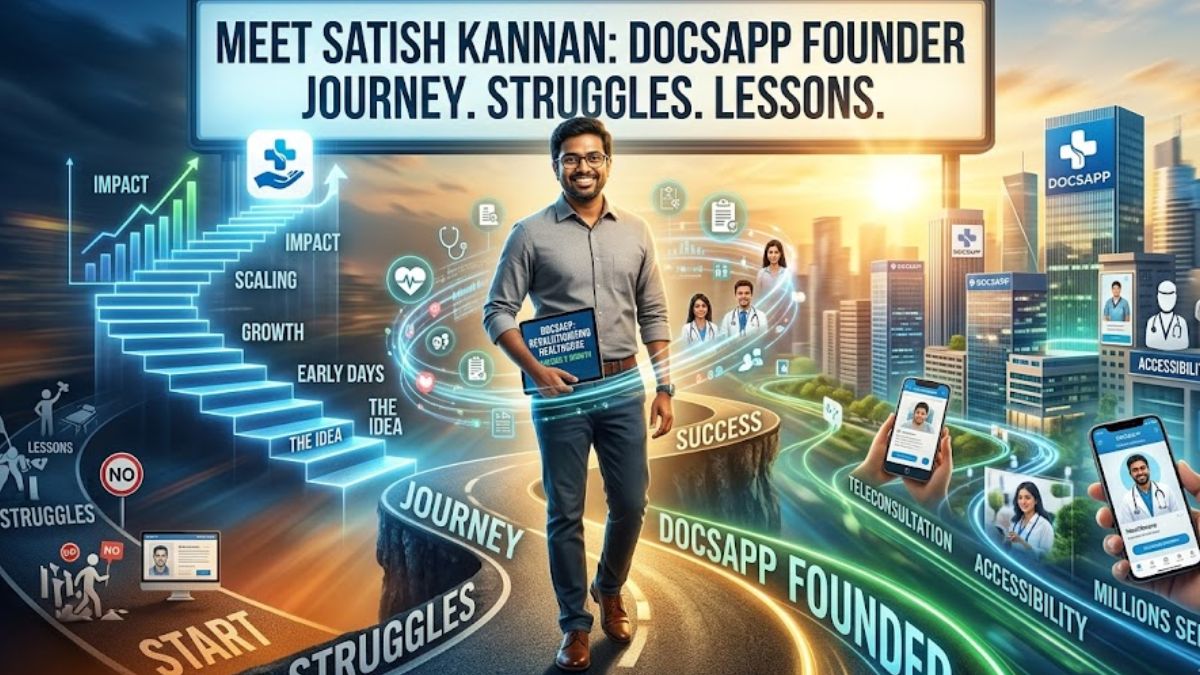
The Satish Kannan DocsApp founder story is one of persistence, deep problem-solving, and quiet innovation in India’s evolving healthcare landscape. Satish Kannan, co-founder of DocsApp, emerged as a key figure in the country’s healthtech startup India ecosystem at a time when digital healthcare solutions were still in their infancy. Founded in 2015 and headquartered in Bengaluru, DocsApp aimed to solve one of India’s most pressing challenges: access to timely, affordable medical consultation.
Kannan, along with his co-founder, built a telemedicine platform India could rely on by enabling patients to consult qualified doctors through a mobile app. The idea was simple yet powerful. Millions of Indians, especially in Tier 2 and Tier 3 cities, struggled to access healthcare due to long queues, high costs, and limited infrastructure. DocsApp’s online doctor consultation app attempted to bridge this gap by bringing doctors to smartphones.
The journey, however, was far from smooth. From early skepticism about telemedicine to regulatory ambiguities, from funding challenges to scaling complexities, Kannan faced multiple roadblocks. Yet, the company went on to raise funding from prominent investors and eventually became part of the PharmEasy ecosystem, marking a significant milestone in the DocsApp startup story India. This article explores how Satish Kannan built DocsApp, diving deep into his early life, entrepreneurial struggles, failures, validation moments, leadership evolution, and the lessons that shaped his journey. It is not just a story of a startup, but of a founder who chose to solve a real problem with grit, clarity, and long-term conviction.
1. Background and Early Life
1.1 Early Life and Family Background
If you look at the journey of Satish Kannan, it doesn’t begin with anything dramatic or extraordinary on the surface. There are no headlines about privilege, no early signs that clearly pointed toward building a healthcare startup. It begins in a setting that many in India would relate to. A middle-class upbringing where stability mattered, where education was seen as the most reliable path forward, and where discipline wasn’t optional, it was expected. These environments don’t always produce loud ambition, but they often build something far more important, quiet resilience. What stands out about Kannan is not what is publicly documented about his early life, but what is reflected in the way he thinks and builds.
There is a certain groundedness in his journey. He never tried to turn his personal story into a narrative. He stayed away from unnecessary visibility, choosing instead to let his work define him. And in a world where founders often chase attention, that restraint says a lot. Somewhere in those early years, a pattern began to form. The habit of observing closely, of questioning why systems work the way they do, and more importantly, why they don’t. That mindset would later become the foundation of everything he built.
1.2 Education and Early Influences
Kannan’s academic path followed a structure that many Indian professionals take, engineering followed by an MBA. But what matters is not the degrees themselves. It is what he took away from them. Engineering gave him a way to think in systems. To break down problems, understand components, and look for logical solutions. The MBA added another layer, business thinking, strategy, and the ability to see how decisions play out at scale. His early career in consulting and corporate roles sharpened this further.
Working inside structured organizations exposes you to how large systems operate. You see processes, inefficiencies, bottlenecks, and sometimes, the gap between intent and execution. For many, these observations remain just that, observations. For Kannan, they became questions. Why are certain processes so slow? Why do systems fail to serve the people they are meant for? inefficiencies persist even when solutions seem obvious? Healthcare, in particular, stood out.
It was fragmented, inconsistent, and often frustrating for the very people it was supposed to help. Access varied drastically depending on location. Even in cities, something as basic as consulting a doctor could take hours. These weren’t isolated issues. They were systemic. And once you start seeing problems at that level, it becomes difficult to ignore them.
2. Founder and Company Overview
2.1 Introduction to the Founder
Satish Kannan doesn’t fit the stereotype of a startup founder who thrives on visibility or bold claims. His approach is quieter, more deliberate. He is the kind of founder who spends more time understanding the problem than talking about the solution. And when he does build, it is rooted in necessity, not trend. That is what makes his journey different.
The Satish Kannan story is not about chasing the next big idea. It is about identifying a gap that affects millions of people and committing to solving it in a meaningful way. Healthcare, in India, is not just a market opportunity. It is a complex, deeply human problem. And Kannan chose to step into that complexity.
2.2 Company Overview and Offerings
When DocsApp was founded in 2015, it entered a space that was still uncertain. Telemedicine existed as a concept, but it hadn’t yet become mainstream in India. Trust was low, awareness was limited, and behavior change was a significant hurdle. DocsApp approached this challenge with a simple idea, make access to doctors easier. Not by replacing hospitals, but by removing friction from the first step of care.
The platform allowed users to consult qualified doctors through chat, call, or video. It covered multiple specialties, from general medicine to dermatology, pediatrics, and mental health. But what made it valuable was not just the range of services. It was the experience. Patients could upload reports, get prescriptions, and follow up without stepping out of their homes. For someone living in a small town, or someone who could not afford to spend hours waiting at a clinic, this was not just convenience. It was access. And access changes behavior.
2.3 Target Audience and Market Served
One of the most important decisions DocsApp made was choosing who to serve. While many startups focus on urban, high-paying customers, DocsApp looked beyond metros. It focused on users in Tier 2 and Tier 3 cities. People who often had limited access to specialists. People who faced long travel times, high costs, and inconsistent quality of care. This was not the easiest market to target. There were challenges around trust, digital literacy, and adoption. But there was also a massive unmet need.
DocsApp understood something fundamental. Healthcare is not just about providing a service. It is about reaching the people who need it the most. By focusing on this segment, the company positioned itself not just as a convenience platform, but as a solution to a real accessibility problem.
2.4 Year of Founding and Business Stage
DocsApp was founded in 2015, at a time when India’s healthtech ecosystem was still taking shape. The early years were about building trust, both with users and with doctors. Convincing people that consulting a doctor online could be reliable was not easy. But over time, the platform grew.
It served millions of users, built a strong network of medical professionals, and became one of the more recognized names in digital healthcare. Its eventual acquisition by PharmEasy was not just an exit. It was a reflection of how the healthcare ecosystem was evolving. Platforms were no longer operating in isolation. They were becoming part of larger, integrated systems that aimed to cover the entire patient journey. From consultation to medicine delivery to diagnostics. DocsApp became a piece of that larger puzzle.
3. The Problem, Insight, and Trigger
3.1 Core Problem Identified
The foundation of DocsApp lies in a problem that is both simple and deeply complex. Access to healthcare in India is uneven. In cities, there may be hospitals and specialists, but even then, the process is slow. Appointments take time. Waiting periods are long. Costs can be high. In smaller towns and rural areas, the challenge is even bigger.
Specialists are scarce. Infrastructure is limited. And people often delay seeking medical help because the effort involved is too high. This gap is not just inconvenient. It has real consequences. Delayed consultations lead to delayed diagnoses. Small issues become bigger problems. Preventive care takes a backseat. Kannan saw this not as an isolated issue, but as a systemic failure.
3.2 Personal Insight Behind the Idea
What made this problem stand out even more was the timing. Smartphones were becoming increasingly common. Internet access was improving. People were getting comfortable with using digital platforms for everyday needs. And yet, healthcare had not adapted.
Why should consulting a doctor still require physical presence in every case? Why couldn’t technology reduce that friction? Kannan’s insight was not just about digitization. It was about rethinking the experience. If a patient could describe symptoms, share reports, and receive guidance remotely, a large part of the healthcare journey could become faster and more efficient. This was not about replacing doctors. It was about making them more accessible. That distinction mattered.
3.3 Trigger Moment to Start
Unlike some startup stories that revolve around a single defining moment, DocsApp emerged from a buildup of observations. Each inefficiency, each delay, each gap in access added to a growing realization. The system was not keeping up with the needs of the people. At the same time, technology was offering new possibilities. The trigger was the intersection of these two realities.
A growing problem and an emerging solution. At some point, the question changes from “Why does this problem exist?” to “Why isn’t someone solving it?” For Kannan, that question became a decision. To take the risk. To step out of a structured career path. And to build something that could potentially change how millions of people access healthcare. That is where the idea of DocsApp moved from thought to action.on.
4. Early Days and Initial Struggles
4.1 Early Assumptions and Naivety
In the early days of building DocsApp, there was a belief that felt logical at the time. If you make healthcare more accessible, people will naturally adopt it.On paper, it made complete sense. Smartphones were everywhere. Internet access was improving. The ability to consult a doctor without stepping out seemed like an obvious advantage. But reality was far more complex.
Healthcare is not like ordering food or booking a cab. It is deeply personal. It involves trust, vulnerability, and often, fear. Patients are not just looking for convenience. They are looking for reassurance. And that reassurance, for many, was tied to physical presence. Sitting in front of a doctor, describing symptoms face-to-face, that experience carried emotional weight. Replacing that with a digital interaction was not just a product challenge. It was a psychological one. This was the first major realization. Adoption would not come just because the product existed. It would have to be earned, slowly, patiently, one user at a time.
4.2 Entrepreneurial Initial Struggles
Building a healthtech company in India is like navigating multiple layers of complexity at once. There were regulatory questions. Telemedicine was still evolving, and clear frameworks were limited in the early days. This created uncertainty around compliance and long-term viability. Then there was the challenge of onboarding doctors. Doctors are not just users of the platform. They are its backbone. Convincing qualified professionals to trust a new, unproven system required credibility that a young startup did not yet have.
At the same time, users had to be acquired. And not just acquired, convinced. Convincing someone to try a new app is one thing. Convincing them to trust it with their health is something else entirely. DocsApp had to build that trust from scratch. Through communication, through experience, and through consistency. Each small win mattered. Each satisfied user became a step forward.
4.3 What Turned Out to Be Harder Than Expected
If there was one thing that stood out as unexpectedly difficult, it was not technology. The platform could be built. Features could be added. Systems could be improved. The real challenge was changing behavior. Helping people shift from “I need to visit a doctor physically” to “I can start with a digital consultation” required more than just a good product. It required education.
Users needed to understand when teleconsultation was appropriate, how it worked, and why it could be trusted. This meant investing time in awareness, in simplifying the experience, and in addressing doubts that were often unspoken. Progress was not immediate. It came in small steps. A first consultation. A positive experience. A recommendation to a friend. Over time, these small steps began to add up.
5. Failures, Setbacks, and Self Doubt
5.1 Toughest Phase of the Journey
The early phase of DocsApp was not filled with rapid growth or clear milestones. It was filled with uncertainty. User numbers were growing, but slowly. Revenue was not immediate. The path to monetization was still being figured out. There were moments when the bigger question started to surface. Is this model truly viable? These are the moments that test founders the most. Not the obvious failures, but the quiet periods where progress feels slow and the future feels unclear.
5.2 Early Failures and Major Setbacks
Not everything worked as planned. Marketing campaigns that seemed promising did not always deliver results. User acquisition costs were higher than expected. Retention was inconsistent in the beginning. People would try the platform once, but not always return. And in a business like this, repeat usage is everything. It is the difference between curiosity and trust.
This forced the team to rethink their approach. What were users really looking for? Where was the experience falling short? How could the platform become not just useful, but reliable? There were multiple iterations. Features were refined. User flows were simplified. Communication was improved. Each setback became a learning point, even if it came with frustration at the time.
5.3 Moments of Self Doubt and Emotional Lows
Behind the product, behind the metrics, there is always the founder’s mind. And in those early days, doubt was never too far away. Building something new means operating without a clear roadmap. There are no guarantees. No certainty that the effort will translate into success. For Kannan, there were moments where questions surfaced.
Is this the right approach? Is the timing right? Will people truly adopt this? These are not signs of weakness. They are part of the process. Because conviction is not something you start with fully formed. It is something that gets tested, challenged, and slowly strengthened over time.
6. Validation and Early Traction
6.1 First Real Validation or Customer
The real turning point for DocsApp did not come from a big announcement or a sudden spike in users. It came quietly. When users started coming back. A first consultation is curiosity. A second consultation is trust. When patients chose to return to the platform, it signaled something important. The experience had worked. It had solved a problem in a way that felt reliable. That repeat behavior became the first true validation. It showed that the product was not just interesting, it was useful.
6.2 Early Revenue Growth or Feedback
With repeat usage came feedback. Patients shared what they liked, what confused them, what could be better. Doctors provided insights from their side of the experience. This feedback loop became one of the most valuable assets for the company. It guided improvements. It shaped decisions. Helped the team focus on what truly mattered.
Gradually, usage became more consistent. Revenue started to grow, not in sudden leaps, but in steady increments that reflected real engagement. This kind of growth may not look dramatic from the outside, but internally, it builds confidence. Because it is rooted in actual value being delivered.
6.3 Why This Moment Changed Belief
Validation changes everything. Before it, you are driven by belief. After it, you are supported by evidence. For Kannan and his team, this phase marked a shift. The doubts that once felt heavy began to ease. Not because all challenges were solved, but because the core question had been answered. The problem was real. And the solution was working. That realization creates momentum. It gives the team the confidence to scale, to invest more deeply, and to push forward with greater clarity. Because once you know you are solving something meaningful, the journey, no matter how difficult, begins to feel worth it.
7. Funding, Money, and Growth Constraints
7.1 Bootstrapped or Funded Journey
DocsApp did not grow in isolation or without support. As the vision became clearer and early traction started showing up, the company attracted backing from investors including TPG Growth and others who believed in the direction of digital healthcare in India. But funding, at that stage, was not just about money.
It was about validation at a different level. When experienced investors step in, they are not just betting on an idea. They are betting on execution, on timing, and on the ability of a team to survive the messy middle between idea and scale. For DocsApp, this capital became a bridge. It allowed the company to move from experimentation to structured growth, to invest in systems, and to prepare for scale that was no longer theoretical, but expected.
7.2 Capital Challenges and Cash Flow Issues
Even after funding, the reality of running a healthtech startup did not become easier. In fact, it became more demanding. Healthcare is not a fast-return business. It takes time for users to adopt, even more time for them to trust, and even longer for consistent revenue patterns to stabilize.
This created a constant balancing act. Money was coming in, but so were expenses. Technology development, doctor onboarding, customer acquisition, support systems, everything required sustained investment. Cash flow discipline became critical. Spending too aggressively could jeopardize stability. Spending too cautiously could slow down growth. Finding that middle ground was not a one-time decision, but a continuous process. There were months where the focus was not just on growth, but on ensuring runway, ensuring efficiency, ensuring survival while still moving forward. That tension never really disappears in a startup like this.
7.3 Early Growth Limitations
Scaling DocsApp was never a single-track problem. It was multiple challenges happening at the same time. Technology had to be robust enough to handle growing user demand. Doctor networks had to expand while maintaining quality and credibility. Marketing had to bring in users who were not just curious, but likely to return. Each layer came with its own bottlenecks.
More users meant more pressure on systems. doctors meant more coordination complexity. More visibility meant higher expectations. This is where many startups slow down or break. Because scaling is not just about adding more. It is about keeping everything aligned while everything is growing at once. The journey of healthtech startup success in India is rarely linear. It is built through cycles of adjustment, correction, and rebuilding.
8. Team Building and Leadership Evolution
8.1 Early Hiring Mistakes
In the early phase, hiring decisions are often driven by urgency. You need people quickly. need execution. You need momentum. DocsApp was no different. Some early hiring decisions were made for speed rather than long-term fit. People who could move fast were prioritized, sometimes over those who deeply understood the space or the problem. And like most early-stage companies, not all of those decisions worked out.
Over time, it became clear that healthcare requires a different kind of mindset. It is not just about execution speed. It is about empathy, precision, and consistency. Correcting these early missteps took time. Some roles had to be restructured. Some expectations had to be reset. But these experiences shaped a more thoughtful hiring philosophy later on.
8.2 Delegation Challenges
As DocsApp started to grow, the role of the founder had to change. This is one of the hardest transitions in any startup journey. Going from doing everything yourself to trusting others to do it well. For Kannan, stepping back from daily operations was not easy. When you build something from scratch, there is a natural instinct to stay involved in every detail. But scale demands distance.
You cannot be in every decision loop and still grow effectively. Delegation became less of a choice and more of a necessity. But trust takes time. Systems take time. And letting go takes even more time. There were phases where this shift felt uncomfortable, even unnatural. But gradually, it became clearer that leadership is not about control. It is about clarity and alignment.
8.3 Leadership Learnings Over Time
Over time, Kannan’s leadership style evolved. From being deeply operational to becoming more directional. The focus shifted toward clarity, what needs to be done, why it matters, and how success is defined. Accountability became a key principle. So did long-term thinking. In a space like healthcare, short-term wins can be misleading. Real impact is measured over time, through consistency and trust. The Satish Kannan entrepreneur story reflects this evolution clearly. Not as a sudden transformation, but as a gradual refinement shaped by experience.
9. Growth, Scaling, and Operational Challenges
9.1 Brand Positioning and Go-To-Market Learnings
As DocsApp matured, one thing became very clear. Trust is not a feature. It is the product. The company positioned itself not just as a convenient healthcare app, but as a reliable way to access medical care. This positioning mattered deeply. Because in healthcare, perception directly affects adoption. If users do not trust the platform, they do not use it, no matter how good the technology is. So the go-to-market approach focused heavily on credibility. Clear communication. Consistent experience. And visible reliability in every interaction. Over time, this helped establish DocsApp as a serious player in digital healthcare, not just another app in the space.
9.2 Scaling Challenges
Scaling a telemedicine platform in India came with unique constraints. Unlike purely digital products, healthcare depends on human availability. Doctors are not scalable in the same way servers or software are. This created a natural bottleneck. As demand increased, ensuring doctor availability became critical. At the same time, maintaining quality of consultations was non-negotiable.
Technology alone could not solve this. Operational systems had to evolve alongside product growth. Another major constraint was infrastructure readiness. Not all users had the same level of digital comfort. Some needed more guidance. Needed simpler interfaces. Some needed reassurance before even starting a consultation. Scaling, therefore, was not just expansion. It was adaptation.
9.3 Operational Breakdowns and Fixes
Growth always exposes cracks. As DocsApp scaled, operational inefficiencies began to surface. Delays in response times. Gaps in user experience. Mismatches between patient expectations and doctor workflows. These issues are almost inevitable in fast-growing systems. What matters is how they are handled. The team focused heavily on iteration. Fixing small issues quickly. Improving workflows. Strengthening backend systems. And refining processes based on real user behavior. Over time, these corrections reduced friction and improved reliability. But more importantly, they created a culture of continuous improvement.
10. Personal Sacrifices and Burnout
10.1 Personal Costs of Entrepreneurship
Behind the structured growth story, there is always a personal cost. For Kannan, building DocsApp meant long stretches of intense focus. Days that started early and ended late. Constant decision-making. Constant responsibility. Personal time naturally shrank. This is not always dramatic. It is gradual. One missed plan. One delayed weekend. One more late night that becomes routine. Over time, work starts occupying more space than intended.
10.2 Burnout Phases and Emotional Pressure
There were phases where the pressure felt heavier than usual. Slow growth periods are particularly difficult. Because effort is constant, but results are not always visible. This creates mental strain. Questions begin to surface. Is the pace right? Are the decisions correct? Is the effort translating into meaningful progress? These moments are part of the journey, even if they are rarely discussed openly. Managing them requires resilience, but also acceptance that not everything moves at the same speed.
10.3 Impact on Personal Life
Entrepreneurship does not stay confined to office hours. It follows you home. Stays in your thoughts. It becomes part of daily rhythm. For Kannan, like many founders, maintaining balance was an ongoing challenge. Relationships, rest, and personal space often had to adjust around the demands of building something from scratch. These are the hidden trade-offs that rarely make it into public narratives, but they are very real for those living them.
11. Lessons, Beliefs, and Values
11.1 Core Lessons Learned
The most important lesson from the journey is simple, but powerful. Real problems take real time to solve. In healthcare, shortcuts do not work. Surface-level solutions do not last. Only deep, consistent problem-solving creates meaningful impact.
11.2 Beliefs That Changed Over Time
Over time, urgency gave way to patience. Early excitement about speed was replaced with respect for process. Kannan’s thinking evolved toward long-term building. Systems over hacks. Trust over traction. Stability over spikes. This shift is often what separates short-lived startups from lasting ones.
11.3 Non-Negotiable Values
As the company matured, certain values became fixed. User trust. Clinical quality. And integrity in how care is delivered. These were not marketing statements. They were operational principles. Because in healthcare, once trust is broken, it is extremely difficult to rebuild. And that understanding shaped how every decision was made moving forward.csApp.
12. Present Challenges and Future Vision
12.1 Ongoing Struggles Today
Even after years of building and scaling, the challenges in digital healthcare have not reduced. They have simply evolved. Regulation continues to be one of the most sensitive areas. Healthcare is a tightly governed space, and any digital layer on top of it has to constantly adapt to changing guidelines, compliance expectations, and policy shifts. This creates an environment where uncertainty is always present in the background.
Then there is competition. What was once a niche space has now become a crowded ecosystem. New players enter with strong funding, aggressive pricing, and fast experimentation. But in healthcare, speed alone is not enough. Consistency and trust matter far more, and those take time to build. The most persistent challenge, however, remains user trust. Even today, a large portion of users still prefer physical consultations for certain cases. That hesitation does not disappear quickly. It takes repeated positive experiences, time, and reassurance to shift deeply rooted behavior. So the struggle is not about proving that telemedicine works anymore. That question has been answered. The real challenge now is scaling trust across millions of diverse users with different levels of comfort and expectations.
12.2 Current Leadership Philosophy
Kannan’s approach today reflects the maturity that comes from years of building in a complex space. There is less focus on noise and more focus on outcomes. Impact has become the central lens through which decisions are made. Not just growth for the sake of numbers, but growth that actually improves access, reduces friction, and delivers meaningful value to users.
Sustainability plays a key role in this thinking. In healthcare, rapid expansion without strong systems can quickly lead to breakdowns. So the emphasis is on building things that last, even if they take longer to scale. There is also a strong sense of discipline in execution. Prioritizing what truly moves the needle and avoiding distractions that do not contribute to the core mission. Over time, leadership has shifted from pushing momentum to maintaining clarity. Ensuring that teams understand not just what they are building, but why it matters in the larger context.
12.3 Long-Term Vision
The long-term vision remains simple at its core, but extremely ambitious in scope. To make healthcare genuinely accessible to every person in India, regardless of location, income, or background. Technology is seen as an enabler, not the end goal. The real objective is to reduce the gap between need and access. Between symptoms and consultation. Between uncertainty and care. This means building systems that can reach beyond urban centers. Systems that can support both digital and physical touchpoints. Systems that can adapt to different user behaviors without losing reliability.
It is not just about scaling a platform. It is about reshaping how healthcare journeys begin and evolve. If successful, the impact goes beyond convenience. It touches early diagnosis, preventive care, and overall health outcomes at a national scale. That is the scale of ambition driving the vision forward.
12.4 The Problem the Founder Remains Obsessed With
Even after years of progress, funding, and growth, the core problem has not changed for Kannan. Access to healthcare is still uneven. Still fragmented. Still difficult for a large portion of the population. This is the issue that continues to sit at the center of the Satish Kannan DocsApp founder story. Not in a theoretical sense, but in a very real, grounded way. Because behind every metric, every consultation, every user journey, there is a simple question that remains unanswered at scale.
Why should getting basic healthcare still be difficult for so many people? That question does not fade with success. If anything, it becomes sharper with it. And it is that persistent discomfort with the problem that continues to drive the next phase of the journey. Even after scaling and acquisition, this problem remains unsolved at a national level.
About foundlanes.com
foundlanes.com is India’s leading startup idea discovery platform. It helps entrepreneurs find actionable startup opportunities, market insights, and industry-specific guidance to turn ideas into real businesses. With deep research and practical resources, foundlanes supports founders at every stage, from idea validation to launch and growth.