Summary
This Licious Case Study explores how a Bengaluru-based startup transformed India’s fragmented meat supply chain into a trusted, tech-enabled direct-to-consumer business. Licious operates as an online fresh meat and seafood delivery platform, offering high-quality, hygienic, and ready-to-cook products directly to urban consumers. It was founded to solve a long-standing problem in India’s meat industry, where inconsistent quality, lack of hygiene, and poor cold chain infrastructure dominated traditional retail.
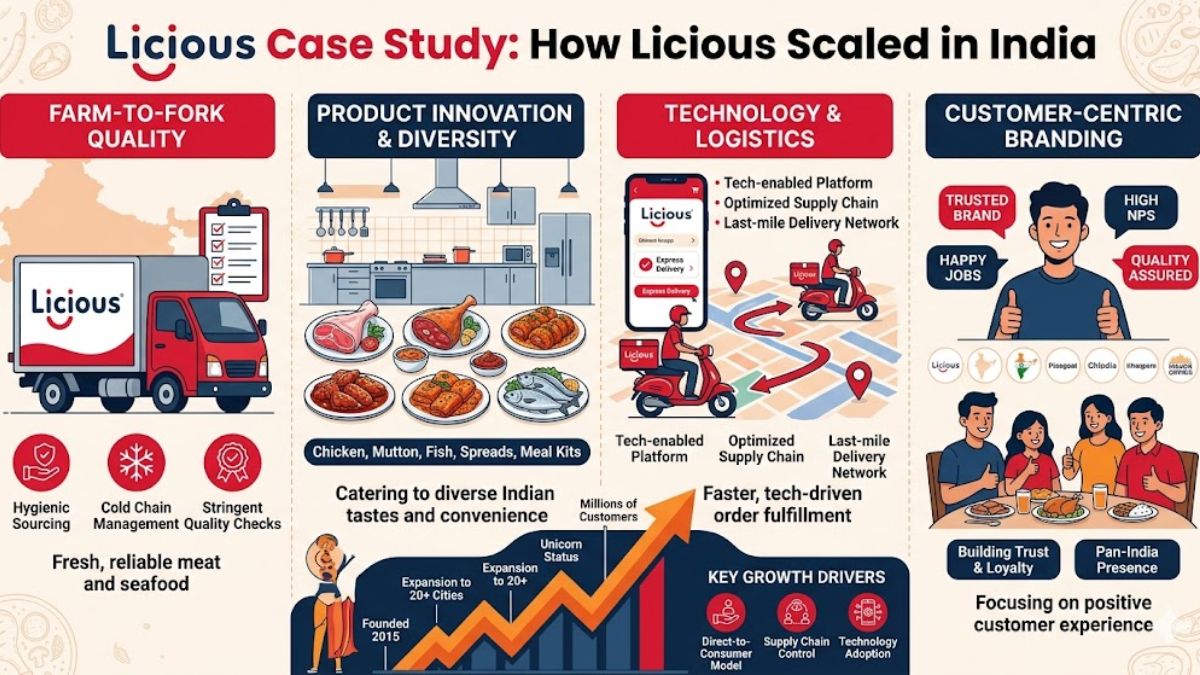
The company was founded by Abhay Hanjura and Vivek Gupta, both alumni of IIM Ahmedabad, who identified the gap in reliable meat sourcing while working in consulting roles. Licious was launched in 2015 and is headquartered in Bengaluru, one of India’s most competitive startup ecosystems. The founders aimed to build a vertically integrated supply chain that could ensure quality control from sourcing to delivery. Licious operates on a farm-to-fork model, managing procurement, processing, storage, and last-mile delivery through its own infrastructure. This allows the company to maintain consistency and freshness, which became its core differentiator in a highly unorganized market.
Over the years, Licious has raised significant funding from investors including Premji Invest and Temasek, and has expanded across multiple Indian cities. It has also reported strong revenue growth, positioning itself as one of the leading players in the online meat delivery India segment. This case study breaks down how Licious built trust in a sensitive category, scaled operations in a complex supply chain environment, and carved a niche in India’s fast-growing D2C food startups India ecosystem.
1. Origin Story and Early Background
The journey of Licious started from a very ordinary but deeply frustrating daily experience. In most Indian cities, buying meat meant visiting wet markets that were crowded, inconsistent, and often uncomfortable. There was no guarantee of hygiene, no clarity on sourcing, and very little standardization in how products were handled or sold. Despite rising incomes and changing lifestyles, this one category still felt stuck in an outdated system that people had simply learned to live with.
For Abhay Hanjura and Vivek Gupta, this gap stood out clearly during their time in corporate and consulting roles. They saw how everything else in urban life was getting modernized, groceries, food delivery, even transport, but meat buying remained untouched. That realization slowly turned into a strong conviction that this category needed a complete structural reset, not just a better shop or app.
2. Founder Journey, Motivation, and Early Struggles
Both founders came from structured consulting backgrounds, where systems thinking and efficiency were core skills. But entering the meat industry was like stepping into an entirely different world. There were no frameworks, no playbooks, and very little organized data to rely on. They had to learn everything from the ground up by spending time in markets, processing units, and supply chains that were highly fragmented and informal.
The early struggle was not just operational, it was emotional and psychological too. Convincing people to trust online meat delivery felt almost impossible at first because buying meat is a deeply sensory habit in India. At the same time, cold chain logistics in India was still weak, making freshness control extremely difficult. Every failure in delivery or quality wasn’t just a business setback, it was a reminder of how complex it is to rebuild trust in a category like this.
3. Problem Identification in the Market
The Indian meat market was dominated by unorganized local vendors, where quality and hygiene varied widely. Customers never had a fixed standard to rely on. One purchase could be acceptable, the next completely disappointing. There was also a lack of traceability, meaning people rarely knew where the meat came from or how it was handled before reaching them.
For Licious, this wasn’t just a supply problem, it was a trust problem. The deeper insight was that consumers didn’t necessarily want cheaper meat, they wanted safer, cleaner, and more reliable meat. That emotional gap between expectation and reality became the core opportunity the company decided to build on.
4. Building the Product and Service
To solve the core issue, Licious built a fully controlled farm-to-fork model. Instead of relying on external vendors, the company invested in its own sourcing network, processing units, and delivery infrastructure. Every step was tightly managed to ensure consistency in hygiene, freshness, and cut quality.
As the market evolved, so did the product strategy. The company realized that customers were not just looking for raw meat, they wanted convenience. This led to the introduction of ready-to-cook and ready-to-eat products, which made cooking easier and faster for urban households. This shift transformed Licious from just a meat supplier into a modern food brand focused on convenience and lifestyle.
5. Early Traction and Customer Validation
In the early phase, growth was slow and highly controlled. Licious focused only on select urban pockets where it could maintain strict quality standards. Instead of chasing scale, the focus was on making sure every single order delivered the same level of freshness and consistency. That discipline helped build early trust.
Once customers experienced reliable hygiene and quality, word-of-mouth started playing a major role. People who had struggled with inconsistent meat quality for years suddenly found a dependable option. That emotional relief turned into loyalty. Over time, repeat purchases increased, and the company slowly moved from validation to steady traction.
6. Business Model and Revenue Approach
The business model of Licious is built on direct-to-consumer sales, which removes intermediaries and gives full control over quality and pricing. This structure allows the company to manage every step of the value chain, from sourcing to delivery, ensuring that customers receive consistent products every time.
Revenue comes mainly from fresh meat, seafood, and value-added products like marinated and ready-to-cook items. But the real strength of the model lies in repeat behavior. Meat is a regular consumption category, and once trust is established, customers keep returning. This repeat cycle has played a major role in building stable revenue and long-term growth for the company.
7. Funding History and Investor Involvement
Licious went through multiple funding rounds as it shifted from an early idea into a full-stack food infrastructure company. Early investors were not just betting on a product, they were betting on a very difficult problem: organizing one of India’s most fragmented and trust-deficient food categories. The vision of building a clean, controlled meat supply chain in India stood out because it required both patience and heavy execution capability, not just a tech layer.
As the company showed early signs of repeat customers and stronger unit economics in select cities, larger investors began to step in. Global and institutional investors backed the model because they could see something deeper than just online delivery. The real bet was on infrastructure, cold chain systems, and consumer behavior shift. Funding helped Licious build processing units, expand into new urban markets, and strengthen its technology backbone. The confidence from reputed investors signaled that this was not just a niche experiment, but a serious attempt to reorganize an entire category.
8. Go-to-Market Strategy and Distribution
From the beginning, Licious followed a digital-first approach, but not in a superficial “app-only” sense. The real focus was on controlling the full customer experience through its website and mobile platform. The goal was simple: make ordering meat as easy as ordering anything else online, while removing the anxiety traditionally associated with it.
The company initially targeted urban consumers who were already comfortable with online food delivery and e-commerce. These users were more open to experimentation and convenience-driven services. Marketing wasn’t just about discounts or promotions. It was deeply centered around emotional triggers like hygiene, trust, and consistency. Every message was designed to address one silent question in the customer’s mind: “Can I actually trust this?”
Distribution, however, was where execution really mattered. Licious built a tightly controlled logistics network with temperature-managed systems to ensure freshness at every step. Delivering meat is not like delivering regular food. Even small delays or temperature changes can affect quality. So the company designed its supply chain backward from customer experience, not forward from operations.
9. Brand Positioning and Messaging Evolution
In the early years, Licious positioned itself as a premium alternative to traditional meat markets. The core idea was not just convenience, but trust. The brand language revolved around reassurance, especially around hygiene and freshness. The message “freshness you can trust” wasn’t just marketing, it was a response to years of consumer doubt in the category.
As the company expanded, the brand identity slowly evolved. It was no longer only about solving a problem, but also about improving everyday food experiences. Convenience, consistency, and product innovation started becoming part of the narrative. Ready-to-cook and marinated products helped shift perception from a basic meat delivery service to a modern food brand. This evolution mattered because it changed how customers emotionally connected with the brand. Instead of seeing it as a utility, they began seeing it as a dependable part of their kitchen routine. That shift played a major role in the broader Licious success story India, especially in building long-term loyalty rather than just one-time purchases.
10. Key Challenges, Failures, and Turning Points
One of the hardest challenges for Licious was building cold chain logistics in India from scratch. Unlike standard e-commerce, meat delivery requires strict temperature control at every step. Even a small operational gap can lead to quality loss. Building this system meant heavy upfront investment, continuous monitoring, and a lot of trial and error in real conditions. At the same time, changing consumer behavior was just as difficult. People were used to inspecting meat physically before buying. Asking them to trust an app required emotional reassurance, not just product quality. There were early hesitations, failed conversions, and skepticism from first-time users who were not ready to switch immediately.
A major turning point came when repeat purchases started rising steadily. That was the real validation. It meant customers were not just trying the service out of curiosity, but actually trusting it enough to return. Once that behavior pattern stabilized, the business moved from uncertainty to predictable growth, which fundamentally changed investor confidence and internal scaling decisions.
11. Operational Execution and Scaling Decisions
Scaling Licious was never about rapid expansion. It was about controlled expansion. The company followed a city-by-city model, ensuring that infrastructure, supply chain, and delivery systems were fully stable before entering new markets. This slowed down expansion in the short term but protected quality in the long run.
Behind the scenes, technology played a critical role in making this scaling possible. The company invested heavily in data systems to understand demand patterns, manage inventory, and optimize delivery routes. Instead of guessing, decisions were increasingly driven by real-time data. This helped reduce waste, improve freshness, and balance supply-demand cycles more efficiently. Operationally, this discipline became one of the strongest pillars of the company. Every expansion decision was tied to readiness, not pressure. That mindset helped avoid the common startup mistake of scaling faster than systems can support.
12. Competitive Landscape and Differentiation
The rise of online meat delivery India brought multiple competitors into the market. Many platforms tried to replicate the convenience model, offering fast delivery and similar product ranges. However, not all of them approached the problem with the same depth of infrastructure thinking. Licious stood apart mainly because of its vertically integrated model. While many competitors depended on third-party suppliers, Licious controlled sourcing, processing, and distribution internally. This gave it far more control over quality consistency, which is extremely important in a category like meat.
That control translated into customer trust over time. In a market where even small quality differences matter, consistency became the real differentiator. Customers weren’t just comparing price or delivery speed. They were comparing reliability. And in that comparison, Licious built a strong edge that was difficult for others to match without heavy infrastructure investment.
13. Growth Metrics and Milestones
Over time, Licious moved from being an experimental service in a few urban pockets to a widely recognized consumer brand in India’s food ecosystem. The early growth was not explosive in the typical startup sense. It was gradual, built on repetition, trust, and consistent product experience. Each satisfied order became a small but important signal that the model was working in real life, not just on paper.
As the company expanded into multiple cities, it steadily built a strong base of repeat customers. That repeat behavior became one of the most important indicators of success, because meat is not an occasional purchase category. It is deeply habitual. Growth was further supported by continuous product expansion, especially into ready-to-cook and value-added items. These milestones collectively showed that Licious was not just acquiring users, but actually retaining them, which is far more difficult in a trust-sensitive category like food.
14. Team Building and Leadership Approach
Building Licious was never just about product or logistics. It was equally about building a team that could handle chaos, complexity, and high operational pressure every single day. The founders focused heavily on bringing in people who understood execution at ground level, not just strategy on slides. Experience in operations, supply chains, and customer-facing roles became just as important as technical expertise.
The leadership style was deeply execution-driven. Instead of overplanning, the focus was on solving real problems quickly and improving continuously. Hiring decisions were guided by one simple question: can this person handle uncertainty and still deliver consistently? This mindset helped build a culture where adaptability mattered more than hierarchy. Over time, that culture became one of the strongest internal advantages of the company, especially during periods of rapid scaling.
15. Technology, Operations, and Supply Chain Insights
Technology in Licious is not visible in a flashy way to customers, but it quietly runs the entire system behind the scenes. From demand forecasting to inventory planning, data plays a critical role in ensuring that the right products are available at the right time in the right locations. Without this layer of intelligence, managing fresh food at scale would be extremely difficult.
On the operational side, the company’s investment in cold chain logistics India became one of its defining strengths. Meat is extremely sensitive to temperature and timing, so even small inefficiencies can lead to quality loss. To prevent this, Licious built tightly controlled supply chains that minimize delays and maintain freshness throughout the journey. The system is designed not just for speed, but for preservation of quality, which is far more complex. Over time, this operational discipline helped reduce wastage and improve overall efficiency across cities.
16. Regulatory, Legal, and Industry Hurdles
Working in the food sector means dealing with strict rules, frequent inspections, and evolving safety standards. For Licious, compliance was not optional or occasional. It was a continuous requirement across every city of operation. From licensing to food safety certifications, every expansion came with a new layer of regulatory complexity that had to be managed carefully.
At the same time, these regulations also played an indirect role in strengthening the brand. In a category where trust is fragile, compliance becomes a signal of seriousness. Following food safety standards consistently helped Licious build credibility with both regulators and consumers. Instead of seeing compliance as a burden, the company gradually integrated it into its core operations, which improved long-term stability and reduced reputational risk.
17. Current Status of the Startup
Today, Licious stands as one of the most established players in India’s fresh meat delivery service space. What started as a solution to a very specific urban problem has now grown into a large-scale consumer brand with presence across multiple cities and strong repeat usage patterns. The company has also expanded its product portfolio significantly beyond raw meat into processed and ready-to-cook offerings.
Within the broader D2C food startups India ecosystem, Licious holds a distinct position because of its full-stack model and focus on quality control. It continues to invest in expanding both its geographic reach and product categories. Even with growing competition, its strength lies in the consistency of experience it delivers, which remains difficult to replicate without similar infrastructure depth.
18. Future Outlook
The long-term trajectory of Licious reflects a larger shift happening in India’s food consumption patterns. As more consumers move toward organized retail and quality-driven food choices, the demand for structured meat and protein supply chains is expected to grow steadily. This creates a strong foundation for future expansion.
Looking ahead, the company is likely to deepen its presence in existing markets while exploring new product categories and adjacent segments. The bigger vision seems to be evolving from a meat delivery platform into a broader protein-focused food brand. As consumer expectations continue to rise, success will depend not just on scale, but on how consistently the company can deliver trust, freshness, and convenience in everyday life.
About foundlanes.com
foundlanes.com is India’s leading startup idea discovery platform. It helps entrepreneurs find actionable startup opportunities, market insights, and industry-specific guidance to turn ideas into real businesses. With deep research and practical resources, foundlanes supports founders at every stage, from idea validation to launch and growth.