News Summary
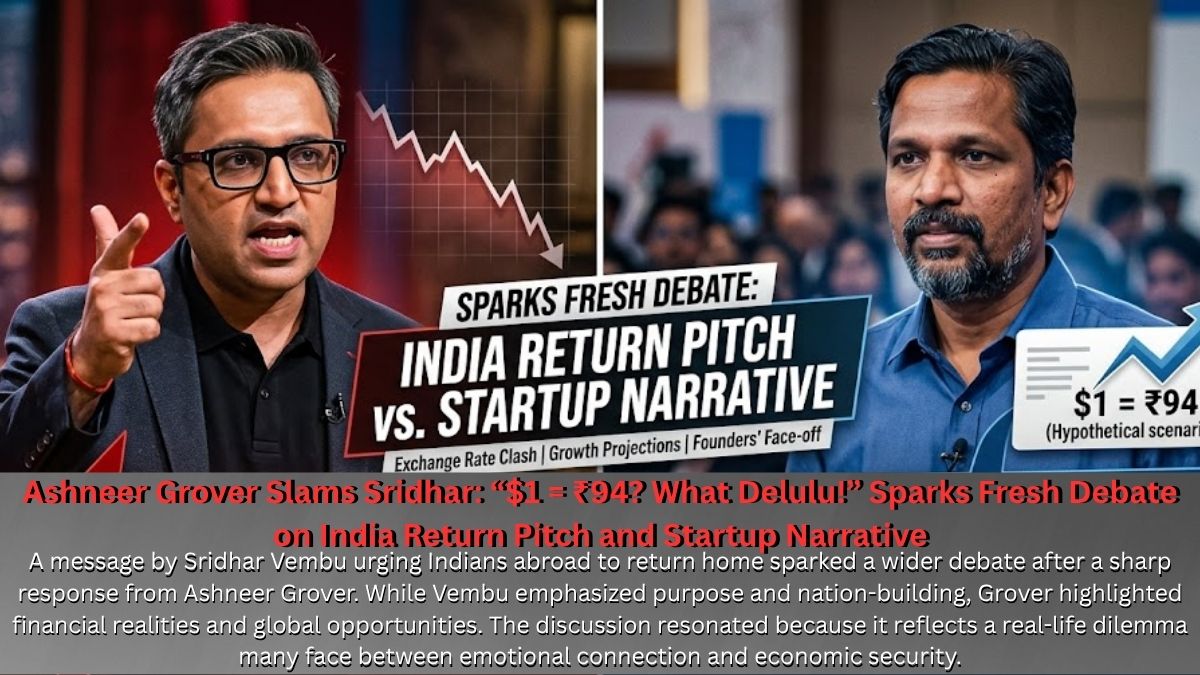
What’s interesting about this whole moment is how something so simple turned into something so personal for so many people. Sridhar Vembu didn’t come out with a bold statement or a viral punchline. It felt more like a quiet nudge, the kind of thought you share after reflecting on something for years. He spoke about Indians working in the US and the idea of returning home, not out of pressure but out of purpose. There was a certain sincerity in it, almost like he was asking people to pause and think about where their work could matter most in the long run. But as the conversation grew, it took a sharper turn when Ashneer Grover reacted strongly, and the narrative quickly shifted to what many are now calling “Ashneer Grover Slams Sridhar.” For some, Vembu’s message felt meaningful and rooted in nation-building. For others, it felt disconnected from ground realities like opportunities, pay, and infrastructure.
Ashneer Grover’s response came from a completely different place
Ashneer Grover’s response came from a completely different place. There was no softness in it. No pause. Just a sharp, almost instinctive reaction. When he talked about the exchange rate, it wasn’t just about currency. It was about what that number represents in real life. Lifestyle, security, choices, freedom. The kind of things people quietly build their lives around. His tone may have been sarcastic, but the point underneath it was something a lot of people understood instantly. That’s probably why this didn’t stay between just the two of them. People saw themselves in this conversation.
For someone working abroad, it’s not just a question of “coming back.” It’s years of effort, risk, and stability tied to that decision. It’s family expectations, career growth, and a certain standard of living that’s hard to give up. At the same time, there’s also that pull, the feeling of wanting to contribute back home, to be closer, to be part of something bigger than just a job. And that’s where the tension really lives.
Sridhar Vembu’s perspective comes from a place of patience and belief
Sridhar Vembu’s perspective comes from a place of patience and belief. You can see it in the way Zoho has been built over the years. Quietly, steadily, without chasing headlines. There’s a kind of confidence in that approach, like building something meaningful doesn’t always need speed or outside validation. Ashneer Grover represents almost the opposite energy. Fast decisions, bold takes, a deep understanding of how money and markets actually move people. In that world, ideals alone don’t drive decisions. Numbers do. Opportunities do. Timing does.
Neither of them is entirely wrong. That’s what makes this conversation stick. Because it’s not really about choosing one side. It’s about the uncomfortable space in between. Where ambition meets reality. Where emotion meets economics. People are constantly balancing what they want to do with what they feel they should do. And maybe that’s why this debate feels so real. It isn’t just about startups or founders. It’s about choices people quietly wrestle with every day, decisions that don’t have clean answers, only trade-offs.
1. Ashneer Grover vs Sridhar Vembu: Where It All Started
What people are now calling “Ashneer Grover slams Sridhar” didn’t begin as a headline. It started as a simple idea, almost a quiet appeal. Sridhar Vembu spoke about Indians living and working in the US and suggested that maybe, at some point, they should consider coming back. Not out of obligation, but out of a sense of contribution. His words carried a kind of long-term thinking, the belief that India is at a stage where talent returning home could genuinely make a difference. But not everyone saw it that way.
Ashneer Grover responded quickly, and in a tone that felt far more grounded in day-to-day reality than in ideals. He didn’t dismiss the emotion behind the message, but he questioned the practicality of it. When he pointed to the dollar-rupee gap, it wasn’t just a sarcastic remark. It was a reminder of the very real gap between earning in dollars and earning in rupees, something that shapes decisions more than people like to admit. That one response was enough to spark a much bigger conversation.
Soon, founders, investors, and professionals across the startup ecosystem started weighing in. Some leaned toward the idea of building in India and contributing to its growth story. Others pointed out that for many individuals, decisions are rarely that simple. They’re tied to financial security, career growth, and the kind of life people have worked years to build.
2. The World Sridhar Vembu Comes From
To understand where Sridhar Vembu is coming from, you have to look at how he has built his own company. Zoho didn’t follow the usual startup playbook. There were no aggressive funding rounds, no constant race for higher valuations. Instead, it grew steadily, almost quietly, focusing on building products that businesses would actually use and pay for.
2.1 How Zoho Works
At its core, Zoho builds software that helps businesses run their operations. From managing customers to handling finances and day-to-day productivity, it has created a full ecosystem of tools. Nothing flashy, just practical solutions that solve real problems.
2.2 How It Makes Money
The model is simple and sustainable. Businesses subscribe to Zoho’s products and pay regularly to keep using them. There’s no overdependence on outside funding to stay afloat. The focus stays on customers, not investors.
2.3 The Thinking Behind It
What really stands out is the philosophy behind all of this. Sridhar Vembu has often spoken about building from smaller towns, creating opportunities outside big cities, and not chasing growth just for the sake of it. There’s a certain patience in that approach, almost like he’s playing a much longer game than most startups. And that same mindset shows up in his message about people returning to India. It’s less about immediate gain and more about where you choose to build your impact over time.
3. The World Ashneer Grover Represents
Ashneer Grover comes from a very different reality. His journey with BharatPe reflects a fast-moving, high-pressure startup environment. One where growth is quick, competition is intense, and funding plays a huge role in how companies survive and expand. In that world, decisions are rarely philosophical. They are practical. There are salaries to match, investors to answer to, and markets to capture before someone else does. Every move is tied to numbers, timelines, and outcomes.
So when he reacted to Vembu’s message, it came from that lens. A lens where the gap between earning in India and earning abroad isn’t just a statistic, it’s a deciding factor in people’s lives. For him, the idea of returning isn’t just about intent. It’s about whether the ecosystem can offer the same level of opportunity, stability, and reward.
4. The Core Argument: The Quiet Tug Between Heart and Reality
If you sit with this long enough, you realize this isn’t really a debate. It’s a tug. A very familiar one. Sridhar Vembu’s words don’t feel like a strategy. They feel like something that has stayed with him for years. There’s a kind of stillness in that thinking. The idea that maybe success isn’t just about how far you can go, but where you choose to stand when you finally slow down. When he talks about people coming back, it doesn’t sound like a call to action. It sounds more like a question he’s asking gently. Almost like, “At some point, won’t you want to build something closer to where it all began?”
And that thought lands… but only for a moment. Because right after that comes the other voice. The louder, more immediate one. The one Ashneer Grover speaks from. The voice that reminds you that life is not lived in ideas. It’s lived in decisions you can afford to make. It’s lived in monthly salaries, rising costs, responsibilities you didn’t choose but still carry. When he talks about money, he’s not reducing everything to it. He’s pointing to the thing that quietly shapes almost every decision we make but rarely admit. That’s why this feels uncomfortable. Because both sides are speaking truths, just from different points in life. One from reflection. The other from pressure.
5. Industry Context: Why People Felt This Personally
This didn’t spread because it was dramatic. It spread because it felt familiar. Almost everyone in the startup space, whether they admit it or not, has had this conversation in their own head at some point. Stay where things are working, or take a chance on something that feels more meaningful. Go where the opportunities are clearer, or return to something that feels closer to who you are. India right now is full of possibility. You can see it everywhere. New companies, new ideas, people building things that didn’t exist a few years ago. There’s pride in that. A sense that something important is happening. But at the same time, there’s hesitation too.
Because for someone who has already stepped out, built a life abroad, and found a certain level of comfort, coming back isn’t just a decision. It’s a disruption. It’s not just about work. About lifestyle, identity, even self-worth in some ways. And those are not things people can easily trade for an idea, no matter how meaningful it sounds. That’s why this conversation didn’t stay online. It slipped into real life. Into late-night thoughts, quiet doubts, and conversations people have with themselves when no one else is around.
6. The Startup Ecosystem: Excitement That Comes With a Cost
From the outside, India’s startup ecosystem looks like it’s on fire in the best possible way. There’s movement everywhere. New founders stepping in, new funding rounds, new milestones being celebrated almost every week. And it’s real. That growth is real. But if you stay close to it long enough, you also start noticing something else. The pace is exhausting. The expectations are high. Everyone is chasing something, and no one really wants to slow down long enough to ask what exactly they’re chasing.
There’s a kind of silent pressure that comes with being part of this world. To grow faster. To raise more. Not fall behind. And that pressure changes people. It changes how they think, how they decide, even how they measure their own worth. Then you look at a company like Zoho, and it feels almost out of place in this environment. Not because it’s small or irrelevant, but because it moves differently. It doesn’t rush. It doesn’t react to every wave. Just keeps building, step by step. And that difference… it’s not just strategic. It’s emotional. It reflects a completely different relationship with success.
7. Competition: The Invisible Force Behind Every Decision
We often talk about competition like it’s just business. But it’s more than that. It’s something that quietly shapes behavior. For companies like Zoho, competing globally means being consistent. It’s not about winning quickly. It’s about staying in the game long enough, building something strong enough, that people trust you over time. That kind of competition demands patience, and patience is hard to hold onto when everything around you is moving fast. Now compare that to fintech.
That space doesn’t give you time to breathe. Every day feels like something is shifting. New players, new features, new expectations. You’re not just building, you’re reacting constantly. And when you’re in that kind of environment, your mindset changes. You become sharper, faster, but also more guarded. You start seeing decisions through the lens of survival and advantage. That’s where Grover’s tone comes from. It’s not just personality. It’s conditioning. What happens when you spend years in a space where slowing down can cost you everything.
8. Funding: The Silent Weight No One Talks About Enough
Funding looks glamorous from the outside. Big numbers, big announcements, big expectations. But inside, it’s different. When a startup takes on external money, it also takes on invisible timelines. There’s always a next milestone, a next target, a next expectation waiting. Even when things are going well, there’s this constant awareness that you’re being measured. That you have to justify not just your decisions, but your pace. That kind of pressure doesn’t always show up in headlines, but it shapes everything.
Zoho chose to stay away from that. And that decision feels less like a business move and more like a stance. A choice to move at its own rhythm, even if it means growing slower. There’s a kind of calm in that approach, but also a kind of discipline that’s easy to underestimate. Most startups don’t have that option. Or maybe they do, but the cost feels too high. And that’s really what this whole conversation comes down to in the end. Cost. Not just financial cost, but emotional cost. The cost of choosing one path over another. The cost of staying. Cost of leaving. Cost of building in one place when you know you could be somewhere else.
There’s no clean answer to any of it. And maybe that’s why this debate doesn’t feel like it’s ending anytime soon. It’s not a problem to solve. It’s something people carry with them, quietly, as they keep moving forward.points like those seen in “Ashneer Grover Slams Sridhar”.
9. Tech Disruption: Two Very Different Ways of Changing the World
If you look at both of them closely, you realize they are not just founders. They are reflections of two completely different ways of building in tech. Sridhar Vembu’s idea of disruption doesn’t come with noise. It doesn’t try to grab attention. It happens slowly, almost quietly. It’s in the way products are built, improved, and trusted over time. There’s a kind of patience in it that feels rare today. The belief that if you keep solving real problems consistently, you don’t need to chase disruption… it just happens as a byproduct. It’s not about being first. It’s about being dependable, year after year, without losing focus.
Ashneer Grover’s world is the opposite in many ways. Here, disruption is fast, visible, and often intense. It’s about entering a market, shaking it up, and capturing attention before anyone else does. There’s urgency in it. A sense that if you don’t move quickly, someone else will. Fintech especially doesn’t allow slow thinking. It rewards bold moves, quick decisions, and the ability to scale before the window closes. That kind of disruption isn’t calm, it’s chaotic, but it’s also what drives rapid change. And when you put these two approaches side by side, you don’t see conflict as much as contrast. Both are valid. Both have worked. They just come from very different beliefs about how change actually happens.
10. Broader Impact: Why This Conversation Didn’t Stay Small
What’s surprising is not that they disagreed. That happens all the time. What’s surprising is how many people felt pulled into it. Because this wasn’t just about two founders sharing opinions. It touched something much wider. Suddenly, people started talking about salaries, about job choices, about whether staying in India or going abroad is a smart decision or an emotional one. Conversations that usually stay private started becoming public.
For someone early in their career, this debate feels very real. Do you chase the highest-paying opportunity, even if it takes you away from home? Or do you stay closer, build something here, and hope the ecosystem catches up? There’s no perfect answer, and that’s exactly why it creates so much friction.
At the same time, founders themselves feel this pressure in a different way. Venture-backed startups operate under constant expectations. Growth isn’t optional, it’s required. And when you’re building under that kind of pressure, your decisions start looking very different from someone who has the freedom to move at their own pace. This is why the conversation spread so widely. It wasn’t just interesting, it was relatable from multiple angles.
11. What Founders Quietly Take Away From This
If you strip away the noise, there are some hard truths sitting underneath this entire exchange. The first is that vision alone is never enough. You can believe in building something meaningful, but if the market around you doesn’t support it, that belief starts to feel heavy. Founders have to constantly balance what they want to build with what the world is ready to accept. That gap between vision and reality is where most real decisions happen.
The second is something people don’t always like admitting. Money matters. Not in a shallow way, but in a deeply practical way. It shapes where people work, how long they stay, and what risks they are willing to take. Talent doesn’t just move because of inspiration. It moves because the opportunity feels worth it. Ignoring that doesn’t make it disappear. And maybe the most important takeaway is this: there is no single “right” way to build.
11.1 Some founders will choose patience, control, and long-term sustainability
Some founders will choose patience, control, and long-term sustainability. Others will choose speed, scale, and aggressive growth. Both paths come with their own pressures, their own sacrifices. What matters is understanding which path you’re on and why you chose it, because once you’re in it, there’s no easy switching sides without paying a price. That’s the part people don’t say often. Every decision in startups comes with a cost. Not always visible, not always immediate, but always there. And learning to live with that cost, without losing clarity, is probably the most honest lesson this entire conversation leaves behind.rs must understand that startup ecosystems evolve through competition, funding, and innovation cycles.
About foundlanes.com
foundlanes.com is India’s leading startup idea discovery platform. It helps entrepreneurs find actionable startup opportunities, market insights, and industry-specific guidance to turn ideas into real businesses. With deep research and practical resources, foundlanes supports founders at every stage, from idea validation to launch and growth.