
News Summary
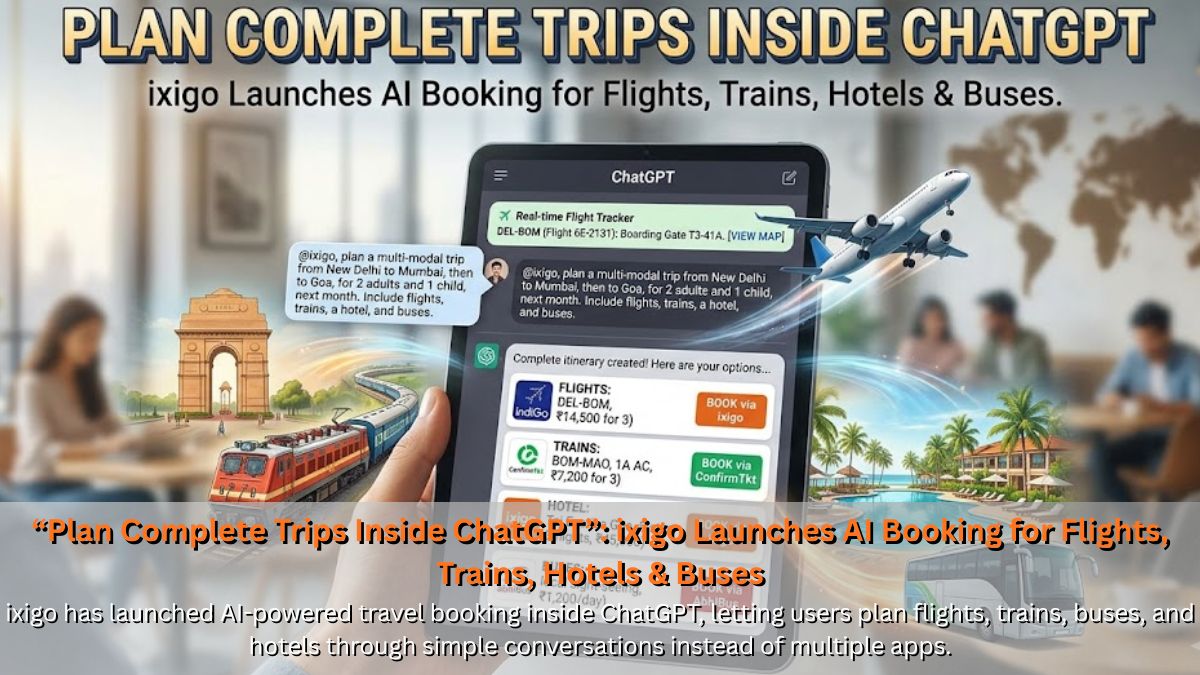
Planning a trip sounds exciting until the real struggle begins. One app for flights. Another for trains. Endless hotel tabs. Price comparisons that never seem to end. Somewhere between searching and booking, the excitement usually disappears. ixigo now wants to make travel planning feel simple again. The Gurugram-based travel company has launched AI-powered trip planning and booking inside ChatGPT, allowing users to search flights, check train availability, find buses, explore hotels, and plan complete journeys just by chatting naturally. No complicated filters. No endless scrolling. Just simple conversations like, “Find me a cheap weekend trip” or “Book a train to Jaipur tonight.”
The move feels bigger than a normal product update. It reflects how people are slowly changing the way they search online. Users today want faster answers, personalized suggestions, and less digital chaos. Instead of jumping between apps and websites, many now prefer asking AI tools directly and getting instant results in one place. Founded in 2007 by Aloke Bajpai and Rajnish Kumar, ixigo started as a small travel search platform focused mainly on helping Indians find train and flight information more easily. Over the years, it quietly grew into one of India’s most used travel apps across rail bookings, buses, hotels, and travel utilities. Now, with ChatGPT integration, ixigo is stepping into a future where planning a trip may feel less like searching the internet and more like talking to someone who already understands where you want to go.
1. How AI Booking for Flights Inside ChatGPT Is Changing Travel Search Forever
India’s online travel industry is entering a new AI-driven chapter, and ixigo’s latest move could become one of the biggest turning points yet. The company’s launch of AI Booking for Flights inside ChatGPT signals a major shift in how travelers may search, compare, and book trips in the coming years. Until now, most people planned trips the same exhausting way. Open flight apps. Compare fares across multiple tabs. Check train schedules separately. Browse hotel websites endlessly. Repeat the process again after prices change. Now that experience is starting to change.
Conversational AI is reshaping digital behavior faster than most industries expected. Instead of typing fragmented keywords into search bars, users are increasingly asking complete questions in natural language. They want direct answers, smarter recommendations, and faster decisions without navigating dozens of platforms. Travel is becoming one of the biggest industries affected by this transformation. ixigo’s ChatGPT integration arrives exactly at that moment.
According to multiple reports, the Gurugram-based travel platform has introduced native travel applications within ChatGPT that support flight discovery, train planning, bus bookings, hotel exploration, itinerary creation, and real-time flight tracking through AI conversations. The move reflects a much larger global trend where AI startups, travel tech companies, and venture-backed platforms are racing to build conversational commerce experiences before traditional search journeys become outdated.
1.1 How ixigo’s AI Travel Experience Inside ChatGPT Actually Works
The new integration turns trip planning into a simple conversation instead of a stressful search process. Rather than opening five different apps, users can now type natural prompts directly into ChatGPT, such as: “Find the cheapest Mumbai to Goa flight this weekend.” “Suggest train options from Delhi to Jaipur.” “Track my flight in real time.” “Plan a family holiday under ₹25,000.” The platform then delivers travel recommendations, routes, fares, booking options, and travel insights inside the same conversation window.
According to reports, the ixigo integration currently supports:
- Flight search and fare discovery
- Train route planning and availability
- Bus booking assistance
- Hotel discovery
- Trip itinerary generation
- Live flight tracking and travel updates
The experience feels less like using a traditional OTA platform and more like speaking with a smart digital travel assistant that already understands what you want. This is exactly where the future of travel technology seems headed. Across the global startup ecosystem, AI assistants are rapidly becoming the next major consumer interface. From ecommerce and fintech to healthcare and customer support, conversational AI is replacing traditional search-heavy user journeys. Travel may be next.
1.2 Why AI Booking for Flights Could Reshape the Entire Travel Industry
The travel business has always depended heavily on search behavior. For years, online travel companies fought aggressively for visibility through SEO rankings, app installs, paid advertising, and Google search traffic. Billions were spent trying to attract users before competitors did. But AI-powered search is beginning to disrupt that entire system.
Today, more users are skipping traditional browsing altogether and asking AI tools directly for recommendations. Instead of comparing 20 tabs manually, travelers increasingly want AI systems to simplify decisions instantly. That shift creates both opportunity and risk for travel startups. If conversational AI platforms become the primary discovery layer for consumers, travel brands that fail to integrate early could slowly lose visibility, traffic, and customer engagement.
ixigo appears to understand that change clearly. Its ChatGPT launch suggests the company is preparing for a future where conversational booking, AI travel assistants, and natural-language trip planning become major digital distribution channels for online travel businesses. In many ways, this may be the beginning of a completely new travel internet.
2. The Story Behind ixigo’s Rise in India’s Travel Startup Ecosystem
To understand why this launch matters, it helps to look back at ixigo’s journey itself. Because the company started long before artificial intelligence became the center of the technology world. Founded in 2007 by Aloke Bajpai and Rajnish Kumar, ixigo originally launched as a travel search and comparison platform designed to simplify travel discovery for Indian users. At the time, India’s online travel market looked very different from today.
Smartphones were still growing slowly. Digital payments were less common. Online bookings had not become mainstream yet. Planning a trip online often felt confusing and unreliable. The founders saw a gap. Indian travelers struggled to compare transportation options efficiently. Flight prices changed constantly. Railway information was difficult to access digitally. Bus ticketing remained fragmented across local operators.
The travel experience lacked simplicity. ixigo tried to solve that problem through technology. Instead of operating as a traditional travel agency, the platform focused first on organizing travel information in a cleaner and more user-friendly way. That early approach helped the company stand out inside India’s growing travel startup ecosystem.
2.1 The Founders Wanted to Simplify India’s Chaotic Travel Experience
Aloke Bajpai, an IIT Kanpur graduate who later studied at INSEAD, came from consulting and technology backgrounds before launching ixigo. Rajnish Kumar, with a strong engineering foundation, played a critical role in building the company’s technology infrastructure from the ground up. Together, the founders recognized something many people experienced daily but few companies were solving effectively.
Travel planning in India felt unnecessarily complicated. Train data was difficult to navigate. Flight fares changed unpredictably. Bus bookings lacked structure. Travel information was scattered everywhere. For millions of Indian travelers, especially budget-conscious users, trip planning often became stressful before the journey even started. ixigo’s vision was simple. Use technology to organize chaos. That vision slowly evolved into one of India’s most recognized travel technology platforms. And now, years later, the company is once again adapting to another massive shift, this time driven by artificial intelligence.
3.2 How ixigo Expanded Beyond a Simple Travel Search Engine
Over time, ixigo transformed itself far beyond a travel discovery platform. The company steadily expanded into railway ticket bookings, bus reservations, hotel partnerships, travel utility services, PNR predictions, live train tracking, and real-time travel alerts. Rail travel became one of ixigo’s strongest categories.
That strategy made sense because India operates one of the world’s largest railway networks, with millions of passengers depending on trains every single day. By focusing heavily on train status updates, seat availability insights, and rail booking support, ixigo built strong engagement among Indian travelers. The company later strengthened its market position further through acquisitions, partnerships, and product expansion.
This helped ixigo compete against larger online travel agencies operating in India’s increasingly crowded travel startup market. Now, with AI Booking for Flights and conversational travel planning inside ChatGPT, ixigo is entering yet another phase of its evolution. This time, the company is not only competing as a travel platform. It is competing for relevance in the future AI-powered internet itself.
3. Inside ixigo’s Business Model: How the Travel Startup Makes Money
Behind ixigo’s AI-powered travel expansion sits a carefully built business model that has evolved over nearly two decades. While most users know the platform for train bookings, flight searches, and travel updates, the company operates a much broader digital travel commerce engine behind the scenes. Unlike traditional travel agencies that depend mainly on ticket sales, ixigo built a multi-layered travel ecosystem designed around discovery, engagement, utility, and transactions.
Its business model combines several revenue-driving segments, including:
- Travel aggregation
- Online ticket booking
- Affiliate travel partnerships
- Sponsored travel advertising
- AI-driven travel recommendations
- Utility-based user engagement
This diversified structure helped ixigo survive intense competition inside India’s crowded online travel market while also building a strong mass-market presence, especially in rail-focused digital services. That became one of the company’s biggest advantages.
While global travel giants focused heavily on air travel and premium users, ixigo quietly built strong engagement among everyday Indian travelers using train utilities, live status updates, PNR tools, and budget-friendly travel discovery. That long-term strategy now gives the company a loyal user base as it enters the AI Booking for Flights era inside ChatGPT.
3.1 How ixigo Generates Revenue Across Travel Categories
ixigo earns money through multiple travel-related revenue streams spread across its platform ecosystem. Flight bookings generate commission-based income whenever users complete reservations through airline and travel partnerships. Train and bus bookings contribute transaction-related earnings through booking services and platform fees.
Hotel partnerships create additional monetization opportunities through listing commissions, affiliate revenue, and promotional collaborations. At the same time, advertising remains another important revenue layer. Travel brands, airlines, hotels, tourism campaigns, and booking partners pay for sponsored placements and visibility across ixigo’s high-traffic travel ecosystem. But one of ixigo’s smartest growth strategies has been utility-driven engagement.
Features like:
Live train tracking
PNR prediction tools
Real-time travel alerts
Seat availability updates
Fare prediction systems
keep users returning to the app repeatedly, even when they are not actively booking tickets. That matters enormously in digital travel commerce. Because platforms that become part of users’ daily travel habits often achieve stronger retention, higher engagement, and lower customer acquisition costs compared to pure booking-only businesses. Now, with conversational AI travel planning entering the picture, ixigo appears to be extending this engagement strategy directly into the ChatGPT ecosystem.
3.2 ixigo’s IPO Marked a Big Moment for India’s Travel Startup Industry
ixigo’s growth story reached another major milestone when its parent company, Le Travenues Technology Ltd, went public in 2024. The IPO became an important moment not only for the company but also for India’s wider startup ecosystem. For years, Indian startup conversations remained heavily dominated by fintech, ecommerce, food delivery, and SaaS companies. ixigo’s successful public market debut showed that travel technology startups could also build sustainable scale and attract investor confidence.
Before going public, the company had raised funding from several well-known investors, including Elevation Capital, Micromax Informatics, SAIF Partners, and Fosun RZ Capital. The listing reflected growing investor belief in India’s rapidly expanding digital travel economy, where online booking behavior, AI-powered travel discovery, and smart mobility platforms continue evolving quickly. It also highlighted something equally important.
Indian startups no longer need to follow identical growth playbooks to succeed. ixigo built its position differently by focusing deeply on utility-led engagement and India’s mass travel ecosystem before expanding aggressively into broader digital commerce and AI-powered travel experiences.
4. Why AI Booking for Flights Could Redefine the Future of Travel Search
The launch of AI Booking for Flights inside ChatGPT reflects a much bigger transformation happening across the internet itself. People are changing how they search online. Traditional browsing behavior is slowly giving way to conversational interaction. Consumers increasingly prefer asking direct questions instead of manually filtering endless search results. And travel may become one of the industries most affected by this shift.
For years, online travel depended heavily on search engines, app ecosystems, paid advertising, and SEO-driven discovery. Travel companies fought aggressively for clicks, rankings, and user attention. Now, conversational AI is beginning to rewrite those rules. Instead of opening multiple tabs and comparing dozens of listings, users increasingly want AI systems to understand intent instantly and deliver curated travel options in seconds. That is exactly where ixigo’s ChatGPT integration fits in. The company is not only launching another booking feature. It is positioning itself for the next generation of digital travel behavior.
4.1 Travel Search Is Moving From Search Bars to AI Conversations
Traditional travel booking often feels exhausting. Users manually search destinations. Compare prices across platforms. Switch between apps repeatedly. Filter endless results. Track fare changes constantly. The process consumes time and attention. Conversational AI changes that experience completely.
Instead of navigating menus and filters, travelers can now simply describe what they want naturally. “Find the cheapest morning flight.” “Suggest a shorter route.” “Plan a weekend trip under budget.” “Which train has better seat availability?” The AI assistant interprets intent, preferences, timing, and budget while surfacing relevant travel recommendations instantly.
This dramatically reduces friction inside the booking journey. And for travel startups, that creates a major opportunity. Because companies integrated early into conversational AI ecosystems may gain stronger visibility and engagement as user behavior evolves away from traditional search-driven discovery.
4.2 Real-Time Travel Intelligence Could Become the Biggest Advantage
One of the strongest benefits of conversational AI travel planning is contextual personalization. Unlike static search systems, AI-powered interactions evolve dynamically based on user questions and follow-up prompts.
A traveler can continue refining plans naturally inside the same conversation:
“Can I reduce hotel costs?”
“Show cheaper flights nearby.”
“Which route saves more time?”
“Suggest evening departures instead.”
This creates a far more intuitive and human-like planning experience compared to traditional travel portals. ixigo’s integration becomes even more useful because of its real-time travel intelligence capabilities. The platform reportedly supports live flight tracking, travel alerts, and dynamic updates directly within conversational workflows.
That matters because travel disruptions remain common across airlines, railways, and intercity transport systems. Delays, cancellations, platform changes, and fare fluctuations often create stress for travelers. Real-time AI-driven updates can significantly improve convenience, trust, and decision-making during those moments. In the long run, this may become one of the biggest competitive advantages for AI-powered travel platforms.
5. The AI Travel Race Is Creating a New Competitive Battlefield
India’s online travel market has always been fiercely competitive. ixigo already competes against several major players across flights, trains, hotels, buses, and digital travel discovery.
Key competitors include:
- MakeMyTrip
- EaseMyTrip
- Cleartrip
- Yatra
- Google Travel
- Booking.com
- Skyscanner
But the rise of conversational AI is changing the nature of competition itself. Travel companies are no longer competing only on pricing, discounts, inventory, or advertising visibility. Now they are competing on intelligence. On personalization. On conversational experience. AI-driven discovery. The companies that simplify decisions fastest may eventually dominate the next phase of digital travel commerce.
5.1 Why Early AI Movers Could Gain a Major Advantage
Traditional online travel agencies still hold enormous market strength because of their user base, inventory scale, partnerships, and marketing budgets. However, conversational travel planning remains relatively new, especially in India. That creates a rare opportunity for early movers.
If consumers rapidly adopt AI-assisted booking behavior, platforms already integrated into conversational ecosystems like ChatGPT could gain higher visibility and stronger engagement before competitors fully adapt. This is why ixigo’s timing matters strategically. The company is not waiting for conversational AI adoption to become mainstream first. It is positioning itself early while user habits are still evolving. And in technology markets, early behavioral shifts often create long-term winners.
5.2 AI Platforms Themselves Could Become Powerful Competitors
At the same time, the rise of AI assistants introduces another layer of competition entirely. Large AI platforms may eventually influence consumer purchasing decisions directly. That changes the balance of power across digital commerce ecosystems. If users begin depending heavily on AI-generated recommendations, travel startups must ensure they remain visible and relevant inside those recommendation layers. Otherwise, they risk losing customer discovery altogether.
ixigo’s ChatGPT integration appears designed precisely to protect against that future risk. Instead of competing against conversational AI, the company is embedding itself within the ecosystem early. That strategy could become critically important as AI-powered search and conversational commerce continue reshaping how consumers interact with the internet itself.ect and strengthen that visibility.
6. Why Conversational AI Travel Planning Is Rising So Fast
The rise of AI-powered travel planning is not happening randomly. Several major technology and consumer behavior trends are pushing the industry toward conversational booking much faster than expected. And India is becoming one of the biggest markets driving that shift.
The first reason is smartphone maturity. Hundreds of millions of Indians now use smartphones comfortably for daily transactions, entertainment, payments, shopping, and digital services. Booking flights, reserving trains, or paying online no longer feels complicated for most users. The second major driver is digital payment adoption. UPI, mobile wallets, and online banking completely changed how Indians interact with digital platforms. Travel bookings that once required physical agents or desktop websites now happen instantly through mobile devices.
The third shift is AI familiarity. Consumers today already interact daily with AI systems without even thinking about it. From chatbot support and recommendation engines to voice assistants and predictive search tools, AI has quietly become part of everyday digital behavior. And now users want something more. They no longer want generic results or endless lists of options. They expect personalized recommendations that understand budget, timing, travel style, and preferences automatically. That expectation is exactly why conversational AI travel planning is growing so quickly. Platforms like ixigo are responding to a deeper behavioral shift where users increasingly prefer asking questions naturally instead of navigating traditional search-heavy interfaces.
6.1 India’s AI Startup Boom Is Accelerating the Shift
India’s AI startup ecosystem has expanded rapidly over the last two years. Venture capital firms, global investors, and technology funds are aggressively backing AI startups focused on automation, conversational commerce, recommendation systems, and intelligent consumer platforms. Generative AI is no longer viewed as an experimental technology. It is becoming core infrastructure. This shift is forcing companies across industries to rethink their digital strategy completely.
Travel startups, fintech platforms, ecommerce companies, edtech firms, and healthcare apps are all racing to integrate AI-powered experiences before user behavior changes permanently. That urgency explains why travel companies are now investing heavily in conversational booking systems, AI itinerary generation, real-time travel intelligence, and smart recommendation engines. For travel platforms, AI integration is quickly becoming less of an optional feature and more of a survival strategy. Because once users become comfortable with conversational planning, traditional booking journeys may start feeling outdated very quickly.
6.2 Conversational Commerce Is Becoming the Next Internet Wave
The rise of conversational commerce is changing how digital transactions happen online. Instead of browsing websites manually, users can now discover products, compare options, ask questions, and complete purchases through natural conversations with AI systems.
- The experience feels faster.
- Simpler.
- More personal.
And that model is already spreading across multiple industries.
Retail platforms use AI shopping assistants. Food delivery apps offer conversational ordering. Fintech companies build AI financial guidance tools. Healthcare startups use AI symptom support systems.
Edtech platforms create conversational learning assistants. Now travel is entering the same transformation cycle.
ixigo’s ChatGPT integration reflects this broader technology disruption where AI interfaces are slowly becoming the new digital storefront. The biggest shift is psychological. Users are starting to treat AI less like software and more like an assistant that helps make decisions. That changes everything about customer engagement.
7. How ixigo Is Trying to Turn Travel Planning Into a Daily Habit
One of the biggest challenges in the travel industry is user frequency. People do not book flights every day. They do not reserve hotels daily. Most travel apps become inactive between trips. That creates a major engagement problem for online travel companies.
ixigo has historically handled this challenge differently from many competitors. Instead of focusing only on bookings, the platform invested heavily in travel utility tools that kept users returning regularly even without immediate travel purchases.
Features like:
- Live train status
- PNR prediction updates
- Fare alerts
- Travel notifications
- Journey tracking tools
helped ixigo become part of users’ routine travel behavior. That strategy built stronger long-term engagement compared to platforms focused only on transactions. Now, the ChatGPT integration could push this engagement even further. Because conversational AI changes how users interact with travel platforms entirely. Instead of opening the app only during bookings, users may begin casually exploring travel ideas, checking routes, comparing budgets, or planning future trips through everyday conversations. Travel planning slowly becomes continuous instead of occasional. And that creates far more consumer touchpoints for the platform.
7.1 AI Personalization Could Become ixigo’s Biggest Strength
One of the most powerful advantages of AI-driven travel planning is contextual personalization. The more users interact conversationally, the more intelligent the recommendations can become over time. Instead of showing the same generic travel listings to everyone, AI systems can adapt based on individual behavior patterns and preferences.
Over time, users may receive smarter recommendations influenced by:
- Previous searches
- Budget preferences
- Favorite destinations
- Travel timing patterns
- Route history
- Hotel choices
- Booking behavior
This creates a much more personalized discovery experience. And personalization matters enormously in travel commerce. Because travelers often feel overwhelmed by too many choices. AI systems that simplify decisions intelligently may eventually drive stronger retention, loyalty, and repeat engagement. For platforms like ixigo, that could become a major competitive advantage in the future AI travel ecosystem.
7.2 Travel Discovery Is Becoming More Conversational Than Transactional
Traditional travel apps are built mainly around transactions.
- Search.
- Compare.
- Book.
- Exit.
Conversational AI changes that dynamic completely. Now users may casually explore destinations without immediate booking intent.
Someone might ask:
- “Where can I travel cheaply this month?”
- “Suggest peaceful weekend destinations near Delhi.”
- “Which beach locations are less crowded?”
- “Plan a family holiday under budget.”
These conversations create discovery-driven engagement rather than purely transactional behavior. That expands the top of the customer acquisition funnel significantly. People begin interacting with travel platforms earlier in their decision-making journey instead of only at the final booking stage. For travel startups, this changes user engagement strategy entirely. The goal is no longer only conversion. The goal becomes staying present throughout the entire travel inspiration and planning process.
8. The Startup Ecosystem Is Watching the AI Travel Race Closely
ixigo’s ChatGPT launch quickly attracted attention across startup news platforms, tech media, AI communities, and venture capital discussions. Many industry observers viewed the move as a sign that Indian startups are beginning to move faster on AI integration instead of waiting for global companies to dominate the space first. And that matters. Because AI interfaces may fundamentally reshape how internet traffic flows in the coming years.
For decades, businesses optimized around search engines, app ecosystems, and social media platforms. Now conversational AI platforms are emerging as a new digital gateway between users and online services. That possibility is creating urgency across the startup ecosystem. Founders increasingly understand that if consumer discovery shifts toward AI assistants, companies must ensure visibility inside those ecosystems early. Otherwise, they risk becoming invisible during the next major internet transition.
8.1 Investors Are Aggressively Backing AI-Led Consumer Platforms
Global investor interest around AI startups remains extremely strong.
Venture capital firms continue pouring funding into companies focused on:
- Generative AI
- Conversational commerce
- AI-powered discovery
- Recommendation engines
- Automation systems
- Intelligent search platforms
Consumer internet businesses integrating AI effectively are attracting especially high attention because investors believe conversational interfaces could become one of the largest technology shifts since smartphones. Travel startups are now entering that conversation too. Platforms combining AI Booking for Flights, personalized travel discovery, conversational commerce, and smart itinerary generation may attract greater venture capital interest as user adoption grows. And if AI-assisted booking becomes mainstream, early movers could gain significant long-term advantages.
8.2 Travel Has Already Survived Multiple Technology Disruptions Before
The travel industry has always evolved alongside major technology shifts. First came online booking websites that replaced physical agents for many consumers. Then mobile-first travel apps changed how people searched and booked trips on smartphones. Now conversational AI appears to be the next major transformation wave. And like every previous disruption, some companies will adapt faster than others.
Platforms that integrate AI early, understand conversational user behavior, and build intelligent travel experiences may secure stronger strategic positioning before the market becomes crowded. That is why ixigo’s ChatGPT launch feels important beyond just another product update. It may represent the early stages of how millions of people will eventually plan trips in the future, where conversations replace search bars and AI assistants become the starting point of digital travel itself. advantages.
9. The Biggest Challenges Facing AI Booking for Flights
The excitement around AI-powered travel planning is real. However, the road ahead is far from simple. While conversational travel platforms look futuristic and convenient, they still face major operational and trust-related challenges that could shape how quickly users adopt them. Because travel is different from casual internet browsing. A wrong movie recommendation may disappoint someone for a few hours. A wrong travel recommendation can ruin an entire trip. That is why accuracy matters deeply in AI Booking for Flights and conversational travel systems.
Travel decisions involve constantly changing prices, real-time inventory updates, timing sensitivities, route preferences, and emotional spending behavior. Users expect correct information instantly, especially when money and schedules are involved. Even small errors can damage trust quickly. And in the travel industry, trust is everything.
9.1 Real-Time Travel Data Is Extremely Difficult to Manage
One of the biggest technical challenges in AI-powered travel planning is real-time data synchronization. Travel information changes constantly. Flight fares fluctuate within minutes. Train seat availability updates rapidly. Hotel prices shift based on demand spikes. Bus operators adjust schedules frequently.
This creates a highly dynamic ecosystem where information becomes outdated almost instantly. For conversational AI platforms, this creates enormous technical pressure.
The AI system must process live inventory, pricing updates, route availability, and booking conditions accurately while still delivering fast conversational responses. That balance is difficult. Because users now expect AI assistants to behave like instant decision-making engines. Any outdated fare, unavailable seat, or incorrect recommendation can immediately reduce confidence in the platform. As conversational commerce grows, maintaining reliable real-time travel intelligence may become one of the biggest competitive advantages in the industry.
9.2 Winning Consumer Trust Will Take Time
Despite growing excitement around AI assistants, many users still hesitate before trusting automated travel recommendations completely. And that hesitation is understandable. Travel purchases often involve significant spending, family planning, emotional expectations, and strict scheduling. People naturally want reassurance before making final decisions. That is why many consumers still cross-check flight prices manually, compare platforms independently, or verify hotel details themselves before booking.
AI systems must slowly earn trust through consistency, reliability, and transparency. The challenge becomes even bigger in India’s travel market, where millions of users remain highly price-sensitive and cautious about online transactions. For conversational travel platforms, the goal is not only convenience. It is confidence. Users must feel that AI recommendations are accurate, unbiased, and dependable before conversational booking becomes mainstream behavior.
9.3 Global AI Travel Giants Are Entering the Race Too
ixigo may have moved early inside India’s conversational travel ecosystem, but competition is only beginning. Global travel companies and major technology platforms are investing aggressively in AI-driven travel experiences, intelligent search systems, and conversational commerce infrastructure.
Large international players already possess:
- Massive user bases
- Global travel inventory
- Advanced AI capabilities
- Large engineering teams
- Strong financial backing
That creates intense long-term pressure for Indian travel startups. To compete effectively, local companies will need faster execution, deeper personalization, regional understanding, and smarter product differentiation instead of relying only on pricing advantages. The AI travel race may eventually become one of the most competitive segments inside the global digital economy. And early positioning could matter enormously.
10. What Problems ixigo’s AI Travel Model Is Actually Solving
At its core, ixigo’s AI integration is trying to solve something millions of travelers experience constantly. Travel planning fatigue. Modern trip planning often feels unnecessarily complicated.
- Too many tabs.
- Too many comparisons.
- Too many booking platforms.
- Too much information everywhere.
Users frequently spend hours checking flight fares, train schedules, hotel prices, baggage rules, route combinations, and cancellation policies before making a final decision. The process becomes mentally exhausting. ixigo’s conversational AI model attempts to remove that friction completely. Instead of manually browsing endless options, users can simply describe what they need naturally and receive curated travel recommendations instantly.
The idea is simple.
- Reduce effort.
- Reduce confusion.
- Reduce digital overload.
And in a world where users increasingly value convenience over complexity, that approach could become very powerful.
10.1 Why Multi-Modal Travel Planning Matters So Much in India
Travel behavior in India is unique compared to many global markets. A single Indian journey often involves multiple transportation layers instead of one direct booking.
Someone traveling across cities may combine:
- Flights
- Trains
- Local taxis
- Bus transfers
- Hotel stays
Managing all these independently becomes difficult very quickly. This is especially true for budget-conscious travelers who optimize routes carefully based on timing and cost. Traditional booking platforms usually separate these experiences into different apps and workflows. Conversational AI changes that.
Instead of planning every segment manually, users can ask AI systems to organize entire journeys contextually. That creates a more unified travel experience. And because India has one of the world’s most complex transportation ecosystems, AI-powered trip coordination could become especially valuable in the country’s digital travel market.
10.2 Conversational Travel Could Help India’s Next Internet Users
Another major opportunity lies in India’s next generation of digital consumers. Millions of new internet users are coming online from smaller cities and regional markets. Many of them may feel more comfortable asking natural-language questions rather than navigating complex interfaces or search-heavy platforms.
Conversational systems feel simpler.
- More human.
- More intuitive.
- Less technical.
For many users, speaking naturally to an AI assistant may eventually become easier than learning how to use multiple booking filters and travel comparison tools manually. That behavioral shift could significantly expand the reach of AI-powered travel platforms over the next decade. And companies adapting early may benefit the most from this transition.
11. Why ixigo’s Launch Matters Beyond the Travel Industry
ixigo’s ChatGPT integration is not just another travel-tech announcement. It reflects a much larger shift happening across the global startup ecosystem. AI is changing how people discover information, interact with platforms, and make decisions online.
And startups across industries are now facing the same uncomfortable but important questions:
- What happens when AI replaces traditional search behavior?
- Will apps lose traffic to conversational assistants?
- How should startups integrate into AI ecosystems?
- What changes when conversations become the new interface layer?
These questions are now influencing startup strategy everywhere. Because the next internet may not be organized around websites and apps alone. It may increasingly revolve around AI-driven interaction layers.
11.1 AI Assistants Could Become the Next Major Distribution Channel
For years, startups depended heavily on three major growth engines:
- Search engines
- App stores
- Social media platforms
These systems controlled visibility, traffic flow, and customer acquisition for most digital businesses. Now AI assistants may become the next major distribution layer. If users increasingly rely on conversational AI for recommendations, discovery, and transactions, businesses integrated into those ecosystems could gain major visibility advantages. This explains why startups across ecommerce, fintech, education, healthcare, and travel are aggressively experimenting with AI integrations right now. No company wants to become invisible during the next major internet shift.
11.2 AI Is Becoming a Core Business Transformation Strategy
Not long ago, many companies treated AI like a trendy feature added mainly for marketing headlines. That phase is ending quickly. Today, AI integration is becoming a deeper business transformation strategy affecting how companies operate, engage users, personalize services, and optimize decision-making.
Businesses now use AI for:
- Customer support automation
- Personalized recommendations
- Pricing intelligence
- Product discovery
- Workflow automation
- Predictive analytics
- User engagement optimization
Travel platforms simply happen to be among the earliest industries where this transformation is becoming highly visible to consumers. And conversational booking may only be the beginning.
12. What Startups and Entrepreneurs Can Learn From ixigo’s Journey
ixigo’s story offers several important lessons for founders, operators, and emerging startups navigating rapidly changing technology markets. The first lesson is timing. The company entered India’s travel technology space early and survived multiple market cycles, consumer behavior shifts, and competitive waves. Instead of remaining static, ixigo kept evolving continuously alongside the internet itself.
The second lesson is diversification. Rather than depending entirely on one business segment, the platform expanded across trains, buses, hotels, travel utilities, and AI-driven discovery systems. That diversification reduced risk while strengthening long-term engagement. The third lesson is adaptation. Many companies ignore technological disruption until it becomes unavoidable. ixigo appears to be taking the opposite approach by integrating directly into emerging conversational AI ecosystems before the market matures completely.
The fourth lesson is local market understanding. India’s transportation ecosystem is very different from Western travel markets. Railway dependence, price sensitivity, multi-modal journeys, and regional complexity all shape consumer behavior differently. ixigo built products specifically around those realities instead of copying global travel models blindly. And perhaps the most important lesson is persistence.
The company operated for years before reaching large-scale public-market recognition. Its journey reminds founders that sustainable businesses are often built through long-term execution, patient iteration, and consistent adaptation rather than overnight hype. For Indian entrepreneurs, especially those building AI startups, consumer platforms, or digital infrastructure businesses, ixigo’s evolution offers a powerful example of how technology adaptation and deep market understanding can help startups survive multiple waves of internet transformation.
About foundlanes.com
foundlanes.com is India’s leading startup idea discovery platform. It helps entrepreneurs find actionable startup opportunities, market insights, and industry-specific guidance to turn ideas into real businesses. With deep research and practical resources, foundlanes supports founders at every stage, from idea validation to launch and growth.