
News Summary
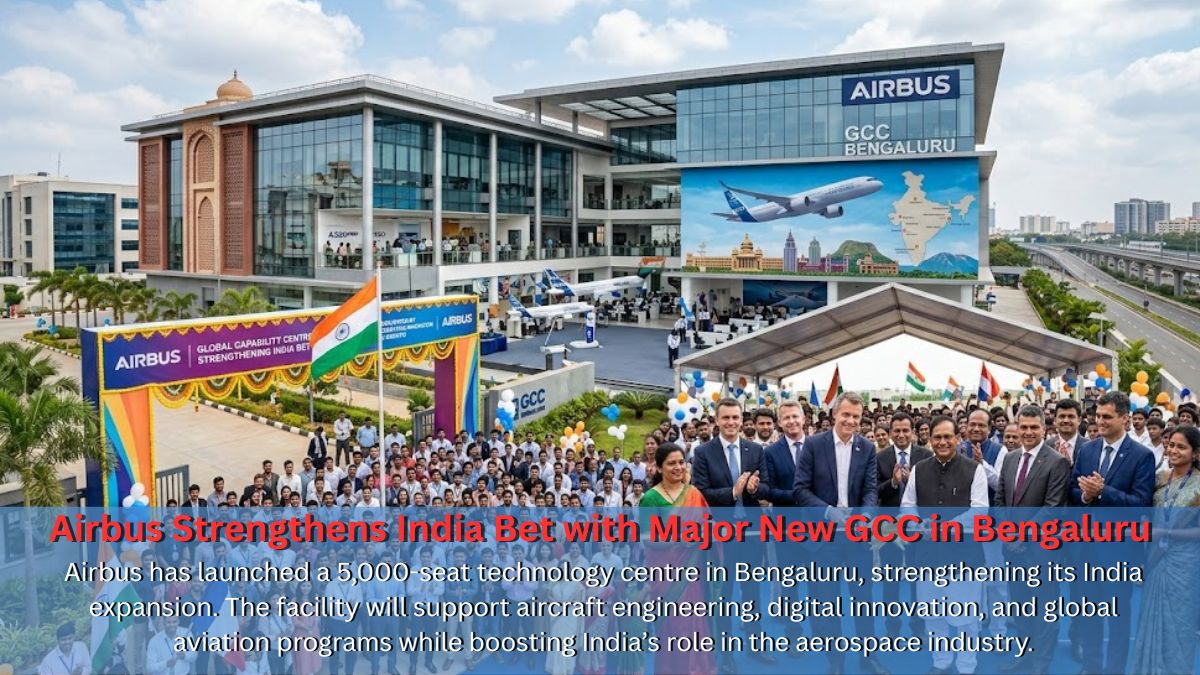
The phrase “Airbus Strengthens India Bet” is becoming increasingly relevant as the global aerospace giant expands its presence in India with a major technology and engineering investment in Bengaluru. Airbus recently inaugurated a massive 5,000-seat Global Capability Centre (GCC), called the Airbus India Technology Centre, marking a new phase in the company’s India growth strategy. The new facility reflects Airbus’s confidence in India’s engineering talent, expanding aviation market, and growing role in global aerospace innovation.
Located in Bengaluru, the technology centre spans roughly 8.8 lakh square feet and is designed to accommodate around 5,000 engineers and digital specialists. The campus will focus on engineering design, digital transformation, customer services, procurement, and research into next-generation aviation technologies. Airbus executives say the new facility integrates Indian engineering talent directly into the company’s global aircraft programs across the entire lifecycle of aircraft design, production, maintenance, and performance optimization.
The investment also signals Airbus’s deeper commitment to India’s aviation ecosystem and the government’s “Make in India” initiative. Over the past few years, Airbus has expanded sourcing from India dramatically, rising from $500 million in 2019 to more than $1.5 billion annually today. The company expects sourcing from Indian suppliers to exceed $2 billion before the end of the decade. More than 100 Indian companies now supply components such as aircraft doors, fuselage sections, and structural parts for Airbus programs worldwide. In addition, the new campus will host training facilities under Airbus Leadership University, preparing the next generation of aerospace engineers and technical managers. The centre will also provide global customer service support for airlines operating Airbus aircraft.
Industry experts say the expansion highlights India’s rise as a global aviation engineering hub. The country already has one of the fastest-growing civil aviation markets in the world, with airlines like IndiGo and Air India placing record aircraft orders. As a result, global aerospace companies are increasingly turning to India for engineering talent, research, digital innovation, and supply-chain manufacturing. This development further strengthens Bengaluru’s position as a major global hub for aerospace innovation, global capability centres, and tech-driven engineering services.
1. Airbus Strengthens India Bet with Major New GCC in Bengaluru
The announcement that Airbus Strengthens India Bet through a massive new Global Capability Centre in Bengaluru represents a major milestone for the aerospace industry in India. The new Airbus India Technology Centre reflects the company’s long-term strategy to integrate India into its global innovation and engineering ecosystem. This move is not only important for Airbus but also for the broader Indian startup ecosystem, tech news landscape, and global aerospace industry trends. The facility highlights how multinational corporations are increasingly building innovation hubs in India to access talent, drive research, and accelerate digital transformation.
1.1 The New Airbus India Technology Centre
1.1.1 A 5,000-Seat Global Engineering Hub
The Airbus India Technology Centre is a large campus designed to host 5,000 engineers and technology professionals. The facility covers about 8.8 lakh square feet, making it one of Airbus’s largest engineering and digital hubs outside Europe. The centre will serve as a global hub for several functions, including engineering, digital transformation, procurement, and customer support. Importantly, engineers working in the centre will contribute to the entire lifecycle of Airbus aircraft, from design and development to maintenance and optimization. This lifecycle approach reflects how aerospace companies now rely heavily on data analytics, AI, and digital engineering tools.
1.1.2 Focus Areas of the Bengaluru GCC
The new facility will focus on several key technology domains. These include artificial intelligence, robotics, cybersecurity, digital engineering platforms, and next-generation aircraft technologies. Such areas represent the future of aviation innovation. For example, AI-driven predictive maintenance can identify aircraft issues before they become serious. Similarly, digital engineering platforms help engineers simulate aircraft performance before building physical prototypes. As a result, companies can reduce development costs and accelerate innovation.
2. The Journey of Airbus in India
2.1 Early Entry into the Indian Market
Airbus began building its presence in India more than two decades ago. Initially, the company focused on engineering services and supply chain partnerships. Over time, India became a strategic location for research, technology development, and manufacturing collaboration. The company has worked closely with several Indian aerospace partners, including Tata Advanced Systems and Hindustan Aeronautics Limited (HAL). These partnerships support aircraft component manufacturing and defense aviation projects.
2.2 Growth of Airbus Engineering in India
The engineering ecosystem around Airbus in India has evolved rapidly. What started as a specialized engineering support team has now become a multi-disciplinary technology hub supporting multiple global programs.
Airbus engineers in India now contribute to:
- Aircraft structural design
- Flight performance analysis
- Digital engineering tools
- Aircraft maintenance and support
This expansion reflects how global companies are shifting complex engineering tasks to India.
3. Airbus Business Model Explained
Understanding how Airbus operates requires looking beyond the aircraft that people see at airports. Behind every aircraft delivery lies a complex system of engineering, global supply chains, service networks, and long-term partnerships with airlines and governments. Airbus is not simply a manufacturer of airplanes. It is a global aerospace ecosystem that combines design, engineering, manufacturing, digital technology, and lifetime service support. This layered model has allowed the company to compete at the highest level of the aviation industry for decades. To understand the Airbus strategy more clearly, it helps to break its operations into two key parts: how the company works operationally and how it generates revenue over time.
3.1 Airbus Working Model
At its core, Airbus functions as a multinational aerospace company that designs, builds, and supports some of the most technologically complex machines in the world. From commercial airliners that carry millions of passengers each day to advanced defense systems and helicopters used in military and rescue missions, Airbus operates across multiple aviation sectors. The company’s operations are structured around three major business segments.
3.1.1 Commercial Aircraft
The largest and most visible part of Airbus’s business is its commercial aircraft division. This segment designs and manufactures passenger airplanes used by airlines across the world. Aircraft families such as the Airbus A320, Airbus A350, and Airbus A380 represent decades of engineering innovation and global collaboration. Each aircraft program involves thousands of engineers, hundreds of suppliers, and years of research before a single plane ever reaches the runway.
Airlines purchase these aircraft to expand their fleets, improve fuel efficiency, and increase passenger capacity. But the relationship between Airbus and airlines does not end once an aircraft is delivered. In fact, delivery is only the beginning of a partnership that can last for decades. Aircraft typically remain in service for 20 to 30 years. During that time, airlines rely heavily on Airbus for maintenance guidance, spare parts, software updates, and operational support. This long lifecycle is one of the reasons Airbus has built such a powerful and resilient business model.
3.1.2 Defense and Space Systems
Another important pillar of Airbus’s operations is its defense and space segment. Through this division, Airbus develops military aircraft, satellite systems, secure communications technologies, and advanced defense solutions. Governments and defense organizations across the world depend on these systems for national security and space exploration programs.
Projects in this segment are often long-term and highly complex. They involve extensive research, collaboration with government agencies, and strict technological requirements. While these projects may take years to develop, they often result in large multi-year contracts that provide stable revenue streams.
3.1.3 Helicopters
The third core segment of Airbus is its helicopter division. Airbus helicopters are used in a wide range of missions including emergency medical services, search and rescue operations, offshore energy transport, law enforcement, and military operations. Helicopter customers include governments, rescue agencies, energy companies, and defense forces. Just like commercial aircraft, helicopters require ongoing service support, which creates long-term relationships between Airbus and its customers.
3.1.4 The Customer Ecosystem
Across these three segments, Airbus sells its products primarily to three types of customers:
- Commercial airlines
- Government and defense agencies
- Aircraft leasing companies
Leasing companies have become especially important in modern aviation. Instead of buying aircraft outright, many airlines lease planes from global leasing firms. These companies purchase aircraft in bulk and then lease them to airlines for fixed periods. This model allows airlines to expand their fleets without massive upfront capital investments. For Airbus, it also means that a single aircraft order can represent business relationships with multiple airlines over time.
3.1.5 Beyond Manufacturing
A critical aspect of the Airbus working model is that the company does not rely solely on selling aircraft.
Instead, it builds long-term service ecosystems around its products. These services include:
- Aircraft maintenance programs
- Spare parts supply networks
- Technical consulting
- Pilot and crew training
- Fleet performance analytics
- Digital monitoring systems
This approach transforms Airbus from a simple manufacturer into a lifetime partner for airlines and aviation operators. When an airline buys an aircraft, it is effectively entering a multi-decade relationship with Airbus. And that relationship becomes one of the most powerful drivers of the company’s long-term business success.
3.2 Role of Global Capability Centres
In recent years, Global Capability Centres have become an important strategic tool for large multinational companies, including Airbus. A Global Capability Centre (GCC) is essentially an offshore hub where companies centralize advanced work such as engineering, data analytics, software development, artificial intelligence research, and technical support operations. Rather than performing all innovation and development in one country, companies distribute their expertise across global hubs.
This approach provides several advantages. First, it allows companies to access highly skilled talent pools around the world. Second, it helps accelerate research and development. Third, it enables companies to operate more efficiently by distributing workloads across time zones. India has become one of the most important destinations for Global Capability Centres. Cities like Bengaluru, Hyderabad, and Pune now host hundreds of such centers for global companies in industries ranging from aviation to banking and technology.
3.3 Why Airbus Built a GCC in Bengaluru
For Airbus, establishing a large technology and innovation campus in Bengaluru represents a strategic investment in the future of aviation. The city has earned a reputation as India’s technology capital and is home to a vast ecosystem of aerospace engineers, software developers, and research institutions. By building a Global Capability Centre here, Airbus gains access to one of the world’s largest engineering talent pools.The Bengaluru campus will play several key roles in Airbus’s global operations.
3.3.1 Technology Development
Modern aircraft are becoming increasingly digital. From predictive maintenance systems to advanced avionics and real-time data analytics, aviation technology now depends heavily on software innovation. Engineers at the Bengaluru center will help develop next-generation digital technologies that improve aircraft efficiency, safety, and operational performance.
3.3.2 Global Aircraft Program Support
Large aircraft programs involve engineering teams spread across multiple countries. Engineers at the GCC will collaborate with Airbus teams worldwide to support aircraft design improvements, testing processes, and system integrations.
3.3.3 Digital Transformation
Airlines today rely heavily on digital tools to manage their fleets. These include platforms that monitor aircraft performance, predict component failures, and optimize fuel consumption. The GCC will help develop and maintain these digital systems, allowing airlines to operate more efficiently.
3.3.4 Customer Support
Airlines operate in a highly time-sensitive environment. When a technical issue arises, it must be addressed quickly to avoid delays and disruptions. Global capability centers allow companies like Airbus to provide around-the-clock support to airline customers across multiple time zones.
3.3.5 A Strategic Advantage
For Airbus, the GCC model is not just about cost efficiency. It is about scaling innovation. Aviation is one of the most technologically demanding industries in the world. Aircraft systems involve millions of components and require constant improvements in safety, efficiency, and sustainability. By expanding its engineering capabilities globally, Airbus can accelerate innovation while maintaining operational resilience.
4. Airbus Revenue Model
While aircraft manufacturing is the most visible part of Airbus’s business, the company’s revenue model is much broader and more sophisticated. Airbus earns revenue through several interconnected streams.
4.1 Aircraft Sales
The largest portion of Airbus’s income comes from selling aircraft to airlines, governments, and leasing companies. Aircraft orders are typically placed years in advance and often involve large multi-billion-dollar contracts. Airlines order dozens or even hundreds of aircraft to support long-term fleet expansion plans. For example, major Indian airlines such as IndiGo and Air India have placed massive aircraft orders in recent years to support their future growth. These orders represent long production pipelines for Airbus factories and create predictable demand for aircraft manufacturing.
4.2 Aviation Services
Over the past decade, Airbus has significantly expanded its services business. Once an aircraft enters service, it requires continuous technical support throughout its operational life. Airbus provides a wide range of services designed to help airlines operate their fleets efficiently.
These services include:
- Aircraft maintenance support
- Spare parts logistics
- Fleet performance monitoring
- Flight-hour support programs
- Engineering consulting
For airlines, these services simplify complex technical operations. For Airbus, they create recurring revenue streams that continue long after an aircraft is delivered.
4.3 Digital Aviation Platforms
Another rapidly growing revenue area for Airbus is digital aviation solutions. Modern aircraft generate enormous amounts of data during every flight. Airbus uses digital platforms to analyze this data and provide airlines with insights that improve operational performance.
These platforms can help airlines:
- Predict maintenance needs before failures occur
- Optimize flight routes for fuel efficiency
- Monitor aircraft health in real time
- Reduce operational downtime
By integrating data analytics into aviation operations, Airbus is gradually transforming itself into a technology-driven aerospace company.
4.4 Long-Term Service Contracts
One of the most powerful aspects of Airbus’s revenue model is its ability to build long-term relationships with customers. Many airlines sign service agreements that last for years or even decades. These agreements cover technical support, spare parts supply, maintenance planning, and training services. Because aircraft remain in operation for such long periods, these service contracts provide Airbus with steady, predictable revenue. In many cases, the lifetime value of servicing an aircraft can rival or even exceed the revenue from the initial aircraft sale.
5. India’s Growing Aviation Industry
India is emerging as one of the most important aviation markets in the world. Over the past decade, rising incomes, urbanization, and improved connectivity have transformed air travel from a luxury into a widely used mode of transportation. Millions of Indians who previously relied on trains or buses are now flying for business, tourism, and personal travel.
5.1 One of the Fastest-Growing Aviation Markets
India’s aviation sector is expanding at an extraordinary pace. Passenger demand continues to rise each year, supported by a growing middle class and government programs that promote regional connectivity. The Ministry of Civil Aviation has launched initiatives to improve airport infrastructure and expand air routes to smaller cities.
At the same time, airlines are rapidly expanding their fleets to keep up with demand. Carriers such as IndiGo and Air India have placed some of the largest aircraft orders in aviation history. These orders are worth tens of billions of dollars and will shape the future of India’s aviation landscape for decades. For aircraft manufacturers like Airbus, this growth represents a major opportunity. Every new aircraft order increases demand not only for manufacturing but also for engineering services, maintenance infrastructure, and aviation technology.
5.2 Increasing Demand for Aviation Engineers
Rapid aviation growth also creates a major talent challenge. Aircraft fleets across India are expected to expand significantly over the next decade. More aircraft in operation means greater demand for maintenance engineers, aviation technicians, and aerospace specialists. Industry experts estimate that India will require thousands of additional aviation engineers to support this growth.
Maintenance, Repair, and Overhaul (MRO) services will become particularly important as airline fleets age and expand. The Airbus technology campus in Bengaluru is designed to help address this growing talent demand. By bringing together engineers, researchers, and digital specialists under one roof, Airbus hopes to contribute to India’s aerospace capabilities while strengthening its own global engineering network.
6. Airbus and the Make in India Strategy
The new GCC is closely linked with India’s “Make in India” initiative. Airbus has significantly increased its sourcing from Indian suppliers. The company’s annual procurement from India has increased from $500 million in 2019 to more than $1.5 billion today. More than 100 Indian companies now supply aircraft components for Airbus global programs. These components include aircraft doors, fuselage sections, and structural elements. This growing supply chain ecosystem creates thousands of jobs in India.
7. The GCC Boom in India
India has become a global hub for Global Capability Centres. Multinational companies across industries are building GCCs to access talent and innovation. Cities like Bengaluru, Hyderabad, and Pune host hundreds of such centres. These hubs support functions such as engineering, AI development, finance, and analytics. For companies, GCCs provide cost efficiency and access to skilled professionals. For India, they generate employment and technology transfer.
8. Airbus Competitors in the Aerospace Industry
Airbus operates in a highly competitive global aerospace market. Its main competitor is Boeing in the commercial aircraft segment. However, several other companies also compete in specific areas.
These include:
- Lockheed Martin
- Northrop Grumman
- Embraer
- Bombardier
Each company focuses on different segments of aviation and defense technology. Despite competition, Airbus remains one of the world’s largest aerospace manufacturers.
9. Impact on the Indian Startup Ecosystem
The expansion of global technology centres like Airbus’s GCC can significantly influence India’s startup ecosystem. Such facilities attract skilled engineers, researchers, and technology professionals. Many professionals eventually leave large companies to start their own ventures. This process creates new startup ideas, tech innovations, and disruptive tech startups. In addition, collaborations between corporations and AI startups, aerospace startups, and engineering startups are increasing. This creates new opportunities for venture capital investment and technology partnerships.
10. Why Bengaluru Remains a Global Tech Hub
Bengaluru continues to attract global technology investments. The city offers several advantages. It has a large pool of engineers and technology professionals. It hosts top universities and research institutions. The city also has a vibrant startup ecosystem with strong venture capital networks. These factors make it an ideal location for global innovation centres.
11. Future Growth of Airbus in India
The opening of the new GCC suggests that Airbus will continue expanding its presence in India. Industry analysts expect more investments in engineering, manufacturing, and supply chain partnerships. India’s aviation market is projected to become one of the largest in the world. This growth creates opportunities not only for Airbus but also for Indian aerospace startups.
12. Learning for Startups and Entrepreneurs
The story of Airbus Strengthens India Bet offers several lessons for entrepreneurs and startup founders. First, talent matters. Companies choose locations where skilled professionals are available. Second, long-term investment creates sustainable growth. Airbus has built its presence in India gradually over decades. Third, partnerships are critical. Airbus works with Indian suppliers, universities, and government agencies. Finally, innovation must be continuous. Aerospace companies invest heavily in research, AI, robotics, and digital engineering. Startups that focus on advanced technology and global markets can follow a similar strategy.
About foundlanes.com
foundlanes.com is India’s leading startup idea discovery platform. It helps entrepreneurs find actionable startup opportunities, market insights, and industry-specific guidance to turn ideas into real businesses. With deep research and practical resources, foundlanes supports founders at every stage, from idea validation to launch and growth.