News Summary
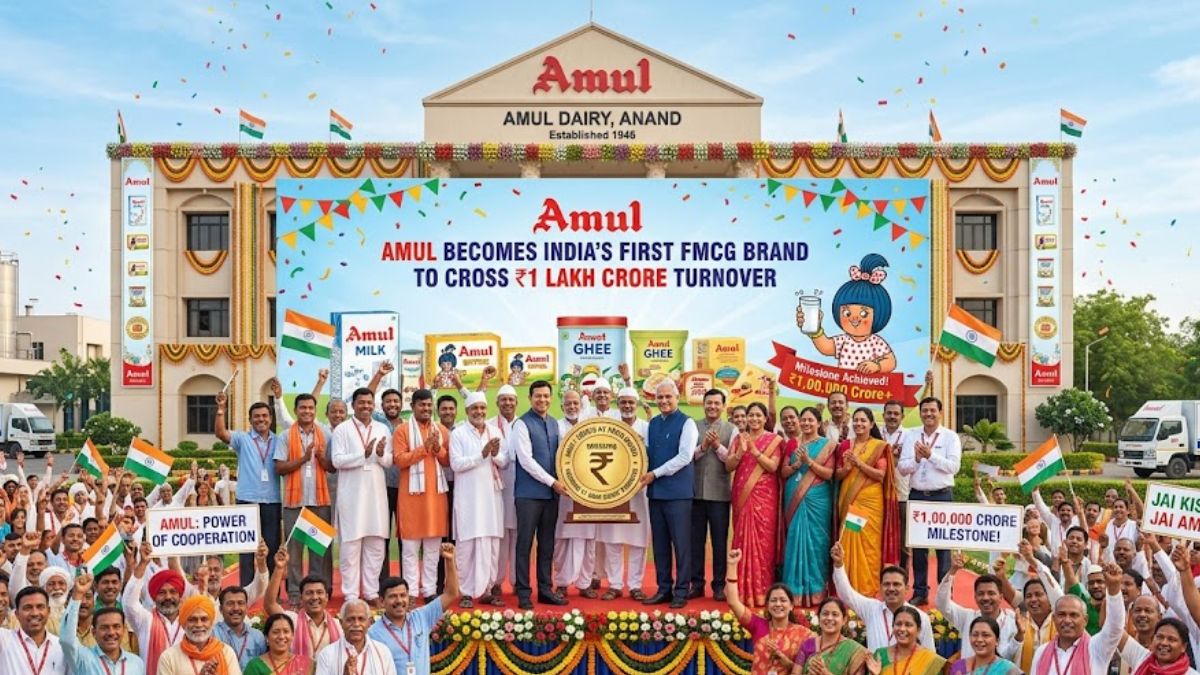
India’s dairy giant Amul has achieved a historic milestone by becoming the First FMCG Brand in the country to cross ₹1 lakh crore turnover. The Gujarat Cooperative Milk Marketing Federation (GCMMF), which markets Amul products, reported that its revenue crossed ₹1 trillion in the financial year, marking a significant moment in India’s FMCG and cooperative sector.
This achievement reflects not just scale but also the strength of Amul’s unique cooperative model. Unlike traditional corporate structures, Amul operates through millions of dairy farmers across India. This decentralized system allows it to maintain cost efficiency while ensuring fair returns to producers. The milestone comes at a time when India’s FMCG sector is witnessing rapid growth, driven by rising consumption, urbanization, and expanding rural demand. Amul’s growth has been fueled by strong demand for milk and dairy products, expansion into value-added segments such as cheese, ice cream, and packaged foods, and consistent brand trust built over decades. Reports indicate that the federation saw double-digit growth, supported by increased milk procurement and better product pricing.
The achievement also positions Amul ahead of several major FMCG companies in India, making it a standout example of how a cooperative structure can scale to compete with corporate giants. Industry experts see this as a turning point for the Indian FMCG landscape, where traditional models and modern supply chains are converging. This news report explores how Amul reached this milestone, its business model, revenue drivers, competitive landscape, and what startups and entrepreneurs can learn from this journey.
1. The Historic Milestone: India’s First FMCG Brand Crosses ₹1 Lakh Crore
1.1 Understanding the Scale of ₹1 Lakh Crore Achievement
When Amul crossed ₹1 lakh crore in turnover, it wasn’t just another business headline. It was a moment that carried decades of effort, millions of lives, and a system that quietly worked while the rest of the world chased fast growth. Numbers like ₹1 trillion can feel abstract, but when you pause and really think about it, it represents an enormous flow of value moving through villages, farms, supply chains, factories, and finally into homes across the country.
What makes this milestone deeply meaningful is not just scale, but the nature of that scale. This isn’t a company driven only by boardroom decisions or investor pressure. It is built on the backs of farmers who wake up every morning, often before sunrise, to do the same work they’ve done for years. Every litre of milk collected is part of that ₹1 lakh crore story. In a way, this achievement belongs as much to rural India as it does to the brand itself. It proves that when systems are built right, growth doesn’t have to exclude people. It can carry them along.
1.2 Growth Drivers Behind the Milestone
Growth at this level doesn’t happen by accident. It is the result of multiple forces coming together over time. One of the biggest drivers has been the steady increase in demand for dairy products. As incomes have risen and lifestyles have changed, consumption patterns have evolved. Milk is no longer just a daily necessity. It has become part of a broader food ecosystem that includes packaged products, convenience foods, and premium offerings.
At the same time, Amul made a crucial shift. It didn’t stay limited to selling raw milk. It moved into value-added products like butter, cheese, and ice cream, where margins are higher and brand loyalty is stronger. This decision changed everything. Add to that an incredibly strong distribution network that reaches both big cities and small towns, and you begin to see how the foundation for this milestone was built. It’s not one big move, but a series of smart, consistent decisions over years.
2. The Journey of Amul: From Cooperative Movement to FMCG Leader
2.1 Origins of the Amul Movement
The story of Amul doesn’t start in a corporate office. It starts in 1946, in Anand, Gujarat, with a problem that was painfully real for farmers. Middlemen controlled the market, prices were unfair, and producers had very little power. What began as a response to this imbalance slowly turned into a movement. Farmers came together, not just to sell milk, but to take control of their own economic future.
There’s something deeply human about this phase of the journey. It wasn’t driven by ambition to build a giant company. It was driven by necessity and fairness. People wanted dignity for their work. They wanted a system where effort translated into income without exploitation. That intention shaped everything that came after. Even today, you can feel that origin in the way the brand operates.
2.2 Evolution into a National Brand
Over time, what started as a local cooperative grew into a national force. Amul expanded step by step, entering new markets, building processing capabilities, and strengthening its supply chain. But growth alone doesn’t build a brand. Trust does. And that trust came from consistency. People knew what they were getting. The quality remained reliable, the pricing stayed reasonable, and the brand never felt distant.
Then came one of its most underrated strengths: communication. The iconic advertising campaigns, simple, witty, and timely, made the brand feel alive. It wasn’t just selling products. It was participating in everyday conversations. Over the years, this created a connection that goes beyond transactions. Today, Amul is not just a dairy brand sitting on shelves. It’s part of people’s routines, memories, and habits.
3. Business Model Explained: How Amul Works
3.1 Cooperative Structure as a Core Strength
The real genius behind Amul lies in its structure. It operates through a three-tier cooperative system that connects farmers directly to the market. At the ground level, there are village societies where farmers bring their milk. These societies are linked to district unions, which handle processing and logistics. At the top sits the state federation, coordinating branding, marketing, and large-scale distribution.
This structure might sound simple, but its impact is profound. It removes unnecessary layers, reduces inefficiencies, and ensures that value flows back to the producers. More importantly, it creates a sense of ownership. Farmers are not just suppliers. They are stakeholders. That psychological shift changes how people work, how they commit, and how they grow with the system.
3.2 Revenue Model and Profit Distribution
Unlike traditional corporations where profits are concentrated at the top, Amul follows a very different path. Revenue comes from selling products, just like any FMCG company. But what happens next sets it apart. A significant portion of that value flows back to the farmers. This ensures that growth is shared, not extracted.
This model creates a self-sustaining cycle. Farmers earn better, which motivates them to produce more and maintain quality. Higher quality leads to stronger products, which drives sales. Increased sales generate more revenue, which again benefits the farmers. It’s a loop where every participant gains something meaningful. And that’s why it has lasted for decades without losing relevance.
3.3 Role in the Startup Ecosystem and Business Models
In today’s world, where startups are constantly experimenting with new business models, Amul offers a powerful lesson. It shows that decentralization, when executed well, can scale massively. You don’t always need a centralized, top-heavy structure to build something large. Sometimes, distributing ownership and responsibility can create stronger systems.
For founders, this is more than just a case study. It’s a reminder that innovation is not limited to technology. It can exist in how you structure your business, how you share value, and how you build trust. Amul’s model may not be easy to replicate, but it certainly expands the way entrepreneurs think about building sustainable ventures.
4. Products and Services Driving Growth
4.1 Core Dairy Products
At the heart of Amul is milk. It remains the foundation, the product that connects directly with millions of households every single day. It’s consistent, essential, and deeply embedded in daily life. But relying only on milk would have limited growth. The real challenge was to build on this foundation without losing focus. Milk provided volume, stability, and reach. It ensured that the brand stayed relevant across all segments of society. From urban homes to rural households, it created a base that could be expanded upon. And that’s exactly what happened over time.
4.2 Value-Added Products
The shift toward value-added products changed the trajectory of the business. Items like butter, cheese, and ice cream are not just extensions. They represent higher margins, stronger brand identity, and deeper customer engagement. When people choose a branded butter or cheese, they are not just buying a product. They are choosing a level of trust and consistency. These categories also allowed Amul to move beyond necessity into preference. Milk is a need. Ice cream is a choice. And building presence in both spaces creates a powerful combination. It ensures that the brand is part of both routine consumption and moments of indulgence.
4.3 Expansion into FMCG Categories
In recent years, Amul has taken steps into broader FMCG categories like chocolates and ready-to-eat foods. This move reflects an understanding of changing consumer behavior. People today are looking for convenience, variety, and trusted brands across different food segments. Diversification at this scale is not easy. It requires new capabilities, new supply chains, and a deeper understanding of markets. But it also opens up new growth avenues. By stepping into these categories, Amul is not just defending its position. It is expanding its identity. From being a dairy brand to becoming a full-fledged FMCG player, this transition marks the beginning of a new phase in its journey.
5. Industry Trends and FMCG Market Growth
5.1 Rising Demand in Indian FMCG Sector
India’s FMCG sector is not just growing, it’s evolving in a way that feels deeply connected to how people are living their lives today. The rise isn’t happening in isolation. It’s tied to real shifts on the ground. More people are moving to cities, incomes are gradually improving, and aspirations are changing. What people consume today is very different from what they consumed even a decade ago. Convenience matters more. Quality matters more. And increasingly, brand trust matters more than ever.
For a brand like Amul, this shift has been both an opportunity and a responsibility. As demand increases, expectations rise alongside it. Consumers don’t just want availability. They want consistency, safety, and value. The expansion of digital platforms has further amplified this demand. Products are now just a few clicks away, and that changes how quickly companies need to respond. Growth, in this environment, is not just about producing more. It’s about understanding people better.
5.2 Role of Innovation and Tech Disruption
Behind the scenes, technology is quietly reshaping how FMCG companies operate. Supply chains that were once slow and fragmented are becoming smarter and more responsive. From tracking inventory in real time to optimizing delivery routes, digital tools are reducing inefficiencies that once seemed unavoidable. What used to take days can now be done in hours, sometimes minutes.
Amul has also had to evolve with this shift. Managing a network that stretches across thousands of villages and cities is not something that can rely on manual processes alone. Technology helps bring structure to this complexity. It ensures that milk collected in one part of the country can reach consumers in another without losing quality. But beyond operations, technology also influences decision-making. Data now plays a role in understanding demand, predicting trends, and planning expansion. It adds a layer of precision to a business that was once driven largely by experience and intuition.
5.3 Position Among Top Startups and Companies
Even though Amul is not a startup, it competes in an environment that is increasingly shaped by startups. New-age companies are fast, aggressive, and often backed by significant capital. They experiment quickly and aren’t afraid to challenge established players. In such a landscape, staying relevant requires constant evolution.
What’s remarkable is that Amul doesn’t just survive in this environment, it holds its ground strongly. In terms of scale, reach, and impact, it stands shoulder to shoulder with some of the largest venture-backed companies in India. But the way it got there is completely different. There’s no rush for hyper-growth at any cost. Instead, there’s a steady, disciplined expansion that has been built over decades. It’s a reminder that there is more than one way to build something big.
6. Competitive Landscape: Who Competes with Amul
6.1 Direct Competitors
Competition for Amul comes from some of the biggest names in the FMCG space. Companies that operate in dairy and packaged foods are constantly trying to capture the same consumer base. These players have strong distribution networks, large marketing budgets, and the ability to scale quickly. In categories like milk, butter, and cheese, the competition is intense and often comes down to pricing, availability, and trust.
But competition at this level is not just about products. It’s about perception. Consumers often stick with brands they trust, especially when it comes to food. That trust takes years to build and seconds to lose. This is where Amul’s long-standing reputation gives it an edge. Still, it cannot afford to be complacent. Every new product launched by a competitor is a reminder that the market is always moving.
6.2 Indirect Competition from Emerging Startups
The more interesting competition, however, is coming from startups. These are smaller, more focused companies that are targeting specific segments of the market. Many of them operate as D2C brands, selling directly to consumers through digital channels. They focus on niche categories like organic dairy, premium products, or health-focused alternatives.
These startups may not match the scale of Amul, but they bring something different to the table. They are quick to adapt, highly customer-focused, and often positioned as modern alternatives. For younger consumers, especially in urban areas, these brands can feel more aligned with their lifestyle. This creates a subtle but important shift in competition. It’s no longer just about volume. It’s about relevance.
6.3 Competitive Advantage
Despite all this competition, Amul holds a set of advantages that are difficult to replicate. Its cooperative model gives it a natural cost advantage. By sourcing directly from farmers, it reduces dependency on intermediaries and keeps pricing competitive. At the same time, this model strengthens relationships at the grassroots level, ensuring a stable supply.
Then there’s the supply chain. Few companies can match the depth and reach that Amul has built over decades. From remote villages to large urban centers, its network is both extensive and reliable. And finally, there’s trust. It’s intangible, but incredibly powerful. When people choose Amul, they are not just buying a product. They are buying years of consistency and familiarity. That kind of trust is not easy to disrupt.
7. Funding, Ownership, and Financial Structure
7.1 Unique Ownership Model
One of the most defining aspects of Amul is its ownership structure. Unlike most large companies, it is not controlled by a group of investors or shareholders. It is owned by farmers. Thousands of them. This changes everything about how the organization functions. Decisions are not driven purely by profit maximization, but by long-term sustainability and collective benefit.
There’s something deeply grounding about this model. It keeps the business connected to its roots. It ensures that growth is not detached from the people who make it possible. In a world where ownership is often concentrated, this distributed model stands out as both rare and powerful.
7.2 Financial Stability Without Venture Capital
In today’s startup-driven economy, where funding rounds and valuations dominate headlines, Amul offers a completely different narrative. It has grown organically, without relying on venture capital or angel investors. This means it hasn’t been under pressure to chase aggressive growth targets or quick exits.
This kind of financial independence brings stability. The company can focus on long-term decisions without being influenced by short-term market expectations. It also reduces risk. There’s no dependency on external funding cycles or investor sentiment. Growth is slower, perhaps, but it is also more sustainable. And over time, that sustainability becomes a strength in itself.
8. Challenges and Future Risks
8.1 Supply Chain Challenges
Running a supply chain of this scale is never easy. For Amul, the complexity is even greater because it involves millions of small producers spread across different regions. Milk production can fluctuate due to weather conditions, feed availability, and other external factors. Even small disruptions can create ripple effects across the system.
Managing this requires constant coordination and adaptability. It’s not just about logistics. It’s about relationships, trust, and real-time problem-solving. The challenge is ongoing, and there’s no permanent solution. It’s something that has to be managed every single day.
8.2 Competition from Private Players
Private FMCG companies are investing heavily in innovation, marketing, and expansion. They are entering categories that were once dominated by traditional players and bringing new strategies with them. This increases pressure on Amul to continuously improve and stay competitive.
The advantage these companies have is speed. They can experiment quickly, launch new products faster, and adapt to market changes with fewer constraints. For Amul, the challenge is to match this agility without compromising the stability of its existing system. It’s a delicate balance between staying rooted and moving forward.
8.3 Changing Consumer Preferences
Perhaps the most subtle but important challenge is changing consumer behavior. People today are more health-conscious. They read labels, question ingredients, and look for products that align with their lifestyle choices. There is a growing demand for low-fat, organic, and plant-based alternatives.
For Amul, this means evolving without losing its identity. It needs to adapt to these preferences while maintaining the trust it has built over decades. This is not easy. Change too quickly, and you risk alienating your core audience. Change too slowly, and you risk becoming irrelevant. Navigating this balance will define the next phase of its journey.
9. Industry Impact: What This Means for Indian Startups
9.1 Inspiration for Startup Founders
The journey of Amul reaching ₹1 lakh crore is not just a business milestone. It’s a quiet but powerful reminder to every founder that great companies don’t always come from flashy ideas or cutting-edge trends. Sometimes, they come from deeply rooted, everyday problems that most people overlook. Milk distribution, at first glance, doesn’t sound like a billion-dollar opportunity. But when you look closer, you realize how broken systems can hide massive potential.
For startup founders, especially those coming from smaller towns or non-traditional backgrounds, this story hits differently. It tells you that you don’t need to chase what’s trending. You don’t need to build something just because it sounds impressive in a pitch. What matters is depth. Understanding a problem so well that you can solve it better than anyone else. Amul didn’t try to reinvent everything. It focused on fixing something real, and then kept improving it over decades. That kind of patience and clarity is rare, but it’s also what builds lasting businesses.
9.2 Lessons for Emerging Startups
If you look closely, the real lessons from Amul are not about scale, but about fundamentals. One of the biggest takeaways is the importance of distribution. You can have the best product in the world, but if it doesn’t reach people consistently, it doesn’t matter. Amul built one of the strongest supply chains in the country, and that became its backbone. It didn’t happen overnight. It was built step by step, relationship by relationship.
Another lesson is something many startups today struggle with: the balance between growth and stability. In a world obsessed with funding rounds and rapid expansion, Amul’s journey feels almost counterintuitive. It grew steadily, without external pressure to scale aggressively. That allowed it to build a strong foundation before expanding further. For early-stage founders, this is a hard but important truth. Growth that is not supported by strong fundamentals eventually collapses. But growth built on solid systems, even if slower, tends to last.
10. Learning for Startups and Entrepreneurs
When you step back and look at the full journey of Amul, the lessons are simple, but they carry weight because they’ve been proven over time. The first lesson is about solving real problems. Not imagined ones, not exaggerated ones, but problems that affect people’s daily lives. Amul started by fixing inefficiencies in milk distribution, something that directly impacted farmers and consumers. That clarity of purpose gave it direction from the very beginning.
The second lesson is about building networks that actually work. Amul’s cooperative structure is not just an organizational model, it’s a living system of trust and collaboration. Farmers, distributors, and the brand itself are all connected in a way that supports each other. Then comes the idea of long-term thinking. In today’s environment, it’s easy to chase quick wins, but Amul’s success shows the power of consistency. Decades of steady growth, careful expansion, and disciplined execution created something that no short-term strategy could replicate. And finally, there’s trust. Brand value is not built through marketing alone. It’s built through repeated, reliable experiences. That’s what keeps people coming back, year after year.
11. The Startups News Perspective
In a fast-moving ecosystem where new startups are launched every day, platforms like TheStartupsNews play an important role. They don’t just report news, they create context. They connect dots between industries, trends, and real-world examples. Stories like that of Amul are not just historical references. They are learning tools for anyone trying to build something meaningful.
For readers, especially those exploring startup ideas or trying to understand business strategies, this kind of coverage offers something valuable. It moves beyond theory. It shows what actually works, what takes time, and what truly matters in the long run. Because sometimes, the best insights don’t come from the newest companies. They come from those that have stood the test of time and still continue to grow.
12. Conclusion: The Rise of India’s First FMCG Brand
The journey of Amul becoming India’s first FMCG brand to cross ₹1 lakh crore is not just about scale. It’s about endurance. It’s about building something that stays relevant across generations, across changing markets, and across shifting consumer behavior. This milestone reflects years of discipline, countless small decisions, and a system that was designed to sustain itself.
For the Indian startup ecosystem, this story stands as a benchmark. Not because every company should try to replicate it, but because it expands what founders believe is possible. It shows that strong business models, rooted in real problems and executed with consistency, can achieve extraordinary outcomes. In a world that often celebrates speed, Amul reminds us of something equally important. That sometimes, the most powerful growth is the kind that happens quietly, steadily, and over time.
About foundlanes.com
foundlanes.com is India’s leading startup idea discovery platform. It helps entrepreneurs find actionable startup opportunities, market insights, and industry-specific guidance to turn ideas into real businesses. With deep research and practical resources, foundlanes supports founders at every stage, from idea validation to launch and growth.