
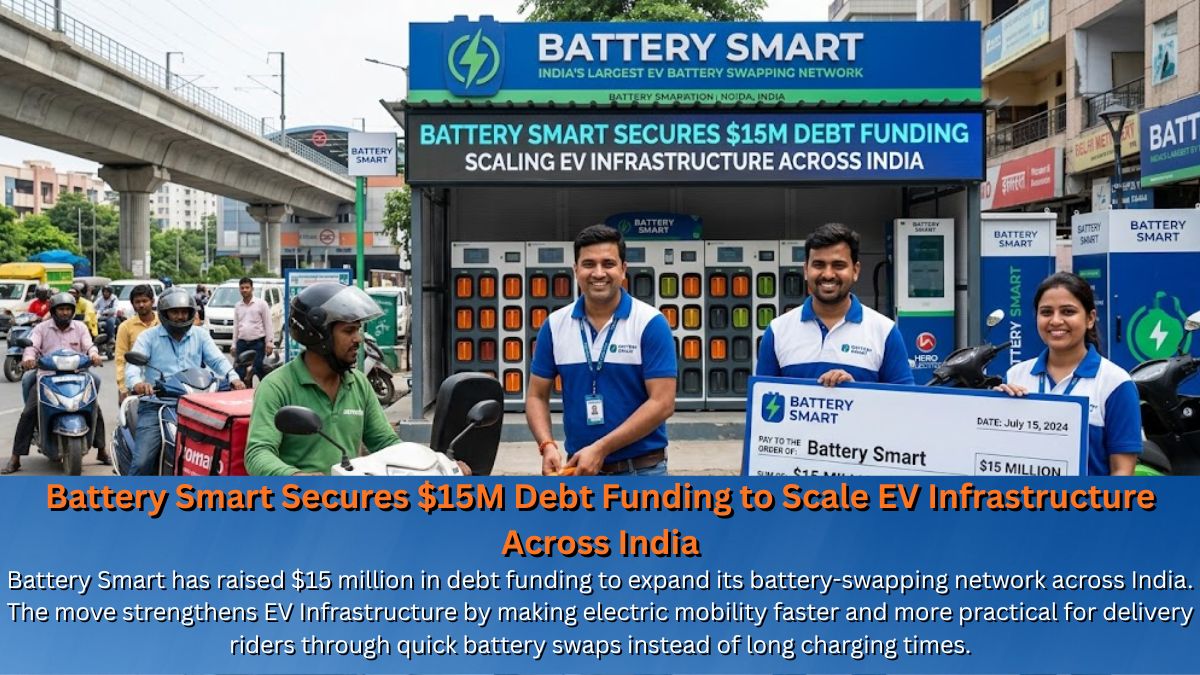
News Summary: Battery Smart’s New $15M Debt Push for EV Infrastructure Expansion
Battery Smart has raised $15 million in debt funding, and on paper it sounds like just another funding headline. But if you look a little closer at what’s happening on the ground, it’s actually part of a much bigger shift in EV Infrastructure that’s slowly changing how people move and earn in India. Electric vehicles are no longer a distant idea in cities like Delhi, Bengaluru, or even smaller towns where delivery riders weave through traffic all day. They’re already here. And for the people who depend on these vehicles every single hour, the biggest problem is not buying them. It’s keeping them running without wasting half the day waiting to charge.
That’s where Battery Smart has quietly built its space. Instead of plugging in and waiting, riders come in, swap out a drained battery, pick up a charged one, and get back on the road. It takes minutes, not hours. And for someone doing deliveries or running a small fleet, those minutes are the difference between a good day and a stressful one. This new funding is meant to push that system further. More swapping stations in more locations. Better coverage in busy city pockets as well as semi-urban areas where EV adoption is picking up but infrastructure still feels patchy. And behind all of it, a focus on making the network smoother so riders don’t feel any friction when they actually need it most.
India’s EV shift is no longer being talked about like a future plan
What’s interesting is the timing. India’s EV shift is no longer being talked about like a future plan. It’s already unfolding in real time, especially in logistics and last-mile delivery, where speed and cost matter every single day. Investors seem to be recognizing that too, and capital is flowing into companies that are solving very real, very practical problems instead of just promising big ideas. There’s also a larger story underneath this. Battery Smart isn’t just building stations. It’s part of a wider change in how energy, mobility, and everyday work are connecting. Cleaner transport is becoming less about policy discussions and more about whether a delivery rider can finish his shift without running out of power.
So while this is technically a $15 million funding round, it also reflects something simpler. A system trying to make electric mobility less complicated, more usable, and honestly, more human for the people who rely on it every day.
1. Introduction to Battery Smart and India’s EV Infrastructure Growth Story
India’s shift toward electric mobility doesn’t feel like a sudden revolution. It feels more like something slowly taking shape in the background of everyday life. You notice it in small things first. A delivery rider silently switching to an electric two-wheeler. A new swapping station appearing near a busy market. Rising fuel costs quietly changing what “affordable transport” even means anymore. In the middle of all this, Battery Smart has carved out a very practical role for itself. It is not trying to make electric vehicles exciting or futuristic. It is trying to make them usable. And in India, usability is everything.
1.1 The real problem the company is solving is painfully simple when you think about it
The real problem the company is solving is painfully simple when you think about it. Time. For someone riding all day to deliver food, groceries, or parcels, a vehicle sitting idle for hours is not just inconvenient. It directly means lost earnings. That is where Battery Smart steps in with something that feels almost obvious once you see it working: don’t wait for a battery to charge, just replace it. This is where the emotional weight of the model actually lies. It is not about technology alone. It is about keeping someone’s workday uninterrupted. A rider comes in tired, swaps a battery in minutes, and gets back on the road without losing momentum. That small moment quietly holds a lot of meaning if you think about how many livelihoods depend on it.
The fresh $15 million debt funding is, on the surface, a growth update. But underneath it, it reflects something bigger in EV Infrastructure. Confidence is building in companies that are solving real, physical problems in India’s EV ecosystem. Not abstract ideas. Not future promises. But systems that already work in the messy reality of Indian streets. Battery Smart’s expansion now is about reaching more cities, improving station coverage, and making sure the system doesn’t break when demand rises. And demand is rising fast, especially in delivery and logistics, where electric two and three-wheelers are becoming less of an experiment and more of a daily necessity.
2. Working Model of Battery Smart
2.1 Battery Swapping Network System
At the heart of Battery Smart’s model is something deceptively simple within EV Infrastructure. It separates the battery from the vehicle itself. That one decision changes everything about how electric vehicles are used in the real world. To understand why this matters, you have to imagine the daily life of a rider. Long hours on the road, constant movement between crowded streets, and pressure to complete deliveries on time. In that environment, a dead battery is not a technical issue. It is a disruption that ripples through income, schedules, and sometimes even family expectations tied to that income.
Battery swapping removes that pause. You don’t wait. You don’t plan your day around charging. Just replace and move. The experience feels almost relieving in a very practical sense. There is a quiet efficiency to it that riders quickly start depending on.
And the stations themselves are placed where life actually happens. Near delivery hubs, busy markets, and dense residential pockets. Not in isolated tech parks or distant industrial zones. That choice matters because it brings infrastructure into the flow of daily survival and work, not away from it. Over time, this creates a subtle but real shift. Electric vehicles stop feeling like a compromise and start feeling like a workable tool. Something you can actually depend on when your day depends on movement.
2.2 Technology-Driven Operations in EV Infrastructure
Behind the visible network of swapping stations, there is a quieter system running in the background. Software, data tracking, battery monitoring, and real-time coordination all work together to keep things from falling apart when usage scales up. This is where the system becomes less about hardware and more about rhythm. Batteries are constantly tracked, their health is monitored, their usage cycles are studied. Stations are adjusted based on demand patterns that change throughout the day. Nothing is static.
For a rider, this should ideally feel invisible. And when it works well, it does. You just arrive, swap, and leave. But behind that simplicity is a constant balancing act ensuring that no station runs dry, no battery is overused, and no region is left unsupported during peak hours.
There is also something interesting happening here. The system is learning from real human movement. Not theoretical models, but actual behavior. Where people travel, when they need power, how often they return. Over time, this builds a living map of mobility patterns across cities. And that is what connects Battery Smart to the broader EV ecosystem in India. It is not just infrastructure anymore. It is infrastructure that learns. Quietly adapting to how people actually live and work.
3. Revenue Model and Business Strategy
3.1 Subscription-Based Model
The subscription model sounds simple on paper, but in practice, it changes the relationship between rider and service. Instead of thinking about every swap as a separate cost, riders move into a more predictable structure. They pay a recurring amount and use the service as needed. That shift matters more than it seems. Because in a job where income is uncertain and daily pressure is high, predictability brings a kind of mental ease.
For many riders, this becomes part of their monthly routine, like rent or phone recharge. Not exciting, but essential. Something that quietly supports their ability to keep working without interruption. From the company’s side, this structure also creates stability. It allows planning, scaling, and investment with more confidence. But more importantly, it aligns the business with how the service is actually used. Not occasionally, but continuously, throughout long working days.
3.2 Pay-Per-Swap and Fleet Partnerships
Not every user fits into a subscription model, and Battery Smart seems to understand that. The pay-per-swap option keeps things flexible for those who use the service less frequently or operate on irregular schedules. But the more significant layer is the partnerships with fleet operators and logistics companies. This is where the system becomes part of something larger than individual riders. It becomes part of business operations.
For logistics companies, the impact is very direct. Less downtime means more deliveries. More predictability means better planning. And in a sector where margins are tight and timing matters, even small improvements in uptime translate into real value. Over time, this creates a deeper integration. Battery swapping stops being an external service and becomes part of how fleets actually function day to day. That kind of adoption is slow to build, but once it settles in, it tends to stick.
3.3 Expansion Strategy for EV Infrastructure
The $15 million debt funding now becomes the fuel for expansion, but expansion here is not just about opening more stations. It is about making the system feel less fragile. India is not a uniform market. Some cities are already deeply into EV adoption, while others are still transitioning. Battery Smart’s approach reflects that uneven reality. It builds stronger networks where demand is already visible, then gradually expands outward.
This kind of growth is less flashy but more stable. It focuses on reliability rather than speed. Because in infrastructure, especially something tied to daily work and income, failure in coverage is more damaging than slower expansion. What is really happening here is the slow construction of a backbone for electric mobility. Not something that feels futuristic, but something that quietly holds up everyday movement in cities.
And that is perhaps the most important part. Battery Smart is not just scaling a company. It is helping build the invisible system that allows electric mobility to actually function in real life, not just in policy documents or investor decks.
4. Problem Solved by Battery Smart
4.1 Eliminating Charging Time Bottlenecks
In theory, electric vehicles sound simple. You plug in, charge, and drive. But in real life, especially in India’s delivery-heavy cities, that “charging time” becomes a real interruption in someone’s entire working day. For a rider who depends on every hour of movement to earn money, waiting for a battery to charge is not just inconvenient, it is stressful. It creates uncertainty. You start planning your day around battery percentage instead of actual work. And that slowly drains efficiency without even being obvious at first.
Battery Smart removes that pause completely. You don’t wait. You don’t sit around calculating time. Just swap and leave. It feels almost like removing a small but constant frustration from the day. And once people experience that kind of speed, it changes their expectation of what an EV should feel like. What’s interesting is how quickly this becomes normal. Riders don’t talk about it as innovation. They talk about it as something that simply “makes work easier.” And in a space like mobility, that is often what really matters.
4.2 Reducing EV Ownership Costs
Cost is another part of the story that often gets overlooked in big discussions. Buying an electric vehicle is one thing. Owning the battery that powers it is another. And for many small operators, that upfront cost becomes a real barrier before they even start. Battery Smart changes that relationship quietly. Instead of forcing users to invest heavily in something uncertain, it shifts the model toward usage. You don’t own the battery. You just use it when you need it.
That shift sounds technical, but the emotional impact is actually quite simple. It removes pressure. People don’t feel like they are locking themselves into a big financial decision. They can start small, test it, and grow into it as their work demands increase.
This is why the model resonates more with working riders and small fleet operators. It feels flexible in a way traditional ownership never does. And in a country where income is often unpredictable, that flexibility is not just useful. It is reassuring. Over time, this also opens doors for people who would have never considered electric mobility in the first place. Not because they didn’t want to, but because the upfront risk felt too heavy.
4.3 Supporting Clean Energy Transition
There is also a bigger shift happening underneath all of this. It is not just about convenience or cost. It is about how cities are slowly changing the way they move. Every swapped battery means one less fuel-based trip. That alone may feel small, almost invisible in the moment. But when you zoom out and look at thousands of riders doing this every day, the impact starts to become real.
Battery Smart is not leading this change in a dramatic or loud way. It is just making it easier for people to choose electric mobility without overthinking it. And that ease is what drives adoption more than anything else. Clean energy transitions don’t usually happen through big moments. They happen through repeated daily decisions. A rider choosing a swap instead of fuel. A fleet operator choosing uptime over tradition. Slowly, those choices stack up and shift the system.
5. Industry Growth Trends in EV Infrastructure
The EV space in India doesn’t feel stable yet. It feels like it is still forming. Some days it looks like rapid acceleration. Other days it feels like it is catching its breath. But overall, the direction is clear. Fuel prices have made traditional transport harder to sustain. Cities are visibly struggling with pollution. And at the same time, electric mobility is becoming more practical than it was just a few years ago. Not perfect, but usable.
Battery swapping has quietly found its place in this transition. Especially for two and three-wheelers, where usage is intense and downtime directly affects income. In that segment, speed matters more than anything else, and swapping fits naturally into that need. What’s also changing is the kind of attention this sector is getting. Investors, funds, and ecosystem builders are no longer treating EV infrastructure as experimental. It is becoming a serious category. Not just for returns, but for long-term relevance.
Startup incubators, accelerator programs, and clean-tech networks are also paying more attention to this space. And that creates a cycle. More support brings more startups. More startups bring more experimentation. And slowly, the system becomes more mature. There is still uncertainty, but there is also momentum. And that combination is what makes this industry feel alive right now.
6. Competitor Landscape
6.1 Direct Competitors
Battery Smart operates in a space that is still taking shape, which means competition is real but not fully settled yet. Companies like Sun Mobility and other emerging battery swapping players are building similar systems across different parts of India. What stands out here is that the competition is not just about who has the best idea. It is about who can actually make the system work on the ground. That includes uptime, station reliability, battery availability, and how smooth the experience feels for riders.
In many ways, users don’t compare brands in a technical sense. They compare experience. If a station works when they need it, they stay. If it doesn’t, they move on. That makes execution far more important than positioning. As a result, this space is becoming less about marketing and more about infrastructure discipline. And that is a very different kind of competition.
6.2 Indirect Competitors
Then there are the indirect players, which are just as important in shaping the market. Traditional fuel-based transport still dominates a large part of daily mobility in India. It is familiar, widespread, and deeply embedded in how cities function. At the same time, EV charging networks offer an alternative approach, focusing more on long charging cycles rather than quick swaps. Both systems are trying to solve the same problem, but in very different ways.
Electric vehicle manufacturers also sit in this ecosystem, because their design decisions affect how infrastructure needs to evolve. A better battery, a more efficient vehicle, or a longer range can completely shift how these systems are used.
So the competition is not one-dimensional. It is layered. And it is constantly shifting as technology, policy, and user behavior evolve together. What makes this moment interesting is that nothing feels fully settled yet. The market is still deciding what “normal” mobility will look like in the next decade. And companies like Battery Smart are right in the middle of that uncertainty, trying to build something that holds up in real life, not just in theory.
7. Journey and Background of Battery Smart
Battery Smart didn’t begin as a big, polished idea with heavy backing or perfect clarity. It started from a very practical observation of something broken in India’s EV experience. Charging was slow, inconvenient, and completely out of sync with how people actually work on the road. In the early phase, the focus was not on scale or expansion. It was on simply making the system usable. That usually means going into dense, messy parts of cities where delivery riders actually spend their entire day. Markets, narrow lanes, traffic-heavy zones, places where time cannot be wasted.
From there, the network slowly began to grow. One station at a time. Not with hype, but with repetition. The kind of growth that doesn’t look dramatic from the outside, but feels very real to the people using it every day. As adoption increased, especially among delivery workers and small fleet operators, the model started proving itself in a very grounded way. If the system works in high-pressure environments where every minute matters, then it starts to gain trust naturally.
Over time, Battery Smart moved from being a simple solution provider to becoming part of the broader EV infrastructure layer in India. It didn’t happen overnight. It happened through repeated usage, feedback, failures, fixes, and quiet improvements that most people outside the system never see. Today, it stands as one of the key players in this evolving space, but its identity is still closely tied to that original problem: making electric mobility usable in real life, not just on paper.
8. Impact of $15M Debt Funding on EV Infrastructure Expansion
This $15 million funding is not just a financial event. It feels more like a turning point in how seriously the EV infrastructure space is being taken in India. For Battery Smart, this capital means something very practical. It means more stations in more places. It means stronger backend systems so users don’t face gaps or delays. And it means being able to expand faster into areas where EV adoption is just beginning to pick up.
But the deeper impact is bigger than one company. Funding like this signals that investors are starting to see EV infrastructure as long-term national infrastructure, not just a startup experiment. That shift in mindset is important because infrastructure doesn’t grow on optimism alone. It grows when capital is patient enough to support scale.
There is also a quiet validation here. Battery Smart’s model has been tested in real conditions, not just in presentations or forecasts. Riders are using it daily. Fleet operators are relying on it. That kind of real-world validation is what makes funding meaningful, not just the number attached to it. At a broader level, this also adds momentum to India’s transition toward cleaner mobility systems. EV adoption is no longer just about vehicles. It is about whether the supporting systems can actually hold up under pressure. And funding like this helps answer that question with more confidence.
9. Learning for Startups and Entrepreneurs
Battery Smart’s journey carries lessons that go far beyond the EV space. It is less about the product itself and more about how the company chose to solve a very specific kind of problem. The first lesson is simple but powerful. Real businesses are often built around problems that feel small but affect people every single day. Charging time might not sound dramatic on paper, but in real life, it controls income, stress, and productivity for thousands of workers.
The second lesson is about models. Battery Smart didn’t rely on one single revenue stream. It combined subscriptions with usage-based systems. That mix created balance. It allowed flexibility for users while keeping stability for the business. In many startup journeys, this kind of hybrid thinking becomes the difference between scaling smoothly and struggling with unpredictability.
Another important insight is around infrastructure. Building physical systems is slower, harder, and less glamorous than building software alone. But when done right, it creates something very durable. Something that doesn’t just scale quickly but actually holds up under real-world pressure. There is also a broader lesson about timing and alignment. Startups that grow in sectors aligned with national priorities tend to find stronger support over time. In this case, clean energy and electric mobility are not just trends. They are structural shifts. And businesses that align with that direction often find themselves in a better position for long-term growth.
In the end, Battery Smart’s story is not just about a company expanding. It is about what happens when someone takes a very specific, very real problem and keeps working on it until it becomes part of how an entire system functions.
About foundlanes.com
foundlanes.com is India’s leading startup idea discovery platform. It helps entrepreneurs find actionable startup opportunities, market insights, and industry-specific guidance to turn ideas into real businesses. With deep research and practical resources, foundlanes supports founders at every stage, from idea validation to launch and growth.