News Summary
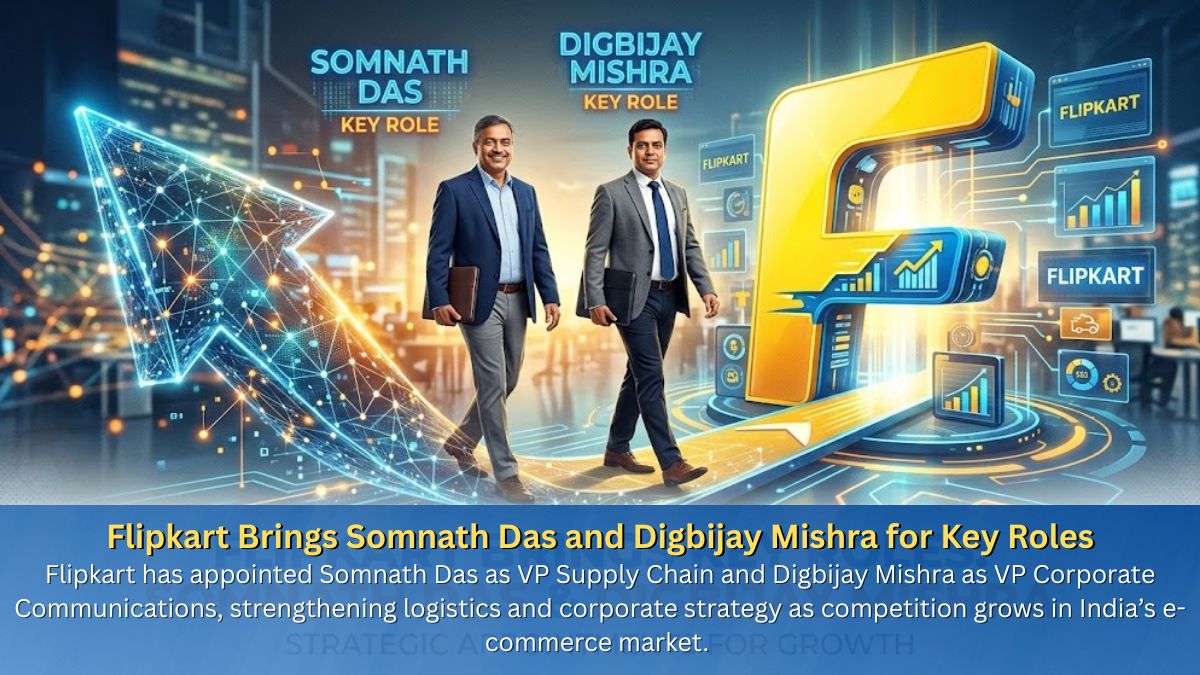
India’s leading e-commerce giant has strengthened its leadership bench. Flipkart brings Somnath Das as Vice President for Supply Chain and appoints senior journalist Digbijay Mishra as Vice President for Corporate Communications. The appointments signal the company’s push to deepen operational efficiency and strengthen strategic communication as competition grows in India’s fast-evolving digital commerce market.
Somnath Das will lead the company’s supply chain strategy. His role will focus on logistics efficiency, warehouse expansion, and delivery optimization across India. Supply chain operations are central to Flipkart’s business model. Faster delivery, strong seller logistics, and last-mile connectivity are critical for maintaining growth in India’s e-commerce industry. Therefore, the appointment reflects Flipkart’s intention to reinforce the backbone of its marketplace operations.
At the same time, Flipkart has hired Digbijay Mishra, former deputy bureau chief at The Economic Times and founding editor of ET Foundry. He will lead corporate communications and public affairs. His role includes managing media strategy, corporate storytelling, and stakeholder engagement for one of India’s largest tech companies. Strong communication leadership is vital for large technology companies navigating regulatory discussions, policy debates, and intense public scrutiny. The move arrives during a time of rapid growth in the Indian startup ecosystem and intense competition among major e-commerce platforms. Companies such as Flipkart are focusing heavily on leadership hiring, technology investments, and business strategies to maintain their market position.
These leadership changes also reflect a broader trend in startup news and tech news: fast-growing startups and unicorn companies are increasingly hiring experienced executives from media, logistics, and technology sectors. Such hires help companies strengthen their business models, growth strategies, and innovation capabilities. In short, Flipkart’s latest appointments underline the company’s ambition to improve logistics infrastructure while enhancing corporate communication capabilities. As India’s digital commerce sector expands, these leadership additions could shape the next phase of the company’s growth.
1. Introduction
1.1 Flipkart Brings Somnath Das as Leadership Expansion Strategy
The latest startup news highlights an important leadership move in India’s technology sector. Flipkart brings Somnath Das to lead supply chain operations while also appointing Digbijay Mishra as Vice President of Corporate Communications. These appointments come at a critical time. India’s startup ecosystem is experiencing rapid growth, intense competition, and strong venture capital interest.
Flipkart’s leadership team believes strong operations and clear communication will help maintain its position among the top startups and unicorn companies in India. Therefore, the move represents more than a simple hiring update. It reflects a broader business transformation strategy focused on operational excellence and brand leadership.
1.2 Why These Appointments Matter
The Indian e-commerce sector is entering a new phase of maturity. Companies are investing heavily in technology infrastructure, supply chains, and strategic communication. Consequently, hiring experienced leaders helps organizations adapt to rapid industry trends, tech disruptions, and regulatory developments.
By bringing in Somnath Das and Digbijay Mishra, Flipkart strengthens two critical pillars:
- Logistics and supply chain innovation
- Corporate reputation and media engagement
2. Flipkart’s Leadership Hiring Announcement
2.1 Flipkart Appoints Somnath Das as VP of Supply Chain
In a major hiring move, Flipkart brings Somnath Das to oversee its supply chain operations. Somnath Das will be responsible for managing the company’s complex logistics network. His work includes improving warehouse efficiency, delivery timelines, and seller logistics systems. India’s e-commerce market depends heavily on strong logistics capabilities. Therefore, this leadership role plays a crucial part in sustaining the platform’s growth. Moreover, the supply chain division supports millions of sellers across India. It ensures products reach customers quickly and efficiently. With this appointment, Flipkart hopes to strengthen its growth strategies and operational capabilities.
2.2 Digbijay Mishra Joins as VP Corporate Communications
Alongside the logistics leadership change, Flipkart has also hired Digbijay Mishra as Vice President for Corporate Communications. Mishra previously served as Deputy Bureau Chief at The Economic Times. He also helped launch and lead ET Foundry, a platform focused on startup stories and founder insights. His move from journalism to corporate leadership reflects a broader trend in global startups and venture-backed companies. Experienced media professionals are increasingly joining large tech companies to guide public relations, corporate messaging, and stakeholder communication. At Flipkart, Mishra will oversee corporate storytelling, media strategy, and public affairs.
3. Background of Flipkart
3.1 Founding Story of Flipkart
Flipkart is one of the most prominent Indian startups and among the earliest success stories in the country’s digital commerce revolution. The company was founded in 2007 by Sachin Bansal and Binny Bansal. Both founders previously worked at Amazon. They started Flipkart as an online bookstore. However, the company quickly expanded into electronics, fashion, home goods, and lifestyle products. Today, Flipkart stands among the largest e-commerce platforms in India.
3.2 Walmart Acquisition and Growth
In 2018, Walmart acquired a majority stake in Flipkart. The deal valued Flipkart at approximately $16 billion. It became one of the biggest acquisitions in the global startup ecosystem. Since then, Flipkart has expanded its marketplace services, logistics infrastructure, and technology investments. The company now competes aggressively with other international startups and tech giants.
4. Flipkart’s Business Model
4.1 Marketplace Platform
Flipkart operates a marketplace platform connecting sellers with buyers. The platform allows millions of merchants to sell products online. Therefore, it supports small businesses and emerging startups across India. The marketplace model also encourages innovation and new business ideas within the digital commerce ecosystem.
4.2 Logistics and Supply Chain Infrastructure
Supply chain operations play a central role in Flipkart’s business. The company manages large warehouse networks and delivery systems across India. Its logistics arm ensures fast delivery in both metro cities and rural markets. This infrastructure allows Flipkart to compete with global e-commerce platforms. Thus, the appointment where Flipkart brings Somnath Das directly supports this critical operational backbone.
4.3 Technology and Innovation
Technology is another core pillar. Flipkart invests in AI-driven recommendations, data analytics, and automation tools. These tech innovations help improve customer experience and operational efficiency. They also strengthen Flipkart’s position among fastest-growing startups and unicorn companies.
5. Revenue Model of Flipkart
Understanding how Flipkart earns money requires looking beyond simple product sales. The company operates a complex digital marketplace that blends technology, logistics, advertising, and seller services. Over the years, it has built multiple revenue streams that work together to sustain growth in India’s intensely competitive e-commerce environment.
5.1 Commission-Based Marketplace Revenue
The backbone of Flipkart’s business is its marketplace commission model. Instead of purchasing products and holding large amounts of inventory, the platform connects independent sellers with millions of buyers across India. When a seller lists a product and successfully sells it on Flipkart, the platform charges a commission. This fee varies depending on the product category, price range, and services used by the seller. On paper, this might sound simple. In reality, this model changed how retail works in India.
For thousands of small entrepreneurs, Flipkart became a gateway to a national customer base that was previously impossible to reach. A small electronics trader in Jaipur or a clothing manufacturer in Surat can now sell to customers in Bengaluru, Delhi, or Guwahati with just a few clicks. For Flipkart, the advantage is scale. Because it does not need to own the majority of inventory, the company can expand product categories quickly while keeping operational risks relatively lower compared to traditional retailers.
The result is a massive product ecosystem. Millions of listings across categories such as smartphones, fashion, electronics, home appliances, and everyday essentials generate continuous transaction activity. Each successful order contributes a small percentage to Flipkart’s revenue pool. Over time, these small commissions add up to billions in annual revenue.
5.2 Advertising Revenue
Another powerful revenue engine for Flipkart is digital advertising. As the platform grew, sellers quickly realized that simply listing a product was not enough. With thousands of similar items competing for attention, visibility became critical. That is where Flipkart’s advertising solutions entered the picture. Sellers can pay for sponsored product placements, banner ads, promotional campaigns, and search-result promotions within the platform. These tools allow brands to push their products to the top of search results or display them prominently during major shopping festivals.
For example, during high-traffic events like the The Big Billion Days, advertising demand spikes dramatically. Brands invest heavily in promotions because visibility during these sales can translate into massive revenue. This advertising model has quietly become one of the most profitable parts of the e-commerce business. Digital ads require relatively low operational costs compared to logistics or warehousing. Yet they deliver high-margin income for the platform. In many ways, Flipkart has evolved into more than just an online store. It has become a marketing platform where brands compete for digital shelf space.
5.3 Logistics and Service Charges
Behind every successful online order lies a complicated logistics operation. Packages must be stored, sorted, transported, and delivered across thousands of cities and towns. To manage this challenge, Flipkart built one of India’s largest e-commerce logistics networks through Ekart Logistics. Sellers who want faster and more reliable deliveries often use Flipkart’s fulfillment services. These services include warehousing, packaging, shipping, and last-mile delivery. For these operations, the platform charges logistics and service fees.
For sellers, these services remove operational headaches. Instead of managing warehouses and shipping partners independently, they can rely on Flipkart’s infrastructure. For customers, the benefits are equally visible. Faster deliveries, reliable tracking, and easy return processes have become standard expectations in Indian e-commerce. This is why strengthening supply chain leadership matters. The appointment of Somnath Das reflects the company’s effort to continuously improve logistics efficiency and scale. In a country as geographically diverse as India, logistics is not just an operational function. It is a competitive advantage.
6. The Problem Flipkart Solves
The success of Flipkart is closely tied to the real problems it addressed in India’s retail ecosystem. Before digital marketplaces emerged, both consumers and small businesses faced limitations that restricted growth.
6.1 Access to Online Commerce
For decades, Indian retail was dominated by physical stores. While local markets served communities well, they also limited the reach of small businesses. A seller in a small city typically depended on foot traffic or local distribution networks. Expanding beyond regional boundaries required expensive infrastructure and relationships with large distributors. Flipkart changed this equation dramatically. By creating a digital marketplace, the company allowed sellers from across India to reach customers nationwide. Suddenly, geography stopped being a barrier.
A handicraft maker in Rajasthan could sell to customers in Kerala. A fashion startup in Delhi could attract buyers in smaller towns that previously had limited product choices. This shift unlocked a wave of digital entrepreneurship. Many small brands that started as single-room operations eventually grew into nationwide businesses thanks to online marketplaces. Flipkart became a crucial bridge between producers and consumers in India’s emerging digital economy.
6.2 Consumer Convenience
For consumers, the transformation was equally powerful. Before e-commerce platforms existed, purchasing specialized products often required visiting multiple stores, comparing prices manually, and sometimes traveling long distances. Online retail simplified this entire process. On Flipkart, customers can search for thousands of products, compare prices instantly, read reviews, and receive home delivery without leaving their homes.
This convenience reshaped consumer expectations. Today, shoppers expect fast deliveries, easy returns, competitive prices, and transparent product information. Flipkart helped normalize these standards across India’s retail ecosystem. The platform also played a major role in encouraging digital payments and online trust. Early initiatives like cash-on-delivery helped millions of first-time users feel comfortable with online shopping. Over time, these habits accelerated the growth of India’s digital commerce landscape.
7. Industry Growth Trends
Flipkart’s evolution cannot be understood without looking at the broader transformation of India’s e-commerce industry. Several powerful trends continue to reshape this market.
7.1 Rapid Growth of Indian E-commerce
India’s online retail sector has expanded at an extraordinary pace over the past decade. Three major forces drove this growth. First, smartphone penetration exploded across urban and rural India. Affordable devices brought millions of new users online. Second, digital payments infrastructure improved dramatically with the rise of systems like National Payments Corporation of India and the adoption of Unified Payments Interface.
Third, venture capital investment poured into technology companies building digital marketplaces and logistics platforms. Together, these forces created the perfect environment for e-commerce platforms like Flipkart to scale rapidly. The result is a massive online retail market that continues to attract global attention and investment.
7.2 Rise of Logistics Innovation
As e-commerce orders multiplied, logistics quickly became one of the most critical aspects of the industry. Delivering millions of packages across a country as vast as India requires constant innovation. Companies are now investing heavily in automation, warehouse robotics, predictive demand systems, and route optimization technology. These tools help reduce delivery times while controlling operational costs. In practical terms, this means warehouses that can process thousands of orders per hour and delivery networks capable of reaching remote towns within days.
For platforms like Flipkart, logistics efficiency directly impacts customer satisfaction. If deliveries are slow or unreliable, users quickly shift to competing platforms. This explains why supply chain leadership roles are so important. Hiring experienced leaders like Somnath Das is part of a broader strategy to keep logistics systems competitive and scalable.
7.3 Increasing Corporate Communication Needs
As technology companies grow larger, they also face greater scrutiny. E-commerce platforms interact with regulators, policymakers, investors, media organizations, and millions of customers. Every decision, from pricing policies to seller relationships, can attract public attention. Managing communication across these stakeholders requires careful strategy.
This is why companies increasingly invest in strong corporate communications teams. Clear messaging helps build trust with customers, regulators, and the broader business ecosystem. The appointment of Digbijay Mishra reflects this reality. Experienced communication leaders help companies navigate complex public narratives while maintaining transparency. In today’s digital age, reputation management is almost as important as operational excellence.
8. Competitors in the Market
Despite its scale and influence, Flipkart operates in one of the most competitive industries in India. E-commerce platforms constantly compete for customer loyalty, seller partnerships, and technological innovation.
8.1 Direct Competitors
The most significant direct competitor is Amazon. Amazon has invested billions of dollars to expand its presence in India. The company offers a vast product catalog, advanced logistics infrastructure, and services like Amazon Prime that combine entertainment, faster delivery, and exclusive deals. This rivalry between Flipkart and Amazon has shaped the Indian e-commerce landscape. Both companies regularly compete on pricing, delivery speed, product selection, and major shopping events. For customers, this competition has been beneficial. It pushed platforms to improve service quality, expand product variety, and introduce innovative features.
8.2 Indirect Competitors
Competition also comes from outside traditional e-commerce platforms. Quick commerce services are redefining consumer expectations by delivering products within minutes. Brand-owned websites are attracting loyal customers who prefer direct purchases. Meanwhile, offline retail chains continue to maintain strong customer relationships in many cities. Some emerging startups are experimenting with niche marketplaces focused on categories like fashion, electronics refurbishment, or sustainable products.
This expanding competitive landscape forces companies like Flipkart to constantly innovate. Better logistics, smarter algorithms, stronger seller ecosystems, and improved customer experiences are no longer optional. They are essential for survival. And that is exactly why leadership decisions, infrastructure investments, and strategic hires continue to shape the future of India’s e-commerce industry.
9. Leadership Strategy and Corporate Culture
Inside any large technology company, leadership decisions quietly shape the future long before customers or the public notice the results. Hiring the right leaders is rarely just about filling positions. It is about preparing the organization for the next phase of growth. For a company like Flipkart, leadership appointments are deeply connected to how the business plans to evolve in an increasingly competitive digital economy.
9.1 Importance of Leadership Hiring
When startups are young, they often survive on energy, improvisation, and the relentless drive of founders. Small teams wear multiple hats. Decisions are quick, sometimes chaotic, but often driven by passion and urgency. However, as companies grow into large organizations, that early-stage chaos must gradually transform into structured leadership. This is where experienced executives become critical.
A seasoned leader brings something that cannot easily be taught inside the company: perspective. They have seen operational crises, supply chain disruptions, market downturns, and scaling challenges before. That experience becomes incredibly valuable when a company begins handling millions of customers and complex operations. Take supply chains as an example. In the early days of e-commerce, delivering a few thousand packages a day was already a big achievement. Today, platforms process millions of orders during peak sales events. Managing that scale requires deep operational discipline, logistics intelligence, and predictive planning.
This is why the appointment of Somnath Das carries strategic importance. Supply chains are no longer just backend operations. They determine how quickly products reach customers, how efficiently warehouses function, and how reliably sellers can run their businesses on the platform. A strong logistics leader can improve delivery speed, reduce operational costs, and strengthen relationships with sellers. These improvements may not always make headlines, but they directly influence customer satisfaction and long-term profitability. Leadership hiring, therefore, is not simply about titles. It is about preparing the company to operate at the scale its ambitions demand.
9.2 Communication Leadership in Tech Companies
While operations keep a company running, communication shapes how the world understands that company. Technology firms today operate under intense public scrutiny. Their decisions affect millions of users, thousands of sellers, and entire digital ecosystems. Governments monitor policy compliance. Investors track growth signals. Media organizations analyze every strategic move. In such an environment, corporate communication becomes far more than public relations.
It becomes the voice of the company. A strong communications leader helps translate complex business strategies into clear narratives that employees, partners, regulators, and customers can understand. They also guide the company through moments of crisis, misinformation, or public debate. This is where the entry of Digbijay Mishra becomes significant. Coming from a journalism background, Mishra brings a deep understanding of how stories are reported, how narratives shape public perception, and how transparency can build long-term credibility.
Journalists often develop a unique instinct for identifying what truly matters in a story. When such experience enters a corporate environment, it can help organizations communicate with greater authenticity. For a company as influential as Flipkart, that authenticity matters. Trust is one of the most valuable currencies in digital commerce. Customers trust the platform to deliver products reliably. Sellers trust it to provide fair access to buyers. Regulators trust it to operate responsibly within India’s digital economy. Clear and honest communication helps strengthen that trust.
10. Learning for Startups and Entrepreneurs
Leadership changes inside large companies often contain valuable lessons for young startups and aspiring entrepreneurs. Behind every such decision lies a deeper insight about building sustainable organizations. The leadership appointments at Flipkart highlight several lessons that founders can apply to their own ventures.
10.1 Operational Strength Always Matters
Many startup founders are passionate about product ideas, innovation, and rapid growth. But as businesses scale, operational efficiency becomes the foundation of everything else. Customers may be attracted by exciting products, but they stay because the experience is reliable. That reliability often depends on systems that customers never see. Warehouses that function smoothly. Delivery networks that rarely fail. Customer service teams that resolve issues quickly. Investing in operational leadership early can help startups avoid painful scaling problems later.
10.2 Communication Is a Strategic Asset
Another lesson is the importance of communication. In the early days of a startup, communication might feel informal. Founders speak directly with customers, investors, and employees. But as companies grow, misunderstandings can easily spread. Public perception can shift quickly. Rumors or incomplete information can damage trust. A thoughtful communication strategy helps companies maintain clarity and credibility even during challenging moments. The hiring of experienced communication leaders reflects the growing recognition that storytelling and transparency play critical roles in business success.
10.3 Diverse Leadership Strengthens Decision-Making
Great companies rarely rely on a single perspective. Diverse leadership teams bring different experiences, professional backgrounds, and ways of thinking. This diversity improves decision-making because leaders challenge each other’s assumptions and explore multiple viewpoints. For example, operational experts focus on efficiency and systems. Communication leaders focus on narratives and relationships. Product teams focus on innovation and customer experience. When these perspectives work together, companies become stronger and more adaptable.
10.4 Growth Requires Experienced Talent
Perhaps the most important lesson is that startups eventually outgrow their founding structure. What works for a 10-person startup rarely works for a company serving millions of customers. At that stage, bringing in experienced professionals becomes essential. These leaders help formalize processes, manage large teams, and guide the company through increasingly complex business environments.
The decision by Flipkart to strengthen its leadership team, including the appointment of Somnath Das, reflects exactly this stage of evolution. It signals that the company is not just thinking about immediate growth but about building systems and leadership structures that can support the next decade of digital commerce in India. And for entrepreneurs watching closely, that is perhaps the most powerful takeaway. Building a startup is about vision. Scaling it into a lasting enterprise is about leadership.
About foundlanes.com
foundlanes.com is India’s leading startup idea discovery platform. It helps entrepreneurs find actionable startup opportunities, market insights, and industry-specific guidance to turn ideas into real businesses. With deep research and practical resources, foundlanes supports founders at every stage, from idea validation to launch and growth.