Introduction
Starting a handmade jewelry business online is no longer just a creative hobby turned side hustle. It has become a serious, scalable business opportunity driven by rising demand for unique, personalized, and affordable accessories. Across India and globally, customers are shifting away from mass-produced products and looking for handcrafted designs that reflect individuality and authenticity. This shift has opened the door for creators, designers, and even beginners to build a profitable brand with relatively low investment.
The idea is simple. Create jewelry at home, build an online presence, and sell directly to customers through digital platforms. The appeal lies in flexibility, low startup costs, and high creative control. Anyone from students and homemakers to aspiring entrepreneurs can enter this space. With access to platforms like marketplaces, social media, and personal websites, the barriers to entry are lower than ever. The timing is also ideal. The growth of e-commerce, influencer-driven shopping, and platforms like Instagram and Etsy has made it easier to reach niche audiences. Consumers are increasingly valuing craftsmanship, sustainability, and storytelling behind products. Handmade jewelry fits perfectly into this trend.
From a financial perspective, starting this business can cost anywhere between ₹10,000 to ₹1 lakh depending on scale. The process involves sourcing materials, creating designs, building a brand, setting up an online store, and marketing products effectively. With the right strategy, this can evolve into a profitable handmade jewelry business online that generates consistent income and long-term brand value.
1. Startup Idea Overview: Handmade Jewelry Business Online
The core idea behind a handmade jewelry business online is to create and sell custom-designed jewelry pieces directly to customers through digital channels. This includes earrings, necklaces, bracelets, rings, and even personalized accessories made using beads, metals, clay, resin, or fabric. The problem it solves is rooted in the growing dissatisfaction with mass-produced accessories. Most retail jewelry lacks uniqueness and emotional value. Handmade jewelry fills that gap by offering individuality, storytelling, and craftsmanship.
This business model allows creators to work from home, control production, and build a direct relationship with customers. With digital platforms acting as storefronts, there is no need for physical retail space in the early stages.
2. Problem Statement & Solution
2.1 What is Broken in the Market
If you walk into most jewelry stores today, you’ll notice something almost immediately. Everything looks polished, expensive, and… strangely similar. The designs may vary slightly, but the feeling doesn’t. It’s mass-produced beauty. Clean, predictable, and safe. For a long time, that worked. People trusted big brands. They bought what was available. But slowly, something started changing. Customers began looking for meaning, not just design.
Especially younger buyers. They didn’t just want something that “looks good.” They wanted something that feels theirs. Something that reflects their personality, their mood, even their story. And that’s where the traditional market starts to fall short. Large brands operate on scale. They produce in bulk. They follow trends that appeal to the majority. Personalization doesn’t fit easily into that model. It slows things down. It increases costs. So it’s often limited or priced at a premium. For someone looking for something truly unique, the options feel limited.
Then there’s pricing. When you buy from a big brand, you’re not just paying for the product. You’re paying for the store, the staff, the marketing, the brand name. All of that adds up. For many buyers, especially students or young professionals, it creates a gap. They want something stylish and meaningful, but they don’t want to overspend for it. So they either compromise on uniqueness or stretch their budget. Neither feels satisfying. This is the space where the real problem exists. Not just in product, but in experience.
2.2 The Practical Solution
This is exactly where an online handmade jewelry business changes the equation. It brings the focus back to the product, and more importantly, to the person wearing it. When jewelry is handmade, it carries a different kind of value. It’s not just about how it looks. It’s about how it was made, who made it, and why it exists. Customization becomes natural here, not an add-on.
A customer can ask for a specific color, a certain design element, or even a piece that represents something personal. And because the production is small-scale, these requests can actually be fulfilled. That creates a connection. The product is no longer just an accessory. It becomes something personal. Then comes pricing. By selling directly to customers through platforms like Instagram or a simple website, creators remove multiple layers of cost. There’s no physical store, no middlemen, no large distribution network.
This allows them to price products more reasonably while still maintaining healthy margins. It’s a win on both sides. The customer gets something unique without overpaying. The creator builds a business with better control and flexibility. But the biggest shift is in storytelling. Handmade businesses don’t just sell products. They share the process, the effort, the small details that go into each piece. Whether it’s a behind-the-scenes video or a story about inspiration, it adds depth to the brand. And people connect with that. Because at the end of the day, customers don’t just buy jewelry. They buy the feeling attached to it.
3. Target Audience & Customer Persona
When you start looking closely at who actually buys handmade jewelry, a clear pattern begins to emerge. The core audience is young, expressive, and deeply influenced by what they see online. Typically, they fall in the 18–35 age group. College students experimenting with their style. Young professionals building their identity. Creators and social media users who want to stand out, even in small ways. For them, accessories are not just add-ons. They are expressions. They care about how something looks, but also about what it says about them. This generation has grown up with platforms like Instagram and Pinterest, where aesthetics play a huge role. They are constantly exposed to new styles, trends, and ideas. But interestingly, they don’t just follow trends blindly.
They remix them. They look for pieces that feel slightly different. Slightly more personal. Something that doesn’t look like what everyone else is wearing. That’s where handmade jewelry fits perfectly. There’s also a strong emotional angle. A growing number of buyers are purchasing jewelry as gifts. And when it comes to gifting, meaning matters more than price.
A handmade piece feels thoughtful. It feels intentional. It tells the person receiving it that time and effort went into choosing it. That emotional value often matters more than brand value. Understanding this mindset is crucial. Because when you’re building a handmade jewelry business, you’re not just selling to “customers.” You’re speaking to individuals who care about identity, expression, and connection. And when you get that right, marketing starts to feel less like selling and more like storytelling.
4. Market Opportunity & Timing
Timing plays a bigger role in business than most people realize. You can have a good idea, but if the market isn’t ready, it struggles. And sometimes, an idea works simply because the environment around it has changed. Right now, the environment is in favor of handmade businesses. Globally, there has been a steady shift toward artisanal and handcrafted products. People are moving away from purely mass-produced items and looking for things that feel more human. In India, this shift has accelerated even faster in recent years.
The pandemic changed buying behavior. People became more comfortable shopping online. Small businesses gained visibility. And platforms that once felt optional became essential. Search behavior reflects this change clearly. More people are searching for terms like “handmade jewelry ideas,” “selling handmade jewelry online,” and “jewelry making at home.” This isn’t just curiosity. It’s intent. Some are looking to buy. Others are looking to start.
At the same time, platforms like Instagram have made it easier than ever to build a business without heavy investment. You don’t need a physical store. You don’t need a large team. can start small, test ideas, and grow based on what works. The rise of direct-to-consumer brands has also changed customer perception. People are more open to buying from independent sellers. In many cases, they prefer it. It feels more authentic.
All of this creates a rare combination. Low entry barriers. High demand. Growing acceptance. Which is why this moment feels right. For someone looking to start a handmade jewelry business online, the opportunity is not just theoretical. It’s already happening. And those who move early, learn quickly, and stay consistent have a real chance to build something meaningful.
5. USP & Value Proposition
When someone chooses handmade jewelry over something mass-produced, they’re not just making a style choice. They’re making an emotional one. That’s where the real strength of a handmade brand lies. It’s not in competing with big brands on scale or price. It’s in offering something they simply cannot replicate, authenticity. Every handmade piece carries small imperfections, subtle variations, and a human touch that machines can’t recreate. And interestingly, those imperfections are exactly what make it feel real.
Customers don’t just see a product. They see effort. They imagine the time spent designing it, the care taken to assemble it, the intention behind every detail. That story becomes part of the purchase. And once that connection is built, everything changes. The relationship shifts from transactional to personal. Customization strengthens this even further.
When a customer can request a specific color, add a personal element, or co-create a design, they feel involved in the process. It’s no longer just something they bought. It’s something they helped shape. That sense of ownership builds a deeper attachment. Direct interaction also plays a big role here.
Unlike large brands where communication feels distant, handmade businesses often connect directly with their customers through platforms like Instagram. A simple conversation, a quick response, or even a thank-you message can leave a lasting impression. Over time, these small interactions build trust. And trust is what turns a one-time buyer into someone who keeps coming back.
6. Business Model & Pricing Strategy
At its core, a handmade jewelry business is beautifully simple. You create something with your hands and sell it directly to the person who values it. Most creators follow a direct-to-consumer model. There are no middle layers, no distributors, no retail markups. Just the creator and the customer. This gives you control. Control over pricing, over branding, over how your story is told. You decide how your product is presented and how your customer experiences it. Sales can happen through personal websites, marketplaces, or social platforms. Each channel has its own advantages, but the underlying idea remains the same, keep the connection direct.
Revenue doesn’t just come from standard product sales. Custom orders often become a significant part of income. These are usually higher in value because they are tailored to individual preferences. Then there are workshops or DIY kits, which allow creators to monetize their knowledge, not just their products. This adds another layer to the business. You’re not just selling jewelry. You’re sharing a skill.
6.1 Pricing Handmade Jewelry
Pricing is where many creators struggle, especially in the beginning. There’s a natural hesitation to charge what the product is truly worth. Many feel that lower prices will attract more customers. But in reality, underpricing often creates more problems than it solves. It affects sustainability. A simple pricing structure usually starts with the basics. Material cost, the time you invest, packaging, and then your margin. But beyond numbers, there’s perception.
If a product is priced too low, it can unintentionally signal lower value. Customers may appreciate affordability, but they also associate price with quality and effort. Margins in handmade businesses can vary widely, often between 30% to 70%. The exact number depends on how you position your brand. If you focus on affordability, your margins may be tighter. If you position yourself as premium, margins can be higher, but expectations also increase. The key is balance. You need to cover your costs, value your time, and still remain attractive to your target audience. And that clarity usually comes with experience. Most creators refine their pricing after a few sales, a few mistakes, and a better understanding of what customers are willing to pay.
7. Execution Plan & Launch Strategy
Starting a handmade jewelry business is not about having everything figured out from day one. It’s about starting small, learning fast, and improving consistently. The biggest progress often comes from simply beginning.
7.1 Step-by-Step Jewelry Business Guide
The journey usually starts with learning. Understanding basic jewelry making at home, getting familiar with tools, experimenting with materials, making mistakes, and slowly getting better. This phase is quiet, often unnoticed, but it builds the foundation. Once there’s some confidence, the next step is creating a small collection. Not hundreds of products. Just 10 to 20 pieces that feel consistent in style and quality. This helps define your identity early on. It gives your brand a clear direction instead of looking scattered.
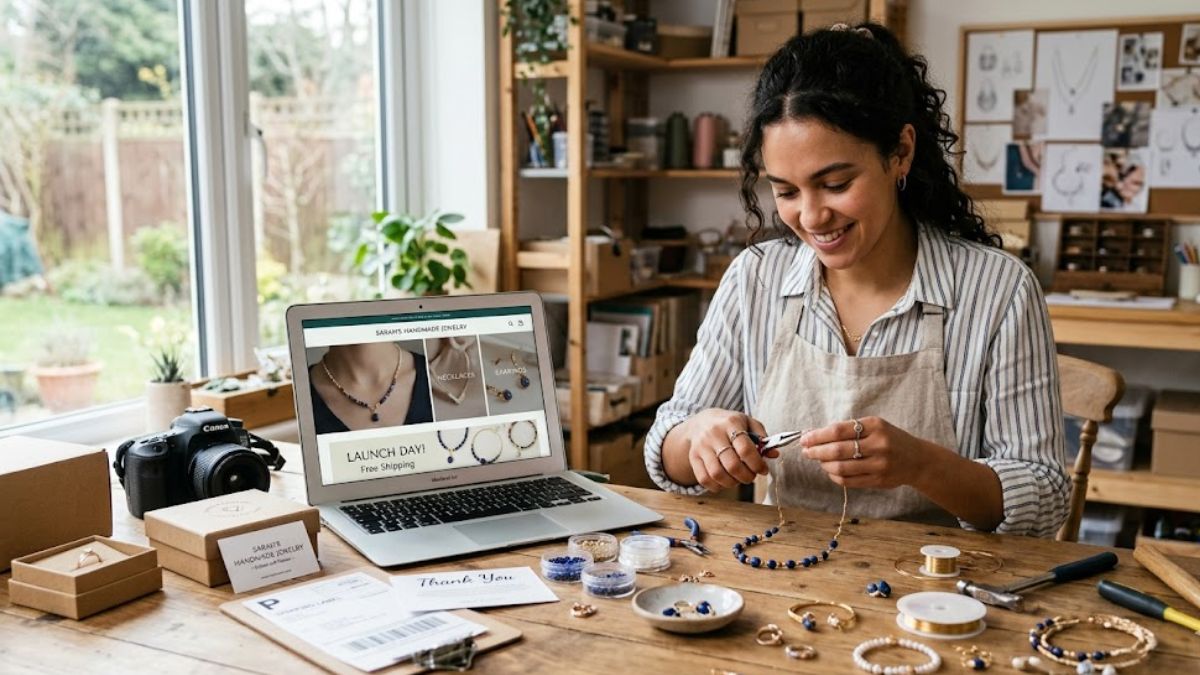
Presentation becomes critical at this stage. Since most sales happen online, visuals do the talking. High-quality photos, good lighting, and clean backgrounds can make a huge difference. A well-shot product instantly feels more premium, even if it’s simple. Platforms like Instagram become your storefront. Every post, every story, every interaction contributes to how your brand is perceived. The first launch doesn’t have to be big. In fact, it’s better if it’s small. Sharing your products with friends, early supporters, or a small audience helps you gather honest feedback. You learn what people like, what they don’t, and what needs improvement. That feedback is gold. It helps you refine your designs, improve your process, and prepare for a larger audience. Growth comes after this stage, not before.
8. Budget, Resources & Infrastructure
One of the most reassuring aspects of starting a handmade jewelry business is how little you need to begin. You don’t need a studio. You don’t need expensive machinery. don’t even need a large team. Most businesses start from a small corner of a room. Initial costs usually go into raw materials, basic tools, and packaging. Then there’s a simple photography setup, sometimes just a phone camera with good lighting.
If you choose to sell through a website, there may be small expenses for domain and hosting. Marketplaces may charge listing or transaction fees. But overall, the investment is manageable. In many cases, founders start with budgets as low as ₹10,000. What matters more than money in this phase is resourcefulness. Using what you already have. Learning skills instead of outsourcing immediately. Experimenting before scaling. As the business grows, investments naturally increase. Better packaging, improved branding, paid marketing, larger inventory. But these decisions are usually backed by revenue, not assumptions. That’s what makes this model sustainable. You’re not risking everything upfront. You’re building step by step, guided by real demand and real feedback. And that journey, though slow at times, often feels far more rewarding because every bit of growth is earned.
9. Brand Strategy
In the handmade jewelry space, your product might bring someone in, but your brand is what makes them stay. Because at some point, designs can look similar. Materials can overlap. Trends can repeat. What truly sets one brand apart from another is the feeling it creates. Branding is not just about looking good. It’s about being remembered.
9.1 Jewelry Branding Tips
It starts with the name. A good brand name doesn’t feel random. It carries a sense of identity. Something that reflects creativity, personality, or the emotion behind your designs. Generic names might feel safe, but they are easy to forget. And in a crowded space, forgettable is risky. Then comes the visual identity. A logo doesn’t need to be complex. In fact, the simpler it is, the more powerful it can be. But it should feel intentional. The colors you choose, the fonts you use, the overall aesthetic, everything should speak to the kind of audience you want to attract.
If your designs are minimal, your branding should feel clean. If your jewelry is bold and expressive, your visuals should reflect that energy. Consistency is where most brands either grow or get lost. When someone visits your page on Instagram or sees your packaging, it should all feel connected. The tone of your captions, the way you present your products, even how you respond to messages, all of it builds your brand voice. And that voice matters more than people realize. Are you elegant and refine playful and quirky? Are you calm and minimal?
Whatever you choose, it needs to stay consistent. Because consistency builds familiarity, and familiarity builds trust. Positioning is the final piece. You can’t be everything for everyone. Trying to appeal to both premium buyers and budget shoppers often creates confusion. It’s better to choose clearly. When your positioning is clear, your pricing, your messaging, and even your designs start aligning naturally. And that clarity makes it easier for customers to understand exactly why they should choose you.
10. Vendor & Partner Strategy
Behind every handmade jewelry brand that delivers consistently, there is a quiet system that keeps everything running smoothly. And that system often starts with the right suppliers. Materials are the foundation of your product. If the quality is inconsistent, everything else suffers. The finish, the durability, the customer experience, all of it is affected. Finding reliable vendors takes time. Sometimes it starts with local markets, where you can physically see and feel the materials. Other times, it involves exploring online suppliers who offer more variety. In the beginning, it can feel like trial and error. But over time, patterns emerge.
You start identifying which vendors deliver on time, which ones maintain quality, and which ones are worth building relationships with. And relationships matter more than price alone. A trusted supplier who understands your requirements can save you from delays, last-minute issues, and inconsistent batches. They become a silent partner in your business. As your volume grows, these relationships often lead to better pricing and priority access. That stability becomes crucial when orders increase and expectations rise. Because at that stage, it’s not just about creating jewelry. It’s about delivering consistently.
11. Go-to-Market & Customer Acquisition Channels
No matter how beautiful your products are, they won’t sell if people don’t see them. Visibility is everything. And in the handmade jewelry space, visual platforms have changed the game completely. Platforms like Instagram and Pinterest are not just marketing channels. They are discovery engines. People scroll through them looking for inspiration, and that’s exactly where your product fits in. A well-shot image can stop someone mid-scroll. A simple video showing how a piece is made can create curiosity. A behind-the-scenes glimpse can build connection. This is where storytelling becomes your biggest advantage. Instead of just showing the final product, you show the process. The effort. The little details. And slowly, people start paying attention.
Influencer collaborations can accelerate this. When the right person wears your product and shares it with their audience, it creates instant visibility. But the key is alignment. The influencer’s style and audience should match your brand. Otherwise, the impact fades quickly. Marketplaces also play a role. Platforms like Etsy and Amazon Handmade can help bring in customers who are already searching for handmade products. They reduce the effort needed to attract traffic, especially in the early stages. But relying only on marketplaces can be limiting. That’s why many founders also focus on building their own presence, whether through a website or social media. Content and SEO add another layer. Writing blogs, sharing styling tips, or educating customers about materials can bring organic traffic over time. It’s slower, but it builds authority. And authority leads to trust.
12. Growth & Retention Strategy
Getting your first few customers feels exciting. But real growth comes from what happens after that. A one-time sale is good. A repeat customer is far more valuable. Retention is often overlooked in the beginning, but it becomes one of the strongest drivers of long-term success. Introducing new collections regularly helps keep the brand fresh. Customers who have already bought from you are more likely to come back if they see something new that fits their style. It gives them a reason to stay connected. Small gestures also make a big difference. Thoughtful packaging, a handwritten note, a quick follow-up message, these are simple things, but they create memorable experiences.
And people remember how you made them feel. Loyalty programs or repeat customer discounts can also encourage return purchases. But beyond incentives, it’s the relationship that matters. When customers feel valued, they come back without being pushed. From a business perspective, this also makes sense. Acquiring a new customer often costs more than retaining an existing one. So focusing on experience is not just emotional, it’s practical. Growth, in this space, is not just about reaching more people. It’s about building something that people don’t want to leave.
13. Team Structure & Responsibilities
In the early days, a handmade jewelry business is deeply personal. The founder does almost everything. Designing pieces, sourcing materials, creating content, handling orders, responding to customers, every part of the business runs through one person. It can feel overwhelming at times. But it also creates a strong foundation. Because when you handle every part yourself, you understand the business in a way that no system or report can teach you. You know what takes time, what customers care about, and where things can go wrong.
As the business grows, this model becomes difficult to sustain. That’s when delegation starts. Not all at once, but gradually. Photography might be outsourced to improve visual quality. Social media management might be handed over to someone who understands content better. Logistics and packaging might be streamlined with external support. Each step creates more space. Space to think, to plan, to focus on growth instead of just execution. But even as the team grows, the founder’s role remains central. Because in a handmade business, the vision, the creativity, and the story still come from that one person who started it all. And keeping that essence alive, even as things scale, is what separates a brand from just another business.
14. Risks, Challenges & Mitigation
No matter how exciting the idea feels in the beginning, every business eventually reaches a phase where reality sets in. For a handmade jewelry business, that reality often shows up quietly. Some days, orders come in steadily. Other days, everything feels still. That inconsistency in sales is one of the first challenges most founders experience. It can be frustrating, especially when you’re putting in the same effort but not seeing the same results. This is where patience becomes part of the process.
Demand in this space is often influenced by seasons, trends, and visibility. There will be highs and lows. The key is to not treat slow phases as failure, but as signals. Signals to improve visibility, refine products, or strengthen customer relationships. Then comes competition. It’s easy to feel overwhelmed when you see dozens of similar brands online. At first, it might feel like the space is already crowded. But over time, you realize something important. No two brands are truly the same. Your style, your story, your way of communicating, these are things that can’t be copied easily. The goal is not to compete on everything. It’s to stand out in something.
14.1 Quality control becomes another real challenge as the business grows
Quality control becomes another real challenge as the business grows. In the early stages, when you’re making every piece yourself, maintaining quality feels natural. But as orders increase, speed becomes a factor. And that’s when small inconsistencies start appearing. A slightly loose clasp. A minor variation in finish. Small things, but noticeable. This is where systems become important. Standardizing your process, setting clear quality checks, and being consistent with materials can help maintain the same level of output even as volume increases. Learning never really stops in this journey. Every mistake, every delayed order, every unhappy customer, these moments feel uncomfortable, but they also teach you what needs to change. And over time, those lessons become the backbone of a stronger, more resilient business.
15. Legal, Compliance & Fundamentals
In the beginning, most handmade businesses start informally. A few products, a few orders, payments through simple methods. It feels manageable, almost effortless. But as the business grows, structure becomes necessary. Registering your business is not just a formality. It’s a step toward stability. It allows you to operate with clarity, build trust with customers, and prepare for scaling. Many founders begin with a sole proprietorship because it’s simple to set up and manage. Others explore MSME registration to access additional benefits and recognition.
At some point, taxation also becomes part of the journey. If your revenue crosses a certain threshold, GST registration becomes important. It might feel complex at first, but it brings transparency and opens doors to working with larger platforms and partners. Beyond registrations, there are smaller but equally important details. Return policies. Refund guidelines. Shipping timelines. These might seem like backend elements, but they directly impact customer experience. When expectations are clear, misunderstandings reduce. And when customers feel informed, trust increases. Legal structure is not about making things complicated. It’s about creating a foundation that supports growth without chaos.
16. Long-Term Vision & Goals
What starts as a small handmade jewelry business often carries the potential to become something much bigger. But that transition doesn’t happen overnight. It begins with a shift in perspective. From just making products to building a brand. In the early stages, survival and consistency are the focus. Getting orders, delivering on time, improving quality. But once that foundation is stable, the horizon starts expanding. A dedicated website often becomes the next step.
It gives you full control over how your brand is presented. It creates a space that is entirely yours, not dependent on any platform. Then comes expansion. New product categories. Different styles. Maybe even collaborations. Each addition allows the brand to grow without losing its core identity. Offline presence is another milestone many founders aim for. Pop-ups, exhibitions, or small retail placements bring the brand into the physical world. It allows customers to see, touch, and experience the products in a different way. And then there’s the global opportunity.
Handmade products carry a universal appeal. What feels local to you can feel unique to someone across the world. With the right platforms and logistics, exporting becomes a real possibility. But beyond all these milestones, the long-term vision is often more personal. It’s about building something that lasts. Something that reflects your creativity, your effort, and your journey. A brand that people recognize not just for its products, but for the story behind it. And if that vision is nurtured with patience and consistency, what starts small can quietly grow into something truly meaningful.
17. Future Outlook
The future of the handmade jewelry business online looks promising. With increasing demand for personalized and sustainable products, this segment is expected to grow further. Entrepreneurs who focus on branding, quality, and customer experience will have a competitive advantage. As digital platforms continue to evolve, the best way to sell handmade jewelry online will also become more sophisticated. From AI-driven recommendations to influencer commerce, new opportunities will keep emerging. For anyone looking to launch handmade jewelry brand online, the key lies in starting small, staying consistent, and adapting to market trends.
About foundlanes.com
foundlanes.com is India’s emerging platform dedicated to startup ideas, founder journeys, and deep-dive business insights. The platform aims to simplify entrepreneurship by publishing practical startup ideas, case studies, and execution frameworks that help aspiring founders transform concepts into real businesses. foundlanes focuses on actionable content designed for students, professionals, and early-stage entrepreneurs who want to explore new opportunities in India’s rapidly evolving startup ecosystem. Through detailed analysis of emerging industries and innovative business models, foundlanes seeks to empower the next generation of founders with knowledge, strategy, and inspiration.