
Summary
To start a travel and tourism business in India today is to enter one of the country’s most dynamic and rapidly evolving sectors. At its core, the business revolves around designing, organizing, and selling travel experiences. This could range from booking flights and hotels to creating customized itineraries, group tours, and niche travel packages. The industry exists to solve a simple but persistent problem: people want to travel, but planning, coordination, and execution often feel overwhelming.
The “why” is driven by rising disposable incomes, increasing digital adoption, and a strong cultural shift toward experiences over possessions. Travel is no longer a luxury for a few. It has become a lifestyle choice for millions of Indians. The “who” includes aspiring entrepreneurs, travel enthusiasts, and professionals looking to build a scalable service business with relatively low entry barriers.
The “where” is both online and offline. While traditional travel agencies still operate, the real growth is happening in digital-first platforms and home-based setups. The “when” could not be better. Post-pandemic recovery has led to a surge in domestic tourism, while international travel demand is steadily rebounding. The “how” involves identifying a niche, setting up partnerships with hotels and transport providers, creating travel packages, and building a strong online presence. The cost can vary widely. A home-based setup can begin with ₹20,000 to ₹1 lakh, while a full-scale agency may require significantly higher investment. In essence, to start a travel agency today is to combine operational efficiency with storytelling, turning destinations into curated experiences that customers are willing to pay for.
1. Startup Idea Overview: Building a Travel and Tourism Venture
The idea to start a travel and tourism business is rooted in connecting people with experiences. Unlike product-based ventures, this business revolves around services, coordination, and trust. Travelers today seek convenience. They want someone to handle bookings, suggest destinations, and manage logistics. This is where a travel business steps in as a service provider and curator. The model can vary. Some entrepreneurs start a travel agency from home, focusing on niche markets like honeymoon packages or adventure travel. Others build larger tour companies offering end-to-end services. The rise of digital platforms has made it easier to start a travel business without heavy infrastructure. A laptop, internet connection, and strong vendor network are often enough to begin.
2. Problem Statement & Solution
2.1 What’s actually broken in the travel market
If you’ve ever tried planning a trip in India, you already know how messy it gets. One tab for flights. Another for hotels. A WhatsApp chat full of “suggestions” from friends. Then random YouTube videos, Instagram reels, and ten different opinions about where you should go and how much it should cost. By the time you actually book something, you are not excited anymore. You are just tired. And that’s the real problem.
Travel today is not hard because options are missing. It is hard because everything is scattered. There is no single place that brings it all together in a way that feels calm and trustworthy. Then comes the bigger issue, trust. People are constantly afraid of getting overcharged, hidden fees, or last-minute changes. Even a small family trip turns into a negotiation exercise instead of a joyful experience. First-time travelers feel this even more strongly. For them, the process feels like stepping into something they don’t fully understand, where one wrong decision can waste money or ruin the trip. So what should feel exciting often ends up feeling risky.
2.2 How this business actually fixes it in real life
A travel agency, when done right, is not just a booking service. It becomes a kind of relief system for the customer. The real value is not “we book tickets for you.” The real value is, “you don’t have to think about ten things at once anymore.” Instead of pushing people to juggle platforms, everything is handled in one place. Flights, stays, transfers, activities, timing, coordination. All of it is simplified into a single conversation. And this is where the difference becomes visible in real experiences.
A customer who was previously confused for two weeks can finalize a trip in a single day. A family that was worried about safety suddenly feels secure because someone is actually guiding them step by step. A group of friends no longer argues about planning because the structure is already built for them. That emotional shift matters more than anything else. When you offer curated packages, you are not just selling a bundle. You are removing decision fatigue. When pricing is transparent, you are removing fear. When support is responsive, you are replacing uncertainty with confidence. And people notice this immediately.
In fact, many customers don’t come back because the trip was “cheap.” They come back because the experience felt controlled, predictable, and stress-free. That feeling becomes the product. Families especially respond strongly to this. They don’t want to experiment with random bookings or risky itineraries. They want someone to take responsibility for the entire journey so they can actually enjoy being together instead of managing logistics. That’s where structured travel wins every time.
3. Target Audience & Customer Persona
A travel business doesn’t serve one type of person. It serves different emotions, different priorities, and very different levels of confidence.
Young professionals and couples
This group is usually short on time but high on curiosity. They want quick escapes. Weekend trips. Short international breaks. They are not looking for complicated itineraries. They want something that feels well-designed, aesthetic, and easy to execute. Most of them are willing to spend a bit more if the process is smooth. What they don’t want is uncertainty or delays in planning.
Families
This is the most sensitive and trust-driven segment. For them, travel is not just a holiday. It is responsibility. Safety matters. Comfort matters. Timing matters. Everything needs to be aligned properly. They are not experimenting. They are choosing reliability. If a business earns trust from families, it usually becomes repeat business for years.
Students and solo travelers
This segment behaves differently. They are budget-focused, flexible, and open to new experiences. But they are also extremely aware of pricing and value. They will compare multiple options before making a decision. If you can offer clear value without confusion, they convert quickly.
The common thread across all segments
Regardless of age or budget, the ideal travel customer wants three things:
- No confusion
- Honest pricing
- Someone who responds when needed
It sounds simple, but in reality it is where most travel experiences fail.
4. Market Opportunity & Timing
India’s travel market is in a very interesting phase right now. People are traveling more frequently than before. Domestic tourism has exploded, not just for leisure but also for short breaks that used to feel unnecessary earlier. Weekend travel is now a habit, not a luxury. At the same time, international travel is coming back strongly. Many first-time travelers are stepping out of India, which creates a completely new demand pattern. These customers need guidance more than anything else.
What is even more important is how people plan travel today. Digital behavior has completely changed expectations. People want everything on their phone, instantly. Payments are digital, bookings are instant, and decisions are made quickly. But ironically, planning is still confusing because too many platforms exist without coordination. That gap between “easy booking” and “complex planning” is exactly where opportunity exists. Another major shift is experience-driven travel.
People are no longer satisfied with just visiting places. They want memories. Unique stays, local experiences, curated activities. Something that feels personal instead of generic. This is where well-designed travel businesses are growing faster than traditional ticketing models. The timing is actually very strong because the demand is already there. What is missing is structure and trust.
5. USP & Value Proposition
In a market full of agents and booking platforms, the only real way to stand out is clarity in what you promise and consistency in how you deliver it. A strong travel business does not try to do everything. It focuses on doing a few things extremely well. One way to stand out is specialization.
Some agencies focus only on luxury travel, where experience and comfort matter more than price. Others focus on budget travel, where efficiency and cost optimization are key. Some go deep into adventure or spiritual tourism, where the audience is highly specific but very loyal. The second big differentiator is personalization. No two travelers want the same thing, even if they are going to the same destination. When itineraries feel customized instead of copied, customers feel understood. That emotional connection drives trust more than any discount ever can.
The third pillar is transparency. Clear pricing. No hidden surprises. Honest breakdowns of costs. This sounds basic, but it is one of the biggest reasons people switch agencies. When customers feel like they are being guided instead of sold to, everything changes. They relax. They trust. And they return. At its core, the value proposition is simple: You remove stress from travel and replace it with structure, clarity, and care.
6. Business Model & Pricing Strategy
6.1 How revenue actually comes in
A travel business typically earns in two main ways. First is commission-based income. Hotels, airlines, and tour operators pay a percentage for bookings. This is the foundation of most travel operations. Second is service fees. This is where the real skill shows. You charge for planning, coordination, customization, and support. Customers are increasingly willing to pay for this because it saves them time and avoids mistakes.
6.2 How pricing really works in practice
Pricing in travel is not just about adding numbers. It is about packaging value in a way that feels justified to the customer. A well-designed package does more than combine services. It creates a sense of “this is sorted for me.” When flights, stays, transfers, and experiences are bundled properly, customers don’t just see cost. They see convenience.
And convenience has value. This is where many businesses get it wrong. They compete only on price. But customers rarely choose travel based on the cheapest option alone. They choose based on trust and clarity.
6.3 Margins and real profitability
Margins usually sit anywhere between 10% to 30%. But the reality is more nuanced. Standardized packages often have lower margins because they are easier to compare. Custom or curated travel, on the other hand, can generate significantly higher margins because customers are paying for expertise and time, not just bookings. And that is the real insight most people miss. You are not just selling travel. You are selling confidence that the trip will actually go right. And people are willing to pay for that feeling more than they admit.
7. Execution Plan & Launch Strategy
7.1 Step-by-step setup (how it actually unfolds in real life)
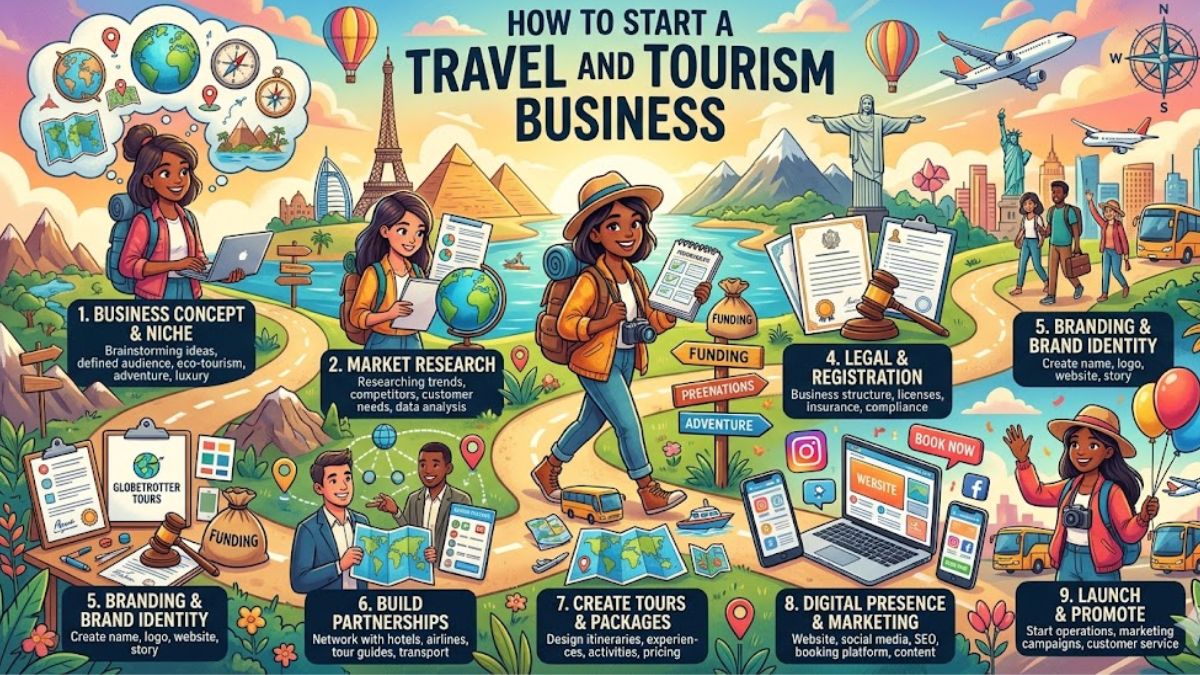
Starting a travel business looks simple on paper. In reality, it feels like building trust before you even have customers. The first real decision is niche selection. This is where most people go wrong. They try to sell everything to everyone. That usually leads to weak positioning and low trust. A stronger approach is to pick one direction and go deep. It could be family holidays, budget group trips, luxury escapes, or even spiritual travel circuits. The more specific you are, the easier it becomes for people to remember you.
Once the niche is clear, itinerary design becomes the backbone of everything. Good itineraries are not just lists of places. They are carefully balanced experiences. Travel time, rest time, emotional pacing, and even small things like when to place a scenic stop or free time. When done well, the customer doesn’t feel rushed or confused. They feel guided. In real operations, this is where customer satisfaction is actually built. Not during booking, but during planning.
Then comes partnerships. Hotels, cab operators, local guides, activity providers. These relationships decide everything about your service quality. One unreliable partner can damage your reputation faster than any marketing campaign can fix. At the beginning, these partnerships are often built personally. Calls, meetings, small negotiated deals. Trust builds slowly, but once it is there, it becomes your biggest asset. Finally, your digital presence. A website and social media are not just marketing tools. They are your first impression. For most customers, especially new ones, your Instagram or website is where they decide if you feel real or not.
7.2 Launching the first offering (the uncomfortable first phase)
The first launch is rarely perfect. And honestly, it shouldn’t be. Start small. A few well-designed packages. Maybe one domestic destination. Something you can control fully. The goal is not scale. The goal is proof. You push these packages through your immediate network first. Friends, family, early social media followers, WhatsApp groups. This stage feels personal because it is personal. You are not selling as a brand yet. You are testing as a founder.
Then comes feedback. And this part can be emotionally difficult. Because customers will tell you things you didn’t notice. A delay felt longer than expected. A hotel didn’t match expectations. A transfer felt disorganized. But this feedback is gold. Every strong travel business is shaped in this phase. The first 10 to 50 trips teach more than any planning document ever can. Only after this cycle do you scale. Not before.
8. Budget, Resources & Infrastructure
The truth about starting a travel business is that it does not require heavy capital in the beginning. But it does require discipline and consistency. A home-based setup is where most founders actually start. A laptop, a phone, internet, and a small set of tools. The real investment here is not money. It is time spent building relationships and designing good travel experiences.
Early expenses usually go into:
- Basic branding and website setup
- Digital marketing experiments
- Travel planning tools or booking platforms
- Small partnership deposits or trial agreements
Nothing is very heavy at this stage. But even small costs feel important because every rupee is tied to trust building. As the business grows, structure becomes more important. You might need a small team. Someone for operations, someone for customer communication, someone handling vendor coordination. At this stage, the business starts feeling less like a side hustle and more like a system. Technology quietly becomes the backbone.
A simple CRM can completely change how you manage customers. Instead of remembering everything manually, you track preferences, past trips, complaints, and future plans in one place. Booking tools and communication platforms reduce chaos, especially when multiple trips run at the same time. What feels like “support tools” early on eventually becomes your operating system.
9. Brand Strategy
In travel, brand is not what you say. It is what people feel after the trip. A strong brand starts with a name that is easy to remember and emotionally connected to travel. Something that feels like movement, discovery, or experience rather than just transactions. But naming is only the surface. Real brand identity comes from consistency.
If you promise premium service, every touchpoint must reflect that. If you promise budget travel, transparency becomes your strongest asset. If you promise adventure, then your itineraries and communication should feel energetic and flexible. Design also matters more than people expect. Colors, logos, and visuals are not decoration. They set emotional expectations. Travel is emotional by nature. People are not just buying a trip. They are buying a feeling of escape, relief, or excitement. Even your communication style becomes part of your brand. If your tone is calm, clear, and helpful, customers feel safe. If it is chaotic or overly sales-driven, trust drops quickly. The strongest travel brands don’t try to impress. They try to reassure.
10. Vendor & Partner Strategy
Behind every smooth travel experience, there is usually a network of silent partners working well together. Hotels, transport providers, guides, activity operators. These are not just vendors. They are extensions of your business. And in reality, your customer judges you based on their performance. This is why partner selection is extremely important.
The cheapest option is rarely the best option in travel. Reliability matters more than discount. A slightly more expensive hotel with consistent service is better than a cheaper one with unpredictable quality. Early on, you learn this the hard way. One delayed pickup or one poorly maintained hotel can lead to a customer feeling like the entire trip was poorly managed, even if everything else was fine. That is how sensitive this industry is.
Strong partnerships are built slowly. You start with small bookings. You observe performance. You check responsiveness. You see how they handle last-minute changes. Over time, the good partners become long-term collaborators. And this is where things get interesting. Once trust is established, better pricing, priority availability, and smoother coordination naturally follow. You stop chasing vendors, and they start valuing your repeat business. That shift changes everything operationally.
11. Go-to-Market & Customer Acquisition Channels
Getting customers in travel is not just about advertising. It is about making people imagine themselves traveling with you. Social media is usually the first serious channel. Platforms like Instagram and Facebook are powerful because travel is visual. A single well-shot destination reel or a real customer experience can trigger curiosity faster than any text-based marketing. But visuals alone are not enough. People also want clarity. That is why consistent posting about itineraries, pricing transparency, and real trip stories builds credibility over time.
Search engine visibility plays a different role. People searching online are usually already in decision mode. They are looking for options, comparisons, and trust signals. If your website appears at that moment with clear, structured information, conversion chances increase significantly. Paid ads can accelerate this, but they only work when the foundation is already strong. Without trust, ads just bring traffic that doesn’t convert. And then there is the most powerful channel of all.
Word of mouth. In this industry, one good trip creates multiple future customers. People talk about stress-free travel experiences. They recommend agencies that made their life easier. They don’t remember discounts as much as they remember how smooth everything felt. That is why early customers are not just revenue. They are reputation builders. A travel business grows fastest when people start saying one simple thing: “They handled everything. I didn’t have to worry at all.” That sentence, more than any marketing strategy, is what actually builds scale.
12. Growth & Retention Strategy
Growth in travel doesn’t come from constant new customers. It comes from people coming back, often without much persuasion. Once a customer has a smooth trip, something interesting happens. The anxiety disappears. They stop asking “Can I trust this?” and start asking “Where should we go next?” That shift is where retention begins. Repeat customers are usually the easiest to work with. You already know their preferences. You know their budget comfort zone. You know whether they prefer relaxed itineraries or fast-paced travel. Planning for them becomes less like selling and more like continuing a relationship.
That’s why loyalty matters. Simple things work better than complicated programs. Early access to deals. Small discounts on second or third bookings. Personalized suggestions based on past trips. Even a message that says “this destination matches what you liked last time” builds emotional connection. Engagement between trips is just as important.
Most travel businesses lose customers simply because they go silent after the trip ends. The better approach is staying present without being intrusive. A few travel updates, destination ideas, seasonal offers. Something that quietly reminds people you exist when they start thinking about their next break. And when you do this right, growth becomes organic. One happy customer often brings in two or three more without any advertising spend. That is the kind of growth that feels slow in the beginning but becomes extremely powerful over time.
13. Team Structure & Responsibilities
Every travel business starts the same way. One person doing everything. Booking calls. Negotiations. Itinerary planning. Customer updates. Late-night problem solving when something goes wrong during a trip. It feels overwhelming, but it also teaches you the entire system from the inside. As the business starts growing, this breaks naturally. You cannot handle everything alone anymore. The first real division usually happens in three directions:
Sales, operations, and customer support. Sales is about conversations and closing bookings. Operations is about making sure everything actually happens on the ground. Customer support is the bridge that handles doubts, changes, and emergencies. Even if it’s a small team, this separation reduces chaos immediately. Later, marketing and design often get outsourced. Not because they are less important, but because consistency matters more than doing everything internally. A good freelancer or agency can maintain quality while the core team focuses on execution. What matters most in team building is clarity. Everyone should know what “a successful trip” looks like. If that understanding is shared, execution becomes smoother automatically.
14. Risks, Challenges & Mitigation
The travel industry looks exciting from the outside, but anyone working in it knows how unpredictable it can be. Demand can change overnight. A political situation, a sudden weather disruption, an economic slowdown, or even global events like pandemics can bring everything to a pause. Unlike many industries, travel reacts instantly to uncertainty. But external risks are only one part of the story.
Operational issues happen every day. A hotel overbooks. A driver arrives late. A customer misunderstands an itinerary. A flight gets delayed and the entire schedule shifts. These are not exceptions. They are normal parts of the business. And this is where most trust is actually tested. Customers rarely remember the problem itself. They remember how you handled it. Whether you responded quickly. Whether you took responsibility. Whether you fixed it without making them feel ignored.
Mitigation is not about avoiding problems completely. That’s impossible. It is about being prepared for them. Diversifying destinations helps reduce dependency on one market. Having backup vendors prevents last-minute failures. Clear policies reduce confusion during cancellations. And most importantly, strong communication reduces panic on both sides. In travel, calm response is often more valuable than perfect execution.
15. Legal, Compliance & Fundamentals
Behind every smooth travel business, there is a layer of structure that customers rarely see. Registration is the first step, not just for compliance but for credibility. It signals that the business is serious, accountable, and not temporary. Understanding travel agency registration in India, licensing requirements, and tourism compliance is not optional. It protects both the business and the customer.
Taxes, invoicing, and documentation may feel like background work, but they are what keep the system stable. Without them, scaling becomes risky very quickly. Another important part is contracts. Clear agreements with vendors prevent misunderstandings. Clear terms with customers prevent disputes. In this industry, most conflicts don’t come from bad intent. They come from unclear expectations. When expectations are written down properly, half the problems disappear before they even happen.
16. Long-Term Vision & Goals
A travel business, if built patiently, naturally evolves into something much larger than bookings. In the beginning, the focus is survival. Then consistency. Then trust. But long term, the goal shifts toward becoming a brand people rely on without hesitation. Expansion usually starts with destinations. From one region to multiple cities, then countries. Each expansion is not just geographic. It is operational learning repeated at a bigger scale.
Technology becomes more important at this stage. Manual coordination stops working when volume increases. Systems take over. Bookings, customer data, vendor coordination, payments, everything needs structure. But even at scale, one thing should never change. The customer experience.
Because travel is deeply emotional. People are not just buying a service. They are trusting you with their time off, their family moments, their memories. That responsibility never becomes routine. If anything, it becomes heavier with growth. The long-term vision is simple but powerful: To become the name people think of when they want travel to feel effortless, safe, and meaningful.
17. Future Outlook: Scaling a Travel and Tourism Business
The future of travel businesses is not just about more bookings. It is about smarter, more personalized experiences. Demand is expected to keep growing, especially in domestic and experiential travel. But the real change is happening in expectations. People no longer want generic itineraries. They want experiences that feel tailored to them. They want flexibility, speed, and clarity. They want technology to remove friction, not add complexity.
This is where businesses will evolve. Those who rely only on traditional booking models will struggle. But those who combine human understanding with digital tools will grow faster. Technology will handle structure. Humans will handle emotion. And travel, more than almost any other industry, needs both. Because at the end of the day, no one remembers the booking process. They remember how the trip made them feel. And the businesses that understand this emotional layer will be the ones that don’t just grow, but stay relevant for years to come.rong partnerships will succeed. What begins as a small venture can evolve into a large-scale travel brand.
About foundlanes.com
foundlanes.com is India’s leading startup idea discovery platform. It helps entrepreneurs find actionable startup opportunities, market insights, and industry-specific guidance to turn ideas into real businesses. With deep research and practical resources, foundlanes supports founders at every stage, from idea validation to launch and growth.