News Summary
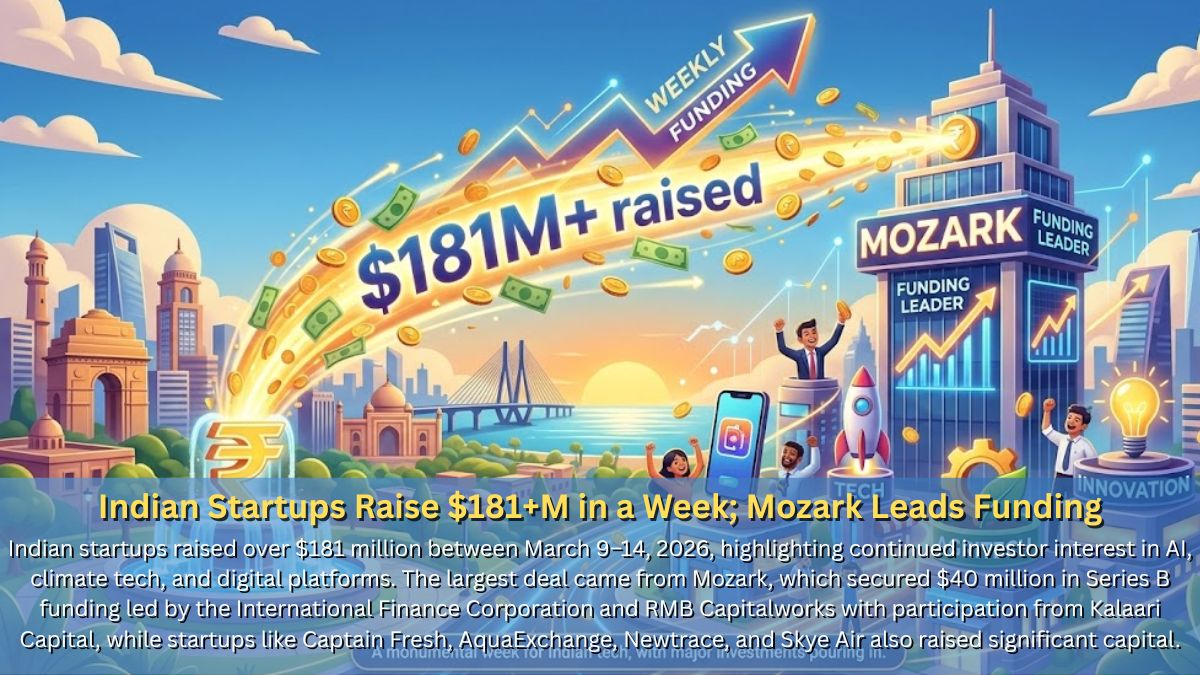
India’s startup ecosystem continues to show resilience as Indian Startups Raise over $181 million in funding between March 9 and March 14, 2026, according to multiple industry reports. The funding activity reflects sustained investor interest in emerging sectors such as AI infrastructure, climate technology, drone logistics, agritech, and enterprise software. Although venture capital investments slowed globally in recent years, India’s startup markets still attract strong backing from both global and domestic investors.
The largest deal during the week came from Mozark, which secured $40 million in Series B funding led by the International Finance Corporation and RMB Capitalworks, with participation from Kalaari Capital. The startup builds AI-powered digital experience testing platforms used by enterprises and regulators worldwide. The fresh capital will help Mozark expand internationally and strengthen its digital infrastructure testing capabilities. Besides Mozark, several other startups raised capital across sectors. Captain Fresh secured about ₹290 crore (around $27 million) in sustainability-linked financing to expand its global seafood sourcing and technology infrastructure. Meanwhile, AquaExchange raised $8 million to build digital tools for fish and shrimp farmers. Climate-tech venture Newtrace secured $6.3 million, and drone logistics firm Skye Air raised $9 million to expand its autonomous delivery network.
Additionally, early-stage startups such as Verdant Impact, CoreworksAI, Basil Health, and Zoff Foods also secured funding rounds ranging from seed to pre-Series B. These investments highlight the growing diversity of India’s startup ecosystem, where technology-driven business models continue to attract venture capital. Overall, the week demonstrates how Indian startups continue raising capital across AI, fintech, climate tech, agritech, and supply chain platforms, reinforcing India’s status as one of the world’s fastest-growing innovation ecosystems.
1. Indian Startups Raise $181M in a Week: A Snapshot of India’s Funding Momentum
The headline story of the week is clear. Indian Startups Raise significant venture capital even amid global funding caution. Between March 9 and March 14, 2026, startups across India collectively secured more than $181 million through multiple funding rounds. The investments span early-stage seed rounds, venture funding, and growth-stage financing. These deals show strong investor confidence in technology innovation and scalable business models. The deals came from sectors including AI developer tools, enterprise SaaS platforms, climate technology, logistics drones, aquaculture technology, and consumer brands. Such diversity reflects the maturity of India’s startup ecosystem.
Furthermore, venture-backed startups now drive innovation across industries. Investors also focus more on sustainable growth and profitable models. As a result, funding strategies have shifted from hyper-growth to long-term value creation. Consequently, the recent funding rounds highlight the rise of emerging startups that solve real-world problems using technology and data-driven insights.
2. Mozark Leads the Week as Indian Startups Raise Major Capital
The past week offered another strong reminder of how quickly India’s startup ecosystem is evolving. Several companies secured meaningful funding, but one deal stood out. Enterprise technology startup Mozark closed a $40 million Series B round, signaling strong investor confidence in infrastructure tools that improve digital performance. While consumer startups often grab headlines, this funding round highlights something deeper. Investors are increasingly backing companies that build the digital backbone of modern products and services.
2.1 Mozark’s $40 Million Series B Round
Mozark raised $40 million in Series B funding in a round led by the International Finance Corporation and RMB Capitalworks. Existing investor Kalaari Capital also participated. The funding will help the company expand its global presence and accelerate product innovation. But beyond the numbers, the round tells a bigger story about where enterprise technology is heading. Digital services today run across thousands of devices, networks, and geographies. A product that works perfectly in a testing lab may fail the moment a real user opens it on a slow mobile network.
Mozark’s technology addresses that exact problem. Instead of relying only on simulated lab tests, the platform measures performance in real-world conditions. For companies running large digital platforms, that difference is critical. Even a few seconds of delay can lead to lost users, abandoned transactions, and frustrated customers. This is why Mozark’s platform has gained attention from global enterprises. The fresh capital will allow the company to expand internationally, build deeper analytics capabilities, and strengthen its testing infrastructure.
2.2 What Mozark Actually Does
At its core, Mozark builds a digital experience measurement platform. The system allows companies to understand how their applications perform in the real world. Rather than relying on controlled testing environments, Mozark simulates actual user journeys.
It measures performance across several layers:
- mobile devices
- telecom networks
- geographic locations
- digital infrastructure systems
This approach helps companies detect issues before users encounter them.
Imagine launching a mobile app that works smoothly in office testing but struggles on slower rural networks. Without real-world testing, those problems often appear only after customers start complaining.
Mozark prevents that. Its system runs automated tests across thousands of devices and networks. The platform replicates how users interact with apps, websites, and digital services. If performance drops anywhere in the system, teams receive alerts immediately. Another important aspect is privacy. The platform does not collect personal user data. Instead, it focuses purely on performance measurement. In a world increasingly concerned about digital privacy, this design makes the platform particularly attractive to enterprises and government clients.
2.3 Founders and Background
Mozark was founded by Kartik Raja and Fabien Renaudineau. Their idea came from a simple but frustrating observation. Digital services were failing users far too often. Most companies test their applications in highly controlled environments. But the real world is messy. Networks fluctuate, devices behave differently, and infrastructure can vary dramatically between locations.
The founders believed digital services needed to be tested under the same conditions real users face. So they built a system that simulates those environments. Over time, the platform evolved into a global testing infrastructure. Today Mozark works with over 50 enterprise and government clients across more than 20 countries. Its testing systems operate across thousands of real devices and networks. So far, the platform has executed more than 25 million performance tests worldwide. Those numbers reveal the scale of the challenge companies face when delivering reliable digital experiences. And they explain why investors are willing to back Mozark’s expansion.
3. Other Major Deals as Indian Startups Raise Funding
Mozark may have led the week, but it was far from the only startup attracting capital. Several companies across logistics, agritech, and climate technology also raised significant funding. Together, these deals reveal a clear trend. Investors are supporting startups that solve real infrastructure and supply chain problems.
3.1 Captain Fresh Expands Global Seafood Supply Chain
Bengaluru-based startup Captain Fresh raised ₹290 crore (around $27 million) from the Swiss impact investor Blue Earth Capital. Captain Fresh operates a digital platform connecting seafood producers, processors, and retailers across international markets. Seafood supply chains are notoriously complex. Products move through multiple intermediaries before reaching restaurants and supermarkets. This fragmentation often leads to inefficiencies, delayed deliveries, and inconsistent product quality. Captain Fresh attempts to simplify that entire process. Its platform uses technology to manage sourcing, logistics, and distribution in one integrated system.
The result is better visibility across the supply chain. For seafood buyers, this means improved freshness tracking and predictable deliveries. For suppliers, it means easier access to global markets. The new capital will help the company expand sourcing networks and strengthen its technology infrastructure.
3.2 AquaExchange: Agritech Innovation in Aquaculture
Agritech startup AquaExchange secured $8 million in Series B funding. The company focuses on a sector that often receives little attention: aquaculture. Fish and shrimp farming is a massive industry across Asia. However, many farms still rely on traditional practices with limited access to data or digital tools. AquaExchange wants to change that.
The startup provides a platform that supports farmers with:
- farm analytics tools
- marketplace access
- supply chain traceability
- productivity insights
Farmers can monitor water quality, track farm performance, and connect directly with buyers. This reduces inefficiencies and improves profitability for small producers. More importantly, the platform introduces data-driven decision making into an industry that has historically operated without it.
3.3 Climate Tech Startup Newtrace
Climate technology startup Newtrace raised $6.3 million in funding. The company is developing advanced electrolysers used to produce green hydrogen. Hydrogen energy is quickly gaining attention worldwide. When produced using renewable electricity, hydrogen can power industries without generating carbon emissions.
However, producing hydrogen efficiently remains a major technological challenge. Newtrace focuses on improving electrolyser technology to make green hydrogen more scalable and cost-effective. If successful, the company could play a role in the global transition toward cleaner energy systems. Investors see long-term potential in startups building infrastructure for the future hydrogen economy.
3.4 Drone Logistics Startup Skye Air
Drone delivery startup Skye Air raised $9 million in venture funding. The company develops autonomous drones designed for last-mile logistics. Delivery infrastructure has become a critical focus area as e-commerce continues expanding. Traditional delivery methods often struggle with traffic congestion and rising operational costs. Drone technology offers a potential solution.
Autonomous drones can transport packages quickly across urban areas and remote locations. For industries like healthcare, drone logistics could even enable rapid delivery of medicines or medical supplies. Investors are betting that drone infrastructure will eventually become an important part of the logistics ecosystem.
4. Emerging Startups That Also Raised Capital
Beyond the larger deals, several early-stage startups also secured funding. These companies may be smaller today, but they represent emerging sectors attracting investor attention.
4.1 Verdant Impact: Climate Data and Carbon Solutions
Climate analytics platform Verdant Impact raised $3 million in seed funding. The company builds software tools that help businesses track carbon emissions and sustainability metrics. As climate regulations become stricter worldwide, companies need reliable systems to measure environmental impact. Verdant Impact provides the analytics infrastructure required for that transition. Its platform allows businesses to monitor emissions, analyze sustainability data, and comply with environmental reporting standards.
4.2 CoreworksAI: AI Infrastructure Startup
AI tools developer CoreworksAI raised $5 million in seed funding. The startup focuses on infrastructure for generative AI development. Its tools help developers integrate AI models into enterprise applications more easily. With AI adoption accelerating across industries, infrastructure startups like CoreworksAI are gaining strong investor interest. They enable other companies to build AI-powered products faster and more efficiently.
4.3 Basil Health and Zoff Foods
Two additional startups also raised capital this week. Healthcare startup Basil Health secured $1.5 million to expand its digital healthcare platform. Meanwhile, food brand Zoff Foods raised $2 million to scale distribution and strengthen its e-commerce operations. These deals show that consumer brands and healthcare startups continue attracting investor attention alongside deep-tech companies.
5. Business Models Behind These Startup Success Stories
When you step back and look at these funding rounds together, a pattern becomes clear. The startups attracting capital share several common characteristics.
5.1 Technology-Led Platforms
Many successful startups build technology platforms powered by data, automation, or AI.
Examples include:
- Mozark’s digital experience testing platform
- CoreworksAI’s AI developer infrastructure
- AquaExchange’s farm analytics system
These platforms solve complex problems while remaining scalable.
Once the core technology is built, it can serve customers across multiple markets.
5.2 Marketplace and Supply Chain Platforms
Another common model involves improving fragmented supply chains. Startups like Captain Fresh and AquaExchange connect producers, suppliers, and buyers through digital marketplaces. This reduces inefficiencies and improves transparency. For industries that historically relied on intermediaries, these platforms can transform how products move through the market.
5.3 Climate and Clean Energy Innovation
Finally, climate technology is emerging as one of the fastest-growing investment sectors. Companies like Newtrace and Verdant Impact represent this new wave of innovation. Investors increasingly support startups developing clean energy systems, carbon tracking tools, and sustainability infrastructure. As global economies shift toward low-carbon solutions, demand for such technologies will likely continue growing.
6. Industry Growth Trends Driving Startup Funding
When you look closely at where investment is flowing, it becomes clear that funding is not random. Investors are responding to powerful shifts happening across technology, energy, and global trade. In many ways, startup funding acts like a compass. It points toward the industries that are quietly shaping the future. Over the past few years, three major trends have consistently driven investment into Indian startups: artificial intelligence, climate technology, and supply-chain digitisation.
6.1 AI and Deep-Tech Growth
Artificial intelligence has moved far beyond the stage of experimentation. A few years ago, AI felt like a futuristic concept that only large technology companies could afford to explore. Today, it sits at the center of product development across industries. Startups are now building tools that make AI more accessible and practical for businesses. Companies like CoreworksAI, for example, focus on the infrastructure layer of AI. Their goal is not just to build a single AI product but to create tools that allow developers and enterprises to integrate AI into everyday applications.
This shift is incredibly important. When businesses adopt AI tools, they improve productivity, automate repetitive tasks, and generate insights from massive datasets that humans simply cannot process alone. Investors recognize this transformation. Developer tools, generative AI platforms, and machine learning infrastructure startups are attracting strong global venture capital interest. From recommendation systems to predictive analytics, AI is gradually becoming the invisible engine behind modern software products. And as more companies depend on AI-driven systems, the demand for startups building the underlying infrastructure will only grow.
6.2 Climate Technology Expansion
Climate technology has also become one of the most emotionally charged and economically important sectors in the startup world. For decades, discussions about climate change stayed mostly within policy circles. Today, the conversation has shifted dramatically. Businesses now face increasing pressure to reduce emissions, track environmental impact, and adopt cleaner technologies.
This is where climate-tech startups step in. Companies like Newtrace are working on advanced electrolysers that make green hydrogen production more efficient. Hydrogen, when produced using renewable energy, has the potential to power industries without generating harmful emissions. Other startups such as Verdant Impact are building analytics platforms that help companies measure carbon footprints and track sustainability metrics.
This type of infrastructure is becoming essential. Large corporations cannot meet environmental targets without reliable data systems that measure emissions accurately. Investors see a long runway for growth in climate technology because the transition toward sustainable energy and operations is no longer optional. It is becoming a global economic priority.
6.3 Supply Chain Digitisation
Another major trend attracting investment is the transformation of supply chains. If the pandemic taught the world anything, it is that supply chains are fragile. Disruptions in logistics, transportation, and sourcing can ripple through entire industries. This realization has pushed businesses to invest heavily in technology that improves supply chain visibility and efficiency. Startups like Captain Fresh are building digital platforms that connect producers, suppliers, and buyers more directly.
Instead of relying on fragmented networks of intermediaries, these platforms create structured systems where data flows smoothly between every participant. The impact is significant. Better logistics tracking, improved inventory management, and real-time data allow companies to reduce waste, cut delivery times, and operate more predictably. For investors, supply chain technology represents a practical solution to a global challenge. And as international trade continues to expand, the need for smarter logistics systems will only increase.
7. Competitors and Market Landscape
Every successful startup operates within a broader ecosystem of competitors. Competition is not necessarily a negative force. In fact, it often signals that a market is large enough and important enough to attract multiple players. Understanding the competitive landscape helps reveal how each startup differentiates itself.
7.1 Mozark’s Competitive Landscape
Mozark operates in the world of digital experience testing and performance monitoring. As businesses become increasingly dependent on digital platforms, ensuring reliable performance has become a critical priority. Mozark’s technology sits at the intersection of several enterprise software categories.
It competes with solutions in areas such as:
- application performance monitoring platforms
- DevOps testing tools
- network performance analytics systems
What makes Mozark unique is its focus on real-world testing environments. Many traditional testing systems operate in controlled laboratory conditions. Mozark, however, simulates real network conditions across devices and geographic locations. This approach gives enterprises deeper insights into how their digital services behave in the real world.
7.2 Captain Fresh’s Competitive Ecosystem
Captain Fresh operates within the complex global seafood industry. Seafood supply chains involve fishermen, processors, exporters, logistics providers, and retailers spread across multiple countries. Because of this fragmentation, inefficiencies often creep into the system.
Captain Fresh competes with several types of players, including:
- global seafood trading networks
- cold-chain logistics companies
- digital B2B marketplaces
However, the company’s strategy focuses on integrating technology directly into the supply chain. By using digital platforms to connect producers and buyers, Captain Fresh aims to improve transparency and reduce delays in product movement.
7.3 Competition in Drone Logistics
Drone delivery startups like Skye Air operate in one of the most exciting but competitive technology spaces. The promise of drone logistics is simple: faster delivery with reduced operational costs. But several types of companies are pursuing similar goals.
Drone startups compete with:
- traditional logistics firms
- e-commerce delivery networks
- robotics and automation companies
Large delivery platforms already have extensive distribution networks, while robotics startups are exploring automated warehouses and ground delivery systems. For drone startups to succeed, they must prove that aerial delivery systems can operate safely, reliably, and at scale.
8. Why Investors Continue Backing Indian Startups
Despite global economic uncertainties, investors continue to show strong confidence in India’s startup ecosystem. This confidence is not based on hype alone. It comes from structural advantages that have developed over the past decade. First, India is one of the fastest-growing digital markets in the world. Hundreds of millions of users rely on smartphones for banking, shopping, communication, and entertainment. This massive digital population creates an enormous testing ground for new products and services.
Second, the country has a deep pool of technical talent. Engineers, product developers, and startup founders across cities like Bengaluru, Hyderabad, and Pune continue to build innovative technology companies that compete on a global stage. Third, government initiatives have played an important role in nurturing the ecosystem. Programs like Startup India provide funding support, regulatory assistance, and incubation opportunities for early-stage startups.
Over time, accelerators, incubators, and venture funds have formed a strong support network for entrepreneurs. Finally, the ecosystem has matured significantly. India now has a growing list of unicorn startups and successful exits, which gives investors greater confidence that their capital can generate long-term returns. For founders, this momentum creates a powerful environment. New ideas can attract funding faster, talent is easier to access, and global investors are paying close attention. And for observers watching the ecosystem grow, there is a certain excitement in the air. The feeling that the next generation of transformative companies may already be quietly taking shape in India’s startup corridors.
9. The Role of Venture Capital in the Startup Ecosystem
Venture capital often becomes the turning point in a startup’s journey. Many founders begin with strong ideas but limited resources. Venture investors help bridge that gap by providing the fuel needed to grow faster. The most obvious support is growth capital. Startups use this funding to hire teams, improve technology, expand into new markets, and scale operations. But funding is only one part of the story.
Experienced investors also provide strategic mentorship, helping founders refine business strategies, avoid common mistakes, and strengthen product-market fit. In addition, venture firms offer global networks, connecting startups with enterprise clients, industry experts, and future investors. This combination of capital and guidance allows companies to move quickly and build stronger products. At the same time, the venture capital environment has evolved. Investors today focus more on sustainable growth rather than rapid expansion without clear profitability. Startups that demonstrate strong fundamentals, clear revenue models, and long-term value are more likely to attract funding. This shift is creating a healthier and more resilient startup ecosystem.
10. Learning for Startups and Entrepreneurs
This week’s funding activity highlights several lessons for founders.
- First, startups that solve real problems attract investors.
Mozark focuses on improving digital infrastructure reliability, while Captain Fresh simplifies global seafood supply chains. These companies address real industry challenges. - Second, technology innovation matters.
Sectors such as artificial intelligence, climate technology, and digital platforms continue to receive strong investor interest. - Third, scalability drives investment decisions.
Investors look for startups whose products can expand across markets and serve large global audiences. - Finally, sustainable business models are essential.
Today’s investors prefer startups with clear revenue strategies and disciplined growth plans.
For entrepreneurs, the takeaway is simple: build meaningful solutions, focus on long-term value, and create products that can scale beyond a single market.
About foundlanes.com
foundlanes.com is India’s leading startup idea discovery platform. It helps entrepreneurs find actionable startup opportunities, market insights, and industry-specific guidance to turn ideas into real businesses. With deep research and practical resources, foundlanes supports founders at every stage, from idea validation to launch and growth.