News Summary
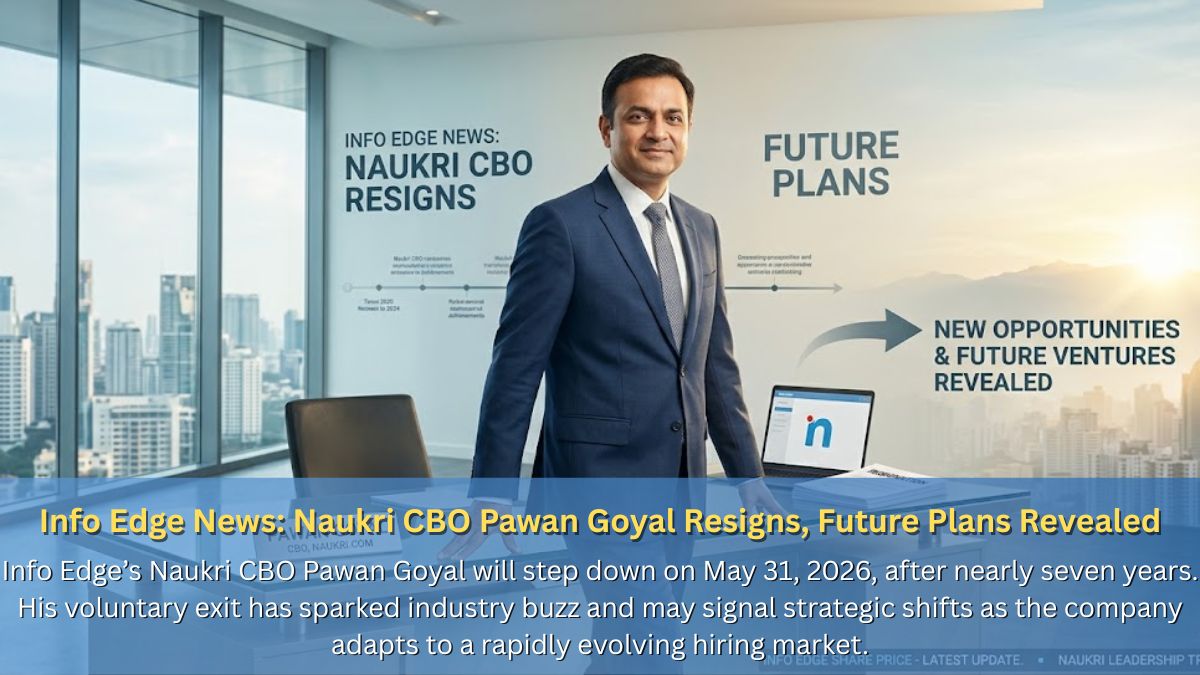
In a major leadership development in the Indian startup ecosystem, Info Edge has announced the resignation of its Chief Business Officer (CBO) of Naukri, Pawan Goyal. After serving the company for nearly seven years, Goyal has decided to step down from his role as Whole-Time Director and CBO, effective May 31, 2026. His exit also includes stepping down from various board committee responsibilities within the organization. This Info Edge News has created a strong buzz across startup news platforms, tech news circles, and hiring industry watchers. Goyal played a key role in strengthening Naukri’s business strategy, scaling recruitment solutions, and driving revenue growth in India’s competitive job market. His leadership came at a time when digital hiring platforms saw massive traction due to tech disruption, remote work, and startup hiring booms.
According to official statements, Goyal’s resignation is voluntary, and he intends to “pursue other passions in life.” While the company has not yet announced his successor, Info Edge confirmed that the transition process will remain smooth, ensuring no disruption in business operations. This development comes at a time when India’s startup ecosystem is witnessing rapid transformation, with increased venture capital activity, evolving hiring needs, and growing competition from AI-driven recruitment platforms. Naukri continues to be one of India’s largest and most trusted hiring platforms, contributing significantly to Info Edge’s revenue streams.
As leadership reshuffles often signal broader strategic shifts, industry experts believe this move could open doors for new growth strategies, product innovations, and digital hiring solutions within Info Edge’s portfolio. This Info Edge News is not just about a resignation it reflects the evolving nature of leadership in India’s fast-changing startup and tech ecosystem.
1. Introduction to Info Edge News and Leadership Change
1.1 Understanding the Latest Info Edge News
The recent Info Edge News about Pawan Goyal’s resignation marks a significant moment in India’s startup ecosystem. Leadership changes in major internet companies often indicate strategic transitions. In this case, the departure of a key executive from Naukri raises questions about future direction and growth strategies. Info Edge, one of India’s earliest internet companies, has built strong platforms in recruitment, real estate, matrimony, and education. Among these, Naukri remains its flagship product and a market leader in online hiring.
1.2 Who is Pawan Goyal?
Pawan Goyal has been a crucial part of Info Edge’s leadership team. Over the past seven years, he contributed to scaling Naukri’s enterprise business and strengthening relationships with recruiters. Before joining Info Edge, Goyal had extensive experience in business strategy and operations. His leadership helped the company navigate evolving hiring trends, especially during the pandemic and post-pandemic recovery phases.
2. Background of Info Edge and Naukri
2.1 Company Overview
To understand why leadership changes matter, you first have to understand what Info Edge really is. This isn’t just another internet company riding a trend. It’s one of the few businesses in India that grew with the internet itself. Founded in 1995, Info Edge quietly built products that solved everyday problems for
Indians before “startups” became a buzzword. Its portfolio reflects that simplicity:
- Naukri – jobs
- 99acres – real estate
- Jeevansathi – matchmaking
- Shiksha – education
Each platform addresses a deeply human need: work, home, relationships, and learning. That clarity is why the company has stayed relevant for nearly three decades. What makes Info Edge different is not just longevity, but consistency. While many internet companies burn cash chasing growth, Info Edge built profitable, category-leading platforms early on. That discipline still shapes how it operates today.
2.2 Founders and Vision
At the center of this story is Sanjeev Bikhchandani not the loud, headline-chasing founder archetype, but someone who built patiently. He started Info Edge with a simple but powerful idea:
India’s classified ads would move online someday. When they do, someone needs to be ready. That belief sounds obvious today. But in the mid-90s, when internet access was rare and trust in online platforms was almost nonexistent, it was a contrarian bet. What stands out in his journey is restraint. Info Edge didn’t try to do everything at once. It focused, executed, and scaled gradually. Over time, the company didn’t just build its own businesses. It became one of India’s earliest and smartest startup investors, backing companies like:
- Zomato
- Policybazaar
These weren’t lucky bets. They were extensions of the same philosophy: identify everyday problems, back founders solving them, and stay patient.
2.3 Naukri’s Growth Story
If Info Edge is the engine, Naukri is its most powerful gear. What started as a basic job listing site slowly turned into something far more valuable a trusted bridge between ambition and opportunity. In its early days, Naukri was simple. Listings, resumes, and basic search filters. But the real breakthrough wasn’t technology. It was trust.
- Job seekers trusted that listings were real
- Recruiters trusted they would find relevant candidates
That trust created a network effect. More candidates attracted more recruiters. More recruiters attracted more candidates. Over time, Naukri became the default starting point for job searches in India.
Today, it serves millions of users and thousands of companies. But behind those numbers are real stories:
- A fresher landing their first job
- A mid-career professional making a risky switch
- A recruiter finding the perfect hire after weeks of struggle
Naukri didn’t just digitize hiring. It normalized online hiring in India.
3. Detailed Breakdown of the Resignation
3.1 Timeline of Events
The recent development around Pawan Goyal isn’t just another corporate update. According to official communication, he will step down as Chief Business Officer effective May 31, 2026, and will also exit all board-level roles. On paper, it looks structured and planned. But in companies like Info Edge, where leadership continuity matters, even a planned exit carries weight.
3.2 Reason Behind the Exit
Goyal’s statement was simple: he wants to pursue other passions in life. There’s something very human about that. After years of operating at the top level of a high-performance organization, stepping away is rarely impulsive. It usually comes from reflection wanting time, space, or a different kind of challenge. And importantly, there’s no indication of conflict, pressure, or internal issues. That matters. Because leadership exits often hint at deeper problems. This one doesn’t seem to.
3.3 Company’s Official Statement
Info Edge acknowledged the resignation with appreciation rather than defensiveness. That tone tells you a lot. When companies are uneasy about exits, their communication feels guarded. Here, it felt respectful and composed. The company recognized Goyal’s contributions and maintained that the decision was voluntary. This kind of transition reflects maturity both at the leadership and organizational level.
4. Naukri Business Model Explained
4.1 How Naukri Really Works
On the surface, Naukri looks like a simple job website. Upload your resume, apply, wait. But anyone who has actually used it whether as a job seeker or a recruiter knows there’s a lot more happening underneath. Yes, it’s a two-sided marketplace. But reducing it to that feels incomplete. On one side, you have millions of people carrying ambition, anxiety, and hope freshers trying to land that first break, professionals chasing better roles, people quietly planning career switches at midnight. On the other side, recruiters are under pressure. They’re racing against time, targets, and internal expectations to find the “right” candidate, not just any candidate. Now imagine connecting these two sides at scale. That’s where Naukri earns its place.
It’s not just listing jobs. It’s constantly filtering chaos.
- Candidates build profiles, upload resumes, and apply
- Recruiters search through massive databases using filters that go deeper than most people realize skills, experience, salary range, location, even activity level
Every click, every search, every application feeds into a system that keeps getting sharper. Over time, the platform starts understanding patterns who is likely to switch jobs, what roles are trending, which profiles are more relevant. If you’ve ever received a recruiter call “out of nowhere” that perfectly matched your experience, that wasn’t luck. That was the system working quietly in the background. Naukri doesn’t eliminate friction completely. No hiring platform can. But it reduces the noise just enough to make the process feel manageable. And in hiring, that’s everything.
4.2 Revenue Model
What’s impressive about Naukri is not just that it works, but that it makes money in a clean, predictable way. While many internet platforms chase users first and revenue later, Naukri built a model where monetization is baked into the core experience.
Here’s how it earns:
- Recruiter subscriptions: Companies pay to access the talent pool. The better the database, the higher the willingness to pay.
- Paid job postings: Visibility matters. Recruiters pay to push their listings above the noise.
- Resume database access: Instead of waiting for applications, recruiters proactively search and reach out.
- Employer branding solutions: Companies invest in standing out, especially in competitive hiring markets.
What makes this model powerful is consistency. Hiring never stops. Even during slowdowns, companies are always replacing, optimizing, or selectively growing teams. That creates recurring demand. From a real-world perspective, ask any HR professional or recruiter they rarely rely on just one hiring channel. But Naukri is almost always part of that mix. Not because it’s perfect, but because it’s reliable. And in business, reliability is underrated.
5. Problems Naukri Solves
5.1 The Hiring Reality in India
India doesn’t have a talent shortage. It has a matching problem. There are millions of job seekers. There are thousands of open roles. And yet, both sides often feel stuck.
- Candidates complain: “I apply everywhere, no response.”
- Recruiters complain: “We get too many irrelevant applications.”
Both are right. This gap isn’t about availability. It’s about alignment. Skills don’t always match job requirements. Expectations don’t always align with budgets. And sometimes, it’s simply about visibility right person, wrong timing.
5.2 The Pre-Digital Hiring Struggle
Before platforms like Naukri, hiring was painfully slow.
Think about it:
- Newspaper classifieds
- Walk-in interviews
- Referral-heavy hiring
Everything depended on limited reach and timing. If you missed an opportunity, it was gone. There was no central system. No searchable database. No real-time updates. For job seekers, it felt like guesswork. For recruiters, it felt like fishing in the dark.
5.3 The Solution Naukri Brings
Naukri didn’t just digitize hiring. It gave structure to a broken process.
It introduced:
- Speed: Jobs and candidates could be discovered instantly
- Access: A recruiter in one city could reach candidates across the country
- Data-driven matching: Profiles and requirements could be filtered with precision
- AI-driven recommendations: Increasingly, the platform suggests better matches over time
But beyond features, it changed behavior. People started updating resumes regularly. Recruiters started relying on data instead of instinct alone. That shift from informal to structured hiring is Naukri’s real contribution.
6. Industry Trends and Market Growth
6.1 The Rise of Online Recruitment
Hiring in India is going through a quiet transformation. It’s no longer just about filling roles. It’s about finding the right fit, faster.
Several forces are driving this shift:
- The startup boom, where companies scale teams aggressively
- Digital transformation across traditional industries
- The normalization of remote and hybrid work
This has expanded the talent market beyond geography. A company in Bangalore can hire from a smaller city without hesitation. And platforms like Naukri sit right at the center of this shift.
6.2 Technology Is Changing the Game
The next phase of hiring is not just digital. It’s intelligent. AI and data analytics are making platforms smarter:
- Predicting candidate intent (who is likely to switch jobs)
- Improving job-candidate matching
- Reducing irrelevant applications
But there’s a human side to this. Hiring decisions are still emotional. Culture fit, communication, ambition these are things no algorithm fully understands yet. So the future isn’t AI replacing humans. It’s AI supporting better decisions.
6.3 Why This Matters for Startups
For startups, hiring is not just an HR function. It’s survival. A single bad hire can slow down a small team. A strong hire can change the trajectory of the company. Efficient recruitment platforms reduce that risk.
They help founders:
- Move faster
- Access better talent
- Compete with larger companies
And that’s why the hiring ecosystem is so critical. Behind every successful startup, there’s always a story of finding the right people at the right time. Platforms like Naukri don’t get credit for those stories. But they quietly enable them every single day.rtups cannot scale.
7. Competitive Landscape
7.1 Direct Competitors
When you look at Naukri today, it’s easy to assume it dominates without resistance. That’s not true. The competition is real, and it’s intense. Platforms like LinkedIn, Indeed, and Monster India are constantly pushing the boundaries of hiring. But here’s the interesting part. They don’t compete in exactly the same way.
- LinkedIn is where identity meets opportunity. It’s not just about jobs, it’s about professional presence. People build credibility there. Recruiters scout passively. Hiring often starts long before a job is even posted.
- Indeed plays the volume game. It aggregates listings, making it a go-to place for quick job discovery. It’s fast, wide, and efficient.
- Monster India, once a strong early player, still operates in the same space but has struggled to maintain the same level of relevance.
Now here’s where Naukri stands apart. It feels. practical. Not aspirational like LinkedIn. Not purely transactional like Indeed. It sits somewhere in between, grounded in real hiring needs. Especially in India, where hiring is often urgent and budget-conscious, that practicality matters. If you speak to recruiters, many will tell you this honestly: They may source candidates from multiple platforms, but they close a lot of roles through Naukri. That’s not branding. That’s behavior.
7.2 Indirect Competitors
The competition doesn’t stop at job portals.
Some of the toughest competition comes from places people don’t always notice:
- HR consultancies
- Staffing agencies
- New-age AI hiring startups
These players solve the same problem, but in very different ways. Staffing agencies bring a human layer screening, shortlisting, even convincing candidates. That matters when roles are niche or urgent. AI hiring startups are trying to flip the game entirely. They promise smarter matching, reduced bias, and faster hiring cycles. But here’s the reality from the ground. Hiring is not just a process. It’s emotional, unpredictable, and often messy. A candidate might look perfect on paper and still not fit. A recruiter might reject someone today and hire them six months later. That’s why, despite all the innovation, platforms like Naukri continue to hold their ground. They don’t try to over-engineer the process. They enable it.
7.3 Competitive Advantage
Naukri’s biggest strength isn’t technology alone. It’s memory. Years of data. Millions of resumes. Countless hiring interactions.
That creates an advantage that’s hard to replicate.
- A recruiter knows they’ll find volume and variety
- A candidate knows they’ll find real opportunities
And then there’s brand trust. In India, “Have you checked Naukri?” is almost instinctive advice when someone is job hunting. That kind of recall isn’t built overnight. It comes from years of quietly delivering results.
8. Info Edge Investment Strategy
8.1 More Than Just a Platform Company
Info Edge didn’t stop at building its own businesses. It looked outward, spotting opportunities early and backing them with conviction. This wasn’t typical corporate investing. It was thoughtful, almost founder-like. The company understood something simple:
If you can’t build everything, invest in people who are building the future.
8.2 Notable Investments
Two names stand out immediately:
- Zomato
- Policybazaar
These weren’t safe bets when they started. Food delivery wasn’t proven. Online insurance felt complicated and trust-deficient. But Info Edge backed them early and stayed patient. The result? Massive value creation. Not just financially, but strategically. These companies went on to define their categories. If you look closely, there’s a pattern. Info Edge doesn’t chase hype. It backs platforms solving real problems at scale.
8.3 Role in the Startup Ecosystem
Info Edge has quietly become one of the pillars of India’s startup ecosystem. Not by being loud, but by being consistent.
It has:
- Provided early capital when it mattered most
- Supported founders through long growth cycles
- Helped validate business models in emerging sectors
For many founders, having Info Edge on the cap table is more than funding. It’s credibility.
9. Leadership Impact on Business Strategy
9.1 What a CBO Really Does
The title “Chief Business Officer” sounds straightforward. But in reality, it’s one of the most demanding roles in any organization.
The CBO sits at the intersection of:
- Revenue
- Partnerships
- Growth strategy
It’s not just about hitting numbers. It’s about shaping how the business grows.
9.2 Pawan Goyal’s Contribution
During his time, Pawan Goyal played a key role in strengthening Naukri’s enterprise relationships. And that’s not a small thing. Enterprise clients are complex. They demand consistency, customization, and results. Retaining them requires more than a good product. It requires trust and ongoing engagement. Goyal also worked on improving monetization.
That often means making tough decisions:
- Pricing strategies
- Product packaging
- Balancing user experience with revenue goals
From a distance, these look like business tweaks. But internally, they shape how the company earns, grows, and competes.
9.3 What Comes Next
With his exit, the natural question is: what changes? Not everything shifts overnight. Companies like Info Edge are built to absorb transitions. But direction evolves.
There’s a strong possibility that the focus deepens on:
- AI-driven hiring tools
- Smarter candidate matching
- Better recruiter productivity
Because that’s where the industry is heading. And companies that adapt early usually stay ahead.
10. What This Info Edge News Means for the Market
10.1 Investor Sentiment
Leadership exits always trigger curiosity, sometimes concern.
Investors ask simple questions:
- Is this planned?
- Does it signal deeper issues?
- What changes next?
In this case, the transition appears stable and voluntary. And that matters. Because Info Edge isn’t a fragile company. It has strong fundamentals, diversified revenue streams, and a proven track record. So while the news draws attention, it doesn’t immediately shake confidence.
10.2 Impact on the Hiring Industry
Moments like these often act as inflection points. Not dramatic, overnight shifts. But subtle recalibrations. Competitors watch closely. Customers stay alert. And internally, teams rethink priorities.
This could lead to:
- Faster innovation cycles
- New product features
- Stronger focus on technology-led hiring
In industries like recruitment, standing still is not an option.
10.3 Startup Ecosystem Reaction
Founders pay attention to leadership changes in companies like Info Edge more than people realize. Why? Because these companies shape infrastructure.
They influence:
- How startups hire
- How talent moves
- How growth is sustained
A leadership shift signals possibility. Sometimes it means new opportunities for partnerships. Sometimes it hints at evolving strategies that startups can benefit from. But beyond strategy, there’s a human layer to all of this. People build companies. People lead them. And sometimes, people choose to step away. And when they do, it reminds everyone watching that behind every headline, there’s a personal decision, a turning point, and a story that doesn’t always make it to the front page.
11. Future Outlook for Info Edge
11.1 Where the Next Growth Will Come From
If you’ve followed Info Edge long enough, you’ll notice a pattern. It doesn’t chase trends blindly. It waits, studies behavior, and then moves with intent. But the next phase of growth will demand more than patience. It will demand speed and precision. AI in hiring is no longer optional.
Platforms like Naukri already sit on years of hiring data. That’s a goldmine. The real opportunity lies in using that data intelligently:
- Predicting when a candidate is likely to switch
- Matching not just skills, but intent and behavior
- Helping recruiters shortlist in minutes instead of days
If done right, this doesn’t just improve efficiency. It changes the experience entirely. Hiring becomes less frustrating, more intuitive. Then there’s international expansion. India is still Naukri’s strongest market, but talent today is global. Indian professionals are working remotely for companies across the world. Recruiters are hiring beyond geography.
This creates a natural extension. If Info Edge can replicate even a fraction of its India success in select global markets, the upside is significant. But it won’t be easy. Every market has its own hiring culture, its own trust barriers. And then comes something Info Edge has always done quietly well startup partnerships. By backing and collaborating with emerging startups, the company stays close to innovation without having to build everything in-house. It’s a smart way to stay relevant without overextending.
11.2 The Challenges That Won’t Go Away
For all its strengths, Info Edge isn’t operating in a comfortable bubble. Global platforms like LinkedIn and Indeed are aggressive, well-funded, and constantly evolving.
They bring:
- Advanced technology
- Global reach
- Strong brand positioning
And they’re not standing still. The real challenge isn’t just competition. It’s expectation. Users today are impatient. Recruiters want faster results. Candidates want better matches, not more options. If the platform slows down, even slightly, people notice. There’s also the constant pressure to innovate without breaking what already works. That balance is harder than it sounds.
11.3 Strategic Direction: What Feels Likely
If you step back and look at how Info Edge has operated over the years, one thing becomes clear. It doesn’t make loud pivots. It evolves steadily.
Going forward, the focus will likely sharpen around:
- Deeper tech integration: especially AI-led matching and automation
- Scalability: systems that can handle growing data without slowing down
- User experience: making hiring feel less transactional and more meaningful
The companies that win in this space won’t just have better algorithms. They’ll understand people better. And that’s where Info Edge has an advantage years of observing real hiring behavior in India.
12. Lessons for Startups and Entrepreneurs
12.1 Leadership Isn’t Permanent, But Impact Is
The exit of someone like Pawan Goyal is a reminder of something founders often overlook. No leader stays forever. And that’s okay. What matters is what they build while they’re there systems, relationships, culture. Strong companies are not dependent on individuals. They are strengthened by them. If your business collapses when one person leaves, the problem isn’t the exit. It’s the foundation.
12.2 Build Models That Don’t Stress You Every Month
One of the most underrated aspects of Naukri’s success is its subscription-based revenue model. It’s predictable. It’s stable. It gives the company breathing room. Compare that to businesses constantly chasing one-time transactions. The pressure is relentless. Every month starts from zero.
Recurring revenue changes how you think:
- You focus on retention, not just acquisition
- You build long-term value, not short-term spikes
- You sleep a little better at night
That’s not just strategy. That’s survival.
12.3 Adaptation Is Not a Choice
If there’s one thing the internet has taught us, it’s this: what works today can become irrelevant faster than you expect. AI, automation, data these are not future trends. They’re already reshaping industries. The question is not whether to adapt. It’s how fast you can do it without losing your core. Naukri didn’t stay relevant by accident. It kept evolving while staying grounded in its purpose. That’s a difficult balance, but it’s necessary.
12.4 Solve Something Real, or Don’t Bother
There’s a reason platforms like Naukri survive decades while others disappear. They solve a real problem. Hiring is messy, frustrating, and time-consuming. Naukri didn’t eliminate those problems completely, but it made them manageable. That’s enough. Startups often chase “big ideas” but ignore basic problems people face every day. The truth is simple. If your product doesn’t make someone’s life easier in a tangible way, it won’t last.
12.5 Think Long-Term, Even When It’s Uncomfortable
Info Edge didn’t become what it is overnight. It took years of consistency, quiet execution, and patience. No viral moment. No overnight success story. Just steady progress. That’s not glamorous. But it’s real. For founders, this is probably the hardest lesson to accept. Growth takes time. Trust takes longer. But if you stay consistent, keep improving, and don’t lose sight of why you started, the results eventually compound. And when they do, they look “sudden” to everyone else. But you’ll know the truth.
About foundlanes.com
foundlanes.com is India’s leading startup idea discovery platform. It helps entrepreneurs find actionable startup opportunities, market insights, and industry-specific guidance to turn ideas into real businesses. With deep research and practical resources, foundlanes supports founders at every stage, from idea validation to launch and growth.