News Summary
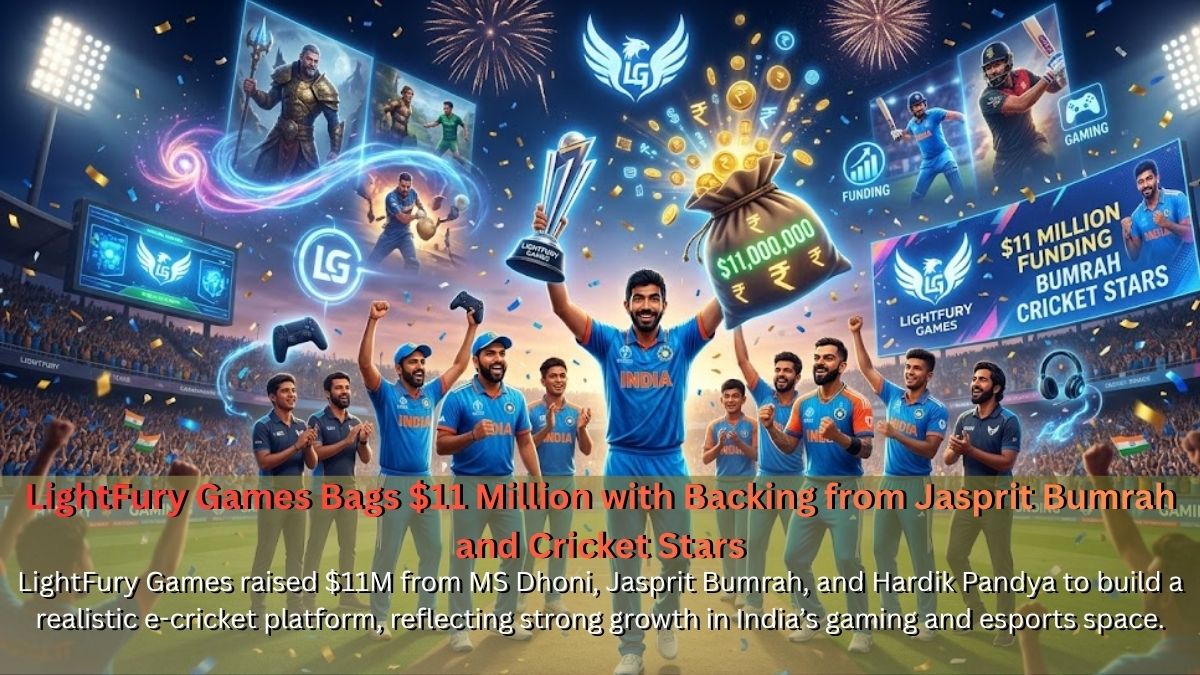
LightFury Games, a fast-emerging player in the global gaming startup ecosystem, has raised $11 million in a fresh funding round backed by prominent cricket stars including Jasprit Bumrah, MS Dhoni, and Hardik Pandya. This funding marks a significant moment not just for the company but also for the intersection of sports, technology, and gaming innovation in India. The investment reflects a growing trend where athletes diversify into venture capital and support tech-driven startups.
The newly raised capital will help LightFury Games accelerate its flagship project, an e-cricket gaming platform designed to transform how cricket is experienced digitally. The company aims to combine immersive gameplay with real-world cricket dynamics, offering users a more realistic and engaging gaming experience. With cricket being a massive cultural and commercial force in India and across global markets, the startup is strategically positioned to tap into a large and loyal audience base.
Founded by industry veterans with experience in gaming and technology, LightFury Games is building products that cater to both casual players and competitive esports enthusiasts. The startup’s focus on innovation, advanced gaming mechanics, and community engagement has helped it attract high-profile investors and industry attention.
This funding round highlights the increasing momentum in India’s gaming sector, which continues to grow rapidly due to smartphone penetration, affordable internet, and rising interest in esports. Moreover, celebrity-backed investments are shaping new startup trends by bringing visibility, credibility, and fan engagement into business models. As LightFury Games scales its operations, the company plans to expand globally while strengthening its presence in India. The funding also signals confidence in the startup’s long-term vision and the potential of cricket-based gaming as a disruptive tech category.
1. Introduction to LightFury Games and Its Latest Funding
1.1 LightFury Games Secures Major Investment
There’s a certain moment in every startup’s journey when things stop feeling like an experiment and start feeling real. For LightFury Games, that moment arrived with its $11 million funding round. Not just because of the size of the cheque, but because of who chose to believe in the vision. When names like MS Dhoni, Jasprit Bumrah, and Hardik Pandya come on board, it changes the narrative instantly. These aren’t passive investors chasing trends. These are individuals who understand pressure, performance, and the psychology of millions of fans. Their involvement signals something deeper than capital. It signals conviction.
Think about it for a second. Cricket in India isn’t just a sport. It’s an emotion that shapes conversations, identities, even daily routines. Now imagine translating that emotional intensity into a digital gaming experience. That’s the bet LightFury Games is making. And clearly, it’s a bet that experienced athletes are willing to stand behind. What makes this funding even more interesting is the timing. The gaming ecosystem in India has been growing quietly for years, but now it’s hitting a point where it’s impossible to ignore. With smartphones in nearly every hand and data costs among the lowest globally, gaming is no longer limited to urban elites. It’s everywhere. Small towns, rural areas, first-time internet users. Everyone is part of the story now.
This is where LightFury Games fits in. It’s not trying to build just another casual game. It’s trying to build something that feels authentic to cricket fans. Something that captures strategy, tension, and the unpredictability of the sport. And that’s why this funding matters. It’s not just money entering a startup. It’s belief entering a category.
1.2 Why This Funding Matters
If you’ve been tracking startup trends in India closely, you’ll notice a subtle but important shift happening. A few years ago, funding headlines were dominated by traditional venture capital firms and tech founders. Today, the ecosystem looks very different. Athletes, entertainers, and creators are stepping into the role of investors. Not as brand ambassadors, but as stakeholders. The participation of MS Dhoni, Jasprit Bumrah, and Hardik Pandya in LightFury Games is a perfect example of this shift. These individuals have spent years building personal brands that command trust across millions. When they invest, they bring more than capital. They bring cultural relevance.
From a startup perspective, that’s incredibly powerful. It means faster visibility. Stronger credibility. And often, deeper user engagement. A cricket fan who sees their favorite player associated with a gaming platform is naturally more curious, more open to trying it out. But beyond the celebrity angle, there’s a bigger story here. The gaming industry itself is evolving rapidly. Globally, gaming has already surpassed movies and music in terms of revenue. India is now catching up, and fast.
What’s driving this growth?
- A young population that is comfortable with digital experiences
- Rising interest in esports and competitive gaming
- Better internet infrastructure
- Increased investor confidence in gaming startups
LightFury Games sits right at the intersection of these trends. It’s not just riding the wave. It’s trying to shape it. And that’s why this funding round stands out. It reflects a broader confidence in India’s ability to build world-class gaming products. Not just for domestic users, but for a global audience. In many ways, this is a signal moment. A reminder that India’s startup ecosystem is no longer just about fintech or ecommerce. Gaming is stepping into the spotlight, and it’s here to stay.
2. The Startup Journey of LightFury Games
2.1 Founding Vision and Background
Every startup begins with a question. For LightFury Games, that question was simple but powerful: Why doesn’t cricket gaming feel as real as the sport itself? Cricket fans don’t just watch matches. They analyze them. They debate strategies, question captaincy decisions, predict outcomes ball by ball. It’s an incredibly interactive experience, even when you’re just sitting in front of a screen. The founders of LightFury Games saw a gap here. Most existing cricket games focused on surface-level entertainment. Hit the ball, score runs, move on. But they rarely captured the deeper layers of the sport. The strategy. The pressure. The mental game.
So the vision became clear. Build a platform that doesn’t just simulate cricket, but recreates the feeling of being part of it. This meant going beyond traditional game design. The team spent time understanding player psychology, fan behavior, and esports dynamics. They looked at how users interact with games over long periods. What keeps them engaged? What makes them come back? It wasn’t about launching quickly. It was about building something meaningful. And that patience shows.
2.2 Early Challenges and Growth Strategy
Of course, vision alone doesn’t build a company. Execution does. And execution, especially in gaming, is never easy. One of the biggest challenges LightFury Games faced early on was balancing ambition with resources. High-quality gaming experiences require significant investment. From graphics and physics engines to backend infrastructure, everything demands precision and capital. Then there’s the competition.
The gaming market is crowded. New apps launch every week. User attention is limited. Retention is even harder. In such an environment, standing out requires more than just a good product. It requires a strong identity. LightFury Games approached this problem thoughtfully. Instead of trying to compete with everyone, they focused on a specific niche: cricket enthusiasts who crave depth and realism. This clarity helped them shape their product and messaging more effectively.
They also prioritized community building early on. Rather than treating users as passive players, they treated them as participants in the journey. Feedback loops were tight. Iterations were constant. There’s something very real about this phase of a startup. It’s messy, uncertain, often exhausting. But it’s also where the foundation is built. And in LightFury’s case, that foundation seems solid.
3. LightFury Games Business Model Explained
3.1 How the Platform Works
At its core, LightFury Games is building an e-cricket ecosystem. But calling it just a “game” would be an oversimplification. The platform is designed to mirror real-world cricket scenarios as closely as possible. Users don’t just play matches. They make decisions. They manage teams. Think like captains. Every aspect of the experience is built around immersion.
- Match simulations that reflect real cricket dynamics
- Strategic decision-making during gameplay
- Competitive modes that allow players to test their skills globally
The idea is to create a sense of ownership. When a player wins, it should feel earned. When they lose, it should feel like a lesson. This is what separates engaging games from forgettable ones. And if executed well, it can create a very loyal user base.
3.2 Revenue Model and Monetization
Let’s talk about money. Because at the end of the day, a startup needs to be sustainable. LightFury Games follows a layered monetization strategy, which is quite common among successful gaming platforms globally.
First, there are in-app purchases. These could include upgrades, customizations, or exclusive features that enhance the gameplay experience. Second, subscriptions. This model works well for users who want a more premium, uninterrupted experience. It also provides predictable revenue for the company. Third, esports tournaments. This is where things get interesting. Competitive gaming is growing rapidly, and cricket-based esports has huge untapped potential in India. Organized tournaments can drive both engagement and revenue.
Then there are brand partnerships and advertising. Given the involvement of high-profile athletes, LightFury Games is well-positioned to attract strong brand collaborations. These partnerships can open up entirely new revenue streams. But here’s the key point. A good business model isn’t just about multiple revenue streams. It’s about aligning monetization with user experience. If users feel forced to spend, they leave. If they feel value, they stay. LightFury Games seems to understand this balance. And that might be its biggest advantage going forward.
4. Products and Services Offered by LightFury Games
4.1 Core Product: E-Cricket Gaming Platform
If you strip everything down, the heart of LightFury Games is its e-cricket platform. But calling it just a “product” feels a bit mechanical. What they’re really building is an experience that tries to answer a very emotional need.
Every cricket fan knows that feeling. You’re watching a match, and somewhere in your head you’re thinking, why didn’t they bowl a slower one here? why that field placement? why that shot? There’s always a sense that you could have played it differently. Better, even. LightFury’s platform taps into exactly that instinct. This isn’t the kind of game where you mindlessly tap the screen and chase a high score. It’s designed to slow you down, to make you think like a captain. You’re not just reacting. You’re planning. Adjusting strategies mid-game. Dealing with pressure when the required run rate climbs or when you’re defending a low total.
The realism isn’t just visual. It’s psychological. Matches are built to reflect actual cricketing situations. Pitch conditions matter. Timing matters. Decisions matter. And when things go wrong, it doesn’t feel random. It feels like a consequence of your choices. That’s a very different kind of engagement compared to traditional mobile games. Then comes the competitive layer. Leagues, tournaments, global matchups. These aren’t just add-ons. They are central to the experience. Because cricket, at its core, is about competition. Rivalries. Comebacks. Moments of brilliance.
And what makes this powerful is the community around it. You’re not playing alone. You’re part of a larger ecosystem of fans who care about the game as much as you do. There’s discussion, comparison, bragging rights. Over time, this creates something deeper than user engagement. It creates belonging. That’s the kind of stickiness most startups struggle to build.
4.2 Future Product Expansion Plans
What’s interesting about LightFury Games is that it doesn’t seem content with staying a single-product company. The ambition clearly goes beyond cricket, even though cricket is the starting point. And that’s a smart move. If you look at how global gaming companies evolve, they rarely stay confined to one format or one genre. They build ecosystems. Once they understand user behavior deeply, they expand horizontally. LightFury appears to be moving in that direction.
There are strong signals that the company is exploring other sports. Not just replicating the same model, but adapting it. Because each sport has its own rhythm, its own fan psychology. Football, for example, is continuous and fast-paced. Cricket is more strategic and episodic. Translating those nuances into gameplay requires a different mindset. Then there’s the technology layer.
AI is likely to play a big role in how the platform evolves. Imagine gameplay that adapts to your style. Opponents that learn from your past decisions. Match simulations that feel less scripted and more organic. That’s where things get exciting. There’s also growing industry chatter around blockchain and digital ownership in gaming. While it’s still early and often overhyped, the idea of owning in-game assets or achievements has real potential if implemented carefully. But here’s the key. Expansion only works if the core remains strong. If LightFury can keep refining its cricket platform while slowly layering new experiences, it can build something much bigger than a single game. It can build a gaming brand.
5. Problems Solved by LightFury Games
5.1 Lack of Realistic Cricket Gaming
Let’s be honest. Most cricket games out there have always felt a bit… shallow. They capture the surface. The visuals, the stadiums, the players. But they rarely capture the soul of the sport. The tension of a close chase. The mental battle between a bowler and a batsman. The small decisions that change the course of a match. For years, fans have settled for less because there weren’t better alternatives.
LightFury Games is trying to change that. By focusing on simulation and decision-making, it brings back the complexity that makes cricket beautiful. It respects the intelligence of the player. It assumes that users don’t just want entertainment. They want authenticity. And when a game starts to feel real, something interesting happens. You stop playing it casually. You start investing in it emotionally. That’s a big shift.
5.2 Limited Esports Opportunities in Cricket
Esports in India has been dominated by a few genres. Shooter games, battle royale formats, fast-paced competitions. Cricket, despite being the country’s most loved sport, hasn’t had a strong presence in competitive gaming. That gap has always felt strange. Millions of fans. Deep understanding of the game. Endless discussions about tactics. And yet, very limited opportunities to compete in a structured, digital format.
LightFury Games is stepping into that gap. By building tournament structures and competitive modes, it’s creating a pathway for cricket fans to not just watch or play casually, but to compete seriously. To test their understanding of the game against others. This could have a ripple effect. If done right, it can create a new category within Indian esports. One that feels culturally rooted, not imported. And that matters more than people realize.
5.3 Engagement Gap for Cricket Fans
There’s something about being a cricket fan that’s both intense and passive at the same time. You feel everything. The highs, the lows, the frustration, the excitement. But your role is limited. You’re watching from the outside. Over time, that creates a gap.
Fans want to participate. They want to influence outcomes, even if it’s in a simulated environment. They want to test their understanding, prove their instincts right. LightFury Games bridges that gap. It turns passive consumption into active participation. It gives fans a space where their knowledge matters. Where their decisions have consequences. And that’s deeply satisfying. Because at the end of the day, people don’t just want to watch stories. They want to be part of them.
6. Funding Details and Investor Insights
6.1 Breakdown of the $11 Million Funding
Funding announcements often sound glamorous from the outside. Big numbers, big names, headlines everywhere. But inside a startup, funding means something very different. It means breathing room. For LightFury Games, the $11 million round is not just capital. It’s time. Time to build better technology. Time to hire the right people. Experiment without the constant pressure of survival.
In practical terms, this funding will likely go into a few critical areas:
- Strengthening the core product and gameplay mechanics
- Scaling infrastructure to handle growing user demand
- Expanding the team across engineering, design, and marketing
- Building partnerships and distribution channels
Gaming is resource-intensive. There are no shortcuts. Quality takes time and investment. This round gives LightFury the ability to focus on quality without cutting corners.
6.2 Role of Celebrity Investors
The presence of MS Dhoni, Jasprit Bumrah, and Hardik Pandya in this funding round is not just a marketing angle. It’s a strategic advantage. Each of these players represents a different kind of influence. Dhoni brings trust and calm authority. Bumrah represents precision and discipline. Pandya brings energy and mass appeal. Together, they cover a wide spectrum of the cricket audience. From a startup’s perspective, this is invaluable. User acquisition becomes easier. Brand recall becomes stronger. Partnerships become more accessible. But beyond all of this, there’s something less tangible but equally important. Credibility.
When people see respected athletes backing a product, they’re more willing to give it a chance. Especially in a space like gaming, where trust can be fragile. And there’s another layer to this. Athletes understand performance. They understand competition. They understand what it takes to stay relevant over time. If they choose to be actively involved, even at a strategic level, their insights can shape the product in meaningful ways. That’s something money alone cannot buy.
7. Industry Trends and Market Growth
7.1 Growth of Gaming and Esports Industry
The growth of gaming in India hasn’t been sudden. It’s been building quietly, layer by layer. Cheap data changed access. Smartphones changed behavior. And over time, gaming moved from being a niche hobby to a mainstream activity. Today, it cuts across demographics. Students, working professionals, small-town users, even older audiences. Everyone is part of this ecosystem in some way. Esports, in particular, is adding a new dimension.
It’s turning gaming into something more structured. More competitive. More aspirational. For many young users, it’s no longer just entertainment. It’s a potential career path. This shift is attracting serious attention from investors. Because where there is attention, there is opportunity. LightFury Games is entering this market at a time when the foundations are already strong. The audience is ready. The infrastructure is improving. The appetite for new experiences is high. That combination doesn’t come often.
7.2 Rise of Athlete Investments in Startups
One of the most fascinating shifts in the startup ecosystem is the rise of athletes as investors. Not long ago, most athletes focused on endorsements. Brand deals, advertisements, short-term associations. Today, many of them are thinking long-term. They’re investing. They’re building portfolios. Aligning themselves with companies that reflect their interests and values.
The involvement of MS Dhoni, Jasprit Bumrah, and Hardik Pandya in LightFury Games is part of this broader trend. And it makes sense. Athletes have spent years building influence and understanding audiences. Startups need exactly that. It’s a natural fit. But there’s also a mindset shift here. Investing in startups requires patience. It requires belief in uncertain outcomes. In many ways, it’s similar to sport. You prepare, you perform, but you don’t control everything. Maybe that’s why athletes are increasingly comfortable in this space. They understand the journey.
8. Competitor Analysis
8.1 Direct Competitors
No startup operates in isolation, especially not in gaming. If anything, gaming is one of the most brutally competitive spaces out there. Attention spans are short, user loyalty is fragile, and new alternatives are always one download away. For LightFury Games, the most obvious competition comes from established cricket gaming titles. These are platforms that have been around for years, refining gameplay, building user bases, and understanding what keeps players hooked. Many of these games have done a decent job at delivering entertainment. They’ve built recognizable brands, loyal communities, and polished user interfaces. Some even have licensing deals, giving them access to real teams, players, and stadiums. But here’s where things get interesting.
Despite all that, a large portion of users still feel something is missing. The gameplay often leans heavily toward arcade-style mechanics. It’s quick, accessible, and fun in short bursts, but it doesn’t always satisfy the deeper cricket fan. The one who wants to think, strategize, and feel the pressure of real match situations. This is the gap LightFury Games is trying to step into. Instead of competing purely on graphics or brand recall, it’s competing on experience. On how closely it can mirror the emotional and strategic depth of real cricket. That’s a harder problem to solve, but if solved well, it creates a very different kind of loyalty. Because once a user feels understood, they don’t switch easily.
8.2 Indirect Competitors
Sometimes the biggest competition isn’t obvious. LightFury Games isn’t just competing with cricket games. It’s competing with everything that demands a user’s time on their phone. Think about it. A user opens their device with limited time and a hundred options. They could play a battle royale game, scroll through social media, watch short videos, or join a fantasy sports contest. Platforms like fantasy cricket apps have built massive user bases by tapping into the analytical side of fans. They allow users to create teams, predict performances, and engage with real matches in a more interactive way.
That’s a powerful pull. Then there are general gaming apps. Fast, addictive, easy to pick up. These games may have nothing to do with cricket, but they compete directly for attention. This is where the challenge becomes real. LightFury Games has to convince users that its experience is worth their time. Not just once, but repeatedly. It has to build habits, not just curiosity. And that only happens when the product delivers consistent value.
8.3 Competitive Advantage
So where does LightFury actually stand in all this? Its biggest strength lies in clarity. It knows who it is building for. Not everyone, but a very specific kind of user. The cricket fan who wants more than surface-level engagement. The focus on realism is a strong differentiator. It signals seriousness. It tells users that this is not just another casual game. It’s something that respects the sport. Then comes the esports angle.
By creating structured competition, LightFury is not just building a game. It’s building a platform where skill matters. Where users can improve, compete, and gain recognition. That’s a powerful motivator. And of course, there’s the backing of MS Dhoni, Jasprit Bumrah, and Hardik Pandya. But it’s important to look at this beyond surface-level marketing. Their involvement adds a layer of authenticity. It tells users that people who understand cricket at the highest level see value in this platform. That kind of signal is hard to replicate. Put all of this together, and you get a startup that isn’t trying to outspend competitors, but outthink them.
9. Global and Indian Startup Ecosystem Impact
9.1 Contribution to Indian Startups Growth
There’s something quietly powerful happening in India’s startup ecosystem right now. For years, the conversation was dominated by a few sectors. Fintech, ecommerce, SaaS. Gaming was always there, but it wasn’t at the center of attention. That’s changing.
Startups like LightFury Games are expanding the narrative. They’re showing that innovation doesn’t have to fit into traditional categories. It can come from culture, from entertainment, from the way people connect with things they love. And cricket, in India, is as cultural as it gets. By building around cricket, LightFury is not just creating a product. It’s building something that feels local, familiar, and emotionally relevant. That matters in a country as diverse as India. It also sends a signal to other founders. You don’t always have to chase global trends. Sometimes, the biggest opportunities lie in understanding your own market deeply. And when startups start solving for real, local needs, the entire ecosystem becomes stronger.
9.2 Role in Global Startup Markets
At the same time, LightFury’s ambitions don’t seem limited to India. And they shouldn’t be. Gaming is inherently global. A good game doesn’t need translation. It needs engagement. If the experience is strong, users from different countries will find their way to it. Cricket itself has a global audience. From the UK to Australia to parts of Africa and Asia, the sport has deep roots. That creates a natural pathway for expansion. But global markets are unforgiving.
Competition is sharper. User expectations are higher. And differentiation becomes even more important. For LightFury Games, this means one thing. Execution has to be exceptional. If they can maintain quality while scaling, they have a real shot at becoming a global player. Not just an Indian success story, but a company that competes with international gaming studios. That’s a big leap. But it’s not impossible.
10. Future Roadmap and Expansion Plans
10.1 Scaling Technology and User Base
Growth in gaming is rarely linear. It comes in waves. One moment, you’re building quietly. The next, a surge of users arrives, and suddenly your systems are being tested in ways you didn’t fully anticipate. This is where the recent funding becomes critical.
Scaling technology isn’t just about adding servers. It’s about building infrastructure that can handle unpredictability. Matchmaking systems, real-time gameplay, user data, all of it has to work seamlessly. Even small lags can break immersion. On the user side, acquisition is only half the battle. Retention is where real success lies. LightFury will need to keep users engaged over long periods. That means constant updates, new features, better gameplay mechanics. It’s an ongoing process. And it requires discipline.
10.2 Entering Global Markets
Expansion sounds exciting when you say it out loud. But in reality, it’s complex. Different markets behave differently. What works in India may not work elsewhere. User preferences, payment behaviors, gaming habits, everything varies. LightFury Games will need to adapt.
Localization will be key. Not just language, but experience. The game has to feel relevant to users in different regions. Partnerships can also play a big role. Collaborating with local players, platforms, or communities can accelerate entry into new markets. But none of this works without a strong core product. Global success is built on local excellence.
12. Learning for Startups and Entrepreneurs
12.1 Key Takeaways from LightFury Games Success
If you step back and look at LightFury’s journey so far, a few clear lessons emerge. The first is simple, but often ignored. Solve a real problem. In this case, the problem wasn’t obvious at first glance. Cricket games already existed. But the deeper issue was a lack of authenticity and engagement. LightFury identified that gap and built around it.
The second lesson is patience. Good products take time. Especially in gaming. There are no shortcuts to quality. Founders who rush often end up rebuilding later. LightFury seems to have taken the slower, more deliberate path. And that usually pays off.
12.2 Importance of Innovation and Strategy
Innovation isn’t just about new ideas. It’s about applying those ideas in a way that creates value. LightFury’s innovation lies in how it combines realism, strategy, and competition. It’s not reinventing cricket. It’s reimagining how cricket can be experienced digitally. But innovation alone isn’t enough.
Strategy is what turns ideas into sustainable businesses. Clear positioning, focused execution, and smart resource allocation. These are the things that separate promising startups from successful ones. And in a crowded market like gaming, strategy becomes even more important.
12.3 Value of Strategic Investors
Not all investors are equal. Some bring money. Others bring something more. The involvement of MS Dhoni, Jasprit Bumrah, and Hardik Pandya highlights the importance of choosing the right kind of backing.
These are individuals who understand the audience LightFury is targeting. They bring credibility, visibility, and potentially even insights into the sport itself. For a startup, that kind of alignment is invaluable. It’s not just about raising funds. It’s about building a support system that helps you grow in the right direction.
About foundlanes.com
foundlanes.com is India’s leading startup idea discovery platform. It helps entrepreneurs find actionable startup opportunities, market insights, and industry-specific guidance to turn ideas into real businesses. With deep research and practical resources, foundlanes supports founders at every stage, from idea validation to launch and growth.