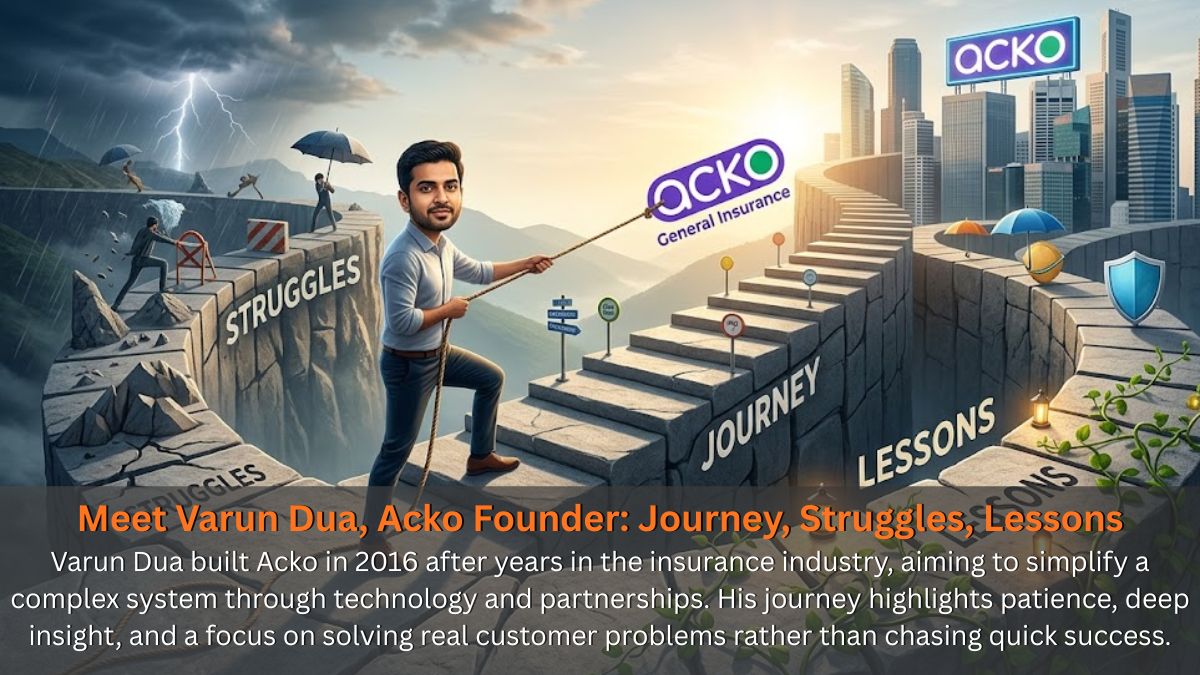
Varun Dua’s story is one of persistence, pattern recognition, and long-term conviction in a slow-moving industry. This deep-dive into the Varun Dua journey explores how an entrepreneur who spent years inside India’s insurance ecosystem eventually built one of the country’s most talked-about insurtech startups, Acko. Founded in 2016 and headquartered in Mumbai, Acko is a digital-first insurance company that aims to simplify and modernize how Indians buy and experience insurance. The company operates without traditional agents, relying instead on technology, partnerships, and direct distribution.
Before starting Acko, Varun Dua had already spent over a decade in the insurance and financial services space, including founding GlitterBug Technologies, a venture backed by major investors. His exposure to the inefficiencies of the insurance industry became the foundation for his next big move. He saw a system weighed down by paperwork, commissions, and poor customer experience.
Acko was built to challenge that system. It offers bite-sized, contextual insurance products embedded into platforms people already use, from ride-hailing apps to e-commerce platforms. Over the years, the company has raised significant capital from global investors and achieved a high valuation, reflecting strong confidence in its model. This Varun Dua success story is not about overnight success. It is about staying close to a problem for years, understanding it deeply, and then building a solution that aligns with changing consumer behavior. From early struggles and skepticism to scaling a category-defining company, his journey offers practical lessons for anyone building in complex, regulated industries.
1. Background and Early Life
1.1 Early Life and Family Background
There isn’t a lot of publicly documented detail about Varun Dua’s childhood, but what becomes clear when you look at his journey is the kind of mindset he developed early on. He wasn’t someone chasing quick wins or glamorous ideas. Drawn to understanding how things actually work beneath the surface. He grew up in an environment that valued education, but more importantly, practical thinking. That matters. Because the difference between someone who builds a flashy startup and someone who builds a durable company often starts right there.
You can see it in the way he later approached business problems. He didn’t try to reinvent everything overnight. Instead, he focused on deeply broken systems. The kind that most people ignore because they look too complex to fix. Insurance was one of them. That early conditioning shaped a founder who was patient, analytical, and comfortable working on problems that don’t offer instant gratification.
1.2 Education and Early Influences
Varun Dua’s professional foundation was built inside the system he would later disrupt. He worked at companies like Tata AIG and Franklin Templeton, where he got a front-row view of how financial services actually operate. And this is where things get interesting. When you work inside large financial institutions, you start noticing patterns that outsiders don’t see. You see how products are designed, how they’re sold, and more importantly, where they fail customers.
In insurance, the gaps were obvious:
- Products were complicated and poorly explained
- Distribution depended heavily on agents
- Costs were inflated because of multiple layers
- Claims processes often frustrated customers
This wasn’t just theory for him. He saw customers struggle. He saw inefficiencies repeat. Over time, these weren’t just observations. They became convictions. And that’s what separates a future founder from an employee. He didn’t just accept the system. He started questioning it.
2. Founder and Company Overview
Varun Dua is best known as the founder of Acko, but his journey into entrepreneurship wasn’t impulsive. It was a slow, deliberate shift built on years of experience and clarity. When he launched Acko in 2016, the idea wasn’t just to create another insurance company. It was to rethink how insurance should exist in a digital-first world.
Acko operates very differently from traditional insurers:
- No heavy dependence on agents
- Fully digital purchase and claims experience
- Simple, transparent products
- Partnerships with platforms for embedded insurance
Instead of asking customers to go out and buy insurance, Acko brings insurance to where the customer already is. For example, offering coverage at the point of booking a ride or purchasing a product.
That shift sounds simple, but it changes everything:
- Customer acquisition costs drop
- Experience becomes seamless
- Trust improves because there’s less friction
Acko didn’t just digitize insurance. It removed layers that were never necessary in the first place. And that’s why it stands out among insurtech startups in India. It’s not innovation for the sake of it. It’s structural correction.
3. The Problem, Insight, and Trigger
The problem Varun Dua identified wasn’t surface-level. It was deeply structural. Traditional insurance in India relied heavily on intermediaries. Agents played a central role, which created a chain of consequences:
- Higher costs for customers
- Misaligned incentives (selling vs advising)
- Lack of transparency
- Poor customer understanding of policies
On top of that, claims processes were slow and often painful. Trust was low, and for good reason. Now here’s where his insight stands out. He didn’t think the problem was insurance itself. He believed the delivery model was broken.
If you remove unnecessary intermediaries and rebuild the system using technology:
- Costs can drop significantly
- Products can be simplified
- Claims can become faster and more predictable
- Customers can finally understand what they’re buying
It’s a simple idea on paper. But executing it in a regulated industry like insurance is anything but simple. The trigger wasn’t a single moment. It was years of watching the same inefficiencies repeat. At some point, it becomes impossible to ignore. That’s when experience turns into action.
4. Early Days and Initial Struggles
Starting Acko wasn’t a smooth ride. In fact, it was probably one of the hardest industries to enter. Insurance is tightly regulated. You don’t just launch a product and test it quickly. You need approvals, capital, and credibility from day one. One of the biggest early challenges was belief. Convincing investors, partners, and even customers that a digital-only insurance company could work in India was not easy. At the time, most people still trusted human agents over digital platforms.
There were also real operational challenges:
- Building a reliable tech infrastructure
- Designing products that were both simple and compliant
- Creating trust without physical touchpoints
- Setting up claims systems that actually worked
Progress was slow. And that’s something many founders underestimate. In regulated industries, speed is limited. You can’t brute-force growth. This phase of his journey shows something important. Building something meaningful often feels frustratingly slow at the start. There are no big wins, just small validations. But those small wins compound.
5. Failures, Setbacks, and Self Doubt
No founder talks about this enough, but doubt is constant when you’re building something new. And for Varun Dua, it was no different.
There were moments when things didn’t click:
- Customer acquisition didn’t scale as expected
- Some product experiments didn’t work
- Partnerships took longer to mature
- The business model needed constant refinement
The hardest part wasn’t failure. It was uncertainty. When you’re building in a new category, there’s no clear benchmark. You don’t know if slow growth means the idea is flawed or just early. And then comes the real test. Proving that the model can sustain itself.
For Acko, that meant balancing two things that often conflict:
- Innovation (doing things differently)
- Compliance (following strict regulatory frameworks)
That balance isn’t easy. Push too hard on innovation, and you risk breaking rules. Play it too safe, and you lose the edge. What stands out in his journey is that these weren’t dramatic failures. They were quiet, ongoing struggles. The kind that test your patience more than your confidence. But those phases shape sharper thinking. They force better decisions. And over time, they build a company that’s not just different, but resilient.
6. Validation and Early Traction
For Acko, the real breakthrough didn’t come from aggressive marketing or burning money on customer acquisition. It came from understanding one simple human behavior: people don’t wake up wanting to buy insurance. That insight shaped everything. Instead of chasing customers, Acko quietly inserted itself into moments where insurance actually made sense. Booking a ride. Buying a gadget. Completing an online transaction. These are moments when risk feels real, not theoretical. So rather than saying “buy insurance,” Acko said, “you might need this right now.”
This partnership-led model did two powerful things:
- It reduced friction. No separate search, no long forms, no confusion
- It increased relevance. The product appeared exactly when the need existed
That’s not just distribution. That’s timing. Early traction, especially in motor insurance, proved this approach worked. Motor insurance already had demand. People were required to buy it. But the experience was broken. Complicated forms, delayed claims, and zero clarity.
Acko simplified that experience:
- Faster policy issuance
- Cleaner interfaces
- Quicker claims turnaround
Customers noticed. And more importantly, they came back. This phase wasn’t just about growth numbers. It was about validation. It answered the one question every founder fears: Does this actually work in the real world? For Varun Dua, the answer was finally yes.
7. Funding, Money, and Growth Constraints
Once the model showed promise, capital followed. Acko raised multiple rounds of funding, with backing from players like Amazon and Accel. On the surface, that signals confidence. But funding in insurance isn’t as straightforward as in other startups.
This isn’t a business where you can just raise money and scale overnight. Insurance comes with strict regulatory requirements:
- Capital adequacy norms
- Compliance-heavy operations
- Long-term liabilities
So even when money is available, it’s not fully flexible. A large part of it is locked into ensuring stability and solvency.
That creates a constant tension:
- Investors expect growth
- Regulations demand caution
And somewhere in between, the founder has to make decisions that don’t break either side. There’s also the reality of unit economics. Insurance isn’t a “growth at any cost” game. If claims aren’t managed well, or pricing isn’t accurate, the business can quickly become unsustainable.
So growth at Acko had to be disciplined:
- Invest in technology, but carefully
- Expand partnerships, but selectively
- Scale products, but only when data supports it
It’s a slower, more thoughtful kind of growth. Less hype, more substance.
8. Team Building and Leadership Evolution
In the early days, building the team was one of the hardest problems. Think about it. Acko wasn’t just a tech company. And it wasn’t just an insurance company either. It sat right in the middle.
That meant they needed people who could think in both worlds:
- Engineers who understood financial risk
- Insurance experts who were open to digital disruption
That combination is rare. Hiring wasn’t just about skill. It was about mindset. People had to be comfortable questioning traditional systems while still respecting the realities of regulation. At the same time, Varun Dua himself had to evolve. Early on, founders are involved in everything. Every decision, every hire, every product detail. But that doesn’t scale.
He had to learn:
- When to step in and when to step back
- How to trust people with critical decisions
- How to communicate vision without controlling execution
That transition is uncomfortable. Letting go usually is. But over time, Acko built a team that could handle complexity at scale. Not just execute tasks, but think independently. That’s when a startup starts becoming a real company.
9. Growth, Scaling, and Operational Challenges
Scaling Acko wasn’t just about adding more users. It was about holding the entire system together while everything expanded at once.
Because in insurance, everything is interconnected:
- Technology drives experience
- Experience drives trust
- Trust drives renewals
- Renewals drive sustainability
If one piece breaks, the whole system feels it.
Acko invested heavily in its digital infrastructure. Not just to look modern, but to function better:
- Instant policy issuance
- Automated underwriting processes
- Faster claims handling
But even with strong technology, operational challenges didn’t disappear. Claims management, for example, is where trust is truly tested. Anyone can sell a policy. But when a customer files a claim, that’s when the promise is evaluated. Delays, rejections, or poor communication can destroy credibility.
So Acko had to continuously improve:
- Claims turnaround time
- Transparency in communication
- Accuracy in risk assessment
Scaling also meant dealing with unpredictability. More customers means more edge cases, more exceptions, more pressure on systems. Each stage of growth forced the company to rebuild parts of itself. New processes, new safeguards, new layers of accountability. That’s the hidden side of scaling. It’s not just expansion. It’s constant reconstruction.
10. Personal Sacrifices and Burnout
Behind all the strategy, numbers, and growth charts, there’s a very human cost to building something like Acko. Even though details of Varun Dua’s personal life aren’t widely public, the pattern is familiar across founders. The long hours don’t feel long at first. In the beginning, there’s energy, excitement, even obsession. You’re building something from nothing. But over time, it changes. Decisions pile up. Responsibility grows. Every outcome, good or bad, feels personal.
There’s no real switch-off:
- Even when you’re not working, you’re thinking
- Even small problems feel heavy because they scale
- Even success brings pressure to maintain it
And then there’s the quiet trade-off. Time with family. Time for yourself. Just exist without thinking about the company. Burnout doesn’t always look dramatic. Sometimes it’s just exhaustion that doesn’t go away. Sometimes it’s the weight of always needing to be “on.” What makes it harder is that founders rarely talk about it openly. Because they’re expected to be resilient. To have answers. But the reality is simpler. Building something meaningful takes something out of you. And yet, people like Varun Dua keep going. Not because it’s easy, but because somewhere along the way, the problem they chose to solve starts to matter more than the comfort they gave up.
11. Lessons, Beliefs, and Values
If you step back and look at the journey of Varun Dua, what stands out isn’t just what he built, but how he chose to build it. The first lesson is almost unglamorous, but incredibly powerful: deep domain expertise matters more than surface-level innovation. He didn’t enter insurance as an outsider trying to “disrupt” it overnight. He spent years inside the system. understood where it broke, why it broke, and why previous attempts to fix it didn’t last.
That kind of understanding changes your decisions:
- You don’t chase vanity metrics
- You don’t oversimplify complex problems
- You don’t underestimate regulatory realities
You build with respect for the system, even when you’re trying to change it. Then comes patience. And not the kind people casually talk about. Real patience. The kind where progress feels invisible for long stretches.
Building Acko meant accepting that:
- Approvals would take time
- Customer trust wouldn’t come instantly
- The market wouldn’t shift overnight
There’s a quiet discipline in sticking with a vision when there’s no immediate validation. That’s something most founders struggle with. Another core belief that shaped Acko is transparency. Insurance, by design, has always been confusing. Long documents, hidden conditions, unclear claims processes. That confusion often benefits the seller, not the buyer.
Acko chose to move in the opposite direction:
- Simpler language
- Clearer pricing
- Faster, more predictable claims
This isn’t just a design choice. It’s a philosophical one. It says: we don’t win unless the customer actually understands and trusts what they’re buying. And finally, there’s customer obsession, but not in a superficial way. Not just better UI or smoother onboarding. Real customer focus shows up where it matters most, especially during claims. Because that’s the moment of truth. When something goes wrong in a customer’s life and they turn to your product, that’s when your values are tested. And how you respond defines your brand far more than any marketing campaign ever will.
12. Present Challenges and Future Vision
Today, Acko sits in a very different position than it did in its early days. Back then, the challenge was proving the model could work. Now, the challenge is staying ahead while the rest of the market catches up. Digital insurance in India is no longer a niche idea. More players are entering the space. Traditional insurers are also adapting, investing in technology, and improving their digital experiences. Competition is sharper. Customers are more aware. Expectations are higher.
That creates a new kind of pressure:
- You can’t just be better than the old system
- You have to be better than every new alternative
There’s also the constant presence of regulation. Insurance isn’t a space where you can move fast and break things. Every product, every process, every expansion has to align with strict guidelines.
So growth becomes a balancing act:
- Move fast enough to stay relevant
- Move carefully enough to stay compliant
At the same time, customer expectations keep evolving. What felt seamless a few years ago now feels average. People want:
- Instant everything
- Zero friction
- Complete clarity
Meeting those expectations consistently, at scale, is not easy. And yet, the vision remains steady.
For Varun Dua, the goal hasn’t changed. It’s still about making insurance:
- Simple enough to understand
- Accessible enough to reach everyone
- Relevant enough to feel useful, not forced
The difference now is the scale at which that vision needs to be executed.
13. Future Outlook
The next chapter of Varun Dua’s journey is closely tied to how India itself evolves digitally. More people are coming online. Financial awareness is growing. Transactions are becoming increasingly digital. All of this creates a natural shift toward digital insurance. And in theory, that should benefit Acko. But theory and reality are rarely the same.
With opportunity comes complexity:
- Regulations will evolve, sometimes unpredictably
- New competitors will enter with fresh ideas and capital
- Customer loyalty will remain fragile
Sustaining growth in this environment requires constant reinvention. What worked yesterday won’t guarantee success tomorrow. The real challenge isn’t building a great company once. It’s building it again and again, at every stage of growth.
What gives Acko an edge is the foundation it was built on:
- A partnership-driven distribution model
- Strong technology backbone
- A clear focus on customer experience
But even strong foundations need continuous reinforcement. For Varun Dua, this journey was never just about creating another successful startup. It was about changing how people experience insurance in their everyday lives. And that kind of mission doesn’t really have an endpoint. It evolves. Just like the market. Just like the company. like the person leading it.
About foundlanes.com
foundlanes.com is India’s leading startup idea discovery platform. It helps entrepreneurs find actionable startup opportunities, market insights, and industry-specific guidance to turn ideas into real businesses. With deep research and practical resources, foundlanes supports founders at every stage, from idea validation to launch and growth.