News Summary
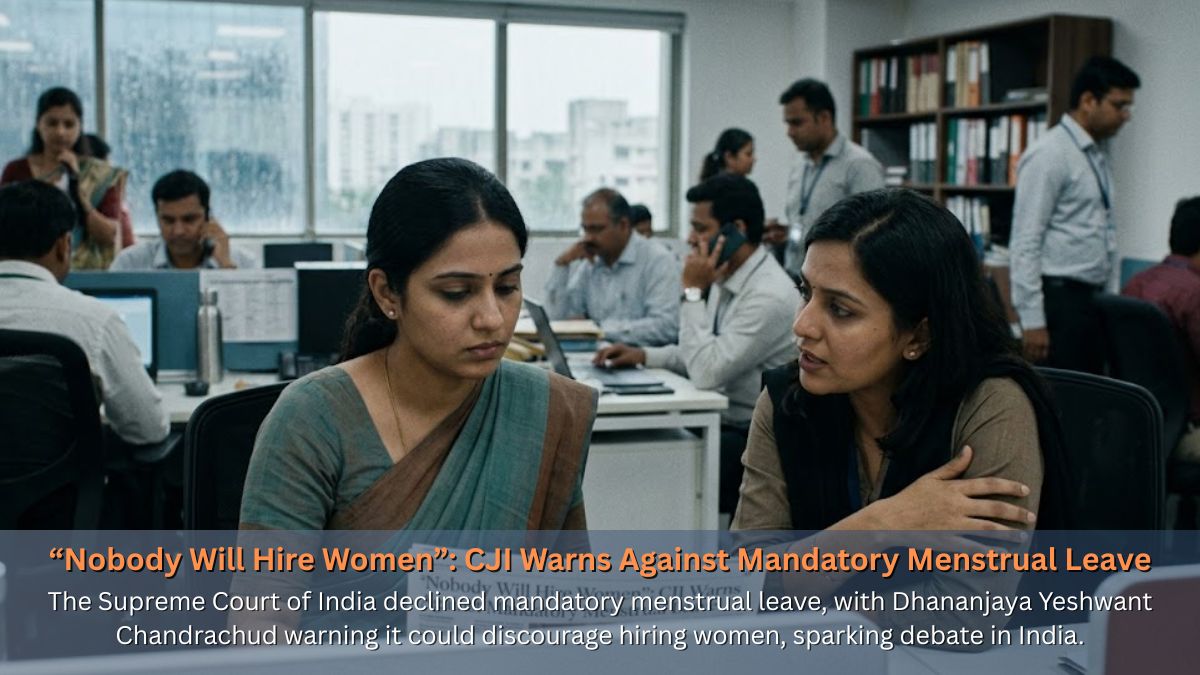
The debate around menstrual leave policies in India has gained national attention after the Supreme Court of India recently refused to mandate menstrual leave across workplaces. During the hearing, the Dhananjaya Yeshwant Chandrachud, Chief Justice of India (CJI), made a remark that quickly became the focus of public discussion: “Nobody Will Hire Women.” The statement came while the court was considering a petition seeking mandatory menstrual leave for working women across the country.
According to the court, while menstrual leave may appear beneficial, making it compulsory through law could unintentionally harm women’s employment opportunities. The bench observed that employers might hesitate to hire women if they are legally required to grant additional leave days every month. As a result, the court warned that such a policy could backfire by discouraging hiring and pushing women out of the workforce. The petition requested that the government create a uniform policy for menstrual leave in both public and private sectors. However, the Supreme Court suggested that the matter should be handled through government policy discussions instead of judicial orders. The bench encouraged the petitioner to approach the Union Ministry of Women and Child Development to explore a broader consultation process.
This discussion has sparked a nationwide debate. Many activists argue that menstrual leave supports women’s health and dignity. Others say mandatory leave may create unintended workplace bias. Several companies and institutions in India already offer voluntary menstrual leave policies. However, there is no national law that mandates such leave. The court’s remark, widely quoted as “Nobody Will Hire Women,” has raised questions about gender equality, workplace policies, and the future of employment regulations in India. As the conversation spreads across the startup ecosystem, corporate sector, and government policy circles, the issue highlights the delicate balance between employee welfare and workplace fairness. The debate also touches broader themes in the startup ecosystem, including startup regulations, hiring trends, workplace policies, and gender diversity in modern organizations.
1. Background of the Case
1.1 Petition Seeking Menstrual Leave Policy
The debate that later sparked the statement “Nobody Will Hire Women” began with a public interest petition filed before the Supreme Court of India. The petition requested the court to direct the government to create a nationwide policy granting menstrual leave for working women. The petitioner argued that menstruation is a natural biological process that often brings intense pain, fatigue, cramps, and emotional strain. Many women continue working through these symptoms because workplaces rarely recognize menstrual health as a legitimate reason for rest. In many offices, women silently manage discomfort while meeting deadlines, attending meetings, and maintaining professional expectations.
Supporters of the petition believed a legal right to menstrual leave would correct this long-standing neglect. They argued that workplace equality should also include recognition of biological realities. Just as maternity leave acknowledges childbirth and recovery, menstrual leave could acknowledge a recurring health condition that affects millions of women every month. However, the judges began examining the issue from another angle. They questioned whether a mandatory law would truly empower women or whether it might create new barriers. Laws often carry unintended consequences, especially when they intersect with employment decisions.
For instance, hiring managers may quietly calculate operational costs when evaluating candidates. If a law mandates additional leave exclusively for women, employers might worry about productivity gaps or staffing challenges. This concern formed the foundation of the court’s hesitation. The bench therefore started asking a deeper question. Would a law meant to support women ultimately harm their job prospects? This concern later shaped the powerful observation that echoed across national media and public discussions.
1.2 Supreme Court’s Initial Observation
During the hearing, the bench led by Dhananjaya Yeshwant Chandrachud, the Chief Justice of India, expressed concern about the potential ripple effects of such a policy. The court acknowledged that menstrual pain is real and often severe. Many women experience debilitating cramps, migraines, nausea, or exhaustion during their cycle. These symptoms can affect productivity and physical comfort at work. However, the judges also looked at the issue through the lens of employment behavior.
Employers often evaluate candidates based on availability, productivity expectations, and operational stability. When legal obligations increase costs or complexity, hiring behavior can shift in subtle but significant ways. That is where the Chief Justice made the observation that sparked national debate. He warned that a mandatory policy could create a perception problem for employers. If the law requires employers to grant recurring leave specifically for women, some companies may see women employees as more “costly” to hire. In simple terms, the court feared a backlash in hiring practices.
That concern led to the widely quoted remark that “Nobody Will Hire Women.” The comment was not a dismissal of women’s health issues. Instead, it was a warning about economic behavior in workplaces. The judges believed that if companies start seeing women employees as requiring additional legal accommodations every month, hiring managers might quietly favor male candidates. Such discrimination may not appear openly in job advertisements. Instead, it may operate silently during recruitment decisions. This subtle bias, the court suggested, could push women out of the workforce rather than protect them.
1.3 Why the Court Refused to Mandate the Policy
After considering the issue, the Supreme Court of India declined to issue a directive mandating menstrual leave. Instead, the bench emphasized that the matter involves complex social, economic, and employment dynamics. Labor laws affect businesses, public institutions, and millions of workers across the country. Therefore, such policies require careful consultation rather than a sudden judicial order. The court advised the petitioner to approach the Union Ministry of Women and Child Development. According to the bench, the government is better positioned to conduct wide consultations with stakeholders.
These consultations could involve employers, labor experts, women’s organizations, medical professionals, and policymakers. Such discussions would help assess the real-world implications of menstrual leave policies. The court’s approach reflected a broader philosophy about policy making. Courts interpret laws, but large-scale social policies are usually designed through legislative and executive processes. By sending the issue to policymakers, the court signaled that the debate deserves deeper study rather than an immediate ruling.
2. The Meaning Behind the “Nobody Will Hire Women” Warning
2.1 Economic Impact on Hiring Decisions
The statement “Nobody Will Hire Women” reflects a deeper concern about how employers make hiring decisions. Most organizations, especially small businesses and startups, operate with tight budgets and lean teams. Hiring a new employee is a significant investment. Companies consider salary costs, training expenses, productivity expectations, and operational needs. If a law requires additional leave days every month for a specific category of employees, some employers may see it as an operational challenge.
For example, imagine a small startup with a team of five employees. If one team member needs to take two additional days off every month due to a legal requirement, the company must redistribute work among other employees or temporarily pause tasks. Large corporations may absorb such changes easily. However, small companies or early-stage startups may find it harder to manage. This economic reality explains why the court raised concerns about unintended consequences. Employers may not openly admit that policies influence hiring preferences. However, workplace economists often note that regulatory costs can quietly shape recruitment behavior. In such scenarios, women candidates could face silent disadvantages during hiring.
2.2 Workplace Bias and Gender Equality
One of the most painful ironies in this debate is that a policy designed to support women could unintentionally create new forms of discrimination. In an ideal workplace, employees are evaluated based on skills, talent, and dedication. However, biases often creep into hiring decisions, sometimes unconsciously. If employers begin associating women with additional leave obligations, they may view women candidates as less “reliable” for continuous work schedules.
This perception is unfair, yet workplace bias often grows from assumptions rather than facts. Women have historically faced similar biases in other contexts. For decades, employers hesitated to hire women due to maternity leave concerns. Some companies feared that women might leave work after marriage or childbirth. Although society has progressed significantly, traces of these assumptions still exist. The court’s remark therefore reflects a realistic understanding of workplace dynamics. The warning was not meant to undermine women’s rights. Instead, it acknowledged that policies must anticipate how employers might react.
2.3 Balancing Welfare and Opportunity
The debate over menstrual leave ultimately reveals a complex balancing act between welfare and opportunity. On one side lies a genuine health concern. Millions of women experience menstrual symptoms that affect physical comfort and emotional wellbeing. Ignoring this reality can make workplaces insensitive and unequal. On the other side lies the challenge of designing policies that do not create unintended disadvantages.
Public policy often requires balancing competing priorities. Lawmakers must protect workers while also ensuring that regulations do not discourage employment opportunities. Some experts suggest flexible solutions instead of rigid mandates. For instance, companies could introduce optional wellness leave that employees can use without specifying reasons. This approach protects privacy while offering flexibility.
Others advocate workplace reforms such as better health awareness, flexible work hours, and remote work options during difficult days. Ultimately, the goal should be simple yet powerful. Workplaces must respect women’s health without creating barriers to employment. Achieving that balance requires thoughtful policy design, honest dialogue, and empathy from both employers and policymakers.
3. Menstrual Leave Policies Around the World
3.1 Countries with Menstrual Leave Laws
While India continues debating menstrual leave policies, several countries have already experimented with such laws. One of the earliest examples comes from Japan, where menstrual leave policies were introduced in the late 1940s. The law allowed women to request time off if they experienced severe menstrual discomfort. Similarly, Indonesia permits women employees to take menstrual leave during the first days of their cycle if symptoms become difficult to manage.
South Korea also recognizes menstrual leave under labor law. Female employees are entitled to a day off each month if needed. Another example is Taiwan, where women are allowed menstrual leave separate from regular sick leave. However, the existence of these laws does not automatically guarantee widespread use. In many workplaces across these countries, women hesitate to request menstrual leave due to stigma or fear of workplace judgment. This reveals an important lesson. Laws alone cannot transform workplace culture. Social attitudes must evolve alongside policies.
3.2 Global Debate on Menstrual Leave
Around the world, menstrual leave remains a sensitive and deeply debated topic. Supporters argue that recognizing menstrual health is a matter of dignity and fairness. They believe workplaces should acknowledge biological differences rather than pretend they do not exist. Many women who support menstrual leave describe deeply personal experiences. Some recall days when severe cramps made it difficult to stand, concentrate, or even commute to work. For these women, menstrual leave represents compassion and understanding.
However, critics worry about the long-term effects on gender equality. Some labor economists warn that labeling women as a special category requiring additional leave may reinforce stereotypes about women being less productive. This concern echoes the warning behind the statement “Nobody Will Hire Women.” The global debate therefore reflects a deeper struggle. Society wants to support women’s health while also protecting equal opportunities in the workplace. Finding that balance remains one of the most important challenges for modern labor policy.
4. Current Menstrual Leave Policies in India
4.1 State-Level Initiatives
Although India does not yet have a national menstrual leave law, some regions have taken independent steps. One notable example comes from Bihar. The state government introduced menstrual leave for women employees decades ago. Under this policy, women government workers can take two days of special leave each month during menstruation. The policy has existed quietly for years and continues to function without major controversy. For many women employees in Bihar, this leave offers a sense of dignity and understanding. It acknowledges that menstruation is not merely a private issue but also a workplace reality.
4.2 Private Companies Offering Menstrual Leave
In recent years, several Indian companies have voluntarily adopted menstrual leave policies. These policies often emerge from corporate efforts to build inclusive workplaces. Companies implementing such policies aim to promote employee wellbeing and attract talent that values progressive work culture. Employees working under these policies often report feeling respected and supported.
However, implementation varies widely. Some companies offer one day of leave per month. Others provide flexible sick leave that employees can use without explanation. Since these policies are voluntary, they reflect the values of individual organizations rather than national regulations.
4.3 Universities and Educational Institutions
The conversation around menstrual leave has also reached universities and colleges. Several educational institutions have introduced menstrual leave for students. These policies allow female students to take leave during severe menstrual discomfort without academic penalties. For many young women, this policy represents an important recognition of menstrual health in academic life.
Students often describe the relief of knowing they will not lose attendance marks or face disciplinary action during painful days. However, as with workplaces, these policies vary widely between institutions. There is still no nationwide framework covering schools, universities, and workplaces together.
5. The Startup Ecosystem and Workplace Policies
5.1 Changing Workplace Culture in Indian Startups
Over the past decade, India has witnessed a remarkable transformation in its startup ecosystem. What once began as a handful of ambitious entrepreneurs working from small offices has grown into one of the world’s most dynamic innovation hubs. According to data from Startup India, the country now has more than 100,000 registered startups, creating millions of jobs and driving new business models across sectors such as fintech, artificial intelligence, health tech, and logistics.
Unlike traditional corporations, startups often pride themselves on building modern workplace cultures. Many founders are young. Many teams are small. And many companies operate with the belief that culture matters as much as code or capital. As a result, Indian startups have experimented with policies that once seemed radical in traditional workplaces. Remote work became common even before the pandemic. Flexible work hours allow employees to manage personal responsibilities alongside professional tasks. Wellness days, mental health support, and inclusive hiring initiatives have slowly entered the vocabulary of modern startup offices.
Yet the recent debate sparked by the statement “Nobody Will Hire Women” has forced founders to pause and reflect. Behind closed doors, startup founders are asking difficult questions. How do we create a workplace that genuinely supports women? At the same time, how do we ensure that policies do not unintentionally influence hiring decisions or operational stability? In many startups, founders share deeply personal experiences. Some founders recall watching female colleagues quietly work through painful menstrual cycles because they feared appearing “weak” in a competitive environment. Others remember employees apologizing for taking a day off when cramps became unbearable.
These stories reveal a simple truth. Workplaces often ignore biological realities. At the same time, founders also understand the fragile nature of early-stage companies. A startup with ten employees depends heavily on each individual. If one person is absent during a critical product launch or investor presentation, the entire team feels the impact. Therefore, the conversation triggered by “Nobody Will Hire Women” has created an emotional and practical dilemma within the startup ecosystem.
Founders want to build compassionate workplaces. They want women employees to feel respected, safe, and understood. Yet they also worry about policies that might unintentionally shape hiring perceptions. Some startups are responding by experimenting with flexible solutions. Instead of labelling leave specifically as “menstrual leave,” they offer wellness leave or personal health days. These policies allow employees to take time off without explaining private health details. In many cases, this approach protects both dignity and equality. The reality is simple but powerful. Startup culture is evolving. And debates like this one are forcing founders to think more deeply about the kind of workplaces they want to build.
5.2 Startup Hiring Trends
The startup ecosystem has become one of the largest generators of new employment opportunities in India. Thousands of young professionals now choose startups over traditional corporate careers. They are drawn by innovation, faster learning, and the excitement of building something from scratch. India’s startup sector employs professionals across engineering, marketing, design, finance, and operations. Cities like Bengaluru, Hyderabad, Mumbai, and Delhi have become vibrant startup hubs where ambitious young people gather to work on new ideas.
However, the hiring dynamics inside startups differ greatly from those in large corporations. Startups operate under intense pressure. Investors expect rapid growth. Founders must deliver results quickly. Resources are limited, and every hiring decision carries weight. For example, a startup with ten employees cannot easily redistribute work when one person is absent. Each team member often manages multiple responsibilities. Developers may also handle product decisions. Marketing professionals may coordinate partnerships and customer support simultaneously. Because of this reality, startup founders often think carefully about operational continuity. When discussions around policies like menstrual leave emerge, founders begin calculating the possible impact. Not out of bias, but out of survival instinct.
Many founders openly admit that they want to hire diverse teams. They believe women bring creativity, empathy, and strong leadership to the workplace. Some of India’s most successful startups today are led by women entrepreneurs who are redefining industries. However, early-stage startups also operate with fragile financial structures. One unexpected operational challenge can affect product launches, investor relationships, and customer delivery timelines. That is why the comment “Nobody Will Hire Women” struck a nerve across the startup community.
Founders understood the warning behind those words. If policies create even a perception that hiring women comes with additional legal complexities, some employers might quietly shift their preferences during recruitment. No founder openly wants such a reality. Yet many admit that hiring decisions are often shaped by practical constraints. This is why the startup ecosystem is now discussing more balanced policy approaches. Founders are exploring solutions that support women employees without creating hiring biases. The conversation is not about rejecting women’s needs. It is about designing systems that protect both equality and opportunity.
6. Business and Economic Perspective
6.1 Employer Concerns
Behind every workplace policy lies a set of economic realities. Employers must balance compassion with operational efficiency. They must ensure that teams remain productive, projects stay on schedule, and customer commitments are fulfilled. For large corporations with thousands of employees, absorbing occasional leave is manageable. Work can easily shift between departments or teams.
However, smaller organizations face a different reality. Imagine a startup with eight employees building a technology product. Each person manages a critical component. If even one employee becomes unavailable during a crucial week, development timelines may slip. Investors waiting for product milestones may grow impatient. This is not a reflection of insensitivity. It is the nature of startup life. Mandatory leave policies introduce legal obligations that companies must follow regardless of operational challenges. Employers must track leave records, adjust work schedules, and sometimes hire additional staff to maintain continuity.
For large companies, these adjustments may appear minor. For small startups, they can influence growth strategies. Therefore, when the court warned that “Nobody Will Hire Women”, it was acknowledging a fundamental economic reality. Businesses often make hiring decisions based on perceived costs and risks. If policies unintentionally signal that one group of employees requires additional compliance or operational adjustments, hiring patterns may quietly shift. This is why economists often caution that workplace policies must be designed carefully. The goal should always be fairness without creating unintended hiring barriers.
6.2 Workforce Participation in India
Another important dimension of this debate is India’s female workforce participation rate. Despite economic growth and expanding education opportunities, women’s participation in the workforce remains relatively low compared to global averages. Several studies estimate that only around one quarter of working-age women in India are part of the labor force.
This statistic reflects deep structural challenges. Social expectations still influence career choices. Many women leave jobs after marriage or childbirth due to caregiving responsibilities. Safety concerns and commuting difficulties also affect employment decisions. In this context, policymakers must be extremely careful when introducing workplace regulations. Every policy must ask a critical question: will it encourage companies to hire more women or fewer?
This is precisely the concern raised during the court hearing. If policies unintentionally reinforce the perception that hiring women involves additional complexity, employers may become cautious. Such caution could slow progress toward gender equality in workplaces. Therefore, the challenge before policymakers is not simply about creating benefits. It is about creating benefits that strengthen women’s presence in the workforce rather than weaken it.
6.3 Balancing Regulations with Growth
India’s startup ecosystem thrives on flexibility. Young companies experiment with new business models, new technologies, and new ways of working. They move quickly because they are not constrained by heavy bureaucratic structures. However, this flexibility also means startups are sensitive to regulatory changes. Excessive regulations can slow hiring decisions, increase compliance costs, and create uncertainty for entrepreneurs. At the same time, the absence of workplace protections can create unfair environments for employees. Therefore, policymakers face a delicate balancing act.
They must design regulations that protect workers without stifling innovation. In the context of menstrual leave, this balance becomes even more important. A rigid nationwide mandate may not work equally well for every company. Large corporations and small startups operate under vastly different conditions. Instead, flexible policy frameworks may offer better outcomes. Companies could be encouraged to adopt wellness leave, flexible work arrangements, or health support programs. Such policies allow organizations to adapt according to their operational realities while still supporting employee wellbeing.
Ultimately, sustainable policy design requires empathy for both sides of the workplace equation. Employees deserve dignity and health support. Employers need operational stability and economic viability. The best policies are those that respect both realities.
7. Role of Government and Policy Institutions
7.1 Government Consultation Process
Recognizing the complexity of the issue, the Supreme Court of India suggested that the matter be examined by policymakers rather than decided through a judicial directive. The court advised the petitioner to approach the Union Ministry of Women and Child Development. This recommendation reflects an important principle of governance. Large social policies require broad consultation before implementation. The ministry has the capacity to engage with multiple stakeholders across the country.
These stakeholders may include employers, labor unions, women’s rights organizations, medical experts, and economists. Each group brings valuable perspectives that can help shape a balanced policy. For example, doctors can provide insights into menstrual health and the severity of symptoms experienced by women. Labor experts can analyze how leave policies influence workplace behavior. Employers can share operational challenges faced by organizations.
Through such discussions, policymakers can move beyond theoretical debates and examine real-life experiences. Consultation processes also create space for listening. Women employees can share personal stories about working through painful cycles. Employers can explain how staffing structures operate in different industries. When these voices come together, policies become more thoughtful and practical.
7.2 Possible Policy Approaches
Instead of imposing a mandatory menstrual leave law across all workplaces, policymakers may explore more flexible solutions. One approach could involve encouraging companies to introduce wellness leave policies. These policies allow employees to take a few days off each year without specifying medical details. Such leave respects employee privacy while providing flexibility for health-related needs. Another possibility is promoting workplace health support programs. Organizations could offer access to medical consultations, awareness workshops, and supportive work environments.
Some companies are also experimenting with hybrid work arrangements. Employees can work from home during days when commuting becomes physically difficult. These approaches focus on empowerment rather than rigid regulation. Ultimately, the goal should be simple but meaningful. Women should feel supported and respected at work. At the same time, policies should strengthen employment opportunities rather than unintentionally limit them. The debate surrounding the phrase “Nobody Will Hire Women” is therefore more than a legal argument. It is a reminder that good intentions must always be paired with thoughtful policy design. Only then can workplaces truly become spaces of equality, dignity, and opportunity.
8. Gender Equality in the Modern Workplace
8.1 Progress and Challenges
Over the past few decades, India has made visible progress toward gender equality in education, entrepreneurship, and leadership. Women today are founders, engineers, investors, scientists, and policymakers. They are building startups, leading global companies, and reshaping industries that were once dominated almost entirely by men. In India’s major startup hubs such as Bengaluru, Hyderabad, and Mumbai, it is no longer unusual to see women leading product teams, heading growth strategies, or pitching companies to venture capital investors.
Yet beneath this visible progress lies a quieter, more complicated story. Despite improvements in education and corporate representation, women’s participation in the workforce remains significantly lower than men’s. Many women step away from careers due to caregiving responsibilities, social expectations, or lack of workplace flexibility. Others face subtle biases during recruitment, promotions, or leadership opportunities. This is why the national debate sparked by the phrase “Nobody Will Hire Women” struck such a deep emotional chord across the country.
For many women professionals, the remark touched a painful truth they have felt but rarely voiced. Some women recall job interviews where they were indirectly asked about marriage plans or family responsibilities. Others remember being told that leadership roles require “long hours” or “constant availability,” statements often used to question women’s commitment. These experiences reveal that gender equality is not only about legal rights. It is also about workplace culture, attitudes, and assumptions. The conversation around menstrual leave sits at the intersection of these realities.
On one hand, recognizing menstrual health is an important step toward acknowledging women’s biological experiences. Many women endure severe menstrual pain while still meeting workplace expectations. For them, supportive policies represent empathy and respect. On the other hand, policymakers must confront a difficult reality. If workplace regulations create even a perception that women employees involve additional obligations, hiring behavior may shift subtly. This is precisely the concern highlighted during the hearing at the Supreme Court of India led by Dhananjaya Yeshwant Chandrachud.
The warning behind “Nobody Will Hire Women” was not a rejection of women’s health concerns. Instead, it was a caution about how economic incentives and hiring behavior sometimes collide with well-intentioned policies. For India, the challenge moving forward is clear. The country must build workplaces that support women’s health, dignity, and professional growth without reinforcing old stereotypes or discouraging employment opportunities. True equality is not achieved simply by adding policies. It is achieved when women can pursue careers without having to constantly prove their reliability, strength, or commitment.
8.2 Corporate Diversity Initiatives
In recent years, many organizations across India have begun addressing gender inequality more seriously. Corporate leaders increasingly recognize that diverse teams are not just socially responsible but also economically beneficial. Studies across global industries show that companies with gender-diverse leadership teams often perform better financially and make more balanced strategic decisions. This understanding has encouraged organizations to launch diversity and inclusion initiatives. Many companies now run leadership development programs specifically designed for women employees. These programs provide mentorship, skill training, and networking opportunities to help women advance into managerial and executive roles.
Several organizations also collaborate with incubators and accelerators to support women entrepreneurs building new companies. These initiatives aim to increase the number of women founders within the startup ecosystem. Inside workplaces, diversity efforts are also becoming more visible. Some companies have introduced return-to-work programs for women who took career breaks due to motherhood or caregiving responsibilities. These programs help women rebuild professional confidence and reconnect with industry networks.
Other organizations have invested in childcare support, flexible working hours, and hybrid work models. These changes make it easier for employees to balance professional ambitions with family responsibilities. For many women professionals, such initiatives have been life-changing. A software engineer in Bengaluru once described how flexible work hours allowed her to continue working after becoming a mother. Without that flexibility, she admitted she might have left the workforce entirely. Stories like these demonstrate that thoughtful workplace policies can reshape careers and lives.
However, the debate triggered by “Nobody Will Hire Women” reminds organizations that diversity initiatives must also consider unintended perceptions. Policies must support women without labeling them as exceptions or creating assumptions about their productivity. Inclusion works best when it normalizes diversity rather than highlighting difference. Companies that succeed in this balance often create cultures where employees feel respected as individuals rather than categories.
9. Industry Trends and Startup Ecosystem Insights
9.1 Startup Culture and Workplace Innovation
The startup ecosystem has always been a laboratory for workplace innovation. Unlike traditional corporations with decades of established policies, startups often experiment with new ways of working. Founders design cultures from scratch, and many see workplace flexibility as a competitive advantage when attracting talent. Young professionals increasingly prefer environments where creativity, autonomy, and wellbeing are valued.
This is why startups often lead the adoption of progressive practices such as remote work, flexible schedules, and mental health support programs. In many early-stage companies, workplace culture evolves through conversations rather than corporate manuals. Employees sit in the same rooms as founders, share ideas openly, and help shape internal policies together. However, startup founders also operate under intense pressure.
Every product launch, investor pitch, or funding milestone can determine the survival of the company. Teams are small, resources are limited, and deadlines are relentless. Because of this reality, founders constantly weigh employee welfare against operational sustainability. When debates like “Nobody Will Hire Women” emerge, startup leaders pay close attention. Many founders genuinely want to create inclusive workplaces that respect women’s health and wellbeing. Yet they must also consider practical questions. How will leave policies affect small teams? How can companies support employees without creating operational uncertainty?
In response, several startups are exploring flexible solutions rather than rigid structures. Instead of labeling leave specifically as menstrual leave, some organizations provide general wellness leave that employees can use for physical or mental health needs. Others offer remote work flexibility during difficult days. These approaches focus on trust and autonomy rather than strict categorization. Over time, such experiments may shape the next generation of workplace policies across the startup ecosystem.
9.2 Hiring News and Startup Regulations
The discussion surrounding “Nobody Will Hire Women” has also reached conversations about hiring trends within the startup ecosystem. Founders, investors, and HR leaders are analyzing how employment regulations influence recruitment decisions. In young companies, hiring choices often determine survival. A startup’s first ten employees usually shape its culture, product direction, and growth trajectory.
Therefore, founders examine every regulatory change carefully. If new policies increase administrative complexity or operational uncertainty, startups may slow down hiring until they fully understand the implications. This is why policymakers must pay attention to the realities of startup life. Large corporations often have dedicated HR teams and legal departments to manage compliance requirements. Startups, however, may have only one HR professional or sometimes none at all.
For early-stage founders juggling product development, fundraising, and market expansion, regulatory clarity becomes extremely important. The conversation sparked by “Nobody Will Hire Women” highlights a crucial lesson for policymakers. Employment policies must be designed not only for large corporations but also for emerging startups that form the backbone of modern economic growth. When regulations align with operational realities, they strengthen both employee protection and business growth.
10. Learning for Startups and Entrepreneurs
The debate surrounding “Nobody Will Hire Women” offers a powerful lesson for founders and entrepreneurs navigating the complex world of workplace policies. At first glance, many policies appear straightforward. Supporting employees seems like an obvious goal. However, real-world outcomes often reveal unexpected consequences. Entrepreneurs must therefore approach workplace policy design with both empathy and foresight.
The most successful founders listen carefully to their teams. They encourage open conversations about employee wellbeing, health challenges, and workplace expectations. When employees feel safe sharing their experiences, leaders gain a deeper understanding of the realities behind policy discussions. For example, women employees may explain how menstrual pain affects concentration or physical energy. These conversations help founders recognize the need for compassionate support systems.
At the same time, entrepreneurs must consider operational sustainability. Early-stage startups often function with limited manpower and tight deadlines. Policies must therefore support employees without creating barriers to recruitment or growth. This is where thoughtful innovation becomes essential. Some startups have introduced flexible wellness leave policies that employees can use whenever necessary without revealing personal health details. Others offer hybrid work models that allow employees to manage difficult days from home.
These approaches maintain dignity, privacy, and operational stability at the same time. Perhaps the most important lesson for entrepreneurs is this: policies should empower employees without defining them by limitations. Women do not want to be treated as exceptions in the workplace. They want equal opportunities, fair evaluation, and supportive environments where their talent can flourish. When founders design policies with empathy, transparency, and practical wisdom, they build organizations that attract diverse talent and sustain long-term growth. In the end, the debate sparked by “Nobody Will Hire Women” is not merely about menstrual leave. It is about the deeper challenge of creating workplaces where equality, compassion, and opportunity exist side by side.
About foundlanes.com
foundlanes.com is India’s leading startup idea discovery platform. It helps entrepreneurs find actionable startup opportunities, market insights, and industry-specific guidance to turn ideas into real businesses. With deep research and practical resources, foundlanes supports founders at every stage, from idea validation to launch and growth.