
News Summary
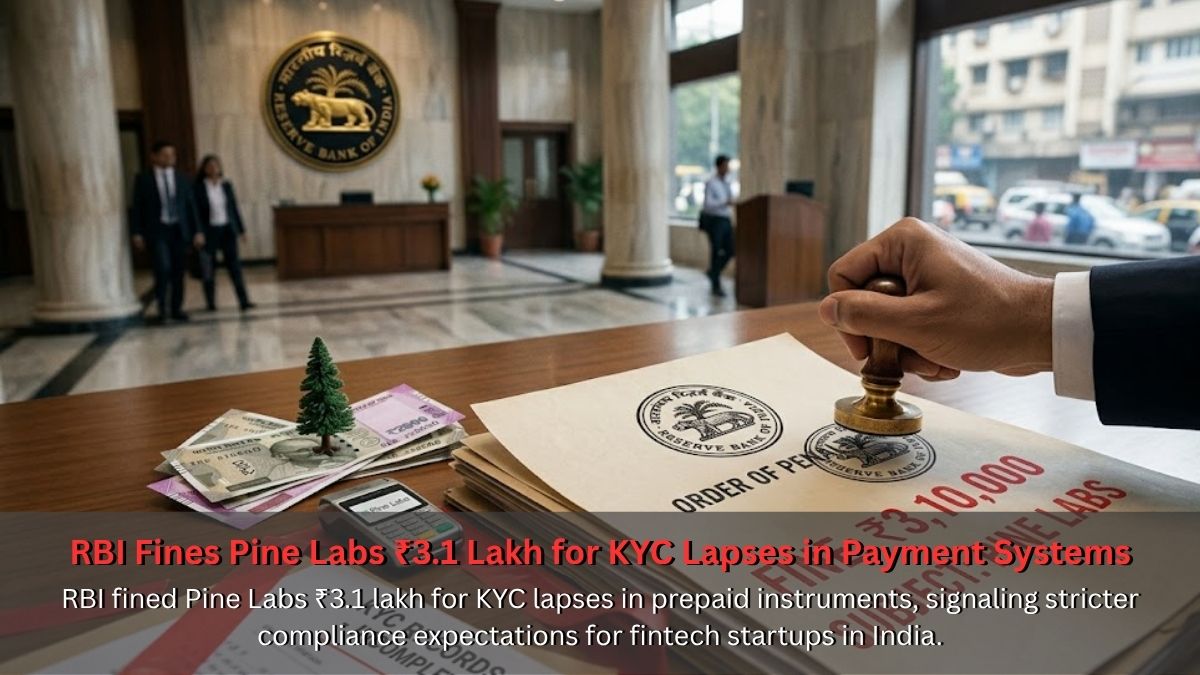
RBI Fines Pine has become a key headline in India’s fintech and startup news landscape after the Reserve Bank of India imposed a monetary penalty of ₹3.1 lakh on Pine Labs for non-compliance with Know Your Customer (KYC) norms related to prepaid payment instruments (PPIs). The action highlights the increasing regulatory scrutiny in India’s rapidly expanding digital payments ecosystem. According to official disclosures, the penalty was imposed because Pine Labs issued certain prepaid payment instruments without completing full KYC requirements. These violations were identified during regulatory supervision, where the central bank found gaps in compliance processes. While the fine amount may appear small, the development sends a strong signal to fintech companies and startup founders about the importance of adhering strictly to financial regulations.
Pine Labs is one of India’s leading fintech startups, offering merchant payment solutions, point-of-sale systems, and digital transaction infrastructure. It plays a significant role in enabling businesses to accept digital payments across offline and online channels. Over the years, the company has evolved into a major player in the fintech ecosystem, backed by global investors and recognized among top startups.
This incident comes at a time when India’s fintech sector is experiencing rapid growth, driven by UPI adoption, digital transactions, and innovation in financial services. However, regulators are also tightening norms to ensure consumer protection and system integrity. Overall, the RBI’s action reinforces the need for strong compliance frameworks within fintech startups. It also reflects the balance regulators aim to maintain between encouraging innovation and ensuring financial discipline in the startup ecosystem.
1. Introduction to the RBI Fines Pine Case
1.1 RBI Fines Pine Labs Over Compliance Issues
The phrase RBI Fines Pine is not just another headline. It reflects a deeper shift happening inside India’s fintech ecosystem. The Reserve Bank of India imposed a penalty of ₹3.1 lakh on Pine Labs Limited after identifying gaps in its KYC processes tied to prepaid payment instruments. At first glance, the amount may look small. However, the implications are far bigger. This was not about the size of the penalty. It was about discipline, trust, and responsibility in a system that handles millions of transactions daily. According to regulatory findings, Pine Labs issued certain full-KYC prepaid instruments without completing the required customer verification. In simple terms, the system moved faster than the checks behind it. That is where the problem began.
In fintech, speed is everything. Startups compete on how fast they can onboard users, approve transactions, and scale operations. But moments like this remind everyone that speed without control creates risk. KYC is not just a regulatory checkbox. It is the first line of defense against fraud, money laundering, and misuse of financial systems. When that layer weakens, even slightly, the entire ecosystem feels the impact. This incident shows how even established players can face compliance gaps. It also highlights how closely regulators are watching the sector. The message is clear. Growth is welcome, but not at the cost of governance.
1.2 Importance in Startup News and Fintech Regulation
This development has quickly become a key talking point in startup news and fintech discussions. It is not just about Pine Labs. It reflects a broader reality that every fintech founder understands but often underestimates. Operating in financial services is very different from running a typical tech startup. Here, every product touches money, and money comes with responsibility. Regulations are not barriers. They are safeguards. When a company like Pine Labs faces a penalty, it sends a signal across the startup ecosystem. Investors notice it. Founders discuss it. Compliance teams revisit their systems.
From an investor’s perspective, compliance issues raise questions. They affect trust, due diligence, and sometimes even valuations. For founders, it becomes a reminder that building a great product is only half the job. The other half is building a system that regulators can trust. There is also a human side to this. Behind every compliance lapse, there are teams working under pressure, chasing growth targets, and trying to stay ahead in a competitive market. Sometimes, processes fail not because of intent, but because of oversight or scaling challenges.
However, regulators do not look at intent alone. They look at outcomes. And in financial systems, even small lapses can have large consequences. This is why the RBI’s action matters. It reinforces discipline in a fast-moving industry. It ensures that innovation does not outpace responsibility. And most importantly, it protects the end user, who trusts these platforms with their money every single day.
2. Background of Pine Labs
2.1 Founding and Growth Journey
Pine Labs did not become a major fintech player overnight. Its journey reflects years of steady execution, market understanding, and constant evolution. The company started with a simple idea. Make payments easier for merchants. At a time when digital payments were still gaining ground in India, Pine Labs focused on building reliable point-of-sale solutions. These machines became a common sight in retail stores, restaurants, and malls. What made Pine Labs different was its approach. It did not just sell hardware. It built an ecosystem around payments. Over time, it added layers like analytics, credit solutions, and buy-now-pay-later services.
As India moved toward digital transactions, especially after demonetization, Pine Labs was already positioned to scale. It had the infrastructure, the merchant network, and the trust of businesses. Global investors noticed this early. The company attracted strong venture capital backing and expanded beyond India into international markets. It became one of the most recognized names in the fintech space. However, growth at this scale is never easy. As systems expand, complexity increases. Managing compliance across products, geographies, and customer segments becomes more challenging. That is where even experienced companies can face gaps.
2.2 Role in the Indian Fintech Ecosystem
Pine Labs plays a crucial role in shaping how digital payments work in India today. It sits at the intersection of merchants, consumers, and financial institutions. For a small shop owner, Pine Labs is not just a payment provider. It is a gateway to digital commerce. It allows them to accept cards, UPI, and other payment modes without friction. For consumers, it ensures smooth transactions. Whether it is splitting payments, using credit options, or accessing offers, the experience often runs through platforms like Pine Labs.
At a larger level, the company contributes to financial inclusion. It helps bring small businesses into the formal economy. It enables data-driven decision-making through transaction insights. However, with this level of influence comes responsibility. The larger the platform, the greater the impact of any lapse. This is why compliance becomes non-negotiable. The fintech ecosystem in India is growing rapidly. New startups are entering the space with innovative ideas. Yet, companies like Pine Labs set the benchmark. Their successes inspire others, and their challenges offer lessons.
3. Understanding the KYC Lapse
3.1 What Went Wrong
To understand this issue, it helps to look beyond the technical details and see the operational reality. The RBI identified that Pine Labs issued certain prepaid payment instruments classified as “full-KYC” without completing the full verification process. In regulatory terms, this is a clear violation. But in real-world terms, it often points to process gaps. It could be a system oversight, a workflow issue, or a lapse in internal controls. In fast-growing companies, such gaps can emerge when scale outpaces process maturity. KYC is meant to confirm that a customer is who they claim to be. It involves verifying identity documents, addresses, and other details. When this process is incomplete, the system becomes vulnerable. Even a small number of such cases can trigger regulatory action. This is because the financial system depends on trust. Once that trust is questioned, the consequences can ripple across the ecosystem.
3.2 Regulatory Framework and Compliance
India’s fintech sector operates under one of the most structured regulatory frameworks in the world. The RBI plays a central role in ensuring stability and transparency. Prepaid payment instruments, in particular, are closely monitored. They are widely used in wallets, gift cards, and payment solutions. Because of their nature, they can be misused if not properly regulated. This is why KYC norms are strict. Full-KYC instruments offer higher transaction limits and more flexibility. In return, they require deeper verification.
For companies, this creates a balancing act. They must offer seamless user experiences while ensuring compliance at every step. In practice, this means investing in systems, training teams, and constantly auditing processes. It also means accepting that compliance is not a one-time task. It is an ongoing commitment. The RBI’s action in this case reinforces that expectation. It shows that even minor deviations will be noticed. More importantly, it reminds the industry that trust is built on consistency, not just innovation.s must follow them strictly.
4. Business Model of Pine Labs
4.1 How Pine Labs Operates
To really understand Pine Labs, you have to step into the shoes of a small business owner. Imagine running a retail store a few years ago, dealing mostly in cash, managing daily collections manually, and worrying about reconciliation at the end of the day. Then digital payments arrive, but the tools feel complex and unreliable. This is where Pine Labs quietly built its strength.
The company created a bridge between merchants and the digital economy. Its point-of-sale machines are not just devices. They are entry points into a larger financial ecosystem. A merchant can accept cards, UPI, and even EMI-based payments from a single terminal. That simplicity is powerful. Over time, Pine Labs expanded beyond physical machines. It integrated online payment systems, allowing businesses to operate seamlessly across offline and digital channels. For many merchants, especially in Tier 2 and Tier 3 cities, this shift was life-changing. What makes the model work is the combination of technology and on-ground execution. Pine Labs did not just build software. It built relationships with merchants, trained them, supported them, and stayed present during their transition to digital. That human layer is often invisible, but it is what makes adoption real.
4.2 Revenue Model
At its core, Pine Labs earns money every time a transaction happens. This is the transaction fee model, and it is the backbone of most fintech businesses. However, what sets Pine Labs apart is how it has layered additional revenue streams on top of this base. The company generates income from value-added services that go beyond simple payment processing. For example, it offers lending solutions to merchants based on their transaction history. This means a shop owner who previously struggled to access credit can now get working capital quickly.
Then there are analytics services. Pine Labs helps merchants understand their customers, track sales patterns, and make better decisions. This data-driven approach adds real value, and businesses are willing to pay for it. Buy-now-pay-later options have also become a strong revenue driver. These services increase customer spending while giving merchants higher conversion rates. What you see here is not just a revenue model. It is a carefully built ecosystem where each service strengthens the other. That is why the company has been able to scale consistently.
5. Products and Services
5.1 Payment Solutions
Pine Labs’ payment solutions are designed to remove friction from transactions. Its POS machines are widely used across retail stores, restaurants, and service businesses. But the real value lies in reliability. When a customer taps their card or scans a QR code, they expect the payment to go through instantly. Pine Labs has built systems that handle high volumes without failure. For a merchant, this reliability builds trust. Every successful transaction reinforces confidence in digital payments. Over time, this changes behavior. Cash becomes secondary, and digital becomes the default. The company has also adapted to changing consumer habits. With the rise of contactless payments and UPI, Pine Labs ensured its systems stayed relevant. This ability to evolve has kept it ahead in a competitive market.
5.2 Financial Services
Beyond payments, Pine Labs has stepped into financial services with a clear purpose. It aims to solve real problems faced by merchants and consumers. One of the biggest challenges for small businesses is access to credit. Traditional banks often require heavy documentation and long approval times. Pine Labs uses transaction data to offer quicker, more accessible credit solutions. This is not just about lending money. It is about enabling growth. A small retailer can now expand inventory, manage cash flow, or invest in improvements without waiting for months. On the consumer side, buy-now-pay-later services have changed how people shop. Customers can make purchases without immediate financial pressure, while merchants benefit from increased sales. These services create a win-win situation. And that is what makes them powerful.
6. Problem Solved by Pine Labs
6.1 Simplifying Digital Payments
Before companies like Pine Labs, digital payments were not easy for everyone. Many small businesses found the systems confusing, expensive, or unreliable. Pine Labs simplified this experience. It made payment acceptance straightforward. A merchant could start accepting digital payments without needing deep technical knowledge. This simplicity matters more than we often realize. Technology adoption is not just about innovation. It is about ease of use. By reducing complexity, Pine Labs helped thousands of businesses transition into the digital economy. That shift has had a lasting impact on how commerce works in India today.
6.2 Supporting SMEs and Retailers
Small and medium businesses are the backbone of India’s economy. Yet, they often operate with limited resources and support. Pine Labs stepped into this gap. It gave these businesses tools that were once available only to large enterprises. From accepting payments to accessing credit, the platform empowers merchants to operate more efficiently. It also helps them compete in a market that is becoming increasingly digital. There is also a deeper impact here. When small businesses grow, they create jobs, support families, and strengthen local economies. In that sense, Pine Labs is not just a fintech company. It is part of a larger economic transformation.
7. Funding and Investor Backing
7.1 Venture Capital and Global Funding
Pine Labs’ journey has been supported by strong investor confidence. Over the years, it has attracted significant venture capital from global investors. This kind of backing does not come easily. Investors look for scalability, strong business models, and market potential. Pine Labs has consistently demonstrated all three. Being part of the top startups in India is not just about valuation. It is about credibility. It shows that the company has built something meaningful and sustainable. However, funding also brings pressure. Investors expect growth, performance, and compliance. Balancing these expectations is not always easy.
7.2 Growth Through Funding Rounds
Each funding round has played a role in Pine Labs’ expansion. The capital has been used to improve technology, expand into new markets, and launch new products. Growth in fintech is not cheap. It requires investment in infrastructure, security, and compliance systems. Funding enables this scale. At the same time, it increases responsibility. As companies grow, they come under greater scrutiny from regulators, investors, and the public. This is where incidents like the RBI fine become important. They remind companies that growth must be matched with strong governance.
8. Industry Trends in Fintech
8.1 Growth of Digital Payments
India’s digital payments landscape has changed dramatically in the last decade. UPI transactions have grown at an unprecedented pace. Today, millions of transactions happen every day across the country. This growth has created massive opportunities for fintech companies. Startups are building innovative solutions for payments, lending, and financial services.
However, this growth is not just about numbers. It reflects a shift in behavior. Consumers are becoming more comfortable with digital transactions. Businesses are adapting quickly. Pine Labs has been a part of this transformation. Its systems support this growing demand, making it a key player in the ecosystem.
8.2 Rising Regulatory Oversight
With growth comes responsibility. As the fintech sector expands, regulators are becoming more vigilant. The RBI has been actively monitoring compliance across payment systems. It is introducing stricter guidelines to protect users and maintain system stability. For startups, this means one thing. Compliance can no longer be an afterthought. It must be built into the system from the beginning.
This shift is not negative. In fact, it strengthens the ecosystem. It builds trust among users and investors. The RBI Fines Pine case is a clear example of this trend. It shows that regulators are serious about maintaining discipline.
9. Competitor Analysis
9.1 Direct Competitors
Pine Labs operates in a highly competitive space. It faces direct competition from other payment platforms and POS providers. These competitors include both emerging startups and established companies. Each one is trying to capture market share through innovation and pricing strategies. Competition drives improvement. It pushes companies to innovate, improve services, and deliver better experiences. However, it also creates pressure. Companies must balance growth with quality and compliance.
9.2 Indirect Competitors
Beyond direct competitors, Pine Labs also faces indirect competition from banks and fintech apps. Banks offer traditional payment solutions, while fintech apps provide alternative ways to transact. UPI-based apps, for example, have changed how people pay. This creates a dynamic market. Companies must constantly adapt to stay relevant. Pine Labs has managed this by evolving its offerings. It continues to expand beyond payments into financial services.
10. Impact of RBI Action
10.1 Signal to the Startup Ecosystem
The RBI Fines Pine case sends a message that goes beyond one company. It speaks to the entire startup ecosystem. It reminds founders that compliance is not optional. core part of building a sustainable business. For many startups, especially in fintech, growth often takes center stage. Teams focus on user acquisition, product development, and scaling operations. But moments like this shift the focus. They bring compliance and governance back into the spotlight.
10.2 Effect on the Fintech Industry
The impact of this action will likely be seen across the fintech industry. Companies will revisit their compliance processes. They will strengthen internal checks and audits. Investors may also become more cautious. They will look closely at compliance frameworks before making decisions. In the long run, this is a positive development. It creates a healthier ecosystem where trust is prioritized.
For Pine Labs, this moment is a challenge, but also an opportunity. It can strengthen its systems, rebuild confidence, and move forward stronger. And for the rest of the industry, it serves as a reminder that in fintech, trust is everything. Once you understand that, everything else falls into place.
11. Learning for Startups and Entrepreneurs
11.1 Importance of Compliance
If there is one lesson that stands out from the RBI Fines Pine case, it is this. Compliance is not a backend function. It is the backbone of any fintech business. In the early days of a startup, compliance often feels like a burden. Founders focus on product, growth, and survival. Paperwork and regulations seem like something to “fix later.” But the truth is, there is no “later” in financial services. Every transaction carries trust. A customer believes their money is safe. A regulator believes the system is secure. An investor believes the company is reliable. The moment compliance weakens, that chain breaks.
Real-world experience shows that even small lapses can lead to bigger consequences. It may start with a fine, but it can escalate to restrictions, reputational damage, or loss of partnerships. And once trust is shaken, rebuilding it takes far more effort than maintaining it. The smartest founders understand this early. They treat compliance as part of the product, not an afterthought. Because in fintech, trust is the product.
11.2 Building Strong Systems
Behind every successful fintech company, there is a strong system that nobody talks about. It is not the app interface or marketing strategy. It is the internal structure that ensures everything works correctly, even under pressure. Building such systems requires patience and discipline. It means setting up clear processes for KYC, transaction monitoring, and audits. It means training teams not just to move fast, but to move right.
In reality, most compliance failures do not happen because people ignore rules. They happen because systems are not designed to handle scale. A process that works for 1,000 users may break at 1 million. That is why startups must think ahead. They must build systems that grow with them. Automation helps, but it is not enough. Human oversight, regular audits, and continuous improvement are equally important.
There is also an emotional side to this. Teams often feel pressure to deliver results quickly. Sales targets, product launches, and investor expectations create urgency. In that rush, shortcuts can feel tempting. But strong systems act as guardrails. They ensure that no matter how fast the company moves, it does not lose control. And in the long run, that stability becomes a competitive advantage.
11.3 Balancing Growth and Regulation
Every founder faces this tension at some point. How do you grow fast while staying compliant? Growth demands speed. Regulation demands caution. At first, these forces seem to pull in opposite directions. But the best companies learn to align them. The reality is simple. Growth without compliance is fragile. It may look impressive on the surface, but it cannot sustain pressure. On the other hand, compliance without growth limits potential.
The balance comes from mindset. Founders must stop seeing regulation as a hurdle. Instead, they should see it as a framework that enables long-term success. Real experience across the startup ecosystem shows that companies which respect regulations early face fewer disruptions later. They build stronger relationships with banks, regulators, and partners. They also attract better investors. Ignoring rules, even unintentionally, creates cracks in the foundation. And those cracks widen as the company scales. The RBI Fines Pine moment is not just a warning. It is a reminder. A reminder that sustainable growth is built on discipline, not shortcuts. For entrepreneurs, the takeaway is clear. Build fast, but build responsibly. Because in the end, the companies that last are not just the fastest. They are the most trusted.
About foundlanes.com
foundlanes.com is India’s leading startup idea discovery platform. It helps entrepreneurs find actionable startup opportunities, market insights, and industry-specific guidance to turn ideas into real businesses. With deep research and practical resources, foundlanes supports founders at every stage, from idea validation to launch and growth.