News Summary
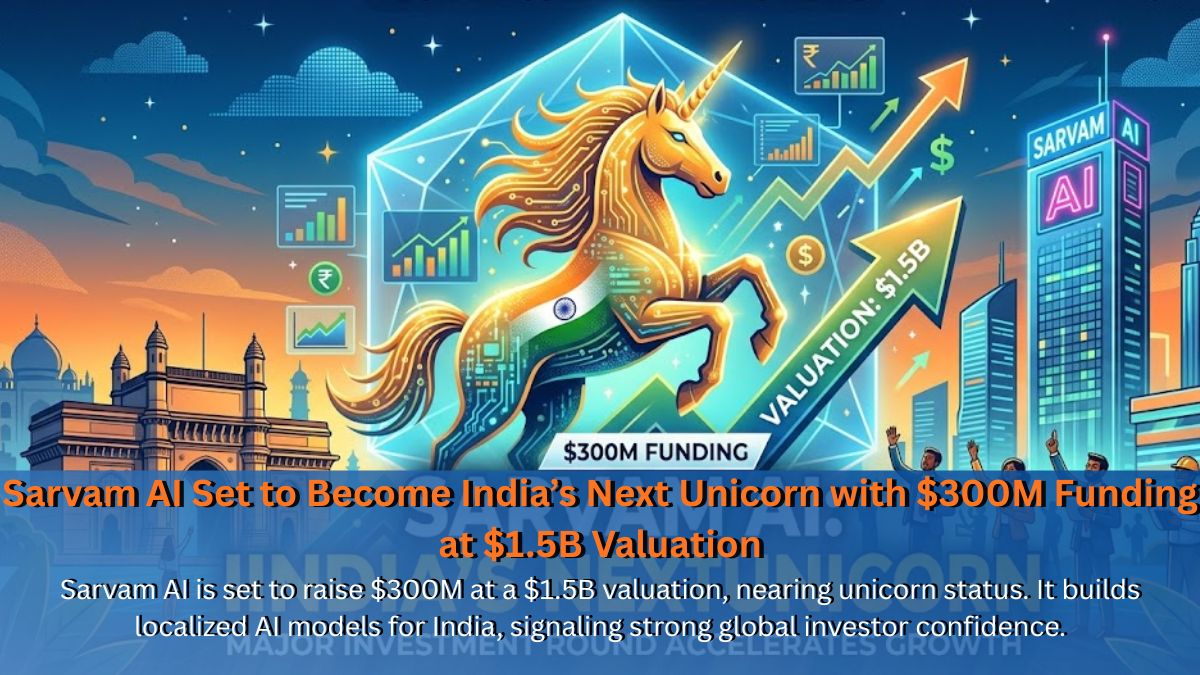
Sarvam AI is emerging as one of the most closely watched AI startups in India, with reports indicating that the company is set to raise $300 million at a valuation of $1.5 billion. This development positions Sarvam AI on the verge of joining the elite club of unicorn startups, signaling a major milestone for the Indian startup ecosystem. The funding round, backed by global venture capital investors, highlights growing confidence in India’s artificial intelligence capabilities and its potential to compete globally.
Sarvam AI focuses on building foundational AI models and language technologies tailored for Indian languages and enterprise use cases. The startup aims to bridge a critical gap in AI adoption by offering localized and scalable solutions for businesses, developers, and governments. Its approach aligns with the broader trend of tech innovation in India, where startups are moving beyond applications to building core technology infrastructure.
The funding comes at a time when global interest in AI startups is surging, with investors actively seeking opportunities in emerging markets. India, with its vast data ecosystem and talent pool, is becoming a key hub for AI development. Sarvam AI’s rise reflects this shift and underscores the growing importance of AI in driving business transformation across industries. This news report explores Sarvam AI’s journey, its business and revenue model, the problem it solves, industry trends, competition, and what this funding means for the future of AI startups in India.
1. Sarvam AI and the Real Shift Happening in India’s Startup Story
There’s a quiet but powerful shift happening in India’s startup ecosystem. You can feel it if you’ve been following the space for a while. A few years ago, most conversations revolved around delivery apps, payments, or quick commerce. Speed, scale, and user acquisition were everything.
Now, something deeper is taking shape. Companies like Sarvam AI are not just building products. They are trying to build technology foundations. That’s a completely different game. This isn’t about launching fast and pivoting later. This is about sitting with hard problems, investing years into research, and betting on something that may not pay off immediately but, if it does, changes everything. And honestly, that’s what makes this moment exciting.
1.1 A Different Kind of Startup Ambition
Sarvam AI represents a new generation of Indian founders who are thinking long-term. Not just “how do we scale this product?” but “how do we create something fundamental that others build on?” That mindset shift matters. Earlier, India’s strength was execution. Take a global idea, localize it, scale it efficiently. That worked well in e-commerce and fintech. But deep tech doesn’t work like that.
You can’t just replicate AI models built elsewhere and expect them to work perfectly in India. The languages are different. The contexts are different. Even the way people interact with technology is different. Sarvam AI seems to understand this deeply. Instead of copying global models, they are trying to build systems that actually understand India. That means training on diverse linguistic data, adapting to regional nuances, and solving problems that global AI often ignores. It’s harder. Slower. More expensive. But if it works, it becomes defensible.
1.2 Competing on a Global Stage Without Pretending to Be Silicon Valley
Let’s be honest. The global AI race is intense. The US has massive research labs and funding.
China has scale, speed, and state-backed ambition. So where does India fit?
At first glance, it feels like a tough competition. But if you look closer, India has something unique:
- A massive and still growing talent pool
- Real-world, messy, multilingual data
- A market that forces practical, cost-efficient innovation
Sarvam AI is operating right at this intersection. Instead of trying to outspend global giants, the smarter move is to out-contextualize them. Build AI that works better in environments where resources are constrained, languages are diverse, and users behave differently. That’s not a limitation. That’s an advantage, if used well. And that’s exactly the space where Indian AI startups can win.
2. Sarvam AI Funding: $300M Round and the Road to Unicorn Status
The reported $300 million funding round, valuing Sarvam AI at around $1.5 billion, isn’t just another headline. It’s a signal. Investors are not just betting on one company. They’re betting on a category shift. A few years ago, funding in India flowed heavily into consumer apps and fintech. Now, serious capital is moving into deep tech. That tells you something important: the expectations have changed. Investors are now willing to wait longer. They are willing to back research-heavy companies. They are thinking in terms of infrastructure-level impact, not just user growth metrics. And that changes how founders build.
With that kind of capital, Sarvam AI can:
- Invest heavily in core AI research
- Attract top-tier talent (which is crucial in AI)
- Build proprietary models instead of relying on external APIs
- Expand into enterprise and global markets
But there’s also pressure that comes with it. At this level, execution has to match ambition.
2.1 Why This Funding Moment Actually Matters
This funding round is significant for reasons that go beyond numbers. First, it shows real investor confidence in India’s ability to produce deep-tech companies, not just scalable apps. Second, it highlights a structural shift in capital allocation. Money is moving from quick-return models to long-term technology bets. Third, it strengthens India’s position in global startup conversations. It signals that the country is not just participating in AI adoption, but actively contributing to AI creation. Sarvam AI’s journey is slowly becoming a reference point. Not because it’s perfect or guaranteed to succeed, but because it represents a bold attempt to do something harder than usual. And in startups, that’s often where the real breakthroughs come from.
3. Background and Journey of Sarvam AI
Every startup has a beginning, but not every beginning feels intentional. Some are reactive. Some chase trends. And then there are a few that start with a very clear, almost stubborn belief about the future. Sarvam AI falls into that second category. From day one, the company chose a harder path. Instead of building quick applications or riding the wave of existing AI tools, it focused on something far more complex, far more uncertain, and honestly, far more meaningful. It chose to build foundational AI technology.
3.1 That decision alone tells you a lot.
That decision alone tells you a lot. Because building core AI models is not glamorous in the early days. There are no instant user numbers to show off. No quick revenue spikes. Just long cycles of research, experimentation, failure, and slow progress that often feels invisible from the outside. But here’s the thing most people don’t see. If you get the foundation right, everything else compounds. Sarvam AI understood early that India didn’t just need AI applications. It needed AI that actually understands India. Not a translated version of global models. Not a patched solution. Something built from the ground up with Indian languages, behaviors, and realities in mind.
Think about it in practical terms. An AI model trained primarily on Western data will struggle with Indian context. It may misinterpret regional languages. It may fail to understand mixed-language conversations. may not adapt well to low-resource environments where internet speed, device quality, and usage patterns are completely different. Sarvam AI’s journey is rooted in solving exactly these problems. They are not just building technology. They are building relevance. And that’s what makes their journey significant. It mirrors a larger shift happening in India, where startups are no longer satisfied with adapting global solutions. They want to create original systems that can stand on their own.
3.2 Founders and Vision
Behind every deep-tech company, there’s usually a group of people who are willing to think long-term when everyone else is chasing short-term wins. The founders of Sarvam AI come from that mindset. They’re not just entrepreneurs. They’re technologists who understand the depth of the problem they’re trying to solve. And more importantly, they’re realistic about how difficult it is. Their vision is simple when you hear it, but incredibly complex when you try to execute it: Make AI truly usable, accessible, and meaningful for Indian users. Not just English-speaking users in metro cities. Not just enterprises with high-end infrastructure. But across languages, regions, and economic segments.
That means building models that can:
- Understand multiple Indian languages, often within the same sentence
- Adapt to different dialects and cultural contexts
- Work efficiently even with limited computational resources
- Deliver real value in everyday use cases, not just demos
This vision is deeply aligned with where global AI is heading. Across the world, there is a growing realization that one-size-fits-all AI doesn’t work. Localization is no longer optional. It’s essential. Sarvam AI is not reacting to this trend. It’s building directly into it. And that’s where their conviction shows.
4. Business Model and Revenue Strategy
Now let’s talk about something that often gets overlooked in deep-tech conversations. The business side. Because building great technology is one thing. Turning it into a sustainable business is another challenge altogether. Sarvam AI operates on a technology-first business model, but it doesn’t ignore commercial reality. At its core, the company is building AI models and offering them as services.
This includes:
- APIs that developers can integrate into their applications
- Platforms that businesses can use without building AI from scratch
- Custom solutions tailored to specific industry needs
If you’ve worked in or around startups, you’ll recognize this pattern. It’s similar to how global AI companies operate.
But here’s where it gets interesting. The real strength of this model is not just in selling technology. It’s in becoming infrastructure. When a company builds its product on top of your AI, switching becomes difficult. Over time, you’re no longer just a vendor. You’re part of their system. That’s how long-term value is created. Sarvam AI is clearly aiming for that layer.
4.1 Monetization Approach
Revenue in this kind of business doesn’t come from millions of individual users. It comes from deep relationships with enterprises and developers. Companies pay for access. They pay for usage. They pay for customization. And most importantly, they pay repeatedly. That’s where the SaaS-like structure comes in.
Instead of one-time deals, the company can generate recurring revenue through:
- Subscription-based access to AI models
- Usage-based pricing (for APIs and compute)
- Enterprise contracts for large-scale deployments
From a business standpoint, this is powerful.
It creates predictability. It allows long-term planning. And it aligns well with how global AI platforms generate revenue. But there’s also a human side to this. When a business starts relying on your AI to make decisions, automate processes, or interact with customers, you’re not just selling a tool anymore. You’re becoming part of their everyday operations. That comes with responsibility. And that’s where trust becomes just as important as technology.
5. Products and Services Offered
At a surface level, it’s easy to say that Sarvam AI builds AI tools. But if you look closer, what they’re really building is capability.
Their product ecosystem likely revolves around:
- Language models that can process and generate human-like text
- Data processing systems that can handle large-scale, unstructured data
- Analytics tools that help businesses extract insights and make decisions
And the industries they’re targeting tell you a lot about their ambition. Finance. Healthcare. Education. These are not easy sectors. They require accuracy. Reliability. Context-awareness. And often, regulatory compliance. If AI works well in these environments, it proves its real value. Imagine a healthcare system where AI can understand patient inputs in regional languages. Or a financial platform that can analyze user behavior across different demographics. Or an education tool that adapts to how students from different backgrounds learn. That’s the kind of impact Sarvam AI is aiming for. Not flashy features. Real-world usefulness.
5.1 Innovation and Technology Stack
Here’s where things get intense. Because everything we’ve talked about so far depends on one thing: continuous innovation. Sarvam AI is heavily invested in research and development. And that’s not optional in this space. It’s survival.
The technology stack likely includes:
- Machine learning models trained on large and diverse datasets
- Natural language processing systems designed for multilingual understanding
- Advanced data analytics for pattern recognition and prediction
But tools and technologies alone don’t create an edge. What creates an edge is how you use them. Innovation, in this context, is not about doing something flashy. It’s about solving problems that others find too complex or too unprofitable. About refining models until they actually work in messy, real-world conditions.
It’s about failing repeatedly and still choosing to continue. And if you’ve ever worked on something technical, you’ll know this feeling. The long nights. The uncertainty. The constant doubt about whether it will all come together. That’s the reality behind deep-tech companies. Sarvam AI is operating in that reality every single day. And if they get it right, they won’t just be another startup in the ecosystem. They’ll be one of the companies that quietly reshape how technology is built and used in India.
6. The Real Problem Sarvam AI Is Trying to Solve
On paper, it sounds simple. “AI for India.” But when you actually sit with the problem, you realize how deep the gap really is. Most of the world’s leading AI models are not built for India. They are trained primarily on English-heavy datasets, shaped by Western contexts, and optimized for environments where language is relatively uniform and infrastructure is stable. Now bring that into India. A country where people switch between languages mid-sentence. Where intent is often implied, not explicitly stated. Where the same word can mean completely different things depending on region, tone, or context.
This is where things start breaking. Businesses try to adopt global AI tools and quickly run into friction. Chatbots misunderstand users. Voice systems fail to recognize accents. Data models misinterpret local behaviors. The promise of AI is there, but the experience falls short. And when AI doesn’t work reliably, companies stop trusting it. That’s the real problem. Sarvam AI is stepping into this gap, not by tweaking existing systems, but by rethinking the foundation itself. Instead of forcing Indian users to adapt to AI, they’re building AI that adapts to India.
That means designing models that can:
- Understand multilingual inputs naturally
- Handle regional diversity without breaking down
- Work in low-resource environments where data and compute may be limited
- Deliver consistent performance across very different user groups
This is not just a technical challenge. It’s a cultural one. And solving it changes how AI is adopted across the country.
6.1 What This Actually Means for Businesses
If you’ve ever worked inside a company trying to implement new technology, you know one thing. Adoption is everything. It doesn’t matter how powerful a tool is. If it doesn’t work smoothly in real conditions, teams stop using it. This is where Sarvam AI starts to create tangible impact. When AI begins to actually understand users, everything shifts. Customer support becomes more natural. Instead of rigid, scripted responses, systems can handle real conversations across languages. Operations become faster. Repetitive tasks that once required manual effort can be automated without constant supervision. Decision-making improves. Data stops being just numbers on a dashboard and starts becoming actionable insight. And you can see the difference in real scenarios.
A financial service provider can analyze customer behavior across regions without losing nuance. A healthcare platform can interact with patients in their native language, improving both trust and accuracy. An education company can personalize learning experiences based on how students actually communicate. These aren’t small improvements. They directly impact revenue, efficiency, and customer satisfaction. That’s where AI stops being a buzzword and starts becoming a business advantage.
7. Industry Trends and the Window of Opportunity
If you zoom out a bit, the timing of all this becomes even more interesting. The AI industry right now is not just growing. It’s accelerating at a pace that feels almost uncomfortable at times. Funding is pouring in globally. New models are being released constantly. Every major company is trying to figure out how AI fits into its future. But within that global surge, India is starting to carve out its own space. There’s a growing recognition that India is not just a market for AI products. It’s a place where unique AI solutions can be built. Government initiatives are pushing digital adoption. Private capital is becoming more patient and more ambitious. Founders are thinking beyond quick wins.
And right in the middle of this shift sits Sarvam AI. The company is not just riding the wave. It’s aligned with where the wave is going. Because as AI matures, localization is becoming critical. The next phase of growth won’t come from generic models. It will come from systems that understand specific markets deeply. That’s the opportunity. And it’s still early.
7.1 The Changing Face of India’s Startup Ecosystem
If you’ve observed the Indian startup space over the last decade, you can almost divide it into phases. First came the execution phase. Fast-scaling companies, consumer apps, aggressive growth strategies. Then came the correction phase. Profitability questions, funding slowdowns, a reality check. Now, we’re entering something more thoughtful. There’s a visible shift toward deep-tech, research-driven companies. Startups that are not just building for today, but for what the market will need five or ten years from now.
Investors are changing too. They’re asking different questions. Not just “how fast can this grow?” but “how defensible is this technology?” and “what happens when competitors enter?” That’s a more mature conversation. And when you look at the funding and attention around Sarvam AI, it reflects exactly this shift. This isn’t just about backing a company. It’s about backing a belief that India can produce globally relevant, deeply technical innovation.
8. The Competitive Landscape: Reality Check
Now let’s not romanticize things too much. The AI space is brutally competitive. On one side, you have global giants. Companies with massive research budgets, world-class talent, and years of head start. On the other side, you have a growing number of Indian startups entering the same space, each trying to carve out its niche. So where does Sarvam AI stand?
Right in the middle of a very intense battlefield. And that’s not necessarily a bad thing. Competition forces clarity. It pushes companies to define what they stand for, what they do better than anyone else, and where they are willing to go deeper than others. Because in AI, you can’t win by being average. You either build something meaningfully different, or you get lost in the noise.
8.1 How Sarvam AI Is Trying to Stand Out
If you look closely, the differentiation strategy of Sarvam AI is not complicated. But it is very deliberate. They are going all-in on localization. Not as a feature. Not as an add-on. But as a core principle. While many global models try to generalize across markets, Sarvam AI is focusing on depth within a specific context. Indian languages. Indian users. business problems.
That focus creates an edge. Because solving these problems well is not easy. It requires specialized data, continuous refinement, and a deep understanding of how people actually communicate and behave. At the same time, the company is not ignoring the importance of strong core technology. Localization without strong models doesn’t work. And strong models without relevance don’t scale. The balance of both is what they are aiming for. And if they get that balance right, it becomes very hard for competitors to replicate quickly.
9. Growth Strategy and Expansion Plans of Sarvam AI
Growth sounds exciting when you say it out loud. But inside a company like Sarvam AI, growth is not a celebration. It’s a responsibility. Because when you’re building deep technology, scaling isn’t just about doing more. It’s about making sure what you’ve built doesn’t fall apart when the pressure increases. Sarvam AI is approaching growth with a layered mindset. At the surface level, yes, they plan to expand. More products. More customers. Possibly new markets. That’s expected.
But if you look deeper, their strategy is more thoughtful than just expansion for the sake of visibility. The first layer is strengthening their product ecosystem. They are not trying to build a single tool. They are building a stack. Language models, developer APIs, enterprise platforms, analytics layers. Each piece connects to the other. Over time, this creates something powerful. A system businesses can rely on instead of stitching together multiple external tools. This kind of expansion creates stickiness.
9.1 Once a company starts depending on your ecosystem
Once a company starts depending on your ecosystem, you’re no longer just a vendor. You become part of their core operations. The second layer is market expansion. Right now, India is both the testing ground and the opportunity. But the problems Sarvam AI is solving are not limited to one geography. Multilingual complexity, resource constraints, and diverse user behavior. These challenges exist across many emerging markets. If they can solve it well here, they carry that advantage globally.
But entering new markets is not just a strategic move. It’s a test of maturity. It forces the company to adapt, refine, and prove that its technology is not limited to one context. Then comes partnerships. No AI company scales alone. Real adoption happens when your technology gets embedded into larger ecosystems. Partnerships with enterprises, government systems, and platforms can accelerate that process. And then, quietly but critically, there’s innovation. Because growth without continuous innovation is fragile.
AI evolves fast. What feels cutting-edge today can feel outdated in a year. So while the company expands outward, it also has to go inward. Constantly improving models, refining performance, and solving new layers of complexity. That balance between expansion and depth is where real growth happens. And the recent funding gives Sarvam AI the space to attempt exactly that.
9.2 Hiring and Talent Acquisition: Where the Real Game Is Played
If you strip away the funding, the strategy, the vision, what you’re left with is people. And in AI, the difference between average and exceptional often comes down to the team. Sarvam AI knows this. That’s why hiring is not just a function. It’s a core priority. But hiring in AI is not straightforward. The best talent is limited. And it’s global. Engineers and researchers who can build and optimize advanced models are being pursued by companies across the US, Europe, and Asia. So the challenge is not just finding talent. It’s convincing them to stay, to build, and to commit to a long, uncertain journey.
The company needs people who can:
- Work with complex machine learning systems without shortcuts
- Handle large-scale, imperfect data without frustration
- Think beyond immediate outputs and focus on long-term impact
- Stay patient when progress feels slow
And here’s something that doesn’t get talked about enough. Skill alone is not enough in deep tech. You need resilience. Because there will be weeks, sometimes months, where nothing seems to work. Models don’t improve. Results plateau. Deadlines feel unrealistic. That’s when belief matters. If Sarvam AI builds a team that not only has skill but also conviction, that becomes their biggest competitive advantage.
10. Challenges and Risks: The Reality Behind the Ambition
Every ambitious story has a side that is less visible. The doubts. The pressure. The constant balancing act between vision and reality. Sarvam AI is no exception. Let’s start with competition. They are not operating in a quiet space. Global AI giants are moving fast. They have resources, infrastructure, and years of research behind them. At the same time, new startups are emerging every month, each trying to solve similar problems. Standing out in this environment is not easy.
Then comes the technology itself. AI is unpredictable. You can invest heavily in research and still not achieve the performance you expect. Scaling models across different use cases adds another layer of difficulty. What works in a controlled environment may fail in real-world conditions. And when businesses depend on your system, even small failures matter. There’s also the cost factor.
AI development is expensive. From compute resources to data pipelines to talent acquisition, every layer requires investment. And these costs don’t go away quickly. Then there’s regulation. As AI becomes more powerful, scrutiny increases. Data privacy, ethical usage, compliance requirements. These are not just theoretical concerns anymore. They can directly impact product design and deployment. And finally, growth itself becomes a challenge. Managing a small, focused team is one thing. Scaling that into a larger organization while maintaining quality, culture, and speed is another. This is where many startups struggle. Growth, if not handled carefully, can dilute what made the company strong in the first place.
10.1 Market and Financial Risks: The Pressure That Builds Quietly
Markets are unpredictable. Today, AI is the center of attention. Funding is flowing. Investors are optimistic. But cycles change. And when they do, companies feel it. Sarvam AI has to operate with that awareness. Funding may not always be easy to raise. Investor expectations may shift. Profitability may become more important than growth. This is where financial discipline becomes critical. It’s not just about how much money you raise. It’s about how you use it. Every investment in research, hiring, and expansion needs to be aligned with long-term sustainability. There’s also the pressure to prove value. AI sounds powerful, but businesses ultimately care about outcomes.
- Does it reduce costs?
- Does it improve efficiency?
- Does it create measurable impact?
If the answers are not clear, adoption slows. So the company is constantly walking a line between innovation and practicality. Building something advanced, but also making sure it delivers real, visible results. That’s harder than it sounds.
11. What Entrepreneurs Can Learn From This Journey
There’s something deeply practical in the journey of Sarvam AI. It’s not just a success story in progress. It’s a set of lessons that feel real if you’ve ever tried to build something yourself. The first lesson is clarity. They didn’t start with “let’s build an AI startup.” They started with a specific problem. A gap that others were either ignoring or underestimating. That clarity shaped everything. The second lesson is patience. In a world that celebrates speed, they chose depth. They chose to build foundational technology, knowing it would take time, effort, and uncertainty. That kind of patience is rare. But it’s often what creates lasting value.
The third lesson is thinking in systems. Instead of building isolated products, they are building an ecosystem. Something that grows stronger as more pieces come together. That’s how scalability becomes real, not just theoretical. And maybe the most human lesson of all is this. Be comfortable with not knowing. Because that’s what this journey is filled with. Uncertainty. Trial and error. Moments where progress feels invisible. But also small breakthroughs. Moments where things start to click. Where the effort begins to show results. That’s what building something meaningful feels like. And that’s exactly where Sarvam AI stands today. Not at the finish line. But in the middle of a journey that, if executed well, could shape far more than just one company’s future.
About foundlanes.com
foundlanes.com is India’s leading startup idea discovery platform. It helps entrepreneurs find actionable startup opportunities, market insights, and industry-specific guidance to turn ideas into real businesses. With deep research and practical resources, foundlanes supports founders at every stage, from idea validation to launch and growth.