News Summary
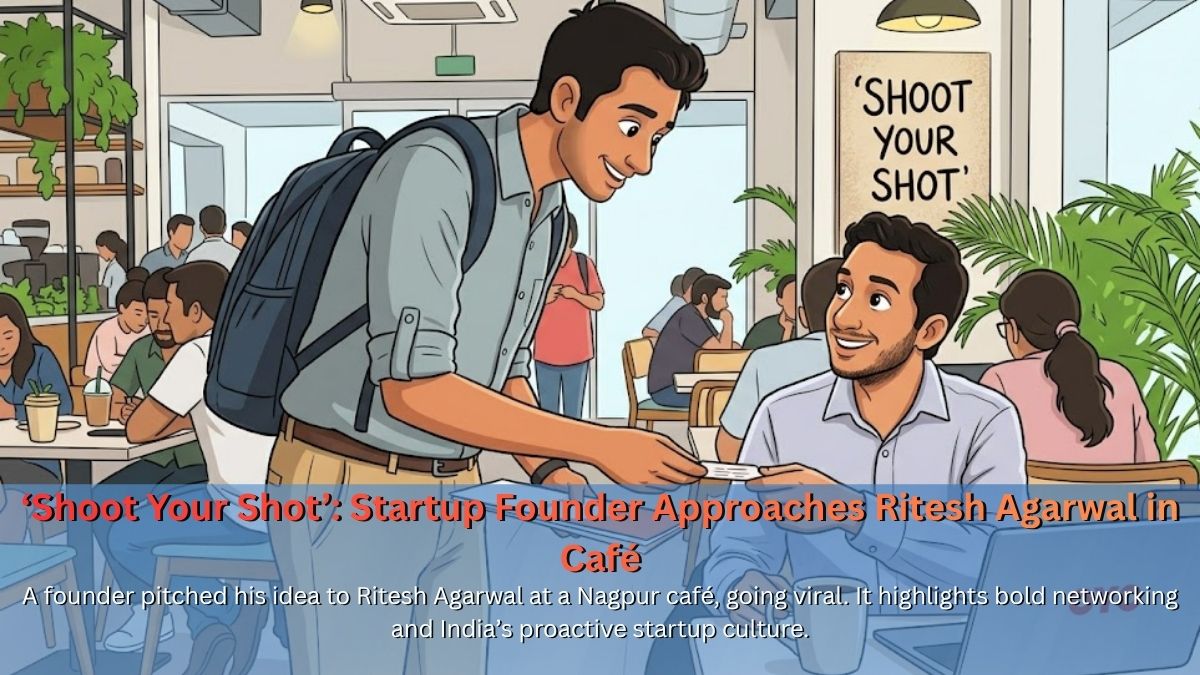
The phrase “Ritesh Agarwal in Café” recently turned into a viral startup moment after a young founder approached Ritesh Agarwal at a café in Nagpur and pitched his business idea on the spot. The unexpected interaction has sparked widespread discussion across startup news platforms, LinkedIn, and Reddit communities. It highlights the power of initiative in the Indian startup ecosystem.
According to reports and social media posts, the founder recognized Agarwal, the CEO of OYO, and decided to take a bold step. Instead of hesitating, he introduced himself and briefly pitched his startup idea. The moment reflects a growing culture where founders actively seek mentorship and opportunities in real-world settings, not just formal startup events. This incident also aligns with a broader trend. Indian startups are increasingly driven by ambition, speed, and access to influential networks. Entrepreneurs are no longer waiting for formal investor meetings. Instead, they are creating opportunities wherever possible.
Interestingly, Ritesh Agarwal has often spoken about how cafes and informal spaces act like “OG Shark Tanks.” Such environments allow spontaneous conversations and raw ideas to emerge. This philosophy reinforces the idea that innovation does not always happen in boardrooms. The story of Ritesh Agarwal in Café goes beyond a simple encounter. It represents a shift in entrepreneurial mindset. Founders today are more proactive, confident, and willing to take risks. As India’s startup ecosystem continues to grow, such moments may become more common, shaping how startups connect with investors and mentors.
1. Introduction to the Ritesh Agarwal Café Moment
1.1 A Chance Encounter That Didn’t Feel Like Chance
When Ritesh Agarwal was spotted sitting in a café in Nagpur, it looked like a completely ordinary moment. There was no event, no formal setting, no indication that anything meaningful was about to happen. But for one founder, this wasn’t just another day. It was an unexpected window of opportunity. Instead of overthinking or waiting for a better situation, he chose to walk up and introduce himself, turning a casual sighting into a defining entrepreneurial moment.
What makes this interaction powerful is how raw and unfiltered it was. There was no polished pitch deck or scheduled meeting, just a real conversation driven by belief and urgency. You can imagine the hesitation before taking that step, the fear of rejection, and the quick mental calculations happening in seconds. Yet, the decision to act transformed a simple café visit into a story that now resonates with thousands of aspiring founders.
1.2 Why This Story Matters in the Startup Ecosystem
This story matters because it breaks the illusion that opportunities only come through structured channels. In reality, the startup world often rewards those who are alert, bold, and ready to act in unpredictable situations. The café moment shows that access to influential people is not always locked behind emails, meetings, or networks. Sometimes, it’s about recognizing the moment and having the courage to step into it.
For many early-stage founders, especially those without strong connections, this incident feels deeply relatable. It reinforces the idea that waiting passively rarely leads to breakthroughs. Instead, progress often comes from uncomfortable actions. The story doesn’t just inspire, it challenges people to rethink their own behavior. It quietly asks a difficult question: if you were in that situation, would you have taken the chance or let it pass?
2. Background: Who is Ritesh Agarwal?
2.1 Early Life and Entrepreneurial Journey
Ritesh Agarwal began his journey at an age when most people are still figuring out their direction. Coming from a small town, he didn’t have the advantages that many assume successful founders possess. What he had instead was curiosity and a strong drive to explore how businesses worked. He traveled extensively, observed industries closely, and started experimenting early with entrepreneurial ideas.
When he founded OYO in 2013, his vision was simple but ambitious: bring consistency and reliability to budget hotels in India. At the time, this segment was highly fragmented and unpredictable. Ritesh identified this gap and built a model that focused on standardization through partnerships rather than ownership. This approach allowed him to move fast, but it also came with its own set of challenges that required constant learning and adaptation.
2.2 OYO as a Unicorn Startup
Over the years, OYO evolved into one of India’s most recognized startup success stories. It expanded rapidly across cities and countries, attracting global investors and achieving unicorn status. The company’s growth was driven by its ability to combine technology with an asset-light model, which enabled scalability at a pace rarely seen in the hospitality industry.
However, the journey wasn’t just about rapid expansion. There were operational hurdles, market criticisms, and moments when the business model itself was questioned. Despite these challenges, Ritesh continued to adapt and refine his approach. This resilience is what makes his story impactful. It’s not just about building a large company, but about navigating uncertainty and staying committed to a long-term vision.
3. The Café Pitch: What Exactly Happened
3.1 The Setting and Interaction
The café in Nagpur became the stage for a moment that perfectly captures the essence of entrepreneurship. A founder noticed Ritesh Agarwal sitting casually, likely going about his routine like any other day. For most people, this would have been a moment of quiet observation. But for this founder, it felt like a rare chance that couldn’t be ignored.
Approaching someone of that stature is never easy. There’s always a risk of being dismissed or misunderstood. Yet, the founder chose clarity over perfection. He introduced himself and shared his startup idea concisely, respecting the situation while making his intent clear. This balance between confidence and humility is what made the interaction genuine rather than intrusive.
3.2 Social Media and Viral Spread
After the interaction, the story didn’t remain limited to that café. It quickly found its way onto platforms like LinkedIn and Reddit, where it began to gain traction. People were drawn to its simplicity and authenticity. It wasn’t a grand success story or a funding announcement, but it carried a level of relatability that made it stand out.
The reactions were mixed but insightful. Many praised the founder’s courage and initiative, seeing it as a reminder of what entrepreneurship truly demands. Others debated whether such spontaneous pitches are appropriate in informal settings. Despite differing opinions, one thing became clear: the story sparked conversation. It pushed people to reflect on their own willingness to take risks and act in uncertain situations, which is ultimately what keeps the startup ecosystem alive and evolving.
4. The Startup Behind the Pitch
4.1 Founder’s Vision and Idea
What stands out most about the founder who approached Ritesh Agarwal isn’t just the courage to pitch, but the clarity behind what he was building. Even though the full details of his startup aren’t publicly known, one thing was evident. He wasn’t pitching a vague dream. He was trying to solve a real, grounded problem. That’s where most meaningful startups begin. Not with complexity, but with observation. A frustration noticed. A gap experienced personally. Something small that keeps bothering you until you decide to fix it.
You could sense that this wasn’t a random idea put together the night before. There was thought behind it. There was emotional investment. Founders like this often carry their ideas with them everywhere, refining them mentally, replaying scenarios, imagining outcomes. So when the moment came, he didn’t need slides or preparation. He just needed a few seconds to express something he had already lived with for months, maybe years. That kind of conviction doesn’t come from theory. It comes from experience, from repeatedly asking yourself, “Does this actually matter?”
4.2 Working Model of Early-Stage Startups
Early-stage startups don’t start with scale. They start with uncertainty. Most people outside the ecosystem imagine startups as fast-growing companies with big funding rounds, but the reality at the beginning is far less glamorous. It’s messy, unpredictable, and often uncomfortable. Founders operate with limited resources, incomplete information, and constant doubt. They build something small, test it, break it, rebuild it, and repeat the cycle over and over again.
The founder in that café was likely in this exact phase. Testing assumptions. Trying to validate whether his idea had real-world demand. Early-stage startups rely heavily on speed and adaptability. They don’t have the luxury of getting everything right the first time. Instead, they survive by learning faster than others. Technology plays a huge role here, not just for scaling, but for experimentation. Every piece of feedback matters. Every conversation counts. Even a short interaction with someone like Ritesh Agarwal can shape how a founder thinks about their product, their market, or their strategy moving forward.
5. Revenue Model and Business Strategy
5.1 Common Revenue Models in Startups
Behind every startup idea lies a fundamental question: how will this make money? It sounds simple, but in reality, this is where many founders struggle. Most early-stage startups experiment with models like subscriptions, commissions, or freemium offerings. These aren’t just buzzwords. They are practical ways to test whether people are willing to pay for what you’re building, or at least engage with it consistently.
But choosing a revenue model is not just a strategic decision. It’s deeply connected to how you understand your customer. Are you solving a problem urgent enough for someone to pay monthly? Can you create enough value to take a percentage of transactions? Or do you need to build trust first before monetizing? These are difficult questions, and the answers rarely come immediately. Founders often pivot multiple times before finding the right fit. What looks clean in hindsight is usually the result of multiple failed attempts and quiet iterations behind the scenes.
5.2 Growth Strategies in Competitive Markets
Once a startup finds even a small signal of traction, the next challenge is growth. And this is where things get intense. Markets today are crowded, attention spans are short, and competition is relentless. Startups have to fight for every user. They experiment with digital marketing, performance campaigns, referral programs, and content strategies. But growth is not just about acquiring users. It’s about keeping them.
Retention is where the real battle happens. If people try your product once and never return, growth becomes unsustainable. That’s why successful startups obsess over user experience. They listen carefully, track behavior, and constantly refine their offering. Adaptability becomes their biggest strength. The ability to change direction quickly, based on real data, often determines whether a startup survives or disappears. The founder in that café wasn’t just pitching an idea. He was carrying the weight of all these decisions, all these uncertainties, and still choosing to move forward.
6. The Power of Informal Networking
6.1 Cafés as Modern Startup Platforms
The story of Ritesh Agarwal in a café changes how we look at everyday spaces. A café is no longer just a place for coffee or casual meetings. For many entrepreneurs, it has quietly become a space where ideas are discussed, connections are formed, and sometimes, life-changing conversations begin. There’s a certain comfort in these environments that formal boardrooms lack. People are more open, more approachable, more human.
That’s what makes such spaces powerful. They remove the pressure of structure. You don’t need an appointment. You don’t need permission to start a conversation. Of course, not every interaction leads to something meaningful, but the possibility is always there. And for founders who are constantly searching for opportunities, that possibility is enough. It encourages them to stay alert, to observe, to be ready. Because sometimes, the most important meeting of your journey won’t be scheduled on a calendar. It will happen unexpectedly, in a place you least expect.
6.2 The “OG Shark Tank” Idea
When Ritesh Agarwal referred to cafés as the “original Shark Tank,” it wasn’t just a clever statement. It carried a deeper truth about how entrepreneurship has always worked at its core. Long before formal pitch events and television shows, ideas were shared in informal settings. Conversations happened naturally, without scripts or rehearsals. Decisions were influenced by instinct as much as logic.
What makes these interactions special is their authenticity. There’s no stage, no audience, no pressure to perform. It’s just two people talking. That simplicity often leads to more honest exchanges. Founders present their ideas as they truly are, not as polished versions designed to impress. And sometimes, that honesty creates a stronger impact than any formal pitch ever could. The café moment wasn’t just about pitching to a successful entrepreneur. It was a reminder that real connections are still built through simple, human conversations.
7. Problem Statement: Challenges Faced by Founders
7.1 Limited Access to Investors
One of the harsh realities of the startup world is that access is not equal. While some founders have networks that open doors easily, many others struggle just to get a foot in. Securing a meeting with an investor can take weeks, sometimes months, and often ends in silence. Emails go unanswered. Messages are ignored. It can feel frustrating and isolating, especially when you truly believe in what you’re building.
This is why moments like the café interaction matter so much. They bypass the usual barriers. They create a direct line, even if it’s brief. For many founders, this is the only way they get noticed. It’s not ideal, but it’s real. And it highlights a deeper issue within the ecosystem. Talent and ideas exist everywhere, but access does not. Until that gap is addressed, founders will continue to rely on courage and chance to create their own opportunities.
7.2 Lack of Mentorship Opportunities
Beyond funding, mentorship is one of the most valuable yet inaccessible resources for early-stage founders. Having someone experienced to guide you, challenge your thinking, and help you avoid common mistakes can significantly change the trajectory of a startup. But not everyone has that support. Many founders build in isolation, learning through trial and error, often making costly mistakes along the way.
That’s why even a short interaction with someone like Ritesh Agarwal can be meaningful. It’s not just about pitching for investment. It’s about gaining perspective. A single piece of advice, a different way of looking at a problem, or even a simple acknowledgment can boost a founder’s confidence. Entrepreneurship can be a lonely journey, filled with uncertainty. Moments of connection, no matter how small, can make that journey feel a little less overwhelming and a lot more possible.
8. How Such Moments Solve Real Problems
8.1 Breaking Barriers in Startup Networking
The moment involving Ritesh Agarwal in a café does more than just inspire. It quietly dismantles one of the biggest invisible walls in the startup world: access. For years, networking has been seen as something structured and exclusive. You attend events, wait for introductions, and hope someone important notices you. But in reality, that system often leaves out countless capable founders who simply don’t have the right connections.
What happened in that café challenges this entire structure. It shows that networking doesn’t always need permission. It can be direct, human, and immediate. Of course, not every attempt will succeed. Many will be ignored or dismissed. But the point is, the barrier is no longer as rigid as it once seemed. Founders begin to realize that sometimes the only thing standing between them and an opportunity is hesitation. And once that hesitation is broken, the ecosystem starts to feel a little more open, a little more accessible.
8.2 Encouraging Entrepreneurial Confidence
Confidence in entrepreneurship is not something you are born with. It’s built through moments of action, especially uncomfortable ones. Stories like this don’t just entertain, they shift how founders see themselves. When someone sees a peer walk up to a person like Ritesh Agarwal and confidently pitch an idea, it creates a ripple effect. It makes others think, “Maybe I can do that too.”
This kind of confidence is critical because the startup journey constantly tests your belief in yourself. There are rejections, failures, and long periods of uncertainty. Without inner conviction, it becomes very easy to give up. But moments like these remind founders that courage is often the first step toward opportunity. Even if nothing immediate comes out of such interactions, the act itself changes how a founder operates going forward. It builds a mindset that says, “I will not wait. I will act.”
9. Industry Trends and Startup Culture
9.1 Rise of Indian Startups
Over the past decade, India has transformed into one of the most dynamic startup ecosystems in the world. What was once a space dominated by a few sectors has now expanded into a diverse landscape of innovation. Companies like OYO have played a role in shaping this perception, showing that Indian startups can scale globally and compete at the highest level.
This growth isn’t accidental. It’s driven by a combination of factors: increasing internet penetration, a young population willing to take risks, and a growing pool of investors actively looking for new ideas. Today, founders are emerging not just from metro cities but from smaller towns as well. The barriers to entry are gradually lowering, and the belief that “big companies can be built from India” is stronger than ever before.
9.2 Changing Startup Trends
The nature of startups itself is evolving rapidly. Earlier, the focus was heavily on e-commerce and basic digital services. Now, the conversation has shifted toward deeper innovation. Sectors like artificial intelligence, fintech, and clean energy are gaining momentum, attracting both talent and capital. Founders are not just solving local problems anymore. They are thinking globally from day one.
At the same time, scalability has become a core expectation. Investors are not just looking for good ideas, they are looking for ideas that can grow fast and sustain that growth. This has pushed startups to become more data-driven, more efficient, and more adaptable. The competition is intense, but it’s also pushing the entire ecosystem forward. It’s no longer enough to just start. You have to build something that can survive, evolve, and stand out in a crowded market.
10. Competitor Landscape
10.1 Direct Competitors of Early-Stage Startups
One of the first realities a founder faces after launching is competition. Even at the earliest stage, there are often others working on similar ideas. These direct competitors might be at the same level, experimenting, testing, and trying to capture the same audience. It can feel overwhelming, especially when resources are limited and every small advantage matters.
But competition at this stage is not always a bad thing. It validates the problem. It shows that there is a real market need. The challenge is differentiation. Founders have to ask themselves hard questions. Why would someone choose my product over another? What am I doing differently? These questions shape the direction of the startup. They force clarity, focus, and better decision-making.
10.2 Indirect Competition from Established Players
While early-stage competitors are one challenge, established companies present a different kind of pressure. These players already have brand recognition, customer trust, and significant resources. They can move faster, spend more, and scale aggressively. For a new startup, this can feel intimidating.
However, large companies often lack the agility that startups possess. They move slower, take longer to adapt, and are sometimes disconnected from emerging customer needs. This is where startups find their edge. They can experiment freely, pivot quickly, and focus deeply on specific problems. The key is not to compete head-on, but to find gaps that bigger players overlook. That’s how many successful startups carve their space in competitive markets.
11. Role of Venture Capital and Funding
11.1 Importance of Business Funding
No matter how strong an idea is, scaling it requires resources. This is where funding becomes critical. Venture capital firms and angel investors don’t just provide money, they bring experience, networks, and strategic guidance. For many founders, this support can significantly accelerate growth and help avoid common pitfalls.
But funding is not just about raising capital. It’s about finding the right partners. Investors who understand your vision, challenge your assumptions, and support you during difficult phases can make a huge difference. The relationship between a founder and an investor is long-term, and choosing the right fit is as important as the funding itself.
11.2 Funding Trends in India
India’s funding landscape has evolved rapidly in recent years. There is a noticeable increase in both the number and size of funding rounds. Investors are actively looking for startups that are not only innovative but also scalable and sustainable. Technology-driven businesses, in particular, are attracting significant attention.
At the same time, investors have become more cautious. The focus has shifted from rapid growth at any cost to building solid, sustainable businesses. Profitability, unit economics, and long-term viability are now key considerations. This shift is healthy for the ecosystem because it encourages founders to build responsibly, rather than chasing growth without a clear foundation.
12. Impact on the Startup Ecosystem
12.1 Inspiration for Emerging Entrepreneurs
The story of Ritesh Agarwal in a café has a ripple effect that goes far beyond that single interaction. For many aspiring entrepreneurs, it becomes a source of motivation. It shows that success is not reserved for a select few. It is accessible to those who are willing to act, take risks, and step out of their comfort zone.
What makes this inspiration powerful is its relatability. It’s not a story about massive funding or overnight success. It’s about a simple decision to speak up. And that simplicity makes it believable. It tells founders that they don’t need perfect conditions to start making progress. They just need the courage to take the first step.
12.2 Strengthening Startup Culture
Moments like these contribute to building a stronger, more dynamic startup culture. They encourage openness, interaction, and a willingness to share ideas. Instead of a closed ecosystem where only a few have access, it moves toward a more inclusive environment where anyone can participate.
This cultural shift is important because startups thrive on collaboration and exchange of ideas. The more people connect, the more knowledge flows, and the stronger the ecosystem becomes. Informal interactions, like the one in that café, play a significant role in this process. They remind everyone that entrepreneurship is not just about competition, but also about community.
13. Future of Informal Startup Interactions
13.1 Rise of Casual Pitching Opportunities
As the startup ecosystem continues to evolve, informal pitching is likely to become more common. Founders are realizing that waiting for formal opportunities can slow them down. Instead, they are exploring new ways to connect, whether it’s through casual meetups, co-working spaces, or even chance encounters like the one with Ritesh Agarwal.
This doesn’t mean structure will disappear. Formal pitches and investor meetings will always have their place. But alongside them, there will be a growing acceptance of spontaneous interactions. These moments bring a level of authenticity that structured environments sometimes lack, and that authenticity can be incredibly powerful.
13.2 Integration with Digital Platforms
At the same time, digital platforms are playing a huge role in amplifying these interactions. A single conversation in a café can now reach thousands of people online. Platforms like LinkedIn and startup communities allow these stories to spread, creating visibility and new opportunities.
The future of networking is likely to be a blend of both worlds. Offline interactions will spark connections, and online platforms will scale them. This hybrid model makes the ecosystem more dynamic and accessible. It ensures that even small moments can have a large impact, influencing how founders think, act, and build.
14. Learning for Startups and Entrepreneurs
The café moment involving Ritesh Agarwal leaves behind lessons that are simple but deeply important. The first is preparation. Opportunities don’t always announce themselves. They appear suddenly, often when you least expect them. If you are not clear about your idea, your vision, and your value, you won’t be able to make the most of those moments. Preparation is what turns chance into opportunity.
The second lesson is confidence, and not the loud kind, but the quiet belief in what you are building. Without that, even the best ideas struggle to survive. Alongside confidence comes the importance of networking. Founders cannot afford to stay isolated. They need to actively seek conversations, build relationships, and stay visible. And finally, simplicity matters. In high-pressure moments, you don’t have time for complexity. A clear, honest, and concise pitch often creates more impact than a long, complicated explanation.
About foundlanes.com
foundlanes.com is India’s leading startup idea discovery platform. It helps entrepreneurs find actionable startup opportunities, market insights, and industry-specific guidance to turn ideas into real businesses. With deep research and practical resources, foundlanes supports founders at every stage, from idea validation to launch and growth.