News Summary
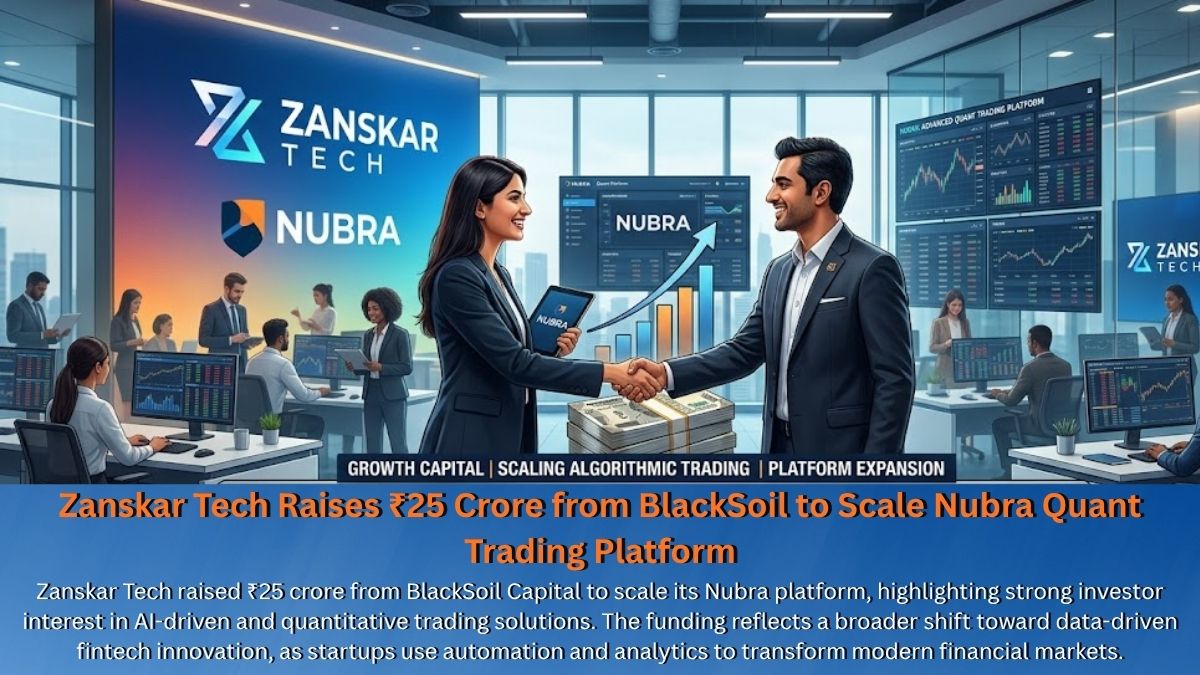
Zanskar Tech Raises ₹25 Crore from BlackSoil in a significant development in India’s fast-growing fintech and AI-driven trading ecosystem. The funding round highlights rising investor confidence in quantitative trading platforms and data-driven financial technologies. The investment, led by BlackSoil Capital, will support the expansion of Zanskar Tech’s flagship platform, Nubra, which focuses on algorithmic and quantitative trading solutions.
Zanskar Tech operates at the intersection of fintech, artificial intelligence, and capital markets. Its Nubra platform uses advanced algorithms and data analytics to help traders and institutions make smarter investment decisions. With this new funding, the startup plans to strengthen its technology stack, scale operations, and improve market reach.
India’s fintech sector is witnessing rapid growth. Startups are increasingly using AI and machine learning to disrupt traditional finance. Quantitative trading platforms like Nubra are gaining attention due to their ability to reduce human bias and improve trading efficiency. As global markets become more complex, demand for such solutions continues to rise.
This funding also reflects broader trends in venture capital and startup ecosystems. Investors are actively backing emerging startups that offer scalable and technology-driven solutions. Zanskar Tech’s progress shows how Indian startups are moving beyond basic fintech services into advanced trading technologies.
The development is not just about funding. It signals a shift in how financial markets operate, with automation and analytics taking center stage. As Zanskar Tech scales Nubra, it may influence how trading platforms evolve in India and globally. This move positions the startup among the fastest-growing fintech innovators in the country.
1. Introduction to Zanskar Tech Raising ₹25 Crore
1.1 What This Funding Really Means
When you hear that Zanskar Tech has raised ₹25 crore from BlackSoil, it’s easy to see it as just another funding headline. But if you look a little deeper, this moment carries far more weight than the number itself. This isn’t just capital. It’s validation. In today’s market, investors are far more cautious than they were a few years ago. Easy money is gone. Every cheque written now comes with intense scrutiny, deep due diligence, and a strong expectation of real outcomes. So when a firm like BlackSoil backs a company like Zanskar Tech, it signals one thing clearly: they believe the problem is real, the solution is scalable, and the team can actually execute.
The ₹25 crore will primarily go toward scaling their Nubra quant trading platform. But “scaling” here isn’t just about hiring more people or expanding infrastructure. It’s about strengthening algorithms, refining data models, improving execution speed, and making the system more resilient in unpredictable market conditions. Because in trading, especially algorithmic trading, small inefficiencies don’t stay small. They compound. And so do advantages. This funding gives Zanskar Tech the breathing room to build with precision instead of rushing for survival.
1.2 Why This Matters in the Larger Startup Ecosystem
If you’ve been following startup news closely, you’ll notice a clear shift. A few years ago, most funding went into consumer internet, quick commerce, and growth-heavy models. Today, the narrative is changing. Investors are now leaning toward businesses that are deeply rooted in technology, data, and defensibility. Zanskar Tech fits perfectly into this new wave. This isn’t a startup trying to acquire users through discounts or burn capital for market share. It’s building infrastructure. Quietly. Intelligently. And that’s exactly where long-term value lies.
What makes this moment important is how it reflects a broader evolution in India’s startup ecosystem:
- There’s a growing appetite for AI-driven fintech solutions
- Founders are solving complex, high-barrier problems
- Capital is moving toward precision over hype
And more importantly, India is no longer just a market for fintech consumption. It’s becoming a place where fintech innovation is actually being built. This funding is a small but meaningful signal of that shift.
2. The Story Behind Zanskar Tech
2.1 Where It All Began
Every strong startup begins with frustration. Not excitement, not opportunity, but frustration with how things currently work. For Zanskar Tech, that frustration came from the inefficiencies of traditional trading systems. Markets are fast. Brutally fast. But many trading decisions, especially in certain segments, still rely on human judgment, delayed reactions, and incomplete data interpretation. Even experienced traders can’t process millions of data points in real time.
That gap is where Zanskar Tech was born. The founders didn’t just see a problem. They experienced it firsthand. They understood how emotion, delay, and bias can affect trading outcomes. And instead of trying to “improve” the existing system, they decided to rethink it entirely. They asked a simple but powerful question: What if trading decisions could be driven purely by data, logic, and speed—without human limitations? That question led to the creation of Nubra, their quant trading platform.
2.2 The Founders’ Mindset and Execution
What sets Zanskar Tech apart isn’t just the idea. It’s the mindset behind it.
The founding team brings together a rare combination:
- Deep understanding of financial markets
- Strong expertise in machine learning and data science
- Practical exposure to capital market dynamics
This blend matters more than it seems. Because building a quant platform isn’t just about writing code. It’s about understanding how markets behave under stress, how patterns form and break, and how risk needs to be managed when things go wrong, not when everything works perfectly.
Their leadership philosophy is grounded in a few key beliefs:
- Data over instinct
- Systems over individuals
- Consistency over short-term wins
And this shows in how they’ve built Nubra.
Instead of chasing aggressive promises, they’ve focused on building a system that can adapt, learn, and improve over time. A system that doesn’t panic during volatility but adjusts. That kind of thinking doesn’t create overnight hype. But it builds long-term trust.
2.3 Real-World Impact and What Comes Next
From an outside perspective, a quant platform might sound abstract. But its real-world implications are significant.
Better algorithms mean:
- More efficient capital allocation
- Reduced trading errors
- Faster decision-making
- Lower dependency on human bias
For institutional players and serious traders, this isn’t a luxury. It’s becoming a necessity.
With this funding, Zanskar Tech now has the opportunity to:
- Strengthen its core technology
- Expand into new market segments
- Improve accessibility for a wider set of users
- Compete at a more global level
But more than anything, they now carry expectation. Because once you move from survival mode to growth mode, the game changes. Execution becomes everything.
3. Nubra Platform: Working Model Explained
3.1 How Nubra Quant Trading Platform Works
At its core, Nubra isn’t just another trading tool. It’s built on the idea that markets are not random chaos, but patterns waiting to be understood. The platform operates using quantitative trading principles, which means it relies on data, mathematics, and logic instead of gut feeling. Every second, markets generate massive amounts of information. Prices move, volumes shift, trends form and break. Nubra’s algorithms are designed to sit quietly in the background and process all of this in real time, something no human trader can realistically do at scale.
What makes this powerful is how it removes emotion from the equation. Anyone who has traded, even casually, knows how fear and greed can take over. You hesitate when you should act, or act when you should wait. Nubra replaces that emotional layer with disciplined execution. Once a strategy is defined, the system follows it without panic or overconfidence. Trades are executed instantly when conditions are met. This doesn’t guarantee success, but it creates consistency, and in trading, consistency is often more valuable than occasional brilliance.
3.2 Core Technologies Used
Behind this seamless experience is a deep stack of technology working continuously. Nubra uses artificial intelligence and machine learning not as buzzwords, but as essential tools to interpret complex market behavior. These systems learn from historical data, identify repeating patterns, and adjust strategies based on changing conditions. Over time, the platform becomes smarter, not in a human sense, but in its ability to refine decisions based on evidence.
Then comes big data, which is the backbone of everything. Financial markets are data-heavy environments, and the ability to process that data quickly is what separates average platforms from truly powerful ones. Nubra integrates real-time data feeds, meaning it doesn’t rely on outdated or delayed information. This is critical because even a few seconds can make a difference in trading outcomes. The result is a system that doesn’t just react to the market, but stays aligned with it as it evolves moment by moment.
3.3 Key Features and Services
From a user’s perspective, Nubra tries to simplify something that is inherently complex. Automated trading is one of its central features, allowing users to deploy strategies without needing to sit in front of screens all day. But beyond automation, the platform also focuses heavily on risk management. Because in trading, protecting capital is just as important as growing it. Tools that help manage exposure, set limits, and monitor performance become crucial, especially for those who are still learning.
Another important aspect is flexibility. Not every trader thinks the same way, and Nubra seems to recognize that. It allows users to customize strategies based on their risk appetite and goals. For institutional users, this means scalability and precision. For individual traders, it means accessibility to tools that were once limited to professionals. Over time, this kind of accessibility can shift how people participate in financial markets, making them less intimidating and more data-driven.
4. Revenue Model and Business Strategy
4.1 How Zanskar Tech Makes Money
Building a sophisticated platform like Nubra requires not just innovation, but a sustainable business model behind it. Zanskar Tech appears to follow a layered approach to revenue, which is common among strong fintech businesses. At the base level, there are subscription fees. Users pay to access the platform, its tools, and its capabilities. This creates a steady stream of recurring income, which is essential for long-term stability.
On top of that, transaction-based commissions add another layer. Every time trades are executed through the platform, a small fee contributes to revenue. Then come premium offerings, advanced analytics, deeper insights, and enhanced tools that serious traders are often willing to pay extra for. This tiered model works because it aligns with user growth. Beginners can start small, and as they become more engaged, they naturally move toward higher-value services.
4.2 Business Strategy for Growth
Growth, however, is not just about making money. It’s about expanding reach and staying relevant in a rapidly evolving market. Zanskar Tech seems focused on scaling its technology first. That means improving performance, increasing reliability, and continuously enhancing the platform’s capabilities. In fintech, trust is everything. If the technology fails, users leave. So investing in infrastructure is not optional, it’s foundational.
Beyond that, expansion into new markets is a logical next step. Financial markets are global, and platforms like Nubra have the potential to serve users beyond India. Partnerships with financial institutions can accelerate this process, providing both credibility and distribution. At the same time, continuous product innovation ensures the platform doesn’t become outdated. In a space where technology evolves quickly, standing still is the fastest way to fall behind.
5. Funding Details and Investor Perspective
5.1 Breakdown of the ₹25 Crore Investment
Raising ₹25 crore is not just about capital, it’s about validation. It signals that someone with experience has looked at the business, the technology, and the market, and decided it’s worth backing. For Zanskar Tech, this funding will likely be spread across multiple critical areas. Product development will take a significant share, because improving AI models and trading systems requires constant investment.
Hiring is another major focus. Strong technology needs strong people behind it, engineers, data scientists, product thinkers. Then comes market expansion, which includes everything from customer acquisition to building brand presence. A portion of the funding will also go into refining AI capabilities, making the platform more accurate, faster, and more reliable. In many ways, this funding is fuel, but how efficiently it is used will determine how far the company can go.
5.2 Role of BlackSoil Capital
BlackSoil Capital is not just another investor writing a cheque. It has built a reputation for supporting high-growth startups through venture debt and structured financing. This type of funding is particularly useful because it allows startups to scale without giving up too much equity early on. It reflects a certain level of maturity in the company’s financial planning.
Their involvement also brings credibility. When an established firm backs a startup, it sends a signal to the market that the business model has potential. But beyond capital, investors like BlackSoil often provide strategic guidance. They have seen multiple startups succeed and fail, and that experience can help founders make better decisions. In a journey filled with uncertainty, having that kind of support can make a meaningful difference.
6. Problem Statement: What Zanskar Tech Solves
6.1 Challenges in Traditional Trading Systems
Traditional trading systems were not built for the kind of speed and complexity we see today. They rely heavily on manual decision-making, which introduces delays and emotional bias. A trader might hesitate during a critical moment or make impulsive decisions based on fear or excitement. Over time, these small mistakes compound into significant losses.
Another major issue is access. Advanced tools and analytics have historically been available only to large institutions. Retail investors are often left with limited resources, making it difficult for them to compete on the same level. This creates an uneven playing field where knowledge and technology become barriers rather than enablers.
6.2 Zanskar Tech’s Solution
Zanskar Tech addresses these challenges by shifting the focus from instinct to data. Its platform automates decision-making based on predefined strategies, reducing the role of emotion. This doesn’t eliminate risk, but it makes the process more structured and disciplined. Traders can rely on logic rather than impulse.
At the same time, the platform democratizes access to advanced tools. What was once available only to large institutions is now accessible to individual traders. This shift is important because it levels the playing field. It gives more people the ability to participate in markets with better information and better systems. Over time, this can change how trading is approached, making it more analytical and less reactive.
7. Industry Trends and Market Growth
7.1 Growth of Fintech and AI Startups
India’s fintech space is going through a significant transformation. Startups are not just building payment solutions anymore. They are rethinking how financial services work at a fundamental level. Companies like Zanskar Tech are part of this shift, where technology is used to simplify complex systems and make them more accessible.
AI startups, in particular, are driving this change. They are introducing smarter ways to analyze data, predict outcomes, and automate processes. As more people become comfortable with digital financial tools, the demand for such solutions continues to grow. This creates a strong foundation for platforms like Nubra to expand and evolve.
7.2 Global Trends in Quantitative Trading
On a global level, quantitative trading is no longer limited to hedge funds and large financial institutions. It is becoming more mainstream, driven by advancements in technology and increased data availability. Firms around the world are investing heavily in AI, machine learning, and even blockchain to gain an edge in the markets.
This global momentum creates a favorable environment for Zanskar Tech. It’s operating in a space that is not only growing but also becoming more relevant with each passing year. The challenge, however, will be differentiation. As more players enter the market, standing out will require continuous innovation, strong execution, and a deep understanding of user needs. But if done right, the opportunity is massive, both in India and beyond.
8. Competitive Landscape
8.1 Direct Competitors
The space that Zanskar Tech is operating in is not empty. In fact, it’s getting crowded faster than most people realize. Over the past few years, there has been a surge of fintech startups building algorithmic trading platforms and AI-driven investment tools. On the surface, many of them look similar. They all talk about automation, data-driven decisions, and smarter trading. But when you go deeper, the real difference starts to show in execution.
What separates serious players from the rest is not just the idea, but how refined the product is. Customization, depth of analytics, and reliability of execution become the deciding factors. Many platforms promise intelligent trading, but very few deliver systems that can actually adapt to different strategies and user behaviors. This is where competition becomes intense. It’s not about who enters the market first, but who builds something that users trust over time. In trading, trust is earned slowly and lost instantly.
8.2 Indirect Competitors
Beyond startups, there’s another layer of competition that is often underestimated. Traditional brokerage firms. These are companies that have been around for years, sometimes decades, and they come with an existing user base and brand credibility. Earlier, they relied heavily on manual systems, but that is changing quickly. Many of them are now integrating technology, offering advanced dashboards, analytics, and even semi-automated trading features.
Then there’s the global angle. International platforms are entering markets like India, bringing with them sophisticated tools and global experience. For a company like Zanskar Tech, this means competing not just locally, but against players who have already matured in other ecosystems. It raises the bar significantly. But it also pushes innovation. Because when competition becomes tougher, products become better. And in the long run, that benefits the user more than anyone else.
9. Startup Ecosystem Impact
9.1 Contribution to Indian Startups
When Zanskar Tech raised ₹25 crore, it wasn’t just a funding announcement. It was a signal. A signal that investors are willing to back deep-tech ideas, not just surface-level applications. For a long time, many founders believed that only certain types of startups attracted funding, e-commerce, delivery, or simple consumer apps. But stories like this expand that belief.
It tells upcoming entrepreneurs that building something complex, something rooted in technology and data, is worth the effort. It encourages them to think bigger, to go beyond obvious problems and explore deeper inefficiencies. In many ways, each such funding story adds a layer of confidence to the ecosystem. It creates momentum. Because when one startup breaks through, it quietly opens doors for many others who are still building in the background.
9.2 Role in Tech Innovation and Disruption
What makes companies like Zanskar Tech important is not just their growth, but the shift they represent. Financial markets have traditionally been complex, slow-moving, and often inaccessible to the average person. By introducing automation, AI-driven insights, and data-backed strategies, they are changing how people interact with money and markets.
This is what real disruption looks like. It’s not loud or flashy at first. It starts quietly, by solving a problem better than before. Over time, it reshapes behavior. Traders become more analytical. Decisions become less emotional. Access becomes more inclusive. And suddenly, what once felt complicated starts to feel manageable. That’s how industries evolve, not overnight, but through consistent, meaningful innovation.
10. Future Plans and Expansion Strategy
10.1 Scaling Nubra Platform
For Zanskar Tech, the journey doesn’t stop at building a strong product. The real challenge begins when you try to scale it. Expanding Nubra beyond its current base means entering new markets, each with its own regulations, user behavior, and competitive dynamics. This is not easy. It requires careful planning, local understanding, and the ability to adapt without losing the core strength of the platform.
At the same time, scaling is not just about geography. It’s also about experience. As more users come in, expectations rise. The platform needs to be faster, more intuitive, and more reliable. Even small issues get amplified at scale. That’s why improving user experience becomes a continuous process. It’s not a one-time upgrade, but an ongoing commitment to making the product better with every iteration.
10.2 Hiring and Team Growth
Behind every strong product is a strong team, and this is where a large portion of the funding will likely go. Zanskar Tech will need skilled engineers who can handle complex systems, data scientists who can refine algorithms, and product managers who can translate technical capabilities into user-friendly experiences.
But hiring is not just about filling roles. It’s about building a culture. Startups operate in high-pressure environments where things change quickly. The team needs to be adaptable, aligned with the vision, and willing to take ownership. A single strong hire can accelerate progress, while the wrong one can slow things down. This makes team building one of the most critical, and often underestimated, parts of scaling a startup.
11. Learning for Startups and Entrepreneurs
If you step back and look at the journey of Zanskar Tech, there are lessons that go far beyond fintech. The first and perhaps most important one is this: start with a real problem. Not something that sounds impressive, but something that genuinely needs solving. Because when the problem is real, the motivation to keep going stays strong, even when things get difficult.
The second lesson is about using technology with purpose. It’s easy to get caught up in trends like AI or machine learning, but what matters is how effectively you apply them. Technology should simplify, not complicate. Then comes the importance of people. A strong, committed team can carry a startup through uncertainty, while a weak one can break even the best ideas. And finally, the role of the right investors cannot be overstated. Money helps, but guidance, belief, and long-term support matter just as much.
At its core, this journey reflects something very human. Building a startup is not just about growth metrics or funding rounds. It’s about persistence, doubt, small wins, setbacks, and the constant effort to build something that works. And in that process, every founder learns the same truth in their own way: success is rarely sudden. It’s built quietly, one decision at a time.
About foundlanes.com
foundlanes.com is India’s leading startup idea discovery platform. It helps entrepreneurs find actionable startup opportunities, market insights, and industry-specific guidance to turn ideas into real businesses. With deep research and practical resources, foundlanes supports founders at every stage, from idea validation to launch and growth.