Summary
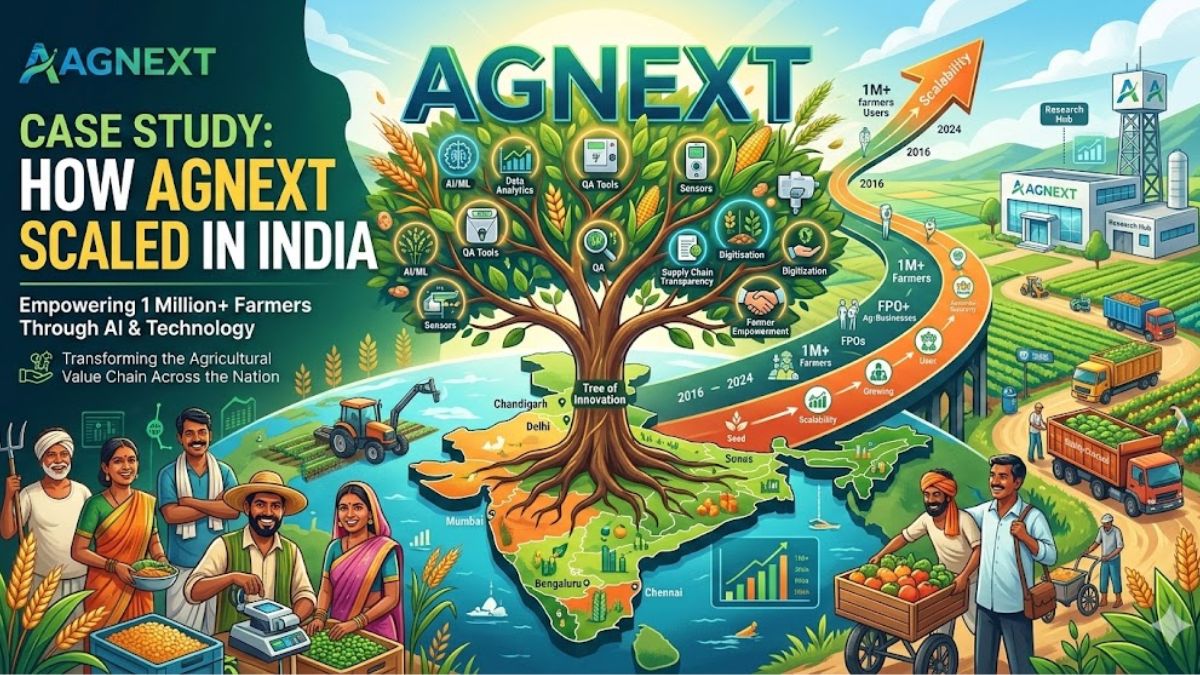
The AgNext Case Study is one of the most interesting stories in India’s agritech ecosystem. It highlights how a deep-technology startup identified a structural inefficiency in global food supply chains and built an AI-powered platform to solve it. AgNext is an Indian agritech company that develops artificial intelligence and sensor-based solutions to analyze food quality instantly across agricultural supply chains. The startup focuses on solving one of agriculture’s most persistent problems: the lack of transparent and reliable food quality assessment during trade.
The company was founded in 2016 by Taranjeet Singh Bhamra, along with co-founders Mrigank Sharad and Deepak Jaiswal. The startup emerged from research and innovation work at IIT Kharagpur, where the founders explored how data science and machine learning could transform agricultural processes. Headquartered in Chandigarh and incubated at the Science and Technology Entrepreneurs Park at IIT Kharagpur, AgNext developed deep-tech tools that combine artificial intelligence, machine learning, computer vision, and IoT sensors to assess the quality of agricultural commodities such as grains, spices, tea, oilseeds, and milk.
At the center of AgNext’s technology is a digital platform called Qualix, which enables food processors, traders, and agricultural enterprises to conduct real-time quality testing of commodities. Instead of relying on manual inspection methods that are slow and inconsistent, the system uses data analytics and sensors to provide rapid and objective quality results. The idea gained strong investor interest as the agritech sector in India began attracting venture capital attention. Over time, AgNext raised funding from investors including Omnivore, Kalaari Capital, and Alpha Wave Incubation, with a Series A round of about $21 million helping the company scale its technology and expand internationally.
Today, AgNext positions itself as a technology platform for building transparent food supply chains. Its systems are used by major agribusiness companies and cooperatives, helping them digitize food quality testing, reduce disputes in trade, and bring greater trust into agricultural markets. This AgNext startup case study explores how the company identified the opportunity in agriculture technology, built its product suite, secured early customers, and scaled its deep-tech agritech startup in India.
2. The Origins of the AgNext Agritech Startup
2.1 The Founder’s Background and Early Inspiration
The story behind this AgNext agritech case study begins with founder Taranjeet Singh Bhamra’s academic and research journey. Bhamra studied engineering at IIT Kharagpur and later completed an MBA from IIM Calcutta. During his academic years, he developed a strong interest in how advanced technologies could be applied to real-world industrial problems. Agriculture quickly emerged as a sector where technology adoption remained limited despite its massive economic importance.
India’s agriculture industry employs millions of people and contributes significantly to the country’s economy. Yet the sector suffers from inefficiencies in supply chains, pricing transparency, and quality assessment. For Bhamra, the problem became clear during his research work and interactions with agribusiness professionals. He noticed that large volumes of agricultural commodities were traded globally without standardized and objective quality measurement systems. This gap created disputes between buyers and sellers, inefficiencies in procurement processes, and financial losses across supply chains. These early insights would eventually shape the vision that led to the creation of AgNext.
3. The Core Problem in Agricultural Supply Chains
The AgNext business case study cannot be understood without examining the fundamental problem the company set out to solve. Agricultural trade depends heavily on quality evaluation. When commodities such as grains, spices, or tea are traded, buyers must determine whether the product meets certain quality standards. However, for decades the assessment process has relied largely on manual inspection methods. Quality analysts visually inspect samples and run laboratory tests to measure chemical and physical characteristics. These processes are time-consuming, expensive, and often inconsistent.
According to industry estimates, the lack of standardized quality assessment results in massive inefficiencies in global food trade. In many cases, buyers and sellers disagree about the quality of commodities after transactions occur. These disputes can delay payments, disrupt supply chains, and reduce trust between trading partners. In addition, manual inspection processes often provide accuracy levels of around 60 percent, making them unreliable for large-scale commercial transactions. The founders of AgNext saw this as a technological opportunity. If artificial intelligence and advanced sensing technologies could automate quality testing, the agriculture industry could move toward faster, more transparent trade systems. This insight became the foundation of the AgNext growth case study.
4. The Vision Behind AgNext
AgNext was founded with a clear mission: to bring transparency, speed, and trust to food supply chains through deep-technology solutions. The founders believed that agriculture needed a digital infrastructure similar to what financial services and e-commerce industries had already adopted. In their view, food quality should not rely on subjective manual judgments. Instead, it should be measured through standardized, technology-driven systems. This idea aligned with a broader shift toward AI agriculture technology, where machine learning and data analytics are used to optimize farming and supply chain processes.
AgNext positioned itself as a company building digital infrastructure for food quality assessment rather than just a single product. By focusing on this niche problem, the startup aimed to create a scalable technology platform that could eventually serve multiple agricultural commodities and global markets.
5. Building the Technology Platform
5.1 The Role of AI in Agriculture Technology
At the heart of the AgNext company case study is the development of its deep-technology platform. The startup uses a combination of artificial intelligence, machine learning algorithms, computer vision, and Internet of Things sensors to analyze agricultural commodities. These technologies allow AgNext’s systems to measure various parameters of food products, including moisture levels, nutrient composition, contamination risks, and physical characteristics.
Instead of sending samples to laboratories for testing, agribusiness companies can use AgNext’s technology to conduct instant quality assessments at procurement centers, warehouses, or processing facilities. This shift from manual inspection to digital testing represents a major advancement in smart farming technology and agricultural supply chain management.
5.2 The Qualix Platform
One of AgNext’s most important innovations is its integrated digital platform known as Qualix. Qualix functions as a centralized system that collects and analyzes data from various sensing devices deployed across the supply chain. Through the platform, agribusiness companies can conduct real-time commodity testing and receive instant digital reports about product quality. The system can evaluate multiple commodities, including grains, spices, tea, oilseeds, milk, and animal feed.
Because the platform collects large datasets over time, its machine learning algorithms continuously improve the accuracy of quality predictions. Over several years of operations, AgNext built one of the largest proprietary datasets for agricultural quality analysis by collecting millions of food samples across different categories. This data advantage has become a key competitive asset for the company.
5.3 Hardware and Sensor Technologies
Unlike many software startups, AgNext also developed specialized hardware devices that integrate with its AI platform. These devices use spectral analysis and other sensing technologies to measure the chemical and physical properties of agricultural products. For example, handheld hyperspectral devices can detect moisture levels, impurities, and nutrient content in crops during procurement processes.
The same devices can also identify contamination risks or adulteration in food products. By combining hardware sensing with machine learning analytics, AgNext created an integrated food quality testing technology platform that can be deployed across supply chains.
5.4 Early Product Development Challenges
Developing deep-tech solutions for agriculture was not easy. Agricultural commodities vary widely in their physical properties, and environmental factors such as temperature, humidity, and storage conditions can affect measurement accuracy. This meant the startup had to collect extensive datasets across different crop varieties and geographic conditions. Building reliable AI models required continuous field testing and validation. However, these early investments in research and development eventually allowed AgNext to create a robust technology platform that could handle large-scale commercial deployments.
6. Early Traction and Product Validation
In the early years of the company, AgNext focused heavily on validating its technology with real industry stakeholders. The founders understood that agricultural supply chains are deeply traditional and risk-averse. Convincing companies to trust a new AI-driven testing system required strong proof of reliability. To overcome this barrier, the startup began working closely with agribusiness companies, commodity traders, and food processors. These early collaborations allowed the company to test its systems in real operational environments.
Field deployments helped AgNext refine its technology. Data collected from these pilots improved the accuracy of its machine learning models and helped the team understand how agricultural products behave across different geographies. This stage became a critical turning point in the AgNext startup case study. Instead of building technology in isolation, the company built its product in close collaboration with industry users. This approach ensured that the final system addressed real operational challenges rather than theoretical research problems. As the technology matured, early customers began integrating AgNext’s testing systems into procurement and quality assurance processes. This real-world adoption provided the first validation of the company’s AI-based crop quality analysis technology.
7. Business Model and Revenue Strategy
The AgNext business case study reveals an interesting hybrid business model that combines hardware deployment with software analytics. Unlike typical SaaS startups that operate purely as software platforms, AgNext provides integrated solutions that include sensing devices, AI analytics software, and cloud-based reporting tools. Customers usually deploy AgNext’s hardware systems at procurement centers, warehouses, or processing facilities. These devices capture data from agricultural commodities and send the information to the company’s AI platform.
The platform then processes the data using machine learning models and provides detailed quality analysis reports. Revenue is generated through a combination of hardware sales, subscription fees for the Qualix platform, and service contracts. Large agribusiness clients often sign enterprise agreements that include installation, maintenance, and ongoing software access. This integrated model allows AgNext to build long-term relationships with customers. Once a company installs the system into its supply chain infrastructure, switching to another provider becomes difficult. As a result, the company benefits from recurring revenue streams while maintaining strong customer retention. Within the broader ecosystem of AI agriculture technology, this hybrid model has allowed AgNext to create a defensible market position.
8. The Role of AI in Food Quality Testing Technology
A central theme of the AgNext agritech case study is the application of artificial intelligence in agricultural quality testing. Traditional quality testing methods rely heavily on laboratory equipment and manual inspection processes. These systems are accurate but slow, making them unsuitable for large-scale supply chain operations. AgNext’s approach replaces these manual processes with automated sensing technologies and machine learning algorithms.
When a commodity sample is analyzed, the sensing device captures spectral and physical data about the product. This information is then processed by AI models trained on millions of data points. The algorithms compare the captured data with historical datasets and generate detailed reports about quality parameters. These parameters may include moisture content, nutrient composition, foreign material presence, or contamination risks. The system provides results within minutes rather than hours or days. This transformation represents a major advancement in food quality testing technology, particularly for large commodity markets where rapid decision-making is critical.
9. Funding Journey and Investor Interest
The AgNext growth case study gained momentum when investors began recognizing the company’s potential. Agritech startups in India have increasingly attracted venture capital as investors look for solutions that improve agricultural productivity and supply chain efficiency. AgNext secured early funding from Omnivore, a venture capital firm known for investing in agritech innovations across India. Omnivore has supported several startups that focus on improving agricultural value chains. The company later raised additional investment from Kalaari Capital and Alpha Wave Incubation. A major milestone came when AgNext raised around $21 million in a Series A funding round led by Alpha Wave Incubation.
This capital allowed the startup to accelerate product development, expand its engineering team, and scale its technology deployments. The funding also supported international expansion efforts as the company explored opportunities beyond India. Investor interest in the company reflects a broader belief that agriculture supply chain technology will become a critical part of the global food economy.
10. Go-to-Market Strategy
For any agritech startup, entering the market requires careful strategy. Agriculture is a highly fragmented industry with multiple stakeholders across the supply chain. AgNext adopted a B2B enterprise approach rather than targeting individual farmers directly. The company focused on large organizations involved in commodity trading, food processing, and agricultural procurement. These organizations handle high transaction volumes and benefit significantly from accurate quality testing.
By targeting institutional customers, the company was able to deploy its technology at scale. Once integrated into procurement operations, the technology became an essential part of the customer’s workflow. This strategy helped AgNext establish strong footholds within major commodity supply chains. Another important element of the company’s go-to-market strategy involved partnerships with agricultural cooperatives and food industry organizations. These partnerships allowed the startup to access large networks of suppliers and buyers. Over time, the company expanded its presence across several commodity categories including spices, tea, oilseeds, dairy, and grains. This diversification strengthened the company’s position as a leading agritech startup in India focused on food quality infrastructure.
11. Brand Positioning in the Agritech Ecosystem
As AgNext expanded its operations, it also developed a distinct brand identity within the agritech ecosystem. The company positioned itself as a deep-technology platform rather than just another agricultural service provider. This positioning aligned with global trends where technology companies are increasingly building digital infrastructure for industries.
By emphasizing artificial intelligence, machine learning, and data analytics, AgNext differentiated itself from traditional agriculture solution providers. Its messaging focused on building transparent food supply chains and enabling data-driven decision making. This approach resonated with large agribusiness organizations seeking to modernize their operations through digital farming solutions. As a result, AgNext gradually established itself as one of India’s emerging agriculture AI startups.
12. Competitive Landscape and Differentiation
The AgNext Case Study also requires understanding the broader competitive landscape in which the company operates. Agriculture technology has become one of the fastest-growing innovation areas in India, attracting startups focused on supply chains, farm analytics, marketplace platforms, and food traceability. Several agritech startups in India operate in adjacent areas such as digital marketplaces, farm advisory platforms, and logistics services. However, AgNext chose to focus on a very specific and technically challenging problem: objective quality measurement using AI agriculture technology.
This positioning created a unique niche. Traditional agriculture supply chains rely heavily on human inspection. Buyers, traders, and exporters often assess crop quality visually or through basic laboratory tests. These processes can be subjective, inconsistent, and time consuming.
AgNext introduced AI-based crop quality analysis that produces data-driven results within seconds. This differentiation matters because quality directly affects pricing, exports, processing decisions, and supply chain transparency. The company’s technology solutions are used across several agricultural commodities, including grains, spices, oilseeds, tea, and coffee. By offering portable and easy-to-use testing systems, AgNext enables quality analysis at multiple points across the supply chain. The company’s advantage lies in three factors.
First is deep scientific research. Unlike some startups that build lightweight digital platforms, AgNext invested heavily in hardware, sensors, and machine learning models. Second is industry integration. The company works with traders, food processors, exporters, and warehouses, embedding its technology directly into operational workflows. Third is scalability. AI-driven systems allow rapid testing without requiring specialized laboratories or skilled technicians. These capabilities position AgNext as a technology infrastructure provider for the agriculture supply chain rather than just another agritech platform.
13. Technology Behind AgNext’s AI Agriculture Systems
One of the most distinctive aspects of the AgNext agritech case study is the company’s technology stack. The startup builds AI-powered tools that combine sensor hardware, spectroscopy techniques, and machine learning algorithms. Spectroscopy is a scientific method that analyzes how materials interact with light. By studying the reflected or absorbed light patterns, it is possible to identify the chemical composition of agricultural commodities. AgNext’s systems use spectrometers to scan crop samples.
The captured spectral data is then processed using artificial intelligence models trained on large datasets of commodity samples. These models can detect parameters such as moisture, protein content, oil levels, and other quality indicators. The result is an objective quality score generated in seconds. The company has built multiple technology products tailored to different commodities and use cases. For example, certain devices are designed for grain quality testing, while others are used for spices, tea, coffee, or edible oils.
Some systems are portable and used directly in procurement centers or warehouses. Others are installed in laboratories or processing units for more detailed analysis. Over time, AgNext has also developed software platforms that store and analyze quality data across supply chains. This enables companies to track quality metrics across multiple locations and suppliers. Such digital farming solutions and agriculture AI startup platforms allow businesses to move toward data-driven procurement and quality assurance systems.
14. Operational Execution and Scaling Decisions
Scaling deep-tech startups in agriculture presents unique operational challenges. Unlike purely digital platforms, AgNext’s technology involves hardware manufacturing, calibration processes, machine learning model training, and customer onboarding. The AgNext company case study highlights how the startup built operational capabilities step by step.
Initially, the company focused on research and technology validation. This phase involved extensive data collection from different crops and environmental conditions. Machine learning models require large and diverse datasets to produce accurate predictions. Therefore, AgNext worked with farmers, traders, and laboratories to gather thousands of commodity samples. Once the models reached acceptable accuracy levels, the company began scaling its technology across commercial supply chains.
A major operational focus was product reliability. Agricultural environments can be unpredictable, with variations in temperature, moisture, and handling practices. Devices had to function reliably across warehouses, procurement centers, and processing units. Another key decision involved building strong customer support and integration teams. AgNext’s solutions often become part of critical supply chain operations. Therefore, training users and ensuring smooth adoption became an important part of the company’s operations. This focus on operational execution helped the company build trust among large agricultural enterprises.
15. Regulatory and Industry Challenges
Agriculture and food supply chains are heavily regulated industries. Quality testing standards, export regulations, and food safety norms vary across countries and commodities. The AgNext business case study shows how the startup navigated these regulatory complexities. Traditional quality testing methods often rely on laboratory standards and government-certified processes. Introducing AI-driven testing methods requires validation and industry acceptance.
AgNext therefore worked closely with industry stakeholders to demonstrate the accuracy and reliability of its systems. In many cases, companies used AgNext’s solutions alongside traditional laboratory testing during initial phases. As confidence grew, organizations began integrating AI-based testing more deeply into procurement and processing workflows.
Another challenge relates to industry adoption. Agriculture supply chains often involve multiple intermediaries, many of whom rely on established practices. Changing these systems requires not only technology but also trust and awareness. AgNext addressed this challenge by focusing on enterprise clients that could implement technology across large operations. Once large companies adopted the system, smaller players gradually followed.
16. Growth Milestones and Achievements
Over the years, AgNext has achieved several milestones that highlight its progress in the agritech startup ecosystem. The company has deployed its technology across multiple commodities and supply chains. Its solutions are used by organizations involved in grain trading, spice processing, tea auctions, and other agricultural industries. The startup has also expanded internationally, exploring markets where commodity quality plays a critical role in trade.
AgNext’s research-driven approach has resulted in patents and scientific publications related to spectroscopy and AI applications in agriculture. The company has also been recognized in various startup and innovation forums. Its work demonstrates how agriculture innovation can emerge from combining academic research with entrepreneurial execution. Another important milestone has been building a multidisciplinary team. The company brings together experts in agriculture science, artificial intelligence, hardware engineering, and supply chain management. This combination of expertise enables AgNext to tackle complex industry challenges.
17. Leadership and Team Culture
The leadership approach taken by founder Taranjeet Bhamra reflects the company’s deep-tech orientation. Building an AI-based agritech startup requires long-term thinking, research investment, and patience. Unlike many consumer startups that scale quickly through marketing, deep technology ventures often spend years refining their products.
AgNext’s leadership team prioritized scientific rigor and industry credibility. The company invested heavily in research partnerships, laboratory infrastructure, and machine learning development. At the same time, the team maintained strong connections with agricultural industry stakeholders. This balance between research and commercial execution helped the startup translate technology into practical solutions.
The company’s culture also emphasizes experimentation and learning. New commodities, markets, and applications require continuous research and testing. This approach aligns with the broader philosophy of building sustainable AI agriculture technology platforms.
18. Current Status of AgNext
Today, AgNext operates as a recognized agriculture AI startup working at the intersection of artificial intelligence, spectroscopy, and agricultural supply chains. The company continues to expand its technology capabilities while exploring new commodity categories and international markets. Its solutions are used across procurement centers, warehouses, processing units, and trading platforms. By enabling real-time quality assessment, the company helps businesses reduce disputes, improve pricing transparency, and optimize supply chain decisions.
AgNext also continues to refine its AI models by expanding datasets and improving predictive accuracy. Advancements in machine learning and sensor technology create new opportunities for the company to develop more sophisticated systems. As the agriculture industry moves toward digitization and data-driven decision making, companies like AgNext play an increasingly important role.
19. Future Outlook for AgNext
The future of agriculture will likely be shaped by technology, data, and automation. The AgNext Case Study offers insights into how deep-tech innovation can transform traditional industries. Global food supply chains face growing challenges related to quality assurance, traceability, and sustainability. Climate change, population growth, and evolving consumer expectations are placing new pressures on agricultural systems. Technology solutions that improve transparency and efficiency will therefore become increasingly valuable.
AgNext’s focus on AI-based crop quality analysis and food quality testing technology positions it well within this evolving landscape. In the coming years, the company may expand its platform capabilities by integrating more advanced machine learning models and cloud-based analytics. Such systems could enable supply chain stakeholders to monitor quality trends, detect anomalies, and optimize procurement strategies. Another potential direction is deeper integration with digital farming solutions and farm-level technologies.
Connecting quality analysis tools with farm data could create more transparent and efficient agricultural ecosystems. As the agritech sector continues to evolve, startups that combine scientific expertise with scalable technology platforms are likely to play a central role. AgNext’s journey demonstrates how innovation in agriculture supply chain technology can unlock value across the entire food ecosystem.
About foundlanes.com
foundlanes.com is a startup knowledge platform that documents and analyzes founder journeys, startup case studies, and business insights from India’s growing entrepreneurial ecosystem. The platform publishes long-form analyses that explore how startups are built, scaled, and transformed across industries including fintech, agritech, edtech, and consumer technology. Through in-depth storytelling and research-driven reporting, foundlanes helps entrepreneurs, students, and professionals understand the strategies, challenges, and lessons behind successful startups.