
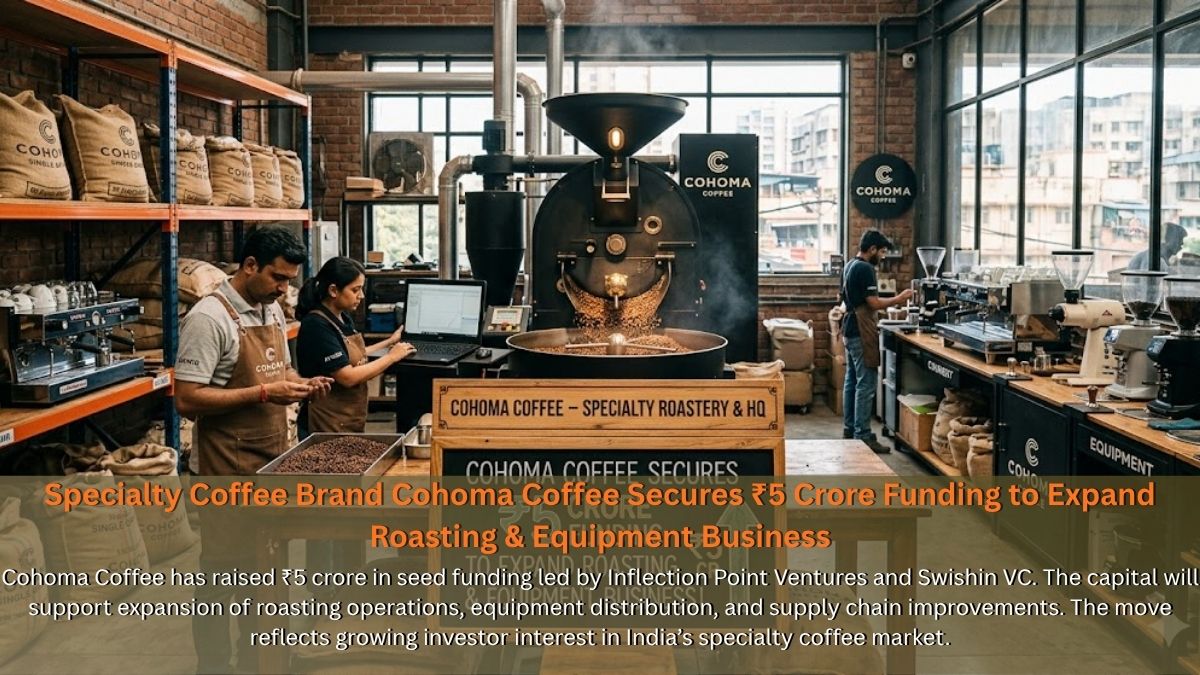
1. News Summary
Cohoma Coffee has secured ₹5 crore in a seed funding round to strengthen its roasting operations and expand its coffee equipment business. The funding highlights growing investor interest in India’s specialty coffee and café supply ecosystem. According to multiple startup and business news reports, the round was led by early-stage venture investors, including Inflection Point Ventures and Swishin VC, reflecting strong confidence in the brand’s expansion strategy.
The fresh capital will support capacity building in roasting infrastructure, improve supply chain efficiency, and expand the company’s equipment distribution network. In addition, the investment is expected to help the company scale its presence in India’s fast-growing specialty coffee market, which has been witnessing strong demand from urban consumers, cafés, and boutique coffee brands.
Cohoma Coffee operates in a niche but rapidly growing segment that combines coffee sourcing, roasting, and equipment supply. This integrated model positions the startup uniquely in the food and beverage ecosystem. The funding also signals increased venture capital activity in India’s hospitality and café supply chain sector, where multiple startups are emerging to serve both retail and B2B demand.
The development comes at a time when India’s café culture is expanding beyond metro cities into Tier 2 and Tier 3 regions. Specialty coffee consumption is rising, driven by young consumers, premium experiences, and digital-first café brands. As a result, startups like Cohoma Coffee are becoming important players in shaping the next phase of India’s beverage industry. Overall, the ₹5 crore funding round is expected to accelerate operational growth, strengthen roasting capabilities, and improve product innovation. It also positions Cohoma Coffee as a notable emerging brand in India’s competitive specialty coffee and café infrastructure space.
2. Introduction to Cohoma Coffee Funding Development
2.1 Overview of the Funding Announcement
The ₹5 crore funding secured by Cohoma Coffee is a small number on paper, but in the context of India’s evolving café and specialty beverage industry, it carries a very real sense of momentum. It signals that investors are beginning to look beyond traditional tech-driven startups and are now paying attention to consumer experience businesses that sit closer to daily lifestyle habits. Coffee, especially specialty coffee, is no longer just a product category. It is becoming a culture-driven consumption space where quality, sourcing, and experience matter as much as the beverage itself.
This funding round reflects that shift clearly. Instead of chasing large-scale digital disruption, investors are backing businesses that are building strong, tangible ecosystems around food and beverage experiences. Cohoma Coffee stands in that category because it is not just selling coffee, but trying to shape how coffee is sourced, processed, and delivered across multiple touchpoints. The ₹5 crore investment also shows early-stage conviction that the café infrastructure and specialty roasting segment in India still has significant untapped potential.
What makes this moment important is the timing. India’s café culture is still evolving, especially outside metro cities. Yet demand is rising steadily, driven by younger consumers who are more aware of quality, origin, and brewing methods. In that environment, even a relatively modest funding round becomes meaningful because it supports a category that is still building its identity. For Cohoma Coffee, this investment is less about scale today and more about establishing a strong foundation in a market that is clearly expanding.
2.2 Significance in Startup Ecosystem
India’s startup ecosystem has been going through a quiet but important transformation. For years, most attention went toward fintech, SaaS, and hyper-growth consumer apps. But recently, there has been a visible shift toward experience-driven businesses, especially in food, beverage, wellness, and lifestyle sectors. Cohoma Coffee sits directly within this transition, where startups are not just solving digital problems but also reshaping physical, sensory experiences.
What makes this shift interesting is that consumer expectations have changed significantly. People are no longer satisfied with generic products. They want origin stories, transparency, consistency, and a sense of craft behind what they consume. Coffee, in particular, has become a space where these expectations are very visible. From bean sourcing to roasting profiles, consumers are becoming more informed and more selective. This creates space for startups like Cohoma Coffee to build strong brand identity through quality control and storytelling.
At an ecosystem level, this also reflects how angel investors and early-stage funds are diversifying their portfolios. They are no longer restricting themselves to pure technology plays. Instead, they are increasingly open to hybrid businesses that combine manufacturing, supply chain control, and consumer engagement. Cohoma Coffee fits this evolving mindset because it operates at the intersection of product quality and operational infrastructure. It is not just a café brand; it is attempting to build a controlled ecosystem around coffee itself.
3. About Cohoma Coffee and Its Working Model
3.1 Business Model Structure
Cohoma Coffee operates on a vertically integrated model, which is one of the strongest approaches in the specialty food and beverage space when executed correctly. Instead of relying on multiple external suppliers and fragmented processes, the company brings key stages of the coffee journey under one system. This includes sourcing raw beans, roasting them in controlled environments, and supplying both finished coffee and brewing equipment to cafés and commercial clients.
The emotional core of this model lies in control. Coffee quality is extremely sensitive to small variations in roasting temperature, bean origin, storage conditions, and brewing equipment. Even minor inconsistencies can completely change taste and customer experience. By controlling these variables internally, Cohoma Coffee aims to reduce unpredictability and deliver a more consistent cup across different consumption points. For café owners, this consistency is critical because it directly affects customer retention and brand reputation.
From a real-world perspective, this model also solves a very practical problem faced by small and mid-sized cafés. Many struggle with maintaining standard quality across multiple locations or even within a single outlet due to dependency on third-party roasters or inconsistent equipment. Cohoma Coffee’s integrated structure addresses this by combining product and infrastructure support. This means cafés are not just buying coffee, they are entering into a more structured ecosystem designed to stabilize output and improve overall customer experience.
3.2 How the Startup Works
The working model of Cohoma Coffee begins at the sourcing stage, where coffee beans are carefully selected from specific growing regions. This step is crucial because bean origin plays a major role in defining flavor profiles, acidity levels, and overall aroma. Once sourced, the beans go through controlled roasting processes, where temperature curves and timing are carefully managed to preserve flavor integrity while achieving the desired roast profile.
After roasting, the coffee enters distribution channels that serve multiple segments. Some batches go directly to cafés and hospitality businesses, while others reach retail customers who prefer brewing at home. This dual-channel approach helps the company balance B2B stability with B2C scalability. At the same time, the equipment division supplies machines and brewing tools that ensure the coffee is prepared correctly, maintaining consistency between production and final consumption.
In real operational terms, this is where the system becomes more than just a supply chain. It becomes a controlled experience pipeline. Every step, from bean selection to final brewing, is designed to reduce variation and improve reliability. For café owners, this reduces operational stress. For consumers, it creates a more predictable and higher-quality experience. Over time, this kind of structure builds trust, and in the coffee industry, trust often translates directly into repeat consumption.
3.3 Value Chain Integration
The real strength of Cohoma Coffee lies in how it integrates multiple parts of the coffee value chain into a single system. Traditionally, coffee businesses operate in fragmented layers where sourcing, roasting, equipment supply, and retail are handled by different players. This creates gaps in quality control and increases dependency on multiple vendors.
Cohoma Coffee attempts to close these gaps by aligning sourcing, roasting, and equipment under one operational framework. This integration improves efficiency because it reduces delays, minimizes quality mismatches, and ensures that every stage of production is aligned with the final customer experience. It also helps the company maintain better control over pricing, margins, and supply consistency.
On a deeper level, this integration creates a more resilient business structure. Instead of relying heavily on one revenue stream, the company benefits from multiple interconnected layers of value creation. If café demand fluctuates, retail or equipment sales can provide balance. If supply chain challenges arise, internal roasting and sourcing coordination help maintain stability. This interconnected system is what gives the business both flexibility and durability in a competitive market.
4. Revenue Model of Cohoma Coffee
4.1 Core Revenue Streams
Cohoma Coffee’s revenue model is built around three strong and interconnected channels, each serving a different segment of the market while reinforcing the overall ecosystem. The first and most consistent stream comes from roasted coffee sales to cafés, restaurants, and retail partners. This creates a recurring revenue base because coffee is not a one-time purchase but a continuous consumption product. For cafés especially, regular replenishment orders ensure predictable demand cycles.
The second revenue stream comes from equipment sales, which often carries higher margins compared to raw coffee sales. This includes brewing machines, grinders, and other café infrastructure tools. For many businesses entering the café space, equipment setup is a significant initial investment, and Cohoma Coffee positions itself as a solution provider in this stage. This creates strong early-stage revenue opportunities while also anchoring long-term relationships with clients.
The third stream is built through B2B partnerships with hospitality businesses. These are longer-term agreements where Cohoma Coffee supplies both products and sometimes operational support. These contracts add stability to the revenue model because they are not dependent on daily retail fluctuations but instead operate on structured supply agreements. Together, these three streams create a balanced model that supports both cash flow stability and scalable growth.
4.2 Growth-Driven Monetization
As café culture continues to grow across India, especially in tier-1 and emerging tier-2 cities, Cohoma Coffee benefits from a rising base of recurring demand. Unlike trend-based products, coffee consumption has a strong habit-forming nature, which makes it a reliable long-term category. Every new café opening represents not just a one-time sale opportunity but a continuous supply relationship that can last for years.
At the same time, the direct-to-consumer segment opens a completely different growth pathway. More consumers are now experimenting with home brewing, specialty beans, and premium coffee experiences. This shift allows Cohoma Coffee to tap into digital commerce channels and build a brand that extends beyond cafés into homes. Over time, this dual structure of B2B stability and B2C expansion creates a compounding effect on revenue growth.
What makes this especially powerful is the emotional connection consumers are developing with coffee. It is no longer just a beverage; it is part of lifestyle identity, daily routine, and personal experience. Cohoma Coffee, by operating across sourcing, roasting, equipment, and retail, is positioned not just as a supplier but as a curator of that experience. And in markets driven by experience and quality, that positioning carries long-term commercial strength.
5. Funding Details and Investment Structure
5.1 Investment Round Overview
The ₹5 crore seed funding round for Cohoma Coffee may look modest in absolute numbers, but it carries a deeper meaning when viewed through the lens of India’s evolving food and beverage startup landscape. Seed-stage capital in this space is becoming more selective, with investors focusing less on hype and more on operational clarity, unit economics, and the ability to scale physical infrastructure. Cohoma Coffee fits into this emerging investment mindset because it is not just a consumer brand, but a system that connects sourcing, roasting, equipment, and café enablement into one integrated structure.
What makes this round particularly relevant is the type of investors involved. Early-stage participants in such deals are typically those who understand the long cycle nature of hospitality and café businesses. They are not expecting overnight exponential returns, but rather steady, compounding growth built on repeat consumption and B2B relationships. This kind of capital is often patient capital, which is essential for businesses that require physical infrastructure like roasting units, logistics networks, and equipment distribution systems.
At a broader level, this funding reflects how niche consumer segments are gaining serious attention in India. Food startups are no longer being evaluated only as lifestyle brands. They are now being seen as infrastructure-backed businesses that can build recurring demand loops. In that sense, Cohoma Coffee is part of a much larger shift where investors are willing to back depth over noise, and execution over visibility.
5.2 Role of Venture Capital
Venture capital in India has been evolving rapidly, especially in how it views consumer-driven businesses. Earlier, most VC attention was concentrated around fintech, SaaS, and hyper-growth digital platforms. Today, there is a visible shift toward businesses that operate in real-world consumption categories like food, hospitality, and lifestyle infrastructure. Cohoma Coffee benefits directly from this transition because it sits at the intersection of experience, product quality, and scalable supply systems.
The interesting part is how investors now evaluate these businesses. It is no longer just about brand appeal or marketing traction. It is about how deeply the startup is embedded into the value chain. Cohoma Coffee, for example, is not only selling coffee; it is influencing how cafés operate, how brewing consistency is maintained, and how supply chains are structured. This operational depth is exactly what makes it attractive to venture capital firms looking for defensible and long-term opportunities.
There is also a strong behavioral shift among younger consumers, which investors are closely watching. Coffee consumption in India is no longer limited to occasional café visits. It has become part of daily routines, remote work culture, and social experiences. Venture capital firms are increasingly betting on this behavioral change because it signals repeat usage, predictable demand, and strong brand stickiness over time. Cohoma Coffee sits right inside this evolving consumption pattern, which strengthens its positioning in the eyes of investors.
5.3 Strategic Use of Funds
The ₹5 crore capital infusion is expected to be deployed across three critical areas, each directly tied to strengthening the company’s operational backbone. The first priority is expanding roasting capacity. In the coffee business, roasting is not just production, it is control over quality and consistency. Scaling this capability allows the company to serve more cafés and retail customers without compromising flavor profiles or delivery timelines.
The second major area of investment is operational systems. This includes improving supply chain efficiency, inventory management, and distribution coordination. In real-world operations, food and beverage businesses often struggle not because of demand issues, but because of backend inefficiencies. Strengthening these systems ensures smoother fulfillment cycles, reduced wastage, and better reliability for café partners who depend on timely supply.
The third focus is scaling equipment distribution. This is particularly important because equipment is not just a product line, it is a gateway into long-term business relationships. When cafés adopt Cohoma Coffee’s brewing systems, they are also aligning themselves with its quality standards. Expanding this segment helps the company deepen its presence across India’s growing café ecosystem, creating stronger integration between product supply and operational execution.
6. Founders and Startup Background
6.1 Founding Vision
Cohoma Coffee was built with a very grounded and practical vision: to improve the overall quality and consistency of India’s specialty coffee experience. Behind this idea is a simple but persistent problem that many café owners and coffee enthusiasts have experienced firsthand. Even when good coffee beans are available, the final cup often varies widely in taste due to differences in roasting, equipment, and brewing practices.
The founding vision was to close this gap between raw coffee quality and real-world café execution. Instead of treating coffee as just a commodity, the idea was to treat it as a controlled experience that could be standardized without losing its craft identity. This requires not just sourcing good beans, but building systems that ensure consistency at every stage, from roasting profiles to brewing infrastructure.
At a deeper level, this vision reflects a growing awareness in India’s urban markets. Consumers are becoming more educated about coffee origins, flavor notes, and brewing methods. The founders recognized this shift early and positioned Cohoma Coffee to serve both sides of the ecosystem: cafés that need reliability and consumers who demand quality. That dual understanding forms the emotional and strategic foundation of the company.
6.2 Early Journey
In its early phase, Cohoma Coffee started as a focused specialty coffee initiative targeting urban café culture. The initial approach was relatively narrow, centered around sourcing and roasting high-quality beans for a small set of cafés that were experimenting with premium coffee offerings. At this stage, the emphasis was heavily on quality control, flavor consistency, and building trust with early café partners.
However, real-world engagement quickly revealed a larger structural gap in the market. Many cafés, especially emerging ones, were not struggling because of lack of interest, but because of inconsistent supply chains and inadequate brewing infrastructure. Even when they received good coffee, they often lacked the equipment or training to extract consistent quality from it. These challenges pushed the startup to rethink its role in the ecosystem.
Over time, Cohoma Coffee expanded beyond roasting into equipment supply and café support systems. This was not just a business expansion, but a response to real operational pain points observed in the field. By engaging directly with café owners and understanding their day-to-day challenges, the company gradually evolved into a more comprehensive solution provider rather than a single-product supplier.
6.3 Evolution in Market
The evolution of Cohoma Coffee reflects a broader transformation happening in India’s food-tech and hospitality ecosystem. Initially positioned as a coffee supply-focused venture, the company gradually expanded into infrastructure support, recognizing that product quality alone is not enough to ensure consistent customer experience in the café industry.
This shift is important because it changes the nature of the business entirely. Instead of operating as a vendor, Cohoma Coffee begins functioning more like an ecosystem enabler. It is not just supplying coffee; it is helping cafés build the systems required to deliver consistent quality. This includes roasting expertise, equipment integration, and operational support.
In market terms, this evolution also strengthens long-term sustainability. Businesses that rely solely on product distribution often face margin pressure and high competition. However, companies that integrate into operational workflows tend to build stronger relationships and higher retention. Cohoma Coffee’s move toward a more integrated model reflects this strategic understanding and aligns with how modern hospitality startups are evolving globally.
7. Products and Services Offered
7.1 Coffee Roasting Services
Cohoma Coffee’s core offering lies in its specialty coffee roasting services, which are designed to deliver consistent and high-quality flavor profiles tailored for both cafés and retail consumers. Roasting is one of the most sensitive stages in the coffee value chain because even minor changes in temperature, timing, or bean treatment can significantly alter taste. By maintaining controlled roasting environments, the company ensures that each batch aligns with predefined flavor expectations.
In practical usage, this consistency becomes extremely valuable for café owners. It removes guesswork from daily operations and allows baristas to focus more on brewing execution rather than compensating for inconsistent bean quality. Over time, this leads to a more stable customer experience, which is essential in building repeat café traffic and brand loyalty.
7.2 Equipment Supply
Alongside roasting, Cohoma Coffee also provides coffee brewing machines and café equipment that are essential for maintaining consistency in beverage preparation. This includes grinders, espresso machines, and other operational tools that directly impact the final cup quality. In many café setups, equipment quality is often the hidden factor behind inconsistent results, even when coffee beans are of high grade.
By supplying both coffee and equipment, Cohoma Coffee ensures alignment between input quality and output execution. This integration reduces friction for café owners who might otherwise need to source equipment from multiple vendors without clear compatibility standards. In real-world scenarios, this also simplifies maintenance, training, and operational workflows, making café management more efficient and predictable.
7.3 B2B Café Solutions
Beyond products, Cohoma Coffee also supports end-to-end café solutions for businesses entering or expanding in the coffee space. This includes guidance on setup, operational structuring, and aligning coffee offerings with equipment capabilities. For new café owners, this kind of support is often critical because the success of a café depends heavily on execution quality rather than just location or branding.
In practice, this makes Cohoma Coffee more than a supplier. It becomes a partner in building functional café operations. By combining product supply with operational support, the company helps reduce early-stage failures and improves the chances of long-term success for its clients. This not only strengthens business relationships but also reinforces the company’s position within the broader café ecosystem.
8. Problems Solved by Cohoma Coffee
8.1 Quality Consistency Issues
One of the most persistent challenges in India’s café industry is inconsistency in coffee quality. Even when high-quality beans are available, the final product often varies due to differences in roasting practices, equipment calibration, and brewing techniques. This inconsistency directly affects customer experience, which is critical in a market where repeat visits determine café success.
Cohoma Coffee addresses this by standardizing the roasting process and ensuring controlled flavor profiles across batches. In real operational terms, this means cafés receive coffee that behaves predictably during brewing, reducing variation in taste and improving overall customer satisfaction. Over time, this consistency builds trust not only with café owners but also with end consumers who begin to associate a specific taste profile with reliability.
8.2 Equipment Accessibility
Another major challenge faced by small and mid-sized cafés is access to reliable and professional-grade coffee equipment. High-quality machines are often expensive, difficult to source, and require technical understanding for proper usage. Many new café owners struggle with choosing the right equipment mix, which can lead to operational inefficiencies or inconsistent output.
Cohoma Coffee solves this by offering integrated equipment supply alongside its coffee products. This removes the complexity of sourcing from multiple vendors and ensures compatibility between beans, machines, and brewing methods. In practice, this creates a smoother onboarding experience for new cafés and reduces the learning curve associated with setting up a functional coffee operation.
8.3 Supply Chain Fragmentation
The coffee supply chain in India is often fragmented, with sourcing, roasting, distribution, and equipment handled by separate entities. This fragmentation leads to delays, quality mismatches, and communication gaps between different stages of production. As a result, cafés often struggle with inconsistent supply and unpredictable quality outcomes.
Cohoma Coffee reduces this fragmentation by integrating multiple layers of the value chain into a single system. By controlling sourcing, roasting, and equipment distribution, the company creates a more cohesive operational flow. This not only improves efficiency but also ensures that each stage of the process is aligned toward delivering a consistent final product.
9. Industry Growth Trends and Market Opportunity
9.1 Specialty Coffee Growth in India
India’s specialty coffee market is experiencing steady and meaningful growth, driven by changing urban lifestyles and increasing exposure to global café culture. Consumers are becoming more aware of coffee origins, brewing methods, and flavor complexity, which is gradually shifting demand away from instant coffee toward specialty experiences.
This trend creates a strong foundation for businesses like Cohoma Coffee, which operate in the premium segment. As café culture expands across metropolitan and emerging cities, the demand for high-quality, consistent coffee is expected to rise significantly, creating long-term opportunities for structured roasting and supply businesses.
9.2 Consumer Behavior Shift
A major driver of this market is the behavioral shift among younger consumers who view coffee as part of lifestyle identity rather than just a beverage. Café visits are increasingly tied to work culture, social interaction, and personal routines. This shift is creating more consistent demand patterns and encouraging businesses to invest in better quality offerings.
For companies like Cohoma Coffee, this means the market is not just growing, but also becoming more predictable. Repeat consumption, brand loyalty, and experience-driven purchasing decisions are making the coffee segment more stable and scalable over time.
9.3 Startup Ecosystem Expansion
India’s startup ecosystem is expanding beyond traditional technology sectors into food-tech, hospitality, and retail infrastructure. Investors are increasingly interested in businesses that combine physical operations with scalable systems. This shift is opening new opportunities for startups that operate in real-world consumption categories.
Cohoma Coffee fits into this trend by blending product manufacturing with service and infrastructure support. This hybrid model aligns well with current investor preferences, which favor businesses that demonstrate both operational depth and scalable potential.
10. Competitors in the Market
10.1 Direct Competitors
Direct competitors in this space include specialty coffee roasters and café supply startups operating across India. Brands such as Toffee Coffee Roasters and similar specialty players compete in the roasting and premium coffee segment. These companies focus on delivering high-quality beans and curated coffee experiences to cafés and retail customers.
Competition in this segment is largely driven by consistency, flavor profiles, sourcing quality, and distribution efficiency. Businesses that can maintain stable quality while scaling operations tend to gain stronger traction in the long run.
10.2 Indirect Competitors
Indirect competition comes from large café chains, international coffee brands, and fragmented local suppliers. These players often operate in different parts of the value chain but still influence consumer choices and café purchasing decisions. Large chains bring brand recognition, while local suppliers compete on price and accessibility.
For Cohoma Coffee, indirect competition is less about direct product overlap and more about alternative purchasing options available to cafés and consumers. This creates a competitive environment where differentiation depends on integration, quality consistency, and operational support.
11. Funding Ecosystem and Startup Trends
11.1 Rising Venture Capital Interest
Venture capital interest in food-tech and hospitality startups has been steadily increasing as investors recognize the long-term potential of consumption-driven markets. Unlike highly volatile tech sectors, food and beverage categories offer stable demand patterns, especially when supported by strong brand and supply chain models. This shift is encouraging more early-stage investments in businesses that operate at the intersection of physical infrastructure and consumer experience, which directly benefits companies like Cohoma Coffee.
11.2 Startup Innovation Trends
Innovation in this space is increasingly focused on supply chain integration, operational efficiency, and consumer experience enhancement. Instead of building purely digital products, startups are now creating hybrid models that combine physical operations with data-driven systems. Cohoma Coffee reflects this trend by integrating roasting, equipment supply, and café support into a unified ecosystem. This approach strengthens operational control while improving customer experience consistency.
12. Journey and Background of Cohoma Coffee
12.1 Early Stage Development
Cohoma Coffee began with a focused effort on coffee roasting quality and small-scale distribution to select cafés. The early stage was heavily experimental, with emphasis on understanding flavor profiles, sourcing challenges, and café requirements. This phase was critical in building foundational trust with early partners and refining roasting techniques to match real-world café expectations.
12.2 Expansion Phase
As the company grew, it expanded into equipment supply and café support services. This expansion was driven by direct feedback from café owners who needed more than just coffee—they needed complete operational solutions. This phase marked a shift from being a product supplier to becoming a system provider for café operations.
12.3 Current Growth Stage
With fresh funding and increasing demand, Cohoma Coffee is now entering a scale-up phase focused on expanding capacity, strengthening distribution, and building a stronger presence in India’s growing café ecosystem. The focus at this stage is on operational scaling, consistency, and deeper market penetration.
13. Learning for Startups and Entrepreneurs
The journey of Cohoma Coffee offers several grounded lessons for founders building in real-world, infrastructure-heavy industries. One of the clearest lessons is that niche markets can become powerful when combined with strong execution and deep understanding of customer pain points. Specialty coffee is not a mass market initially, but it becomes scalable when quality and experience are consistently delivered.
Another key insight is the value of integration. Businesses that control multiple parts of their value chain tend to build stronger resilience and better margins over time. In Cohoma Coffee’s case, combining roasting, equipment, and café support creates a more stable and defensible business model.
Finally, this journey highlights the importance of timing and adaptability. Markets evolve, consumer behavior shifts, and startups that respond by expanding their scope without losing core focus tend to perform better in the long run. Cohoma Coffee’s evolution from a niche roaster to a broader café ecosystem enabler reflects this principle clearly and shows how thoughtful expansion can drive sustainable growth.
About foundlanes.com
foundlanes.com is India’s leading startup idea discovery platform. It helps entrepreneurs find actionable startup opportunities, market insights, and industry-specific guidance to turn ideas into real businesses. With deep research and practical resources, foundlanes supports founders at every stage, from idea validation to launch and growth.