
News Summary
Pronto Raises Funding and Expands Valuation in Rapid Growth Phase
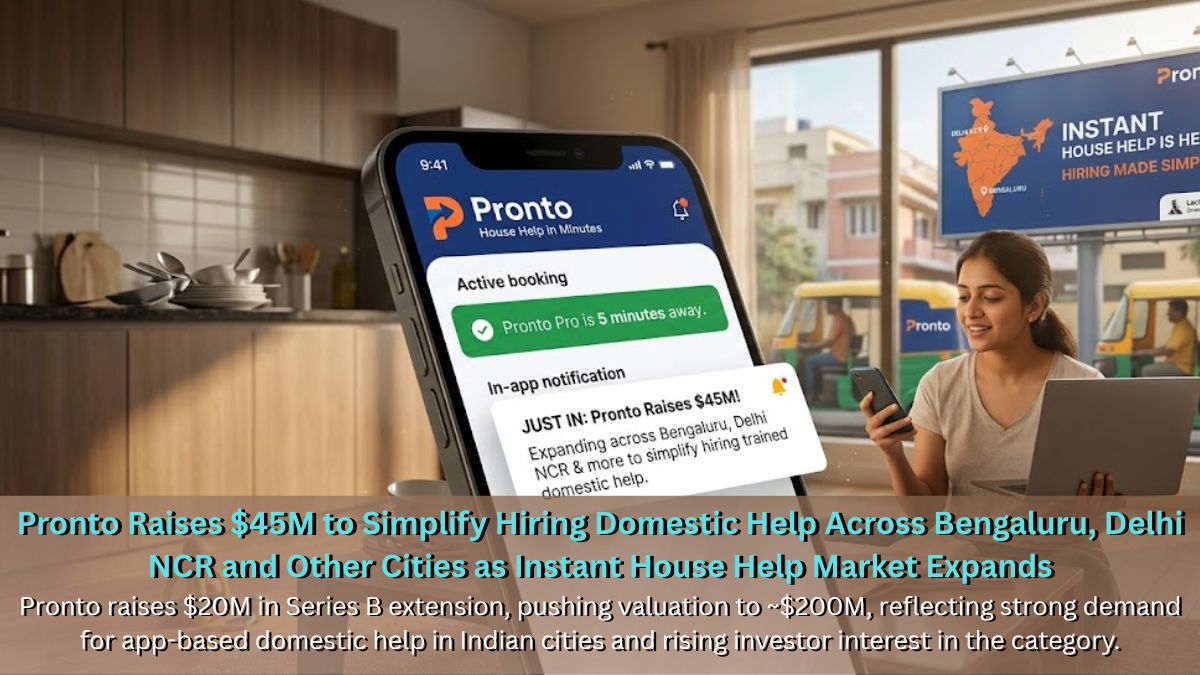
The latest Pronto raises funding round reflects something much bigger than just another startup headline. It shows how quickly India’s urban service economy is changing beneath the surface. Pronto, an instant house help platform, has secured an additional $20 million in an extended Series B round, pushing its valuation close to $200 million. On paper, it looks like a financial milestone. But in reality, it represents a deeper shift in how urban households are now choosing to manage everyday life.
What makes this moment important is not just the number, but the speed behind it. Within a relatively short period, the company has seen its valuation almost double, which is never just about hype in serious venture capital circles. It usually signals one thing clearly: investors are seeing real usage, real demand, and real behavioural change happening in the market. Cities like Bengaluru and Delhi NCR are slowly moving away from informal domestic help networks and shifting toward structured, app-based systems where reliability matters more than word-of-mouth uncertainty. In that sense, Pronto raises is not just funding news, it’s a reflection of how trust in everyday services is being rebuilt through technology.
At the same time, this funding cycle also shows how global and Indian capital are now looking at the same opportunity space. Investors are not just betting on a single company; they are betting on a category. Domestic help, which was once completely unorganized and emotionally dependent on personal networks, is now turning into a structured, scalable service market. The participation of international investors like Lachy Groom adds another layer of validation, showing that this is not just an India-specific experiment, but part of a larger global trend where everyday services are becoming platform-driven.
1. Demand for Organized Domestic Help Services in Urban India
Behind the Pronto raises story, there is a very real, everyday problem that millions of people in cities quietly deal with. Finding reliable domestic help in India has always been a deeply personal, often stressful process. It depends on references, neighbors, brokers, or sheer luck. And even then, consistency is never guaranteed. For working families in cities like Bengaluru or Delhi NCR, this uncertainty often creates more stress than convenience.
This is exactly where Pronto positions itself. Instead of relying on informal networks, it tries to bring structure, verification, and predictability into a space that has historically been completely unstructured. The idea may sound simple on the surface, but the emotional impact is significant. When someone knows their home support system is reliable, verified, and accountable, it changes daily life in subtle but powerful ways. That emotional relief is actually one of the biggest drivers behind adoption of such platforms, even if it is not always discussed in financial reports.
From a market perspective, this shift is also being supported by broader changes in urban India. Dual-income households are increasing, work hours are stretching, and time has become the most expensive currency for middle-class families. So instead of spending energy on uncertainty, people are willing to pay for reliability. This is why Pronto raises becomes more than just startup funding news—it reflects a slow but deep transformation in how urban households think about convenience, trust, and time management.
2. Pronto Raises Funding and Market Position in Startup Ecosystem
2.1 Latest Funding Round and Valuation Surge
The recent Pronto raises development, where the company secured $20 million in an extended Series B round, highlights how quickly investor sentiment can shift when a category starts showing real traction. What stands out here is not just the amount raised, but the confidence behind it. A valuation touching $200 million indicates that investors are seeing strong early signals of product-market fit in a space that many previously underestimated.
In real terms, valuation jumps like this are rarely driven by speculation alone. They are usually backed by growth signals such as increasing user adoption, repeat usage, and strong demand concentration in urban centers. In Pronto’s case, the domestic services category is naturally recurring, which means once trust is established, users tend to return repeatedly. That repeat behavior is what makes the model attractive to venture capital firms. It converts what used to be a fragmented offline service into something that behaves more like a structured digital marketplace with predictable demand patterns.
At a broader level, this funding also fits into a larger pattern within the Indian startup ecosystem. Investors are increasingly shifting focus from pure consumer apps to real-world service platforms that solve daily friction points. Whether it is mobility, delivery, or home services, the trend is clear: startups that reduce uncertainty in everyday life are gaining stronger attention. In that sense, Pronto raises is part of a much bigger funding movement happening across India’s venture capital landscape.
2.2 Investor Participation and Global Interest
One of the more interesting aspects of this Pronto raises round is the participation of high-profile global investors, including Lachy Groom. This kind of backing is not just financial; it also brings credibility, network access, and strategic validation. When international investors step into a category that is still evolving in India, it often signals that the opportunity is not just local, but globally relevant in structure and scalability.
From an ecosystem point of view, this also reflects how interconnected startup funding has become. Indian startups are no longer viewed in isolation. They are now part of a global venture capital flow where ideas, models, and capital move across borders much faster than before. Investors are actively scanning emerging markets like India for business models that can scale efficiently in high-density urban environments. Domestic services, logistics, fintech, and consumer platforms all fall into this category.
On the ground, this translates into something very practical for startups like Pronto. Global participation doesn’t just increase funding it also raises expectations. Investors now expect clearer execution, stronger retention, and faster scaling across cities. So while Pronto raises reflects success, it also quietly raises the bar for what comes next. Growth is no longer just about raising capital; it is about proving that the model can sustain itself across different urban environments without losing trust or quality.
3. About Pronto and Its Business Model
3.1 Startup Background and Vision
Pronto didn’t really come from a flashy “startup idea.” It comes from a very everyday frustration that almost everyone living in a big city knows too well. That moment when you desperately need help at home, but the person doesn’t show up. Or they come once, and the next day everything changes again. Or you keep asking around in your society or friends group, hoping someone “knows someone reliable.” It’s small things like this, but they slowly build stress in the background of daily life. Pronto is basically trying to fix that quiet chaos.
What makes this idea feel different is not the tech part, but the emotional weight behind it. For a lot of people in cities like Bengaluru or Delhi NCR, home is the only place where they expect some stability. But even that starts feeling uncertain when basic help becomes unpredictable. Pronto steps into that emotional gap. It is trying to turn something random and informal into something you can actually trust without overthinking every single time. And that shift matters more than it looks on paper, because it directly affects how calm or stressed a household feels on a daily basis.
3.2 Working Model of Pronto
At a simple level, Pronto works like an app where you book domestic help the same way you would book a cab. But behind that simplicity, there is a very controlled system trying to remove the usual mess people face. When a user books a service, the platform doesn’t just “send someone.” It tries to match availability, skill, and location so the experience feels consistent every time. That consistency is the real challenge in this space, not just finding people.
For users, the biggest change is mental. Earlier, you would spend time calling, waiting, following up, and still not be sure if someone would actually come. Now, it becomes more predictable. You book, and it happens. For workers too, the system is more structured than the old informal setups where income was uncertain and dependent on random calls. It doesn’t solve every problem, but it reduces a lot of daily friction that people had quietly accepted as “normal” for years. And that’s where the model starts feeling meaningful, not just functional.
4. Revenue Model and Business Strategy of Pronto
4.1 Core Revenue Streams
Pronto earns through a very straightforward structure, but the impact of it is deeper than it sounds. Every time someone books a service, a part of that payment becomes revenue for the platform. On top of that, there is a share from service providers as well. It is not complicated on paper, but what makes it work is how often people actually use the service once trust is built.
The real strength here is repetition. Domestic help is not something you use once in a while. It becomes part of your weekly rhythm, sometimes even daily life. So once someone starts trusting the platform, they keep coming back. And slowly, without any loud marketing push, the platform becomes part of the household routine. That’s where revenue starts becoming stable, not because of big one-time transactions, but because of small repeated moments that feel almost invisible but very consistent.
4.2 Long-Term Monetization Strategy
In the long run, Pronto is clearly moving towards something more layered than just basic bookings. The direction seems to be about improving the experience itself. Faster service, better trained workers, priority support, and maybe even premium plans for people who want everything handled without stress. It is less about adding more features and more about removing friction from everyday life.
What’s interesting is how this reflects a bigger shift happening in startups today. Companies are no longer just trying to “acquire users.” They are trying to stay useful inside a person’s daily routine. If Pronto gets this right, it stops being just an app on the phone and slowly becomes something people rely on without thinking too much. And that kind of position in a household is extremely powerful, because once trust is built at that level, it is very hard to replace.
5. Problem Pronto Solves in Indian Market
5.1 Unorganized Domestic Help Sector
If you talk to anyone living in a metro city, this problem feels very personal very quickly. Finding domestic help is not just about hiring someone. It is about trust, timing, behaviour, and consistency. Most people depend on word of mouth. One recommendation leads to another, and still there is always some uncertainty. Someone might stop coming without notice. Someone else might suddenly change terms. And in between all this, households are left adjusting again and again.
Pronto tries to bring some order into this very scattered system. Instead of depending on informal networks, everything is structured through onboarding, verification, and defined processes. It doesn’t magically remove all problems, but it reduces the randomness. And for a user, that alone feels like a big relief. Because the real stress was never just about finding help, it was about not knowing what will happen tomorrow. That uncertainty slowly drains energy from daily life more than people openly admit.
5.2 Demand for Reliable Urban Services
Urban life has changed quietly in the last few years. People are busier, schedules are tighter, and even small disruptions at home can affect the whole day. In that situation, domestic help is no longer just support. It becomes something that holds the routine together. But ironically, the system behind it has remained very informal and inconsistent for a long time.
That gap is exactly what Pronto is stepping into. What users are really looking for is not just “someone to clean or cook.” They are looking for reliability. They want to not worry about whether someone will show up or not. They want things to just work without constant follow-ups. When a platform starts delivering that feeling, even partially, it changes how people experience their own homes. And that emotional shift is what makes this category much bigger than it first appears on the surface.
6. Industry Growth Trends and Startup Ecosystem Impact
6.1 Growth of On-Demand Service Startups
The Indian startup ecosystem is going through a very visible but also very emotional shift right now. A few years ago, most conversations were only about hyper-growth, discounts, and customer acquisition at any cost. But today, the focus feels different. People are building around real-life problems that sit inside daily routines. That is why on-demand services have started growing so fast. Whether it is fintech, AI startups, or service marketplaces, everything is moving towards one direction: making everyday life feel less complicated and more predictable.
In that larger shift, Pronto raises funding at exactly the right moment. It is not just about money flowing into a startup. It is about investors backing the idea that convenience is becoming a basic need, not a luxury. If you look closely, people are no longer impressed by complex tech stories. They just want things to work without stress. That emotional demand is what is quietly pushing fastest-growing startups in this space. The interesting part is, this growth is not loud or dramatic. It is slow, steady, and deeply connected to how people actually live their lives every single day.
6.2 Tech Disruption in Household Services
There is something very real happening inside Indian homes that doesn’t always get talked about in startup discussions. The way people manage their daily life is changing. Earlier, household services were built on phone calls, references, and informal agreements. Now, everything is slowly shifting into mobile-first platforms where trust is created through systems instead of personal networks. This is not just convenience. It is a complete restructuring of how basic home support works.
This kind of tech disruption is not just an Indian story, it is part of a global shift. But in India, the emotional layer is stronger because households depend heavily on domestic help for daily functioning. So when platforms like Pronto enter this space, they are not just introducing technology. They are changing habits that have existed for decades. And that change always feels a little uncomfortable at first, but slowly it starts becoming normal. Over time, it creates a new expectation in people’s minds that things should be simple, fast, and reliable without constant follow-ups or uncertainty.
7. Competitor Landscape in Domestic Help Platforms
7.1 Direct Competitors
The competition for Pronto is not just about other apps. It is about every platform that tries to organize household services in urban India. These companies are all solving a similar problem, which is making domestic help more accessible, structured, and predictable. On the surface, they may look similar, but the real competition is about trust. Because in this category, users don’t just compare features, they compare experiences.
In real usage, people don’t think in terms of “apps.” They think in terms of who showed up on time, who did the job properly, and who didn’t create extra stress. That is why competition in this space is very emotional in nature. One bad experience can push a user away, and one smooth experience can build long-term loyalty. So even though multiple startups operate in the same category, the real difference comes down to execution, consistency, and how well they reduce daily friction for users who are already mentally tired from managing too many things.
7.2 Indirect Competition
Indirect competition in this space is actually much bigger than it looks. Local agencies, small offline service providers, and even personal networks still dominate a large part of the market, especially outside major metro cities. These systems are not structured, but they are familiar. People trust them because they have been using them for years, even if they are not perfect. That emotional comfort is a strong barrier for digital platforms to break.
At the same time, these offline systems lack scalability and consistency. There is no guarantee of service quality, no standard pricing, and no accountability layer. This is where digital platforms try to slowly replace old habits. But this transition is not just about technology. It is about changing human behaviour, which always takes time. So the competition here is not a simple business fight. It is a slow shift from comfort-based decisions to system-based trust, and that shift happens gradually, one household at a time.
8. Funding Journey and Startup Growth Strategy
8.1 Rapid Funding Acceleration
The funding journey of Pronto reflects something that is becoming more common in today’s startup ecosystem. When investors see a clear problem and strong early traction, funding decisions happen faster than before. Pronto raises capital in multiple stages, and the fact that its valuation has doubled in a relatively short period shows strong belief in its model. But beyond numbers, what really stands out is the speed of confidence building in this category.
In real startup life, this kind of acceleration doesn’t come from hype alone. It usually comes when users start returning repeatedly and the product becomes part of their routine. That repeated usage is what convinces investors that the business is not just growing, but becoming necessary. In many ways, funding in such startups is not just about potential anymore. It is about proof of behaviour change. When people start depending on a service for daily life, investors see something much stronger than projections. They see habit formation, and that is where long-term belief is built.
8.2 Expansion Strategy Across Cities
Pronto’s expansion across cities like Bengaluru and Delhi NCR is not just a geographic move. It is a very intentional attempt to enter places where daily life is already fast, demanding, and emotionally stretched. These cities are where domestic help is not optional, it is essential. So the demand is already strong, but the expectation for reliability is even stronger. That combination creates both opportunity and pressure at the same time.
Expanding in such markets is never easy because every city has its own behavioural patterns and service expectations. What works in one location does not always work in another. But if done right, this expansion becomes very powerful because it allows the platform to learn, adapt, and improve continuously. Over time, it also builds network effects where more users and service providers strengthen the system together. And that is when growth stops feeling like expansion and starts feeling like integration into everyday life.
9. Startup Ecosystem and Market Positioning
9.1 Role in Indian Startup Landscape
Pronto sits in a very interesting place inside India’s startup ecosystem because it is not trying to reinvent something futuristic, it is trying to fix something very real and very daily. That is why it feels different from many other startups that often sound exciting on paper but don’t really touch people’s everyday lives. Pronto is operating in a space where the problem is already deeply felt, just never properly organized. In that sense, it becomes part of a quiet but powerful shift in Indian startups where real-world inconvenience is becoming the biggest opportunity.
What makes its position even more meaningful is how it reflects a broader emotional change in how startups are being built. Founders are no longer just chasing scale for the sake of it. They are looking at problems that sit inside households, routines, and stress points that people don’t always talk about openly. Pronto reflects that shift very clearly. It is not just a platform, it is a response to how modern life has become faster, more demanding, and mentally heavier. And when a startup starts solving something that people feel every single day, it naturally finds a stronger place in the ecosystem without needing loud positioning or over-explanation.
9.2 Investment Trends in Service-Based Startups
There is a noticeable change happening in how investors look at service-based startups today. Earlier, most attention went towards high-tech sectors like fintech or deep AI innovation. But now, there is growing interest in businesses that operate closer to everyday human needs. Venture capital firms, angel investors, and even global funding networks are increasingly comfortable backing platforms that solve simple but persistent problems. This is why service marketplaces like Pronto are seeing strong attention from investors.
What is really driving this interest is not just the business model, but the predictability of demand. Domestic help, home services, and daily assistance are not trends that fade away. They are ongoing needs that only grow with urbanization. So when investors see platforms that can organize this demand efficiently, they start viewing them as long-term infrastructure plays rather than short-term apps. That shift in mindset is important because it changes how capital flows. It is no longer just about excitement. It is about stability, repetition, and how deeply a platform can embed itself into everyday life without constantly fighting for attention.
10. Hiring News and Workforce Impact
10.1 Job Creation in Gig Economy
One of the less discussed but very real impacts of Pronto is on employment itself. When you look at the gig economy closely, it is not just about flexible work, it is about giving structure to work that already exists but was never formally organized. Domestic help in India has always been part of urban life, but most of it operated without systems, schedules, or predictable income. Pronto introduces a layer of structure that changes how work feels for many people involved in it.
For workers, this shift is not just financial, it is emotional too. Having scheduled bookings, defined expectations, and fewer uncertainties brings a sense of stability that was missing earlier. It reduces the constant stress of not knowing what the day will look like. At the same time, for urban households, it creates a more reliable experience. So in a way, the platform is connecting two sides that both needed clarity, just in different forms. This is where hiring news in the startup space becomes more than just job creation numbers. It becomes about how work itself is being reshaped quietly through platforms that add structure to informal systems.
10.2 Women in Workforce Participation
The impact of service platforms like Pronto also touches something deeper in society, especially when it comes to women’s participation in the workforce. A large part of domestic work in India is performed by women, and historically, it has been understructured and undervalued. When platforms introduce scheduling, transparency, and consistent demand, it slowly changes how this work is perceived and experienced.
For many women workers, this shift means more control over time, more predictable income, and a better sense of dignity in how their work is organized. It may not solve every challenge, but it does bring visibility and structure into a space that was often invisible. On the other side, it also helps households, especially working women, manage their own time better because they are not constantly handling uncertainty around domestic support. So the impact is layered. It is not just about employment. It is about how work, time, and daily life begin to feel slightly more balanced in an environment that is otherwise very fast and demanding.
11. Learning for Startups and Entrepreneurs
The journey of Pronto carries lessons that go far beyond just one business model. The first and most important learning is that real problems often sit in places people overlook because they feel too ordinary. Domestic help is something so common that it is easy to assume it doesn’t need innovation. But in reality, it is exactly these everyday frustrations that create the biggest opportunities. When a startup solves something people deal with emotionally every day, it naturally finds strong adoption without needing heavy persuasion.
Another important lesson is about trust. In categories like this, technology alone is not enough. People are not just buying a service, they are trusting a system to enter their homes and manage something personal. That means scalability depends heavily on consistency, reliability, and emotional comfort, not just features. And once trust breaks, recovery is extremely difficult. So startups in this space have to treat trust as their core product, not just a side effect of operations.
Finally, Pronto highlights something very important about timing and execution. Even a good idea struggles if the market is not ready, or if execution is weak. But when timing, demand, and execution align, growth can feel surprisingly fast. Investor confidence, funding cycles, and valuation jumps all reflect this alignment. For entrepreneurs, the real takeaway is simple but powerful. Build where pain is real, make the experience dependable, and focus on reducing uncertainty in people’s daily lives. That combination is what turns a basic service into a long-term business.
About foundlanes.com
foundlanes.com is India’s leading startup idea discovery platform. It helps entrepreneurs find actionable startup opportunities, market insights, and industry-specific guidance to turn ideas into real businesses. With deep research and practical resources, foundlanes supports founders at every stage, from idea validation to launch and growth.