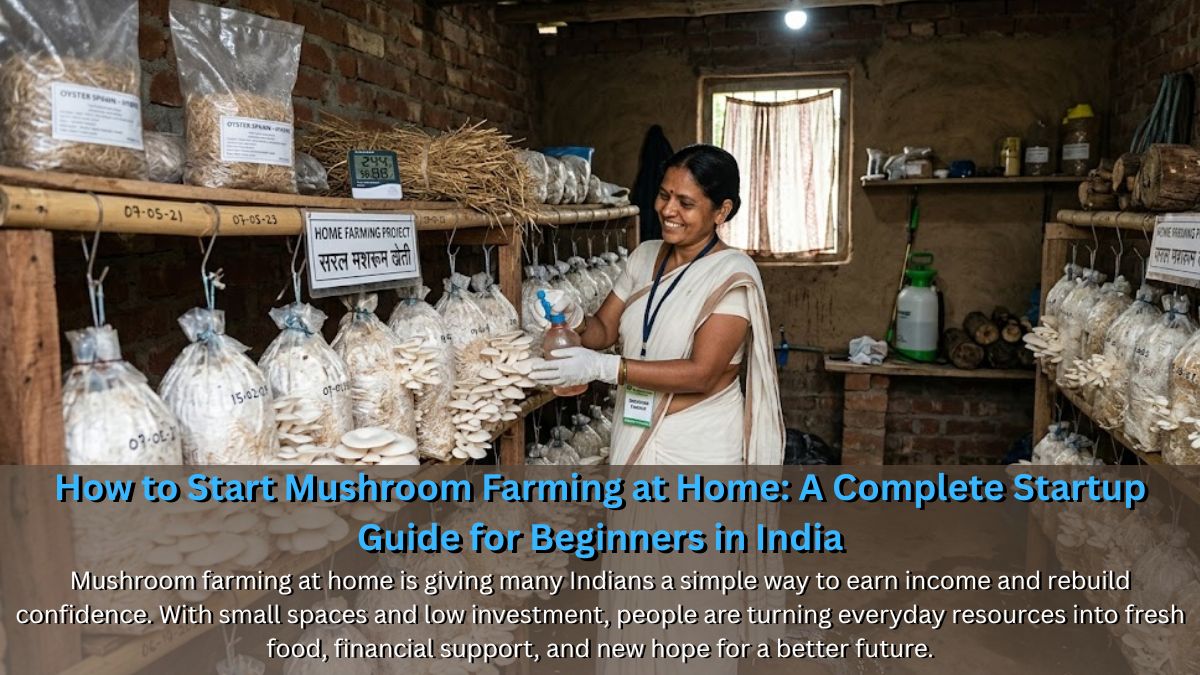
Mushroom farming at home is not just about growing mushrooms anymore. For many people in India, it is becoming a quiet fight against helplessness. Behind almost every small mushroom setup, there is usually a story nobody sees. A father worried about monthly bills. A graduate tired of hearing “we will let you know” after every interview. A homemaker silently wanting to contribute financially without leaving her children behind. A farmer exhausted from depending on uncertain weather and unstable crop prices. Most people do not enter mushroom farming because it looks glamorous. They enter because life pushes them into a corner where they desperately need something that can still work.
The beginning is often painfully simple. An old storeroom gets cleaned after years. A damp corner of the house suddenly becomes important. A few mushroom bags are arranged carefully with nervous hands. Family members watch quietly, unsure whether this idea will survive or fail like so many others. Every single day, the person checks the room again and again, touching the bags gently, adjusting moisture, worrying constantly. Then one morning, tiny white mushrooms finally begin appearing. And in that small moment, something emotional happens inside people. It is difficult to explain unless someone has lived it. Because those mushrooms are not just crops. They become proof that maybe life is finally responding to their effort after a long time.
What makes mushroom farming deeply beautiful is that it grows from things people usually throw away. Straw. Sawdust. Agricultural waste. Things considered useless suddenly begin creating food, income, and dignity. In many ways, the people starting this business feel similar themselves. Many of them come from backgrounds where society underestimated them, ignored them, or made them feel small. Yet slowly, quietly, inside tiny rooms hidden from the world, they begin building something meaningful with their own hands. The first customer. The first repeat order. First few thousand rupees earned independently. These moments may look ordinary to others, but inside those homes, they feel life-changing.
Today, restaurants, cafés, grocery shops, hotels, and health-conscious consumers are demanding fresh mushrooms faster than ever before. But behind this growing market are deeply human stories filled with fear, courage, pressure, and hope. Stories of mothers saving household money secretly to buy their first setup. Stories of unemployed youth refusing to give up on themselves. Families slowly smiling again after months of stress. That is why mushroom farming feels different from many business ideas. It is not only creating income. It is rebuilding confidence in people who had almost forgotten what confidence feels like. Sometimes all it takes is one small room, a little patience, and the courage to try once more for a person’s entire life to slowly begin changing again.
1. Startup Idea Overview
Mushroom farming at home is not just a business trend people are talking about online. For many families across India, it is becoming an emotional turning point in life. Behind every small mushroom farm, there is usually a person sitting quietly with worries nobody fully sees. A young graduate tired of hearing rejection after rejection. A father calculating expenses late at night when everyone else is asleep. A homemaker wanting to support her family but unable to leave home responsibilities behind. A farmer exhausted after watching crops fail because rain came too early, too late, or not at all. Most people do not enter mushroom farming with excitement in the beginning. They enter with desperation mixed with hope.
The reason this idea is spreading so fast is because it feels possible even for ordinary people. No giant farmland. Expensive machinery. No fancy office. Just one small room, some growing bags, humidity control, patience, and the courage to try. Across villages, towns, and crowded cities, people are slowly converting forgotten spaces into indoor farms. Old storerooms. Damp corners. Empty terraces. Garages filled with dust for years. Places nobody cared about suddenly become spaces where families begin rebuilding their confidence.
Most beginners start with oyster mushrooms because they are easier to cultivate and require lower investment. But emotionally, the first harvest feels much bigger than business. Every morning, people walk into those rooms, checking moisture levels again and again, silently praying the crop survives. And then one day, tiny white mushrooms begin appearing from the bags. That moment changes something inside people. To outsiders, it may look small. But for the person standing there, staring at those first mushrooms, it feels like life whispering back, “Maybe you still have a chance.”
Many first-time growers become emotional during their first successful harvest because those mushrooms represent more than food. They represent proof that their effort was not wasted. Proof that they can still build something with their own hands even after disappointment, unemployment, debt, or failure. And maybe the most beautiful part of mushroom farming is this: mushrooms grow from things people usually throw away. Straw. Sawdust. Agricultural waste. Things considered useless suddenly create life and income. In many ways, the people building these farms feel exactly the same. Overlooked by society. Ignored by opportunities. Financially exhausted. Yet quietly, inside hidden rooms, they begin growing again too.
At the same time, demand for mushrooms is increasing rapidly across India. Health-conscious consumers want cleaner food. Restaurants, cafés, grocery stores, hotels, and cloud kitchens need fresh supply constantly. More people are becoming aware of protein-rich diets and organic eating habits. Yet many smaller cities still lack reliable local suppliers. That gap creates opportunity for people willing to work patiently and consistently.
But there is one truth nobody should hide. Mushroom farming is not magical success overnight. There are failed batches. Humidity mistakes. Sleepless nights. Mold contamination. Financial pressure. Days where people wonder if they made the wrong decision. But those who continue learning slowly discover something powerful: small consistent effort can completely change a family’s future over time.
2. Problem Statement & Solution
2.1 What Is Broken in the Current Market
India’s mushroom market still carries many invisible problems. In countless towns, people either cannot find fresh mushrooms regularly or they find products that already feel old and damaged by the time they reach local shops. Since mushrooms spoil quickly, long transportation chains destroy freshness before customers even buy them. Many consumers stop purchasing simply because their earlier experiences felt disappointing. At the same time, traditional farming is becoming emotionally painful for many families. Farmers are working harder than ever but earning less certainty in return. Weather patterns feel unpredictable now. Water shortages are increasing. Fertilizer costs keep rising. Crop prices fluctuate constantly. For many small farmers, farming no longer feels like security. It feels like anxiety.
Urban consumers are struggling too. More families want healthy food today, but organic produce often feels expensive and inaccessible. Parents want better nutrition for their children, but healthier choices still seem out of reach for many middle-class households. Then there is unemployment. Perhaps the heaviest problem of all.
Across India, millions of young people are educated yet financially stuck. Many want to start something independently but lack the capital for large businesses. Homemakers want income opportunities without abandoning family responsibilities. Rural youth want dignity without migrating far away from home. Retired individuals want purpose after losing structured work life. But affordable opportunities that feel realistic are rare.
2.2 How Mushroom Farming Fixes the Problem
Mushroom farming does not solve every problem overnight, but it creates something incredibly important: possibility. An unused room suddenly becomes productive. Agricultural waste suddenly becomes valuable. A family that once felt financially trapped suddenly sees income entering the house from a small indoor setup. That emotional shift is powerful.
Fresh mushrooms grown locally reach customers quickly, improving quality, taste, and trust. Instead of travelling for days through complicated supply chains, mushrooms can move from farm to customer within hours. Restaurants get fresher products. Families get healthier food. Growers build stronger local relationships. The sustainability behind the business also matters deeply. Wheat straw, sawdust, and compost that would normally be discarded now become the foundation of income generation. Nothing feels wasted anymore. But the biggest transformation happens inside people themselves.
When someone earns money from something they built with their own hands, fear slowly begins losing power over them. Confidence returns little by little. The feeling of helplessness weakens. And for many families, that emotional recovery becomes even more valuable than the profits.
3. Target Audience & Customer Persona
The people buying mushrooms today are changing rapidly across India. Health-conscious consumers are becoming one of the biggest customer groups. Families are thinking more seriously about nutrition, immunity, and cleaner eating habits after the pandemic. Mushrooms naturally fit into that lifestyle because they are rich in protein, fiber, vitamins, and minerals while remaining affordable compared to many health foods. Gym-goers and fitness-focused young consumers are also increasing mushroom consumption because it supports healthier diets. Vegan and vegetarian consumers increasingly use mushrooms as alternatives in daily meals.
Restaurants and cafés represent another powerful market. Food culture across India has evolved dramatically in recent years. Mushrooms are no longer limited to luxury restaurants. Today they appear in pizzas, curries, wraps, noodles, soups, salads, biryanis, sandwiches, and street-food innovations. Cloud kitchens especially require consistent fresh supply because food quality directly affects customer ratings and repeat orders.
Local grocery stores and vegetable vendors also create major opportunity, especially in Tier 2 and Tier 3 cities where reliable fresh mushroom supply still feels limited. But perhaps the most emotional side of this business is the type of people starting it.
- A homemaker wanting to stop asking for money for every small household expense.
- A student trying to reduce pressure on aging parents.
- A farmer searching desperately for additional income after repeated crop failures.
- A retired worker trying to feel useful again.
- A rural young person refusing to leave home and disappear into overcrowded city life just to survive.
These are not startup founders chasing luxury lifestyles or social media fame. Most are simply trying to create stability. Trying to breathe without constant financial fear. Trying to feel respected again. One challenge remains important though. Many Indian households still consume mushrooms only occasionally because they are unfamiliar with recipes or nutritional benefits. That means successful mushroom businesses often grow through trust, conversation, local awareness, recipe sharing, and personal relationships. In this business, human connection matters enormously.
4. Market Opportunity & Timing
The timing for mushroom farming in India feels almost emotional when viewed closely. People are tired. Tired of unstable jobs. Tired of rising expenses. Waiting endlessly for opportunities that never arrive. And at the same time, consumer behavior is changing rapidly. Families now care more about immunity, nutrition, organic food, and fresh produce than ever before. After the pandemic especially, people became more aware of what they consume daily. Protein-rich diets gained popularity. Local farming began feeling more trustworthy. Slowly, mushrooms entered that conversation.
Globally, mushroom cultivation is already a massive industry worth billions of dollars. Countries like China dominate production, but India still has enormous untapped space. Considering India’s huge population and growing health-food market, demand will likely continue rising for years. Government support is improving too. Agricultural universities, Krishi Vigyan Kendras, rural entrepreneurship programs, and organic farming schemes are helping more people access training and guidance. Earlier, information felt inaccessible. Today, someone sitting in a small village with a smartphone can learn mushroom cultivation techniques from YouTube, online communities, and local workshops.
Social media has changed small businesses emotionally as well. Earlier, small farmers remained invisible. Today, even a tiny home-based mushroom grower can post harvest videos online, connect with local customers through WhatsApp, and slowly build a loyal community around fresh produce.
Climate uncertainty is another painful reason behind this shift. Traditional farming has become emotionally exhausting because weather no longer feels predictable. Indoor mushroom cultivation offers something many farmers desperately want now: control. Control over environment. Over production cycles. Control over risk.
But beneath all the market trends, startup discussions, and business opportunities lies a much deeper truth. Mushroom farming is growing because ordinary people are trying very hard not to give up on life. Inside tiny rooms across India, people are watering hope every single day. And sometimes, that hope grows quietly in the shape of mushrooms.
5. USP & Value Proposition
5.1 Accessibility Makes This Business Feel Real for Ordinary People
One of the biggest reasons mushroom farming is touching so many lives across India is because it feels reachable. Most startup ideas today sound exciting until people hear the actual investment numbers. Huge capital. Expensive technology. Large teams. Risky loans. For middle-class and rural families already carrying financial pressure, those businesses often feel emotionally distant before they even begin. Mushroom farming feels different from the very first step. It tells people something they rarely hear anymore: “You can start with what you already have.”
That emotional accessibility matters more than most business experts realize. A spare room inside a home suddenly becomes valuable. An unused balcony starts looking like an opportunity instead of dead space. Families who once believed entrepreneurship was only for wealthy people slowly begin imagining themselves building something independently. Many first-time growers begin with extremely limited resources. Some borrow small amounts from relatives. Some use savings meant for emergencies. Start secretly because they are afraid family members will mock the idea if it fails. Yet despite all the fear, people begin because the barrier to entry feels manageable. That alone makes mushroom farming emotionally powerful.
Unlike many businesses where technical knowledge becomes intimidating, mushroom cultivation allows people to learn gradually through practice. Nobody becomes an expert overnight. Most growers make mistakes in the beginning. Humidity becomes difficult to control. Contamination damages batches. Temperature management feels confusing initially. But over time, people slowly gain confidence because the learning process feels human. They can see improvement with every cycle. That visible progress keeps people emotionally connected to the work.
Another major strength is freshness, and honestly, customers can feel the difference immediately. In many Indian markets, mushrooms travel long distances before reaching local shops. By the time consumers buy them, texture, flavor, and shelf life have already weakened. Home-grown mushrooms completely change that experience. Freshly harvested mushrooms delivered within hours feel softer, cleaner, and more flavorful. Customers notice it after the very first purchase. Many small growers across India built loyal customer bases not because they had fancy branding, but because people genuinely trusted the freshness and honesty behind their products.
5.2 Sustainability Creates Emotional Connection Beyond Business
There is also something deeply meaningful about the sustainability behind mushroom farming. Mushrooms grow using agricultural waste materials like straw, sawdust, and compost. Things that are usually burned, discarded, or ignored suddenly become valuable again. For many growers, this process feels symbolic in an emotional way. They often say mushroom farming taught them that even neglected things can create life and value when handled with care.
This idea connects strongly with today’s consumers too. People are becoming more conscious about food quality, chemical exposure, and environmental sustainability. Customers increasingly want to know where their food comes from and how it is produced. Small mushroom farms naturally fit into that emotional shift because they feel local, transparent, and authentic. Unlike industrial food systems that feel distant and mechanical, home-based mushroom farms feel personal. Customers often know the grower directly. They see harvest videos. They visit small setups. Trust develops naturally.
5.3 Low space requirement is another incredibly powerful advantage
Low space requirement is another incredibly powerful advantage, especially in modern India where land prices continue rising. Traditional farming often feels impossible for young people who do not own agricultural land. Mushroom farming removes that limitation almost completely. Some successful growers started inside tiny rented rooms. Others built vertical growing racks in urban homes where outdoor farming was impossible. This flexibility gives people freedom that traditional agriculture rarely offers anymore.
The faster production cycle also creates emotional motivation for beginners. Traditional crops often take months before farmers see results, which can feel exhausting financially and mentally. Mushrooms grow much faster. Within weeks, beginners can witness their first harvest. That early success matters psychologically because it keeps people motivated during difficult phases. Many growers describe their first successful harvest as the moment they finally believed they could actually build a business.
Packaging and branding create another emotional layer many beginners underestimate. Customers no longer buy only products. They buy stories, trust, and feelings. A simple package explaining how the mushrooms were grown, recipe suggestions for families, or videos showing fresh harvesting processes often create stronger customer loyalty than expensive advertisements. Some of the most successful small mushroom brands in India grew because consumers emotionally connected with the honesty and simplicity behind them.
6. Business Model & Pricing Strategy
6.1 Mushroom Farming Is More Than Just Selling Mushrooms
Most beginners think mushroom farming only means harvesting mushrooms and selling them in local markets. But experienced growers eventually realize the business has multiple income possibilities hidden inside it. Fresh mushroom sales remain the foundation, especially for oyster mushrooms because they are easier to grow and relatively affordable for customers. In the beginning, most entrepreneurs focus entirely on supplying nearby grocery stores, vegetable vendors, local restaurants, and direct household customers.
What surprises many new growers is how quickly repeat customers begin appearing when quality remains consistent. Freshness changes customer behavior completely. A family that once bought mushrooms occasionally may start ordering weekly after experiencing locally harvested produce. Restaurants especially value reliability. Chefs care deeply about texture, shelf life, and consistency because food quality directly affects customer satisfaction. Many small growers slowly build stable restaurant partnerships simply because they deliver fresher products than larger suppliers.
But over time, successful entrepreneurs understand something important: real stability comes from multiple revenue streams, not just raw mushroom sales. This is where the business becomes emotionally and financially interesting. Many growers begin selling mushroom spawn kits and starter kits for hobby farmers. Urban families, students, and gardening enthusiasts increasingly want DIY food-growing experiences after the pandemic changed how people think about food and self-reliance. Selling cultivation kits creates additional income while also building stronger community engagement around the brand.
Training workshops become another major opportunity. Many experienced growers who once struggled themselves eventually begin teaching others through online courses, local seminars, YouTube channels, or WhatsApp communities. There is something deeply satisfying about this transition because people who once searched desperately for guidance now become mentors for others. Some growers say teaching gave them even more emotional fulfillment than the profits themselves because they watched other struggling families begin earning independently too.
6.2 Pricing Is Not Just About Profit, It Is About Trust
Pricing mushrooms is more emotional than many beginners initially realize. Customers are not simply comparing prices. They are evaluating freshness, trust, quality, and consistency. Oyster mushrooms usually sell at accessible prices because production costs remain relatively lower. Exotic varieties like shiitake naturally command higher pricing due to cultivation complexity and lower availability.
However, the real power of small mushroom businesses often comes from positioning rather than competing on cheap rates. Large commercial farms may produce at scale, but small growers compete differently. They compete through freshness, direct customer relationships, local delivery speed, organic positioning, and transparency. Customers often willingly pay slightly higher prices when they emotionally trust the producer.
Value-added products also transform the economics of the business dramatically. Fresh mushrooms have limited shelf life, which creates pressure during overproduction periods. Smart growers eventually begin converting excess harvest into dried mushrooms, powders, soup mixes, pickles, seasonings, or healthy snacks. These products not only improve margins but also reduce wastage anxiety that many beginners struggle with emotionally.
One thing experienced growers learn over time is that branding changes perception completely. A simple mushroom packet sold loosely in a market feels ordinary. The same product packed neatly with clean labeling, nutritional information, recipe ideas, and a local farm story suddenly feels premium. Customers emotionally respond to authenticity. They want to feel connected to what they consume.
Commercial mushroom operations focus heavily on scale efficiency, automation, and distribution. But small home-based businesses succeed through human connection. Customers often continue buying from local growers because they feel personally connected to the story behind the farm. In many cases, people are not only supporting a business. They are supporting a hardworking family they respect emotionally.
7. Execution Plan & Launch Strategy
7.1 Learning Before Launch Is an Emotional Journey in Itself
One of the biggest mistakes beginners make is assuming mushroom farming looks easier than it actually is. Videos online often show perfect harvests and smiling entrepreneurs, but very few people talk honestly about the anxiety, failures, and learning struggles behind those videos. Real mushroom cultivation requires patience, discipline, hygiene, and emotional resilience.
The smartest founders begin by learning slowly instead of rushing blindly into large setups. Agricultural universities, ICAR institutes, and certified training programs provide strong foundational knowledge. But experienced growers often say the most valuable lessons come through hands-on practice. You can watch hundreds of tutorials online and still panic during your first contamination outbreak because practical experience feels completely different from theory.
Many successful farmers recommend starting with very small batches initially, even if financially capable of investing more. That advice may sound cautious, but emotionally it protects beginners from crushing disappointment. Small failures become manageable learning experiences instead of devastating financial losses. Many growers still remember how emotionally painful their first failed batches felt because they had attached so much hope to them. Starting small allows confidence to grow gradually.
Choosing the right mushroom variety also matters enormously. Oyster mushrooms remain ideal for beginners because they tolerate wider environmental fluctuations. They forgive mistakes more easily. Button mushrooms, although commercially popular, demand stricter temperature control and higher investment. Milky mushrooms often perform better in warmer Indian climates. Smart founders study their regional weather carefully before deciding because climate compatibility reduces emotional stress later.
7.2 Launching Small Builds Stronger Foundations
The first setup usually begins inside a clean room with controlled humidity and ventilation. Founders need basic supplies like racks, mushroom spawn, straw, spray systems, plastic bags, and proper airflow arrangements. Urban entrepreneurs increasingly prefer vertical farming models or mushroom container farms because they maximize production in limited spaces.
But emotionally, the first setup feels much bigger than just equipment installation. Many people spend nights worrying whether customers will buy. Whether contamination will destroy crops. Whether family members will eventually lose faith in the idea. That emotional pressure becomes part of the startup journey itself.
The smartest approach during launch is focusing entirely on consistency rather than scale. Many beginners dream about huge production numbers immediately, but experienced growers know stable quality matters far more during the early phase. Producing smaller batches consistently builds trust faster than overpromising and failing.
Early customers usually come from personal networks. WhatsApp groups. Nearby grocery stores. Local restaurants. Friends. Neighbors. These first buyers become emotionally important because their feedback shapes the founder’s confidence. A customer saying, “These mushrooms taste fresher than market mushrooms,” can motivate a beginner more than profits initially.
Social media now plays a surprisingly emotional role too. Videos showing harvesting processes, room setups, fresh deliveries, or behind-the-scenes farming moments perform extremely well because people crave authenticity. Consumers enjoy watching real human effort behind food production. Some small mushroom businesses gained strong local recognition simply by consistently posting honest farming content online. And slowly, something changes. What began as a survival experiment starts feeling like a real business. Not overnight. But harvest by harvest.
8. Budget, Resources & Infrastructure
8.1 The Financial Beginning Often Feels Small, But Emotionally It Feels Huge
One reason mushroom farming attracts ordinary people is because the starting investment feels achievable compared to most businesses. A small home-based setup can often begin within ₹20,000 to ₹50,000 depending on infrastructure quality and mushroom variety. But emotionally, even that amount feels enormous for many struggling families.
For some people, that money comes from personal savings carefully collected over years. For others, it comes from borrowed support from relatives or friends who quietly believe in them. Many beginners feel intense fear before investing because failure feels personal when resources are limited. Yet despite that fear, people begin because the possibility of changing their lives becomes stronger than the fear of losing money.
The primary expenses usually include mushroom spawn, humidity control equipment, shelves, raw materials like straw or sawdust, ventilation systems, water spray arrangements, and room preparation. Founders growing button mushrooms may need cooling systems too, increasing setup costs significantly.
Cleanliness becomes one of the most emotionally stressful aspects during cultivation. Contamination can destroy entire batches quickly. Many beginners experience heartbreak after watching healthy crops suddenly develop mold because of minor hygiene mistakes. Experienced growers often say mushroom farming teaches patience and discipline in ways few businesses do because success depends heavily on consistency in small daily actions.
8.2 Scaling Requires Patience More Than Aggression
During the early stage, labor requirements remain relatively manageable. Most small home-based farms operate with family support. Spouses help with packaging. Parents assist with maintenance. Siblings manage deliveries. In many homes, mushroom farming slowly becomes a shared family effort rather than an individual business. As production increases, infrastructure needs expand too. Founders eventually require better packaging systems, transportation arrangements, cold storage access, and more organized inventory management. Some move toward greenhouse setups or larger indoor cultivation units once demand stabilizes.
But one thing experienced growers repeatedly warn beginners about is overspending too early. Many people become emotionally excited after seeing initial success and immediately invest heavily in larger infrastructure before fully understanding market demand. When sales fluctuate later, financial stress becomes overwhelming.
The most stable businesses usually grow slowly and carefully. One room becomes two. Ten customers become fifty. One grocery store becomes multiple restaurant partnerships. And over time, what once felt like a tiny experiment inside a forgotten corner of the house slowly becomes the foundation of a family’s future. That transformation is what makes mushroom farming feel different from many startup ideas. Because behind every successful harvest, there is usually a human being who refused to stop believing that life could still improve.
9. Brand Strategy
9.1 People Do Not Buy Mushrooms First. They Buy Trust First.
One of the biggest mistakes beginners make in mushroom farming is thinking branding is only for large companies with fancy budgets. In reality, branding becomes even more important for small home-based food businesses because customers are not just buying a product, they are buying confidence. And when it comes to mushrooms in India, confidence matters deeply because many consumers are still unfamiliar with them.
In countless Indian households, mushrooms are not yet part of everyday meals. Many people still hesitate before buying because they worry about freshness, storage, hygiene, or simply do not know how to cook them properly. That hesitation creates an emotional barrier. A customer standing in front of your product is silently asking questions inside their mind: “Is this safe?” “Will my family like it?” “Will it spoil quickly?” “Can I trust this seller?” Good branding answers those questions even before the customer speaks.
This is why successful mushroom brands often feel warm, natural, and emotionally comforting rather than overly commercial. The brand name itself should sound simple, memorable, and connected to freshness or nature. Names related to farms, forests, wellness, earth, or organic living usually create stronger emotional connection because people associate them with purity and health. Customers want food that feels real, not artificial. Especially after the pandemic, people have become emotionally sensitive about what enters their kitchens.
The visual identity matters too, but not in a flashy corporate way. Clean packaging, earthy colors, natural textures, and minimal design often create stronger trust than loud branding. Green tones, farm-inspired imagery, and simple typography quietly communicate freshness and sustainability. People subconsciously connect calm and natural branding with safer food choices. Many successful local mushroom brands grew simply because customers felt emotionally comfortable with the way the product looked and presented itself.
9.2 The Strongest Brands Feel Human, Not Corporate
What truly separates successful mushroom businesses from ordinary sellers is the way they communicate with people. The brand voice should never feel robotic or overly sales-driven. Customers buying fresh food want warmth, honesty, and guidance. Many first-time buyers need education before they become repeat customers. They want to know how mushrooms are cooked, how they should be stored, what health benefits they offer, and why fresh local mushrooms taste different from market products.
This is where storytelling becomes incredibly powerful. When customers see videos of fresh harvesting, family members packing orders carefully, or simple cooking recipes shared honestly, they begin feeling emotionally connected to the brand. Suddenly, the business no longer feels like “some seller.” It feels like a real family working hard to provide healthy food. That emotional trust creates loyalty far stronger than discounts ever can.
Many small mushroom brands underestimate how much customers value transparency today. Showing the cultivation process, talking openly about hygiene practices, or even sharing small struggles honestly can strengthen trust deeply. People appreciate authenticity because modern consumers are exhausted by fake marketing and exaggerated promises. They want to support businesses that feel human.
And this is something every founder should remember clearly: customers are rarely buying only mushrooms. They are buying freshness for their children. Health for their family. Trust for their kitchen. And the emotional comfort of knowing their food came from people who genuinely care.
10. Vendor & Partner Strategy
10.1 The Wrong Supplier Can Break Months of Hard Work
In mushroom farming, supplier quality is not a small technical detail. It can completely decide whether a business survives or collapses. One poor-quality spawn batch can destroy weeks of effort emotionally and financially. Many beginners learn this lesson painfully after investing time, money, and hope into cultivation only to watch contamination spread because the spawn quality was weak. That experience can feel heartbreaking.
Imagine waking up every morning checking your growing room carefully, believing the harvest is progressing well, only to suddenly notice mold spreading across the bags. For beginners especially, moments like these feel emotionally crushing because the crop represents much more than inventory. It represents dreams, financial pressure, and the hope of improving life.
This is why experienced growers become extremely careful about sourcing spawn only from trusted suppliers. Agricultural universities, government institutes, ICAR centers, and reliable private laboratories often provide safer quality standards. Good spawn does not just improve yield. It improves peace of mind. Founders sleep better when they trust their inputs.
The same emotional importance applies to packaging vendors. Food businesses survive on customer trust, and poor packaging destroys trust quickly. If mushrooms arrive damaged, sweaty, or unhygienic, customers may never reorder again. Clean packaging silently communicates professionalism, care, and safety. In food businesses, details customers never verbally mention often shape their trust the most.
10.2 Strong Partnerships Create Stability During Difficult Times
Restaurant partnerships often become emotional milestones for small growers. The first time a local café or cloud kitchen places a recurring order, many founders feel their business is finally becoming “real.” Unlike random daily customers, restaurant clients create consistency. And consistency brings emotional relief because predictable demand reduces constant financial anxiety.
Local restaurants increasingly prefer nearby suppliers because freshness directly affects taste and shelf life. Chefs quickly notice the difference between locally harvested mushrooms and products transported long distances. Some small growers built stable businesses entirely through a few reliable restaurant relationships built slowly over time.
Delivery partnerships are becoming equally important, especially in urban areas where convenience shapes customer behavior heavily. Hyperlocal delivery services allow small mushroom startups to compete with larger brands without owning expensive logistics infrastructure. Fresh mushrooms delivered quickly create better customer experiences and reduce spoilage risks.
As businesses expand, wholesaler and supermarket relationships gradually become more relevant too. But experienced founders usually recommend building strong local trust first before chasing aggressive expansion. Large partnerships can create pressure if production consistency is not fully mastered yet.
The truth is, mushroom farming is emotionally easier when founders stop trying to do everything alone. Reliable suppliers, honest vendors, restaurant owners who trust your product, and delivery partners who care about handling freshness properly all become part of the business journey itself. Behind every stable food startup is usually a network of relationships built slowly through trust, reliability, and shared respect.
11. Go-to-Market & Customer Acquisition Channels
11.1 In The Beginning, Local Trust Matters More Than Big Marketing
Most successful mushroom businesses do not explode overnight through massive advertising campaigns. They grow quietly, customer by customer, neighborhood by neighborhood. In the early stage, local trust matters far more than fancy marketing strategies because food businesses survive on reputation before anything else.
The smartest founders usually begin very close to home. Nearby residential societies, gyms, organic stores, cafés, local restaurants, and health-conscious families become the first customer base. These customers are emotionally easier to connect with because they care about freshness and often appreciate supporting local businesses. Many growers personally deliver their first few orders, and those early interactions become incredibly important emotionally. One satisfied customer can bring five more through word-of-mouth.
Food businesses feel deeply personal because people are feeding their families. Customers remember freshness. They remember honesty. They remember how they felt after interacting with the founder. Many small mushroom brands built loyal customer communities simply because they treated early customers warmly and consistently.
Social media now plays a surprisingly emotional role in food startups too. Instagram and Facebook are no longer just promotional platforms. They have become storytelling spaces. Videos showing fresh harvesting, daily cultivation routines, packaging processes, family involvement, or simple cooking recipes perform well because people emotionally connect with authenticity.
11.2 Customers Stay When They Feel Connected
WhatsApp Business has quietly become one of the strongest tools for local food startups across India. Many successful mushroom businesses rely heavily on WhatsApp groups and recurring customer lists because direct communication builds stronger relationships than anonymous marketplaces. Customers enjoy messaging local founders directly, asking questions, placing repeat orders, or requesting recipe suggestions.
Offline tasting campaigns also work beautifully because mushrooms remain unfamiliar for many consumers. Once people taste fresh oyster mushrooms cooked properly, hesitation often disappears completely. Some founders set up small tasting counters near gyms, organic markets, apartment societies, or food exhibitions. Watching customers react positively to fresh mushrooms for the first time gives founders emotional motivation too because they realize the product genuinely creates value. Google Business Profile optimization is another underrated strategy. Many customers searching for “fresh mushrooms near me” discover local brands through simple local SEO. For small startups with limited budgets, this visibility can become incredibly valuable.
Collaborating with nutritionists, dieticians, food bloggers, or local fitness communities also helps build authority naturally. When trusted health voices recommend mushrooms as part of balanced diets, customer hesitation reduces significantly. But at its core, customer acquisition in mushroom farming remains deeply human. People buy again because they trust the person behind the product. Not because of aggressive advertising.
12. Growth & Retention Strategy
12.1 Slow Growth Often Builds Stronger Businesses
One painful reality many founders learn too late is that growing too fast can destroy a business emotionally and financially. In the excitement of early success, beginners often rush toward expansion before mastering consistency. Suddenly, production pressure increases, quality drops, deliveries become stressful, and customer trust weakens. Experienced growers almost always say the same thing: stable growth matters more than rapid growth.
The first real milestone is not viral success. It is repeat customers. When families begin ordering every week consistently, it means trust has formed. That trust becomes the foundation of long-term survival. Subscription models work especially well because mushrooms are consumable products. Weekly delivery plans create predictable revenue and reduce constant uncertainty for founders.
Educational content also plays a surprisingly powerful role in customer retention. Many consumers still do not fully understand how versatile mushrooms can be in daily cooking. Recipe videos, cooking tips, health benefits, storage guides, and nutrition education help customers integrate mushrooms into regular eating habits. Businesses that educate customers emotionally often retain them longer. And honestly, customers appreciate feeling guided rather than sold to.
12.2 Growth Happens Naturally When Trust Deepens
As demand increases, founders can gradually expand into value-added products like dried mushrooms, soup powders, seasoning mixes, pickles, or healthy snacks. These products improve margins and reduce stress related to short shelf life. More importantly, they make the business feel more stable emotionally because excess harvest no longer feels like a financial threat.
Commercial kitchens, cafés, hotels, and catering businesses eventually become major long-term growth opportunities because they require recurring supply. But strong B2B relationships only emerge when consistency becomes reliable over time. Some experienced founders eventually move beyond farming itself into consulting, greenhouse setup guidance, workshops, and training programs. There is something emotionally meaningful about this stage because people who once struggled desperately for guidance now become mentors for others trying to begin. And maybe that is the most beautiful part of sustainable business growth. The business no longer changes only the founder’s life. It begins helping others grow too.
13. Team Structure & Responsibilities
13.1 Most Mushroom Businesses Begin Like Family Stories, Not Companies
In the beginning, mushroom startups rarely look like structured businesses. They look like families trying together. The founder usually handles almost everything personally. Cultivation, humidity monitoring, customer calls, packaging, delivery coordination, social media replies, raw material sourcing, problem-solving, and endless worrying all happen simultaneously. The emotional pressure can feel exhausting because the business carries financial expectations along with personal dreams.
Family members quietly become part of the journey too. A spouse helps with packaging late at night. Parents assist with cleaning or sorting. Younger siblings help deliver orders nearby. In many homes, mushroom farming slowly becomes a shared emotional mission rather than one person’s startup. These early stages feel messy, emotional, and imperfect. But they also feel deeply real. Many founders later say those small family-driven days became the most meaningful memories of the entire journey because everyone was building something together from almost nothing.
13.2 Growth Slowly Turns Survival Into Structure
As businesses expand, responsibilities naturally become more specialized. One person may focus entirely on production quality and hygiene while another manages customer relationships, orders, and marketing. Clear division of roles reduces emotional burnout because founders stop carrying every responsibility alone. Digital marketing is often outsourced during early growth phases because hiring full-time teams feels financially risky initially. Freelancers can manage Instagram pages, branding design, website development, and basic advertising cost-effectively while founders stay focused on cultivation.
Technical consultants also become valuable during scale-up phases, especially for climate-controlled systems or larger greenhouse operations. Many founders resist seeking expert advice initially because they want to save money, but experienced guidance often prevents expensive mistakes later. Still, no matter how large the business grows, one thing usually remains unchanged in mushroom farming.
The emotional connection. Because unlike many businesses built only around profits, mushroom farming often begins with people simply trying to survive difficult phases of life. And perhaps that is why even successful founders continue speaking about their businesses with so much emotion. They remember exactly where it all started. Usually inside one small room. With fear, hope, and a decision not to give up.
14. Risks, Challenges & Mitigation
14.1 Contamination Risks
One of the hardest emotional realities of mushroom farming is how quickly things can go wrong despite days or weeks of careful effort. A beginner may spend hours preparing substrate, monitoring humidity, cleaning the growing room, and checking every bag with excitement, only to walk in one morning and see green mold spreading across the crop. For many first-time growers, that moment feels heartbreaking because contamination does not just destroy mushrooms, it destroys confidence too.
Unlike traditional crops where damage may happen slowly, fungal contamination inside mushroom farming can spread aggressively if hygiene slips even slightly. Poor air circulation, dirty equipment, excess moisture, or contaminated spawn can ruin entire batches within days. And for small home-based farmers depending emotionally and financially on those harvests, the pressure becomes very real. Many growers quietly admit that their first contamination experience made them question whether they should continue at all.
But over time, experienced mushroom farmers learn something important. Contamination is not always failure. Sometimes it is part of the learning process itself. The growers who survive long term are usually the ones who become disciplined about cleanliness and environmental control. They sanitize tools carefully, maintain proper airflow, monitor humidity daily, and treat hygiene almost like a sacred ritual. Mushroom farming rewards patience and consistency more than speed. The people who respect the process deeply are often the ones who eventually succeed.
Many experienced growers say contamination taught them emotional resilience along with technical skill. Because after losing crops, cleaning rooms again, and starting fresh despite disappointment, they slowly build mental strength too. In a strange way, mushroom farming trains people not only to grow food, but also to recover emotionally from setbacks without giving up on themselves.
14.2 Market Awareness Challenges
Another major challenge many mushroom entrepreneurs face is not production, but awareness. In many Indian households, mushrooms still feel unfamiliar or occasional rather than part of everyday meals. Some families hesitate because they do not know how to cook them. Others worry about freshness or simply grew up without mushrooms being part of regular food habits.
For beginners, this can feel frustrating initially. They may grow beautiful fresh mushrooms but struggle to convince people to buy regularly. Many customers ask repetitive questions. “How do I cook this?” “Will children eat it?” “How long will it stay fresh?” “Does it taste strange?” New founders sometimes underestimate how much emotional reassurance customers need before trying something unfamiliar. But experienced growers eventually realize something powerful: education itself becomes part of the business.
The startups that grow successfully are often the ones that patiently teach customers instead of simply trying to sell products. Recipe videos, cooking demonstrations, simple WhatsApp recipe cards, Instagram Reels showing quick meals, or explaining health benefits slowly remove fear from customers’ minds. Once people taste fresh mushrooms cooked properly, many become repeat buyers naturally.
There is something beautiful about watching customer behavior change slowly. Families that once bought mushrooms once a month begin ordering weekly. Children who initially refused mushrooms start enjoying mushroom noodles or curries. Customers begin asking for recipe ideas themselves. These moments may seem small from outside, but for founders they feel deeply rewarding because they realize they are not just selling food anymore. They are slowly changing food habits and building trust inside people’s homes.
14.3 Shelf-Life Problems
Fresh mushrooms are delicate. That is one of the biggest emotional and operational pressures in the business. Unlike packaged snacks or dry grocery items that can sit safely for weeks, mushrooms demand urgency. Once harvested, time starts moving very fast. If delivery slows down, refrigeration fails, or customer demand drops unexpectedly, the product can spoil quickly. For beginners especially, this creates constant anxiety.
Many small growers remember nights where they stared at unsold harvests wondering whether all their hard work would go to waste by morning. Watching fresh mushrooms lose texture and freshness after days of effort can feel emotionally painful because every crop carries labor, care, and hope attached to it.
This is why fast local delivery becomes incredibly important. Small mushroom businesses often succeed because they harvest and deliver within hours, preserving freshness that larger supply chains cannot match. Customers notice this difference immediately. Fresh mushrooms feel softer, cleaner, and more flavorful compared to products sitting for days in transport.
As businesses grow, cold storage and efficient logistics become essential. But these improvements also increase operational costs, which creates another layer of pressure for growing startups. Many founders struggle emotionally during scaling because balancing freshness, inventory management, and profitability becomes increasingly complex.
Over time, smart growers reduce this stress by diversifying products. Excess harvests can become dried mushrooms, powders, soups, or packaged foods with longer shelf life. This not only reduces wastage but also gives founders emotional relief because they no longer feel trapped by the clock after every harvest cycle.
14.4 Seasonal Demand Fluctuation
One thing many beginners do not realize early enough is that customer demand changes emotionally and culturally throughout the year. In some seasons, mushroom demand rises rapidly because people crave healthier or warmer foods. During other periods, sales may slow depending on local eating habits, festivals, climate, or regional preferences. For small founders, these fluctuations can feel mentally exhausting.
One month, customers order enthusiastically. The next month, sales suddenly become slower without obvious reasons. Many new growers panic during these phases, assuming something is wrong with the business itself. But experienced entrepreneurs understand that seasonal fluctuations are normal in food businesses.
The smartest way to reduce this risk is diversification. Relying only on one type of customer often creates emotional instability. Businesses that serve restaurants, retail stores, gyms, cloud kitchens, direct household customers, and local vegetable shops together usually feel more financially balanced. If one customer segment slows temporarily, others continue generating revenue. Some founders also use slower seasons creatively by focusing more on content creation, customer education, recipe marketing, or experimenting with value-added products. Over time, they learn not to fear temporary fluctuations emotionally because they understand customer behavior more deeply. And honestly, that emotional maturity becomes one of the biggest hidden skills in entrepreneurship.
14.5 Pricing Pressure
Pricing becomes emotionally difficult for many small mushroom startups because larger suppliers often sell at lower rates due to scale advantages. Beginners sometimes panic after seeing cheaper market prices and start reducing their own margins aggressively just to compete. But experienced growers eventually understand something important. Competing only on low price is dangerous for small businesses.
Large suppliers may produce massive quantities cheaply, but small local growers possess something far more valuable: freshness, authenticity, direct relationships, and trust. Customers buying from home-based mushroom farms often care about quality, local sourcing, organic practices, and transparency more than saving a few rupees. The businesses that survive long term are usually the ones that position themselves emotionally rather than cheaply. Customers remember freshness. They remember personal interaction. They remember honest service. And they remember how food made them feel.
Many successful growers stopped trying to become “the cheapest option” and instead focused on becoming “the most trusted option.” That shift changes everything psychologically. Instead of feeling trapped by market prices constantly, founders begin building loyal communities around quality and reliability.
15. Legal, Compliance & Fundamentals
15.1 Building Trust Also Means Following Responsibility
Many beginners become so emotionally focused on cultivation and sales that they overlook legal foundations in the beginning. But food businesses carry responsibility. Customers are feeding these products to their families, which means compliance matters not only legally but emotionally too. FSSAI registration becomes one of the first essential steps for mushroom businesses in India. For many founders, receiving their registration feels like an emotional milestone because it makes the business feel legitimate for the first time. Suddenly, the idea inside a small room starts feeling like a real professional venture.
As revenue grows, GST registration may also become necessary depending on turnover thresholds. Many small entrepreneurs initially fear paperwork and compliance because it feels confusing or intimidating. But over time, they realize proper documentation actually creates stability and long-term credibility. Trademark protection becomes important during scaling phases too. Many founders become emotionally attached to their brand names and packaging identities because they represent years of effort and sacrifice. Protecting those identities early helps prevent future conflicts or imitation.
Simple vendor agreements with restaurants or retailers also reduce misunderstandings later. Clear expectations around pricing, payment cycles, delivery schedules, and quality standards create smoother partnerships emotionally and operationally.
15.2 Stability Matters More As The Business Grows
As mushroom businesses expand into larger facilities, operational risks increase too. Climate-control failures, contamination outbreaks, or electricity issues can suddenly create significant losses. This is why insurance slowly becomes important for larger commercial farms. Many founders ignore these protections initially because they want to save costs. But experienced growers often say peace of mind becomes valuable once responsibilities increase. Knowing that unexpected breakdowns will not completely destroy the business reduces emotional stress enormously.
Waste disposal and municipal guidelines also matter more than people initially assume. Responsible farming practices create cleaner operations and improve customer trust indirectly. Consumers increasingly care about ethical and sustainable food systems. And honestly, legal structure does something deeper emotionally too. It transforms survival thinking into long-term thinking. The founder stops feeling like someone “trying an experiment” and starts feeling like someone building a future carefully and responsibly.
16. Methods of Mushroom Cultivation
16.1 Bag Cultivation Method
Bag cultivation is where most mushroom journeys begin. Simple plastic bags filled with treated straw or substrate quietly hanging inside a room may not look impressive to outsiders, but for beginners they often represent the first real attempt at building something independently. This method remains popular because it is affordable, manageable, and emotionally less intimidating for first-time growers.
Many successful mushroom farmers still remember their first few cultivation bags vividly. They remember checking them repeatedly every day, adjusting moisture carefully, and anxiously waiting for signs of growth. When tiny mushrooms finally emerge from the substrate, the emotional feeling is difficult to describe properly. It feels like proof that effort can still create something meaningful.
Bag cultivation works especially well for home-based setups because it allows gradual learning without massive investment pressure. Mistakes feel survivable. Confidence grows slowly. And over time, beginners begin understanding humidity, contamination prevention, airflow, and harvest timing through direct experience rather than theory alone.
16.2 Shelf Cultivation Method
As production increases, many growers eventually shift toward shelf cultivation systems to maximize vertical space utilization. Instead of growing horizontally, mushrooms are cultivated on layered shelves, allowing significantly higher output within limited indoor areas. For urban entrepreneurs especially, this method feels revolutionary because space in cities is expensive and limited. Vertical farming techniques transform tiny rooms into productive indoor farms capable of supporting larger operations.
Emotionally, the transition from basic bag setups to organized shelf systems often feels like a huge milestone for founders. The farm suddenly begins looking more structured and professional. Family members who once doubted the idea sometimes start seeing genuine potential for the first time. Shelf cultivation also creates better workflow management during harvesting, cleaning, and monitoring. The operation feels less chaotic and more scalable emotionally and operationally.
16.3 Greenhouse Cultivation
Greenhouse cultivation represents a major step forward for growers aiming for year-round stability and larger production capacity. Inside greenhouse systems, temperature, humidity, and airflow become easier to manage consistently, reducing seasonal disruptions. For many founders, building a greenhouse feels deeply emotional because it symbolizes progress after years of small beginnings. What once started inside a tiny room slowly evolves into something larger and more stable.
Controlled environments also reduce stress related to weather unpredictability, which has become increasingly important for Indian farmers facing climate uncertainty. Many growers describe greenhouse cultivation as emotionally comforting because production becomes more predictable compared to open agriculture.
However, greenhouse farming also requires greater discipline and investment. Scaling too fast without understanding environmental management can create financial pressure quickly. Experienced growers usually recommend entering greenhouse cultivation gradually after mastering smaller setups fully.
16.4 Container Farming
Container farming is becoming increasingly popular among modern agritech startups, especially in urban environments where space optimization matters heavily. Shipping containers equipped with humidity systems, temperature control, racks, and airflow management create highly controlled indoor farming environments. To many young entrepreneurs, container farms feel futuristic and exciting because they combine agriculture with technology and scalability. But behind the innovation still exists the same emotional foundation: people trying to build sustainable income through controlled food production.
Container farming allows year-round cultivation with greater environmental consistency. It also reduces dependency on external climate conditions significantly. Some urban startups prefer this approach because it feels modular and scalable compared to traditional farming models. Still, experienced growers often remind beginners that technology alone does not guarantee success. Even inside advanced systems, discipline, patience, hygiene, and daily attention remain essential. Mushrooms still require care from human hands.
17. Understanding Mushroom Growing Supplies
17.1 Good Supplies Build More Than Crops. They Build Confidence.
Many beginners underestimate how emotionally important quality supplies become in mushroom farming. Reliable inputs create peace of mind. Poor-quality materials create constant stress. Spawn remains the heart of cultivation because it directly affects growth quality, yield consistency, and contamination resistance. Experienced growers often become extremely selective about spawn suppliers because one weak batch can emotionally and financially damage multiple production cycles.
Substrate materials like straw and sawdust also influence results heavily. Proper treatment and cleanliness matter enormously because mushrooms respond sensitively to environmental conditions. Many beginners initially try cutting corners to save money but later realize good raw materials actually reduce losses and stress long term.
Humidity control systems, airflow arrangements, and temperature monitoring devices also play huge roles. Mushrooms are delicate organisms. Small environmental changes can impact growth quickly. Maintaining stable conditions gives growers emotional reassurance because unpredictability reduces.
17.2 Simplicity Helps Beginners Start Without Fear
One positive trend helping new growers today is the availability of beginner-friendly mushroom kits and bundled supply systems. Many “grow mushrooms at home” kits simplify operations for people feeling overwhelmed initially. These kits often include spawn, substrate, instructions, and basic growing materials together, making the process feel less intimidating emotionally. For first-time growers afraid of making mistakes, simplicity matters enormously.
Packaging materials also deserve more attention than many beginners realize. Proper packaging protects freshness, hygiene, and shelf life while communicating professionalism to customers. Food businesses survive on trust, and customers notice details silently. Over time, experienced growers stop seeing supplies as “expenses” and start seeing them as investments in stability. Good materials reduce stress, improve consistency, and create smoother operations emotionally.
18. Technology and Innovation in Mushroom Farming
18.1 Modern Farming Is Slowly Becoming Smarter
Mushroom farming today looks very different compared to earlier generations. Technology is quietly transforming how indoor agriculture operates, especially for growers aiming for consistency and scale.
Climate automation systems now help monitor humidity, airflow, and temperature automatically. Instead of manually checking conditions constantly, growers receive alerts and data that improve environmental stability. For many founders, this technology reduces emotional exhaustion because they no longer feel forced to monitor everything endlessly themselves.
Mobile applications are also helping growers manage customer orders, harvest cycles, inventory tracking, and delivery coordination more efficiently. Small farms that once depended entirely on handwritten notes are now operating with surprisingly organized digital systems.
Agritech startups are increasingly developing IoT-based solutions specifically for indoor farming. Sensors, automation tools, and monitoring software are slowly making controlled-environment agriculture more accessible even for smaller entrepreneurs.
18.2 Technology Helps, But Human Care Still Matters Most
AI-driven farming analytics may eventually improve disease prevention, contamination forecasting, and yield prediction in large-scale commercial mushroom farms. Around the world, several urban farming startups have already demonstrated how scalable indoor farming can become when combined with smart technology. But despite all these innovations, one truth remains unchanged.
Mushroom farming is still deeply human. No automation system can replace the emotional attention good growers give to their crops. Experienced farmers still walk into growing rooms every morning carefully observing changes. They still notice subtle moisture differences. They still respond emotionally to harvest quality. Technology improves efficiency. But human patience, consistency, and care are what truly build successful mushroom farms. Because at the end of the day, behind every healthy harvest is still a person quietly trying to grow something meaningful with their own hands.
19. Sustainability and Environmental Benefits
Mushroom farming supports circular agriculture. Agricultural waste becomes productive raw material instead of landfill waste. This reduces environmental pressure while generating economic value. Water usage also remains lower compared to many traditional crops. Indoor farming models reduce land dependency. Therefore, mushroom cultivation aligns strongly with sustainable food production trends. As climate challenges intensify globally, environmentally efficient farming methods may become increasingly important.
20. Why Urban India Is Adopting Mushroom Farming
Urban India is changing rapidly. Consumers now care more about health, sustainability, and local food sourcing. Small indoor farming businesses fit perfectly into this shift. Many apartment residents now experiment with grow mushrooms at home indoors kit products. Social media has normalized urban farming culture. Consequently, mushroom farming no longer feels like a “rural-only” activity. Young entrepreneurs also prefer businesses with lower startup risk and faster learning curves. Mushroom farming fits that requirement effectively.
21. How FoundLanes.com Supports Startup Founders
FoundLanes.com focuses on practical startup ideas that ordinary people can realistically start. Mushroom farming at home represents exactly that type of opportunity. The platform helps entrepreneurs discover emerging business models, startup strategies, market trends, and scalable ideas across India’s evolving economy.
For aspiring agritech founders, FoundLanes.com can become a valuable resource for learning how small local businesses grow into sustainable brands. As India’s startup ecosystem expands beyond metro cities, practical low-investment ideas like mushroom cultivation will likely gain stronger attention.
22. Future Outlook
The future of mushroom farming at home looks promising in India. Rising health awareness, urban farming trends, and organic food demand continue supporting market growth. Government support for agritech and food entrepreneurship may further improve opportunities for small growers. Additionally, digital commerce allows even micro-farmers to reach consumers directly. Commercial mushroom growing is also evolving rapidly through automation, climate-controlled systems, and sustainability-focused farming methods. Startups entering the sector today can still build strong local brands before competition intensifies further.
Over the next five years, India may witness significant growth in indoor farming businesses, mushroom growing greenhouse operations, and premium organic food startups. Entrepreneurs who focus on quality, hygiene, and customer education will likely build long-term success. For many Indian households, mushroom farming at home may become more than just a side business. It could evolve into a sustainable micro-enterprise supporting income generation, healthier food systems, and local entrepreneurship.
About foundlanes.com
foundlanes.com is India’s leading startup idea discovery platform. It helps entrepreneurs find actionable startup opportunities, market insights, and industry-specific guidance to turn ideas into real businesses. With deep research and practical resources, foundlanes supports founders at every stage, from idea validation to launch and growth.