Summary
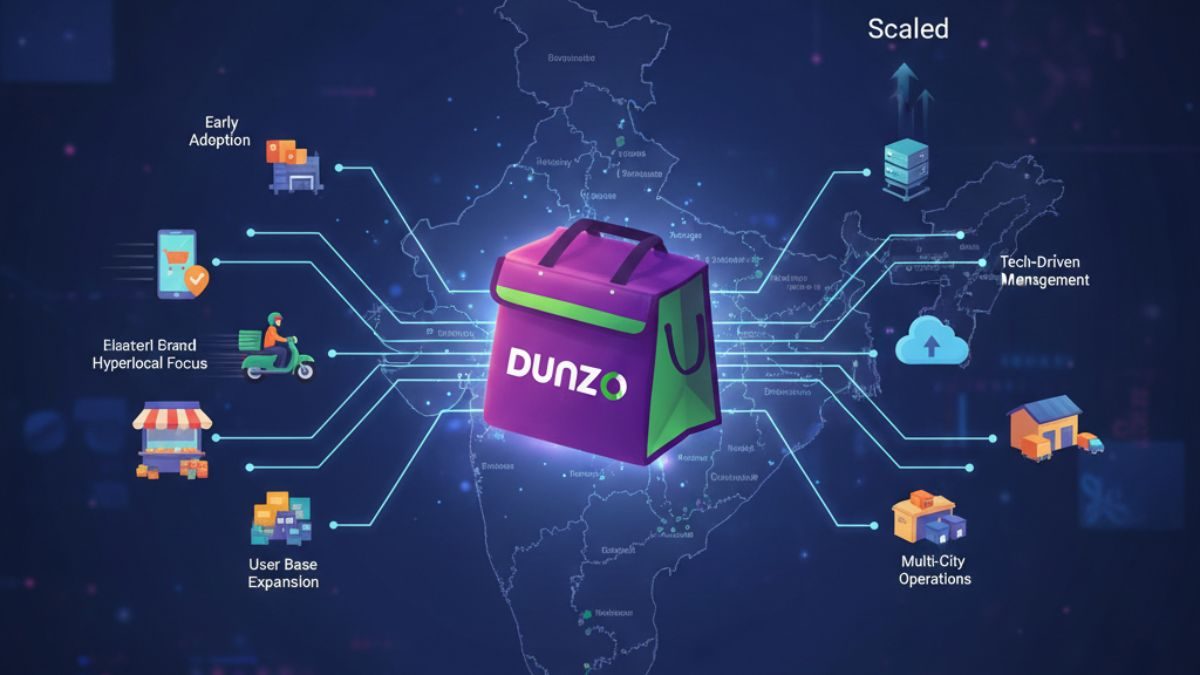
Dunzo was an Indian hyperlocal delivery startup that built one of the first app-based on-demand delivery platforms in the country. What began as a simple WhatsApp concierge service evolved into a comprehensive solution that promised users delivery of groceries. Medicines, meals, documents, pet supplies, and virtually anything else within a city in under 60 minutes. Dunzo’s core idea was rooted in solving the persistent last-mile logistics challenges in India’s urban centres and connecting neighbourhood merchants to mobile consumers with speed and reliability.
The company was founded in July 2014 in Bengaluru by Kabeer Biswas along with co-founders Ankur Aggarwal, Dalvir Suri, and Mukund Jha. Biswas had prior startup experience with a venture acquired by Hike Messenger, and that early exposure shaped Dunzo’s initial product direction. From a WhatsApp group coordinating deliveries for friends to a full-blown app. It is launched to address the simple problem of urban convenience in sprawling Indian cities.
Dunzo grew through rounds of funding
Dunzo grew through rounds of funding including early backing from Blume Ventures and Aspada in 2016. A milestone $12 million round led directly by Google in 2017 that marked Google’s first direct investment in an Indian startup, and later significant capital from Lightbox Ventures. 3L Capital, STIC Investment, and strategic investor Reliance Retail. By 2022, Reliance had invested roughly $240 million, becoming the largest shareholder. In total, the company raised upwards of $450 million.
At its peak, Dunzo’s platform connected millions of users with local stores and delivery partners. Building a vast network across multiple Indian cities and cementing the hyperlocal delivery market as a critical segment within India’s on-demand delivery ecosystem. The company’s model blended technology, operations, and logistics to fulfil rapid deliveries. Often in under 30 minutes, reshaping how urban consumers expected convenience services to work.
However, high operational costs, aggressive quick commerce ambitions, and mounting competitive pressures eventually strained the startup’s economics. By 2025, Dunzo had ceased operations amid financial difficulties and investor pullback, marking a sobering end to what had once been one of India’s most promising hyperlocal delivery success stories.
1. The Startup’s Origin Story and Early Background
Dunzo’s journey started in the summer of 2014 in Bengaluru, a city that was itself becoming a hub for innovation in India’s startup ecosystem. Kabeer Biswas had recently navigated the acquisition of his previous venture and was looking for ideas that could meaningfully impact daily life in Indian cities. The underlying insight was simple: India’s hyperlocal economy — its countless roadside stores, small merchants, and independent service providers — was ripe for digital connection but lacked a seamless delivery and coordination layer.
What set Dunzo apart initially was its informal launch as a WhatsApp group. This unconventional beginning was less about polished tech and more about solving real problems for real users. Early members could request that someone pick up laundry, fetch forgotten items, or run errands around the city. This organic approach allowed the founders to learn firsthand what urban Indians valued most in convenience services long before the app formally existed.
As mobile internet adoption surged in India and smartphones proliferated across income groups. The founders saw an opportunity to build a dedicated platform that could scale this service model beyond friends and early adopters. This led to the development of Dunzo’s first mobile app, effectively transforming a manual, chat-based service into a scalable, technology-driven platform.
1.1 Early Product Concept and Evolution
The initial product was straightforward. Users could request a “Dunzo” — shorthand for “done” — to pick up and deliver items. There was no fixed category; it was a general-purpose errands fulfilment service. Importantly, Dunzo’s platform employed gig workers who could accept these tasks and complete them within a city’s limits. This model tapped into the burgeoning gig economy that was simultaneously powering ride-hailing and food delivery platforms.
Over time, Dunzo refined its offering to streamline key categories like grocery, food, medicine, and courier deliveries. It shifted from a purely concierge model to a more structured hyperlocal delivery service, driven by an app interface that connected users with nearby delivery partners and partnered merchants.
2. Founder Journey, Motivation, and Early Struggles
Kabeer Biswas’ journey as founder was shaped by practicality and a willingness to learn from the market rather than adhering to a fixed blueprint. Prior to Dunzo, Biswas had built technology ventures and experienced acquisition dynamics, but none had been as deeply rooted in the day-to-day life of urban consumers. This lens helped him see the latent potential in solving mundane problems. Getting a document delivered, picking up groceries — at scale.
In the earliest days, the challenges were operational rather than technological. Coordinating deliveries manually through WhatsApp groups meant that scaling beyond a small circle of users was limited by human bandwidth. The leap to a mobile app required not just engineering resources but the vision to reimagine these processes as seamless, automated flows.
Early traction didn’t come overnight. Dunzo had to prove that users were willing to pay for convenience in a market still accustomed to physical errands and informal delivery arrangements. Convincing users to download an app, place orders digitally, and trust gig workers with errands required persistent user engagement and incremental improvements in service quality.
3. The Problem Identified in the Market
India’s urban delivery ecosystem before Dunzo was fragmented. There were traditional courier services for packages, food providers with their own delivery, and informal arrangements for errands, but no unified platform that could handle a broad range of last-mile tasks with speed and transparency. The problem was clear: city residents needed a faster, simpler way to get everyday tasks done without navigating multiple services or sacrificing hours of their day.
Additionally, local merchants and small stores lacked digital interfaces to tap into the growing queue of online demand. Grocery and retail stores served customers physically but were disconnected from the new expectations forming around rapid delivery. Dunzo’s platform aimed to bridge that gap by integrating these offline businesses into a digital logistics and commerce network.
4. Building the Product and Early Traction
Dunzo’s early product development focused on simplicity. An intuitive interface allowed users to create delivery requests by entering pickup and drop locations, selecting or describing items, and tracking task status. Under the hood, the platform deployed real-time mapping, location tracking, and dynamic assignment of delivery partners — innovations that were not common in India’s tech landscape in 2014.
Early traction came from Bengaluru’s dense urban districts where demand for convenience services was highest. Word-of-mouth played a significant role; satisfied customers recommended Dunzo to colleagues and friends. The network effect took hold as both users and delivery partners expanded organically.
By 2019, Dunzo was operating in multiple major cities and processing millions of deliveries monthly. It had crossed the milestone of around two million deliveries per month and was averaging sub-30-minute delivery times in key markets. These metrics were powerful signals of product-market fit in the hyperlocal delivery segment.
5. Business Model and Revenue Approach
Dunzo’s business model was built on a multi-sided marketplace that connected users, delivery partners, and merchants. Revenue primarily came from commissions charged on transactions. Delivery fees paid by users, and subscription or value-added services offered to partner merchants.
The core value proposition was convenience at speed. Users were willing to pay a small premium for rapid deliveries, and merchants valued access to an expanded customer base without managing their own logistics. At scale, Dunzo believed this model could achieve sustainable unit economics by optimizing routing, batching orders, and leveraging data for efficient partner assignments.
However, the economics were inherently complex. Quick commerce — the promise of ultra-fast grocery and essentials delivery. Demanded significant investment in infrastructure such as micro-fulfilment centres and dark stores to reduce fulfilment times. These costs, combined with discounting to acquire users and retain merchant partners, contributed to pressure on profitability.
6. Funding History and Investor Involvement
Dunzo’s funding journey reflects its evolution from a scrappy startup to one of India’s most well-backed hyperlocal delivery platforms. The first external capital came in March 2016, when Blume Ventures, Aspada Ventures, and angels including Google India MD Rajan Anandan invested roughly $650,000. In December 2017, Dunzo closed a significant $12 million round led by Google with participation from existing investors. This was notable as Google’s first direct investment in an Indian startup and a formative moment in Dunzo’s growth trajectory.
Subsequent rounds brought in capital from Lightbox Ventures. 3L Capital, STIC Investment, and others, including a long-anticipated Series D round of $45 million in October 2019. These funds helped expand operations to nine Indian cities and scale delivery volume significantly. The most transformative capital event came in January 2022 when Reliance Retail led a $240 million round. Acquiring a 25.8% stake and signalling deep strategic alignment with one of India’s biggest conglomerates. In total, Dunzo raised over $450 million in its lifetime. Building one of the most capital-intensive hyperlocal delivery platforms in India.
7. Go-to-Market Strategy and Distribution
Dunzo’s go-to-market strategy hinged on rapid scaling of city operations with a focus on user acquisition through convenience and reliability. The company invested in digital marketing, partnerships with local stores, and referral incentives that encouraged network growth. Strategically, Dunzo expanded from Bengaluru into cities like Delhi-NCR, Mumbai, Pune, Chennai, Hyderabad, and Jaipur. Local merchant integrations facilitated deeper market penetration, enabling Dunzo to deliver both generic errands and category-specific products like groceries and medicines.
On the distribution side, Dunzo made significant investments in micro-fulfilment centres — small warehouses stocked with fast-moving items — to shorten delivery times. By 2021, the company planned over 250 such centres to serve 700+ neighbourhoods, emphasising efficiency and speed.
8. Brand Positioning and Messaging Evolution
In its early years, Dunzo positioned itself as a simple errand service. A digital helper that could “get things done.” As it evolved, this message expanded into a broader promise: instant delivery of everyday essentials. The brand narrative underscored convenience, speed, and local integration, differentiating itself from traditional courier services and food delivery apps.
With the rise of quick commerce, Dunzo’s messaging shifted toward ultra-fast deliveries, particularly for groceries and daily needs. However, this pivot also introduced a new set of expectations and operational demands that tested the company’s ability to deliver consistently.
9. Key Challenges, Failures, and Turning Points
Dunzo’s trajectory was marked by notable inflection points. The pivot to quick commerce with Dunzo Daily required heavy investments in infrastructure and logistics, fundamentally changing the cost structure. Establishing dark stores and micro-fulfilment networks increased fixed expenses in a business already operating on thin margins. Competitive pressures from Swiggy Instamart, Zepto, and Blinkit further strained Dunzo’s economics. These players aggressively expanded their grocery and essentials delivery services, backed by deep capital and established consumer bases. Dunzo found itself in a crowded field where sustaining user loyalty and cost efficiencies became more difficult over time.
Another major turning point was Reliance Retail’s involvement. While the 2022 investment was initially seen as a validation and a potential catalyst for growth, strategic misalignment between Dunzo’s independent scaling ambitions and Reliance’s broader priorities reportedly created governance challenges. The limits on fundraising and company decisions under Reliance’s influence became an increasing point of contention as the startup sought more capital amidst a tightening funding climate.
Operational pressures manifested in layoffs, delayed salary payments, and scaling back of services in multiple cities. Monthly expenses ballooned, and the promise of 15-minute deliveries gradually extended to longer windows as Dunzo sought to contain costs.
10. Operational Execution and Scaling Decisions
Dunzo’s operational backbone was a complex orchestration of technology, human partners, and local infrastructure. Fast, reliable delivery across sprawling urban geographies wasn’t just a feature — it was the lifeline of the platform. Every order depended on precise coordination: from real-time routing of delivery partners to micro-fulfilment centre inventory management, every element had to function seamlessly.
Building a dense network of dark stores was a deliberate strategic choice. These micro-warehouses reduced delivery times dramatically, but they came at a steep cost. Each new dark store added fixed expenses, requiring a consistent flow of orders to remain viable. The team wrestled with this tension daily: how to maintain ultra-fast service while keeping operations economically sustainable. Competitive discounting, market fragmentation, and the pressure to scale added emotional and strategic weight to every decision. Executives often balanced spreadsheets alongside live operational dashboards, feeling the pulse of both financial sustainability and customer satisfaction.
Execution wasn’t just about logistics; it was about instilling a culture of precision. Every late delivery, every inventory shortage, became a lesson. The leadership learned that operational excellence is not accidental — it is painstakingly built through monitoring, iteration, and relentless accountability.
11. Competitive Landscape and Differentiation
Dunzo’s earliest edge came from its wide-ranging, category-agnostic promise. It wasn’t just a grocery app, or a courier service; it was a one-stop platform for anything a consumer needed delivered. This breadth struck a chord with urban users seeking convenience over specialization, establishing trust and loyalty early on.
But the landscape quickly evolved. Hyper-focused quick commerce players like Zepto and Instamart poured deep capital into grocery verticals, integrating supply chains and offering razor-sharp operational efficiency. Dunzo’s generalist model, once a differentiator, faced pressure as customers compared speed, availability, and pricing across category-specific rivals. The leadership team had to constantly innovate — from tech-enabled routing improvements to partner incentives — to maintain relevance without losing the brand’s broad promise.
12. Growth Metrics, Milestones, and Achievements
Dunzo’s growth numbers were tangible proof of its operational success. At its peak, the platform completed over two million deliveries per month, maintaining average delivery times under 30 minutes in key cities — a benchmark few competitors could match. Its network expanded rapidly, integrating thousands of local merchants, from corner stores to small-scale service providers, creating an ecosystem that benefited both consumers and partners.
Strategic funding rounds played a pivotal role in scaling operations. Google’s early investment signaled international confidence, while Reliance Retail’s major infusion provided both capital and strategic market insight. These funds were not just about growth on paper — they allowed Dunzo to strengthen tech infrastructure, enhance data-driven decision-making, and expand into new markets without sacrificing service quality. Each milestone represented a mix of technological achievement, operational mastery, and the human effort of the thousands of delivery partners and support staff who kept the platform moving.
13. Team Building and Leadership Approach
Dunzo’s leadership team, led by Kabeer Biswas and his co-founders, approached scaling with a combination of operational rigor and tech-driven decision-making. They didn’t just set targets; they watched the pulse of the business through data and feedback loops, understanding that every delivery delay, every customer complaint, reflected a systemic gap. Product evolution was never theoretical — it was informed by real, sometimes messy, human experiences across cities.
As the company expanded, building the right teams became a constant balancing act. City operations managers, marketing specialists, merchant relationship leads, and technology engineers had to operate in sync across multiple urban ecosystems. Coordinating a dispersed network of gig delivery partners added an extra layer of complexity: these were independent, mobile workers whose performance could fluctuate daily. The leadership had to craft incentive structures, communication protocols, and quality monitoring systems that could operate at scale, all while maintaining operational accountability.
Yet, the strain of rapid scaling took its toll. Strategic shifts and financial pressures led to departures among co-founders and senior leaders, a reality that often goes unspoken in startup narratives. These exits were not just about personal decisions but reflected the immense emotional and operational pressure of steering a hyperlocal logistics business — juggling investor expectations, partner satisfaction, and the relentless pace of urban delivery demands. The experience left an indelible mark on the surviving leadership: scaling is as much about culture, trust, and human endurance as it is about technology and capital.
14. Technology, Operations, and Supply Chain Insights
At the heart of Dunzo’s platform lay a sophisticated blend of real-time technology and operational strategy. Dynamic routing algorithms, location tracking, and task allocation systems turned thousands of daily deliveries into coordinated, efficient operations. These systems minimized idle time for delivery partners and optimized coverage across dense and sprawling urban areas alike.
The introduction of micro-fulfilment centres, or dark stores, was a game-changing decision. Stocking high-demand SKUs closer to neighborhoods dramatically cut delivery times, often from hours to under thirty minutes. While costly, these centres became the backbone of reliability — a model that would later be widely adopted across India’s hyperlocal ecosystem.
Data analytics formed the nervous system of operations. Forecasting demand, optimizing delivery windows, and monitoring stock levels at each fulfilment point allowed Dunzo to scale methodically rather than blindly. Yet, this technological sophistication came with constant trade-offs. Investments in infrastructure and AI-driven analytics had to be balanced against the thin margins typical in last-mile delivery. Every algorithm tweak, every staffing decision, had direct financial consequences, forcing leadership to marry precision with pragmatism.
15. Regulatory, Legal, and Industry-Specific Hurdles
Running a hyperlocal delivery platform in India was never purely a business challenge — it was a legal and regulatory tightrope. Dunzo had to navigate a maze of labour laws, tax codes, and compliance obligations while maintaining operational agility. Its workforce, largely independent contractors, sparked debates about worker protections, benefits, and fair compensation, highlighting the human dimension of running a gig-driven ecosystem. Leadership faced constant questions: how to ensure partner safety, how to maintain morale, and how to balance flexibility with responsibility.
On the financial front, tax compliance presented ongoing complexity. Filing regulations across multiple states, handling GST implications for millions of small transactions, and reconciling partner payouts under evolving legal frameworks was arduous. These challenges weren’t theoretical; they affected daily operations, slowed decision-making, and sometimes threatened cash flow stability. Yet, overcoming these hurdles became part of Dunzo’s operational DNA. Each successful navigation of a regulatory or compliance bottleneck reinforced resilience, strengthened internal processes, and deepened leadership understanding of the broader business ecosystem.
16. Current Status of the Startup
By early 2025, Dunzo faced a stark reality that no founder likes to confront: despite years of rapid expansion, innovation, and market leadership, the business model had become unsustainable under prevailing financial conditions. The company’s cash burn had outpaced its revenue streams, and attempts to secure further funding in a tighter startup investment climate were unsuccessful. Investors who had once championed Dunzo’s vision — including Reliance Retail, which had poured in hundreds of millions of dollars — faced significant write-offs, a tangible marker of the gap between ambition and market realities.
The decision to wind down operations was not abrupt but the culmination of years of operational complexity, thin margins, and increasing competition. Co-founder and CEO Kabeer Biswas exited, leaving behind the leadership void that had been integral to navigating the unpredictable urban logistics landscape. His departure marked the end of a leadership era built on relentless operational focus, tech-driven strategy, and a hands-on approach to problem-solving.
16.1 Beyond finances, Dunzo’s closure left a ripple of unresolved challenges
Beyond finances, Dunzo’s closure left a ripple of unresolved challenges. Debt obligations, pending legal cases, and partner settlements remained outstanding, reflecting the intricate human, regulatory, and financial web that underpinned the company’s daily operations. For employees, gig partners, and local merchants who had relied on the platform, the shutdown was more than a corporate decision — it was a lived disruption, a tangible reminder of the fragile balance between scale, profitability, and sustainability in hyperlocal startups.
Dunzo’s story, in its final chapter, is both a cautionary tale and a testament. It illustrates the extraordinary vision required to transform delivery in Indian cities, the human ingenuity behind complex operations, and the sobering realities of cash flow, market shifts, and investor expectations. For those who built, scaled, and relied on it, Dunzo will be remembered not just as a startup, but as an experiment in ambition, resilience, and the relentless pursuit of convenience in an urbanizing India.
17. Future Outlook and Long-Term Reflections
Though Dunzo’s operational journey has concluded in 2025, its legacy in shaping India’s hyperlocal delivery market persists. The startup was an early pioneer in connecting neighbourhood commerce with digital demand, and its innovations in delivery routing, micro-fulfilment infrastructure, and marketplace dynamics influenced how competitors and subsequent entrants structured their offerings.
The future of hyperlocal delivery in India will likely continue under players like Swiggy Instamart, Zepto, and others who have learned from both the successes and challenges Dunzo encountered. The sector’s long-term viability will depend on sustainable unit economics, efficient supply chains, and smart integration of tech solutions that balance speed with profitability.
Dunzo’s story stands as a case study in ambition, innovation, and the complexities of scaling a capital-intensive business in a price-sensitive market. Its rise illustrated the power of addressing real urban needs with thoughtful tech solutions. Its challenges highlighted the limits of rapid scaling without balanced economics and the risks that come from strategic dependencies on major investors with divergent priorities.
About foundlanes.com
foundlanes.com documents and analyses in-depth startup case studies, founder journeys, and growth stories from India’s dynamic entrepreneurial ecosystem. It provides factual, journalistic insights into how startups evolve, scale, and navigate challenges in real market conditions.