Summary
Ajith Karimpana, the founder of Furlenco, is one of the early pioneers of India’s subscription economy. His journey reflects a mix of corporate experience, entrepreneurial risk-taking, and a deep understanding of evolving urban lifestyles. Born and raised in India, Karimpana pursued engineering and later management studies before stepping into the corporate world, where he gained exposure to operations, supply chains, and consumer behavior. However, it was his observation of the struggles faced by urban migrants particularly in setting up homes that led him to identify a gap in the market.
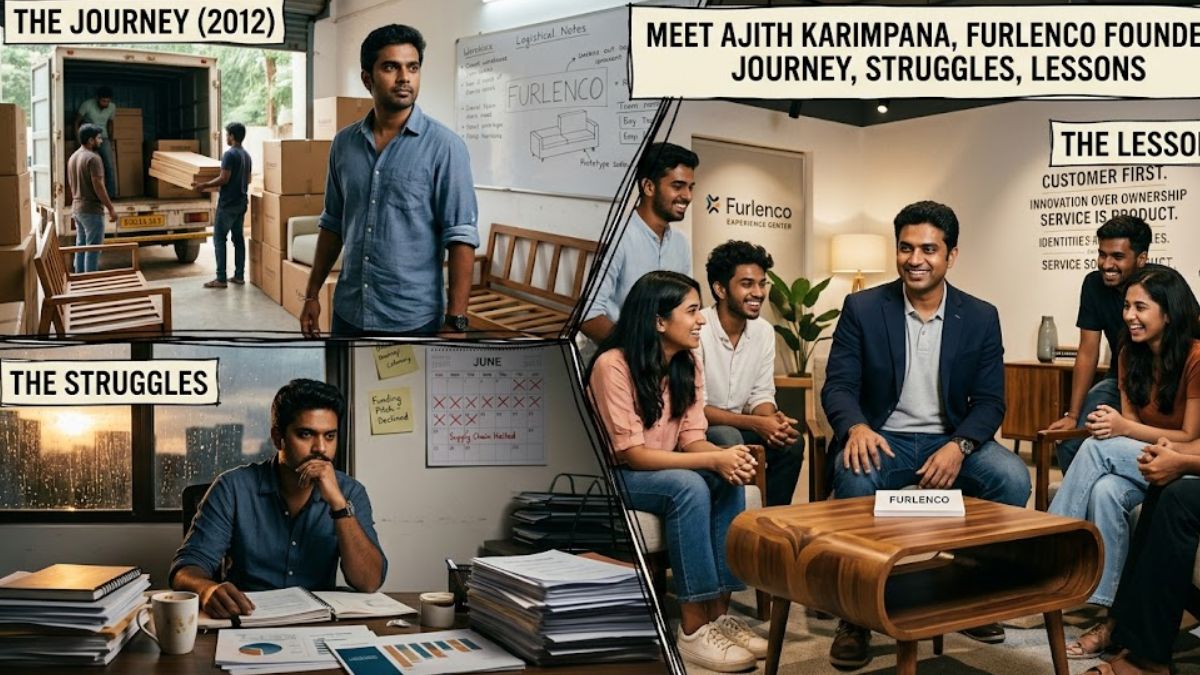
Furlenco was founded in 2012 in Bengaluru, at a time when renting furniture was still an unconventional idea in India. Karimpana envisioned a platform where consumers could subscribe to furniture instead of owning it, reducing upfront costs and increasing flexibility. The idea aligned with changing urban patterns, where mobility, affordability, and convenience were becoming more important than ownership. The journey was far from smooth. From convincing customers to trust a rental model, to managing logistics-heavy operations, Karimpana faced multiple challenges. Early struggles included funding constraints, operational inefficiencies, and skepticism from both investors and consumers. Yet, through persistence and iterative learning, Furlenco gradually found product-market fit.
Today, Furlenco stands as a key player in India’s furniture rental startup ecosystem, having raised significant funding and expanded across multiple cities. Karimpana’s story is not just about building a company, but about reshaping consumer behavior in India. His journey offers deep insights into startup challenges in India, the realities of building a startup from scratch, and the mindset required to navigate uncertainty while staying committed to a long-term vision.
1. Background and Early Life
1.1 Early Life and Family Background
There’s something quietly powerful about growing up in a middle-class Indian household. It rarely comes with dramatic turning points or glamorous advantages. Instead, it builds you slowly, almost invisibly, through routines, expectations, and a constant awareness of trade-offs. This was the world Ajith Karimpana grew up in. His early life was shaped by a familiar script: education was non-negotiable, stability was the goal, and risk was something to be carefully measured, not embraced blindly. Like countless families across India, his environment placed a deep emphasis on doing well academically, securing a respectable career, and ensuring financial security. These weren’t just expectations. They were survival strategies refined over generations.
1.2 what often gets overlooked in such environments
But what often gets overlooked in such environments is how they quietly train the mind. Living within constraints forces you to think harder, observe more closely, and solve problems with limited resources. For Ajith, this translated into a habit of questioning everyday inefficiencies. Why are things done this way? Is there a simpler method? Why do people accept inconvenience as normal? These weren’t loud, rebellious questions. They were subtle, persistent thoughts that stayed with him.
While there isn’t extensive public documentation about his family, what’s evident is the kind of grounding he received. Discipline wasn’t taught through lectures. It was embedded in daily life. Ambition wasn’t about chasing headlines. It was about doing something meaningful and sustainable.
And perhaps most importantly, there was an unspoken understanding of value. When you grow up in an environment where every purchase is considered, every expense weighed, you develop a deep sensitivity toward cost, utility, and long-term benefit. This perspective would later become central to how he viewed consumer behavior. Years later, when he would build a company around the idea that people don’t need to own everything they use, that early conditioning would quietly resurface. Because he had already seen, firsthand, how ownership comes with invisible burdens.
1.3 Education and Early Influences
If his upbringing built the foundation, his education sharpened the tools. Like many driven students in India, Ajith chose engineering as his first serious step into the professional world. Engineering education in India does more than teach technical concepts. It trains you to think in systems, to break down complex problems into smaller, solvable parts, and to approach challenges with structure. During these years, he wasn’t just absorbing formulas or passing exams. He was learning how things work beneath the surface. Systems, processes, dependencies. The invisible architecture behind everyday operations.
But something interesting happens to many engineers at some point. They begin to look beyond the “how” and start questioning the “why.” Why does a business operate in a certain way? Why do inefficiencies exist even when better solutions seem obvious? large systems fail to adapt? This curiosity often pulls them toward management, and Ajith was no exception. Pursuing an MBA marked a shift in perspective. It moved him from technical problem-solving to strategic thinking. Suddenly, the focus wasn’t just on building systems, but on understanding markets, consumer behavior, operational scalability, and financial sustainability.
1.4 Business school exposed him to case studies
Business school exposed him to case studies that went far beyond textbooks. Stories of companies that scaled rapidly, collapsed unexpectedly, pivoted at the right time, or failed because they ignored subtle consumer signals. These weren’t abstract lessons. They were real-world patterns. More importantly, it introduced him to a different way of thinking about problems. Not as isolated issues, but as interconnected opportunities.
He began to see how a simple inefficiency, if understood deeply enough, could become the foundation of an entire business. How consumer frustration, when validated at scale, could signal a market gap. And how timing, execution, and clarity of thought often mattered more than having a completely original idea. These insights didn’t immediately turn him into an entrepreneur. But they planted something far more valuable. A framework. A way to look at the world not just as it is, but as it could be improved.
2. Founder and Company Overview
2.1 Introduction to the Furlenco Founder
Before he became known as the founder of Furlenco, Ajith Karimpana was a professional navigating the structured world of corporate India. His early career was rooted in operations and supply chain roles, areas that most people don’t romanticize but are absolutely critical to how businesses function. These roles don’t sit at the surface. They operate behind the scenes, ensuring that systems run smoothly, costs are controlled, and processes are efficient. And this is where he gained one of his biggest advantages.
Working in operations forces you to confront reality. There’s no room for abstract thinking when things break down. You deal with delays, inefficiencies, logistical challenges, and customer dissatisfaction in their raw form. You see where systems fail, where money is wasted, and where customer expectations are not being met. For Ajith, this exposure was invaluable. He wasn’t just learning how companies operate. seeing where they struggle.
He began noticing patterns. Industries that hadn’t evolved with changing consumer behavior. Processes that existed simply because “that’s how it’s always been done.” Businesses that were optimized for ownership models even when customers were shifting toward flexibility. This wasn’t a sudden realization. It built gradually over time. And somewhere along the way, the idea started taking shape. Not as a fully formed business plan, but as a question: What if we could remove the friction people experience in everyday living?
2.2 Company Overview and Offerings
When Furlenco was launched in 2012, the idea of renting furniture in India wasn’t entirely new. But it wasn’t mainstream either. It existed in fragmented, unorganized pockets, often associated with low-quality offerings and poor customer experience. Ajith didn’t just want to enter this space. He wanted to redefine it.
Furlenco was built around a simple but powerful proposition: instead of asking people to spend large amounts of money on furniture they may not need long-term, why not give them access to well-designed, high-quality furniture on a subscription basis? At first glance, it sounds straightforward. But the execution required rethinking multiple layers of the traditional model.
Furlenco didn’t just rent out individual pieces of furniture. It curated complete living experiences. Customers could choose fully designed room packages that were aesthetically aligned and functionally optimized. This wasn’t about renting a bed or a sofa. It was about creating a home without the burden of ownership.
The company focused heavily on three core elements:
- Convenience: From selection to delivery, setup, and maintenance, the entire process was designed to be seamless.
- Affordability: By converting large upfront costs into manageable monthly payments, it made quality furniture accessible.
- Flexibility: Customers could upgrade, swap, or return furniture based on their changing needs.
This approach aligned perfectly with the emerging mindset of urban consumers. Ownership, which was once seen as a symbol of stability, was slowly being questioned. Younger generations were prioritizing mobility, experiences, and financial flexibility. They didn’t want to be tied down by heavy investments in assets that were difficult to move or liquidate. Furlenco positioned itself right at the intersection of this shift.
2.3 Target Audience and Market Served
The real brilliance of Furlenco wasn’t just in the idea. It was in understanding who the idea was for. India’s urban landscape was changing rapidly. Cities like Bengaluru, Mumbai, and Delhi were attracting a growing population of young professionals. These were individuals in their 20s and early 30s, often living away from their hometowns, building careers, and constantly on the move.
They shared a few common characteristics:
- They relocated frequently due to job changes.
- They preferred spending on experiences rather than long-term assets.
- They valued design, comfort, and convenience.
- They were comfortable with subscription-based services.
But they also faced a common problem. Setting up a home every time they moved was exhausting. Buying furniture meant heavy upfront costs, logistical headaches, and the eventual burden of reselling or transporting it. Renting from local vendors often meant compromising on quality and aesthetics. Furlenco stepped in as a solution that felt almost intuitive once you experienced it. Instead of asking customers to adapt to the limitations of traditional models, it adapted to their lifestyle. It allowed them to live well without committing heavily. And that’s a powerful value proposition.
2.4 Year of Founding and Business Stage
Furlenco was founded in 2012 in Bengaluru, a city that, in many ways, was the perfect testing ground for such an idea. Bengaluru wasn’t just a tech hub. It was a city of migrants. People from across India moved there for opportunities, often living in rented apartments and constantly transitioning between spaces. This created a natural demand for flexible living solutions.
In its early days, Furlenco operated as a niche concept. Awareness was low, and consumer trust had to be built from scratch. Renting furniture wasn’t an obvious choice for most people. It required a shift in mindset. But over time, as more users experienced the service, the model began to gain acceptance.
The company expanded across multiple cities, strengthened its supply chain, invested in design capabilities, and built a brand that stood for modern, flexible living. It wasn’t an overnight success. It required patience, capital, and continuous refinement of the model. But gradually, Furlenco established itself as a recognizable name in India’s startup ecosystem.
3. The Problem, Insight, and Trigger
3.1 Core Problem Identified
Every meaningful startup begins with a problem that feels personal, even if it affects millions. For Ajith, the problem wasn’t abstract. It was visible in everyday life. Urban professionals moving to new cities were constantly struggling with the same set of challenges. Finding a house was just the first step. Turning that house into a livable home was an entirely different battle. Furniture was at the center of this struggle. Buying it required significant upfront investment. Good-quality furniture wasn’t cheap, and for someone unsure about how long they would stay in a city, it felt like a risky commitment.
Then came the logistics. Transporting furniture across cities was expensive and inconvenient. Selling it before moving often meant accepting heavy losses. And perhaps the most overlooked aspect was emotional fatigue. The repeated cycle of setting up and dismantling homes drained time and energy. This wasn’t just a logistical problem. It was a lifestyle problem. And yet, it was largely ignored.
3.2 Personal Insight Behind the Idea
What set Ajith apart wasn’t just that he noticed the problem. It was how he interpreted it. He didn’t see it as a furniture problem. He saw it as a shift in consumer behavior. The traditional model was built on ownership. You buy, you use, you keep. But this model assumed stability. It assumed that people stayed in one place, built long-term homes, and accumulated assets over time. But that reality was changing.
A new generation was emerging that valued access over ownership. They didn’t necessarily want to own furniture. They wanted the experience of a well-furnished home without the long-term baggage. This insight was subtle but powerful. It aligned with global trends where industries were moving toward subscription-based models. From entertainment to transportation, ownership was being replaced by access. Ajith recognized that India was ready for this shift, at least in urban pockets. And furniture, despite being a traditional category, was ripe for disruption.
3.3 Trigger Moment to Start
Ideas often exist in the background for a long time before something pushes them into action. For Ajith, that trigger came from observing real, repeated patterns. Friends, colleagues, and countless professionals around him were going through the same struggles. The problem wasn’t isolated. It was widespread. At some point, the question changed from “Why does this problem exist?” to “Why hasn’t anyone solved this properly?” That shift is critical. Because once you start believing that a problem is solvable, it becomes hard to ignore.
Starting Furlenco wasn’t just a business decision. It was a response to that persistent question. It meant stepping away from the predictability of a corporate career and entering a space filled with uncertainty. meant building trust in a market that wasn’t fully ready. meant convincing people to rethink something as fundamental as how they furnish their homes. But it also meant building something that could genuinely make life easier for millions. And that’s what made the risk worth taking.
4. Early Days and Initial Struggles
4.1 Early Assumptions and Naivety
In the beginning, Ajith Karimpana approached the idea of furniture rental with a sense of clarity that, in hindsight, also carried a degree of innocence. The logic seemed straightforward. Urban professionals were spending heavily on furniture despite frequently relocating. Offering them a flexible, cost-effective alternative should naturally attract demand. It felt like a problem waiting to be solved, and a solution that would immediately resonate once explained.
However, the market responded very differently. What Ajith encountered was not resistance to the idea itself, but resistance rooted in deeply ingrained behavior. In India, furniture is not just functional. It represents permanence, security, and progress. Convincing someone to rent instead of own meant asking them to rethink something they had grown up believing in. This realization forced him to confront an uncomfortable truth early on: a good idea is not enough if it challenges long-standing cultural habits.
4.2 Entrepreneurial Initial Struggles
As the business moved from idea to execution, the complexity increased rapidly. Furlenco was not a digital product that could be scaled with minimal cost. It required physical inventory, storage facilities, logistics coordination, and on-ground teams. Every new customer added operational pressure, and every mistake had a direct cost. Managing supply while ensuring quality quickly became a balancing act that demanded constant attention.
The day-to-day realities were far from smooth. Deliveries were delayed, inventory mismatches occurred, and customer expectations were often higher than what the system could consistently deliver in the early stage. Each of these issues required immediate resolution, leaving little room for strategic thinking. These early struggles shaped the company’s operational backbone, forcing Ajith and his team to build systems that could handle complexity without compromising customer experience.
4.3 What Turned Out to Be Harder Than Expected
Among all the challenges, building trust turned out to be the most difficult. Customers were not just evaluating the price or convenience. They were questioning the entire concept. Concerns around hygiene, product quality, and reliability were common, and these concerns often stopped people from even trying the service. The hesitation was emotional as much as it was practical.
To overcome this, Furlenco had to go beyond just offering a service. It had to create an experience that reassured customers at every step. From the quality of furniture to the professionalism of delivery teams, every detail mattered. This required significant investment and patience. Trust was not built through marketing claims, but through consistent delivery over time, one customer at a time.
5. Failures, Setbacks, and Self Doubt
5.1 Toughest Phase of the Journey
The early phase of Furlenco’s journey was marked by uncertainty that tested both the business and the founder’s conviction. Growth was slower than expected, and the gap between effort and visible results often felt discouraging. There were periods when progress seemed unclear, and the long-term viability of the model came into question.
This phase was particularly challenging because there were no clear benchmarks to rely on. Building a new category meant there were no proven playbooks. Ajith had to navigate decisions without knowing whether the outcomes would justify the risks. It was during this time that resilience became more important than strategy, as continuing forward required belief even when results were not immediately visible.
5.2 Early Failures and Major Setbacks
Failures in the early stage were not isolated incidents but recurring operational challenges. Inefficiencies in supply chain management led to higher costs, while delays in delivery affected customer satisfaction. Inventory planning was another area where miscalculations created pressure on both finances and operations. Each of these setbacks exposed gaps in the system that needed immediate correction.
Over time, these failures became valuable lessons. They pushed the team to refine processes, improve coordination, and build more reliable systems. While each setback carried a cost, it also contributed to a stronger operational foundation. The ability to learn quickly and adapt became one of the key strengths that helped the company move forward.
5.3 Moments of Self Doubt and Emotional Lows
Behind the operational and financial challenges, there was a personal journey that was equally demanding. Building a startup, especially in an unproven category, often brings moments of isolation. Decisions carry weight, and the responsibility extends beyond the business to the people involved in it. During difficult phases, it is natural for doubt to surface.
Ajith experienced these moments as well. Questions about whether the timing was right, whether the model would scale, and whether the effort would ultimately pay off were hard to ignore. However, these periods of doubt also served as moments of reflection. They forced him to revisit the core problem and the reason he started, helping him stay grounded and continue despite the uncertainty.
6. Validation and Early Traction
6.1 First Real Validation or Customer
The first signs of validation did not come as a sudden breakthrough but through small, meaningful interactions with customers. When early users not only tried the service but chose to continue using it, it indicated that the problem being solved was real. These initial customers played a crucial role in shaping confidence around the business model.
Their feedback provided insights that went beyond assumptions. It highlighted what was working and what needed improvement. More importantly, it confirmed that there was a segment of the market willing to embrace a new way of accessing furniture. This early validation, though limited in scale, was critical in building belief within the team.
6.2 Early Revenue Growth or Feedback
As customer adoption slowly increased, revenue began to reflect consistent, albeit gradual, growth. This was not driven by aggressive expansion but by repeat usage and positive word-of-mouth. Customers who experienced the service began to recognize its value, especially in terms of convenience and flexibility.
This phase was important because it showed a shift in perception. Renting furniture was no longer seen as an unconventional choice but as a practical solution for a specific lifestyle. The steady growth in subscriptions indicated that the model was gaining acceptance, even if it was happening at a measured pace.
6.3 Why This Moment Changed Belief
Validation had a direct impact on how Ajith viewed the journey ahead. It reinforced the understanding that while behavioral change takes time, it is achievable with the right approach. The focus shifted from expecting rapid adoption to building a sustainable model that could grow steadily.
This change in perspective brought clarity. Instead of trying to accelerate growth prematurely, the emphasis moved toward strengthening operations and improving customer experience. The belief in the model became more grounded, supported by real user behavior rather than assumptions.
7. Funding, Money, and Growth Constraints
7.1 Bootstrapped or Funded Journey
In its early stages, Furlenco focused on proving its concept before attracting significant external investment. As the business began to show signs of traction, it started gaining attention from investors who saw potential in the model and the emerging market trend.
Securing funding marked an important milestone, but it also introduced new dynamics. Investor expectations brought pressure to scale and deliver results within defined timelines. This transition required balancing long-term vision with short-term performance, adding another layer of complexity to the journey.
7.2 Capital Challenges and Cash Flow Issues
The nature of Furlenco’s business made capital management a critical concern. Unlike asset-light models, it required upfront investment in inventory, which would generate returns over time. This created a constant need to manage cash flow carefully while supporting growth.
Decisions around spending, expansion, and inventory had to be made with precision. Any miscalculation could impact financial stability. Managing this balance required discipline and a clear understanding of the business’s financial structure, making capital allocation one of the most important aspects of operations.
7.3 Early Growth Limitations
Growth in the early years was naturally constrained by resources. Expanding into new markets required significant investment in infrastructure and logistics, which limited how quickly the company could scale. This meant prioritizing certain cities and focusing on building strong operations in those markets.
While this approach slowed expansion, it helped maintain service quality and operational efficiency. By growing selectively, Furlenco was able to strengthen its foundation before scaling further. This measured growth strategy ensured that the business was better prepared for long-term sustainability.
8. Team Building and Leadership Evolution
8.1 Early Hiring Mistakes
In the early days, hiring felt more like filling immediate gaps than building a long-term team. Like many first-time founders, Ajith Karimpana initially focused on speed. The priority was simple: get people in, get things moving, solve problems quickly. But what looks like urgency in the beginning often turns into misalignment later. Some hires, while capable individually, did not fully align with the intensity, ambiguity, and ownership mindset that a startup demands.
These early hiring decisions came with consequences. Misalignment showed up in execution gaps, slower decision-making, and sometimes even friction within the team. It forced Ajith to confront a hard truth that many founders learn the difficult way. Skills can be hired, but mindset and cultural fit are much harder to instill. Over time, he became far more deliberate, focusing not just on what someone could do, but how they approached problems, uncertainty, and responsibility.
8.2 Delegation Challenges
As Furlenco began to grow, one of the most difficult transitions Ajith had to make was stepping back from being involved in everything. In the early phase, founders are deeply hands-on. Every decision, every problem, every detail runs through them. It creates control, but it also creates dependency. And as the company grows, that model stops working.
Delegation was not just a skill he had to learn, it was a shift in mindset. Letting go of control is uncomfortable, especially when the stakes are high. There were moments when things were not executed exactly as he would have done them. But over time, he realized that scaling a business is not about doing everything yourself. It is about building people who can think, decide, and act independently. That shift, though gradual, became essential for the company’s growth.
8.3 Leadership Learnings Over Time
Leadership for Ajith did not evolve through theory. It evolved through experience, mistakes, and constant adjustment. In the beginning, leadership meant solving problems directly. But as the company expanded, it became clear that this approach was not sustainable. The role had to shift from problem-solver to system-builder.
Over time, his focus moved toward creating structures that allowed teams to perform without constant oversight. Empowerment became a central theme. Instead of controlling outcomes, the emphasis shifted to enabling teams with clarity, tools, and ownership. This evolution was critical because it allowed Furlenco to operate at scale while maintaining consistency, something that is nearly impossible without strong leadership systems in place.
9. Growth, Scaling, and Operational Challenges
9.1 Brand Positioning and Go to Market Learnings
One of the most important strategic decisions Furlenco made was how it positioned itself in the market. Instead of presenting itself as a low-cost rental service, the company chose to position itself as a lifestyle brand. This was a deliberate shift, aimed at changing how customers perceived the offering. Renting was not framed as a compromise, but as a smarter, more flexible way to live.
This positioning influenced everything from product design to customer experience. The focus on aesthetics, curated packages, and seamless service created a perception of premium value. It allowed Furlenco to connect with a customer segment that valued convenience and design as much as affordability. This approach played a key role in differentiating the brand in a space that could have easily become commoditized.
9.2 Scaling Challenges
Scaling Furlenco was not just about acquiring more customers. It required building infrastructure that could support consistent service across multiple cities. Each new market introduced its own set of challenges. Logistics networks had to be established, warehouses had to be set up, and supply chains had to be adapted to local demand patterns.
As operations expanded, complexity increased significantly. Managing inventory across locations, ensuring timely deliveries, and maintaining quality standards became more difficult. What worked in one city did not always translate seamlessly to another. This forced the team to continuously adapt and refine their approach, making scaling a constant learning process rather than a straightforward expansion.
9.3 Operational Breakdowns and Fixes
Operational breakdowns were inevitable in a business of this nature. Delays, inventory mismatches, and service inconsistencies surfaced as the company scaled. These issues were not just operational challenges, they directly impacted customer trust. Each breakdown required immediate attention and long-term correction.
To address these challenges, Furlenco invested heavily in improving processes and leveraging technology. Systems were built to track inventory more accurately, optimize delivery routes, and monitor service quality. Over time, these improvements created a more stable operational framework. While problems never fully disappeared, the ability to manage and resolve them improved significantly.
10. Personal Sacrifices and Burnout
10.1 Personal Costs of Entrepreneurship
Behind the growth of Furlenco was a personal journey that demanded significant sacrifice. Building a company from the ground up required long hours, constant decision-making, and an almost continuous state of mental engagement. There were no clear boundaries between work and personal life, as the business often took priority over everything else.
These sacrifices were not always visible from the outside. While the company grew, the personal cost accumulated quietly. Time with family, moments of rest, and personal space were often compromised. This is a reality many entrepreneurs face, where progress in one area often comes at the expense of another.
10.2 Burnout Phases and Emotional Pressure
With sustained pressure came periods of burnout. There were phases where the demands of the business felt overwhelming, where the pace did not slow down, and where challenges kept compounding. Burnout is not always dramatic. Sometimes it shows up as exhaustion, lack of clarity, or simply the feeling of being stretched too thin.
For Ajith, these phases required resilience and self-awareness. Continuing to operate under constant pressure without addressing burnout can affect both decision-making and overall effectiveness. Recognizing these moments and pushing through them, while also learning to manage energy better, became an important part of the journey.
10.3 Impact on Personal Life
The intensity of building Furlenco inevitably affected personal relationships. Time constraints and mental preoccupation made it difficult to maintain balance. Even when physically present, the mind often remained occupied with business challenges, making it harder to fully engage in personal moments.
Over time, this imbalance becomes noticeable. It forces a reevaluation of priorities and boundaries. While entrepreneurship demands commitment, sustaining it over the long term requires finding some level of balance. This realization often comes gradually, shaped by experience rather than intention.
11. Lessons, Beliefs, and Values
11.1 Core Lessons Learned
One of the most important lessons from Ajith Karimpana’s journey is the value of persistence. Building something new, especially in an unproven category, requires the ability to stay committed even when results are not immediate. Progress is often slow, and success is rarely linear.
Adaptability is another key takeaway. Markets evolve, customer behavior changes, and strategies that work at one stage may not work at another. The ability to learn, unlearn, and adjust quickly becomes essential. These lessons are not theoretical. They are built through real challenges and continuous iteration.
11.2 Beliefs That Changed Over Time
At the start of the journey, there is often an expectation that a strong idea will lead to relatively quick adoption. Over time, Ajith’s perspective evolved. He realized that building a business is less about the idea and more about execution, timing, and patience.
He also came to understand that consumer behavior does not change instantly. It requires consistent effort, education, and trust-building. This shift in belief influenced how he approached growth, focusing more on long-term sustainability rather than short-term gains.
11.3 Non Negotiable Values
As the company matured, certain values became central to its identity. Customer experience emerged as a non-negotiable priority. In a business where trust is critical, even small lapses can have a significant impact. Along with this, reliability and quality became key pillars. Ensuring that customers received consistent service was essential for building long-term relationships. These values were not just statements, they were embedded into operations and decision-making processes.
12. Present Challenges and Future Vision
12.1 Ongoing Struggles Today
Even at a more mature stage, challenges continue to exist. The market has become more competitive, with new players entering the space and existing ones evolving their offerings. At the same time, customer expectations have increased, requiring constant innovation.
Changing consumer preferences also add complexity. What worked a few years ago may not be as relevant today. Staying ahead requires continuous adaptation, making the journey an ongoing process rather than a completed one.
12.2 Current Leadership Philosophy
Ajith’s leadership approach today reflects the learnings from his journey. The focus is no longer just on growth, but on building a sustainable and resilient business. Short-term gains are balanced against long-term value creation. This philosophy influences decision-making across the organization. It emphasizes stability, consistency, and thoughtful expansion. Rather than chasing rapid scale at any cost, the approach is more measured and strategic.
12.3 Long Term Vision
Looking ahead, the vision extends beyond furniture rental. The broader goal is to expand the subscription-based model into other categories, aligning with changing consumer preferences toward access over ownership. This vision is rooted in the belief that urban lifestyles will continue to evolve. As mobility increases and priorities shift, flexible solutions will become more relevant. Furlenco aims to position itself at the center of this transformation.
12.4 Future Outlook: The Continuing Journey of the Furlenco Founder
Ajith Karimpana’s journey reflects the realities of building a startup in India. It is not defined by a single breakthrough, but by continuous effort, adaptation, and resilience. The challenges have not disappeared, they have simply changed in nature. As the market continues to evolve, so does the opportunity. The shift toward flexible ownership models is still unfolding, and its full potential is yet to be realized. In that sense, the journey is far from complete. It is still being written, shaped by decisions, challenges, and the ability to keep moving forward.
About foundlanes.com
foundlanes.com is India’s leading startup idea discovery platform. It helps entrepreneurs find actionable startup opportunities, market insights, and industry-specific guidance to turn ideas into real businesses. With deep research and practical resources, foundlanes supports founders at every stage, from idea validation to launch and growth.