News Summary
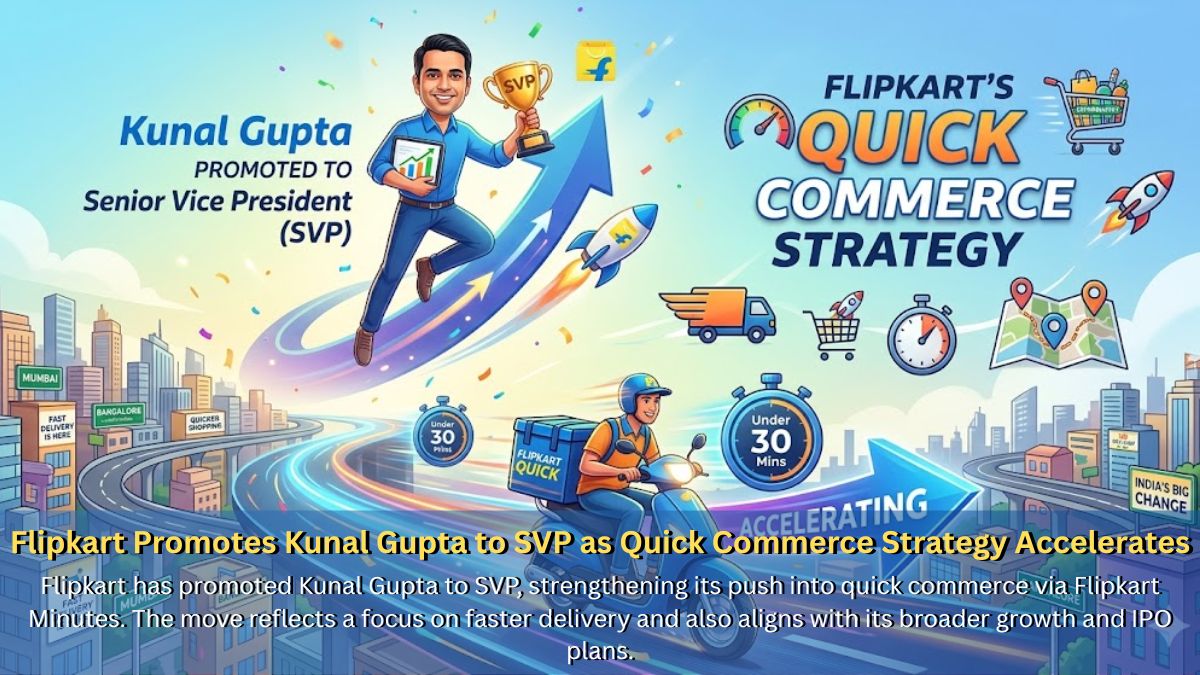
Flipkart Promotes Kunal Gupta to Senior Vice President (SVP) as the company sharpens its focus on quick commerce, a segment that is rapidly transforming India’s e-commerce and startup ecosystem. The move signals a strategic push by Flipkart to strengthen its leadership bench while accelerating its presence in ultra-fast delivery services through its quick commerce initiative, Flipkart Minutes. Kunal Gupta, who previously led Flipkart Minutes, has been instrumental in building and scaling the platform. His elevation comes at a time when competition in the quick commerce space is intensifying, with major players investing heavily in faster deliveries and hyperlocal logistics. Industry experts see this promotion as a clear indication that Flipkart is doubling down on innovation, speed, and operational efficiency.
The development also aligns with Flipkart’s broader growth strategy as it prepares for a potential IPO. Leadership restructuring is often a key step before public listing, ensuring strong execution and accountability across verticals. Alongside Gupta’s promotion, the company has also made leadership changes in other business units, reinforcing its commitment to scaling multiple segments.
Quick commerce has emerged as one of the fastest-growing startup trends in India, driven by urban demand for convenience and instant gratification. Flipkart’s renewed focus on this space highlights the evolving nature of digital commerce and the increasing role of tech-driven logistics. This move is not just about leadership. It reflects a broader shift in the e-commerce business model, where speed, efficiency, and customer experience define success in a highly competitive market.
1. Flipkart Promotes Kunal Gupta: Leadership Move Signals Strategic Shift
1.1 Elevation to SVP Role
Some announcements don’t hit you instantly. You read them, move on, and then later they come back to you. That’s how this felt when Flipkart promoted Kunal Gupta to Senior Vice President. It wasn’t flashy or dramatic. Just a simple update. But the more you think about it, the more you realize there’s a long story sitting behind that one line.
Because roles like that don’t come from one good quarter or a single big idea. They come from sticking through phases where nothing is clear. Building something like Flipkart Minutes isn’t smooth work. Some days things click, other days everything feels off. You’re fixing one problem while three more show up. And still, you keep going. That’s what this promotion reflects to me. Not just success, but the ability to stay with the problem long enough to actually solve it.
1.2 Timing of the Promotion
The timing here is interesting. Not in a dramatic way, but in a quiet, strategic sense. Flipkart is at a stage where every move carries a bit more weight than usual. There’s ongoing talk around a possible IPO, expectations from investors, and the general pressure of proving that growth isn’t just happening, but that it can continue.
At the same time, quick commerce isn’t a space where you get the luxury to move slowly anymore. Everything is fast. Customers expect deliveries in minutes without really thinking about what goes behind it. Competitors are pushing hard. In that kind of environment, promoting someone who has already been in the middle of that chaos makes sense. It feels less like a big statement and more like a practical decision. Someone who understands the pressure gets to lead through it.
2. Background of Flipkart and Its Growth Journey
2.1 Founding and Early Days
If you think back to 2007, when Sachin Bansal and Binny Bansal started Flipkart, it’s almost hard to relate that time to today. Ordering online wasn’t normal. In fact, most people were unsure about it. There was hesitation even before clicking “buy.”
I still remember how common it was to ask, “Will it actually arrive?” That doubt was real. And Flipkart had to deal with that every single day. It wasn’t about scaling quickly back then. It was about getting one customer to trust you, then another. Cash on delivery wasn’t just a feature, it was a way of saying, “We get your concern.” Over time, those small moments added up. Trust didn’t come overnight. It was built slowly, one delivery at a time.
2.2 Evolution into a Unicorn Company
As Flipkart grew, things naturally got more complicated. Growth brought visibility, and visibility brought pressure. Suddenly, every decision mattered more. Expanding categories, improving delivery systems, handling competition, all of it had to happen together. It wasn’t a straight journey upward. There were ups and downs, adjustments, and moments where things could have gone differently.
When Walmart acquired a majority stake, it felt like a big moment. Not just for Flipkart, but for the idea that an Indian startup could reach that level. But with that came a shift. Expectations changed. Flipkart wasn’t just building anymore, it was expected to lead. And that kind of shift affects how a company thinks. It becomes less about trying things out and more about getting things right at scale.
2.3 Current Position in the Market
Today, Flipkart is part of everyday life for a lot of people. You don’t really think about it much, you just use it. Whether it’s ordering something small or browsing during a sale, it’s become routine. And reaching that point takes years of consistent work. Delivering on time, fixing issues, improving systems, all of that adds up over time.
But even now, it doesn’t feel like the company is settled. The market keeps changing, and expectations keep rising. What felt fast or convenient a few years ago now feels normal. That’s probably why Flipkart keeps exploring new areas like quick commerce. Not because it’s trendy, but because customer behavior is changing. And if you don’t adapt, you slowly fall behind.
3. Understanding Flipkart’s Quick Commerce Strategy
3.1 What is Quick Commerce?
At first, quick commerce feels simple. You order something, and it arrives quickly. But when you think about it for a second, you realize how much has to go right for that to happen. Inventory needs to be in the right place. Delivery partners need to be available. Systems need to work without delay.
And the tricky part is, there’s no extra time to fix mistakes. Everything has to work almost instantly. That’s what makes it challenging. From the outside, it feels easy. But behind the scenes, it’s constant coordination and adjustment. It’s one of those things where the better it works, the less you notice the effort behind it.
3.2 Flipkart Minutes: The Core Initiative
Flipkart Minutes feels like a response to how people shop today. It’s not just about offering convenience anymore, it’s about speed. Under Kunal Gupta, this wasn’t treated like a side project. It was built seriously, with a clear focus on making it work in real conditions.
And building something like this comes with its own challenges. There are always gaps in the beginning. Systems don’t align perfectly. Delivery times fluctuate. But over time, with consistent effort, things improve. That’s what Flipkart Minutes represents. Not a perfect system, but one that’s being shaped continuously to meet real expectations.
3.3 Why Quick Commerce Matters
If you look at how people behave now, it’s clear things have changed. People expect faster responses, quicker deliveries, and smoother experiences. Waiting even a little longer than expected feels noticeable. Quick commerce fits into that shift naturally. It reduces the time between wanting something and getting it. And that matters more today than it did before. For Flipkart, investing in this space feels like a logical step. It’s not just about staying competitive, it’s about staying relevant to how people live and shop right now.
4. Role of Kunal Gupta in Flipkart’s Growth
4.1 Leadership in Flipkart Minutes
Kunal Gupta stepped into Flipkart Minutes at a time when speed wasn’t just a feature, it was the whole game. He focused heavily on strengthening the logistics backbone because without that, quick commerce is just a promise on paper.
That effort didn’t go unnoticed. The platform picked up pace quickly, and a lot of that momentum came from getting the basics right.
4.2 Strategic Contributions
Beyond operations, he worked on tightening processes and making the experience smoother for customers. Small fixes, smarter systems, fewer delays those things add up.
It also helped Flipkart hold its ground as new quick commerce players kept popping up, each trying to move faster than the other.
5. Business Model of Flipkart
5.1 E-commerce Revenue Model
At its core, Flipkart still runs on a fairly straightforward model. It earns through product sales, takes commissions from sellers, and brings in money through advertising.
On top of that, logistics and other value-added services quietly add another layer of revenue.
5.2 Quick Commerce Monetization
Quick commerce adds a different flavor to the mix. Things like delivery fees and premium services start to matter more here.
It’s not just about selling products anymore, it’s about how fast and how conveniently you can get them to someone’s doorstep.
6. Products and Services Offered
6.1 Core E-commerce Offerings
Flipkart has built its name on variety. Whether it’s a phone, a pair of shoes, or something for the house, people know they’ll probably find it there.
That wide range is what keeps millions of customers coming back.
6.2 Digital and Fintech Services
Over time, the company has also moved into fintech and digital payments. It makes sense—once people trust your platform for shopping, extending that trust into payments feels like a natural next step.
And it’s clearly becoming an important part of their overall growth story.
7. Problem Flipkart Solves
7.1 Accessibility and Convenience
Not too long ago, shopping options were limited, especially if you weren’t in a metro city. You either visited a nearby store or settled for whatever was available.
Flipkart quietly changed that. It brought variety to people’s screens suddenly, you could compare products, check reviews, and order without leaving home. It also removed a lot of small friction points. No bargaining, no running between shops, no wondering if you’re getting the right price. For many users, especially in smaller towns, that shift wasn’t just convenientit felt empowering.
7.2 Speed and Efficiency
But convenience alone isn’t enough anymore. Expectations have moved fast. Waiting 3–5 days for delivery now feels longer than it used to. That’s where quick commerce steps in. Essentials groceries, daily-use items, even last-minute needs can reach you in hours. It’s not just about speed for the sake of it. It solves real situations: unexpected guests, missed grocery runs, or just a busy day where stepping out isn’t possible.
8. Industry Trends and Market Growth
8.1 Rise of Quick Commerce in India
Quick commerce isn’t just a trend it’s becoming a habit, especially in urban India. People are getting used to the idea that if something is needed, it should arrive almost immediately. This shift is pushing companies to rethink everything behind the scenes. Warehouses are getting closer to residential areas, delivery routes are being optimized, and inventory is planned more carefully.
It’s a constant balancing act between speed, cost, and reliability.
8.2 Impact on Startup Ecosystem
Whenever a new habit forms, startups follow and that’s exactly what’s happening here. A wave of new companies is trying to solve the “faster delivery” problem in different ways. Investors are paying close attention too. There’s more funding flowing into logistics, supply chains, and last-mile delivery solutions.
What’s interesting is that most of the real innovation is happening behind the curtain how to deliver faster without burning too much cash. That’s where the real challenge lies.
9. Competitors in the Quick Commerce Space
9.1 Direct Competitors
Flipkart is competing directly with names like Blinkit, Zepto, and Swiggy Instamart. All of them are chasing the same promise get everyday items to customers as quickly as possible. From a user’s perspective, it often comes down to small details. Which app loads faster, which one shows better offers, or simply which one says “delivery in 10 minutes” instead of 15.
Loyalty exists, but convenience often wins.
9.2 Indirect Competitors
At the same time, competition isn’t limited to quick commerce apps. Traditional e-commerce platforms and even local kirana stores are still very much in the picture. They may not match the same delivery speed, but they offer familiarity, sometimes better pricing, and in the case of local stores, a level of trust built over years.
For many customers, it’s still a trade-off do you want it fast, or do you want it cheaper?
10. Funding, Investments, and IPO Plans
10.1 Venture Capital and Funding
Flipkart’s growth story has been backed by significant investment over the years. Global investors have put in capital not just for returns, but to support long-term expansion. These partnerships often go beyond funding. They bring strategic inputs, global insights, and sometimes even pressure to scale faster and perform better.
It’s a mix of opportunity and expectation.
10.2 IPO Expectations
There’s increasing buzz around Flipkart preparing for an IPO. At this stage, it feels like a natural progression for a company of its size. What’s interesting is how internal changes like leadership shifts often signal that something bigger is being lined up. It doesn’t confirm anything on its own, but it usually means the company is getting its structure and strategy ready for the next phase.
11. Growth Strategy and Future Plans
11.1 Focus on Innovation
Flipkart seems to be doubling down on technology, and that’s not surprising. Behind every fast delivery or smooth checkout, there’s a lot happening in the background.
They’re investing in things like AI, improving how logistics work, and making the overall experience easier for customers. It’s the kind of work most people don’t see, but definitely feel when things just… work.
11.2 Expansion Plans
At the same time, they’re looking to take quick commerce to more places. Not just the big cities, but newer markets and different types of customers.
It’s a natural next step. Once something works well in one place, the real challenge is scaling it without losing speed or quality.
12. Learning for Startups and Entrepreneurs
When you step back and look at the whole “Flipkart promotes Kunal Gupta” story, a few practical lessons stand out. First, leadership really does matter. Spotting and trusting talent from within can make a bigger difference than bringing someone new every time.
Second, staying flexible is important. Flipkart didn’t stick to just e-commerce they adapted when quick commerce started gaining traction. Then there’s innovation. Not the flashy kind, but the steady effort to improve things, test ideas, and keep moving forward. And maybe the most underrated one timing. Getting into a space early, before it becomes crowded, can give you a real edge later on.
About foundlanes.com
foundlanes.com is India’s leading startup idea discovery platform. It helps entrepreneurs find actionable startup opportunities, market insights, and industry-specific guidance to turn ideas into real businesses. With deep research and practical resources, foundlanes supports founders at every stage, from idea validation to launch and growth.