
News Summary
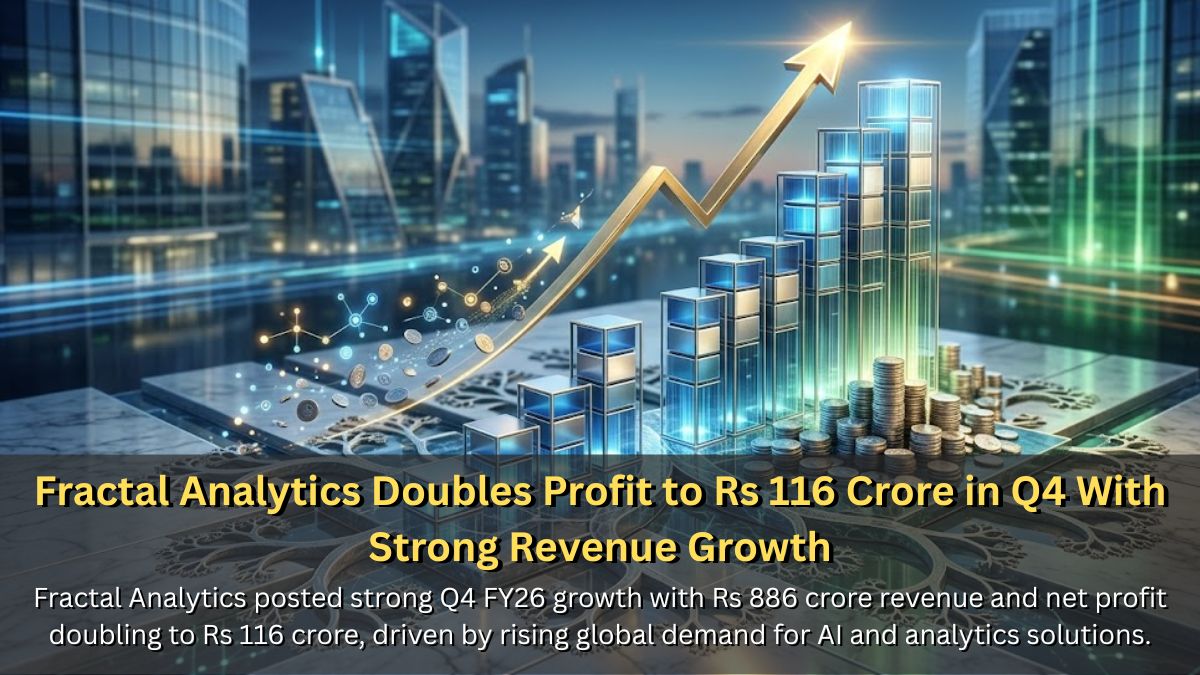
Fractal Analytics reported a sharp rise in profitability during the fourth quarter of FY26 as the artificial intelligence and analytics company continued to expand its enterprise technology business across global markets. The Mumbai-headquartered firm posted consolidated revenue of Rs 886 crore in Q4 FY26, while net profit more than doubled year-on-year to Rs 116 crore. The strong financial performance reflects rising enterprise demand for AI-led business solutions, data engineering services, and advanced analytics platforms.
The company’s quarterly revenue increased by nearly 18% compared to the previous year. At the same time, profitability improved significantly due to operational efficiency, higher enterprise spending on AI transformation, and stronger global client demand. Fractal Analytics has become one of India’s most recognized AI startups, serving Fortune 500 companies across healthcare, retail, financial services, insurance, and consumer goods sectors.
Founded in 2000 by Srikanth Velamakanni, Pranay Agrawal, and Ramakrishna Reddy, the company has evolved from a niche analytics consulting business into a global artificial intelligence platform company. Over the years, Fractal Analytics expanded through acquisitions, AI investments, and product innovation. Today, the company operates globally with offices across the United States, Europe, Asia, and the Middle East. The strong quarterly performance comes during a major global AI boom. Businesses worldwide are increasing investments in generative AI, automation, machine learning, and predictive analytics. This trend has created strong growth opportunities for Indian startups working in enterprise AI and tech innovation.
Industry experts believe Fractal Analytics is positioning itself strongly ahead of potential future IPO discussions. The company already has backing from major investors including TPG Capital and Apax Partners. Moreover, its profitability growth signals increasing maturity in India’s startup ecosystem, where many venture-backed startups are now focusing on sustainable revenue and long-term business transformation instead of only aggressive expansion.
1. Fractal Analytics Reports Strong Q4 FY26 Results
1.1 Revenue and Profit Surge in Fourth Quarter
Fractal Analytics delivered an impressive Q4 FY26 performance, and the numbers say a lot about where the Artificial Intelligence industry is heading right now. The company reported consolidated revenue of Rs 886 crore for the quarter, while net profit jumped to Rs 116 crore. What made the performance even more noticeable was the pace of growth. Profit more than doubled compared to the same period last year. But beyond the numbers, the results tell a much deeper story.
Businesses across the world are no longer treating AI as a futuristic experiment or optional technology upgrade. Companies now want smarter systems, faster decision-making, automation, predictive insights, and better operational efficiency because competition is becoming more intense across every industry. That demand is creating massive opportunities for companies like Fractal Analytics.
According to reports, sectors such as healthcare, banking, retail, and insurance contributed strongly to the company’s growth. At the same time, improved operational efficiency also helped strengthen margins and profitability. For many people watching India’s startup ecosystem, these results feel encouraging because they show that AI businesses can move beyond hype and build real, sustainable financial strength.
1.2 Why the Results Matter
Over the last few years, the startup world has seen countless companies chase rapid growth while struggling to become profitable. Investors started becoming more cautious. Markets became tougher. Suddenly, everyone began asking the same question: Can these businesses actually make sustainable money? That is why Fractal Analytics stands out. The company is showing that an AI-driven business can grow globally while also building healthy profitability. That balance matters because it creates confidence, not only for investors but also for young founders trying to build long-term technology companies from India.
The timing also feels important. Right now, enterprises everywhere are increasing spending on AI, automation, analytics, and digital transformation. Businesses want tools that help them operate faster, reduce inefficiencies, improve customer understanding, and make better decisions using data. Companies that spent years building deep expertise in analytics are naturally benefiting from this shift. For India, moments like this carry emotional weight too.
For a long time, Indian startups were often seen mainly as outsourcing or service providers for global businesses. But companies like Fractal Analytics are helping reshape that image by building globally respected technology businesses with Indian roots and international impact. That creates belief for a new generation of entrepreneurs watching from smaller cities, startup hubs, and even college campuses across the country.
2. The Journey of Fractal Analytics
2.1 Founding Story
Fractal Analytics was founded in 2000 by:
- Srikanth Velamakanni
- Pranay Agrawal
- Ramakrishna Reddy
What makes their story especially interesting is how early they entered the world of analytics and data science. Today, Artificial Intelligence is everywhere. Every startup pitch mentions AI. Every company wants automation. Investor is searching for the next big AI opportunity. But back in 2000, things looked completely different. Most businesses were not talking seriously about Machine Learning, predictive analytics, or data-driven intelligence. The market was still immature, and many companies did not fully understand how valuable data would eventually become.
Yet the founders of Fractal Analytics saw something long before most people did. They believed data would eventually shape how businesses make decisions. That belief became the foundation of the company. In the early days, the company focused on helping businesses use analytics and data science to improve decision-making. It was not a glamorous industry at the time. There was no massive AI hype cycle. No social media excitement around generative AI. No rush of investors throwing money into AI startups. It was simply a small team building patiently in a space most people barely understood.
2.2 Early Challenges
Building an analytics company in the early 2000s was not easy at all. The founders were trying to convince businesses to invest in technologies many executives had never even heard of properly. Predictive analytics sounded complicated. Machine Learning felt unfamiliar. Enterprise budgets for advanced analytics were still limited. In many ways, Fractal Analytics was building for a future that had not fully arrived yet. That required patience most startups struggle to maintain.
There were no shortcuts. The company had to spend years educating clients, proving value slowly, and building trust project by project. And honestly, that part of startup building rarely gets talked about enough. People often celebrate successful companies once they become big. What they do not always see are the quiet years before success arrives. The years where founders keep pushing forward even when markets are uncertain and growth feels slow. Fractal Analytics survived those years by focusing deeply on solving real problems instead of chasing temporary hype. Over time, multinational corporations started trusting the company for analytics and enterprise AI solutions. Those relationships gradually became the base for global expansion.
2.3 Expansion Into Global Markets
As the company matured, Fractal Analytics steadily expanded beyond India and established a presence across:
- United States
- United Kingdom
- Singapore
- Australia
- Multiple European markets
Step by step, the company evolved from an early analytics startup into one of India’s most respected global AI and enterprise analytics firms. Today, Fractal Analytics works with Fortune 500 companies around the world, helping businesses improve customer understanding, operational efficiency, automation, forecasting, and decision-making using Artificial Intelligence and advanced analytics. But perhaps the most inspiring part of the journey is what it represents.
It shows that globally competitive technology companies can absolutely be built from India with patience, long-term thinking, and deep expertise. And for many young founders watching the AI industry grow today, that possibility feels more real than ever before..
3. Fractal Analytics Working Model
3.1 How the Company Operates
At its core, Fractal Analytics operates as an enterprise Artificial Intelligence and analytics company that helps businesses make smarter decisions using data. That may sound simple on the surface, but the work happening behind the scenes is actually very deep and complex.
Today, companies generate massive amounts of data every single day. Customer behavior, transactions, operations, logistics, marketing performance, risk patterns, sales numbers, and digital interactions all create enormous streams of information. The problem is that most businesses struggle to turn that raw data into meaningful decisions. That is where Fractal Analytics comes in.
The company works with enterprises to help them use:
- Artificial Intelligence
- Machine Learning
- Data engineering
- Predictive analytics
- Cloud technologies
- Automation systems
to improve efficiency, forecasting, customer understanding, and business performance. Instead of relying only on intuition or outdated reporting systems, companies can make faster and more informed decisions using AI-driven insights. What makes the company’s model especially powerful is the combination of
different types of expertise working together. Its teams include:
- Data scientists
- AI researchers
- Engineers
- Consultants
- Analytics specialists
All of them work closely with enterprise clients to solve real operational problems instead of simply building technology for hype. And honestly, that is one of the biggest reasons companies continue investing heavily in analytics firms today. Businesses are not just buying software anymore. They are looking for solutions that genuinely improve outcomes.
3.2 Core Services
Fractal Analytics offers multiple AI and enterprise analytics services designed to help large organizations modernize operations and become more data-driven.
3.2.1 AI and Analytics Consulting
One of the company’s biggest areas is AI and analytics consulting. Many enterprises know they need Artificial Intelligence, but they often struggle with implementation. They may have data, but they do not always know how to organize it, analyze it, or turn it into business value. Fractal Analytics helps businesses create data-driven strategies that improve decision-making and operational performance. In many ways, the company acts as both a technology partner and a business transformation advisor.
3.2.2 Generative AI Solutions
As Generative AI adoption grows globally, Fractal Analytics has also been expanding into AI-powered productivity and automation solutions. These tools help businesses automate repetitive tasks, improve workflows, generate insights faster, and increase operational efficiency. Right now, companies everywhere are trying to understand how Generative AI can fit into daily operations, and businesses with strong AI expertise are naturally becoming more valuable because of that shift.
3.2.3 Decision Intelligence Platforms
Another important part of the business is decision intelligence platforms.
These systems help enterprises with:
- Forecasting
- Business insights
- Performance analysis
- Operational optimization
- Risk assessment
In large organizations, even small improvements in forecasting or operational efficiency can save enormous amounts of money. That is why AI-driven decision systems are becoming increasingly important across industries.
3.2.4 Cloud and Data Engineering
Modern businesses cannot rely on outdated infrastructure anymore. A huge amount of enterprise data still exists inside fragmented systems that are difficult to manage efficiently. Fractal Analytics helps companies modernize these systems through cloud migration and advanced data engineering solutions. This helps businesses organize information more effectively and build stronger AI capabilities over time.
3.2.5 Industry-Specific AI Solutions
One thing that makes Fractal Analytics particularly valuable is its industry-specific approach.
Instead of offering only generic AI tools, the company creates tailored solutions for sectors like:
- Healthcare
- Finance
- Retail
- Insurance
Every industry has different operational challenges, customer behaviors, compliance requirements, and data structures. Customized AI solutions usually create far better results than one-size-fits-all systems. That practical approach has helped the company build long-term enterprise relationships globally.
4. Revenue Model of Fractal Analytics
4.1 Enterprise Contracts
The majority of Fractal Analytics revenue comes from enterprise contracts.
Large corporations partner with the company for:
- AI transformation projects
- Analytics services
- Data modernization
- Cloud infrastructure upgrades
- Automation initiatives
These contracts often become long-term relationships because enterprise transformation is not something companies complete overnight. Once businesses integrate AI systems deeply into operations, they usually continue investing over multiple years. That creates strong recurring revenue opportunities.
4.2 Subscription-Based Platforms
In addition to consulting and enterprise services, Fractal Analytics also generates recurring revenue through proprietary software platforms. These AI-driven platforms help enterprises with predictive analytics, business intelligence, operational insights, and decision-making support.
Subscription-based products are especially valuable because they create more stable long-term revenue compared to purely project-based consulting models. For modern AI companies, recurring revenue is often seen as one of the strongest signs of business stability.
4.3 Consulting Revenue
Consulting remains another major part of the company’s business model. Many enterprises still need guidance when adopting Artificial Intelligence because implementation can feel overwhelming.
Companies often need help understanding:
- Which AI systems to adopt
- How to structure data properly
- How to modernize operations
- How to scale automation responsibly
Fractal Analytics supports organizations throughout this transformation journey.
And as AI adoption continues growing globally, demand for experienced consulting partners is increasing rapidly.-
4.4 Long-Term Partnerships
One of the smartest things about the company’s approach is its focus on long-term enterprise relationships instead of short-term transactions.
That strategy creates:
- Stable recurring revenue
- Stronger client retention
- Lower customer acquisition risk
- Better operational predictability
In enterprise technology, trust takes years to build.
Once companies trust a partner deeply with their data systems, analytics infrastructure, and AI operations, those relationships often become extremely valuable over time.
5. Funding History and Investors
5.1 Major Funding Rounds
Over the years, Fractal Analytics attracted strong interest from major institutional investors. In 2016, Khazanah Nasional invested around $100 million into the company, reflecting growing confidence in the global future of Artificial Intelligence and enterprise analytics. Later, Apax Partners acquired a majority stake in Fractal Analytics through a deal reportedly valued at nearly $685 million.
These investments became major turning points for the company.
The funding helped accelerate:
- Global expansion
- AI research initiatives
- Product development
- Enterprise platform growth
- Strategic acquisitions
For AI companies operating globally, access to strong capital often becomes essential because the industry moves extremely fast and requires continuous innovation.
5.2 Role of Institutional Investors
Institutional investors played a major role in helping Fractal Analytics scale internationally.
The funding allowed the company to:
- Expand into global markets
- Hire top AI talent
- Invest heavily in research
- Build enterprise-grade platforms
- Strengthen operational capabilities
But beyond financial support, institutional backing also gave the company stronger credibility in global enterprise markets.
For large corporations choosing long-term AI partners, stability matters enormously. Strong investors often signal that a company has the financial strength and long-term vision needed to handle enterprise-scale transformation projects. And in an industry evolving as quickly as Artificial Intelligence, that confidence becomes incredibly important.he AI industry.
6. Acquisitions and Expansion Strategy
6.1 Strategic Acquisitions
Over the years, Fractal Analytics did not grow only through internal expansion. The company also strengthened its position by acquiring businesses that added new capabilities and deeper expertise. As the AI industry evolved rapidly, the company understood something important very early:
technology moves too fast for businesses to stand still.
That is why Fractal Analytics focused on acquiring firms working in areas like:
- AI engineering
- Consumer analytics
- Healthcare AI
- Cloud technology
- Data science
Each acquisition was not just about increasing size. It was about expanding knowledge, strengthening enterprise solutions, and staying ahead in an industry where innovation changes almost constantly. For enterprise clients, this mattered because businesses no longer wanted isolated analytics services. They wanted complete AI ecosystems capable of solving multiple operational challenges together. By expanding strategically, Fractal Analytics gradually built stronger capabilities across industries and technologies. And honestly, in the AI world, companies that stop evolving usually fall behind very quickly.
6.2 Importance of AI Investments
Artificial Intelligence is one of those industries where standing still can become dangerous. Technology changes rapidly. New models appear constantly. Customer expectations evolve fast. What feels advanced today can feel outdated much sooner than most industries expect.
Because of this, Fractal Analytics continued investing heavily in:
- AI research
- Machine Learning systems
- Generative AI technologies
- Automation platforms
- Enterprise intelligence tools
These investments were not only about staying modern. They were about staying relevant in a highly competitive global market. Right now, almost every major company wants stronger AI capabilities. Businesses are searching for faster automation, smarter forecasting, deeper analytics, and productivity improvements. That creates enormous pressure on AI firms to keep innovating continuously. Companies that fail to adapt quickly risk becoming outdated. That is why long-term investment in research and AI infrastructure has become such an important part of the company’s strategy.
7. What Problems Fractal Analytics Solves
7.1 Managing Massive Enterprise Data
Modern businesses generate unbelievable amounts of data every single day. Every transaction, customer interaction, digital click, payment, order, support request, operational process, and online activity creates information. The problem is that most companies struggle to organize and use that data effectively. For many businesses, the data exists, but clarity does not. That is one of the biggest problems Fractal Analytics helps solve.
Using AI-powered analytics systems, the company helps enterprises convert raw information into useful business insights that support smarter decision-making. Because in today’s business world, having data alone is no longer enough. Companies need the ability to understand it quickly and act on it intelligently.
7.2 Improving Decision-Making
Many businesses lose time and money because decision-making processes are too slow, reactive, or inaccurate. Executives often need to forecast customer behavior, market demand, operational risks, inventory needs, and financial trends. But without advanced analytics, those decisions become much harder. Fractal Analytics helps companies improve forecasting and operational efficiency through predictive analytics systems powered by Artificial Intelligence.
Instead of relying only on guesswork or outdated reporting methods, businesses can make decisions using real-time insights and predictive models. And in highly competitive industries, even small improvements in decision-making can create massive long-term advantages.
7.3 Automating Business Processes
One of the biggest challenges inside large organizations is operational inefficiency. Manual processes slow teams down. Repetitive tasks consume time. Employees often spend hours doing work that could be automated far more efficiently. That is why automation has become such a major focus across industries.
Fractal Analytics develops AI-powered automation systems that help enterprises reduce repetitive workloads, improve productivity, and streamline operations. For companies managing large-scale operations, automation is no longer just about convenience. It is becoming essential for staying competitive.
7.4 Enhancing Customer Experience
Modern businesses are under constant pressure to understand customers better. People expect personalized experiences, faster service, relevant recommendations, and smoother interactions across digital platforms. Industries like retail, banking, insurance, and healthcare increasingly rely on AI systems to understand customer behavior more deeply.
Fractal Analytics helps organizations analyze customer patterns, preferences, and interactions to improve personalization and business performance. Because at the end of the day, businesses grow stronger when customers feel understood.
8. AI Industry Growth Trends
8.1 Rising Enterprise AI Spending
Artificial Intelligence is no longer a niche technology trend. It is becoming a core part of how modern businesses operate.
Across the world, companies are increasing spending on:
- Generative AI
- Automation systems
- Cloud analytics
- Predictive intelligence
- AI infrastructure
- Machine Learning platforms
The reason is simple:
Businesses want to work smarter, faster, and more efficiently.
- Companies today are competing in environments where speed, personalization, automation, and data-driven decisions matter more than ever before. That pressure is pushing enterprises to invest heavily in AI technologies.
- And naturally, this creates major growth opportunities for AI startups and enterprise technology companies like Fractal Analytics.
8.2 India’s Growing AI Ecosystem
India is quickly becoming one of the fastest-growing AI startup ecosystems in the world.
A combination of factors is helping drive this growth:
- Strong engineering talent
- Rapid digital adoption
- Rising enterprise demand
- Startup incubators
- Venture capital investment
- Expanding cloud infrastructure
What makes this moment especially exciting is that Indian startups are no longer building only for local markets. Many companies are now competing globally in areas like enterprise AI, SaaS automation, analytics, cybersecurity, fintech, healthcare technology, and Generative AI systems. That shift is creating a completely new generation of technology entrepreneurs across the country. And for many young founders, AI feels like one of the biggest business opportunities of this decade.
8.3 Generative AI Boom
The rise of advanced Generative AI systems completely changed the global technology conversation. Suddenly, businesses everywhere started exploring how AI could improve productivity, automate workflows, generate content, support decision-making, and reduce operational costs. This shift dramatically increased enterprise spending on AI tools and automation platforms. Companies no longer want AI only for experimentation. They want practical systems that improve real business outcomes.
Fractal Analytics has been actively expanding in this segment by investing in Generative AI solutions and enterprise productivity technologies. And honestly, this may still be only the beginning. The AI industry is evolving at a pace few people fully expected, and businesses capable of adapting quickly could become some of the biggest long-term winners of the coming decade.
9. Competitors of Fractal Analytics
9.1 Direct Competitors
The AI and analytics industry has become extremely competitive over the last few years. As more businesses invest in Artificial Intelligence, automation, cloud analytics, and data-driven decision-making, several companies are competing aggressively to become long-term enterprise technology partners.
Fractal Analytics competes with major firms such as:
- Mu Sigma
- Tiger Analytics
- LatentView Analytics
- Accenture AI services
- Cognizant AI services
- Tredence
These companies all operate in areas like:
- Enterprise analytics
- AI transformation
- Data engineering
- Automation
- Predictive intelligence
- Cloud modernization
And honestly, the competition is intense because businesses today are spending billions globally trying to improve efficiency and stay technologically ahead. But what separates strong companies in this market is not only technology. It is trust, long-term execution, industry expertise, and the ability to solve real business problems consistently over time.
Enterprise clients usually do not switch partners easily. Once a company becomes deeply integrated into critical business operations, those relationships can last for years. That is why reputation matters enormously in this industry.
9.2 Indirect Competitors
Beyond direct analytics firms, Fractal Analytics also faces competition from a much broader technology ecosystem.
Indirect competitors include:
- Cloud providers
- Enterprise software companies
- Consulting firms
- Generative AI startups
- Automation platforms
The lines between industries are becoming increasingly blurred. Today, cloud companies are building AI tools. Consulting firms are launching automation platforms. SaaS businesses are integrating Machine Learning systems. Generative AI startups are entering enterprise markets rapidly. Because of this, the AI industry evolves almost constantly. New competitors appear quickly, technologies shift rapidly, and customer expectations continue rising. Companies operating in this environment need to innovate continuously just to stay competitive. And that pressure is unlikely to slow down anytime soon.
10. Fractal Analytics and India’s Startup Ecosystem
10.1 A Major Indian AI Success Story
Fractal Analytics is often seen as one of India’s most important AI startup success stories. What makes the company especially unique is that it built a large global business without depending on the typical consumer internet startup model that dominated much of India’s startup ecosystem for years.
Instead of focusing on food delivery, social media, or eCommerce discounts, the company built its identity around enterprise AI, analytics, and deep technology. That path required patience. Enterprise businesses usually grow slower in the beginning compared to consumer startups, but they often build much stronger long-term stability. And today, that strategy appears to be paying off.
The company’s journey has shown that Indian startups can build globally respected AI and enterprise technology businesses capable of competing with international firms. That changes how many young founders think about entrepreneurship now.
10.2 Impact on Indian Tech Innovation
The success of Fractal Analytics has had a wider impact on India’s technology ecosystem. For a long time, deep-tech startups in India received far less attention compared to consumer internet businesses. But companies like this helped prove that advanced AI, analytics, and enterprise technology could also become massive opportunities.
That shift matters because it encourages more founders to explore:
- Artificial Intelligence
- Machine Learning
- SaaS platforms
- Cybersecurity
- Data infrastructure
- Enterprise automation
instead of focusing only on traditional startup categories. In many ways, companies like Fractal Analytics helped normalize the idea that Indian founders can build globally competitive deep-tech businesses from India itself. And that inspiration quietly influences thousands of aspiring entrepreneurs across the country.
10.3 Growing Demand for AI Talent
As Fractal Analytics expanded globally, demand for AI talent also increased rapidly. The growth of companies working in Artificial Intelligence, analytics, automation, and Machine Learning has created huge demand for:
- AI engineers
- Data scientists
- Cloud specialists
- Machine Learning researchers
- Analytics consultants
- Automation experts
Today, AI hiring has become one of the biggest growth trends across the startup ecosystem. Students, engineers, and working professionals are increasingly trying to upskill in areas related to data science and AI because they see how quickly the industry is growing. And honestly, this trend is probably still in its early stages.
11. Why Profitability Matters in Today’s Startup Market
11.1 Shift From Growth to Sustainability
The startup world has changed a lot over the last few years. There was a period when companies were rewarded mainly for rapid growth. Many startups expanded aggressively, raised huge funding rounds, and focused heavily on customer acquisition, even if profitability remained far away. But markets eventually became more cautious.
Investors started asking harder questions:
- Can the business sustain itself?
- Are margins improving?
- Is growth financially healthy?
- Can the company survive tougher economic conditions?
That is why profitability has become much more important in today’s startup environment. Businesses that combine growth with financial discipline are now viewed much more positively by investors and markets.
11.2 Strong Margins Improve Investor Confidence
Profitability gives companies something extremely valuable:
flexibility. When businesses have healthy margins and stable revenue, they can navigate uncertain market conditions more confidently. They become less dependent on constant fundraising and gain more control over long-term strategy.
Strong financial performance also improves:
- Investor confidence
- Operational stability
- Expansion opportunities
- IPO readiness
- Long-term scalability
And in difficult market cycles, profitable businesses often survive far more comfortably than companies dependent entirely on external funding. That is one reason why Fractal Analytics’s recent financial results attracted attention
11.3 Enterprise AI Business Models Are Becoming Stronger
Enterprise AI businesses are increasingly seen as financially attractive because they often generate stronger margins compared to many consumer internet startups. One major reason is the nature of enterprise contracts.
Large corporations usually sign:
- Bigger contracts
- Multi-year partnerships
- Recurring subscription agreements
- Long-term transformation projects
That creates more predictable revenue and stronger customer retention. Once AI systems become integrated deeply into enterprise operations, businesses are less likely to switch providers frequently. And that stability makes enterprise AI business models increasingly powerful in today’s technology market.
12. Future Growth Opportunities for Fractal Analytics
12.1 Expansion in Generative AI
Generative AI has become one of the biggest technology shifts in recent years. Businesses across industries are now exploring how AI can improve productivity, automate workflows, generate content, support decision-making, and simplify operations. For companies like Fractal Analytics, this creates enormous opportunity. The company continues investing heavily in Generative AI systems because enterprise demand in this area is growing extremely fast. And honestly, many experts believe enterprise adoption of Generative AI is still only beginning.
12.2 Global Enterprise Demand
Around the world, businesses are modernizing operations faster than ever before.
Companies want:
- Better automation
- Faster analytics
- Smarter forecasting
- Improved operational efficiency
- AI-powered decision systems
That means demand for enterprise AI and analytics platforms will likely continue growing strongly over the next several years. Businesses capable of helping enterprises navigate this transformation are positioned for major long-term opportunities. And Fractal Analytics is already operating directly inside that global shift.
12.3 Potential IPO Discussions
Although Fractal Analytics has not officially announced any IPO timeline, market discussions around a possible future public listing continue appearing regularly. And honestly, the speculation makes sense. Strong profitability, recurring enterprise revenue, global expansion, and growing AI demand all strengthen the company’s long-term market position.
Public market investors are increasingly interested in AI businesses with:
- Sustainable revenue
- Strong margins
- Enterprise contracts
- Scalable platforms
- Long-term growth visibility
If the company continues strengthening financially while expanding its AI capabilities globally, many market experts believe an IPO could eventually become a realistic next step.
13. Challenges Facing Fractal Analytics
13.1 Intense Competition
The Artificial Intelligence industry is moving at an incredibly fast pace. Almost every major technology company today wants a strong position in enterprise AI, automation, analytics, and cloud infrastructure. Global consulting firms, large tech corporations, SaaS companies, and fast-growing AI startups are all competing aggressively for the same enterprise customers.
That creates constant pressure. For companies like Fractal Analytics, staying competitive is not only about building good technology anymore. It is about continuously proving value in a market where innovation changes almost every few months. And honestly, this is one of the hardest parts about operating in AI right now. What feels cutting-edge today can become outdated surprisingly quickly. New tools launch constantly. Customer expectations keep rising. Competitors evolve rapidly. That means companies cannot afford to slow down.
13.2 Talent Retention
One of the biggest challenges across the global AI industry is talent. Experienced AI engineers, Machine Learning specialists, data scientists, and cloud experts are in massive demand worldwide. Almost every fast-growing technology company is competing for the same skilled professionals. Because of this, hiring strong teams is difficult. Retaining them is often even harder.
Companies working in Artificial Intelligence need people who can combine technical expertise with real business understanding. And as AI adoption accelerates globally, the competition for talent keeps becoming more intense. For firms like Fractal Analytics, building a strong culture, investing in research opportunities, and creating meaningful long-term career growth becomes extremely important. Because in technology businesses, great teams often become the real competitive advantage.
13.3 Technology Evolution
Artificial Intelligence evolves faster than most industries. New AI models, frameworks, automation systems, and enterprise tools appear constantly. Technologies that dominate headlines today may get replaced by more advanced systems tomorrow. That creates enormous pressure on AI companies to keep innovating continuously.
Businesses cannot simply build one successful product and remain comfortable for years. They must keep improving capabilities, investing in research, experimenting with new technologies, and adapting to changing customer needs. For Fractal Analytics, staying relevant means continuously evolving alongside the industry itself. And honestly, that constant evolution is both exciting and exhausting for almost every company operating in AI today.
14. Learning for Startups and Entrepreneurs
14.1 Focus on Long-Term Value
One of the biggest lessons from Fractal Analytics is the importance of thinking long term. The company did not grow by chasing temporary hype or short-term trends. Instead, it spent years building deep enterprise relationships, solving practical business problems, and earning client trust gradually. That patience became one of its biggest strengths.
In today’s startup world, there is often pressure to grow extremely fast and constantly chase attention. But sustainable businesses are usually built through consistency, execution, and long-term value creation. And honestly, trust compounds slowly over time.
14.2 Invest in Deep Technology
Deep-tech businesses are rarely easy in the beginning. Industries like Artificial Intelligence, analytics, cybersecurity, cloud infrastructure, and enterprise software often require years of learning, experimentation, and technical development before reaching large scale. That process demands patience.
But once strong expertise is built, deep-tech companies can create very powerful competitive advantages because the barriers to entry are much higher compared to simpler business models. Fractal Analytics showed that investing deeply in technology and research can eventually create long-term global opportunities.
14.3 Build Global Businesses Early
Another important lesson is the value of thinking globally from an early stage. Fractal Analytics expanded internationally relatively early in its journey instead of limiting itself only to one market.
That decision helped:
- Diversify revenue
- Reduce dependency on one region
- Build global credibility
- Expand enterprise opportunities
- Strengthen brand recognition
Today, many Indian startups are following a similar path by building products for international customers from day one. And in a digitally connected world, global expansion feels far more accessible than it did years ago.
14.4 Strong Teams Matter
Technology companies are ultimately built by people. No AI platform, analytics system, or enterprise product becomes successful without strong engineering, research, and operational teams working behind the scenes. Fractal Analytics invested heavily in hiring skilled engineers, AI researchers, consultants, and analytics professionals over the years.
That investment played a huge role in the company’s long-term growth. For startups, this lesson matters enormously. A strong product idea alone is not enough. Building the right team, culture, and execution capability often determines whether a company survives long term.
14.5 Profitability Is Important
One of the clearest lessons from today’s startup market is that profitability matters. There was a period when many startups focused almost entirely on rapid expansion. But recent market conditions showed that growth without financial discipline can become risky during uncertain times. Sustainable profits create stability.
They help companies survive difficult economic environments, invest confidently in future growth, and reduce dependence on external funding. Fractal Analytics demonstrated that enterprise AI businesses can grow while also building strong financial health. And for entrepreneurs, that balance between ambition and sustainability may be one of the most important lessons of all.line.
About foundlanes.com
foundlanes.com is India’s leading startup idea discovery platform. It helps entrepreneurs find actionable startup opportunities, market insights, and industry-specific guidance to turn ideas into real businesses. With deep research and practical resources, foundlanes supports founders at every stage, from idea validation to launch and growth.