Summary
To start a kirana store in India today is not just about opening a small grocery shop. It is about entering one of the most resilient and deeply rooted retail segments in the country. Kirana stores are everywhere, from crowded city lanes to remote villages. They serve millions of customers daily, often becoming a part of their routine and trust system. The idea sounds simple. Sell daily essentials. But behind that simplicity lies a powerful business model that has survived decades of economic shifts, modern retail competition, and even the rise of quick commerce.
Why does this still matter in 2026? Because despite the growth of supermarkets and apps, kirana stores continue to control a major share of India’s retail market. They are fast, accessible, and personal. For someone looking to build a stable business with consistent demand, this is one of the most practical startup ideas. It requires moderate investment, but the returns, when managed well, can be steady and long-term.
Who should consider this? Anyone with a basic understanding of their local area, strong discipline, and willingness to build customer relationships. Where can you start? Almost anywhere. Residential neighborhoods, semi-urban towns, and even high-footfall streets work well. When is the right time? Honestly, there is no perfect time. Demand for groceries never stops. How do you start? That is where planning comes in. From licenses to suppliers, from store layout to inventory, each step matters. And how much investment is needed? Typically, a kirana store investment cost in India can range from ₹2 lakh to ₹10 lakh depending on size, location, and inventory scale. This guide breaks it all down. Not just theory, but what actually works on the ground.
1. Startup Idea Overview
Starting a kirana store might sound simple on paper, but anyone who has spent even a week inside one knows it’s a living, breathing business. It runs on rhythm. Early mornings with milk crates arriving, mid-day lull, evening rush when people walk in after work. It’s not just about selling groceries. It’s about becoming part of people’s daily routine.
What’s changed over the years is not the core idea, but how it’s executed. Step into a well-run kirana store today and you’ll notice subtle but powerful upgrades. QR codes for UPI payments, neatly categorized shelves, quick order-taking on WhatsApp, sometimes even home delivery on a scooter. These are not big, flashy innovations, but they make the store feel faster, smarter, and more reliable. At its core, the business solves something very basic but very real. People don’t want to travel far for essentials. They don’t want to wait for delivery when they need something now. And they definitely don’t want uncertainty around availability. A kirana store removes all of that friction. It gives instant access. It gives familiarity. It gives comfort.
What makes this model quietly powerful is predictability. Unlike businesses driven by trends or seasonal demand, a kirana store runs on everyday needs. Cooking oil will run out. Snacks will be restocked. Soap, toothpaste, tea. These are habits, not occasional purchases. That means customers keep coming back. Over time, your store stops being just a shop. It becomes part of how people live their daily lives.
2. Problem Statement & Solution
India’s retail system is a mix of extremes. On one side, you have large supermarket chains with scale and branding. On the other, you have millions of small, local stores trying to serve neighborhoods. In between, you now have delivery apps promising convenience. But even with all these options, gaps still exist.
Customers face small but frustrating issues every day. An item is out of stock online. Delivery takes longer than expected. Prices fluctuate. Or sometimes, there’s simply no time to plan a big grocery run. And beyond all of this, there’s something deeper. Trust. People still prefer buying essentials from someone they know, someone who won’t overcharge, someone who understands their needs.
This is exactly where a kirana store wins. It doesn’t try to compete with scale. It competes with closeness. You are right there in the neighborhood. You know who buys what. You remember preferences without needing data analytics. You know when someone might need credit for a few days. These are small gestures, but they build something powerful over time. The solution is not just convenience, it’s reliability. A kirana store says, “Whatever you need, I’ve got you.” No waiting, no confusion. That assurance creates loyalty in a way no app notification ever can. And once loyalty is built, the business becomes stable, even during market fluctuations.
3. Target Audience & Customer Persona
On the surface, it feels like everyone is your customer. And that’s true to an extent. But if you really observe closely, you’ll notice patterns that can completely change how you run your store. In urban areas, time is the biggest factor. Customers are usually in a hurry. They want quick service, easy access, and minimal waiting. A working professional might walk in late at night for essentials. A parent might rush in for something they forgot during the day. These customers value speed over everything else. If you can serve them fast and consistently, they will keep coming back.
In semi-urban or smaller towns, the dynamics shift slightly. Here, relationships matter more. Customers may not buy in bulk all the time. They may prefer smaller quantities based on daily needs. They may even expect a bit of flexibility in pricing or credit. But once they trust you, they stay loyal for years.
Now think about individual personas. A working mother who stops by after a long day, tired but needing groceries. A college student counting every rupee while buying snacks. An elderly person who prefers familiar brands and friendly conversation. Each of them walks into the same store, but for very different reasons. When you start seeing your customers this way, your decisions become sharper. You stock smarter. You communicate better. And slowly, your store starts feeling like it was built specifically for that neighborhood. That’s when it truly begins to grow.
4. Market Opportunity & Timing
If you step back and look at the numbers, India’s grocery market is enormous. It’s one of the largest retail segments in the country, and it continues to grow every year. Despite the rise of e-commerce and quick commerce platforms, kirana stores still hold a massive share. That alone tells you something important. This model is deeply rooted and incredibly resilient.
But what makes this moment especially interesting is the shift happening right now. Technology is no longer limited to big companies. Even small store owners are adopting digital tools. UPI payments are now standard. Inventory apps are becoming common. Some stores are even taking orders through messaging platforms and delivering within minutes.
This creates a unique opportunity. You are not forced to choose between traditional and modern. You can combine both. You can build trust like a traditional kirana store while operating with the efficiency of a modern business. That combination is powerful because it gives you an edge over both sides.
Timing matters in business, and right now, the timing is favorable. Consumers are comfortable with digital payments. Suppliers are becoming more organized. And customers are open to small improvements as long as convenience remains intact. If executed well, a kirana store today can grow faster and operate more efficiently than ever before.
5. USP & Value Proposition
The truth is, most kirana stores sell similar products. Same brands, similar pricing, similar layouts. So why do some stores thrive while others barely survive? The answer lies in small but meaningful differences. Your USP does not need to be complicated or expensive. It can be as simple as how you treat your customers. Maybe your store is cleaner and easier to navigate. Maybe you serve people faster during peak hours. Maybe you stock products that others don’t think of. These small improvements create a better experience, and that experience is what people remember.
But if you look deeper, the real value comes from trust. Customers want consistency. They want to know that the price is fair, the product is genuine, and the person behind the counter respects them. When that trust is built, price becomes less of a deciding factor. Convenience becomes a given. And loyalty becomes natural. Over time, your store becomes more than a place to buy groceries. It becomes a dependable part of people’s lives. They don’t compare options anymore. They don’t look around. They simply come to you. And in a business like this, that kind of loyalty is not just valuable. It’s everything.
6. Business Model & Pricing Strategy
If you strip everything down, the kirana store business model is beautifully simple. You buy low, you sell at a margin, and you repeat that cycle every single day. But in reality, the simplicity is deceptive. The difference between a store that survives and one that thrives comes down to discipline in execution.
When you source products from wholesalers, every rupee matters. Even a small difference in purchase price can impact your margins over time. In FMCG, margins typically range between 5% and 20%, and that’s not a lot if you think about it. This is why experienced shop owners don’t chase high margins alone. They focus on fast-moving products and consistent turnover. A packet of biscuits that sells ten times a day is more valuable than a premium item that sits on the shelf for weeks.
Pricing, in this business, is almost like walking a tightrope. If your prices are even slightly higher than nearby stores, customers notice. They may not say it immediately, but they will quietly shift. At the same time, if you undercut too much, your profits start disappearing before you even realize it.
Most successful kirana owners follow a very grounded approach. They stick close to market prices, sometimes matching competitors exactly. Where they win is not pricing alone, but availability and speed. When a customer knows they will always find what they need at your shop, price becomes a secondary factor. Over time, volume builds. And in this business, volume is what quietly compounds your earnings day after day.
7. Execution Plan & Launch Strategy
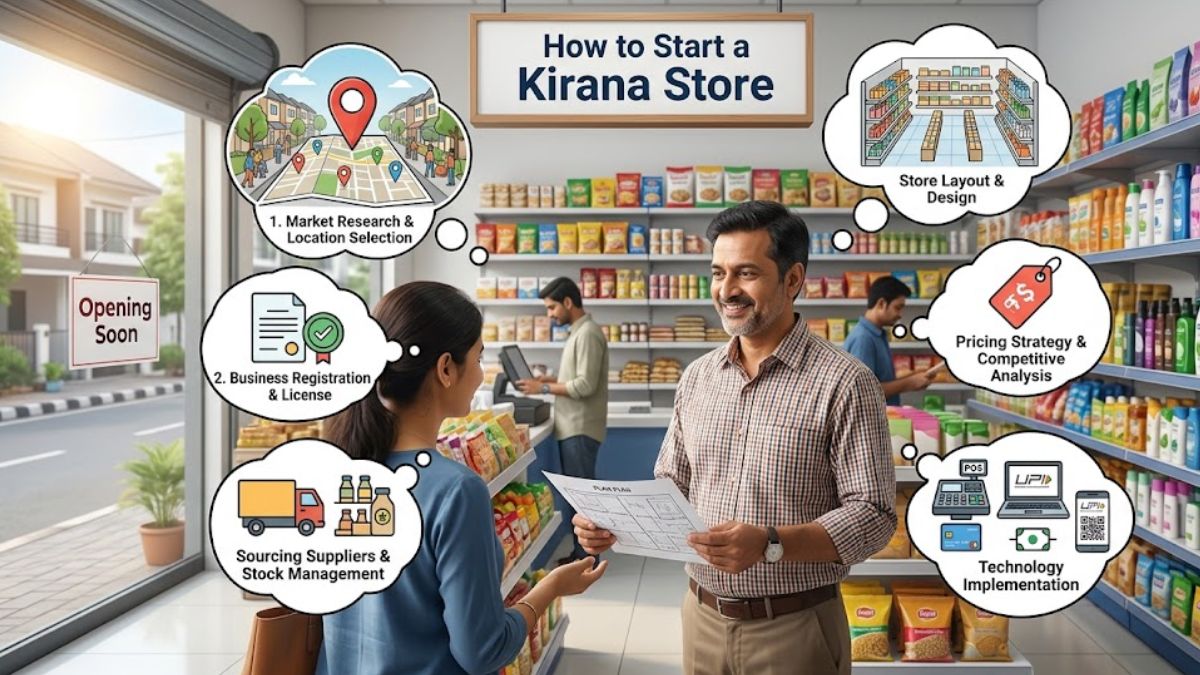
Ideas don’t build kirana stores. Execution does. And the truth is, the first few decisions you make will shape everything that comes after. Location is the biggest one. You could have the best setup, the best pricing, even the best suppliers, but if your store is not placed where people naturally pass by or live nearby, growth becomes an uphill battle. A residential area with steady footfall and limited direct competition is often the sweet spot. Not too crowded, not too isolated. Just enough demand to build consistency.
Once the location is set, the setup doesn’t need to be fancy. In fact, trying to overdesign a kirana store is a common mistake. What matters is practicality. Shelves that are easy to access, products that are visible, lighting that makes the space feel open and clean. Customers should be able to walk in, find what they need quickly, and leave without confusion. That experience matters more than decoration.
Sourcing inventory is where many beginners either overestimate or underestimate demand. The smart way to start is simple. Begin with essentials. Daily-use products that people cannot avoid. Rice, oil, packaged foods, basic household items. Don’t try to stock everything from day one. Let your customers tell you what’s missing. The launch itself doesn’t need a big announcement. In fact, a quiet start often works better. Serve a handful of customers. Observe what they ask for. Notice which products move faster. Adjust accordingly. This early phase teaches you more than any plan ever will. Over time, as patterns become clear, you expand your range. Not based on guesswork, but based on real buying behavior.
8. Budget, Resources & Infrastructure
One of the reasons kirana stores remain such a strong business model is because they are accessible. You don’t need massive capital to begin, but you do need clarity on where your money goes. For a small setup, you can realistically start with around ₹2–3 lakh. This would cover basic inventory, a small rented space, shelves, and essential equipment. If you’re aiming for a slightly larger, more stocked store, the investment can go up to ₹8–10 lakh. The biggest chunk usually goes into inventory because that’s what drives your daily sales.
What many people get wrong is spending too much on interiors. Fancy shelves, expensive designs, unnecessary decor. Customers don’t come to a kirana store for aesthetics. They come for convenience. A clean, well-organized store is enough. Functionality will always beat appearance in this business.
In terms of resources, you don’t need a big team. Initially, one or two people can manage everything. Billing, stocking, customer interaction. As your sales grow and footfall increases, you can gradually bring in help. Starting lean is not just about saving money, it’s about staying in control. When you understand every part of the operation yourself, scaling becomes much easier later.
9. Brand Strategy
Branding is often ignored in kirana stores, and that’s a missed opportunity. People assume branding is only for big companies with marketing budgets. But in reality, even a small neighborhood store builds a brand whether it realizes it or not. Your brand starts with your name. Something simple, easy to remember, easy to recognize. Then comes how your store looks. Clean shelves, organized products, clear pricing. These small details create a sense of trust the moment someone walks in.
But the real brand is built in everyday interactions. The way you greet customers. The way you handle complaints. The way you remember regular buyers and their preferences. These moments stay with people. Over time, they shape how your store is perceived. You don’t need advertisements to build a strong brand. You need consistency. If customers know that your store is reliable, fair, and respectful, they will not just return, they will recommend you. And in a neighborhood business, word of mouth is more powerful than any marketing campaign.
10. Vendor & Partner Strategy
Behind every successful kirana store is a strong supplier network. This is one area where experience really shows. The right supplier doesn’t just give you good prices, they give you stability. Working with reliable wholesalers means your shelves are never empty when customers need something. It also means fewer disruptions in pricing and supply. Over time, building relationships with suppliers becomes just as important as negotiating prices. Sometimes, better credit terms or flexible payment cycles can make a bigger difference than saving a few rupees per product.
It’s also worth exploring partnerships with brands and distributors. Many FMCG companies offer small incentives, promotional materials, or better margins for visibility. These might seem minor at first, but they add up. A small discount here, a free display rack there. Over time, these benefits improve your profitability without increasing your costs.
The key is to treat suppliers as partners, not just vendors. When they see your store growing, they are more likely to support you with better deals and opportunities. And in a business where margins are tight, these relationships often become your hidden advantage.
11. Go-to-Market & Customer Acquisition Channels
You don’t need billboards, ads, or a big marketing budget to get your first customers in a kirana store. Your biggest advantage is something far simpler. You exist where people already are. A well-placed shop in a residential area is, in itself, a marketing channel. People notice it during their daily routines. They walk past it, peek inside, and eventually step in when they need something urgently. That first visit is everything. If the experience feels smooth, they come back.
But relying only on footfall is leaving growth on the table. Small, practical steps can make a huge difference. Taking orders on WhatsApp, offering quick home delivery within the neighborhood, or giving minor discounts to regular customers. These are not complicated strategies, but they work because they solve real problems. Over time, your happiest customers become your strongest marketing force. They tell neighbors, recommend your shop to friends, and slowly, without any formal effort, your customer base grows. In this business, good service doesn’t just retain customers. It attracts new ones naturally.
12. Growth & Retention Strategy
Growth in a kirana store doesn’t come in sudden spikes. It builds slowly, almost quietly, but once it stabilizes, it becomes incredibly reliable. The smartest way to grow is not by adding everything at once, but by expanding based on what your customers are already asking for. If people frequently request a product you don’t stock, that’s your signal. If a category starts selling faster, that’s where you go deeper.
Retention, however, is where the real strength lies. Customers don’t come back just because you are nearby. They come back because they trust you. They know your products are genuine. They know your prices are fair. And they know they will be treated well. Even small gestures matter here. Remembering what a regular customer usually buys, keeping their preferred brand in stock, or simply greeting them by name. These things feel personal, and that’s exactly why they work. You don’t need a formal loyalty program. In many cases, your behavior becomes the loyalty system.
13. Team Structure & Responsibilities
In the beginning, the kirana store is entirely personal. You are not just the owner, you are the operator, the cashier, the stock manager, and sometimes even the delivery person. This phase is intense, but it’s also where you learn everything. You understand which products move fast, which ones sit idle, how customers behave at different times of the day. This hands-on experience becomes your foundation.
As the store grows, you start sharing responsibilities. One person can manage inventory, ensuring shelves are always stocked correctly. Another can focus on handling customers and billing efficiently. Tasks like accounting can be outsourced to save time and reduce errors. But even as you delegate, your role remains critical. You stay close to operations and customer experience. Because in a business like this, small details matter, and those details are easiest to manage when the owner stays involved.
14. Risks, Challenges & Mitigation
No matter how simple the business looks from the outside, challenges are very real. Competition is the most obvious one. Another kirana store opening nearby, or the growing presence of online delivery platforms, can impact your daily sales. Customers today have options, and they won’t hesitate to switch if they find something better or more convenient.
Then comes inventory management, which is often underestimated. Overstocking ties up your money and increases the risk of unsold goods. Understocking, on the other hand, frustrates customers and leads to missed sales. Finding the balance requires constant attention. The only way to manage this is through discipline. Track what sells. Observe patterns. Adjust regularly.
There’s also the challenge of staying relevant. Markets change, customer preferences evolve, and new products keep entering. A store that doesn’t adapt slowly loses its edge. The key is not to react in panic, but to stay aware. Keep observing, keep adjusting, and keep improving. In this business, survival is not about avoiding challenges. It’s about responding to them consistently.
15. Legal, Compliance & Fundamentals
Setting up a kirana store doesn’t involve complicated legal structures, but ignoring basic compliance can create problems later. At the very least, you need a shop license to operate legally. GST registration becomes necessary once your business crosses certain thresholds or if you deal with taxable goods.
If you are selling packaged or food-related items, FSSAI registration is also required. These steps may feel like paperwork in the beginning, but they protect your business in the long run. They also build credibility. Customers may not ask about licenses, but operating properly ensures you don’t face disruptions later. The important thing here is to treat compliance as part of your setup, not as an afterthought. Once everything is in place, you can focus fully on running and growing your store without unnecessary stress.
16. Future Outlook
The future of kirana stores is not about disappearing under the pressure of modern retail. It’s about adapting and staying relevant. The core strength of this model, proximity, trust, and daily utility, is not going anywhere. What will change is how these strengths are delivered.
Technology will continue to play a bigger role. Digital payments are already standard. Inventory management tools are becoming more common. Some stores are experimenting with online ordering and faster delivery. But even with all these changes, the essence remains the same. People still prefer buying essentials from someone they trust, someone who understands their needs without needing data or algorithms.
For anyone starting today, this creates a unique advantage. You are not bound by old habits, and you can adopt modern practices from day one. You can build a store that feels traditional in trust but modern in execution. The demand for groceries will always exist. The market is vast. And the barriers to entry, while real, are manageable with the right approach. If you are willing to stay consistent, pay attention to details, and genuinely care about your customers, a kirana store is not just a small business idea. It is a long-term, stable path that can quietly grow into something deeply rewarding over time.
About foundlanes.com
foundlanes.com is India’s leading startup idea discovery platform. It helps entrepreneurs find actionable startup opportunities, market insights, and industry-specific guidance to turn ideas into real businesses. With deep research and practical resources, foundlanes supports founders at every stage, from idea validation to launch and growth.