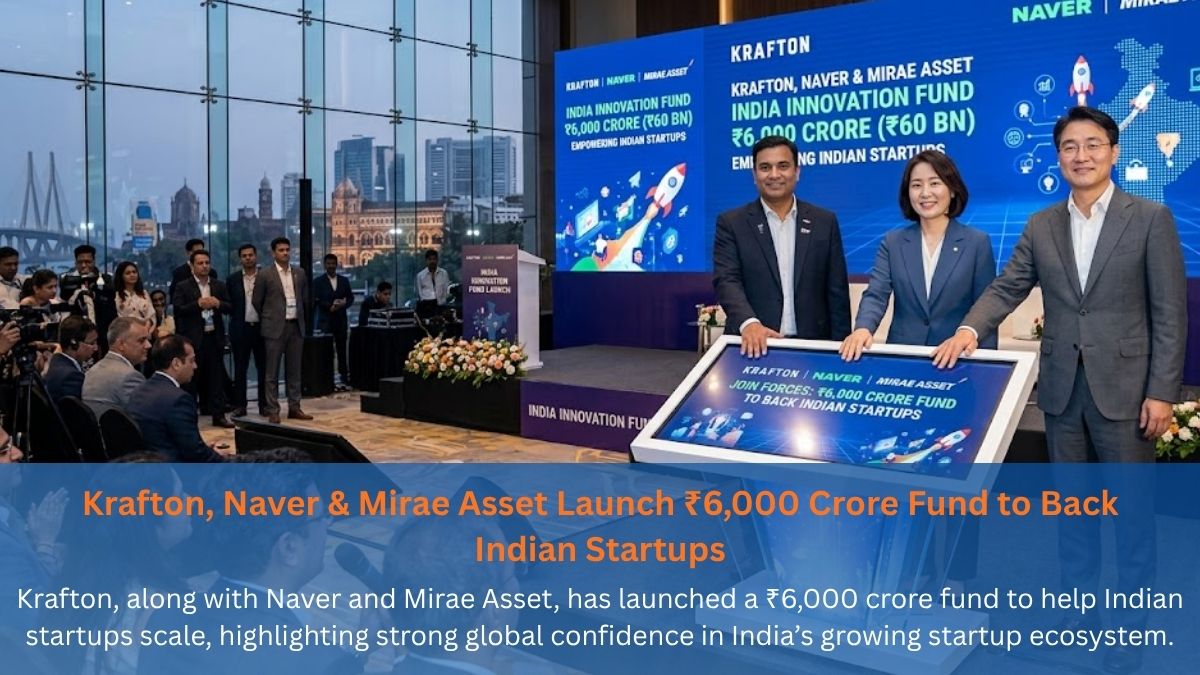
News Summary
When a company like Krafton makes a move of this scale, it’s rarely just about money. It’s about belief. And in this case, it’s a very clear belief in India’s startup future. Krafton, along with Naver and Mirae Asset, has come together to launch a ₹6,000 crore (around $720 million) India-focused investment fund. On paper, it’s being called a Unicorn Growth Fund. But if you look closer, it’s really about something bigger, giving Indian startups a real shot at scaling without constantly worrying about running out of runway. More Than Just Capital: What This Fund Really Means, Anyone who has spent time around startups knows this uncomfortable truth: Getting started is hard, but scaling is where most companies break.
India has no shortage of ideas today
India has no shortage of ideas today. Founders are sharper, more aware, and more ambitious than ever before. You see it across sectors, whether it’s fintech solving real payment problems in rural areas or AI startups trying to build globally competitive products. But there’s a gap. A very real one. Early-stage funding has become relatively accessible. Angel investors, seed funds, incubators, they’re all active. But when a startup reaches that awkward middle phase, where it needs serious capital to grow, hire, expand, and compete, things get difficult. This is exactly where many promising startups stall. This ₹6,000 crore fund is trying to solve that exact problem. It’s designed not just to fund ideas, but to carry them through the hardest phase of growth. And from experience, that’s where the difference between a good startup and a great company is decided.
Why India, and Why Now? India’s startup ecosystem didn’t grow overnight. It has been building quietly for years. Cheap internet changed everything. Smartphones put access in people’s hands. Digital payments normalized online transactions. And suddenly, millions of users who were invisible to the digital economy became active participants. That shift created opportunities everywhere. Today, India isn’t just a large market. It’s a complex, evolving one where solving even a small problem at scale can create massive businesses. Global investors have noticed this shift. But what’s interesting here is the timing.
We’re at a stage where:
- Founders are thinking globally from day one
- Technology adoption is accelerating beyond metros into smaller towns
- AI and deep tech are no longer abstract ideas but real business tools
So when Krafton steps in now
So when Krafton steps in now, it’s not early. It’s actually very well-timed. They’re entering at a point where the ecosystem is mature enough to produce outcomes, but still underfunded in critical growth stages. The Strategic Edge: Not Just Money, But Experience What makes this fund stand out isn’t just its size, but the mix of partners behind it. Krafton understands scale from a product perspective. Building and sustaining global platforms requires sharp execution, constant iteration, and deep user understanding.
Naver brings strong expertise in internet infrastructure, content ecosystems, and AI-led services. They’ve operated in highly competitive markets and know how to build products that retain users over time. Mirae Asset understands capital in a way most founders don’t. They’ve seen how companies grow, how they fail, and how they eventually reach public markets. Together, this isn’t just funding. It’s guidance shaped by real-world experience. And that matters more than people think. Because when founders hit roadblocks, and they will, what they need isn’t just more money. They need perspective. Someone who has seen similar situations before and can help them make better decisions. Focus Areas: Where the Future Is Being Built The sectors this fund is targeting tell you exactly where things are headed.
- AI startups are moving beyond hype into real-world applications, automation, healthcare, finance, and decision-making systems
- Deep tech is tackling harder, long-term problems, often requiring patience but offering massive upside
- Consumer technology is evolving rapidly as user behavior in India keeps changing
- Digital platforms continue to scale by connecting services, users, and data in smarter ways
Krafton’s India Journey
These aren’t easy spaces. They demand strong execution, long-term thinking, and resilience. But they also create companies that can define industries. Krafton’s India Journey: From Participant to Enabler Krafton isn’t new to India. They’ve already been investing here, especially in gaming and digital platforms. But this fund marks a shift. Earlier, they were participants in the ecosystem. Now, they’re trying to shape it. That’s a big difference. When a company moves from selective investments to building a dedicated fund of this scale, it signals long-term intent. It means they’re not just testing the waters anymore. They’re committing to being part of the journey. And for Indian founders, that changes the equation. It creates confidence that there are investors who are willing to stay through the ups and downs, not just chase quick returns.
The Bigger Picture: Global Confidence in Indian Innovation, If you zoom out, this isn’t just about one fund. It’s part of a larger story. International investors are increasingly seeing India as more than just a market. They see it as a place where innovation is happening, where real problems are being solved, and where scalable businesses are being built. And honestly, that shift has been a long time coming. For years, Indian startups were often seen as adaptations of global ideas. That’s changing now. More founders are building for India first, and then taking those solutions global. This fund is a response to that change.
1. Krafton Leads ₹6,000 Crore Fund for Indian Startups
1.1 Krafton’s Strategic Investment Move
There’s something quietly powerful about a company deciding to reinvent its role in the world. Krafton isn’t just dipping its toes into India’s startup ecosystem with this ₹6,000 crore fund, it’s stepping in with intent. For years, Krafton has been associated with gaming success. That identity still matters, but this move signals something deeper. It shows a shift from being just a content creator to becoming a builder of ecosystems. And that’s a very different game.
From a practical standpoint, this fund positions Krafton as a serious venture capital participant. Not the kind that just writes cheques and waits, but one that wants to shape outcomes. When tech companies invest directly into startups, they bring more than money. They bring product thinking, global exposure, and sometimes even mistakes they’ve already paid for. That kind of learning is incredibly valuable for early-stage founders. If you’ve been following startup funding cycles, you’ll know that capital alone isn’t rare anymore. What’s rare is smart capital. The kind that understands scale, understands users, and understands failure. Krafton seems to be aiming for that space. And honestly, this feels like a calculated bet on India’s next decade.
1.2 Partnership with Naver and Mirae Asset
What makes this fund even more interesting is who Krafton chose to partner with. Naver and Mirae Asset aren’t just passive participants here. Naver brings deep expertise in internet platforms, search, content ecosystems, and AI-led products. They’ve built systems that operate at massive scale, particularly in Asia. That experience matters when you’re backing startups that aim to grow fast and break things along the way. Mirae Asset, on the other hand, understands capital markets in a way most founders don’t. They know how companies transition from private to public, how valuations evolve, and how global investors think. That perspective can shape how startups plan their growth, not just how they raise money.
Put together, this partnership creates a blend that’s rare:
- Product intelligence
- Platform experience
- Financial discipline
For a founder, that’s not just funding. That’s guidance at every stage of the journey. And from experience, founders don’t just struggle with building products. They struggle with scaling, hiring, governance, and timing the market. Having backers who’ve seen these cycles before can genuinely change outcomes.
2. Background of Krafton and Its India Strategy
2.1 Krafton’s Global Journey
Krafton’s story isn’t just about success. It’s about evolution. They started as a gaming company, yes. But what’s often overlooked is how they scaled globally in an industry that’s brutally competitive. Gaming isn’t forgiving. User attention shifts quickly, and one wrong move can kill momentum. To survive and grow there, you need sharp instincts. You need to understand behavior, psychology, monetization, and technology all at once.
Over time, Krafton built strong financial reserves and operational confidence. That gave them the freedom to explore beyond gaming. And like many mature tech companies, they realized something important: Building products is powerful. But backing builders can be even more powerful. That realization often marks the transition from operator to investor.
2.2 Krafton’s Growing Focus on India
India isn’t just another market for Krafton. It’s a long-term opportunity. They’ve already invested in Indian startups across gaming, content, and digital platforms. These weren’t random bets. They were early signals that Krafton was studying the ecosystem closely.
India offers something unique:
- A massive, young user base
- Rapid digital adoption
- Founders who are increasingly global in thinking
But it also comes with complexity. Infrastructure gaps, monetization challenges, and intense competition make it a tough environment. That’s why this ₹6,000 crore fund matters. It’s not a short-term experiment. It’s a commitment. From a ground-level perspective, this kind of backing can change how founders think. When you know there’s patient capital available, you take slightly bolder bets. You invest more in product. You think beyond survival. And that shift in mindset is what builds strong companies.
3. Understanding the Unicorn Growth Fund
3.1 What the Fund Aims to Achieve
The term “Unicorn Growth Fund” sounds ambitious, but the intention behind it is very real. This fund is targeting startups that are not just promising, but scalable. Companies that can grow fast, capture markets, and eventually cross that $1 billion valuation mark. But here’s the important part: Unicorns aren’t created by funding alone.
They are created when three things align:
- Timing
- Execution
- Market demand
This fund is essentially trying to increase the probability of that alignment. From what we’ve seen in the startup ecosystem, early-stage founders often struggle during the “growth gap.” That phase where the product works, but scaling becomes chaotic. Costs rise, systems break, and decisions become harder. Funds like this are designed to step in at that exact moment. Not just to fuel growth, but to stabilize it.
3.2 Investment Focus Areas
The sectors this fund is targeting are not random trends. They reflect where the future is already moving.
- AI startups: Not just chatbots, but real applications in healthcare, finance, and automation
- Deep tech: Hard problems, longer timelines, but massive long-term value
- Consumer technology: Products built for India’s evolving digital habits
- Digital platforms: Scalable ecosystems that connect users, services, and data
If you’ve spent time around startups, you’ll notice a pattern. The biggest opportunities now are not in copying existing models, but in solving problems that haven’t been solved properly yet. That’s where AI and deep tech come in. But these sectors are also risky. They require patience, technical depth, and capital that doesn’t panic at the first sign of delay. This is where funds like this make a real difference. They give founders breathing room.
4. Startup Ecosystem Context in India
4.1 The Relentless Rise of Indian Startups
If you’ve been anywhere near the startup space in India over the last decade, you’ve probably felt this shift firsthand. It didn’t happen overnight. It built slowly, then suddenly all at once. India today isn’t just “emerging” anymore. It’s active, noisy, competitive, and full of intent.
What changed? A few things came together at the right time:
- Affordable internet reached places that were never part of the digital conversation before
- Smartphones became accessible, not aspirational
- Digital payments became second nature, even in smaller towns
- Policies like Startup India gave early legitimacy and encouragement
But beyond all of this, something more human changed, mindset. A decade ago, stability was the goal. Today, building something of your own is a serious career choice. You see engineers, marketers, even people from non-tech backgrounds stepping into entrepreneurship with conviction. And the results are visible. India now has thousands of startups across fintech, edtech, healthtech, logistics, AI, and beyond. Some are solving problems unique to India. Others are quietly building solutions that can compete globally. But growth at this scale brings its own challenges. Because building a startup is one thing. Sustaining it is another story altogether.
4.2 The Silent Struggle: Funding Gaps in Growth Stages
Here’s something most headlines don’t tell you. Early-stage funding in India has improved a lot. If you have a decent idea, a strong pitch, and some traction, you can usually find someone willing to back you. But the real struggle begins later.
That uncomfortable phase when:
- Your product works
- Your users are growing
- Your costs are rising faster than your revenue
- And suddenly, you need serious capital to scale
This is where things get difficult. Investors become more cautious. Expectations rise. Metrics are scrutinized. And many startups that looked promising start slowing down, not because they lack potential, but because they lack fuel at the right time. This is often called the “growth-stage gap.” And it’s very real in India. You’ll hear founders talk about it quietly. “How do we survive the next 18 months?” “Do we scale aggressively or play safe?” These are not theoretical questions. They decide whether a company grows or fades out. This is exactly where the Unicorn Growth Fund, backed by Krafton along with Naver and Mirae Asset, is trying to step in. Not at the idea stage. But at the stage where things are real, messy, and uncertain.
5. How the Fund Works: Investment Model Explained
5.1 Venture Capital Structure: What Actually Happens Behind the Scenes
At its core, this fund follows a venture capital model. But that simple definition doesn’t capture the reality of how these deals play out. Here’s what typically happens.
The fund identifies startups that show strong potential, not just in terms of idea, but execution. They look at:
- Market size
- Team capability
- Product-market fit
- Growth trajectory
If a startup checks enough of these boxes, the fund invests capital in exchange for equity. That means they own a piece of the company. Sounds straightforward, right? It’s not. Because once the investment is made, the real work begins.
Good investors don’t disappear after writing a cheque. They get involved. Push founders to think sharper. They question decisions. Sometimes they slow things down when founders want to move too fast, and sometimes they push harder when founders hesitate. From experience, this relationship can make or break a company. A strong investor isn’t just a financer. They become part of your decision-making environment. And that’s exactly what this fund is positioning itself to be.
5.2 Revenue Model: How Investors Actually Make Money
There’s a common misconception that venture capital is about quick returns. It’s not. It’s patient, often uncomfortable capital. The fund makes money only if the startups it backs succeed. And success, in this context, usually comes through exits:
- IPO (Initial Public Offering): When a startup goes public and its shares are listed
- Acquisitions: When a larger company buys the startup
- Secondary sales: When shares are sold to other investors at a higher valuation
Here’s the catch. Most startups don’t succeed at this level. But the few that do, generate outsized returns. That’s the entire logic of venture capital. You don’t need every company to win. You need a few big winners to carry the entire portfolio. And this is why funds like this are willing to take calculated risks on high-growth startups, especially in sectors like AI and deep tech.
6. Problems the Fund Aims to Solve
6.1 Limited Access to Growth Capital
This is the most obvious problem, and probably the most painful one for founders. Raising small rounds is one thing. Raising large rounds is a completely different challenge.
At growth stages, investors expect:
- Clear revenue models
- Predictable growth
- Strong unit economics
Many startups are still figuring these out when they need capital the most.
So they either:
- Dilute too much equity
- Raise at unfavorable terms
- Or fail to raise at all
This fund aims to reduce that pressure. By providing larger, structured funding at the right time, it allows founders to focus on building rather than constantly fundraising. And that shift in focus can change outcomes.
6.2 The Missing Piece: Access to Global Expertise
Money alone doesn’t solve scaling problems. Many Indian startups hit a ceiling when they try to expand beyond domestic markets. Not because their product isn’t good, but because they lack:
- International networks
- Market understanding
- Strategic guidance
This is where the involvement of players like Naver and Mirae Asset becomes valuable. They bring global exposure. They’ve seen how businesses operate across different markets. They understand how to adapt, localize, and compete internationally. For a founder, this kind of access is hard to get otherwise. And it often becomes the difference between staying local and going global.
6.3 The Reality of Scaling: It’s Not Just About Growth
Scaling sounds exciting. In reality, it’s chaotic. Hiring goes wrong. Systems break. Customer expectations rise. Competition reacts. And suddenly, what worked for a 10-member team doesn’t work for a 200-member company. This is where many startups struggle.
They don’t just need money. They need:
- Better processes
- Strong leadership decisions
- Access to the right people at the right time
Funds like this can play a crucial role here. Not by controlling the company, but by supporting it. By connecting founders with mentors, operators, and networks that help them navigate growth.
7. Industry Trends Driving This Investment
7.1 The Surge of AI and Deep Tech
If you talk to founders today, one thing becomes clear very quickly, almost everyone is either building with AI or thinking about how AI will disrupt their space. But this isn’t just hype anymore.
A few years ago, AI felt like something experimental. Interesting, but not always practical. Today, it’s quietly becoming the backbone of real businesses. Startups are using it to automate operations, improve decision-making, reduce costs, and build entirely new products that simply weren’t possible before. The same goes for deep tech. This is where things get harder, and more exciting. Deep tech startups don’t chase quick wins. They solve complex problems, sometimes taking years before showing results. But when they succeed, they don’t just build companies, they reshape industries.
In India, this shift is still early but very real. You’re seeing founders move beyond service-based models into building core technology. And global investors are paying attention. From a practical standpoint, this is exactly why funds like the one led by Krafton are focusing here. Because the next big companies won’t just be fast-growing. They’ll be technologically defensible.
7.2 The Global Spotlight on India
There was a time when India was seen as a secondary market. Important, but not central. That perception has changed. Today, India is one of the few markets where scale, growth, and innovation are all happening at the same time. And global players know this. Companies like Naver and Mirae Asset aren’t entering India casually. They’re doing it because the numbers make sense, and more importantly, the moment makes sense.
You have:
- A massive and still growing digital population
- Increasing internet penetration beyond metro cities
- A new generation of founders building with global ambition
From experience, investors don’t just follow trends, they follow momentum. And right now, India has that momentum. But there’s also a deeper layer to this. Global investors aren’t just looking to invest in India. They’re looking to build from India. That’s a big shift.
7.3 The Move Toward Disruptive Tech
Another clear trend is the kind of businesses getting attention. Incremental ideas are no longer enough. Investors are now looking for startups that can genuinely disrupt industries, not just improve them slightly.
You see this across sectors:
- Fintech rethinking how people access and use money
- Clean energy startups tackling sustainability and long-term resource challenges
- Digital platforms redefining how services are delivered and consumed
What’s common across all of these is ambition. These startups are not trying to fit into existing systems. They’re trying to rebuild them. And that’s risky. But it’s also where the biggest outcomes come from. This is why large funds are willing to take those bets. Because even if a few fail, the ones that succeed can redefine entire markets.
8. Competitive Landscape
8.1 A Crowded but Evolving Funding Space
India’s venture capital ecosystem is no longer small or fragmented. It’s crowded, competitive, and constantly evolving.
You have:
- Established global venture capital firms
- Strong domestic funds
- Accelerators and incubators supporting early-stage startups
- On the surface, it looks like there’s plenty of capital available. But here’s the reality founders experience. Not all capital is equal.
Some investors focus only on early-stage bets. Some avoid risk. Hesitate during uncertain market conditions. And when startups reach growth stages, the number of investors willing to write large cheques becomes significantly smaller. This is where a ₹6,000 crore fund stands out. It has the capacity to support startups beyond the early hype phase, when real scaling begins.
8.2 Indirect Competition: The Hidden Battle for Deals
The competition isn’t just between venture capital firms.
There’s an entire layer of indirect players:
- Corporate venture arms investing strategically
- Angel investors backing early-stage founders
- Family offices exploring startup investments
All of them are looking for strong opportunities. And the best startups? They don’t struggle to find investors. Investors compete to get into them. In that environment, scale becomes a major advantage.
Large funds like this can:
- Invest bigger amounts
- Support companies through multiple rounds
- Offer long-term stability
From a founder’s perspective, that matters a lot. Because switching investors at every stage isn’t just tiring, it’s risky.
9. Role of Naver and Mirae Asset
9.1 Naver’s Technology Depth
Naver brings something that goes beyond funding, real product experience at scale.
They’ve built and managed platforms that handle massive user bases. They understand how to:
- Design systems that don’t break under pressure
- Keep users engaged over long periods
- Continuously evolve products based on data
For Indian startups, especially those building in AI and digital platforms, this kind of insight is incredibly valuable. Because scaling a product isn’t just about adding more users.
It’s about maintaining quality while growing. And that’s where many startups struggle.
9.2 Mirae Asset’s Financial Strength
Mirae Asset brings a completely different kind of strength. They understand capital, deeply. know how markets behave. They know how valuations shift. know what it takes for a company to eventually go public or attract large acquisitions.
For founders, this matters more than it seems. Because building a company isn’t just about growth. It’s about building something that can sustain itself financially and eventually deliver returns. Mirae Asset’s involvement adds that layer of discipline and long-term thinking. It balances the ambition that startups naturally have.
10. Impact on Indian Startups
10.1 A Real Boost for Emerging Companies
For startups on the edge of scaling, this fund could be a turning point.
Not just because of the money, but because of what comes with it:
- Strategic mentorship
- Access to global networks
- Long-term backing
From experience, when founders feel supported, they make better decisions.
They invest more in product. They hire more confidently. Take calculated risks instead of playing defensively. And that’s when real growth happens.
10.2 Strengthening the Entire Ecosystem
The impact of a fund like this doesn’t stop with the startups it invests in. It creates a ripple effect.
More funding leads to:
- More experimentation
- More innovation
- More competition
And ultimately, better products for users. It also sends a signal to the global market. That India isn’t just a place for ideas, but a place where ideas can grow into large, sustainable businesses.tartup ecosystem.
11. Growth Opportunities for Startups
11.1 Opening Doors to Global Markets
For many Indian founders, the dream doesn’t stop at building a successful company locally. The real ambition is bigger, to take something built in India and make it work globally. That’s where partnerships like the one led by Krafton, along with Naver and Mirae Asset, start to matter in a very real way. Because expanding internationally isn’t just about translating your app or entering a new market. It’s complex.
You’re dealing with:
- Different customer behaviors
- New regulatory environments
- Strong local competitors
- Cultural nuances that can completely change how your product is received
Most founders underestimate this. From experience, even strong companies struggle when they step outside their home market. What worked in India doesn’t always work in Southeast Asia, Europe, or the US. This is where global investors add serious value. They don’t just provide introductions. They bring pattern recognition. They’ve seen companies expand, fail, adapt, and eventually succeed. That insight can save founders months, sometimes years, of trial and error.
And sometimes, it’s not even about expansion. It’s about thinking globally from the start. When founders know they have access to international networks, they design better products. They think about scalability differently. They avoid building something too narrow. That shift in thinking alone can change the trajectory of a startup.
11.2 Sharper Business Strategies Through Mentorship
There’s a moment in every startup’s journey when things stop being simple. In the early days, decisions are quick. Small team, clear direction, fast execution.
But as the company grows, things get complicated:
- Revenue models need refinement
- Customer acquisition becomes expensive
- Teams grow and misalignment creeps in
- Founders are forced to make decisions they’ve never made before
This is where mentorship becomes critical. And not the generic kind. Real mentorship, from people who’ve built, scaled, and sometimes failed before. Investors like Krafton and its partners bring exactly that.
They can challenge assumptions:
- Is your growth sustainable or just aggressive spending?
- Are you building for scale or just chasing short-term traction?
- Is your business model strong enough to survive market shocks?
These are uncomfortable questions. But they’re necessary. From what we’ve seen across startups, founders who actively engage with experienced investors tend to make more grounded decisions. They waste less time. They avoid common mistakes. And over time, that compounds into stronger companies.
12. Challenges and Risks
12.1 The Reality of Market Competition
Let’s be honest for a moment. Not every startup backed by this fund will succeed. In fact, most won’t reach the kind of scale people expect. India’s startup ecosystem is incredibly competitive right now. Every promising idea attracts multiple players. And execution becomes the only differentiator.
You’ll often see:
- Similar products launching at the same time
- Price wars to capture users
- Aggressive marketing just to stay visible
And in that environment, survival becomes tough.
Even well-funded startups can fail if they:
- Misread the market
- Scale too fast without strong fundamentals
- Lose focus on their core value
Funding helps, but it doesn’t guarantee success. From experience, the startups that survive are the ones that stay disciplined when things get chaotic. They don’t just chase growth, they build strong foundations.
12.2 Economic Uncertainty: The Factor No One Controls
There’s another layer of risk that founders often can’t control, the global economy. Funding cycles don’t stay consistent. When markets are strong, capital flows easily. Valuations rise. Investors are willing to take risks.
But when uncertainty hits:
- Funding slows down
- Investors become cautious
- Valuations drop
- Startups are forced to rethink their growth plans
We’ve seen this happen multiple times. And it’s during these phases that the strength of your investors really matters. Long-term investors, like those behind this fund, are more likely to stay committed even during downturns. They understand that building companies takes time and that temporary market conditions shouldn’t derail long-term potential. Still, startups need to be prepared. Because no matter how strong your backing is, you can’t rely entirely on external conditions. You need a business that can sustain itself.
13. Future Outlook of Krafton’s Investment Strategy
Looking ahead, this ₹6,000 crore fund feels less like a one-time initiative and more like the beginning of a deeper involvement. Krafton has already shown that it sees India as more than just a market. It sees it as a long-term growth engine. And that perspective is important. Because consistent investment creates stability in the ecosystem.
If Krafton continues on this path, we can expect:
- More structured funding opportunities for growth-stage startups
- Stronger collaboration between Indian founders and global markets
- Increased confidence from other international investors
Will this fund create unicorns? Most likely, yes. But the more meaningful impact will be in how it changes the ecosystem.
It will:
- Encourage founders to think bigger
- Reduce the fear of scaling too early
- Attract more global capital into India
And over time, that leads to something more valuable than just high valuations, strong, sustainable companies.
14. What Startups and Entrepreneurs Can Actually Learn From This
There’s a tendency to read funding news like this and treat it as something distant, something that only applies to big startups or well-connected founders. But if you look closely, there are very real, practical lessons hidden inside this move by Krafton and its partners Naver and Mirae Asset. These aren’t abstract ideas. They’re patterns that show up again and again in successful startups.
14.1 Growth Potential Is What Truly Attracts Capital
A lot of founders believe funding is about storytelling. Pitch decks, presentations, networking. All of that matters, but only to a point. At the end of the day, investors are asking one simple question: Can this become big enough to matter? That’s what growth potential really means.
It’s not just about current revenue. It’s about:
- How large the market is
- How fast you can scale
- Whether your product solves a problem that actually exists at scale
From experience, startups that clearly demonstrate this don’t chase investors for long. Investors come to them. This fund is specifically targeting companies that have that “something more”, the ability to grow beyond incremental success into something significant. And that’s a reminder for founders: Don’t just build something that works. Build something that can expand.
14.2 Global Partnerships Can Change the Game
There’s a clear pattern in today’s startup ecosystem. The companies that scale faster are the ones that don’t operate in isolation.
When you have backing from global players, you gain access to:
- Markets you didn’t understand before
- Networks you couldn’t reach on your own
- Insights that take years to develop internally
For Indian founders, this is especially important. Because India is a great testing ground, but scaling globally requires a different level of understanding. What Krafton and its partners are offering isn’t just funding. It’s a bridge. A bridge between local innovation and global opportunity. And if founders learn to use that bridge well, it can compress years of learning into months.
14.3 Innovation and Scalability Are No Longer Optional
There was a time when copying a successful model and adapting it locally was enough. That time is passing. Today, competition is too intense, and users are too aware.
Startups need to:
- Build something unique
- Solve real problems
- Design products that can scale without breaking
This is where many founders struggle. They either focus too much on innovation without thinking about scalability, or they scale something that isn’t strong enough to sustain growth. The balance is difficult. But it’s exactly what investors look for. Funds like this are not chasing small wins. They’re looking for companies that can grow fast and hold their ground.
14.4 Understanding Market Trends Is a Real Advantage
If there’s one thing that separates good founders from great ones, it’s awareness. Great founders don’t just build. They observe.
They understand:
- Where technology is heading
- What users are slowly shifting toward
- Which industries are about to change
Right now, trends like AI, deep tech, and digital platforms are shaping the future. Startups aligned with these trends naturally attract more attention, not because they’re trendy, but because they’re relevant. From experience, timing matters as much as execution. Build too early, and the market isn’t ready. Build too late, and the competition is overwhelming. Understanding trends helps you find that narrow window where opportunity exists.
About foundlanes.com
foundlanes.com is India’s leading startup idea discovery platform. It helps entrepreneurs find actionable startup opportunities, market insights, and industry-specific guidance to turn ideas into real businesses. With deep research and practical resources, foundlanes supports founders at every stage, from idea validation to launch and growth.