Introduction
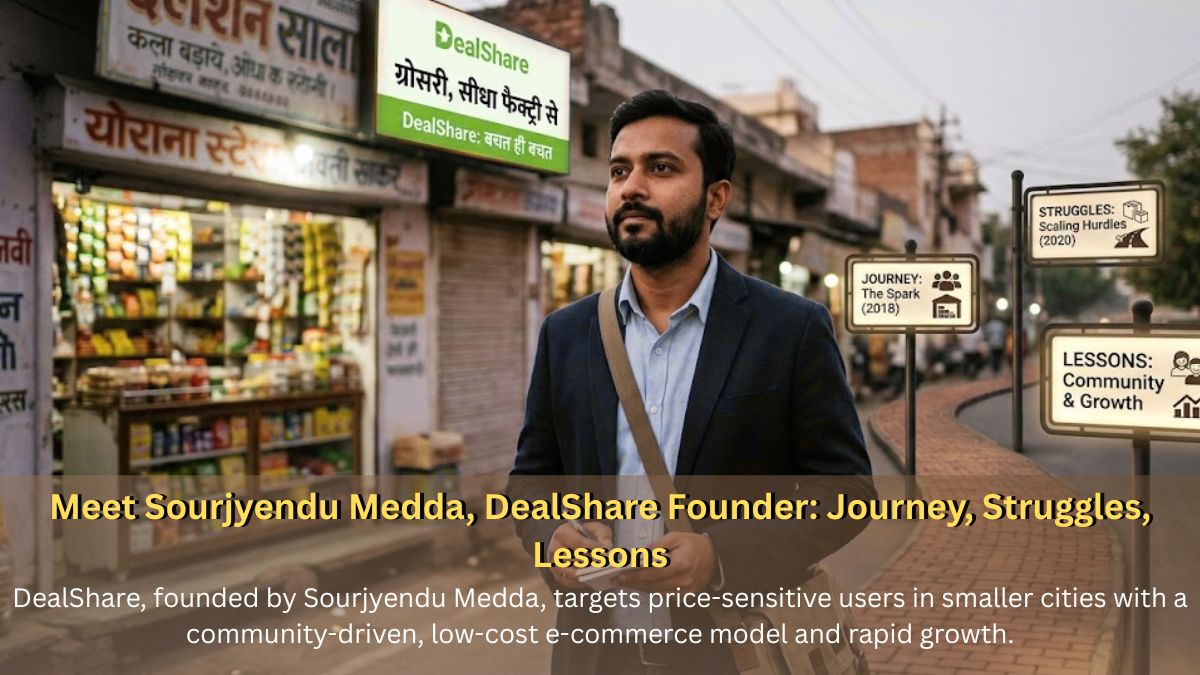
The story of the DealShare founder reflects a deeper shift in India’s digital commerce landscape one that moves beyond metros and targets value-conscious consumers in smaller cities. Sourjyendu Medda is one of the key minds behind DealShare, a platform built to serve price-sensitive users in tier 2 and tier 3 markets through a unique social commerce model.
Founded in 2018 and headquartered in Jaipur, DealShare was co-founded by Sourjyendu Medda along with Vineet Rao and Sankar Bora. The startup focuses on selling low-cost, high-frequency household products, groceries, and essentials through a community-driven, WhatsApp-like sharing model. Unlike traditional e-commerce platforms that prioritize premium customers, DealShare targets the mass market particularly those who are highly price-conscious and less brand-sensitive.
The idea emerged from a simple observation. While India’s e-commerce boom was being led by urban consumers, a massive population in smaller towns remained underserved. These users were not always comfortable with complex apps or high prices. DealShare’s approach simplified the buying process, offering curated deals and encouraging group buying behavior through social sharing.
The platform works by offering limited-time deals on essential products, which users can share within their networks. This reduces customer acquisition costs while increasing trust through peer recommendations. Over the years, DealShare has raised significant funding from investors such as Tiger Global and Alpha Wave Global, scaling rapidly across multiple states. This case study explores the journey of the DealShare founder, tracing how Sourjyendu Medda built a business rooted in affordability, distribution innovation, and deep understanding of India’s next billion users.
1. Early Life and Background of DealShare Founder
The journey of Sourjyendu Medda doesn’t follow the usual startup narrative of jumping straight into entrepreneurship. In fact, his early career had very little to do with e-commerce. It was shaped in boardrooms, consulting environments, and strategy discussions where the focus was on understanding markets at a deeper level. He spent years working in consulting roles, breaking down business problems, analyzing inefficiencies, and learning how large systems function. This phase may not have been glamorous, but it gave him something far more valuable, clarity. He learned how businesses scale, where they fail, and what separates sustainable models from short-lived ones.
His transition into operational roles marked a turning point. Working with high-growth companies exposed him to the realities of execution, where strategies are tested in the real world. His time at Udaan was especially defining. Here, he got a front-row seat to India’s supply chain complexities and the nuances of digital commerce in a diverse market. He saw how distribution gaps created pricing inefficiencies and how these inefficiencies directly impacted consumers, especially in smaller towns. This wasn’t just data on a spreadsheet, it was a pattern that repeated itself across regions. And slowly, it began to shape a larger thought in his mind, that India’s commerce story was incomplete, and there was a massive segment still waiting to be served properly.
2. The Spark Behind DealShare Founder Journey
2.1 Identifying the “Missing Middle”
The idea behind DealShare didn’t come from chasing trends, it came from observing what others were overlooking. Medda realized that while platforms like Flipkart and Amazon were rapidly expanding, their reach was still heavily skewed toward urban consumers. Millions of people in tier 2 and tier 3 cities remained underserved, not because they lacked demand, but because existing models didn’t fit their needs. These consumers were not driven by brand aspiration. They were driven by value. Every purchase decision was practical, often influenced by price and necessity rather than convenience or variety.
This segment, often referred to as the “missing middle,” became the foundation of his vision. These were consumers who were comfortable buying from local kirana stores, negotiating prices, and relying on familiarity rather than digital interfaces. Traditional e-commerce platforms struggled to win their trust because they weren’t designed with this mindset in mind. Medda saw this gap clearly. It wasn’t just about building another e-commerce platform, it was about building one that truly understood this audience. That realization turned into a strong conviction, that if solved correctly, this market could unlock massive scale.
2.2 Understanding Consumer Behavior
One of the most important insights that shaped DealShare’s journey came from deeply understanding how people in smaller towns actually make decisions. Unlike urban consumers who are influenced by ads, discounts, and brand positioning, consumers in these regions rely heavily on trust. And trust, in these communities, is built through relationships. Recommendations from friends, family, and neighbors carry far more weight than any marketing campaign. This behavioral pattern became a cornerstone of DealShare’s approach.
Instead of trying to force a traditional e-commerce model, Medda and his team leaned into this insight. They realized that commerce in these markets is inherently social. People don’t just buy, they discuss, compare, and validate before making a decision. This led to the foundation of a social commerce model where sharing became a key part of the buying process. It wasn’t just about transactions anymore, it was about participation. And this shift made the platform feel more natural to its users, almost like an extension of how they already shopped in their daily lives.
3. Building DealShare: From Idea to Execution
When DealShare was built, the focus was not on scale from day one. It was on relevance. The founding team made a conscious decision to avoid the typical “everything store” approach. Instead of offering endless product choices, they focused on a curated selection of essential items. This decision may seem limiting at first, but it solved multiple problems at once. It simplified operations, reduced inventory complexity, and ensured better pricing through bulk sourcing. More importantly, it aligned perfectly with the needs of their target audience, who were not looking for variety, but for value.
Another critical aspect was the platform design. The app was built to be lightweight, simple, and intuitive. This was not a cosmetic choice, it was a necessity. Many users in smaller towns deal with slower internet speeds and limited digital familiarity. A heavy, complex app would immediately create friction. By keeping the interface clean and easy to navigate, DealShare removed that barrier. This attention to detail reflects a deeper understanding of the user, not just as a customer, but as someone with specific constraints and habits. Execution, in this case, wasn’t about doing more, it was about doing the right things thoughtfully.
4. Product Evolution and Platform Strategy
As DealShare grew, its product strategy continued to evolve, but always stayed rooted in its core audience. The platform focused heavily on daily-use items, groceries, kitchen essentials, and household products that people need regularly. This wasn’t accidental. These categories ensured repeat usage and consistent demand. Instead of chasing high-margin luxury products, the company focused on building frequency and trust. Every successful order reinforced the habit of using the platform again.
Over time, the company introduced features that encouraged users to share deals within their networks. This wasn’t just a growth hack, it was a reflection of real consumer behavior. By enabling group buying and easy sharing, DealShare turned its users into participants in its growth story. The integration of platforms like WhatsApp played a significant role here. Users could forward deals to friends and family with ease, creating a natural viral loop. This reduced the need for heavy marketing spend and allowed the company to grow organically. What stands out is how every feature was tied back to a real-world insight. Nothing was built in isolation. Everything had a purpose, and that purpose was to make the platform more aligned with how people actually shop.
5. Early Traction and Validation
The early traction of DealShare didn’t come from big metro launches or flashy campaigns. It came quietly, from tier 2 cities where real demand existed but was often ignored. Cities like Jaipur became the testing ground, not because they were easy markets, but because they reflected the reality of India beyond metros. Here, the team didn’t just launch a product, they observed behavior closely. What people were buying, how often they were ordering, what price points worked, and more importantly, what didn’t. Every order was a piece of feedback. Every repeat purchase was a signal that they were getting something right.
What truly drove early adoption was simplicity and affordability. People didn’t need convincing if the value was clear. Lower prices compared to local options, combined with a straightforward app experience, made the platform feel accessible rather than intimidating. There was no unnecessary complexity, no overwhelming choices. Just what people needed, at prices they trusted. And that trust translated into repeat usage. Over time, these small wins turned into strong validation. It gave Sourjyendu Medda and his team the confidence that they were not just experimenting, they were solving something real.
6. Business Model and Revenue Approach
The business model of DealShare reflects a deep understanding of its audience. It doesn’t try to replicate traditional e-commerce structures. Instead, it follows a low-margin, high-volume approach, where scale matters more than per-unit profit. This decision is rooted in the behavior of its target customers, who prioritize savings above everything else. By focusing on private labels and unbranded products, the company is able to control costs and pass those savings directly to consumers. This isn’t just a pricing strategy, it’s a philosophy that defines how the entire business operates.
Revenue generation, in this case, is tightly linked to operational efficiency. The margins may be thin, but they are optimized through better sourcing, streamlined supply chains, and reduced marketing expenses. Unlike platforms that rely heavily on branded products with higher margins, DealShare builds its strength in consistency and volume. Every order contributes to a larger system that becomes more efficient over time. This model requires patience and discipline, because the rewards are not immediate. But when executed well, it creates a strong foundation that is difficult to replicate.
7. Funding and Investor Confidence
What makes DealShare’s funding journey interesting is not just the amount raised, but the kind of belief it attracted. Investors don’t back ideas alone, they back clarity. And DealShare offered exactly that. Its focus on underserved markets, combined with a differentiated business model, stood out in a crowded e-commerce landscape. Global investors like Tiger Global and Alpha Wave Global saw the potential not just in growth numbers, but in the structural gap the company was addressing.
This funding wasn’t just capital, it was fuel for expansion. It enabled the company to move into new cities, strengthen its supply chain, and invest in technology that could support scale. But beyond the operational impact, it also reinforced confidence. For any founder, external validation at this level signals that the vision is strong and the execution is on track. The journey of Sourjyendu Medda reflects this clearly. It shows that when you stay focused on a real problem and build patiently, the right kind of support eventually follows.
8. Go-to-Market Strategy and Distribution
DealShare’s go-to-market strategy breaks away from the conventional playbook. Instead of spending heavily on advertising, the company chose to grow through its users. This wasn’t just a cost-saving decision, it was a strategic one. The team understood that in smaller towns, trust spreads through people, not through ads. So instead of pushing the product aggressively, they made it easy for users to share it within their own networks. This created a natural distribution channel, where growth felt organic rather than forced.
The integration of sharing behavior into the platform turned customers into advocates. Deals were not just consumed, they were forwarded, discussed, and recommended. This created a viral loop that reduced dependency on paid marketing. At the same time, focusing on tier 2 and tier 3 markets allowed DealShare to avoid direct competition with giants in metro cities. This gave them space to build, learn, and refine their model without constant pressure. It’s a reminder that sometimes, the smartest strategy is not to compete head-on, but to find your own path and own it completely.
9. Brand Positioning and Messaging
DealShare’s brand is not built on aspiration, it’s built on relatability. From the beginning, the company positioned itself as a platform for affordable essentials, something that fits naturally into everyday life. The messaging focused on savings, value, and trust, because that’s what mattered most to its audience. There was no attempt to appear premium or exclusive. Instead, the brand embraced simplicity. And in doing so, it connected deeply with its users.
This approach may seem understated, but it is incredibly powerful. In markets where people are careful with their spending, trust is everything. DealShare didn’t try to impress its users, it tried to serve them. And that difference shows. The brand’s identity is closely tied to its mission, making e-commerce accessible to India’s mass market. It’s not just about selling products, it’s about creating a platform where people feel comfortable spending their money. And that emotional connection is what truly sets the brand apart.
10. Challenges Faced by DealShare Founder
10.1 Building Trust in New Markets
One of the hardest parts of building DealShare wasn’t technology or funding. It was trust. For Sourjyendu Medda, this challenge was deeply personal because the audience he was trying to serve wasn’t naturally inclined toward online shopping. These were first-time internet users in many cases, people who had spent years relying on local kirana stores where relationships mattered more than pricing. Convincing them to shift to a digital platform wasn’t just about offering discounts. It was about changing behavior that had been built over decades.
Every small mistake had a larger impact in these markets. A delayed delivery wasn’t just an inconvenience, it reinforced doubt. A poor-quality product didn’t just lead to a return, it damaged credibility. The team had to work twice as hard to ensure consistency. They focused on getting the basics right, delivering on time, maintaining product quality, and being responsive when things went wrong. Slowly, trust began to build. Not through campaigns, but through repeated positive experiences. One satisfied customer would tell another, and that chain reaction became more powerful than any marketing strategy.
10.2 Supply Chain Complexity
If trust was the emotional challenge, supply chain was the operational one. Serving tier 2 and tier 3 cities is fundamentally different from operating in metros. Infrastructure is inconsistent, routes are less predictable, and supplier networks are often fragmented. For DealShare, this meant constantly dealing with uncertainties. A disruption in one part of the chain could affect multiple orders. Managing this complexity required more than just standard processes, it demanded creativity and adaptability.
The company had to rethink how supply chains are built. Instead of relying entirely on traditional systems, they developed localized solutions that could work within the constraints of each region. This involved building strong relationships with suppliers, optimizing inventory placement, and ensuring that last-mile delivery was reliable even in challenging conditions. It wasn’t always smooth. There were setbacks, delays, and moments when the system felt stretched. But each challenge brought new learning. Over time, those learnings turned into a stronger, more resilient network that could handle scale without breaking.
10.3 Competition and Market Dynamics
Success attracts attention, and DealShare’s model was no exception. As the company started gaining traction, other startups and established players began exploring similar strategies. The space that once felt open started becoming crowded. For Medda and his team, this was both a validation and a new challenge. It confirmed that they were on the right path, but it also meant that staying ahead would require continuous effort.
Competing in such an environment is not just about offering lower prices or better deals. It’s about staying true to your core strengths while evolving with the market. DealShare had to keep refining its model, improving its operations, and strengthening its connection with customers. The pressure was constant, but it also pushed the team to think deeper and act faster. In many ways, competition became a catalyst for growth, forcing the company to raise its own standards and stay focused on what made it unique in the first place.
11. Operational Execution and Scaling
Behind the scenes, the growth of DealShare was driven by a relentless focus on execution. Scaling a business like this isn’t just about increasing orders, it’s about ensuring that every part of the system can handle that growth. The company invested heavily in supply chain optimization, building warehouses, improving inventory management systems, and strengthening last-mile delivery networks. These investments were not optional, they were necessary to maintain consistency as volumes increased.
Technology played a critical role in this process. Data was used not just for tracking, but for predicting demand, optimizing inventory, and reducing wastage. This allowed the company to operate more efficiently and avoid common pitfalls that many growing startups face. But what stands out is the discipline behind these decisions. Scaling was not rushed. It was measured, thoughtful, and backed by real insights. This approach ensured that growth was sustainable, not just impressive on paper.
12. Competitive Landscape and Differentiation
The Indian e-commerce market is one of the most competitive in the world. Giants like Flipkart and Amazon dominate the space, while new social commerce startups continue to emerge. In such an environment, differentiation is not just important, it’s essential. For DealShare, that differentiation came from a deep and unwavering focus on affordability and community-driven growth.
While others chased scale in metros, DealShare went deeper into underserved markets. While others focused on brand variety, it focused on value. And while others relied heavily on advertising, it leaned into organic, community-led distribution. This clarity of purpose gave the company a strong edge. It wasn’t trying to be everything for everyone. It was building something specific, for a specific audience. And that focus made it harder for competitors to replicate its model effectively. The journey of Sourjyendu Medda is a reminder that sometimes, the strongest advantage comes from knowing exactly who you are building for.
13. Growth Milestones and Achievements
The growth of DealShare has been both rapid and meaningful. From its early days in select cities to expanding across multiple states, the platform has built a strong presence in non-metro India. This expansion is not just about geography, it reflects the company’s ability to connect with a segment that was previously underserved. Each new market brought its own challenges, but also new opportunities to learn and improve.
Over time, DealShare established itself as one of the key players in India’s social commerce space. Its growing customer base, increasing order volumes, and strong investor backing all point toward a model that is working. But beyond the numbers, what truly stands out is the impact. The company has made online shopping more accessible to people who were once excluded from it. That shift, from exclusion to inclusion, is perhaps its biggest achievement. And it’s a journey that continues to evolve with every new customer it reaches.
14. Team Building and Leadership Style
Building DealShare was never just about strategy or execution, it was about people who could understand the ground reality of India beyond spreadsheets and dashboards. For Sourjyendu Medda, team building meant bringing in individuals who were not only skilled but deeply connected to the markets they were serving. Hiring local talent became a conscious decision, not just a hiring strategy. People who came from tier 2 and tier 3 cities brought something invaluable to the table, context. They understood customer behavior, price sensitivity, and the subtle cultural nuances that no amount of data could fully capture.
The leadership style within the company reflected this grounded approach. In the early days especially, the founders were not distant decision-makers. They were involved in the details, visiting markets, understanding customer feedback firsthand, and constantly questioning what could be improved. This hands-on involvement created a culture where problems were not ignored or delayed. They were addressed quickly, often through direct action rather than long discussions. At the same time, there was a strong emphasis on agility. The team had to move fast, adapt to feedback, and remain flexible as the business evolved. This balance between speed and understanding became a defining aspect of how DealShare operated.
15. Technology and Innovation
For a platform targeting users in smaller towns, technology was not about sophistication, it was about accessibility. DealShare understood that if the product itself became a barrier, everything else would fail. That’s why the platform was designed to work smoothly even on low bandwidth connections. This may seem like a small detail, but in many parts of India, it makes the difference between adoption and rejection. A fast-loading, lightweight app ensured that users could browse and place orders without frustration, even on basic smartphones.
Beyond the interface, technology played a deeper role in decision-making. Data analytics became a powerful tool to understand what customers actually wanted. Which products were selling consistently, what price points worked best, how demand changed across regions, these insights helped the company optimize inventory and reduce wastage. Instead of relying on assumptions, decisions were backed by real patterns observed over time. This integration of technology into everyday operations allowed DealShare to remain efficient while scaling. It wasn’t about building complex systems, it was about building the right systems that solved real problems.
16. Regulatory and Industry Challenges
Operating across multiple states in India brings a level of complexity that is often underestimated. For DealShare, scaling the business meant navigating a constantly changing regulatory environment. Different states come with different rules, whether it’s taxation, logistics compliance, or product standards. Each expansion required careful planning to ensure that operations remained smooth while staying within legal frameworks. This wasn’t a one-time effort, it was an ongoing process that demanded attention and adaptability.
These challenges don’t always make headlines, but they have a direct impact on how a company functions. A delay in compliance can slow down operations. A misunderstanding of regulations can create setbacks that take time to fix. For DealShare, managing this complexity became part of the journey. Systems had to be built, teams had to stay updated, and processes had to evolve continuously. Balancing growth with compliance is not easy, but it is essential. And over time, the company developed the capability to handle this balance without losing momentum.
17. Current Status of DealShare
Today, DealShare has grown into a significant player in India’s social commerce landscape. What started as an experiment in a few cities has now expanded across multiple regions, reaching customers who were once outside the reach of traditional e-commerce platforms. The company’s ability to connect with this audience has been one of its biggest strengths. It’s not just about scale, it’s about relevance. DealShare has managed to build a platform that feels familiar and useful to its users, rather than distant or complicated.
As the company continues to grow, its focus remains clear. Affordability and accessibility are still at the center of everything it does. New products, expanded categories, and deeper market penetration are all aligned with this core mission. But what truly stands out is the consistency. Despite scaling operations and increasing complexity, the company has stayed true to the principles that defined its early days. That consistency is what keeps users coming back and what strengthens its position in the market.
18. Future Outlook
The future of DealShare is closely tied to the larger story of India’s digital growth. As internet access continues to expand in smaller towns and more people come online, the opportunity for social commerce will only increase. But with that opportunity comes higher expectations. Users will demand better experiences, faster deliveries, and greater reliability. Meeting these expectations will require continuous innovation and disciplined execution.
The journey of Sourjyendu Medda highlights something important, success in India doesn’t come from copying global models, it comes from understanding local realities. DealShare’s strength lies in this understanding. If the company continues to listen to its users, adapt to changing needs, and invest in the right areas, it has the potential to play a defining role in the next phase of India’s e-commerce evolution. It’s not just about growth anymore, it’s about shaping how millions of people experience online commerce in their everyday lives.
About foundlanes.com
foundlanes.com is India’s leading startup idea discovery platform. It helps entrepreneurs find actionable startup opportunities, market insights, and industry-specific guidance to turn ideas into real businesses. With deep research and practical resources, foundlanes supports founders at every stage, from idea validation to launch and growth.