The Story Behind Aravind Sanka and the Making of Rapido in India’s Urban Mobility Shift
When people look up “Aravind Sanka Rapido,” what they’re really trying to understand is the person behind a service they’ve probably used in a hurry, on a hot day, or when nothing else was working. Aravind Sanka is closely tied to Rapido, but the story isn’t just about a startup. It’s about noticing a problem that millions of people had quietly accepted as normal.
Indian cities were expanding fast, but the way people moved within them hadn’t kept up. Anyone who has tried getting from a metro station to home during rush hour knows the frustration. Autos charging too much, cabs cancelling, buses not quite reaching where you need to go. That “last stretch” was always the hardest part. Somewhere in that everyday chaos, the idea for Rapido began to take shape. Not as a big, polished vision, but as a simple question. What if getting around the city could be quicker, cheaper, and just… easier?
When Rapido started in 2015
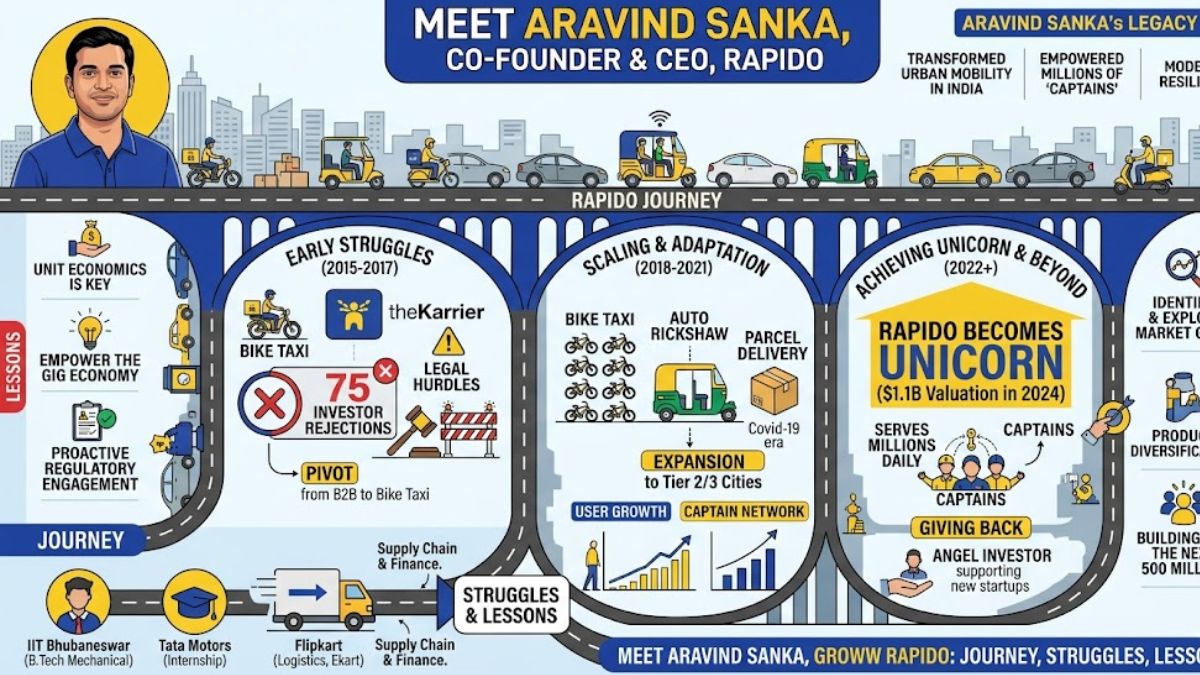
When Rapido started, it wasn’t stepping into a well-defined market. It was stepping into uncertainty. Bike taxis weren’t a widely accepted idea. There were questions around safety, legality, and whether people would even trust a stranger on a bike for their daily commute. Building the app was only a small part of it. The harder part was building belief. Convincing riders to join, convincing customers to try, and constantly navigating rules that weren’t fully clear yet.
In the middle of all this was Aravind Sanka, not as a distant founder figure, but as someone figuring things out in real time. The early days weren’t smooth. There were doubts, funding challenges, and moments where things could have easily gone the other way. But what kept things moving was a kind of stubborn clarity. The problem was real. People needed a solution. And if they could make it work even a little better than what existed, it was worth pushing forward. Over time, Rapido didn’t just grow as a company, it became part of how cities function. For many, it turned into a daily habit. A quick ride to work, a faster way to beat traffic, a small but meaningful convenience in an otherwise unpredictable commute.
There’s also a lot of confusion online linking
There’s also a lot of confusion online linking Aravind Sanka to other startups like Groww, but his story is firmly rooted in mobility and in building something that fits into the rhythm of everyday life in India. It’s not a story of overnight success. It’s one of persistence, trial and error, and slowly earning trust in a space where nothing was guaranteed. And maybe that’s what makes it relatable. Because at its core, this isn’t just about a startup growing. It’s about seeing a problem everyone else has learned to live with and deciding not to accept it as it is.
1. Background and Early Life
1.1 Early Life and Family Background
There isn’t much out there about the early life of Aravind Sanka, and in a strange way, that feels right. Not every story begins with something remarkable. Some begin in very ordinary settings, in everyday routines, in the kind of life where nothing looks like it’s leading to a startup someday. And maybe that’s what makes journeys like this feel real. They don’t come from a place of certainty. They come from observation.
If you grow up in India, especially in a city that’s constantly trying to keep up with itself, you don’t need to go looking for problems. They find you. You see them every day without even trying. Traffic that doesn’t move, short distances that somehow take forever, systems that almost work but never fully do. Most people don’t question it after a while. You learn to adjust. You leave earlier, you take longer routes, you accept that this is just how things are.
But some people don’t fully accept it. They carry that discomfort a little longer. They notice patterns. The same problems, repeating, every single day. It doesn’t feel dramatic in the moment. It just stays with you quietly. And over time, that quiet noticing becomes something else. Not frustration exactly, but a kind of curiosity. Why hasn’t this changed? Why does something so basic still feel so broken?
1.2 Education and Early Influences
We don’t have a detailed breakdown of Aravind’s academic journey, but if you look at founders who build in spaces like mobility, there’s usually a certain way they’ve learned to think. Whether it comes from engineering, business, or just being around people who build things, there’s a shift that happens. You stop seeing problems as fixed. You start asking what’s underneath them.
But honestly, the real influence doesn’t come from classrooms. It comes from experience. From being stuck in situations where things don’t work the way they should. From waiting, adjusting, compromising, again and again. Cities teach you that without ever trying to teach you.
If you’ve spent enough time in a place like Bengaluru, you know this feeling. You leave for something that should take fifteen minutes, and somehow it turns into forty-five. Wait for a cab that cancels. You argue with an auto. You stand there thinking, “There has to be a better way,” and then you move on because you have no choice. Most people move on. A few people don’t. They keep thinking about it even after the moment has passed. And sometimes, that’s where everything starts.
2. Founder and Company Overview
2.1 Introduction to the Founder
When people talk about Aravind Sanka, it’s easy to focus on the outcome, the company, the scale, the success. But what often gets missed is the kind of environment he chose to build in. Mobility in India isn’t clean or predictable. It’s messy in a very real, human way. It involves behavior, trust, regulation, and things that don’t always follow logic.
Building in that space means constantly dealing with uncertainty. Not the kind you can plan for, but the kind you have to respond to in real time. Things change. People react differently than you expect. Systems don’t always support what you’re trying to do. And yet, you keep going. Not because you’re sure it will work, but because the problem feels real enough that it’s worth trying. That’s a very different kind of motivation. It’s quieter, but also stronger in some ways.
2.2 Company Overview and Offerings
Rapido didn’t begin as something polished or fully figured out. It started with an idea that almost feels obvious now, but at the time, wasn’t. Using bikes to solve short-distance travel. Simple on paper. Complicated in reality. Because the idea itself is never the hard part.
The hard part is everything around it. Will people trust it? Will they feel safe? Riders see value in joining? Will the system hold together when it’s actually used at scale? These are not questions you answer once. You keep answering them, again and again, as you grow. Over time, Rapido became part of how people move without even thinking about it. It became that option you open when nothing else is working. And slowly, it expanded beyond just rides. Deliveries, logistics, new use cases. Not as a sudden shift, but as a natural extension of something that was already working.
2.3 Target Audience and Market Served
The people using Rapido are not thinking about innovation or disruption. They’re thinking about getting somewhere on time. A student trying not to miss a lecture. Someone heading to work, already running late. A person who just needs a quick ride without dealing with the usual uncertainty. These are everyday situations. Nothing extraordinary. But they happen millions of times, every single day. That’s where the real value lies.
It’s not in creating something new. It’s in making something familiar work better. Faster. More reliably. At a cost people can actually afford. And as cities grow, this need doesn’t reduce. It increases. Because infrastructure takes time, but people don’t wait. They find alternatives. They adapt. And platforms like Rapido become part of that adjustment.
2.4 Year of Founding and Business Stage
When Rapido started in 2015, it wasn’t entering a clearly defined space. It was stepping into something that was still being figured out. The startup ecosystem was growing, but mobility was complicated. There were players, but there were also gaps that no one had fully solved.
The early days weren’t about growth. They were about figuring things out. Testing, failing, adjusting. Understanding what works and what doesn’t, not in theory, but in real conditions. And that takes time. Today, the company operates at a much larger scale, but that doesn’t mean the challenges have disappeared. They’ve just changed. Managing multiple cities, dealing with regulations, maintaining consistency, these are different kinds of pressures. Growth doesn’t make things easier. It just raises the stakes.
3. The Problem, Insight, and Trigger
3.1 Core Problem Identified
The problem Rapido focused on is something almost everyone has experienced but rarely stops to think about deeply. That last part of the journey. The one that somehow never works smoothly. You get close to your destination, but not close enough. And that remaining distance becomes the hardest part. No direct transport, no reliable option, just a series of small inconveniences that add up. Over time, people stop questioning it. But that doesn’t mean the problem goes away. It just becomes invisible. And sometimes, the most powerful ideas come from noticing what everyone else has stopped noticing.
3.2 Personal Insight Behind the Idea
The insight behind Rapido isn’t complicated, but it requires attention. Two-wheelers already exist everywhere. They move faster. They cost less. Fit into the way Indian roads actually work. The real question was whether that could be turned into something organized. Something predictable. Something people would trust enough to use regularly. That shift, from possibility to structure, is where most ideas struggle. Because it’s one thing to see a solution. It’s another to build it in a way that people accept.
3.3 Trigger Moment to Start
There wasn’t one big moment where everything suddenly clicked. It was slower than that. A series of small realizations, repeated over time. The same traffic. The same delays. Same feeling that something so basic shouldn’t be this difficult. At some point, that repetition becomes hard to ignore. And then comes the difficult part.
Deciding to do something about it. Because once you cross that line, it’s no longer just an observation. It becomes a responsibility. A risk. A commitment to try, even when you don’t know how it will turn out. And that’s usually how real journeys begin. Not with certainty, but with a decision to not look away anymore.
4. Early Days and Initial Struggles
4.1 Early Assumptions and Naivety
In the beginning, there was a quiet kind of confidence around Rapido. Not loud or overhyped, just a simple belief that this made sense. Bikes were already part of everyday life, traffic was getting worse, and people clearly needed something faster and more affordable. It felt logical. Almost too logical. The kind of idea you assume people will accept the moment they see it. But ideas don’t live in isolation. They meet people, habits, fears, and doubts. And that’s where things slow down.
Because asking someone to get on a bike with a stranger is not a small shift. It’s not just about convenience, it’s about trust. People don’t immediately say no, but they hesitate. They think about safety, about whether this is even allowed, about what could go wrong. These are not loud objections, they’re quiet pauses. And those pauses are enough to delay adoption. That’s when the gap between a good idea and real acceptance becomes visible. What looked simple on paper started unfolding into something far more layered.
4.2 Entrepreneurial Initial Struggles
The early days didn’t feel like building a company. They felt like holding something together and hoping it doesn’t fall apart. Getting riders onboard wasn’t just about offering income. It was about asking them to step into something uncertain. There was no strong proof yet, no guarantee that this would work long term. For many bike owners, it felt like a risk. Time, effort, and trust were all on the line. And when people are unsure, they hold back. That hesitation was real.
On the user side, things weren’t easier. An app alone doesn’t create trust. People needed to feel safe, needed to feel that this wasn’t just an experiment that might disappear tomorrow. That feeling doesn’t come from ads or messaging. It comes from experience. One ride that goes right. Then another. And slowly, something shifts. Not dramatically, but enough for people to come back. That’s how belief started building. Quietly, one ride at a time.
4.3 What Turned Out to Be Harder Than Expected
Most people assume the hardest part of a startup is building the product. But in this case, the product was only the beginning. The real challenge was everything that surrounded it. You weren’t just building a platform. You were trying to make three different worlds work together. Riders, users, and regulators. Each with their own expectations, concerns, and limitations. And none of them fully aligned.
Regulation, especially, became something you couldn’t ignore or fully control. Every city felt different. Rules were unclear, sometimes shifting, sometimes open to interpretation. What worked in one place could break in another. Expansion wasn’t just scaling, it was relearning. Again and again. And that kind of unpredictability doesn’t just slow progress, it tests your patience. It forces you to stay flexible even when you feel like you’ve already figured things out.
5. Failures, Setbacks, and Self Doubt
5.1 Toughest Phase of the Journey
There comes a point in every journey where things stop feeling stable. Where the path ahead isn’t clear anymore. For Rapido, that phase showed up when regulations began pushing back. Suddenly, operations in certain cities were no longer as smooth. Restrictions came in, uncertainty increased, and something that was growing started feeling fragile again. That kind of disruption hits differently. Because it’s not something you can fix by improving the product or tweaking the system. It’s external. It’s bigger than you.
And in those moments, the question changes. It’s no longer about how to grow faster. It becomes much more basic. Can this even continue? That shift in thinking is heavy. It forces you to pause, to rethink, to find a way forward without clear answers.
5.2 Early Failures and Major Setbacks
There were also smaller struggles that didn’t make noise but mattered just as much. Supply and demand rarely stayed balanced. Sometimes there were too many riders waiting, sometimes too many users searching. Even slight imbalances affected the experience.
And then there was the reality of different cities. Each one came with its own behavior, its own pace, its own set of challenges. What worked in one place didn’t always translate. You had to adjust constantly. And that repetition, solving similar problems in slightly different ways, can wear you down over time. Because it feels like progress, but also like starting over, again and again.
5.3 Moments of Self Doubt and Emotional Lows
This is the part people don’t often talk about. The moments when things feel unclear. When the idea that once felt strong starts to feel uncertain. For Aravind Sanka, like many founders, those moments were unavoidable. There are days when you question timing, question decisions, question whether the system will ever fully support what you’re trying to build. It’s not dramatic. It’s quiet. A kind of doubt that sits in the background.
And still, you continue. Not because you’re fully confident, but because stopping doesn’t feel like an option anymore. That quiet persistence, continuing even when clarity is missing, is what carries most journeys through their hardest phases.
6. Validation and Early Traction
6.1 First Real Validation or Customer
The shift didn’t happen overnight. There was no single moment where everything suddenly worked. It came slowly, through behavior. People didn’t just try Rapido once. They came back. And then they came back again. That repetition mattered. Because trying something is easy. Depending on it is different. When users started choosing Rapido without thinking twice, it meant something had changed. The product wasn’t just interesting anymore. It had become useful.
6.2 Early Revenue Growth or Feedback
The feedback was simple. Almost too simple. It’s cheaper. It’s faster. It saves time. But that simplicity is what made it powerful. Because it reflected something real. People weren’t using it because it felt new or exciting. They were using it because it solved a problem they dealt with every day. And that kind of validation doesn’t fade quickly. It builds consistency.
6.3 Why This Moment Changed Belief
Every startup reaches a point where belief changes. Where it stops being about hope and starts feeling real. For Rapido, that moment came when it became part of routine. When people didn’t think of it as an option, but as a default. That shift is subtle, but it changes everything. Because once something becomes a habit, it proves that it fits into real life. And once that happens, scaling stops feeling like a risk and starts feeling like a direction.
7. Funding, Money, and Growth Constraints
In the early days, money wasn’t about growth. It was about staying alive. Making sure operations didn’t break. Making sure the system kept running. In a business that deals with real-world movement, costs are constant. They don’t wait for growth to catch up.
Funding helped create momentum. It allowed expansion, improvements, better execution. But it also brought pressure. Every decision carried weight. Every move had consequences. Balancing growth with control became a constant tension. Moving too fast could break things. Moving too slow could stall progress. Finding that balance required discipline, not just ambition.
8. Team Building and Leadership Evolution
In the beginning, teams are not built with structure. They are built with instinct. You bring in people who believe enough to take the risk with you. Roles overlap. Responsibilities blur. Everyone is figuring things out at the same time. But as things grow, that chaos has to turn into clarity. Processes start forming. Roles become defined. Decisions become more deliberate. Leadership shifts from reacting to problems to anticipating them. And that shift doesn’t come easily. It comes from mistakes, from learning, from adjusting.
Over time, leadership becomes less about holding everything together and more about trusting others to carry parts of it. Delegation, accountability, speed, these are not just strategies. They are habits built slowly, shaped by everything the journey demands.
9. Growth, Scaling, and Operational Challenges
Growth, from the outside, always looks clean. Numbers go up, cities get added, the story feels like it’s moving forward in a straight line. But from the inside, scaling something like Rapido feels very different. It’s not one problem, it’s three happening at the same time, all pulling in different directions. You need enough riders on the road, enough users requesting rides, and at the same time, you have to stay within rules that are not always clearly defined. If even one of these slips, the whole system starts feeling unstable.
And the moment you move into a new city, everything resets. What worked before doesn’t fully apply anymore. The roads are different, the behavior is different, even the expectations feel different. You can’t just copy and paste your playbook. You have to listen, adjust, and sometimes unlearn what you thought you knew. There are moments when things break, when demand spikes but supply doesn’t match, or when operations fail in ways you didn’t predict. And each time, the only way forward is to fix it, quietly, and keep going. Over time, these fixes turn into systems, better training, stronger processes, but they are always built on top of lessons learned the hard way.
10. Personal Sacrifices and Burnout
What people see is the outcome. What they don’t see is the cost. Building something in the real world, especially in mobility, doesn’t stop when the workday ends. It runs all the time. Late nights don’t feel like exceptions, they become normal. There’s always something that needs attention, something that didn’t go as planned, something that can’t wait till tomorrow. And over time, that constant pressure starts to build in ways that are not always visible.
For founders like Aravind Sanka, even if the details aren’t publicly shared, the pattern is familiar. The mental load, the responsibility, the constant uncertainty, it all adds up. There are moments when exhaustion feels deeper than just being tired. Moments where you question how long you can keep going at the same pace. But the thing about building something like this is, you rarely have the option to slow down completely. You learn to carry that weight, to keep moving even when you feel stretched, because too many things depend on you not stopping.
11. Lessons, Beliefs, and Values
If there’s one thing this journey makes clear, it’s that ideas are only a small part of the story. Execution is where everything is tested. You can have a strong concept, but if it doesn’t survive real-world complexity, it doesn’t matter. That’s something this path teaches again and again. That building is not about having the best idea, it’s about making that idea work in conditions that are far from perfect.
Over time, certain beliefs become stronger. That patience matters more than speed in the long run. That solving real problems takes repetition, not shortcuts. That scale is not just about reaching more people, but about doing it without breaking what already works. These aren’t things you learn in theory. They come from experience, from mistakes, from watching things fail and then figuring out how to make them better. And slowly, those lessons turn into a way of thinking, something that stays even beyond one company or one phase of growth.
12. Present Challenges and Future Vision
12.1 Ongoing Struggles Today
Even now, things are far from simple. The environment around Rapido is still competitive, still unpredictable. Pricing pressures, regulatory requirements, expansion challenges, they haven’t disappeared. They’ve just evolved. Every decision feels like a balance between moving forward and staying stable.
What makes it harder is that the expectations are higher now. When you’re small, people give you room to figure things out. When you grow, that space becomes tighter. You’re expected to deliver consistency, reliability, and scale, all at once. And doing that in a system that is still evolving itself is not easy.
12.2 Current Leadership Philosophy
Leadership, at this stage, starts to look very different from what it was in the beginning. It’s less about reacting quickly and more about building something that can hold steady over time. The focus shifts from chasing growth to strengthening what already exists.
For founders like Aravind Sanka, this means thinking in terms of resilience. Building systems that don’t collapse under pressure. Creating teams that can operate independently but still stay aligned. Adapting when things change, but without losing direction. It’s a quieter kind of leadership, but in many ways, it’s more demanding.
12.3 Long-Term Vision
Looking ahead, the vision doesn’t feel like a sudden leap. It feels like an extension of what has already been built. Becoming a strong, reliable part of how cities move. Not just in rides, but in how people and goods travel across short distances.
There’s also an understanding that growth won’t come from just doing more of the same. It will come from expanding into areas that naturally connect to what already works, like logistics and delivery. But even that expansion carries the same philosophy. Build carefully. Stay grounded in real needs. Don’t rush beyond what the system can handle.
And somewhere in the background, there’s always that quiet confusion that shows up in public perception, people mixing names, connecting unrelated companies like Groww to this journey. But the real story has always stayed rooted in one space. Mobility. Solving something that people experience every day, even if they don’t think about it too deeply. And maybe that’s what makes it meaningful. Because it’s not just about building a company. It’s about becoming part of how everyday life moves.
About foundlanes.com
foundlanes.com is India’s leading startup idea discovery platform. It helps entrepreneurs find actionable startup opportunities, market insights, and industry-specific guidance to turn ideas into real businesses. With deep research and practical resources, foundlanes supports founders at every stage, from idea validation to launch and growth.