Introduction:
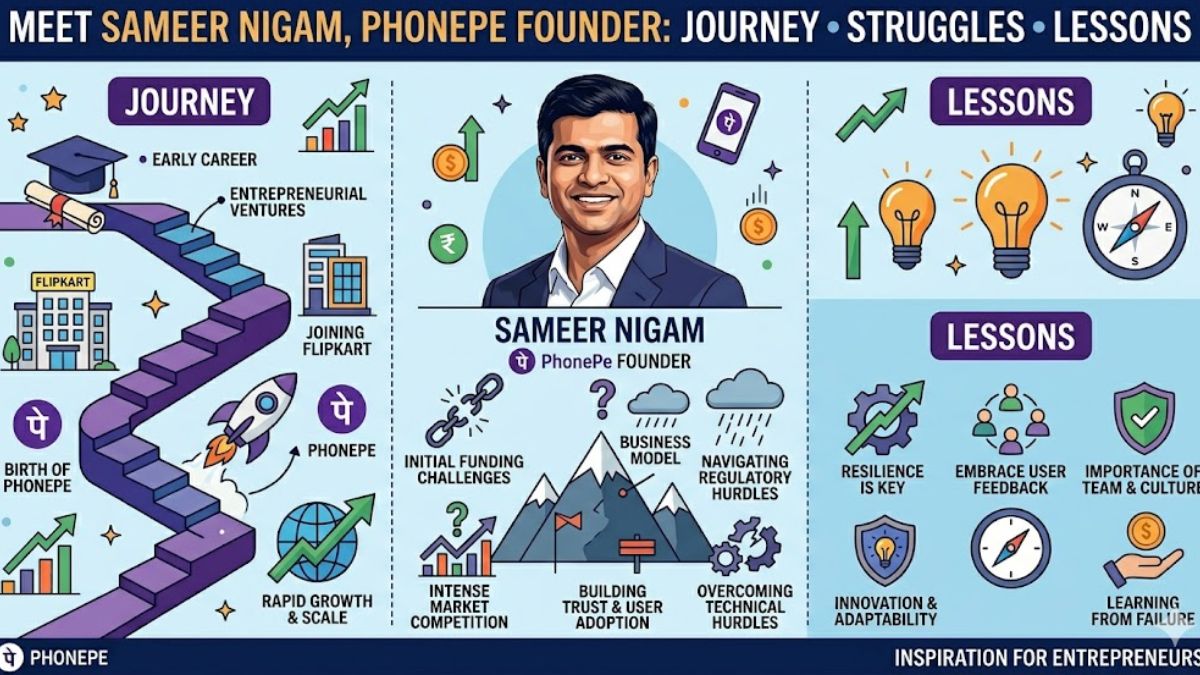
Sameer Nigam, the founder of PhonePe, is one of the most influential figures behind India’s digital payments revolution. His journey reflects the transformation of India itself, from a largely cash-driven economy to a global leader in UPI payments India. Born and raised in India, Nigam’s path to building one of the country’s largest fintech platforms was not linear. It involved years of corporate experience, entrepreneurial failures, and a deep understanding of consumer behavior.
He co-founded PhonePe in 2015 in Bengaluru at a time when digital payments were still in their early stages. The timing coincided with the launch of UPI, a government-backed payments infrastructure that would go on to redefine financial transactions. Nigam saw an opportunity where others saw uncertainty. His vision was simple but ambitious: make payments seamless, secure, and accessible to every Indian.
The “why” behind PhonePe was rooted in a fundamental problem. India lacked a unified, easy-to-use digital payment system that worked across banks. Nigam and his co-founders believed technology could bridge this gap. The “how” involved building a mobile-first platform that simplified payments for both urban and rural users.
The journey was not easy. From early struggles to scaling challenges, from fierce competition to regulatory shifts, Nigam’s story is one of resilience. Today, PhonePe stands as a dominant player in fintech startup India, backed by Walmart and valued among the top startups in the country. This is not just a success story. It is a detailed look at the mindset, decisions, failures, and lessons behind one of India’s most impactful entrepreneurs.
1. Background and Early Life
1.1 Early Life and Family Background
Sameer Nigam didn’t grow up in a world filled with startup stories, venture capital buzz, or founders chasing billion-dollar dreams. His childhood looked a lot like that of many middle-class Indian families, quiet, disciplined, and centered around one core belief: education is your way forward. There’s something very grounding about that kind of upbringing. No shortcuts. No illusions of overnight success. Just a steady rhythm of showing up every day, doing the work, and trusting that consistency will take you somewhere meaningful.
In that environment, curiosity becomes your biggest advantage. And for him, curiosity wasn’t loud or flashy. It was subtle. It showed up in how he approached problems, how he questioned things, how he tried to understand systems instead of just using them. He wasn’t trying to “become a founder.” That idea didn’t even exist in his early world. What he was doing, without realizing it, was building a way of thinking. Learning how to stay patient. Learning how to go deep instead of wide. How to find satisfaction in solving something difficult. Looking back, those years didn’t look extraordinary. But that’s the thing about foundations, they rarely do. They only reveal their strength much later, when everything else starts to shake.
1.2 Education and Early Influences
Like many who are naturally drawn to logic and structure, he chose engineering. It wasn’t just about getting a degree. It was about learning how to think in systems.Engineering teaches you something very real: problems don’t care about opinions. They only respond to clarity and precision. That mindset stays with you. But somewhere along the way, technical thinking alone wasn’t enough. He needed to understand the bigger picture, how decisions are made, how businesses scale, how ideas turn into something that touches millions of lives. That’s what led him to Indian Institute of Management Ahmedabad.
IIM Ahmedabad isn’t just another college. It’s a place that stretches how you think. It pushes you to question assumptions, to deal with ambiguity, to make decisions even when you don’t have perfect information. For someone like him, this phase wasn’t about chasing grades or prestige. It was about sharpening perspective. But the real education started after that. When he stepped into companies like Flipkart, everything changed. Theory met reality. Ideas met execution.
At Flipkart, he wasn’t working on small, isolated problems. He was building products that millions of people depended on. And that does something to your thinking. It forces you to care about scale, reliability, and the tiny details that most people overlook. You begin to see how fragile systems can be when they grow too fast. Understand how one small friction point can impact millions of users. You learn that in a country like India, simplicity isn’t just a feature, it’s survival. Those experiences didn’t just teach him how to build products. They taught him responsibility. Because when your work touches millions of lives, you don’t get to hide behind excuses.
2. Founder and Company Overview
2.1 Introduction to the Founder
It’s easy to call Sameer Nigam a founder. But that word doesn’t fully capture who he is. He is a builder. The kind of person who finds meaning in making things work, not just making them look good. There’s a quiet intensity in people like him. They don’t chase attention. They don’t rush to be in the spotlight. Focus on getting the product right, again and again, even when no one is watching. His time at Flipkart shaped this mindset deeply. He saw firsthand what it takes to build for India, not the idea of India, but the real India, messy, diverse, unpredictable.
He understood something many miss: users don’t care about your vision statement. They care about whether your product works when they need it. That belief stayed with him. When he eventually stepped into entrepreneurship, it wasn’t driven by hype. It was driven by a very grounded thought, “Can we solve something real, and can we do it well enough that people trust us with it?”
2.2 Company Overview and Offerings
When PhonePe started, it didn’t feel like the beginning of a giant. It felt like a small, focused attempt to solve a very real problem: making digital payments simple. At that time, Unified Payments Interface was still new. Most people didn’t fully understand it. There was hesitation, confusion, even fear around digital transactions. And that’s where the real challenge was. Not technology. Trust.
PhonePe didn’t try to impress users with complexity. It did the opposite. It removed friction. Made things feel easy, almost invisible. Send money. Receive money. That’s it. No unnecessary steps. No overwhelming interface. Just a clean, reliable experience. Over time, the platform grew. It added insurance, investments, and other financial services. But it never lost that core feeling of simplicity.
That’s not accidental. It’s a conscious choice. Because once you start complicating financial products, you start losing people. What makes PhonePe powerful isn’t just its scale. It’s the emotional trust users place in it. People trust it with their money. And that kind of trust is built slowly, through consistency, not marketing.
2.3 Target Audience and Market Served
One of the most human aspects of PhonePe is who it was built for. Not just urban users. Not just tech-savvy individuals. But everyone. Think about that for a moment. A small shopkeeper in a village. A vegetable vendor on the street. Young professional in a metro city.
All of them using the same product, in their own way. Designing for that level of diversity is not easy. It requires empathy. It requires patience. Requires you to step outside your own assumptions and truly understand how people live and transact. PhonePe managed to do that. It didn’t try to force users to adapt. It adapted to them.
In smaller towns and rural areas, where digital trust doesn’t come easily, reliability became its strongest ally. When transactions worked consistently, people started believing. And once belief turns into habit, adoption follows naturally. This is where the impact becomes real. It’s not just about payments anymore. It’s about participation. About bringing more people into the financial system in a way that feels natural, not intimidating.
2.4 Year of Founding and Business Stage
PhonePe was founded in 2015. At that time, digital payments in India were still finding their footing. Then came a moment that changed everything, the Demonetisation in India. Suddenly, millions of people were pushed toward digital transactions. It wasn’t gradual anymore. It was immediate. For PhonePe, this wasn’t just an opportunity. It was a test. Could the system handle the surge? Users trust it during a time of uncertainty? Could it deliver when it mattered the most? Moments like these define companies. And PhonePe held its ground.
From there, its journey unfolded in phases, early struggle, rapid growth, relentless scaling, and eventual maturity. But what stands out is not just the growth curve. It’s the discipline behind it. There were no unnecessary distractions. No chasing every new trend. Just a consistent focus on building something that works, and keeps working. Today, it stands as one of India’s leading fintech platforms. But if you trace it back, it all comes down to something very simple, almost human in its nature. Show up. Solve real problems. Stay consistent. Earn trust. And over time, that quiet consistency turns into something extraordinary.
3. The Problem, Insight, and Trigger
3.1 Core Problem Identified
Before PhonePe came into the picture, digital payments in India felt… broken. Not completely unusable, but far from effortless. If you wanted to transfer money, you often had to depend on your bank’s app. Each bank had its own interface, its own process, its own limitations. Nothing spoke to each other smoothly. One app would work on some days, fail on others. Another would take forever to process a transaction. For a country that runs on speed and urgency, this friction was exhausting.
And when money is involved, even the smallest friction feels big. People didn’t just want a way to send money. They wanted certainty. They wanted to know that when they tapped “send,” the money would actually go through. No confusion. No delays. Anxiety. What Sameer Nigam saw was not just a technical gap. He saw a trust gap. India didn’t just need another payments app. It needed a layer of simplicity on top of a complex system. Something that could hide all the backend chaos and present a clean, reliable experience to the user. That gap, between what existed and what people actually needed, was massive. And that’s where the opportunity lived.
3.2 Personal Insight Behind the Idea
Sometimes, the most powerful insights don’t come from brainstorming sessions. They come from frustration. During his time at Flipkart, Nigam had a front-row seat to how messy payments really were. You could build the best shopping experience, the fastest delivery system, the most compelling offers, but if the payment failed at the last step, everything collapsed.
Imagine a user spending 20 minutes selecting a product, entering details, reaching checkout… and then the payment fails. That moment is not just a failed transaction. It’s a broken experience. Multiply that across millions of users, and you start to see the scale of the problem.
He saw patterns:
- Transactions failing at critical moments
- Delays causing confusion and distrust
- Users abandoning purchases because payments felt unreliable
And slowly, a realization started to form. Payments were not just a feature. They were the backbone. If you fix payments, you don’t just improve one product. You unlock growth across the entire ecosystem, e-commerce, services, small businesses, everything. This wasn’t a surface-level idea. It was a deep, almost uncomfortable realization that a core layer of India’s digital economy was still fragile. That insight didn’t feel like a “startup idea.” It felt like a responsibility waiting to be taken seriously.
3.3 Trigger Moment to Start
Ideas often wait for the right moment. And when the moment arrives, it’s obvious. That moment came with the launch of National Payments Corporation of India’s Unified Payments Interface. UPI was powerful. It was revolutionary in what it enabled. For the first time, it allowed seamless bank-to-bank transfers in real time. But there was a catch. Infrastructure alone doesn’t create adoption. People don’t adopt systems. They adopt experiences.
UPI was the engine. But it needed a vehicle that people could actually use without confusion. That’s what Nigam saw clearly. He didn’t need to build the rails. The rails were already there. What he needed to build was the interface, the layer that sits between complex technology and everyday users. That combination, strong infrastructure and sharp product insight, created the perfect starting point for PhonePe. It wasn’t luck. It was timing meeting preparation.
4. Early Days and Initial Struggles
4.1 Early Assumptions and Naivety
Every startup begins with a certain level of optimism. Sometimes, that optimism borders on naivety. And honestly, it has to. Because if founders fully understood the complexity ahead, many would never start. In the early days of PhonePe, there was a belief that if the technology is strong enough, the problem will solve itself. It sounds logical. Build a fast, reliable system. Users will come. But payments are not just about technology.
They sit at the intersection of banks, regulations, compliance, security, and user behavior. It’s a system where one weak link can break the entire chain. The team quickly realized that building a payments platform is less like building an app and more like building an ecosystem. And ecosystems don’t move fast. They resist change. They demand patience. Test your resilience.
4.2 Entrepreneurial Initial Struggles
One of the hardest parts wasn’t writing code. It was building trust. Convincing banks to integrate with a new platform wasn’t easy. Banks are naturally cautious, and rightly so. They deal with people’s money. They cannot afford risk. For a new startup to walk in and say, “Trust us with your infrastructure,” is a big ask.
Every partnership required conversations, negotiations, and reassurance. And even after integration, there was the challenge of users. India, at that time, was still heavily dependent on cash. Digital payments were not yet a habit. They were an option, and often a confusing one.
People were hesitant:
- “Will my money be safe?”
- “What if the transaction fails?”
- “What if I lose access?”
These are not technical questions. These are emotional questions. And emotional resistance is much harder to overcome than technical barriers.
4.3 What Turned Out to Be Harder Than Expected
If there’s one thing that truly tested the team, it was scale. Payments demand near perfection. If a social media app crashes, it’s annoying. If a payments app fails, it’s personal. Because money is involved. Even a tiny failure rate can affect thousands, sometimes millions, of transactions. And each failed transaction chips away at trust. Building infrastructure that can handle massive volumes without breaking is incredibly hard.
It requires:
- Constant monitoring
- Rapid response systems
- Deep coordination with banks and networks
There were nights when things didn’t work as expected. Moments when systems were under stress. Times when the team had to fix issues in real time, knowing that millions were depending on them. That kind of pressure changes you. It forces you to become sharper, calmer, and more disciplined.
5. Failures, Setbacks, and Self Doubt
5.1 Toughest Phase of the Journey
The early years of PhonePe were not glamorous. There was no instant success. No overnight validation. Just long stretches of uncertainty. Growth was slow at first. Users were cautious. The ecosystem was still evolving. And then there was competition. Big players, well-funded, already established. In those moments, doubt doesn’t come as a dramatic breakdown. It comes quietly. “Are we too early?” “Are we missing something?” “Will this actually work at scale?” These questions don’t have immediate answers. And yet, you still have to keep going.
5.2 Early Failures and Major Setbacks
There were technical failures. Transactions that didn’t go through. Systems that didn’t behave as expected. There were user complaints. Frustration. Confusion. There were operational challenges, coordinating with banks, handling edge cases, fixing issues that didn’t have clear solutions. Each setback felt heavy in the moment. Because in fintech, mistakes are not abstract. They affect real people, real money, real trust. But something important happens when you face repeated setbacks.
You stop taking things personally. You start focusing on solving the problem, not reacting to it. The team learned to respond faster, think clearer, and build stronger systems. Failure stopped being an obstacle. It became feedback.
5.3 Moments of Self Doubt
No founder escapes self-doubt. And in a space like fintech, where the stakes are high and the margin for error is almost zero, that doubt can feel intense. For Sameer Nigam, these moments were part of the journey. Not because he lacked confidence, but because he understood the weight of what they were building. When you’re dealing with money, you don’t get the luxury of being careless.
Every decision matters. Every delay matters. Failure matters. And in those quiet moments, when things aren’t moving as fast as you hoped, it’s natural to question everything. But what defines founders is not the absence of doubt. It’s the ability to move forward despite it.
6. Validation and Early Traction
6.1 First Real Validation or Customer
Validation doesn’t always come as a big milestone. Sometimes, it comes quietly. A user completes a transaction successfully. Then they do it again. Then they tell someone else. And slowly, a pattern begins. As Unified Payments Interface started gaining traction, more people became willing to try digital payments. And when they tried PhonePe, something clicked. It felt simple. It worked. That’s all users really wanted. That moment, when users stop hesitating and start trusting, that’s real validation
6.2 Early Revenue Growth or Feedback
With growing usage came feedback. And not the polite kind. Real, honest feedback. What works. What doesn’t. What’s confusing. What needs to change. Instead of resisting it, the team leaned into it. They improved the product. Simplified flows. Fixed pain points. And gradually, the numbers started reflecting that effort. Transactions increased. Engagement improved. Retention got stronger. It wasn’t explosive overnight growth. It was steady, meaningful progress. The kind that feels real because it’s earned.
6.3 Why This Moment Changed Belief
There’s a moment in every startup journey when things shift internally. Before that, you’re hoping it works. After that, you know it works. For PhonePe, that shift came when adoption started compounding. When users didn’t just try the product but stayed. When transactions didn’t just happen but increased consistently.
That’s when belief changes. The conversation inside the team moves from survival to possibility. “What if this works?” becomes “How far can we take this?” And that shift, more than anything else, is what drives the next phase of growth. Because once belief is backed by evidence, execution becomes sharper, faster, and far more confident.
7. Funding, Money, and Growth Constraints
7.1 Bootstrapped or Funded Journey
PhonePe was never a story of scraping by with zero capital. But that doesn’t mean money made things easy. In fact, sometimes access to capital brings a different kind of pressure. Early on, the company became part of Flipkart, which was later acquired by Walmart. On paper, this looks like the dream scenario, strong backing, deep pockets, and the ability to scale aggressively. But inside the company, the reality feels different.
When you have backing from giants like Flipkart and Walmart, expectations are not small. You’re not just building a product anymore. You’re expected to build something that can dominate, something that justifies the scale of investment and belief placed in you. Capital gave PhonePe fuel. But it also raised the stakes. Every decision mattered more. Every delay felt heavier. Opportunity had to be evaluated not just for survival, but for long-term impact. Money can buy time, but it cannot buy clarity. That still had to come from within the team.
7.2 Capital Challenges and Cash Flow Issues
From the outside, fintech often looks like a high-growth, high-revenue space. But payments, especially in the early days, are a different game. Margins are thin. Sometimes, almost invisible. You’re processing huge volumes of transactions, but the actual revenue per transaction is tiny. And yet, the cost of maintaining that system, infrastructure, security, compliance, partnerships, is massive. It’s a strange paradox. You can be growing rapidly, handling millions of transactions, and still feel the pressure of cash flow.
For PhonePe, this meant constantly making tough choices:
- Where do we invest aggressively?
- Where do we hold back?
- How do we grow without burning unsustainably?
There’s no perfect answer to these questions. Because in a space like this, if you slow down too much, you lose relevance. But if you move too fast without control, you risk breaking the system. Balancing that tension is not just financial discipline. It’s emotional discipline. It requires the ability to say no, even when growth is tempting.
8.3 Early Growth Limitations
Growth is exciting. It gives you momentum. It gives you validation. But growth, if not handled carefully, can also expose every weakness in your system. In the early days, the team at PhonePe understood something critical, scaling too fast without stability is dangerous. Every new user is not just an opportunity. It’s a responsibility. If the system fails under pressure, users don’t just leave. They lose trust. And in payments, once trust is broken, it’s very hard to rebuild. So the team had to slow down at times when speeding up would have looked better from the outside.
They focused on strengthening the foundation:
- Making transactions more reliable
- Improving system uptime
- Ensuring consistency across banks and networks
These decisions don’t make headlines. But they are what make long-term growth possible.
9. Team Building and Leadership Evolution
9.1 Early Hiring Mistakes
No founder gets hiring right in the beginning. And neither did Sameer Nigam. In the early stages, hiring often happens under pressure. You need people quickly. You’re trying to build momentum. And sometimes, decisions are made based on immediate needs rather than long-term fit. Some hires work out. Some don’t. And in a fast-moving environment like fintech, the cost of a wrong hire is not just time. It’s momentum. It’s culture. Execution quality.
At PhonePe, finding the right people was particularly challenging because the problem itself was complex. You didn’t just need good engineers. You needed people who understood payments, systems, scale, and responsibility. Needed people who could stay calm when things broke. Over time, the team became more intentional. Hiring shifted from “who can do the job now” to “who can grow with the company.” That shift made all the difference.
9.2 Delegation Challenges
In the beginning, founders are involved in everything. Every product decision. Every hiring call. Partnership discussion. It’s exhausting, but it also feels necessary. Letting go of that control is not easy. For Nigam, this was one of the biggest internal shifts. Moving from doing everything himself to trusting others to do it. Delegation is not just about assigning tasks. It’s about trusting that someone else will make decisions that affect the company’s future. And that trust doesn’t come instantly.
It builds slowly, through small wins, through shared understanding, through alignment. There are moments when things don’t go as expected. When decisions made by others don’t work out. And in those moments, the instinct is to take control back. But real leadership means resisting that instinct. It means allowing people to learn, to grow, and sometimes to fail.
9.3 Leadership Learnings Over Time
Over time, Sameer Nigam’s role began to change. In the early days, he was deeply involved in execution, building, fixing, solving. But as the company grew, his focus had to shift.
From:
- Solving immediate problems
To:
- Thinking about long-term direction
- Building culture
- Ensuring alignment across teams
This transition is not easy for someone who loves building. Because strategy can feel abstract compared to the satisfaction of solving real problems. But at scale, leadership is less about doing and more about enabling. It’s about creating an environment where great work can happen consistently, even when you’re not directly involved. And perhaps the most important lesson was this: culture is not something you write down. It’s something you live, especially in difficult moments.
10. Growth, Scaling, and Operational Challenges
10.1 Brand Positioning and Go to Market Learnings
From the very beginning, PhonePe made a clear choice. It didn’t try to be everything. It focused on being simple. Reliable. Easy to use. In a market where many products try to impress users with features, PhonePe chose clarity over complexity. This positioning wasn’t just a marketing decision. It was a product decision. Every feature, every flow, every interaction was designed with one question in mind: “Does this make things easier for the user?” That consistency built trust. And trust, in financial products, is the strongest form of branding.
10.2 Scaling Challenges
Scaling a payments platform is unlike scaling most other products. You’re not just increasing users. You’re increasing responsibility.
Millions of transactions every day means:
- Millions of points of failure
- Millions of moments where things can go wrong
The infrastructure has to be incredibly robust. It has to handle spikes, failures, and unpredictable behavior across multiple systems, banks, networks, devices. For PhonePe, scaling wasn’t just about adding servers or improving speed. It was about building resilience. Systems that don’t just work under ideal conditions, but continue to function even when things go wrong. That requires deep engineering discipline, constant monitoring, and the ability to respond in real time.
10.3 Operational Breakdowns and Fixes
No system is perfect. There were times when things broke. Transactions failed. Systems slowed down. Users faced issues. And in those moments, everything feels urgent. Because every second matters. For the team, these weren’t just technical problems. They were emotional moments. Users were frustrated. Support channels were flooded. Pressure was high. But this is where character is built. Instead of hiding failures, the team focused on fixing them quickly and learning from them.
Every breakdown became a lesson:
- Improve monitoring systems
- Strengthen fail-safes
- Build better coordination with banking partners
Over time, these improvements compound. What once felt like a crisis becomes a controlled situation. And slowly, the system becomes stronger, more reliable, more resilient.
11. Personal Sacrifices and Burnout
11.1 Personal Costs of Entrepreneurship
When people look at PhonePe today, they see scale, success, and stability. What they don’t see as clearly are the quiet trade-offs that came along the way. For Sameer Nigam, building a company like this was never a 9-to-5 commitment. It was all-consuming. There are days in a startup where work spills into everything. Weekends blur into weekdays. Even when you’re not working, your mind is still running through problems, decisions, risks. You could be sitting with family and still thinking about a system failure. You could be in a conversation and still replaying a product decision in your head.
That’s the hidden cost. Not because someone forces it on you, but because you care too much to switch it off. There are moments you miss. Time that doesn’t come back. And while you may not feel it immediately, over time you start to realize that building something meaningful often comes at the cost of stepping away from parts of your personal life. And yet, you continue. Because somewhere deep down, you believe the thing you’re building matters.
11.2 Burnout Phases and Emotional Pressure
Burnout in startups doesn’t always look dramatic. It’s not always a breakdown or a sudden collapse. Sometimes, it’s quieter. It’s waking up tired even after sleeping. Feeling mentally drained before the day even begins. It’s the weight of constant decision-making that never really stops.
Leading a high-growth company like PhonePe means living with continuous pressure. There’s pressure from scale. Pressure from competition. Pressure from users who depend on your product every single day. And then there’s the internal pressure, the one that doesn’t come from outside. “Are we doing enough?” “Are we moving fast enough?” “Are we missing something critical?”
These questions don’t leave you. There were phases where the pace was relentless. Where the team had to push through exhaustion because the system couldn’t afford to slow down. And in those moments, resilience is not about motivation. It’s about endurance. It’s about showing up even when you don’t feel at your best.
11.3 Impact on Personal Life
Entrepreneurship doesn’t exist in isolation. It spills into relationships, routines, and emotional space. For someone like Nigam, the impact wasn’t always visible from the outside, but it was real. When your mind is constantly occupied with building, it becomes harder to be fully present elsewhere. Conversations get shorter. Time feels limited. Priorities shift without you even realizing it. And relationships, whether with family or close friends, sometimes feel the distance.
Balancing this is not a one-time solution. It’s an ongoing struggle. There’s no perfect formula. Some days you get it right. Some days you don’t. But over time, you start to understand that success at work doesn’t mean much if everything else quietly fades in the background. That awareness itself becomes a form of growth.
12. Lessons, Beliefs, and Values
12.1 Core Lessons Learned
If there’s one lesson that defines the journey of Sameer Nigam, it’s this: Solving real problems matters more than building impressive technology. It’s easy to get excited about innovation. New features. Advanced systems. Complex ideas. But none of that matters if it doesn’t make life easier for the user. At PhonePe, this lesson came from experience. Every time something failed, it wasn’t because the idea was weak. It was because execution fell short. That’s where the real learning happened. Execution is not glamorous. It’s repetitive. It’s detailed. It demands discipline. But it’s what separates ideas from impact.
12.2 Beliefs That Changed Over Time
In the early days, like many founders, there’s a tendency to equate speed with success. Move fast. Grow fast. Capture the market. But over time, Nigam’s perspective evolved. He began to see that in a space like fintech, speed without stability is dangerous. Growth is important, but sustainable growth is what truly matters. Patience, which often feels like a weakness in fast-moving environments, became a strength. Waiting to get things right. Holding back when systems weren’t ready. Choosing long-term trust over short-term gains. These are not easy decisions, especially when the market rewards aggressive expansion. But they define the kind of company you build.
12.3 Non-Negotiable Values
At the heart of PhonePe are a few values that never changed. Trust. Reliability.
User-first thinking. These are not just words used in presentations. They show up in decisions. If a feature risks confusing users, it’s reconsidered. System isn’t stable, it’s improved before scaling.
If something compromises trust, it’s not worth pursuing. In financial services, these values are not optional. Because users are not just engaging with your product. They are trusting you with something deeply personal, their money. And once that trust is broken, it’s almost impossible to rebuild.
13. Present Challenges and Future Vision
13.1 Ongoing Struggles Today
Even at its current scale, PhonePe is far from a finished story. In many ways, the challenges have only become more complex. The fintech space in India is intensely competitive. New players continue to emerge. Existing players continue to innovate. At the same time, regulations are constantly evolving. And in fintech, regulation is not something you work around. It’s something you work with. Every new rule, every policy change, requires adaptation. And when you operate at scale, even small changes can have large implications. So the journey doesn’t get easier. It just becomes different.
13.2 Current Leadership Philosophy
Over time, Sameer Nigam’s leadership philosophy has become more grounded. Less about chasing growth at any cost. More about building something that lasts. There’s a strong emphasis on discipline now. Not just financial discipline, but operational discipline. Decision-making discipline. It’s about asking the right questions:
- Does this add real value?
- Is this sustainable?
- Are we building for the long term?
This shift reflects maturity, both at an individual level and at an organizational level.
13.3 Long Term Vision
The vision for PhonePe has always been larger than payments. Payments were the starting point. The entry layer. But the real ambition is to build a complete financial ecosystem.
A platform where users can:
- Pay
- Save
- Invest
- Insure
All in one place. And more importantly, do it with ease. The goal is not just expansion. It’s integration. Bringing different financial services together in a way that feels simple and intuitive.
13.4 Problem the Founder Remains Obsessed With
At the core of everything, Sameer Nigam is still focused on one thing: How do you make financial services feel simple for everyone? Not just for urban users. Not just for the financially literate. For everyone. In a country as diverse as India, this is not a small problem.
It requires:
- Deep understanding of user behavior
- Thoughtful product design
- Continuous iteration
It’s the kind of problem that doesn’t have a final solution. And maybe that’s what keeps it interesting.
14. Future Outlook: Sameer Nigam and the Road Ahead
The journey of Sameer Nigam is still unfolding. If anything, the most important chapters may still be ahead. India’s digital economy is evolving rapidly. The foundation laid by Unified Payments Interface has already changed how money moves. But the next phase is deeper.
It’s about financial inclusion at a level we haven’t fully seen yet. Reaching people who are still outside the system. Simplifying products that still feel complex. Building trust in places where it doesn’t come easily. PhonePe is in a strong position to be part of this transformation. With its scale, its experience, and its focus on simplicity, it has the potential to shape how millions of people interact with financial services in the future. But beyond the company, there’s something more human in this story. It’s a reminder that success is rarely clean or linear. It’s built through uncertainty. Through mistakes. Through moments of doubt and quiet persistence.
For anyone looking at startup journeys in India, this story offers something real. Not just inspiration, but perspective. That timing matters. That execution matters even more. And that staying consistent, especially when things are uncertain, is what ultimately makes the difference.
About foundlanes.com
foundlanes.com is India’s leading startup idea discovery platform. It helps entrepreneurs find actionable startup opportunities, market insights, and industry-specific guidance to turn ideas into real businesses. With deep research and practical resources, foundlanes supports founders at every stage, from idea validation to launch and growth.