Summary
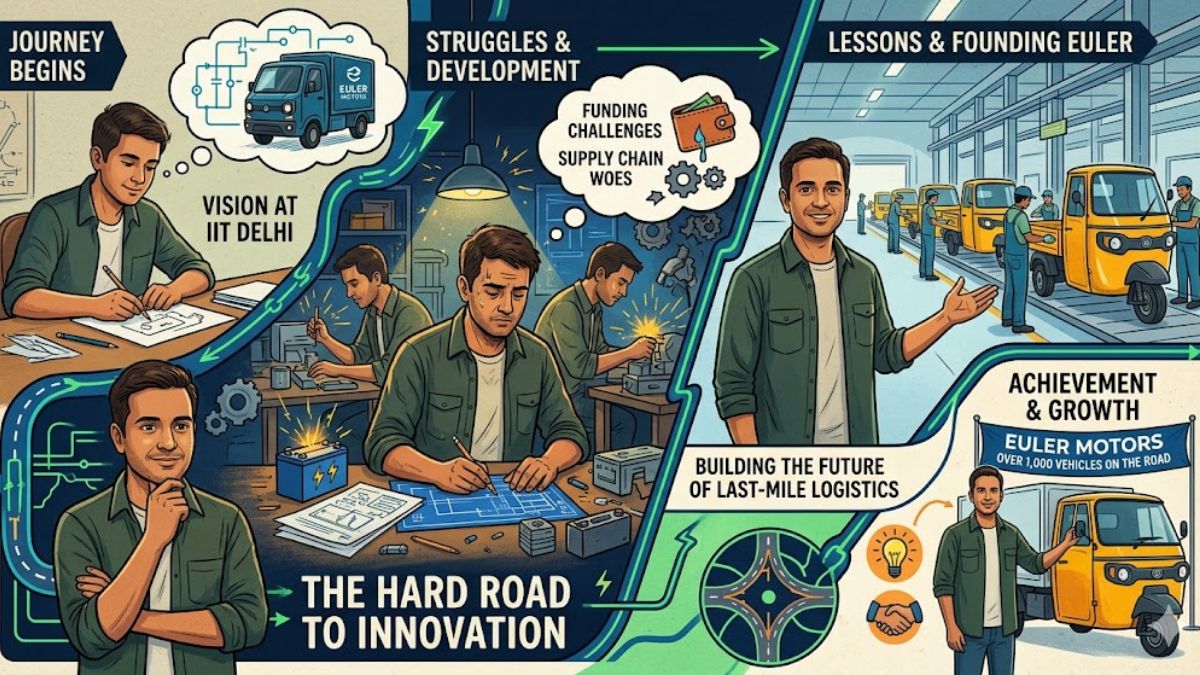
The Saurav Kumar Euler Motors founder story is a compelling narrative of conviction, deep market understanding, and long-term thinking in India’s rapidly evolving electric mobility space. Saurav Kumar is the founder and CEO of Euler Motors, a company focused on building electric commercial vehicles designed specifically for last-mile delivery solutions in India. Founded in 2018 and headquartered in New Delhi, Euler Motors is part of a new wave of electric vehicle startup India ventures solving real, infrastructure-heavy problems.
Kumar’s journey into entrepreneurship was shaped by his prior experience at Bain & Company and his earlier startup, Cube26. These experiences exposed him to the structural inefficiencies in India’s logistics and transportation sectors. As e-commerce boomed, the demand for EV commercial vehicles in urban logistics grew rapidly, but existing solutions failed to meet the needs of fleet operators. Euler Motors entered this gap with a focused approach. Instead of building electric passenger vehicles, the company chose to target commercial logistics, where the economics of electric mobility India made more sense. Its flagship vehicle, the HiLoad EV, was designed for heavy-duty urban deliveries, addressing payload, range, and reliability challenges that traditional electric vehicles struggled with.
The journey, however, was not linear. From capital-intensive manufacturing challenges to infrastructure gaps, from customer skepticism to operational complexity, Kumar faced multiple hurdles. Yet, Euler Motors has emerged as a strong player in the sustainable transportation India ecosystem, backed by leading investors and a growing customer base. This is the Saurav Kumar Euler Motors founder story that goes beyond headlines, unpacking the real journey, struggles, and lessons behind building one of India’s most focused EV startups.
1. Background and Early Life
1.1 Early Life and Family Background
The Saurav Kumar biography begins in India, where he grew up in a typical middle-class environment that valued education and stability. His early years were not marked by privilege but by discipline and curiosity. Like many first-generation entrepreneurs, Kumar’s upbringing instilled a strong sense of responsibility. This would later influence his approach to risk-taking and decision-making. While detailed public information about his family remains limited, his grounded personality and structured thinking reflect these early influences.
1.2 Education and Early Influences
Kumar pursued engineering before going on to complete his MBA from Indian Institute of Management Ahmedabad, one of India’s premier business schools. At IIM Ahmedabad, he developed a strong foundation in business strategy, operations, and market analysis. These skills would later become critical in building a capital-intensive business like an electric vehicle startup India.
His early career at Bain & Company gave him exposure to large-scale problem-solving. Consulting helped him understand industries from a macro perspective, especially sectors with structural inefficiencies. This combination of technical knowledge and strategic thinking laid the groundwork for the Saurav Kumar entrepreneur story.
2. Founder and Company Overview
2.1 Introduction to the Founder
Saurav Kumar is a second-time entrepreneur with a clear focus on solving complex, large-scale problems. Before Euler Motors, he founded Cube26, a technology startup that worked on mobile innovation. His journey reflects a shift from consumer technology to deep-tech and industrial sectors. This transition is not common, and it highlights his willingness to take on harder problems. The Saurav Kumar Euler Motors founder story is defined by this shift toward impact-driven entrepreneurship.
2.2 Company Overview and Offerings
Founded in 2018, Euler Motors focuses on designing and manufacturing electric commercial vehicles for logistics and delivery use cases. Its flagship product, HiLoad EV, is built for urban cargo movement. The vehicle is designed to handle heavy payloads, long operating hours, and rough road conditions. Euler Motors also provides a full-stack ecosystem, including charging infrastructure, financing support, and fleet management tools. This positions the company as more than just a vehicle manufacturer.
2.3 Target Audience and Market Served
Euler Motors primarily targets e-commerce companies, logistics firms, and fleet operators. These businesses rely heavily on last mile delivery solutions, making them ideal customers for EV adoption. The company focuses on urban and semi-urban markets where delivery density is high. This allows better utilization of EV commercial vehicles and improves unit economics.
2.4 Year of Founding and Business Stage
Euler Motors was founded in 2018. Since then, it has scaled manufacturing, expanded its product portfolio, and raised multiple funding rounds. Today, it is considered one of the promising players in electric mobility India, competing with both startups and established OEMs.
3. The Problem, Insight, and Trigger
3.1 Core Problem Identified
When Saurav Kumar started looking closely at last-mile logistics, what he saw wasn’t just inefficiency, it was a system quietly bleeding money every single day. Delivery vehicles running on internal combustion engines were expensive to operate. Fuel costs kept rising, maintenance was unpredictable, and downtime directly affected business outcomes. For fleet operators, this wasn’t a small inconvenience. It was a constant pressure on margins. At the same time, electric vehicles were already entering the market, but they weren’t built for this reality. Most EVs were designed for personal use, not for the harsh, repetitive, high-load demands of commercial logistics.
They couldn’t carry enough weight. They weren’t durable enough for long hours on Indian roads. And reliability, which is non-negotiable in logistics, was still a question mark. This created a very real gap. Not a theoretical opportunity, but a practical, everyday problem waiting to be solved. A need for vehicles that were electric, yes, but more importantly, built specifically for commercial use.
3.2 Personal Insight Behind the Idea
Sometimes, the most powerful ideas don’t come from sudden inspiration. They come from observation. Kumar was watching the rise of e-commerce closely. Orders were increasing, delivery networks were expanding, and expectations from customers were getting sharper. Faster delivery, lower costs, higher reliability. But the infrastructure supporting this growth was struggling to keep up.
There was a disconnect. On one side, there was demand growing at an almost relentless pace. On the other, there were outdated systems trying to support it. What stood out to him was the economics. If fleet operators could reduce fuel costs and maintenance expenses, their entire business model could improve. Electric vehicles had the potential to do exactly that. But only if they were designed for the job. That “if” was everything. This realization, simple on the surface but powerful in its implications, became the foundation of what would eventually become Euler Motors.
3.3 Trigger Moment to Start
Every startup has a moment where the idea stops being just an idea. For Kumar, that moment came when multiple trends began to align at the same time. Fuel prices were rising steadily, putting pressure on logistics companies. Environmental concerns were no longer abstract discussions, they were becoming real business considerations. And e-commerce was growing at a pace that demanded new solutions.
Individually, these trends were important. Together, they created urgency. It was no longer about whether change would happen. It was about who would build for it. That convergence acted as a trigger. It turned observation into action. It made the risk feel worth taking. And that is often the point where founders decide to step forward, not because the path is clear, but because the problem is too important to ignore.
4. Early Days and Initial Struggles
4.1 Early Assumptions and Naivety
In the beginning, like many founders entering a new space, Kumar believed the biggest challenge would be technology. Build a good electric vehicle, solve the engineering problems, and the rest would follow. But reality has a way of reshaping assumptions. Very quickly, it became clear that building a vehicle was not just about technology. It was about manufacturing at scale, managing supply chains, ensuring consistency, and delivering a product that could survive real-world conditions.
The ecosystem itself was still evolving. There were limited suppliers, limited infrastructure, and very few examples to learn from. That early phase often comes with a certain kind of naivety. And in hindsight, it is not a bad thing. Because without it, many founders might never begin.
4.2 Entrepreneurial Initial Struggles
Building a hardware startup is a different kind of challenge altogether. Unlike software, where you can iterate quickly, test, and deploy updates almost instantly, hardware demands patience. Every change takes time. Every mistake costs money. Euler Motors had to build from the ground up.
Setting up manufacturing capabilities. Finding the right suppliers. Ensuring quality at every step. Each of these required not just effort, but resilience. There were logistical challenges, financial constraints, and constant pressure to move forward despite uncertainty. And through all of this, there was one expectation that could not be compromised. The product had to work. Not just in controlled conditions, but in the chaos of real-world usage.
4.3 What Turned Out to Be Harder Than Expected
If there is one thing that stood out as unexpectedly difficult, it was achieving product-market fit. In software, you can release a version, gather feedback, and improve quickly. In hardware, every iteration is slower, heavier, and more expensive. Customers in the logistics space are not forgiving. They depend on reliability. A vehicle that fails is not just a product issue, it directly impacts their business.
This meant that Euler Motors had to get things right, often under tight timelines and limited resources. Balancing speed with quality became one of the toughest challenges. It required discipline, constant learning, and the ability to make tough decisions without complete information.
5. Failures, Setbacks, and Self Doubt
5.1 Toughest Phase of the Journey
There is always a phase in a startup journey where things feel particularly heavy. For Euler Motors, that phase came during early product development. Timelines stretched. Technical challenges surfaced. Costs began to rise faster than expected. Each delay added pressure, not just financially, but emotionally. It is in these moments that the excitement of building something new is tested against the reality of how difficult it actually is.
5.2 Early Failures and Major Setbacks
The first versions of any product rarely meet expectations, and Euler Motors was no exception. Early prototypes faced issues. Battery performance needed improvement. Durability under real-world conditions had to be tested again and again. Efficiency was not always where it needed to be. Each of these challenges required going back, rethinking, redesigning.
From the outside, these may look like technical adjustments. But internally, they can feel like setbacks, especially when time and resources are limited. Yet, this is where real progress happens. Because every failure carries a lesson. And in hardware, those lessons are often hard-earned.
5.3 Moments of Self Doubt and Emotional Lows
Behind every startup story is a human story. There are moments when things don’t go as planned. When the path forward is unclear. When the weight of responsibility feels overwhelming. Kumar faced those moments too. Building a capital-intensive company without guaranteed outcomes is not easy. There are days when confidence dips, when questions arise, when the future feels uncertain.
But those moments also bring clarity. They force you to revisit why you started. They test whether the problem you are solving is worth the struggle. And when the answer remains yes, despite everything, that is what keeps the journey moving forward.
6. Validation and Early Traction
6.1 First Real Validation or Customer
There is a big difference between believing your product will work and seeing someone actually use it in the real world. For Euler Motors, that moment came when early fleet operators decided to take a chance on their vehicles. These were not casual users. These were businesses whose daily operations depended on reliability, cost efficiency, and consistency. And they chose to trust a young company.
That trust was not given easily. It had to be earned through countless conversations, demonstrations, and proof that the product could handle real conditions, not just controlled tests. Once those first vehicles hit the road and started operating within fleets, something shifted. It was no longer just a prototype or an idea. It was a working solution. Fleet operators began noticing tangible changes. Lower running costs, fewer maintenance issues, and better efficiency over time. These weren’t abstract benefits. They showed up directly in their numbers. That is when validation becomes real, when the product starts solving a problem in a way that people can measure and rely on.
6.2 Early Revenue Growth or Feedback
With those first deployments came something even more valuable than revenue, feedback. Real, unfiltered, sometimes uncomfortable feedback. Vehicles were pushed to their limits. Long hours, rough roads, heavy loads. And with that came insights that no lab testing could fully replicate. Customers pointed out what worked and what didn’t. Where the vehicle performed well and where it needed improvement. Instead of resisting that feedback, Euler Motors leaned into it.
They iterated. They refined. went back to the drawing board when needed. Each version became a little better, a little more reliable, a little closer to what the market truly needed. As confidence grew, so did adoption. More businesses started showing interest. Word began to spread within logistics networks. Revenue followed, not as a sudden spike, but as steady, hard-earned growth. It was the kind of growth that comes from trust, not hype.
6.3 Why This Moment Changed Belief
Every founder reaches a point where belief stops being internal and starts being shared. For Saurav Kumar, this was that moment. Until then, the journey had been driven by conviction. By the belief that there was a problem worth solving and that their solution could work. But when customers began adopting the vehicles and seeing results, that belief was no longer just his.
It became market validation. It proved that the timing was right. That the industry was ready for a purpose-built electric commercial vehicle. That this was not just a good idea, but a necessary one. That shift changes everything. It gives the team confidence. It gives investors reassurance. And most importantly, it gives the company direction.
7. Funding, Money, and Growth Constraints
7.1 Bootstrapped or Funded Journey
Building a hardware startup without funding is almost impossible, especially in a space like electric mobility. Euler Motors brought in investors such as Blume Ventures and Athera Venture Partners, who believed in the vision early on. This capital was not just about survival. It was about enabling scale. Manufacturing requires infrastructure. It requires equipment, supply chains, and people. None of this comes cheap.
Funding allowed Euler Motors to move from small-scale production to something more structured. It helped them invest in better technology, expand operations, and build a foundation for growth. But funding also brings expectations. Once investors come in, the pressure to deliver becomes sharper. Milestones matter more. Timelines become tighter.
7.2 Capital Challenges and Cash Flow Issues
Even with funding, managing cash flow in a hardware business is a constant balancing act. Money goes out before it comes in. Production requires upfront investment. Inventory ties up capital. Delays can disrupt entire financial plans. There is very little margin for error. Euler Motors had to navigate this carefully.
Every decision, from sourcing components to scaling production, had financial implications. Growing too fast could strain resources. Moving too slow could mean losing market opportunity. This is where discipline becomes critical. Not just ambition, but control. Knowing when to push and when to hold back.
7.3 Early Growth Limitations
Growth, especially in manufacturing, is rarely smooth. Scaling production while maintaining quality is one of the toughest challenges. Each new unit needs to meet the same standards as the last. Any compromise can damage trust. At the same time, external factors come into play. Supply chain disruptions, delays in component availability, fluctuations in costs, these are realities that cannot always be controlled. For Euler Motors, these challenges slowed down certain aspects of growth.
But they also taught valuable lessons. They forced the team to build resilience. To create systems that could handle uncertainty. To plan not just for growth, but for stability. Sometimes, limitations shape a company more than rapid success ever could.
8. Team Building and Leadership Evolution
8.1 Early Hiring Mistakes
In the early days, hiring is one of the hardest decisions a founder makes. For a hardware startup, the challenge is even greater. You need specialized skills. Engineers who understand not just theory, but real-world application. People who can work with ambiguity and still deliver. Finding that combination is not easy. There were hires that didn’t work out as expected. People who were talented, but not the right fit for the pace or the nature of the work. These moments can be difficult. Letting someone go, rethinking decisions, starting again, it takes both clarity and emotional strength. But over time, these experiences sharpen judgment. They help founders understand not just what skills they need, but what mindset matters most.
8.2 Delegation Challenges
In the beginning, founders are involved in everything. Every decision, every detail, every problem passes through them. It feels necessary, and often it is. But as the company grows, this approach stops working. Kumar had to make a shift. From doing everything himself to trusting others to take ownership. From being in the details to focusing on direction.
Delegation is not just about handing over tasks. It is about building systems, creating accountability, and trusting people to make decisions. And trust does not come instantly. It is built over time, through both success and failure.
8.3 Leadership Learnings Over Time
Leadership is not something that stays fixed. It evolves with experience. Kumar’s journey reflects that evolution. From being deeply hands-on in the early days to becoming a leader who balances vision with execution. Someone who understands when to step in and when to step back. Over time, the focus shifts.
From solving immediate problems to thinking long-term. From managing tasks to building teams that can operate independently. There is also a certain calm that comes with experience. The ability to handle uncertainty without panic. To make decisions without complete information. To stay grounded even when the stakes are high. That is what defines real leadership. And in many ways, it becomes the foundation on which the entire company stands.
9. Growth, Scaling, and Operational Challenges
9.1 Brand Positioning and Go-To-Market Learnings
One of the smartest decisions Euler Motors made early on was clarity. They did not try to be everything for everyone. They did not position themselves as just another EV company. Instead, they chose a very specific identity, a solution provider for commercial logistics. That clarity made all the difference. Fleet operators are not looking for fancy features or futuristic branding. They care about performance, reliability, and cost efficiency. They want vehicles that work, day in and day out, without surprises.
Euler Motors leaned into that understanding. Their messaging, their product design, even their sales conversations were built around solving real operational problems. Lower running costs. Higher uptime. Better payload capacity. This focus helped them stand out in a crowded EV space where many players were still targeting personal mobility. Sometimes, growth is not about doing more. It is about doing the right things with precision.
9.2 Scaling Challenges
Scaling a hardware business is never smooth. As demand started to grow, Euler Motors faced the reality of expanding manufacturing and distribution. This is where ambition meets constraint. Production capacity had to increase, but without compromising quality. Distribution networks had to expand, but in a way that ensured service and support remained strong. And then there was the larger ecosystem problem.
Charging infrastructure in India was still developing. For a commercial EV company, this is not a small hurdle. It directly impacts usability and adoption. Instead of waiting for the ecosystem to catch up, Euler Motors took a more proactive approach. They started building parts of that ecosystem themselves. Charging solutions, service networks, and operational support systems that could make their vehicles viable in real-world conditions. It was not easy. It required additional investment, more coordination, and a longer-term mindset. But it also gave them control.
9.3 Operational Breakdowns and Fixes
No scaling journey is free of breakdowns. There were supply chain disruptions. Components that didn’t arrive on time. Vendors who couldn’t meet expectations. Service challenges that affected customer experience. These moments test a company’s resilience. What matters is not whether problems occur, but how quickly and effectively they are addressed.
Euler Motors treated these challenges as learning opportunities. Systems were strengthened. Processes were refined. Feedback loops were created to catch issues earlier. Over time, these fixes became part of the company’s DNA. Because in operations, consistency is everything. And consistency is built through repetition, correction, and discipline.
10. Personal Sacrifices and Burnout
10.1 Personal Costs of Entrepreneurship
Behind every startup story is a personal story that rarely gets told fully. Building Euler Motors was not just a professional commitment for Saurav Kumar. It became a personal one. Long hours became normal. Weekends blurred into weekdays. The line between work and life slowly faded. There are moments in entrepreneurship where you realize that time is no longer yours in the way it used to be.
Family, friends, personal time, all of it takes a step back. Not because it is unimportant, but because the demands of building something from scratch are relentless. These are the quiet sacrifices that do not show up in headlines.
10.2 Burnout Phases and Emotional Pressure
Pressure in a startup does not come in a single form. It comes from investors expecting progress. From teams depending on leadership. customers expecting reliability. From the constant need to move forward, even when things are uncertain. Over time, this pressure builds. There are phases where exhaustion sets in. Where decisions feel heavier. Where the pace becomes difficult to sustain. Burnout is not always dramatic. Sometimes it is subtle. A constant fatigue, a mental strain that does not go away easily. Managing this becomes as important as managing the business itself. For Kumar, like many founders, building mental resilience became part of the journey. Learning when to push, when to pause, and how to stay grounded through it all.
10.3 Impact on Personal Life
Entrepreneurship has a way of consuming space. It enters conversations, thoughts, and even moments that are meant to be personal. It becomes difficult to switch off completely. For Kumar, this meant navigating a life where work was always present in some form.
Relationships require attention. Time requires intention. And when both are limited, it creates its own set of challenges. This is one of the less visible aspects of building a company. Success stories often focus on outcomes. But the journey includes these trade-offs, these quiet adjustments that founders make along the way.
11. Lessons, Beliefs, and Values
11.1 Core Lessons Learned
If there is one lesson that stands out from this journey, it is the importance of solving a real problem. Euler Motors did not start with a trend. It started with a gap that was visible, measurable, and impactful. Another key lesson is patience. Hardware businesses do not move at the speed of software. They require time, iteration, and persistence. There are no shortcuts. Understanding this early can save founders a lot of frustration.
11.2 Beliefs That Changed Over Time
In the beginning, like many founders, there is often a desire for quick progress. Fast growth, rapid scaling, visible success. But experience changes that perspective. Over time, Kumar’s focus shifted toward long-term thinking. Building systems that last. Making decisions that may not show immediate results but create stability over time. This shift is subtle but powerful. It moves the company from chasing momentum to building substance.
11.3 Non-Negotiable Values
Certain values become non-negotiable only after being tested. For Euler Motors, quality and reliability are not just product features. They are commitments. In the logistics space, a single failure can have cascading effects. A vehicle that breaks down affects deliveries, operations, and trust. Customer trust, once lost, is hard to rebuild. This is why these values sit at the core of the company’s approach.They are not optional. They define how the company operates.
12. Present Challenges and Future Vision
12.1 Ongoing Struggles Today
Even today, the journey is far from easy. Electric mobility in India continues to face challenges. Charging infrastructure is still uneven. Regulations evolve. Market dynamics shift as new players enter the space. Competition is increasing, not just from startups, but also from established automotive companies. This creates a more demanding environment. But it also validates the opportunity.
12.2 Current Leadership Philosophy
Kumar’s approach today reflects everything the journey has taught him. There is less emphasis on noise and more on execution. Less focus on quick wins and more on building a strong foundation. The goal is not just to grow fast, but to grow right. This kind of leadership often appears quiet from the outside. But internally, it creates clarity. Teams know what matters. Decisions become more aligned.
12.3 Long-Term Vision
At its core, the vision remains unchanged. To transform last-mile logistics through electric vehicles that are built for real-world use. It is a vision that goes beyond just selling vehicles. It is about changing how transportation works in a critical part of the economy. If done right, the impact is significant. Lower costs for businesses. Reduced environmental impact. More efficient delivery systems. But like everything else in this journey, it will take time. And that is something Kumar seems to have fully embraced. The Saurav Kumar Euler Motors founder story continues to evolve as the company scales.
The Problem the Founder Remains Obsessed With Kumar remains focused on making sustainable transportation India practical and scalable. The Saurav Kumar Euler Motors founder story is ultimately about solving this problem at scale.
About foundlanes.com
foundlanes.com is India’s leading startup idea discovery platform. It helps entrepreneurs find actionable startup opportunities, market insights, and industry-specific guidance to turn ideas into real businesses. With deep research and practical resources, foundlanes supports founders at every stage, from idea validation to launch and growth.