
News Summary
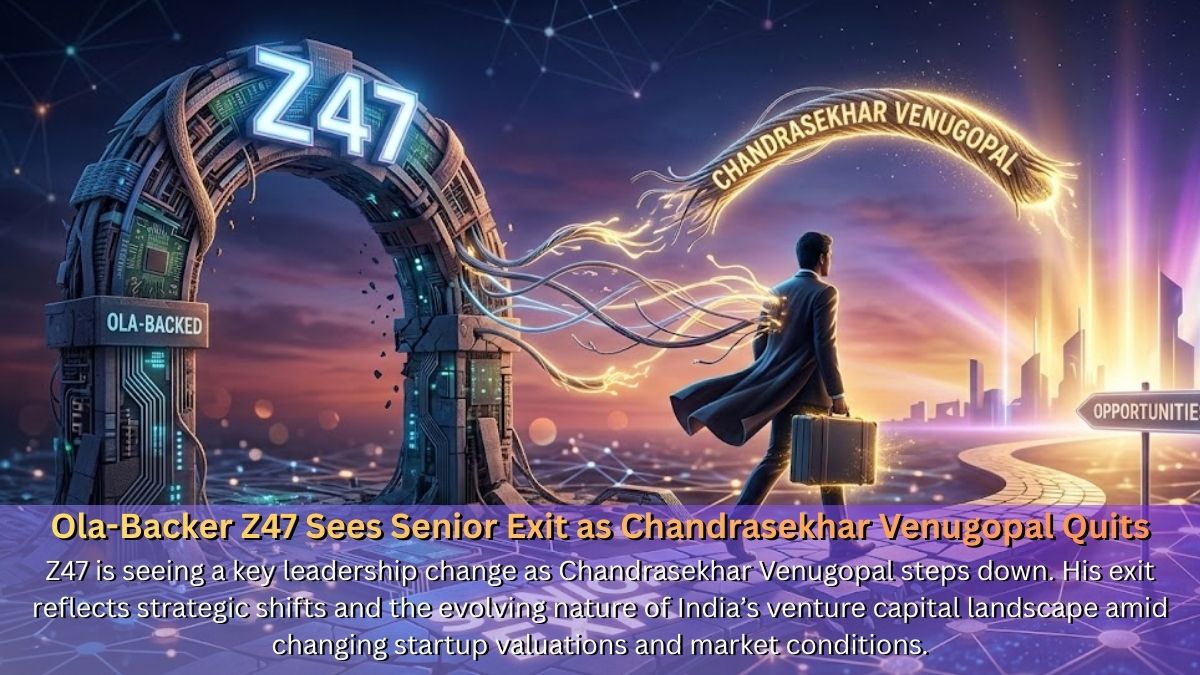
Ola-Backer Z47, a venture capital firm known for backing several high-growth startups, is witnessing a significant leadership change. Senior executive Chandrasekhar Venugopal has stepped down from his role, marking an important moment for the investment firm and the wider venture capital landscape in India. The development has drawn attention across the startup ecosystem because leadership changes at venture-backed investment firms often signal shifts in strategy, investment focus, or organizational structure.
Chandrasekhar Venugopal played a key role in the operations and strategic direction of the firm. His exit comes at a time when venture capital funds in India are reassessing investment strategies due to evolving market conditions, changing startup valuations, and increased focus on profitability among emerging startups. The departure highlights the dynamic nature of leadership within the venture capital industry, where senior executives frequently move between funds, advisory roles, or entrepreneurial ventures.
Z47 has gained recognition as a venture capital platform supporting early-stage and growth-stage companies. The firm has been associated with investments in technology startups and emerging sectors across the Indian startup ecosystem. The backing of companies linked to prominent entrepreneurs and ventures such as ride-hailing giant Ola has placed the firm within conversations around influential startup investors in India.
Leadership transitions within venture capital firms often raise questions about future investment direction, portfolio management, and fundraising strategies. However, such changes are also common as venture firms expand, restructure teams, or adapt to new market opportunities. The exit of Venugopal also reflects broader industry trends within venture capital, where experienced investors frequently transition to new roles across startup platforms, private equity funds, or advisory networks. With India’s startup ecosystem continuing to evolve, leadership changes within venture-backed investment firms remain an important indicator of shifts in the venture capital landscape. This development therefore not only affects the internal operations of Z47 but also reflects broader changes in how venture capital firms operate, grow, and compete in one of the world’s fastest-growing startup markets.
1. Understanding the Leadership Exit at Z47
1.1 A Significant Leadership Departure
The venture capital world often moves quietly behind the scenes, but when a senior investor steps away from a fund, it rarely goes unnoticed. That is exactly what happened at Z47, the venture firm known for backing some of India’s most ambitious startups. The recent departure of Chandrasekhar Venugopal has triggered conversations across the startup ecosystem about what this shift might mean for the firm’s future direction. Venugopal was not just another executive inside the organization. His role sat close to the heart of how venture capital actually works. From evaluating promising founders to shaping the firm’s investment strategy, he was part of the decision-making layer that determines which startups receive capital and which ideas move forward.
Inside venture capital firms, these decisions carry enormous weight. A single investment can influence the trajectory of an entire company. When investors choose to support a founder early, they are often betting not just on the product but on the people behind it. During his time at Z47, Venugopal worked closely with founders, entrepreneurs, and emerging startup teams. Conversations with founders often went far beyond spreadsheets or pitch decks. Venture investors frequently help founders refine their strategy, navigate fundraising challenges, and prepare for the realities of scaling a company.
This is why leadership exits inside venture capital firms attract attention. When someone deeply involved in investment decisions leaves, it naturally raises questions about how the firm might evolve next. While transitions are common in the venture capital industry, each departure signals a moment of change within the organization.
1.2 Why Leadership Changes Matter in Venture Capital
To someone outside the startup ecosystem, the departure of a venture capital executive might appear like a routine professional move. But within venture capital firms, leadership transitions often carry broader strategic implications. Venture capital is not just about deploying money. It is about building conviction around ideas that do not yet fully exist.
Senior partners and investment leaders help define what a fund believes in. They shape the investment thesis that guides where capital flows. Some investors focus on fintech innovation, others on deep technology, consumer platforms, or artificial intelligence. These preferences shape the identity of the firm itself. When a senior leader leaves, the firm sometimes reassesses its investment priorities. New leaders may bring fresh perspectives, explore different sectors, or adjust the way the firm works with founders.
However, such transitions are also a normal part of the venture capital journey. Across global venture ecosystems, many investors eventually move on to new opportunities. Some launch their own venture funds, eager to build an investment philosophy of their own. Others join startup companies, stepping into operational roles where they can directly help build businesses. Some investors choose to become founders themselves.
The venture capital world is deeply interconnected, and professionals often move between funds, startups, and entrepreneurial ventures throughout their careers. Seen in that light, Venugopal’s departure from Z47 reflects both a moment of transition for the firm and a reminder of how fluid leadership can be in the startup investment landscape.
2. The Story Behind Z47
2.1 Building a Venture Platform in India’s Startup Boom
India’s startup ecosystem has expanded rapidly over the past decade, and venture capital firms have played a central role in that transformation. Among the firms that gained recognition during this period is Z47, an investment platform known for supporting high-growth technology companies. The firm built its reputation by identifying founders early and backing ideas that had the potential to scale quickly in India’s digital economy.
In venture capital, timing matters as much as vision. Investors who recognize emerging trends early often gain access to the most promising startups before the rest of the market catches on. Z47’s investment approach has largely focused on innovation-driven companies operating in technology and digital platforms. As India’s internet economy expanded, the firm positioned itself among the investors searching for the next generation of transformative businesses.
One factor that brought additional visibility to the firm was its association with Ola, one of India’s most prominent technology companies. Connections to successful startup founders often help venture funds gain credibility within the broader ecosystem. For founders seeking investment, the reputation of a venture firm matters deeply. Startups are not simply looking for capital. They are looking for partners who can support them through the unpredictable journey of building a company. By building relationships with founders and participating in early-stage investments, Z47 gradually strengthened its presence within India’s competitive venture capital landscape.
2.2 Betting on Technology and Emerging Sectors
Technology remains at the center of Z47’s investment philosophy. The firm has typically focused on startups building digital platforms, fintech innovations, and disruptive technology solutions designed to reshape traditional industries. This focus reflects a broader pattern across the venture capital world. Investors are often drawn to sectors where technology can dramatically improve efficiency or create entirely new markets. Fintech platforms can redefine financial access. Digital marketplaces can connect buyers and sellers at unprecedented scale. Artificial intelligence and automation are opening new possibilities across industries.
For venture capital firms, these sectors represent both opportunity and risk. Many startups experimenting with new technologies will fail. Business models may struggle, markets may not evolve as expected, and competition can quickly intensify. Yet venture capital operates on a simple reality: a small number of successful investments can deliver extraordinary returns. That is why firms like Z47 focus on identifying founders with strong vision, resilient leadership, and the ability to adapt as markets evolve.
3. Chandrasekhar Venugopal’s Role Within the Firm
3.1 Guiding Investment Strategy
Within a venture capital firm, senior investors play a role that blends analysis, judgment, and experience. Chandrasekhar Venugopal held a position that required exactly this combination. His work involved studying emerging markets, evaluating startup ideas, and deciding where the firm should deploy its capital. This process is rarely straightforward. Founders present ambitious visions, often backed by early prototypes or limited traction. Venture investors must look beyond current numbers and imagine how a business could evolve over the next five or ten years. They ask difficult questions. Is the market large enough? Does the founding team have the resilience to survive inevitable challenges? Can the company build something competitors cannot easily replicate?
These decisions determine which startups receive the financial support needed to grow. Venugopal’s responsibilities also included helping shape Z47’s broader investment direction. Every venture firm develops a certain identity based on the sectors it focuses on and the type of founders it supports. Senior leaders influence that identity through their investment choices and strategic insights.
3.2 Supporting Founders Beyond Capital
One of the most misunderstood aspects of venture capital is the idea that investors simply provide money and step aside. In reality, many venture investors become deeply involved in the journeys of the companies they back. For founders navigating the chaotic early years of building a startup, experienced investors often act as advisors, sounding boards, and sometimes even emotional anchors during difficult moments.
During his tenure at Z47, Venugopal reportedly played this kind of supportive role with several portfolio companies. Startups frequently encounter obstacles that go far beyond product development. Hiring leadership teams, structuring future funding rounds, managing rapid growth, and dealing with competitive pressures all become part of the founder’s daily challenges.
Investors who understand these struggles can provide valuable guidance. They may introduce founders to strategic partners, help refine business models, or connect companies with future investors during later fundraising stages. These contributions often remain invisible to the public. But within the startup ecosystem, such mentorship can shape the difference between a startup that scales successfully and one that fades away. In that sense, the role of investors like Venugopal extended well beyond capital allocation. It was about supporting entrepreneurs through one of the most demanding journeys in modern business.
4. Venture Capital and the Startup Ecosystem
4.1 How Venture Capital Firms Actually Operate
Behind every successful startup story, there is often a group of investors who believed in the idea long before the rest of the world noticed it. Venture capital firms exist to take those early bets. They look for founders with bold ideas, unproven markets, and the determination to build something meaningful from scratch. Firms like Z47 raise capital from a network of investors that usually includes institutional funds, global financial organizations, family offices, and high-net-worth individuals. These investors commit money to the venture fund with the expectation that the fund managers will identify promising startups capable of delivering strong long-term returns.
Once the capital is raised, the venture firm begins the process that defines the industry: searching for potential. Partners and analysts spend months evaluating startups, studying industries, speaking with founders, and analyzing market opportunities. The goal is not just to find a company that is doing well today, but to identify businesses that could dominate entire markets in the future.
When a venture capital firm invests in a startup, it usually receives equity in return. This means the firm becomes a partial owner of the company. If the startup succeeds, grows rapidly, and eventually exits through an acquisition or public listing, the value of that equity can increase dramatically. This is the foundation of the venture capital model. Most startups will struggle or fail. But a small number will grow into extremely valuable companies. Those few successes often generate returns large enough to compensate for the rest of the portfolio. It is a model built on conviction, patience, and a willingness to take risks where others hesitate.
4.2 Why Venture Capital Matters for Startup Growth
For many entrepreneurs, building a startup is both exciting and overwhelming. A founder might begin with a brilliant idea, but turning that idea into a scalable company requires resources that are often difficult to access early on. This is where venture capital becomes transformative. Across India’s rapidly evolving startup ecosystem, venture investors have played a crucial role in helping founders move from concept to company. They provide the capital needed to build products, hire teams, develop technology infrastructure, and expand into new markets. But the impact of venture capital goes far beyond money.
Experienced investors often become mentors and advisors to founders. They bring industry knowledge, operational insights, and strategic guidance that young companies might otherwise lack. Many venture partners have worked with dozens of startups over the years, giving them a deep understanding of what works and what fails in high-growth environments.
When a founder faces difficult decisions such as entering a new market, raising the next round of funding, or restructuring a team, venture investors frequently become trusted sounding boards. These relationships can shape the trajectory of entire companies. Some of India’s most successful startups reached scale only because early investors believed in their potential when very few others did. Venture capital does not just fund startups. It helps build the ecosystem that allows innovation to flourish.
5. The Working Model of Z47
5.1 How the Firm Identifies Investment Opportunities
The investment philosophy at Z47 revolves around identifying startups that combine strong technological capabilities with ambitious market potential. Venture capital firms operate in an environment where thousands of startups compete for attention, but only a handful receive investment. That means the evaluation process becomes incredibly selective.
When founders approach venture firms, they often present detailed pitch decks outlining their product, market opportunity, revenue strategy, and long-term vision. Investors examine these ideas carefully, looking for signals that suggest the company could grow far beyond its current stage. Several factors usually influence the decision. One of the most important is the strength of the founding team. Venture investors frequently say they invest in people first and ideas second. Markets evolve, products change, and strategies pivot, but resilient founders with clear vision can adapt to these shifts.
Another critical factor is the size of the opportunity. Venture capital thrives in markets that have the potential to scale quickly. Investors want to support companies that can expand rapidly and reach millions of users. Technology also plays a major role. Startups that use technology to solve real-world problems or disrupt traditional industries often attract strong interest from venture funds. By focusing on these elements, firms like Z47 attempt to identify companies that could become the next generation of industry leaders.
5.2 Building and Supporting a Portfolio of Startups
Once an investment is made, the relationship between the venture firm and the startup truly begins. Unlike traditional financial investors who remain distant, venture capital firms often stay deeply involved with their portfolio companies. The success of the startup directly influences the success of the fund, so investors have a strong incentive to support founders through every stage of growth. At Z47, this support can include strategic mentoring, introductions to industry experts, and guidance on future fundraising rounds.
For early-stage startups, one of the biggest challenges is building the right team. Venture firms frequently help founders recruit experienced executives who can manage scaling operations. They may also assist with partnerships that open doors to new customers or markets. Another critical area is fundraising. Startups typically raise multiple rounds of investment as they grow. Venture firms often connect founders with other investors, global funds, and startup accelerators that can participate in later funding stages. This network effect becomes extremely valuable. The more connections a venture firm has within the startup ecosystem, the greater its ability to support founders as they expand their businesses.
6. The Revenue Model Behind Venture Capital
6.1 Management Fees That Sustain the Fund
Venture capital firms operate as investment managers, and like most asset managers, they earn revenue through management fees. When investors commit money to a venture fund, a small percentage of that capital is paid annually to the fund managers. These fees help cover operational costs such as research, due diligence, salaries for investment teams, and the administrative infrastructure required to manage a portfolio of startups. Although these fees provide stability for the firm, they are not the primary source of long-term profit. Most venture investors are far more focused on the second and more significant component of the revenue model.
6.2 Carried Interest and the Power of Successful Exits
The real financial upside for venture capital firms comes from carried interest. This mechanism allows the firm to earn a percentage of the profits generated when portfolio companies achieve successful exits. These exits usually occur through acquisitions or initial public offerings. If a startup backed by a venture fund grows dramatically in value, the fund’s equity stake becomes highly valuable. When that equity is eventually sold, the profits are shared between the investors and the fund managers. This structure creates a powerful incentive system. Venture investors are motivated to identify startups with extraordinary growth potential and to support those companies throughout their journey. When a portfolio company succeeds, both the founders and the investors benefit from the value created. It is this possibility of outsized returns that makes venture capital such a powerful force within the innovation economy.
7. The Changing Global Funding Landscape
7.1 India’s Rise as a Global Startup Hub
Over the past decade, India has transformed into one of the world’s most vibrant startup ecosystems. The combination of a massive digital consumer base, rapid smartphone adoption, and expanding internet infrastructure has created fertile ground for innovation. As a result, venture capital investment in Indian startups has grown dramatically.
Global investors from the United States, Europe, and Asia have deployed billions of dollars into technology companies across sectors such as fintech, mobility, e-commerce, and software platforms. This influx of capital has helped produce dozens of unicorn startups and accelerated the growth of the country’s digital economy.For venture firms like Z47, this environment presents enormous opportunity. A growing ecosystem means more founders, more ideas, and more companies seeking capital to scale their innovations.
7.2 A Shift Toward Sustainable Growth
However, the venture capital landscape has also evolved in recent years. During earlier phases of the startup boom, investors often prioritized rapid growth above all else. Companies raised large funding rounds and expanded aggressively, sometimes without a clear path to profitability. The global economic climate and shifting market realities have changed that mindset. Today, venture capital firms increasingly emphasize sustainable growth, efficient capital usage, and stronger business fundamentals. Startups are expected to demonstrate not only growth potential but also disciplined financial management.
For founders, this shift has created a more balanced environment. Investors are still searching for ambitious ideas, but they are also asking tougher questions about revenue models, profitability timelines, and long-term sustainability. In many ways, this evolution reflects a maturing startup ecosystem. The next generation of successful startups will likely be those that combine bold innovation with responsible growth strategies.
8. Industry Trends Influencing Venture Capital
8.1 A Growing Focus on Sustainable Business Models
Over the past few years, venture capital has gone through a noticeable shift. For a long time, the startup ecosystem celebrated speed above everything else. Companies raised large funding rounds, expanded rapidly, and chased user growth even if profitability seemed far away. But that mindset has started to change. Today, investors look much more carefully at the fundamentals of a business. They want to understand how a startup makes money, how efficiently it spends capital, and whether its growth can actually be sustained over time. Founders are now expected to demonstrate clear revenue streams, responsible spending habits, and a realistic path to profitability.
This change did not happen overnight. Many venture-backed companies that once raised massive funding rounds eventually struggled because their business models depended too heavily on continuous external capital. When global markets tightened and funding slowed down, those weaknesses became visible. Investors learned from those experiences. As a result, venture capital firms now ask deeper questions before writing checks. They look at unit economics, customer acquisition costs, retention rates, and long-term scalability. Instead of rewarding aggressive expansion alone, investors increasingly value discipline and resilience.
For founders, this shift has been both challenging and healthy. It forces entrepreneurs to build companies that are not only exciting but also financially responsible. In the long run, this approach strengthens the startup ecosystem and creates businesses that can survive market cycles rather than collapse when funding slows.
8.2 The Rise of New and Emerging Startup Sectors
While the investment mindset has matured, the range of opportunities for startups continues to expand rapidly. Venture capital firms are constantly scanning the market for industries that could shape the future. In recent years, several sectors have emerged as particularly attractive to investors. Artificial intelligence is one of the most talked-about areas. AI-powered startups are transforming industries ranging from healthcare and finance to logistics and education. Investors believe that companies building intelligent automation tools and data-driven platforms could become some of the most influential technology businesses of the coming decade.
Fintech continues to remain another major investment category. Digital payments, lending platforms, and financial infrastructure startups are reshaping how individuals and businesses access financial services. In countries like India, where millions of people are still entering the formal financial system, fintech innovation carries enormous growth potential. Clean energy and climate-focused startups have also captured growing attention. With governments and corporations increasingly committed to sustainability, investors see opportunities in renewable energy, energy storage technologies, and climate solutions. These startups are not only building profitable businesses but also addressing urgent global challenges.
Blockchain and decentralized technologies have also generated curiosity within the venture capital community. While the space continues to evolve, investors are exploring use cases that extend beyond cryptocurrencies, including digital identity, supply chain verification, and decentralized finance platforms. For venture capital firms, these emerging sectors represent the next wave of transformative companies. For founders, they offer fertile ground for bold ideas that could reshape entire industries.
9. Competitors and Market Position
9.1 Direct Competitors in the Venture Capital Landscape
The venture capital industry is intensely competitive. Funds constantly compete to discover and invest in the most promising startups before others do. For a firm like Z47, this means operating in an environment where several experienced investors are chasing the same opportunities. Across India’s startup ecosystem, multiple venture capital firms actively back technology startups. Each firm has its own investment philosophy, sector preferences, and network of founders. Some specialize in early-stage investments, while others focus on growth-stage companies that are preparing to scale rapidly.
Because of this competition, gaining access to top startup deals often depends on relationships and reputation. Founders tend to choose investors who bring more than just money. They look for partners who understand their industry, provide valuable mentorship, and help open doors to customers, talent, and future investors. This dynamic makes venture capital a relationship-driven industry. The firms that succeed over the long term are those that earn the trust of founders and consistently help their portfolio companies grow.
9.2 Indirect Competitors in the Investment Ecosystem
Venture capital firms are not the only players providing capital to startups. The broader investment ecosystem includes several other participants who also compete to support promising companies. Angel investors, for instance, often provide the first capital that early-stage founders receive. These investors are typically successful entrepreneurs or industry professionals who invest their own money in new ideas. Their involvement can be deeply personal, as many enjoy mentoring the next generation of founders.
Startup accelerators and incubators also play a critical role. These programs offer funding, mentorship, and structured guidance to young companies during their earliest stages. By helping founders refine their business models and connect with investors, accelerators act as an important bridge between ideas and scalable companies. Private equity firms represent another category of investors, though they usually enter the picture at later stages. Unlike venture capital funds that invest in early growth, private equity firms often focus on mature businesses that are already profitable.
Despite this competition, venture capital firms still lead many of the largest funding rounds for high-growth startups. Their ability to deploy significant capital and support companies through multiple growth stages keeps them at the center of the startup ecosystem.
10. Impact of the Leadership Exit
10.1 What It Means for Z47
Leadership changes within venture capital firms often attract attention because of the influence senior partners have on investment decisions. The departure of Chandrasekhar Venugopal from Z47 represents one such moment. Executives in these roles are not simply managers. They shape the fund’s investment philosophy, evaluate startup opportunities, and build long-term relationships with founders. Their judgment can determine which startups receive funding and which ones do not.
When a leader leaves, it naturally raises questions about the firm’s future direction. Will the investment strategy remain the same? Will new leadership bring different priorities or sector interests? These are questions that investors, founders, and industry observers often consider during such transitions. However, experienced venture capital firms are built to handle these moments. Investment teams typically operate collaboratively, and funds often have multiple partners involved in key decisions. While leadership departures may influence the culture or strategy over time, the core investment process usually continues without disruption. In many cases, such transitions even create new opportunities. Fresh leadership can introduce new perspectives, expand networks, and explore emerging sectors that were previously overlooked.
10.2 Signals for the Broader Venture Capital Market
Leadership shifts also reflect the dynamic nature of the venture capital industry itself. Professionals in this field frequently move between funds, start new investment platforms, or join startup companies they once backed. These movements are part of the natural evolution of the ecosystem. As markets mature, experienced investors often pursue new challenges or seek greater independence in shaping their investment vision.
For the broader startup community, such developments highlight how interconnected the venture capital world has become. A single leadership change can ripple through networks of founders, co-investors, and portfolio companies. At the same time, these transitions remind entrepreneurs that venture capital is not static. It evolves constantly alongside technological innovation, market opportunities, and economic conditions.
11. Lessons for Startups and Entrepreneurs
Events like the leadership transition at Z47 carry meaningful lessons for founders navigating the startup ecosystem. First, leadership changes are a normal part of any organization’s journey. Companies grow, industries shift, and individuals pursue new paths. Founders should understand that investors, just like entrepreneurs, operate in an environment defined by constant change. Second, the fundamentals of building a strong business remain more important than ever. Venture capital may fluctuate with market cycles, but investors consistently back companies that demonstrate clear value, strong teams, and sustainable growth potential.
Third, mentorship from experienced investors can be incredibly valuable. Venture capitalists often bring years of industry insight, networks, and operational knowledge that can help startups avoid costly mistakes. The relationship between founders and investors, when built on trust, can become a powerful growth engine. Finally, adaptability remains one of the most important qualities for entrepreneurs. Markets evolve quickly. Funding conditions change. Customer needs shift. The founders who succeed are those who remain flexible, learn from challenges, and continuously refine their strategies.
In many ways, the story unfolding around leadership shifts in venture capital is a reminder that the startup world is constantly moving. New ideas emerge, industries transform, and new leaders step forward. For entrepreneurs willing to learn and adapt, these changes are not obstacles. They are opportunities waiting to be recognized.te the startup journey.
About foundlanes.com
foundlanes.com is India’s leading startup idea discovery platform. It helps entrepreneurs find actionable startup opportunities, market insights, and industry-specific guidance to turn ideas into real businesses. With deep research and practical resources, foundlanes supports founders at every stage, from idea validation to launch and growth.