News Summary
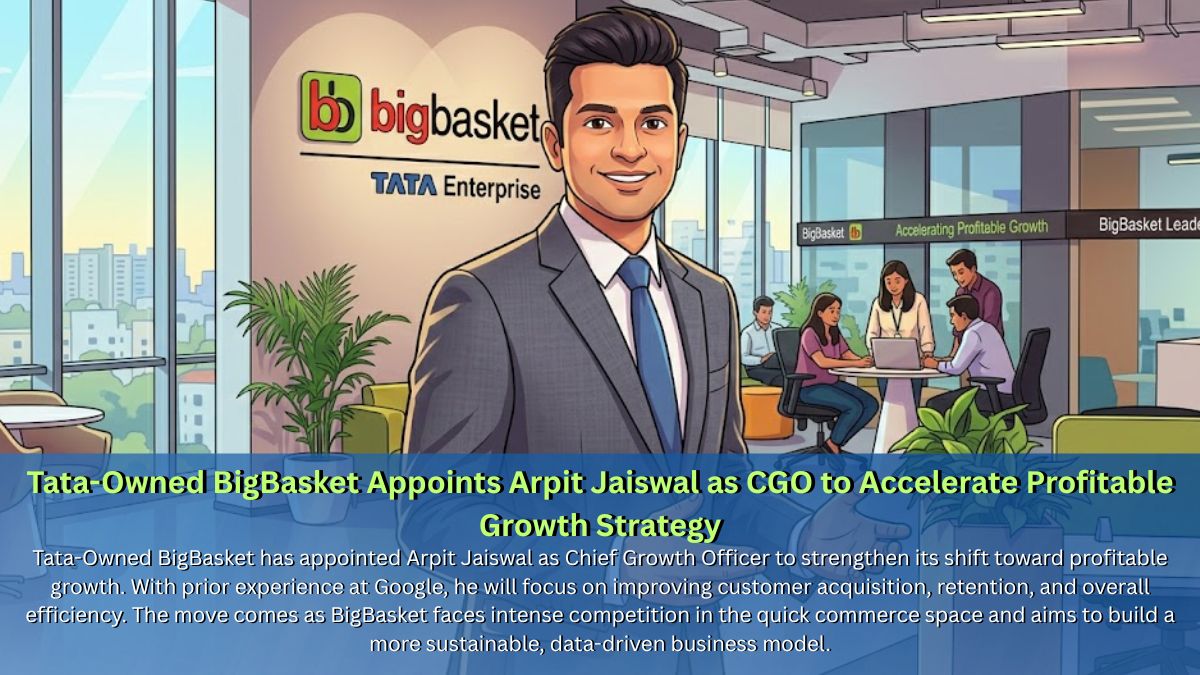
The Tata-Owned BigBasket has appointed Arpit Jaiswal as its new Chief Growth Officer (CGO), marking a significant leadership move aimed at strengthening its profitable growth strategy in India’s highly competitive quick commerce and online grocery market. Jaiswal, a former Google executive, brings extensive experience in scaling digital businesses, product-led growth, and advertising-driven ecosystems.
This leadership change comes at a crucial time for Tata-Owned BigBasket, which is focusing more on sustainable profitability rather than aggressive expansion alone. The company, operated under Tata Digital, continues to face strong competition from Blinkit, Swiggy Instamart, Zepto, and Reliance-backed JioMart. As a result, BigBasket is now shifting toward improving unit economics, strengthening customer retention, and enhancing operational efficiency.
Arpit Jaiswal’s appointment is expected to accelerate data-driven growth initiatives, improve customer acquisition strategies, and refine monetization models across platforms. His experience in global tech ecosystems is likely to help BigBasket optimize marketing efficiency and improve long-term profitability. Founded in 2011, BigBasket has grown from a simple online grocery delivery platform into one of India’s largest grocery aggregators. Over time, it evolved into a key player in the Indian startup ecosystem, especially after its acquisition by Tata Group, which further strengthened its market position and supply chain capabilities.
The appointment reflects a broader trend in Indian startup news, where companies are prioritizing profitability, sustainable business models, and stronger leadership structures. As venture capital-backed startups face pressure to deliver returns, BigBasket’s move signals a shift in the broader startup ecosystem toward disciplined growth and improved financial performance.
1. Tata-Owned BigBasket Leadership Update and Strategic Shift
1.1 BigBasket’s Leadership Expansion Under Tata-Owned BigBasket
The leadership changes at Tata-Owned BigBasket are not just a routine corporate update. They reflect a deeper shift in mindset inside the company. For years, BigBasket operated in a market where growth was measured mainly by how fast it could expand into new cities and how aggressively it could win customers through discounts. But that phase is clearly fading.
Now, under Tata Digital, Tata-Owned BigBasket is moving toward something more mature and, honestly, more demanding: profitable growth. This is not an easy transition in a market like India, where price sensitivity is extremely high and competition is constantly pushing discounts to the edge.
The arrival of Arpit Jaiswal as Chief Growth Officer fits directly into this shift. His role is not just about “growth” in the traditional sense. It is about reshaping how growth itself is defined inside the company. That means asking harder questions like: Are we acquiring the right customers? Are they staying? Are we spending too much to bring them in? And most importantly, are we actually making money after fulfilling their orders?
1.2 Inside Tata-Owned BigBasket
Inside Tata-Owned BigBasket, this leadership expansion signals a more disciplined era. Teams are being pushed to think beyond vanity metrics like app installs or order volume. Instead, the focus is moving toward customer lifetime value, retention quality, and contribution margin per order. There is also a visible shift in how marketing is being approached. Earlier, aggressive promotions and cashback-heavy campaigns were common across the industry. Now, BigBasket is clearly aligning toward smarter spending. Every rupee spent on customer acquisition is expected to show measurable long-term return.
At a practical level, this means tighter control on marketing budgets, sharper targeting of high-value customers, and better integration between product, data, and operations teams. The goal is simple but tough: grow without burning cash unnecessarily. And this is exactly where Arpit Jaiswal’s profile becomes important.
2.2 Profile of Arpit Jaiswal and His Industry Experience
Arpit Jaiswal is stepping into Tata-Owned BigBasket at a time when experience matters more than experimentation. His background at Google is particularly relevant because Google is one of the most data-driven companies in the world, especially when it comes to scaling digital products globally. At Google, growth is not driven by guesswork. It is built on structured experimentation, constant A/B testing, and deep behavioral analysis of users. That kind of thinking is exactly what BigBasket needs right now, as it tries to balance scale with profitability.
In practical terms, his experience translates into something very specific for BigBasket. Instead of pushing broad, expensive marketing campaigns, the focus shifts toward precision. Which user segments are profitable? Which cohorts are returning consistently? Acquisition channels are actually worth investing in?
These are not abstract questions. They directly impact how money flows inside the company. There is also a deeper layer here around customer lifecycle thinking. BigBasket is no longer just competing to acquire users. It is competing to keep them. In the grocery space, loyalty is fragile. One better offer from a competitor can shift behavior quickly. So retention becomes as important as acquisition. Arpit Jaiswal’s experience in digital ecosystems helps in building systems where users are not just acquired, but gradually guided into higher frequency and higher value purchase cycles. That is where real profitability begins to show.
Another important aspect is monetization. Beyond grocery sales, platforms like Tata-Owned BigBasket rely on ads, brand partnerships, and subscription models. Managing these streams efficiently requires a deep understanding of ad-tech systems and platform economics, something that aligns closely with his previous work. So his role is not symbolic. It is operational. It touches marketing efficiency, revenue optimization, and long-term platform stability.
3. About Tata-Owned BigBasket: Company Background and Evolution
3.1 Founding Journey and Startup Ecosystem Growth
The story of Tata-Owned BigBasket starts in 2011, when India’s online grocery market was still uncertain. At that time, ordering groceries online was not a habit. It was a risk for most customers. People were used to touching, checking, and personally selecting their daily essentials. BigBasket entered this environment with a very simple but powerful idea: remove friction from grocery shopping. Founded by Hari Menon, Vipul Parekh, Abhinay Choudhari, and VS Sudhakar, the platform began by solving a very real urban problem. Grocery shopping in India was fragmented, time-consuming, and heavily dependent on local store availability.
In the early years, growth was slow and operational challenges were high. Supply chain inefficiencies, delivery delays, and customer trust issues were constant hurdles. But over time, BigBasket refined its model. It invested in warehouses, improved sourcing systems, and slowly built trust in metro cities. What made BigBasket stand out in the Indian startup ecosystem was its patience. Unlike many startups that chase rapid expansion, it focused on stability first. That decision later became a key strength.
As Indian consumers became more comfortable with digital transactions, BigBasket started scaling faster. It expanded its product categories from basic groceries to fresh produce, dairy, packaged foods, and household essentials. Gradually, it became one of the most recognized names in Indian startup news and a core player in the country’s evolving digital commerce landscape.
3.2 Acquisition by Tata Group and Strategic Transformation
The acquisition of BigBasket by Tata Group was a defining moment in its journey. It was not just a funding event. It was a structural transformation. When Tata-Owned BigBasket came under Tata Digital, the company gained something far more valuable than capital. It gained ecosystem strength. Tata’s retail presence, logistics capabilities, and brand trust created a completely new foundation for BigBasket.
This changed how the company operated internally. Earlier, scaling meant solving problems step by step. After Tata’s entry, scaling became more system-driven. Supply chain integration improved. Procurement became more structured. And customer trust increased significantly due to the Tata brand association. But the bigger shift was strategic. BigBasket was no longer just a standalone startup. It became part of a larger digital ecosystem that includes multiple consumer-facing platforms. This allowed BigBasket to think beyond survival and focus on long-term positioning in India’s competitive grocery and quick commerce market.
4. Business Model and Revenue Model of Tata-Owned BigBasket
4.1 Working Model of Tata-Owned BigBasket
The working model of Tata-Owned BigBasket is built on a hybrid structure that combines inventory ownership with marketplace flexibility. At its core, BigBasket operates through its own warehouses, where it stores high-demand and fast-moving products. This allows the company to maintain control over quality, pricing, and delivery speed. At the same time, it also works with external suppliers and vendors to expand product variety without overloading inventory risk.
Behind this system, technology plays a central role. Demand forecasting is not done manually. It is powered by AI-driven systems that analyze purchase behavior, seasonal trends, and location-based demand patterns. For example, if certain products show rising demand in a specific region, the system adjusts inventory allocation automatically. This reduces stockouts and improves delivery efficiency.
Last-mile delivery is another critical part of the model. Grocery is a time-sensitive category. Even a delay of a few hours can impact customer satisfaction. So BigBasket continuously optimizes delivery routes, warehouse proximity, and order batching. In real operational terms, this model creates a delicate balance. Too much inventory increases cost. Too little inventory reduces service quality. Managing this balance is one of the toughest challenges in the grocery startup ecosystem.
4.2 Revenue Model of Tata-Owned BigBasket
The revenue model of Tata-Owned BigBasket is layered and designed for diversification. The primary revenue comes from direct product sales. Every grocery order contributes to margins, although these margins are often thin due to competition and price sensitivity in India. To improve profitability, BigBasket uses subscription services like BB Star. These subscriptions offer benefits like free delivery and faster service, while also ensuring predictable revenue streams.
Advertising has also become a growing revenue stream. Brands pay to promote products on the platform, especially in high-visibility categories. This is similar to how modern digital commerce platforms operate globally, where attention becomes monetizable inventory. Another important layer is data-driven insights. Suppliers and brands are willing to pay for aggregated consumer behavior data, which helps them optimize production and marketing strategies.
Finally, the biggest advantage for Tata-Owned BigBasket is ecosystem integration. Being part of Tata Digital allows synergies across platforms, reducing operational inefficiencies and improving customer reach. But despite these advantages, profitability remains a constant challenge. High delivery costs, competitive pricing pressure, and rising customer expectations make this one of the toughest business models in Indian startup markets. Still, with leadership changes like the appointment of Arpit Jaiswal, BigBasket is clearly trying to move from scale-first thinking to sustainability-first execution. And that shift, while difficult, is exactly what defines the next phase of India’s startup ecosystem.
5. Products, Services, and Market Positioning of Tata-Owned BigBasket
5.1 Services Offered by Tata-Owned BigBasket
The everyday experience of Tata-Owned BigBasket is built around something very simple, but extremely difficult to execute at scale: making grocery shopping feel effortless. For most customers, grocery shopping is not exciting. It is routine, repetitive, and time-consuming. BigBasket tries to remove that friction completely. Over the years, it has evolved from a basic online grocery store into a full-scale digital supply platform that touches nearly every household category.
At the core, the platform offers a wide assortment of essentials. Fresh fruits and vegetables are one of its most sensitive categories because quality expectations are extremely high. Even a small inconsistency can break trust. Alongside this, dairy products, packaged foods, snacks, beverages, personal care items, and household cleaning essentials form the backbone of its catalogue.
5.2 What makes Tata-Owned BigBasket different is not just what it sells
What makes Tata-Owned BigBasket different is not just what it sells, but how it delivers it. The platform has invested heavily in cold chain systems, local sourcing networks, and warehouse distribution models to ensure freshness and reliability. In cities where operations are mature, customers often experience predictable delivery windows and consistent product availability, which builds long-term trust.
In recent years, BigBasket has also entered the quick commerce space. This is where expectations change dramatically. Customers no longer wait for next-day delivery. They expect groceries in minutes or a few hours. To respond to this shift, BigBasket has introduced express delivery in selected regions, using smaller dark-store networks and tighter inventory cycles.
However, this shift is not just operational. It is emotional too. Quick commerce changes how people think about food and household consumption. It moves grocery shopping from planning-based behavior to impulse-driven behavior. That changes everything for platforms like BigBasket, from forecasting to staffing to delivery routing. In reality, this is where the pressure shows up. Faster delivery means tighter margins, more complex logistics, and higher operational stress. Yet, it is unavoidable because customer expectations are already shifting across India’s urban centers.
Alongside speed, Tata-Owned BigBasket continues to position itself on three pillars: convenience, affordability, and availability. These are not just marketing terms. They directly reflect what customers feel. Convenience means fewer store visits. Affordability means competitive pricing. Availability means products are actually in stock when needed. And in a market like India, where millions of daily grocery decisions happen under time pressure, this combination matters deeply.
5.3 Market Position in Indian Startup Ecosystem
Within the Indian startup ecosystem, Tata-Owned BigBasket holds a very interesting position. It is not a new entrant trying to disrupt the market anymore. It is an established player trying to defend and evolve its space at the same time. This creates a very different kind of pressure.
On one side, BigBasket has the advantage of brand trust, especially after becoming part of Tata Digital. That trust matters in a category like groceries, where quality and consistency are non-negotiable. Customers are not just buying products; they are trusting someone with their daily essentials. On the other side, the market around it has become extremely aggressive. Quick commerce startups have redefined expectations. A few years ago, next-day delivery was acceptable. Now, 10–30 minute delivery windows are becoming normal in major cities. That shift has forced every major player, including BigBasket, to rethink how they operate.
Inside the company, this creates a constant balancing act. Should the focus be on deepening efficiency in the traditional grocery model, or aggressively expanding into ultra-fast delivery? The answer is not simple, and it often depends on geography, customer segment, and unit economics. What is clear, however, is that Tata-Owned BigBasket is not standing still. It is actively evolving into a hybrid model. One part of the business focuses on planned grocery shopping with large basket sizes. The other part is shifting toward faster, smaller, high-frequency orders.
This dual approach reflects a broader reality in Indian startups today. There is no single winning model anymore. There are only adaptable models. And that is where BigBasket’s market positioning becomes interesting. It is not trying to be the fastest in every segment. Instead, it is trying to be the most reliable across segments.
6. Industry Growth Trends and Startup Ecosystem Impact
6.1 Growth of Quick Commerce in India
The rise of quick commerce in India has been one of the most visible shifts in the startup ecosystem in recent years. What started as an experiment in a few metro cities has now become a full-scale consumer behavior change. People no longer plan grocery shopping the way they used to. Instead, they expect instant fulfillment. If something runs out in the kitchen, the assumption is simple: it can be delivered quickly.
This change has completely reshaped operational expectations for companies like Tata-Owned BigBasket. Delivery speed is no longer just a feature. It is a competitive requirement. But behind that simple expectation lies a very complex system. Faster delivery means smaller delivery radiuses, more warehouses closer to customers, higher inventory turnover, and tighter coordination between demand prediction and supply availability.
In practice, this is extremely difficult to execute profitably. Many companies in the quick commerce space are still experimenting with how to balance speed with sustainable unit economics. BigBasket’s response has been more structured than impulsive. Instead of rushing blindly into ultra-fast delivery everywhere, it has been building infrastructure selectively. In some cities, it is optimizing traditional grocery delivery. In others, it is testing faster models.
This measured approach reflects a deeper understanding of the Indian market. Not every customer needs 10-minute delivery. But many customers do want reliable next-day service with consistent quality. And that insight is important because it prevents the business from overextending itself in a market where costs can spiral quickly.
6.2 Venture Capital and Funding Landscape
The broader startup funding environment has also changed significantly, and this directly impacts companies like Tata-Owned BigBasket. A few years ago, venture capital in India was heavily focused on aggressive growth. Startups were rewarded for scaling fast, acquiring users quickly, and expanding into new markets without immediate concern for profitability. That mindset has now shifted.
Investors are increasingly asking harder questions. How long does it take for a customer to become profitable? What is the real cost of delivery? Can this model survive without constant funding support? This shift in mindset has changed how startups operate internally. Growth alone is no longer enough. Growth must be efficient. For BigBasket, this environment actually aligns well with its current direction. Being part of the Tata Group already gives it a more stable foundation compared to many venture-backed startups. It does not need to chase growth at any cost.
Instead, it can focus on building a sustainable model where revenue, margins, and customer retention are balanced more carefully. This is where leadership decisions like appointing a Chief Growth Officer become important. It signals that growth is not being abandoned. It is being redefined.
7. Competitors and Market Competition
7.1 Direct Competitors of Tata-Owned BigBasket
The competitive landscape around Tata-Owned BigBasket is intense, and honestly, it feels like one of the most aggressive battlegrounds in Indian startups right now. On the direct side, companies like Blinkit, Swiggy Instamart, Zepto, and Reliance-backed JioMart are all competing in overlapping spaces. But they are not identical in how they compete. Some players focus heavily on speed. Their entire identity is built around delivering groceries in minutes. Others compete more on pricing, pushing discounts and offers to attract price-sensitive customers. Then there are platforms trying to balance both speed and assortment.
For BigBasket, the challenge is not just competition. It is differentiation. Because when multiple apps offer similar products, similar prices, and similar delivery promises, the real competition shifts to reliability. Who delivers consistently? Who avoids stockouts? Maintains quality during peak demand hours? In real-world usage, customers often switch platforms based on very small experiences. A delayed delivery, a missing item, or a quality issue can quickly shift loyalty. That makes the market extremely fragile. Tata-Owned BigBasket tries to stand out through consistency and trust rather than pure speed. But in a market increasingly driven by instant gratification, maintaining that position is not easy.
7.2 Indirect Competitors in Startup Markets
Beyond direct competitors, there is another layer of competition that is often underestimated: the traditional retail ecosystem. Local kirana stores, neighborhood vendors, and offline supermarkets still play a massive role in India’s grocery economy. In many semi-urban and rural areas, they remain the default choice. And even in cities, they are far from irrelevant.
The reason is simple. They are immediate, flexible, and deeply integrated into daily life. There is no app dependency, no delivery delay, and often, personal relationships between shop owners and customers. For Tata-Owned BigBasket, this creates a long-term structural challenge. Digital platforms are still competing not just with other startups, but with deeply rooted consumer habits. At the same time, this is also an opportunity. As digital adoption increases, more customers are gradually shifting toward online grocery platforms. But this shift is not absolute. It is gradual, mixed, and often situation-based.
Many customers now use both systems together. They order heavy or planned groceries online and rely on local stores for urgent needs. This hybrid behavior defines the real market today. And it shows something important. The future of grocery in India is not going to be winner-takes-all. It will be shared, layered, and constantly evolving. For Tata-Owned BigBasket, surviving and growing in this environment requires more than just logistics or technology. It requires patience, adaptability, and a deep understanding of how real households actually behave every day.
8. Technology, Innovation, and Business Strategy at Tata-Owned BigBasket
8.1 Role of Tech Innovation in Tata-Owned BigBasket
Inside Tata-Owned BigBasket, technology is not treated as a support function. It is treated as the core operating system of the entire business. Every order placed, every product stocked, and every delivery completed is shaped by layers of technology working quietly in the background. At the center of this system is data. BigBasket collects and processes large volumes of customer behavior data every day. This includes what people buy, when they buy, how often they reorder, and even how their preferences change with seasons, festivals, or local events.
This data is not just stored. It is actively used. AI and machine learning models help the company predict demand before it actually happens. For example, if certain products start trending in a particular locality, the system can adjust inventory placement in nearby warehouses. This reduces delays and prevents stockouts, which are critical in a category where customers expect consistency. Predictive analytics also plays a major role in supply chain planning. Instead of reacting to demand, BigBasket increasingly tries to anticipate it. This shift may sound small, but in practice, it changes everything from procurement timing to warehouse stocking patterns.
8.2 Delivery optimization is another key area
Delivery optimization is another key area. Routes are not decided manually anymore. Algorithms analyze traffic conditions, order density, and delivery windows to assign the most efficient path. This improves delivery speed while also reducing fuel and operational costs. What makes this even more important is scale. At BigBasket’s size, even small improvements in efficiency translate into significant cost savings. A one percent improvement in routing or inventory accuracy can impact millions in annual expenses.
But there is also a human side to this technology. Behind every algorithm are operational teams trying to ensure real-world execution matches digital planning. Because in grocery delivery, reality often behaves differently than models. So the real strength of Tata-Owned BigBasket is not just its tech stack. It is how tightly that technology is connected to everyday operations.
8.3 Business Strategy for Profitable Growth
The business strategy of Tata-Owned BigBasket has clearly moved into a new phase. Earlier, the primary goal was expansion. Now, the focus is controlled, measurable, and much more financially grounded. At the center of this shift is one simple idea: growth is only valuable if it is sustainable. That means every part of the business is being evaluated through a profitability lens. Customer acquisition cost, delivery cost per order, repeat purchase rates, and basket size are now critical metrics that directly influence decision-making.
One of the biggest challenges in grocery delivery is unit economics. Delivering a single order involves multiple cost layers: warehousing, picking, packing, logistics, fuel, and customer support. If these costs are not carefully controlled, scale can actually increase losses instead of reducing them. So BigBasket is now focusing heavily on improving efficiency per order rather than just increasing order volume. Customer lifetime value is another key focus area. Instead of chasing one-time buyers, the platform is trying to build long-term customers who order frequently and consistently. This requires better personalization, stronger retention strategies, and more reliable service experience.
This is where the appointment of a Chief Growth Officer becomes strategically important. Arpit Jaiswal’s role is not just about increasing numbers. It is about restructuring how growth is achieved. That includes refining marketing spend, improving conversion efficiency, and aligning growth initiatives with profitability goals. In simple terms, BigBasket is trying to move from “grow at any cost” to “grow with clarity.” And that shift is often the hardest part of a startup’s journey, especially in a market as competitive as India.
9. Hiring Trends and Organizational Transformation at Tata-Owned BigBasket
9.1 Strategic Hiring in Tata-Owned BigBasket
The hiring of Arpit Jaiswal is not an isolated decision. It reflects a broader transformation happening inside Tata-Owned BigBasket and, more widely, across the Indian startup ecosystem. Over the past few years, Indian startups have increasingly started bringing in leaders from global tech companies. The logic is straightforward. As companies scale, they need people who have already managed large, complex systems.
At Google, Amazon, Meta, and similar companies, growth is not experimental. It is engineered. Every decision is backed by data, testing, and long-term impact analysis. That kind of mindset becomes extremely valuable when a startup transitions into a large-scale enterprise. BigBasket is now clearly in that transition phase. The hiring trend also shows a shift in expectations. Earlier, startups prioritized aggressive operators who could drive fast expansion. Now, the focus is shifting toward leaders who can balance growth with discipline.
In practical terms, this means companies are looking for people who understand efficiency, not just speed. People who can scale systems without breaking profitability models. For Tata-Owned BigBasket, this is especially important because grocery is a low-margin, high-volume business. One wrong decision in pricing, logistics, or acquisition strategy can quickly impact financial stability. So leadership hiring is no longer about filling roles. It is about shaping the company’s future operating model.
9.2 Organizational Growth Strategy
Along with leadership changes, there is also a deeper shift happening in how Tata-Owned BigBasket is structured internally. The company is gradually moving away from expansion-driven hiring. In earlier phases, hiring was focused on scaling teams quickly to support rapid geographic expansion and increasing order volumes. Now, the focus has shifted. The new approach is efficiency-driven hiring. This means building leaner teams that can handle more complex responsibilities, reducing redundancy, and improving cross-functional collaboration.
This change reflects a larger reality in Indian startups. The funding environment is no longer as aggressive as it once was. Investors and parent companies now expect more accountability in spending and clearer paths to profitability. As a result, organizations are becoming more structured. Decision-making is becoming more data-driven. And performance expectations are becoming more clearly defined.
In BigBasket’s case, this also means closer integration between technology, operations, and business teams. Instead of working in silos, teams are increasingly required to collaborate on shared outcomes like cost efficiency, delivery speed, and customer retention. This transformation is not always smooth. It often involves restructuring, role redefinition, and cultural adjustment. But it is necessary for long-term stability.
10. Startup Ecosystem Analysis and Business Transformation
10.1 Role of Tata-Owned BigBasket in Startup Ecosystem
Within the broader Indian startup ecosystem, Tata-Owned BigBasket plays a very specific and important role. It sits at the intersection of technology, logistics, and everyday consumer behavior. Unlike many startups that operate in emerging or experimental sectors, BigBasket works in a deeply established category: groceries. This makes its impact more visible and more direct in people’s daily lives. Over time, it has contributed significantly to how India thinks about online grocery delivery. It helped normalize the idea that essential household items can be ordered digitally and delivered reliably.
This shift has influenced not just consumer behavior but also the broader logistics and supply chain ecosystem in India. Many innovations in cold chain logistics, warehouse automation, and last-mile delivery optimization have been accelerated because of demand from companies like BigBasket. In that sense, Tata-Owned BigBasket is not just participating in the startup ecosystem. It is actively shaping it.
10.2 Business Transformation Journey
The journey of BigBasket from a startup to a Tata-owned enterprise is a clear example of how Indian startups evolve over time. In the early phase, the focus was survival. The company had to prove that online grocery delivery could actually work in India. That involved solving trust issues, supply chain inefficiencies, and delivery challenges.
In the growth phase, the focus shifted to expansion. BigBasket scaled across cities, expanded product categories, and built stronger infrastructure. Now, in its mature phase under Tata Group, the focus has shifted again. This time, it is about sustainability, profitability, and long-term positioning. This transformation reflects a broader pattern in Indian startups. Many companies start with experimentation, move into aggressive growth, and eventually transition into structured, efficiency-driven organizations.
In BigBasket’s case, this transition is supported by strong corporate backing, which provides stability during this evolution. But even with that support, the core challenge remains the same: how to grow in a competitive market without compromising financial health.
11. Learning for Startups and Entrepreneurs
The story of Tata-Owned BigBasket offers several important lessons for startups and entrepreneurs. The first and most important lesson is balance. Growth alone is not enough. A business must also understand its cost structure, profitability, and long-term sustainability. Many startups grow fast but struggle later because they ignore unit economics early on.
The second lesson is leadership timing. Bringing the right leaders at the right stage of growth can completely change a company’s direction. Experienced professionals often bring structure, clarity, and discipline that early-stage teams may not yet have. The third lesson is adaptability. Markets change quickly, especially in sectors like e-commerce and quick commerce. Customer expectations evolve faster than business models. Companies that fail to adapt risk losing relevance.
Finally, the BigBasket journey shows that transformation is continuous. There is no final stage where a company stops evolving. Even established players must keep adjusting to competition, technology shifts, and consumer behavior changes. For entrepreneurs, the key takeaway is simple but powerful: sustainable businesses are built not just on ideas, but on execution discipline, financial clarity, and the ability to evolve with time.
About foundlanes.com
foundlanes.com is India’s leading startup idea discovery platform. It helps entrepreneurs find actionable startup opportunities, market insights, and industry-specific guidance to turn ideas into real businesses. With deep research and practical resources, foundlanes supports founders at every stage, from idea validation to launch and growth.