
News Summary
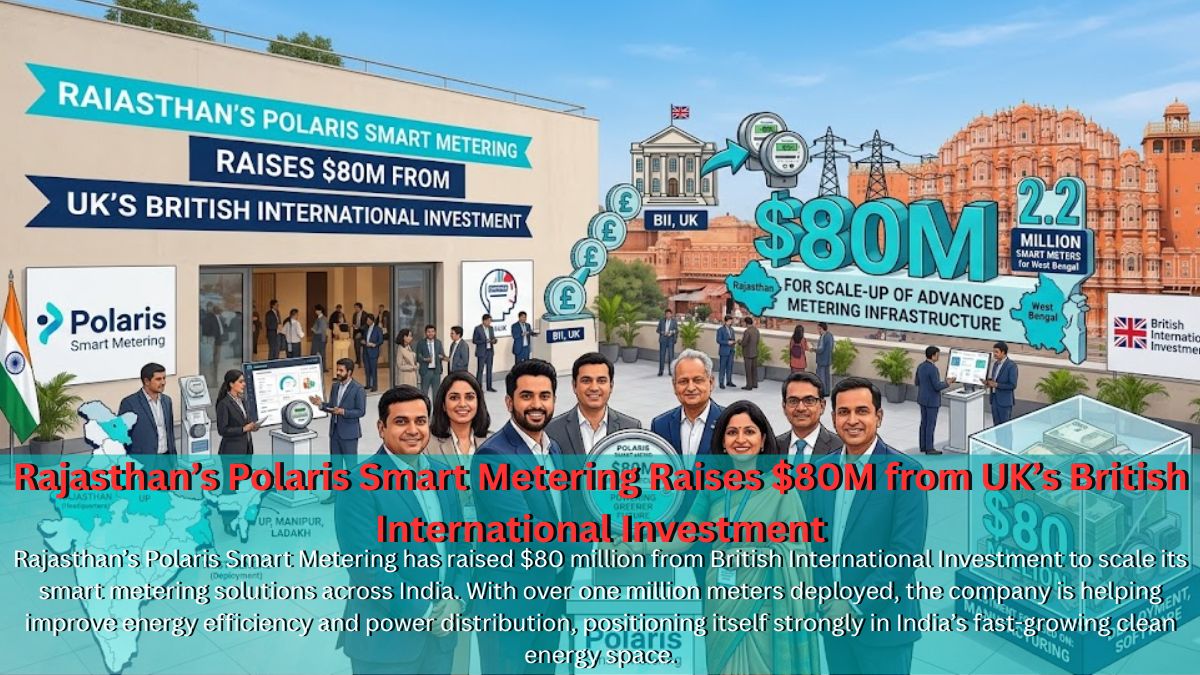
Rajasthan’s Polaris Smart Metering has secured $80 million in funding from British International Investment (BII), the UK’s development finance institution. This major funding round highlights growing global interest in India’s clean energy transition and smart infrastructure ecosystem. The investment will support Polaris in scaling its smart metering solutions across India, improving energy efficiency, and strengthening power distribution systems.
Founded in 2011, Polaris Smart Metering has emerged as a key player in India’s energy tech and smart grid space. The company focuses on deploying advanced metering infrastructure (AMI), enabling real-time energy monitoring, billing accuracy, and reduced power losses. With over one million smart meters deployed, the company has already achieved significant scale in a sector that is rapidly evolving. This funding comes at a time when India is pushing aggressively toward digital energy transformation. Government initiatives such as smart grid modernization and power sector reforms are accelerating the adoption of smart electricity meters. As a result, startups like Polaris are gaining attention from global investors and venture capital firms.
The fresh capital will help Rajasthan’s Polaris Smart Metering expand its operations, invest in technology innovation, and strengthen its position in India’s fast-growing clean energy market. It also signals confidence from international investors in India’s startup ecosystem and infrastructure-driven innovation. Overall, this development reflects broader startup trends where energy tech, climate-focused startups, and infrastructure innovation are becoming key areas of investment. With rising demand for efficient energy management, Polaris Smart Metering is well-positioned to play a crucial role in shaping India’s digital power ecosystem.
1. Rajasthan’s Polaris Smart Metering: Funding Update and Strategic Growth
1.1 Funding Milestone for Polaris Smart Metering
The recent $80 million investment in Polaris Smart Metering by British International Investment is more than a financial boost. It reflects growing confidence in India’s smart energy infrastructure and signals that the sector is entering a serious growth phase. Funding at this scale doesn’t come easily, especially in infrastructure-heavy businesses, which makes this moment particularly significant for Polaris.
This capital will directly accelerate deployment of smart meters across multiple states, improve backend infrastructure, and support entry into new markets. More importantly, it strengthens Polaris’s competitive positioning in a space where execution, scale, and reliability matter more than hype. The company now has both the resources and validation needed to move from steady growth to aggressive expansion.
1.2 Role of British International Investment in Global Funding
British International Investment has consistently focused on projects that combine financial returns with long-term developmental impact. Its investment strategy revolves around climate finance, clean energy, and infrastructure in emerging markets, making Polaris a natural fit within its portfolio.
This partnership also highlights a larger trend. Global investors are increasingly looking at Indian startups that solve fundamental infrastructure problems rather than just consumer-facing opportunities. By backing Polaris, BII is not just investing in a company but supporting a larger transition toward efficient, transparent, and sustainable energy systems in India.
2. About Polaris Smart Metering: Background and Journey
2.1 Founding Story and Startup Evolution
Polaris Smart Metering was founded in 2011 at a time when India’s power distribution system was struggling with inefficiencies like inaccurate billing, power theft, and lack of real-time monitoring. These weren’t minor issues. They were deeply embedded structural problems affecting both utilities and consumers on a daily basis.
The founders saw an opportunity where others saw complexity. Instead of working around the system, they chose to rebuild a part of it using technology. Their focus was clear from the beginning: create smart metering solutions that bring transparency and accountability. Over time, this focused approach helped Polaris evolve from a small startup into a trusted player in the energy infrastructure space.
2.2 Growth Milestones and Market Expansion
One of the most defining achievements for Polaris has been the deployment of over one million smart meters. This milestone is not just about numbers. It reflects consistent execution, strong partnerships with utilities, and the ability to operate at scale in a highly regulated sector.
As demand for smart energy solutions continues to rise, Polaris has steadily expanded its footprint across India. Government initiatives supporting smart grids and digital infrastructure have further accelerated this growth. The company is now positioned to move beyond early adoption markets and deepen its presence in both urban and semi-urban regions.
3. Business Model and Revenue Model of Polaris Smart Metering
3.1 Working Model of Smart Metering Technology
Polaris operates on an advanced metering infrastructure system where smart meters capture real-time electricity usage and transmit that data to centralized platforms. This continuous data flow allows utilities to monitor consumption patterns, identify irregularities, and improve overall grid efficiency.
y=f(t)
The shift from periodic manual readings to real-time tracking changes how the entire system functions. Utilities gain better control, billing becomes more accurate, and issues like power theft or sudden consumption spikes can be detected quickly. This real-time visibility also encourages consumers to become more conscious of their usage, creating a behavioral shift toward efficiency.
3.2 Revenue Model and Monetization Strategy
Polaris generates revenue primarily through long-term contracts with power distribution companies. These contracts cover installation, maintenance, and ongoing operation of smart metering systems, ensuring a steady and predictable income stream. Unlike one-time hardware sales, this model creates continuous engagement with clients.
In addition to core services, Polaris also earns through data analytics, software platforms, and extended service agreements. Over time, the value shifts from hardware to insights derived from data, allowing the company to build higher-margin revenue streams. This layered monetization strategy ensures sustainability while aligning the company’s growth with improvements in energy efficiency.
4. Products, Services, and Problem Solving
4.1 Services Offered by Polaris Smart Metering
Polaris Smart Metering doesn’t just sell meters. It builds an entire ecosystem around how electricity is measured, understood, and managed. Its offerings start with hardware installation, but that’s only the entry point. The real strength lies in how seamlessly it integrates software platforms, communication networks, and analytics into a single system that utilities can actually rely on day to day.
On top of that, Polaris provides energy management tools that give utilities visibility they never really had before. Instead of reacting to problems after they happen, companies can monitor loads, detect inefficiencies, and optimize distribution in real time. This shift from reactive to proactive operations is where the real value shows up, especially for large-scale power distribution networks.
4.2 Problems Solved by Smart Metering
If you’ve ever seen an electricity bill that didn’t make sense, you’ve already experienced the problem Polaris is trying to solve. Traditional systems depend heavily on manual readings, delayed data, and rough estimates. That leads to billing errors, disputes, and a general lack of trust between consumers and utilities.
Polaris tackles this at the root level through automation and real-time monitoring. Every unit of electricity consumed is tracked accurately, which removes guesswork from billing and makes discrepancies easier to resolve. At the same time, issues like power theft or abnormal usage patterns become visible almost instantly. The result is not just operational efficiency, but a more transparent and reliable experience for everyone involved.
5. Industry Growth Trends and Startup Ecosystem Impact
5.1 Growth of Clean Energy and Smart Infrastructure
India’s energy sector is going through a quiet but powerful transformation. Clean energy is no longer a future goal. It’s actively reshaping how infrastructure is being built today. Solar, wind, and decentralized power systems are growing fast, but they also demand smarter grids to function effectively.
That’s where smart metering becomes essential. Without accurate, real-time data, integrating renewable energy into the grid becomes messy and inefficient. Polaris sits right at this intersection. As the country pushes toward sustainability goals, solutions like smart metering move from being optional upgrades to critical infrastructure that supports the entire ecosystem.
5.2 Venture Capital and Global Funding Trends
There’s been a noticeable shift in how global capital is flowing. Investors are moving beyond consumer apps and looking at deeper, more complex problems. Climate tech, energy efficiency, and infrastructure are now attracting serious attention, especially from long-term investors.
The backing from British International Investment reflects this broader trend. Institutions are not just funding growth, they’re funding impact. Startups that can combine technology with real-world problem solving, like Polaris, are becoming increasingly attractive because they operate in markets that are both essential and scalable.
6. Competitors and Market Landscape
6.1 Direct Competitors
Polaris operates in a space where competition is strong but highly specialized. Its direct competitors include companies that provide smart grid technologies, advanced metering infrastructure, and digital energy management solutions. These players often have global exposure and bring significant technical expertise to the table.
What makes this competition interesting is that it’s not just about pricing or technology. It’s about execution on the ground. Deploying smart meters at scale in India comes with logistical, regulatory, and operational challenges. Companies that can navigate these complexities consistently are the ones that stand out, and this is where Polaris has built a strong reputation over time.
6.2 Indirect Competitors
Indirect competition comes from traditional metering systems and legacy energy infrastructure that still dominate large parts of the market. These systems are deeply entrenched, and in many regions, they continue to operate simply because replacing them requires time, investment, and policy support.
However, the shift away from these legacy systems is already underway. As inefficiencies become harder to ignore and technology becomes more accessible, utilities are gradually transitioning to smarter solutions. While traditional systems may still exist for now, their relevance is shrinking, making way for companies like Polaris to define the future of energy management.
7. Technology, Innovation, and Business Strategy
7.1 Role of Innovation in Smart Metering
At the heart of Polaris Smart Metering is not just technology, but the thoughtful use of it. Words like IoT and data analytics get thrown around a lot, but here they actually translate into something tangible. Every smart meter installed is constantly communicating, sending usage data in real time, turning what used to be a static system into a living, breathing network.
This changes how decisions are made. Utilities are no longer guessing or reacting late. They can see patterns as they happen. Sudden spikes, unusual drops, signs of theft, system inefficiencies. It all becomes visible. And once something becomes visible, it becomes fixable. That’s the real power of innovation here. It doesn’t just make things faster, it makes them clearer. And clarity, in a system as complex as electricity distribution, is everything.
But what’s even more impressive is how this technology is adapted to Indian conditions. This isn’t a plug-and-play imported system. It has been shaped around unreliable connectivity, diverse geographies, and large-scale deployments. That kind of ground-level innovation doesn’t get talked about enough, but it’s exactly what separates working solutions from theoretical ones.
7.2 Business Strategy for Growth
Polaris’s growth strategy feels grounded, almost deliberate. It’s not chasing rapid expansion just for the sake of numbers. Instead, it focuses on building depth in the markets it enters. Scaling operations here doesn’t mean just installing more meters, it means strengthening execution, improving service reliability, and ensuring systems don’t break under pressure.
A big part of this strategy lies in partnerships. Working closely with power distribution companies, government bodies, and infrastructure stakeholders allows Polaris to stay embedded in the ecosystem rather than operating on the outside. At the same time, continuous investment in technology ensures that the product doesn’t become outdated in a fast-moving space.
What stands out is the balance. Growth is happening, but not at the cost of stability. Innovation is being pushed, but not without practicality. That balance is hard to maintain, and it’s often where many startups lose their way. Polaris seems to understand that long-term sustainability in infrastructure is built slowly, through consistency more than speed.
8. Startup Ecosystem Analysis and Business Transformation
8.1 Role in Indian Startup Ecosystem
Polaris Smart Metering represents a different kind of startup story. It’s not consumer-facing, it’s not flashy, and it doesn’t rely on viral growth. Yet, its impact is deeply embedded in everyday life. By improving how electricity is measured and managed, it quietly supports millions of households and businesses.
In the broader Indian startup ecosystem, this kind of company plays a crucial role. It shows that innovation isn’t limited to apps and platforms. Real transformation often happens in sectors that are harder to enter, like energy and infrastructure. Polaris contributes directly to India’s push toward digital infrastructure and clean energy, aligning with national priorities while building a scalable business.
This also sends a signal to other founders. There is space, and more importantly, opportunity in solving foundational problems. The ecosystem is slowly maturing, and companies like Polaris are proof that you don’t need to follow trends to build something meaningful.
8.2 Transformation Journey
The journey from a startup in 2011 to a recognized player in smart metering hasn’t been quick or easy. Infrastructure businesses rarely are. There are regulatory hurdles, long sales cycles, operational challenges, and constant pressure to deliver at scale. Polaris has had to navigate all of it.
What makes this journey compelling is the consistency. Instead of pivoting endlessly or chasing short-term wins, the company stayed aligned with its core mission. Over time, that focus compounded. One project led to another, one partnership opened doors to more, and gradually, the company built credibility that cannot be bought with funding alone.
The recent investment from British International Investment is, in many ways, a reflection of that journey. It’s not the beginning of success. It’s recognition of years of groundwork that finally reached a scale where global investors took notice.
9. Learnings for Startups and Entrepreneurs
If you step back and really look at Polaris Smart Metering’s journey, there are lessons that go beyond the energy sector. The first one is simple but often ignored. Solving real problems creates real value. Not temporary traction, not vanity metrics, but something that sustains over time.
The second lesson is about technology. It’s easy to get caught up in trends, but what matters is how technology is applied. Polaris didn’t just adopt IoT and analytics because they were popular. It used them to fix something broken. That intent makes all the difference between innovation that lasts and innovation that fades.
Another important takeaway is how global funding is evolving. Investors like British International Investment are actively looking for startups that operate in sectors like clean energy and infrastructure. These are not quick-return markets, but they offer scale and impact. For founders, this opens up a completely different path compared to traditional venture-backed models.
And finally, there’s the idea of sustainable growth. Polaris didn’t grow overnight. It built patiently, layer by layer, project by project. In a world that often celebrates speed, this is a reminder that durability matters more. Businesses that last are not always the fastest ones. They are the ones that keep showing up, keep delivering, and keep improving, even when no one is watching.
About foundlanes.com
foundlanes.com is India’s leading startup idea discovery platform. It helps entrepreneurs find actionable startup opportunities, market insights, and industry-specific guidance to turn ideas into real businesses. With deep research and practical resources, foundlanes supports founders at every stage, from idea validation to launch and growth.