News Summary
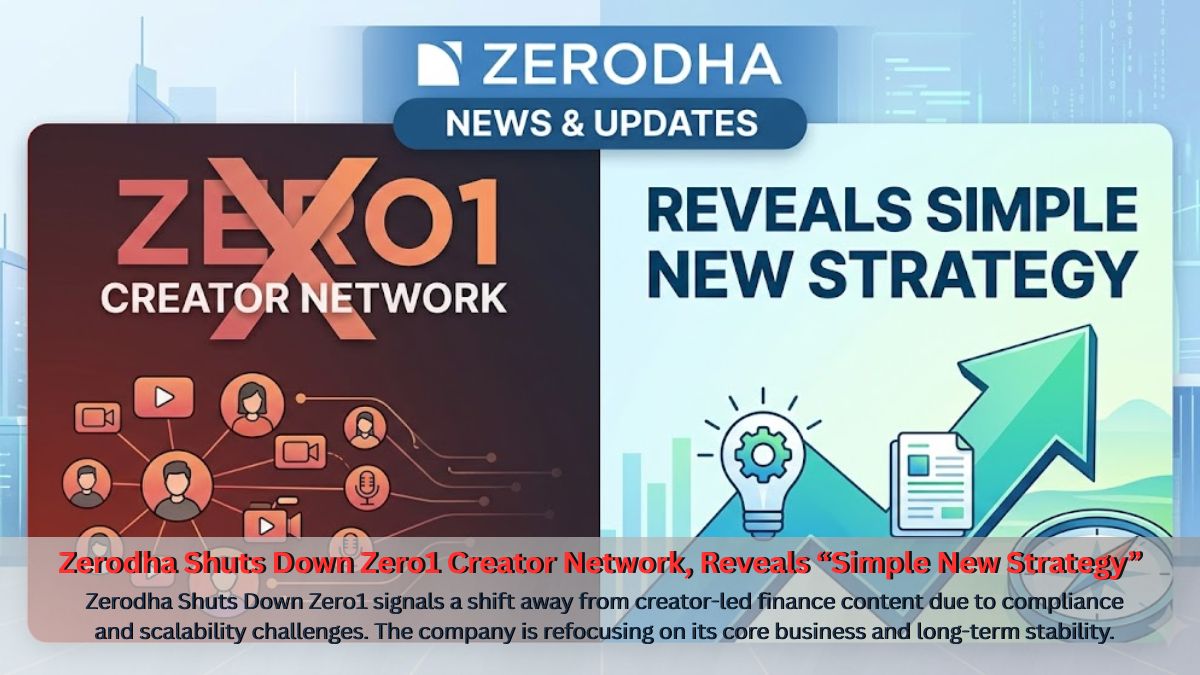
Zerodha Shuts Down Zero1 the headline has quickly captured attention across India’s startup ecosystem. The decision by Zerodha to wind down its creator-focused initiative, Zero1, marks a notable shift in how fintech companies are approaching content, community, and compliance. Launched as an experimental network to empower creators in finance and investing, Zero1 aimed to bridge the gap between financial knowledge and digital content creation. However, within a relatively short span, the initiative has been shut down, with Zerodha calling it a strategic decision aligned with a “simpler” approach going forward.
The move comes amid increasing scrutiny around financial content, influencer-driven investing advice, and evolving regulatory frameworks in India. While there has been no direct government directive forcing the closure, regulatory concerns around content, compliance, and investor protection have clearly influenced the decision. Industry observers note that this reflects a broader trend in fintech, where companies are becoming more cautious about how financial information is distributed through creators.
Zero1 was part of Zerodha’s broader push into education and community building, complementing its existing platforms like Varsity. However, the experiment revealed challenges in scaling a creator network within the tightly regulated financial services space. Questions around accountability, monetization, and compliance created friction that proved difficult to resolve.
Zerodha’s new direction emphasizes simplicity, focus, and core product strength. This aligns with its long-standing philosophy of sustainable growth over aggressive expansion. The shutdown of Zero1 is not just a company-level decision. It signals deeper fault lines in the creator economy, especially in sectors like fintech where trust and regulation intersect.
1. Zerodha Shuts Down Zero1: What Happened and Why It Matters
1.1 Understanding the Shutdown Decision
When Zerodha decided to shut down its creator-focused initiative Zero1, it did not feel like a dramatic collapse. There was no scandal, no sudden breakdown, no external shock that forced the decision overnight. Instead, it felt measured. Almost quiet. And that is exactly what makes it worth paying attention to. Because decisions like these rarely come from a single moment. They build slowly, in the background, through conversations, concerns, and a growing awareness that something may not fit as cleanly as it once seemed.
Zero1 was launched at a time when India’s creator economy was exploding. Finance creators were gaining millions of views. People were learning about investing not from textbooks, but from YouTube videos and Instagram reels. The format was changing. The audience was growing. And naturally, companies wanted to be part of that shift. On the surface, Zero1 made perfect sense.
But fintech is not content. It carries weight. It carries responsibility. The moment financial advice enters the picture, the rules change. It is no longer just about engagement or reach. It is about accuracy, compliance, and trust. A single piece of misleading content can have real consequences for real people. This is where the complexity begins. Zerodha clarified that there was no direct regulatory order forcing the shutdown. That is important. It means the decision was not reactive. It was proactive. However, regulatory sensitivity clearly played a role.
1.2 In India, financial platforms operate under strict oversight
In India, financial platforms operate under strict oversight. The line between education and advice is thin, and often blurred. When creators speak about markets, even casually, their words can be interpreted as recommendations. And when a platform is involved, the responsibility does not stop with the creator. It extends to the company. This creates a risk that is difficult to manage at scale.
Imagine hundreds of creators, each with their own voice, style, and interpretation of financial concepts. Ensuring that every piece of content meets compliance standards is not just challenging. It is exhausting. Over time, this risk starts to outweigh the opportunity. And that is what this decision reflects. It shows a company choosing clarity over expansion. Discipline over experimentation. It is a reminder that not every good idea fits within every industry. In a startup ecosystem that often celebrates growth at all costs, this kind of restraint stands out.
1.2 The “Simple New Strategy” Explained
Zerodha’s response to the shutdown was simple. Almost disarmingly so. Focus on what works. That has always been the company’s philosophy. While others expanded aggressively, launched multiple products, and chased new markets, Zerodha moved differently. It stayed close to its core. It avoided unnecessary complexity. And that discipline is not accidental.
It comes from understanding where real value lies. For Zerodha, that value has always been in its brokerage platform. In making trading accessible, affordable, and reliable. Everything else has been an extension of that mission, not a distraction from it. Zero1, in many ways, tested the boundaries of that focus. It was an attempt to step into the creator economy. To explore how content and community could complement financial services. And while the idea was strong, the execution came with challenges that did not align with Zerodha’s core strength. So the company made a choice.
It chose to step back. This is not a sign of failure. It is a sign of clarity. Because knowing what not to do is just as important as knowing what to build, the phrase “simple new strategy” may sound modest, but it carries weight. It reflects a mindset that values sustainability over speed. Long-term trust over short-term attention. In today’s startup world, where expansion is often seen as progress, this approach feels almost countercultural. But it works. Zerodha has built one of the most profitable fintech businesses in India without external funding. That alone speaks volumes about the strength of its strategy. And this decision reinforces that identity.
1.3 Why This Move Matters
At first glance, the shutdown of Zero1 may seem like a small event. A product decision. A strategic shift. But when you look closer, it reveals something deeper about the intersection of fintech, content, and regulation. It highlights the limits of the creator model in highly regulated industries. Not every format scales the same way across sectors. What works in entertainment or lifestyle does not automatically work in finance. The stakes are different. The expectations are higher.
This move also sends a signal to the broader startup ecosystem. Innovation is important. Experimentation is necessary. But alignment matters more than both. If a new idea does not fit the regulatory environment, the business model, or the company’s core strength, it will eventually face friction. And friction, over time, slows everything down. Zerodha’s decision is a reminder of that reality. It is a lesson in focus. It is a lesson in discipline. And perhaps most importantly, it is a lesson in knowing when to stop.
2. Background: Zerodha’s Journey in the Indian Startup Ecosystem
2.1 Founders and Early Days
To understand Zerodha’s decisions today, you have to go back to its beginnings. In 2010, Nithin Kamath and Nikhil Kamath started Zerodha with a simple but powerful idea. Make stock trading accessible to everyone. At that time, the Indian stock market was not as open as it is today. Brokerage fees were high. The process was complicated. Retail investors were hesitant. Trading felt exclusive.
Zerodha changed that. By introducing a discount brokerage model, it removed a major barrier. Lower costs meant more people could participate. Simpler platforms made trading easier to understand. But the journey was not easy. In the early days, trust was a challenge. Convincing users to move away from traditional brokers required patience. It required consistency. Zerodha did not grow overnight. It built slowly. Carefully. One user at a time. There is something deeply human about that approach. It is not driven by hype. It is driven by belief. And that belief became the foundation of everything that followed.
2.2 Growth Without External Funding
One of the most unique aspects of Zerodha’s journey is how it chose to grow. While most startups chase funding, Zerodha chose a different path. It remained bootstrapped. No venture capital. No external investors pushing for rapid expansion. pressure to scale at any cost. This decision gave the founders control. They could make decisions based on what was right for the business, not what looked good on a pitch deck.
It also forced discipline. When you do not have external funding, every decision matters. Every expense is considered. Every experiment is evaluated carefully. This is why Zerodha’s growth feels different. It is steady. Profitable. Sustainable. And in an ecosystem filled with funding rounds and valuations, that kind of growth stands out.
2.3 Expansion into Education and Content
As Zerodha grew, it began to see a pattern. Many users were entering the market without enough knowledge. They wanted to invest, but they did not fully understand how markets worked. This was not just a gap. It was a responsibility. So Zerodha expanded into education. Platforms like Varsity were created to simplify complex financial concepts. They focused on clarity, not jargon. On understanding, not just information. This move strengthened trust.
Users did not just see Zerodha as a platform. They saw it as a guide. Zero1 was a natural extension of this philosophy. If education could be delivered through structured content, why not through creators? Why not allow individuals to share knowledge in their own voice, in formats that audiences already love? It was a logical step. But as the company discovered, logic alone is not enough. Execution, especially in a regulated industry, brings its own set of challenges.
3. What Was Zero1? Understanding the Creator Network Model
3.1 Concept Behind Zero1
Zero1 was built on a simple yet powerful idea. Give creators a platform to talk about finance in a way that feels natural, relatable, and engaging. In a world where attention is fragmented, traditional formats often struggle to connect. Long articles and complex reports are important, but they do not always reach a wider audience. Creators fill that gap. They simplify. They personalize. Connect. Zero1 aimed to bring this energy into the world of finance. It was not just about content. It was about community. Creators could build their own voice while educating others. Users could learn in a format that felt familiar. It was a bridge between knowledge and storytelling.
3.2 How the Platform Worked
The model itself was straightforward. Creators joined the network. They produced content around markets, investing, and financial concepts. Zerodha provided the infrastructure, the visibility, and the support. In return, the platform benefited from increased engagement and reach. It was a symbiotic relationship.
Creators gained access to a trusted brand. Zerodha gained access to a growing audience that preferred digital content over traditional formats. However, simplicity at the surface often hides complexity underneath. Managing content at scale is not easy. Ensuring accuracy is even harder. And when the subject is finance, the margin for error is extremely small.
3.3 Revenue and Monetization Model
Monetization in a platform like Zero1 was always going to be a challenge. Unlike entertainment content, financial content operates within boundaries. Promotions must be handled carefully. Partnerships must be transparent. Revenue could come from sponsorships, collaborations, or audience-driven models. But each of these carries its own risks.
Trust becomes the central currency. If users feel that content is biased or influenced, the entire ecosystem weakens. This creates a delicate balance. Creators need freedom. Platforms need control. Users need trust. Maintaining all three at the same time is difficult. And in a regulated environment, it becomes even more complex. This is where the model begins to strain. Not because the idea is flawed, but because the environment is demanding. And sometimes, even strong ideas need to be reconsidered when they meet real-world constraints.
4. The Core Problem Zero1 Tried to Solve
4.1 Financial Literacy Gap in India
India’s investing story has changed dramatically over the last decade. More people are opening demat accounts. More young users are entering the stock market. Mobile apps have made trading accessible in a way that was almost unimaginable earlier. On the surface, it looks like progress. And it is. But beneath that growth, there is a quieter, more uncomfortable truth.
Financial literacy has not kept pace. Many first-time investors are stepping into markets without fully understanding how they work. They know the excitement of returns, but not always the reality of risks. They hear about opportunities, but rarely about discipline, patience, or long-term thinking. So where do they turn? Increasingly, they turn to social media.
Short videos. Quick tips. Viral posts. Content that promises clarity in under a minute. It feels easy. It feels accessible. Feels like learning. But it is not always reliable. A single misleading piece of content can shape decisions. A confident voice can create a false sense of certainty. And in finance, certainty is often an illusion. This is where the real risk lies.
Losses are not just numbers on a screen. For many people, they represent savings, aspirations, and trust. When that trust is misplaced, the impact goes beyond money. Zero1 was born out of this tension. The realization that access alone is not enough. That participation without understanding can be dangerous. That the gap between information and true knowledge needed to be addressed in a more structured way.
4.2 Rise of Finfluencers
At the same time, a new force was shaping the financial landscape. Finfluencers. Creators who spoke about markets, investments, and money in a way that felt personal. They broke down complex ideas into simple language. They connected with audiences in ways traditional institutions often could not. And people listened. Because these creators did not sound like experts from a distance. They sounded like peers. Like someone you could trust.
This shift was powerful. It democratized financial conversations. It made investing feel less intimidating. Brought new energy into a space that was often seen as rigid and inaccessible. But with that power came responsibility. Not every creator had the same level of knowledge. Not every piece of content was accurate. And not every recommendation was unbiased. The line between education and influence became blurred. Some creators genuinely wanted to help. Others were driven by visibility, engagement, or even monetization opportunities. And for the audience, it became difficult to tell the difference.
This created a fragile environment. An environment where trust could be built quickly, but also broken just as fast. For platforms like Zerodha, this was both an opportunity and a concern. Opportunity, because this new wave of content could drive awareness and engagement. Concern, because it introduced risks that were hard to control.
4.3 Zero1’s Intended Solution
Zero1 was an attempt to bring order to this chaos. The idea was not to stop creators. It was to support them. To create a structured environment where content could be both engaging and responsible. Instead of leaving the ecosystem completely open, Zerodha tried to build a layer of guidance. Creators would operate within a framework. They would have access to resources, support, and a trusted platform. In return, the content would align more closely with standards of accuracy and compliance. At least, that was the vision. It was a thoughtful approach.
Rather than fighting the rise of finfluencers, Zerodha chose to work with them. To channel their energy in a way that could benefit users while reducing risk. But execution proved far more complex than the idea. Because structure and creativity do not always move in the same direction. Creators value freedom. They want to express ideas in their own voice. They want to experiment with formats, opinions, and storytelling. Regulated industries, on the other hand, require control. They demand consistency. Demand accountability. They leave little room for ambiguity. Balancing these two forces is not easy. And over time, that balance becomes harder to maintain.
5. Industry Trends: Digital Content Meets Fintech
5.1 Growth of Creator Economy in India
India’s creator economy is not just growing. It is evolving at a pace that few could have predicted. Millions of people are now creating content across platforms. Some do it for passion. Others do it professionally. Many do it somewhere in between. Platforms like YouTube, Instagram, and LinkedIn have changed how information flows. They have broken down traditional barriers. Anyone with a smartphone and an idea can reach an audience.This has reshaped industries.
Education, entertainment, fitness, lifestyle, and now finance. Content is no longer just a medium. It is a business model. For startups, this opens new possibilities. Instead of relying only on traditional marketing, they can build communities. They can engage directly with users. They can create value through storytelling. But with opportunity comes saturation. Attention is limited. Competition is high. Standing out requires not just content, but meaningful content. And in sectors like finance, meaningful also means responsible.
5.2 Intersection with Fintech
The intersection of fintech and content feels natural at first. Finance is complex. Content simplifies it. Together, they seem like a perfect match. Users prefer learning through videos rather than textbooks. They want explanations, not just data. They want relatability, not just expertise. This shift has changed how fintech companies think. Education is no longer optional. It is essential. However, this intersection also creates tension. Because finance is not like other topics.
You can experiment freely in lifestyle content. You can take creative risks in entertainment. But in finance, every statement carries weight. A suggestion can be interpreted as advice. An opinion can influence decisions. This changes the stakes completely. For fintech companies, entering the content space is not just about engagement. It is about responsibility. And that responsibility is not easy to manage at scale.
5.3 Regulatory Landscape and Compliance Pressure
In recent years, regulators in India have started paying closer attention to financial content. This is not surprising. As more people rely on digital platforms for investment advice, the potential for misinformation increases. Protecting investors becomes a priority. Regulatory bodies focus on clarity. What is education? What is advice? Where does one end and the other begin? These questions are not always easy to answer. For creators, the boundaries can feel restrictive. For companies, they can feel risky. Because once a platform is associated with financial content, it becomes part of the responsibility chain.
Even if the content is created by individuals, the platform hosting it cannot ignore the implications. This creates pressure. Pressure to monitor. Pressure to verify. Ensure compliance at every level. And as the ecosystem grows, this pressure only increases.
6. Why Zerodha Shuts Down Zero1: Deeper Analysis
6.1 Regulatory Concerns
When looking at why Zerodha shut down Zero1, regulation sits quietly at the center of the conversation. Not as an immediate trigger, but as a constant presence. Even without a direct order, the direction of regulatory thinking is clear. There is increasing scrutiny on how financial information is shared. There is a growing emphasis on accountability. For a company like Zerodha, this cannot be ignored. Because trust is its foundation.
If users begin to question the reliability of content associated with the platform, that trust weakens. And once weakened, it is difficult to rebuild. Managing this risk in a decentralized creator network is extremely challenging. Every creator brings their own perspective. Their own tone. Their own interpretation. Ensuring that each piece of content aligns with regulatory expectations requires constant oversight. And even then, there is no guarantee. One mistake can create ripple effects. In such an environment, stepping back becomes a rational decision.
6.2 Operational Complexity
Beyond regulation, there is the reality of operations. Running a creator network is not simple. It involves onboarding creators, guiding them, reviewing content, managing feedback, and maintaining quality. Each step requires time, resources, and coordination. And as the network grows, complexity multiplies. What works for ten creators does not work for a hundred. What works for a hundred does not scale to thousands.
Each creator has a different style. A different audience. A different way of communicating. This diversity is valuable, but it is also difficult to manage. Especially when consistency is required. For Zerodha, which has built its reputation on simplicity and efficiency, this level of operational complexity may not align with its core strengths. Over time, the cost of managing this complexity can outweigh the benefits.
6.3 Strategic Refocus
At its core, the decision to shut down Zero1 is about focus. Zerodha has always been clear about what it wants to be. A reliable, efficient, and user-centric financial platform. Everything it builds is measured against that identity. When something does not fit perfectly, it is reconsidered. This is not hesitation. It is discipline.
In a world where startups often chase multiple opportunities at once, Zerodha chooses depth over breadth. It invests in what it understands best. It avoids distractions. And that approach has worked. The shutdown of Zero1 is not a retreat. It is a recalibration. A return to what the company does best. And in many ways, that is what makes Zerodha different. It is not driven by trends. It is guided by clarity. And sometimes, clarity means knowing when to let go.
7. Competitors and Market Comparison
7.1 Direct Competitors
When you look at Zerodha in the broader fintech landscape, it sits alongside strong players like Groww and Upstox. All three operate in the same core space. They enable investing, simplify trading, and compete for the same growing base of retail users. On the surface, the competition looks similar.
Each platform focuses on onboarding new users, improving app experience, and expanding financial services. They invest in technology, marketing, and customer support. They compete on pricing, features, and ease of use. But when it comes to Zero1, Zerodha stepped into territory that others approached more cautiously. Groww and Upstox have invested heavily in content. They produce educational videos, blogs, and tutorials. They use content to build trust and drive engagement. But they have largely kept control of that content within their own ecosystem.
They did not attempt to build a creator incubator at scale. And that difference matters. Because building your own content is predictable. You control the narrative. You manage compliance internally. The risk is manageable. But once you open the door to external creators, the equation changes.
You introduce variability. You introduce unpredictability. Introduce voices that may not always align perfectly with regulatory expectations. Zerodha’s attempt with Zero1 was bold in that sense. It was not just competing on product or pricing. It was experimenting with how financial knowledge could be distributed in a new way. And when it chose to step back, it highlighted something important. Even strong companies with deep understanding of the market must respect the boundaries of their domain. Sometimes, the smartest move is not to push further, but to recognize where the risk outweighs the reward.
7.2 Indirect Competitors
If direct competitors operate within the same industry, indirect competitors often operate in a completely different world. In this case, that world is social media. Platforms like YouTube, Instagram, and LinkedIn have quietly become the largest distributors of financial content. They are not fintech companies. They are not investment platforms. But they shape how people learn about money. Creators on these platforms build massive audiences without needing a centralized network like Zero1. They control their content. They control their brand. Decide how they engage with their followers. And most importantly, they move freely.
There are no platform-specific constraints tied to a financial institution’s compliance framework. While general content guidelines exist, they are not as strict as those applied to regulated fintech environments. This freedom is attractive. It allows creators to experiment. To grow quickly. To build a personal connection with their audience. For users, it also feels more organic. They are not consuming content within a financial app. They are discovering it in their daily digital life. This reduces the need for a structured creator network. Zero1, in many ways, was trying to formalize something that thrives in an informal environment. And that is a difficult balance to achieve. Because the very thing that makes creator content powerful, its freedom, is also what makes it risky in a regulated context.
7.3 Global Comparisons
If you step outside India and look at global fintech companies, a pattern begins to emerge. Most of them have been cautious when it comes to integrating creator ecosystems directly into their platforms. They invest in education. They build blogs, courses, and tutorials. Collaborate with influencers. But they stop short of creating large-scale creator incubators within their core product. This is not by accident.
Global markets have faced similar challenges around financial content and compliance. Regulators in countries like the United States and the United Kingdom have already tightened rules around financial promotions and advice. Companies have learned to be careful. They understand that once content crosses into the territory of influence, the responsibility becomes heavier.
Zerodha’s experiment with Zero1 was, in that sense, ahead of its time. It tried to explore a model that others had approached cautiously. And its decision to step back aligns with what we see globally. Fintech companies prefer control when it comes to communication. They prioritize accuracy over virality. They choose consistency over experimentation. This does not mean the creator economy will not play a role in finance. It already does. But it suggests that the integration between fintech and creators will likely remain indirect, rather than deeply embedded within core platforms.
8. Impact on Startup Ecosystem and Creator Economy
8.1 Signal to Indian Startups
The shutdown of Zero1 sends a message that goes beyond Zerodha itself. It speaks to every startup navigating the balance between innovation and reality. In India’s startup ecosystem, there is a strong push toward experimentation. New ideas are encouraged. New models are tested. And that energy is important. But Zero1 reminds us of something equally important. Not every idea scales.
Especially when the environment is complex. Regulated industries, like fintech, healthcare, or insurance, come with constraints that cannot be ignored. These constraints shape what is possible and what is sustainable. For startups, this is a valuable lesson. It is not enough for an idea to be exciting. It must also be viable within the ecosystem it operates in. Zerodha’s decision shows maturity. It shows that stepping back is not failure. It is part of the process. And for founders, that perspective can be incredibly important. Because building a startup is not just about growth. It is about making the right decisions at the right time.
8.2 Implications for Finfluencers
For creators in the finance space, this moment feels like a turning point. The rise of finfluencers has been rapid. Audiences have grown. Engagement has increased. Opportunities have expanded. But with that growth comes scrutiny. As platforms and regulators pay closer attention, the expectations placed on creators are changing.
Accuracy matters more than ever. Transparency becomes essential. The casual tone that once defined financial content may need to evolve into something more structured. This does not mean creativity will disappear. But it does mean responsibility will take center stage. Creators may need to rethink how they present information. They may need to back their content with stronger research. They may need to be more cautious in how they frame opinions. For some, this will be a challenge. For others, it will be an opportunity to build deeper trust. Because in the long run, trust is what sustains an audience. And in finance, trust is everything.
8.3 Broader Startup Trends
If you zoom out, the Zero1 shutdown reflects a broader shift in the startup world. For years, the focus was on growth. Scale quickly. Expand aggressively. Capture market share. But now, there is a gradual shift toward sustainability. Startups are beginning to ask different questions. Is this model viable in the long term? Does it align with our core strengths? Can it operate within regulatory boundaries?
This shift is subtle, but significant. It signals a move from experimentation to consolidation. From trying everything to focusing on what works. Zerodha’s decision fits perfectly into this trend. It is not abandoning innovation. It is refining it. And that distinction matters.
9. Zerodha’s Business Model and Strength
9.1 Core Revenue Streams
At the heart of Zerodha’s success lies a business model that is both simple and powerful. It earns primarily through brokerage fees, subscription-based services, and value-added financial offerings. But what makes this model stand out is its transparency. There are no hidden charges. No complex pricing structures. Users know exactly what they are paying for. This builds trust. And in finance, trust translates directly into loyalty. Zerodha does not rely on aggressive upselling or complicated products. It focuses on delivering a reliable core service. That simplicity is its strength.
9.2 Profitability and Market Position
In an ecosystem where many startups chase valuation, Zerodha chose a different path. Profitability. It built a business that generates consistent revenue. It controls costs carefully. Avoids unnecessary expansion. As a result, it has become one of the most profitable fintech companies in India. This position gives it flexibility. It can experiment without pressure. It can make decisions without external influence. Can pivot when needed. And most importantly, it can prioritize long-term stability over short-term gains. That is a rare advantage.
9.3 Focus on Long-Term Value
Everything Zerodha does ties back to one principle. Long-term value. It does not chase trends for the sake of visibility. It evaluates whether an idea aligns with its mission. If it does, it invests. If it does not, it steps back. Zero1 was part of that evaluation. It was an experiment. A thoughtful one. But when it became clear that it did not fit perfectly within the company’s long-term vision, Zerodha made a decision. It chose focus over expansion. It chose clarity over complexity. And in doing so, it reinforced what has always defined it. A company that values trust, discipline, and sustainability above all else.
10. Lessons from the Zero1 Shutdown
When Zerodha decided to shut down its creator-led platform Zero1, it didn’t feel like a dramatic failure. It felt more like a quiet, thoughtful decision. The kind that comes after you’ve tested something honestly and accepted what isn’t working. And if you look closely, there’s a lot to learn from that moment.
10.1 Importance of Regulatory Alignment
In industries like fintech, regulation isn’t just a checklist. It shapes everything. Zero1 was built around creators influencing financial decisions. On paper, it sounds powerful. People trust creators. They listen to them. But finance isn’t like fashion or tech reviews. Here, even a small misstep can have serious consequences for users. What likely became clear over time is that scaling a creator-driven financial platform isn’t just about engagement. It’s about accountability, compliance, and control. Regulations in finance are designed to protect users, and they don’t leave much room for ambiguity.
Many startups learn this the hard way. They build fast, grow fast, and only later realize that regulatory friction slows everything down. Zerodha, on the other hand, has always operated with a deep respect for the system. The shutdown reflects that discipline. It shows that aligning with regulations early isn’t optional. It’s survival.
10.2 Limits of Creator-Led Models in Finance
The creator economy is one of the strongest forces right now. It has changed how people learn, buy, and make decisions. But not every model translates cleanly into every industry. Finance demands trust at a different level. Not just emotional trust, but structural trust.A creator can recommend a product, but who is responsible if things go wrong? Who ensures that advice is unbiased, compliant, and suitable for every user? That’s where the model starts to strain.
Zero1 probably revealed something important. Influence alone isn’t enough in fintech. Systems need guardrails. Decisions need verification. And platforms need tighter control than what a decentralized, creator-first model typically allows. This doesn’t mean the creator economy is weak. It just means its boundaries are real. And recognizing those boundaries early can save years of struggle.
10.3 Strategic Discipline Matters
One of the hardest things for any company is to stop something it has already invested in. There’s always a temptation to “give it more time.” To tweak, adjust, relaunch. Because shutting down feels like admitting defeat. But in reality, it often takes more courage to stop than to continue. Zerodha’s decision shows a level of clarity that many companies lack. They didn’t let momentum or ego drive the decision. They looked at what was working, what wasn’t, and chose focus over distraction. That’s not failure. That’s maturity. It’s easy to start experiments. It’s much harder to end them at the right time.
11. Learning for Startups and Entrepreneurs
The story of Zero1 doesn’t feel like a cautionary tale. It feels more like a grounded lesson in how real businesses evolve. If you’re building something, especially in a space like fintech, there are a few truths here that are hard to ignore. First, you can’t afford to treat regulation as an afterthought. It’s not something you “handle later.” It shapes your product, your growth, and your risks from day one. Founders who understand this early move with more clarity. Those who don’t often find themselves rebuilding under pressure.
Second, not every trend deserves to be followed blindly. The creator economy is powerful, no doubt. But copying a trend without questioning its fit can lead you into uncomfortable territory. Every business has its own nature. Some models align naturally. Others don’t, no matter how attractive they look from the outside. Third, simplicity is underrated. Zerodha’s core strength has always been its focus. Clean product. Clear value. No unnecessary noise. That clarity is what built trust over time. And this decision reinforces that they are willing to protect that simplicity, even if it means letting go of new ideas.
And finally, experimentation is essential. You can’t build anything meaningful without trying new things. But there’s a quiet skill in knowing when to stop. When to accept that something isn’t moving in the right direction. When to redirect energy instead of forcing outcomes. That balance between ambition and restraint is what separates sustainable companies from the rest. Zero1 ending isn’t the loud kind of story that grabs headlines for weeks. But if you pay attention, it says something deeper. Not every idea is meant to scale. Not every experiment is meant to last. And sometimes, the smartest move a company can make. is to walk away at the right time.
About foundlanes.com
foundlanes.com is India’s leading startup idea discovery platform. It helps entrepreneurs find actionable startup opportunities, market insights, and industry-specific guidance to turn ideas into real businesses. With deep research and practical resources, foundlanes supports founders at every stage, from idea validation to launch and growth.