News Summary
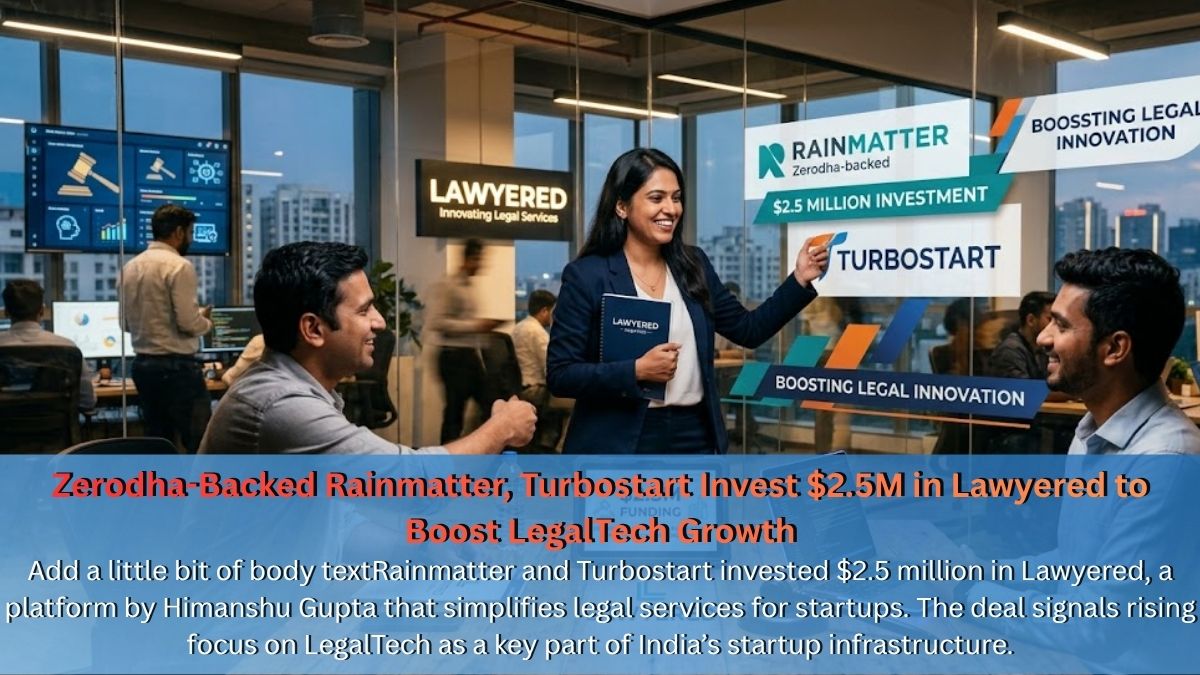
Rainmatter, the investment arm of Zerodha, along with Turbostart, has invested $2.5 million in Lawyered, marking a meaningful push into India’s fast-emerging LegalTech space. At first glance, it looks like another startup funding announcement. But the timing and focus of this deal by Zerodha-Backed Rainmatter say something deeper about where the ecosystem is heading. Lawyered, founded by Himanshu Gupta, is built around a very real problem that every founder eventually faces but rarely talks about early on, legal complexity. Whether it’s incorporation, contracts, compliance, or fundraising paperwork, legal work often becomes a silent bottleneck in a startup’s journey.
The platform tries to fix this by connecting
The platform tries to fix this by connecting users with verified legal professionals through a structured, digital-first system. Instead of navigating uncertainty, users get curated legal solutions across areas like startup compliance, intellectual property, contracts, and advisory work. The goal is simple in theory but powerful in practice: make legal support feel accessible, transparent, and less intimidating.
What makes this investment important is not just the money, but what it represents. LegalTech in India has traditionally been underfunded compared to sectors like fintech or SaaS. Yet as the startup ecosystem expands, the demand for reliable legal infrastructure is becoming unavoidable. Every new business brings recurring legal needs, and that demand doesn’t scale linearly, it compounds.
From experience, this is where many early founders struggle. Legal decisions are often delayed, not because they aren’t important, but because they feel complex, expensive, or unclear. That hesitation can slow down deals, create compliance risks, and add unnecessary friction to growth. Platforms like Lawyered aim to reduce that friction by adding structure and clarity to what has traditionally been an unstructured space.
With this funding, the company plans to strengthen its technology, expand its verified lawyer network, and grow its presence across India, especially in Tier 2 and Tier 3 cities where access to structured legal services is still limited. It also signals increasing investor interest in backend infrastructure startups, not just consumer-facing or high-growth categories. Overall, this move highlights a quiet but important shift in India’s startup ecosystem. Investors are beginning to look beyond the obvious sectors and focus on the systems that make businesses run smoothly in the background. LegalTech may not always be visible, but it is becoming essential, and this investment is a clear sign of that change.
1. Zerodha-Backed Rainmatter Invests in LegalTech Startup Lawyered
1.1 Understanding the Investment Announcement
When a player like Rainmatter decides to back a company, it rarely feels like just another funding update. There’s usually intent behind it, almost like a quiet signal to the market about where things are headed next. That’s exactly what this $2.5 million investment into Lawyered, alongside Turbostart, feels like.
On paper, it’s a funding round. But in reality, it’s a recognition of a problem most founders don’t talk about loudly enough. Legal work in India is messy. It’s unpredictable, often expensive, and for early-stage founders, deeply confusing. This is where the significance of the deal really begins to show. Rainmatter isn’t known for chasing hype. Their bets tend to come from a place of conviction. So when they step slightly outside their usual comfort zone of fintech and sustainability, it’s worth paying attention. It tells you they’re seeing something deeper in LegalTech, something structural.
From a founder’s lens, this investment also brings reassurance. Capital is one thing, but backing from Rainmatter and Turbostart means access to people who’ve seen startups fail, pivot, and scale. That kind of guidance often ends up being more valuable than the cheque itself. In simple terms, this isn’t just money entering Lawyered. It’s experience, pattern recognition, and belief entering the company at a time when LegalTech is still trying to define its place in India.
1.2 Why This Deal Matters
Funding usually flows into sectors that promise quick scale or obvious returns. Fintech, SaaS, consumer apps, they dominate headlines. LegalTech, on the other hand, has mostly stayed in the background.
But here’s the thing. Every startup, no matter how exciting, eventually runs into legal complexity. Incorporation, contracts, compliance, IP protection, fundraising paperwork. It’s unavoidable. And yet, the tools to handle these problems haven’t evolved at the same pace as the startups themselves. That gap is where this deal becomes important. It reflects a subtle but powerful shift. Investors are starting to realize that building startups isn’t just about funding the front-end innovation. It’s also about strengthening the backend infrastructure that supports it.
From real founder experience, this hits home. Many early-stage founders either delay legal work or do it reactively, often after a mistake has already been made. That leads to bigger problems later, equity disputes, compliance penalties, messy contracts. Platforms like Lawyered step into this exact moment of friction. And the fact that capital is now flowing here suggests one thing clearly: LegalTech is no longer optional infrastructure. It’s becoming essential.
2. Lawyered: Startup Background and Founding Story
2.1 The Vision Behind Lawyered
Every meaningful startup begins with a moment of frustration. For Himanshu Gupta, that moment came from observing how broken the legal services experience was in India. If you’ve ever tried finding a lawyer, you already know the feeling. You don’t know who to trust. Pricing is unclear. The process feels intimidating. And there’s always this underlying fear that you might be overpaying or missing something important.
Lawyered was built to remove that uncertainty. The idea wasn’t just to create a directory of lawyers. It was to build a system where legal services feel structured, predictable, and accessible. Almost like ordering a service online, where you know what you’re getting before you pay for it. That shift, from ambiguity to clarity, is where the real value lies.
2.2 Early Journey and Challenges
Of course, building something in the legal space isn’t easy. Trust is everything here, and trust takes time. In the early days, convincing users to rely on an online platform for legal services was a challenge. People are naturally cautious when it comes to legal matters. One wrong decision can have serious consequences. Lawyered had to earn that trust step by step. They focused heavily on quality control. Instead of onboarding anyone, they built a network of verified lawyers. They worked on standardizing services so users wouldn’t feel lost. Slowly, this started to change perception.
From real-world startup experience, this phase is often the hardest. There’s no immediate scale. Growth feels slow. But these are the moments where strong foundations are built. Over time, Lawyered began to see traction, especially among startups and SMEs. These are users who don’t always have access to big law firms but still need reliable legal support. That’s where Lawyered found its early product-market fit.
3. Zerodha-Backed Rainmatter: Investment Philosophy
3.1 Rainmatter’s Role in the Startup Ecosystem
Rainmatter operates very differently from traditional venture capital firms. They don’t just chase growth metrics or short-term returns. Their focus tends to be on businesses that create long-term value. Startups that solve real problems, not just build convenience. This is important because it shapes the kind of companies they choose to back. Over the years, Rainmatter has supported startups across fintech, climate tech, and health. What ties these investments together is a clear sense of purpose. There’s always an underlying belief that the startup is improving something fundamental.
Lawyered fits into this narrative quite naturally. It’s not flashy, but it’s solving a real, deeply rooted problem in India’s startup ecosystem. From a broader perspective, this investment also shows how Rainmatter is evolving. They’re starting to look beyond vertical-specific bets and into infrastructure plays, companies that enable other startups to function better.
3.2 Turbostart’s Contribution
While Rainmatter brings conviction and long-term thinking, Turbostart adds another layer, execution support. Early-stage founders often struggle with more than just funding. They need guidance on hiring, product decisions, scaling operations, and even avoiding common mistakes.
That’s where accelerators like Turbostart come in. Their involvement means Lawyered isn’t just receiving capital. It’s gaining access to a support system that can help it grow faster and more efficiently. From experience, this combination, capital plus mentorship, tends to produce stronger outcomes than funding alone.
4. How Lawyered Works: Business Model Explained
4.1 Platform-Based Legal Services
At its core, Lawyered simplifies something that has traditionally been complicated. Instead of forcing users to navigate the legal world blindly, the platform offers structured services. You don’t start with confusion. You start with clarity.
Users can select predefined legal solutions based on their needs. Whether it’s company registration, contract drafting, or compliance, the process feels guided rather than overwhelming. This approach does something subtle but powerful. It reduces decision fatigue. From a user’s perspective, especially a founder juggling multiple responsibilities, this matters a lot. Legal work stops feeling like a burden and starts feeling manageable.
4.2 Revenue Model
Lawyered’s revenue model reflects both practicality and scalability. On one side, it earns through commissions and service fees on transactions. This aligns its success with the value it delivers. The more users find the platform useful, the more revenue it generates.
On the other side, it offers subscription-based plans. This is particularly valuable for businesses that need ongoing legal support rather than one-time services. This hybrid model creates stability. Transactional revenue brings immediate cash flow, while subscriptions build predictability over time. From a business standpoint, this balance is critical. It allows the company to grow without being overly dependent on one revenue stream.
5. Problems Lawyered Solves
5.1 Access to Reliable Legal Services
If you’ve ever tried finding a good lawyer in India, you already know how uncertain that journey feels. It usually starts with asking friends, then maybe a referral, and eventually landing in a conversation where you’re not fully sure whether you’re in the right hands. This is the gap Lawyered is trying to close. The platform removes that randomness. Instead of relying on word-of-mouth, it gives users access to a curated network of verified legal professionals. That verification piece is not just a feature, it’s the foundation of trust.
From a real founder’s perspective, this matters more than anything. When you’re building a company, one wrong legal decision can undo months of hard work. Signing a poorly drafted agreement or missing a compliance deadline isn’t just a mistake, it can become an expensive lesson. Lawyered brings a sense of control into that chaos. You’re not guessing anymore. You’re choosing from a system that has already filtered for quality. And that shift, from uncertainty to confidence, is what truly changes the experience.
5.2 Transparency in Pricing
Legal pricing in India has always felt like a grey area. You walk into a conversation not knowing whether the cost will be ₹5,000 or ₹50,000. And most of the time, you only find out after the work has already started. That lack of clarity creates hesitation. People delay important legal decisions simply because they’re unsure about the cost.
Lawyered tackles this head-on by introducing structured pricing. You don’t just ask for a service, you see what it costs before committing. That sounds simple, but in the legal world, it’s a big shift. From experience, this kind of transparency changes behavior. Founders become more proactive. Instead of avoiding legal work, they start planning for it. They budget for it. They treat it as a necessary part of building a business rather than an unpredictable expense. And over time, this doesn’t just help individual users, it improves the overall discipline of the startup ecosystem.
5.3 Speed and Efficiency
Traditional legal processes are slow. There’s no polite way to say it. You send a document, wait for a response, follow up, wait again. What should take a few days often stretches into weeks. For a startup, that delay can be frustrating. Sometimes even damaging. Deals get stuck, partnerships are delayed, and momentum slows down. Lawyered changes this dynamic by using technology to streamline workflows.
Requests are structured, communication is more direct, and turnaround times are significantly reduced. It’s not just about speed for the sake of it. It’s about maintaining momentum. From real-world experience, momentum is everything in the early stages of a startup. When things move fast, you feel progress. When they slow down, doubt creeps in. By making legal processes faster and more predictable, Lawyered quietly removes one of the friction points that founders constantly struggle with.
6. Industry Trends: Rise of LegalTech in India
6.1 Growth of LegalTech Startups
For a long time, LegalTech in India was overlooked. It didn’t have the excitement of fintech or the scale of SaaS. But that’s slowly changing. As the number of startups grows, so does the complexity around them. More companies mean more contracts, more compliance, more legal interactions.
This creates a natural demand for better legal infrastructure. And that’s exactly why platforms like Lawyered are starting to gain attention from investors and founders alike. What’s interesting is that this growth isn’t driven by hype. It’s driven by necessity. From a ground-level view, you can see the shift happening. Founders are becoming more aware. They’re no longer treating legal as an afterthought. They’re looking for solutions early on. That behavioral change is what’s fueling the rise of LegalTech.
6.2 Digital Transformation of Legal Services
The legal industry has traditionally been slow to adopt technology. Processes were manual, documentation was physical, and communication often felt outdated. But like every other industry, change is inevitable. Digital platforms are now stepping in to modernize how legal services are delivered. Instead of fragmented interactions, users are getting structured, tech-enabled experiences. This transformation is not happening in isolation. It’s part of a larger shift across industries where technology is simplifying complex services. What makes LegalTech unique, though, is the emotional weight behind it. Legal decisions often carry risk. They involve trust, money, and sometimes even survival for a business.
So when technology enters this space, it has to do more than just optimize processes. It has to build confidence. That’s where platforms like Lawyered stand out. They’re not just digitizing services, they’re reshaping how people feel about engaging with legal systems.
7. Competitive Landscape
7.1 Direct Competitors
The LegalTech space in India is still evolving, but it’s starting to get crowded. There are multiple platforms trying to solve similar problems, connecting users with lawyers, offering standardized services, and simplifying access. This competition is healthy. It pushes companies to improve their offerings and refine their user experience. But what differentiates Lawyered is its focus on structure and reliability.
From a user’s perspective, not all platforms feel the same. Some feel like directories, others feel like marketplaces. Lawyered tries to position itself somewhere deeper, as a trusted system rather than just a listing platform. That positioning can make a big difference in a space where trust is everything.
7.2 Indirect Competition
Even with the rise of LegalTech, traditional law firms remain a strong force. They bring experience, reputation, and deep expertise. For complex cases, many businesses still prefer working with established firms. But they also come with limitations. Scalability is one of them. Traditional firms often struggle to handle high volumes of smaller, standardized requests. Their processes are not built for speed or accessibility. This is where Lawyered finds its edge.
By focusing on technology and structured services, it can handle a larger number of users efficiently. It doesn’t replace traditional firms entirely, but it complements them by addressing a different segment of the market. From experience, this coexistence is common in industries undergoing transformation. New models don’t immediately replace old ones, they reshape the landscape gradually.
8. Funding Impact and Growth Plans
8.1 Use of Funds
The $2.5 million investment is not just about scaling quickly. It’s about building the right foundation for scale. A significant part of this capital will go into technology development. Improving the platform, making it more intuitive, faster, and reliable.
Another focus will be expanding the network of lawyers. More professionals mean better coverage across different legal needs and geographies. From a practical standpoint, this is where many startups either succeed or struggle. It’s not just about acquiring users, it’s about maintaining quality as you grow. Lawyered will need to balance both carefully.
8.2 Scaling Strategy
One of the most interesting parts of Lawyered’s plan is its focus on Tier 2 and Tier 3 cities. These regions are often underserved when it comes to quality legal services. At the same time, they are seeing a rise in entrepreneurship. This creates a powerful opportunity.
By expanding into these markets, Lawyered is not just growing its user base, it’s unlocking a segment that has been largely ignored. From real experience, founders in smaller cities face even greater challenges when it comes to legal access. They don’t always have the same networks or resources as those in metro cities. Reaching them can create a meaningful impact, not just for the company, but for the ecosystem as a whole.
9. Broader Impact on Startup Ecosystem
9.1 Supporting Emerging Startups
Every startup journey has moments where legal clarity becomes critical. Incorporation, funding rounds, partnerships, compliance. These are not optional steps. They are essential milestones. Platforms like Lawyered step in during these moments and make the process smoother.
For early-stage founders, this support can make a real difference. It reduces stress, saves time, and prevents costly mistakes. From experience, having the right legal support early on can change how confidently a founder operates. It removes hesitation and allows them to focus on building their business.
9.2 Enabling Business Growth
At a deeper level, simplifying legal processes does something powerful. It removes friction. When friction is reduced, things move faster. Decisions are made quicker. Opportunities are seized more easily. This has a ripple effect.
Startups grow faster. They operate more efficiently. And over time, this contributes to a healthier, more structured ecosystem. Lawyered’s role in this might not always be visible, but it’s significant. Because behind every successful startup, there are countless small decisions that went right. And many of those decisions depend on having the right legal support at the right time. That’s the space Lawyered is quietly building in. Not the spotlight, but the backbone.
10. The Future of LegalTech in India
10.1 Increasing Investment Interest
For years, LegalTech in India sat quietly on the sidelines. It wasn’t the sector investors rushed into. It didn’t promise overnight scale or viral growth. But something has started to shift. Investors are beginning to see LegalTech for what it really is, not just a service layer, but a foundational layer. When firms like Rainmatter start putting money into companies like Lawyered, it sends a clear signal. This is no longer an experimental space. It’s becoming a serious category. What’s driving this interest is simple, but powerful. Every startup, no matter how innovative, eventually depends on legal systems to function. Contracts, compliance, governance, these aren’t optional. They’re inevitable.
From an investor’s lens, that makes LegalTech incredibly stable. It’s not tied to trends. It’s tied to necessity. And from real-world observation, once investors recognize necessity, capital tends to follow consistently. Not in bursts, but in a steady, compounding way. So the coming years will likely see more funding rounds, more players entering the space, and more attention being paid to how legal infrastructure can be improved.
10.2 Innovation and Expansion
Right now, most LegalTech platforms are focused on solving access and efficiency problems. But that’s just the beginning. The next wave of innovation will go deeper. You’ll start seeing smarter tools, automation in contract management, AI-driven legal insights, predictive compliance systems. Things that don’t just assist lawyers, but actually change how legal decisions are made. And then there’s expansion. Indian LegalTech startups won’t remain confined to India forever. Legal problems exist everywhere, and while regulations differ, the underlying challenges are often similar, access, cost, complexity.
Companies that build strong, adaptable systems here will naturally look outward. From experience, this is how categories evolve. First, they solve local inefficiencies. Then they refine their model. And eventually, they scale beyond borders. LegalTech in India is still in its early chapters, but the direction is clear. It’s moving from solving problems to redefining how the system works.
11. Learning for Startups and Entrepreneurs
The story of Lawyered doesn’t just sit in the LegalTech category. It carries lessons that apply to almost every startup journey.
11.1 Solving a Real Problem
This might sound obvious, but it’s often overlooked. Lawyered didn’t start with a fancy idea. It started with a frustrating reality, legal services were hard to access, hard to trust, and hard to understand. That clarity gave it direction. From experience, startups that solve real, painful problems don’t need to force demand. Demand already exists. The challenge is simply capturing it in the right way.
11.2 Building Trust
In product businesses, users can experiment. If something doesn’t work, they move on. In service businesses, especially something as sensitive as legal, trust is everything. Lawyered had to build that trust slowly. Through verified professionals, structured services, and consistent delivery. There’s no shortcut here. From a founder’s perspective, this is one of the hardest parts. You don’t see immediate results. Trust builds quietly, over time. But once it’s there, it becomes your strongest advantage.
11.3 Strategic Partnerships Matter
Not all funding is equal. Having investors like Rainmatter and support from Turbostart brings more than just capital. It brings perspective. These are partners who understand startups, who’ve seen patterns, who can guide decisions when things get uncertain. From real experience, this kind of backing can change the trajectory of a company. It helps founders avoid mistakes they didn’t even know they were about to make.
11.4 Scalability Through Technology
One of the smartest things Lawyered did was not position itself as a traditional service provider. It built a system. Technology allowed it to standardize services, improve efficiency, and scale beyond individual capacity. This is where long-term value is created. Because in the end, service businesses that rely purely on human effort struggle to scale. But when you combine human expertise with technology, you create something far more powerful.
11.5 Final Reflection
If you step back and look at the bigger picture, Lawyered’s journey feels less like a startup story and more like a reflection of where the ecosystem is heading. Founders are becoming more aware. Investors are becoming more thoughtful. And infrastructure, the parts that were once ignored, is finally getting the attention it deserves. And somewhere in that shift, LegalTech is quietly moving from the background to the center of how businesses are built and sustained.
About foundlanes.com
foundlanes.com is India’s leading startup idea discovery platform. It helps entrepreneurs find actionable startup opportunities, market insights, and industry-specific guidance to turn ideas into real businesses. With deep research and practical resources, foundlanes supports founders at every stage, from idea validation to launch and growth.