Summary
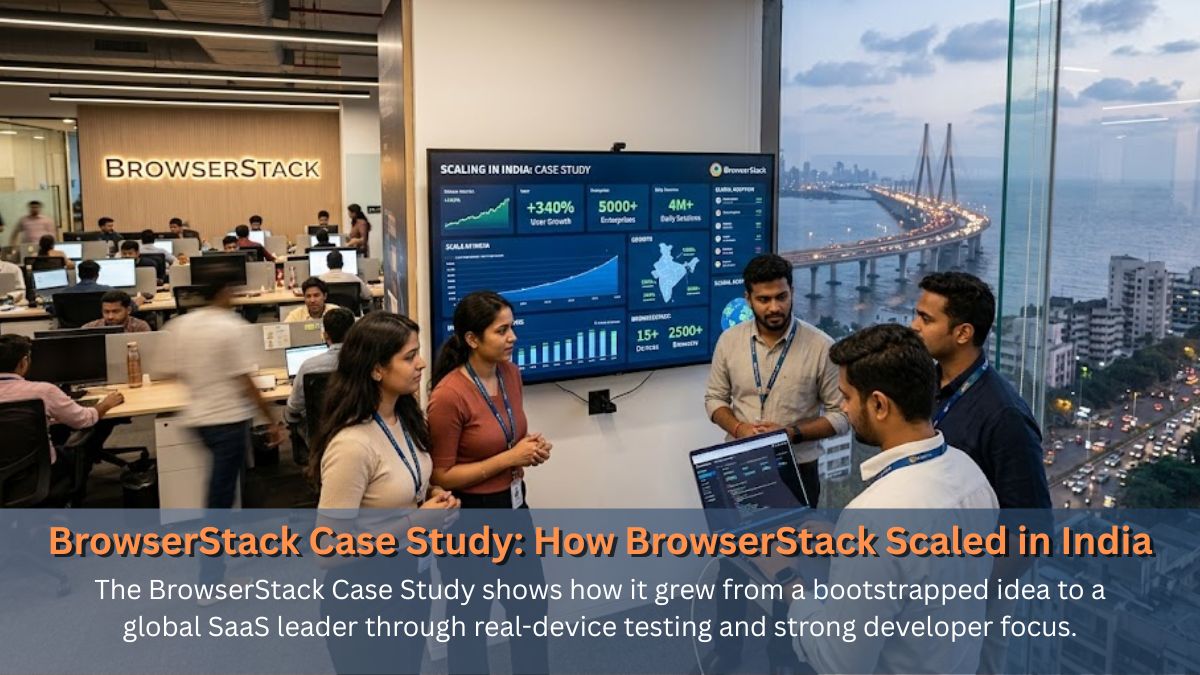
This BrowserStack Case Study examines the rise of one of India’s most successful developer-focused startups and how it grew from a small bootstrapped product idea into a globally recognized cloud software company. BrowserStack is a cloud testing platform that allows developers and quality assurance teams to test websites and mobile applications across thousands of real devices and browsers without maintaining physical testing infrastructure. The company was founded by Ritesh Arora and Nakul Aggarwal, two Indian entrepreneurs who experienced firsthand the challenges developers faced while testing applications across different browsers and devices. The startup was launched in 2011 and is headquartered in Mumbai, India, with offices in several global technology hubs including San Francisco and Dublin.
BrowserStack’s core product provides access to real browsers
BrowserStack’s core product provides access to real browsers and devices hosted in the cloud, enabling developers to run automated and manual tests without setting up complex infrastructure. As the web ecosystem expanded and mobile devices proliferated, developers needed reliable cross browser testing tools to ensure consistent performance across platforms. BrowserStack positioned itself as a solution to that challenge.
Initially bootstrapped by the founders, BrowserStack gained traction among developers who needed scalable and affordable testing infrastructure. The product’s ease of use and global accessibility quickly attracted customers ranging from startups to large enterprises. The company’s growth trajectory accelerated after it raised funding from international investors, including Accel and Insight Partners. In 2021, BrowserStack achieved unicorn status with a valuation exceeding $4 billion, becoming one of India’s notable global SaaS success stories.
Today, BrowserStack serves hundreds of thousands of developers and thousands of enterprise clients worldwide. Companies such as Microsoft, Twitter, Expedia, and PayPal have publicly acknowledged using the platform to improve software testing efficiency. This BrowserStack business case study explores the company’s origins, product strategy, market positioning, funding journey, and the decisions that helped it scale into a leading global SaaS testing platform.
2. The Origin Story Behind the BrowserStack Case Study
The BrowserStack startup story began with a practical problem faced by developers around the world. In the late 2000s and early 2010s, web development was becoming increasingly complex. Websites had to function across multiple browsers such as Chrome, Firefox, Safari, and Internet Explorer. At the same time, mobile devices were expanding rapidly, creating a fragmented ecosystem of operating systems, screen sizes, and device capabilities. Developers were expected to ensure that applications worked consistently across all these environments.
This requirement created a logistical challenge. Companies had to maintain large collections of devices and browsers to test their applications properly. For many startups and smaller development teams, maintaining such infrastructure was expensive and inefficient. The founders of BrowserStack recognized this challenge and envisioned a cloud-based solution that would allow developers to test applications without purchasing and maintaining physical devices. The idea was simple but powerful: provide access to real browsers and devices through the cloud.
3. Founder Journey and Early Motivation
3.1 Ritesh Arora and Nakul Aggarwal
The founders behind BrowserStack were Ritesh Arora and Nakul Aggarwal, both graduates of the Indian Institute of Technology (IIT). Before launching BrowserStack, the founders had professional experience working in technology companies and startups. During their early careers, they frequently encountered difficulties in testing applications across multiple browsers.
The process often involved installing multiple browser versions or maintaining separate machines for testing purposes. The founders realized that this problem was not unique to them. It was a widespread challenge faced by developers globally.
3.2 Recognizing a Global Opportunity
Instead of building another consumer-facing startup, Arora and Aggarwal decided to focus on developer tools. They believed that if they could simplify browser testing, they could help millions of developers improve productivity. This belief formed the foundation of the BrowserStack success story. The founders began developing a platform that would host real browsers and devices in the cloud and allow developers to access them remotely.
4. The Problem BrowserStack Identified in the Market
Before platforms like BrowserStack emerged, software testing was largely infrastructure dependent. Development teams needed to maintain a wide range of devices and browsers to ensure compatibility. This approach presented several challenges. First, purchasing and maintaining hardware devices required significant capital investment.
Second, managing these devices was time-consuming and operationally complex. Third, testing processes were often slow, which delayed product releases. These challenges became more pronounced as mobile devices entered the mainstream. Every new device introduced new screen sizes, operating systems, and hardware capabilities that developers needed to test. The industry lacked scalable web app testing platforms that could support real device testing on demand. BrowserStack recognized that cloud computing could solve this infrastructure problem.
5. Building the Product: The BrowserStack Platform
At its core, BrowserStack wasn’t built as just another developer tool. It was born out of frustration. Anyone who has worked in development knows the pain of testing across browsers. You install Chrome, Firefox, Safari, then struggle with different versions, operating systems, and devices. Something always breaks somewhere. It’s messy, time-consuming, and honestly, exhausting. BrowserStack changed that experience completely. Instead of forcing developers to recreate multiple environments on their own machines, it brought everything into the cloud. With a simple login, developers could instantly access real browsers and devices hosted on remote infrastructure. No setup. No maintenance. wasted hours.
That shift sounds simple, but the impact was huge. What used to take hours or even days could now be done in minutes. Teams could test across hundreds of browser-device combinations without touching a single installation file. What made the platform even more powerful was its flexibility. Developers weren’t locked into one way of working. If someone preferred hands-on testing, they could interact with real browsers directly. If they leaned towards automation, they could plug in their existing frameworks and run large-scale test suites effortlessly.
Over time, BrowserStack didn’t just stop at solving cross-browser testing. It expanded in a very intentional way. Mobile app testing became a natural addition as smartphones took over user behavior. Automated testing pipelines were introduced to fit into modern CI/CD workflows. Integrations with development tools made it part of the daily workflow rather than a separate step. What started as a simple solution to a frustrating problem slowly evolved into a complete testing ecosystem. And that evolution wasn’t forced. It came from listening to developers, understanding their daily struggles, and building around those realities.
6. Early Traction and Validation
The early days of BrowserStack weren’t driven by flashy marketing campaigns or aggressive sales tactics. In fact, it was quite the opposite. The founders focused almost entirely on the product. They believed that if they solved the problem well enough, users would come. And that’s exactly what happened.
Developers who tried BrowserStack immediately felt the difference. It saved time, reduced frustration, and simply worked the way they expected it to. That kind of experience doesn’t stay quiet for long. People started talking about it in team meetings, Slack channels, and developer communities. One developer would recommend it to a colleague. That colleague would bring it into their team. Slowly, it spread across organizations. This wasn’t growth driven by ads. It was growth driven by genuine utility.
What’s interesting is how natural this adoption felt. There was no push. No pressure. Just a product solving a real problem at the right time. This kind of traction is powerful because it’s rooted in trust. When developers recommend a tool, they’re putting their credibility on the line. And BrowserStack earned that trust early on. The result was steady, organic growth. The platform became a go-to solution for cross-browser testing without needing to shout about it. It quietly became essential.
7. Business Model and Revenue Strategy
BrowserStack’s business model is straightforward, but very intentional. It operates on a subscription-based Software-as-a-Service model, where customers pay recurring fees to access the platform. On the surface, that might sound like a standard SaaS approach. But what makes it effective is how closely it aligns with customer needs.
Different teams have different requirements. A small startup might need limited testing sessions and a handful of devices. A large enterprise, on the other hand, may require thousands of parallel tests, multiple integrations, and dedicated infrastructure. BrowserStack built its pricing around this reality.
Customers can choose plans based on:
- Number of browsers and devices
- Testing sessions and concurrency
- Access to advanced features and integrations
This flexibility allows companies to scale their usage as they grow. They don’t have to overcommit early, and they’re not restricted later.
For enterprises, the approach goes even deeper. Many large organizations rely heavily on testing as part of their release cycles. For them, BrowserStack becomes a critical part of their development pipeline. Customized plans ensure that the platform fits seamlessly into their workflows.
The result is a strong, predictable revenue stream. Subscription models create consistency. Instead of chasing one-time sales, BrowserStack builds long-term relationships with its customers. And because the product is deeply integrated into development processes, churn tends to be low. Once a team relies on it, it becomes difficult to replace.
8. Bootstrapping and Funding History
One of the most defining aspects of BrowserStack’s journey is how it started. In its early years, the company was bootstrapped. There was no rush to raise capital. No pressure to scale prematurely. The founders focused on building something sustainable. This decision shaped the company in a fundamental way. Without external pressure, they could prioritize product quality over growth hacks. They could listen to users, iterate slowly, and build with clarity.
Bootstrapping also meant discipline. Every decision mattered. Resources were limited, so they had to be used wisely. This often leads to better products because there’s no room for unnecessary complexity. But as BrowserStack grew, the reality changed. Supporting a global user base requires massive infrastructure. Hosting real devices, maintaining uptime, and ensuring performance at scale is not cheap.
At that stage, external funding became necessary. The company raised investment from well-known venture firms like Accel, followed by later rounds from Insight Partners. These weren’t just financial boosts. They were signals that the market recognized BrowserStack’s potential.
The most defining moment came in 2021, when BrowserStack raised $200 million. This funding round valued the company at around $4 billion, officially making it a unicorn. But what makes this milestone meaningful isn’t just the number. It’s the journey behind it. From a bootstrapped startup solving a niche developer problem to a globally recognized platform trusted by thousands of companies, the growth was steady, grounded, and real. And even after reaching that scale, the core philosophy didn’t change. Build for the user. Solve real problems. Stay useful. That’s what turned BrowserStack from a tool into an essential part of modern software development.
9. Go-to-Market Strategy and Distribution
BrowserStack didn’t grow by chasing customers. It grew by letting customers discover it on their own terms. That difference matters more than it sounds. Developers don’t like being sold to. They like figuring things out themselves. They want to try a tool, break it, test its limits, and see if it actually makes their life easier. The founders understood this deeply. Instead of building a heavy sales engine early on, they focused on making the product accessible. The idea was simple. Let people experience the product before asking them to pay for it.
Free trials weren’t just a marketing tactic. They were the core of the go-to-market strategy. A developer could land on the platform, start testing instantly, and feel the difference within minutes. No long onboarding. No friction. Just immediate value. And once that happened, something interesting kicked in. Developers started advocating for it internally. A QA engineer would try BrowserStack and realize it saved hours of setup time. That engineer would then bring it up in a team meeting. Soon, the entire team would start using it. From there, it would spread across departments. Before long, what started as an individual trial became an organizational dependency.
9.1 BrowserStack’s growth feel almost invisible from the outside
This is what made BrowserStack’s growth feel almost invisible from the outside. There were no loud campaigns. No aggressive outreach. Just quiet, consistent adoption driven by real usage. Documentation also played a huge role. Not the kind that sits untouched, but the kind developers actually rely on. Clear guides, real use cases, practical integrations. Everything was built to reduce friction.
The platform integrated seamlessly with popular testing frameworks and development tools. This meant teams didn’t have to change how they worked. BrowserStack simply fit into their existing workflows. That’s a big deal because developers resist anything that forces them to relearn their process. Over time, educational content added another layer. Tutorials, use cases, and real-world examples helped developers understand not just how to use the tool, but how to get the most out of it. The result was a powerful bottom-up distribution model. Instead of chasing enterprise deals from the top, BrowserStack entered organizations through the people who actually used the product every day. And once it was inside, it stayed.
10. Brand Positioning and Messaging Evolution
BrowserStack never tried to be flashy. It never relied on exaggerated claims or marketing buzzwords. From the beginning, its positioning was grounded in one clear idea: make testing simple and reliable for developers. In the early days, the messaging was very focused. Speed, ease of use, and access to real browsers. That’s what developers cared about, and that’s what the brand delivered.
There was a kind of honesty in the way BrowserStack communicated. It didn’t try to be everything at once. It focused on solving one problem really well. And that clarity made it easy for developers to trust the product. As the platform evolved, the messaging evolved with it. BrowserStack was no longer just a cross-browser testing tool. It had become a much broader testing infrastructure. Mobile testing, automated pipelines, integrations across the development lifecycle. The scope had expanded significantly.
But instead of complicating the message, the brand adapted it carefully. It started positioning itself as a complete testing platform while still staying rooted in its original promise: reliability and simplicity. This balance is hard to maintain. Many companies lose their identity when they expand. BrowserStack didn’t. It kept its developer-first mindset intact while scaling its capabilities. Over time, the brand began to reflect something deeper. It wasn’t just about testing anymore. It was about enabling teams to build better software with confidence. And that shift mattered. Because at its core, every developer wants to ship something that works flawlessly. BrowserStack positioned itself as a partner in that journey. Not just a tool, but an enabler.
11. Key Challenges and Turning Points
Behind the steady growth, there were real challenges. The kind that test not just the product, but the resilience of the company itself. One of the biggest challenges was infrastructure. Offering real devices in the cloud sounds simple when you say it quickly. In reality, it’s incredibly complex. Thousands of devices need to be maintained, updated, and made available at any given moment. And not just available, but reliable.
Imagine a developer running critical tests before a release, and the platform slows down or fails. That’s not just a bad experience. It breaks trust. BrowserStack had to ensure that didn’t happen. This required heavy investment, both financially and operationally. Building and maintaining such infrastructure is not a one-time effort. It’s continuous. Devices need to be replaced. Systems need to be upgraded. Performance needs to be optimized constantly.
At the same time, competition was increasing. As the developer tools space grew, new web app testing platforms and automation tools started emerging. Each offering something slightly different. Some focused on automation. Others on speed. A few tried to replicate parts of what BrowserStack was doing. This is where many companies lose momentum. They either get distracted or spread themselves too thin.
BrowserStack took a different approach. It doubled down on its strengths. Instead of reacting to every new competitor, it focused on improving its own platform. Expanding features where it made sense. Strengthening infrastructure where it mattered most. Listening to users and evolving based on real needs, not market noise. There were moments where these decisions became turning points. Investments that seemed heavy in the short term paid off in the long run. The result was stability. While others tried to catch up, BrowserStack continued to lead.
12. Operational Execution and Scaling Decisions
Scaling BrowserStack wasn’t just about adding more users. It was about supporting those users without compromising performance. And that required a level of operational precision that most people don’t see. At the heart of this was infrastructure. BrowserStack invested heavily in building and managing data centers filled with real devices. Not simulators. Not emulators. Actual devices that developers could test on. This commitment made a huge difference in accuracy and reliability.
But it also made operations significantly more complex. Every device had to be maintained in optimal condition. Network stability had to be ensured. Latency had to be minimized. And all of this had to work seamlessly across different geographies. This is where execution becomes everything. It’s one thing to promise performance. It’s another to deliver it consistently at scale. BrowserStack focused deeply on this.
Speed became a key differentiator. Developers don’t want to wait. Fast test execution isn’t just a convenience. It directly impacts productivity. If tests run faster, teams can iterate faster. If teams iterate faster, products improve faster. BrowserStack understood this chain reaction and optimized for it relentlessly.
Reliability was equally critical. A testing platform isn’t useful if it’s unpredictable. Teams need to trust that it will work every time they use it. Building that level of reliability requires constant monitoring, quick issue resolution, and a proactive approach to system health. Over time, these operational decisions became a competitive advantage. While others focused on features, BrowserStack focused on execution. And in a space where developers depend on consistency, that focus made all the difference. The result wasn’t just growth. It was trust at scale.
13. Competitive Landscape and Differentiation
If you’ve ever worked in software testing, you already know how crowded and fragmented this space is. On one side, you have open-source tools like Selenium that give you flexibility but demand time, setup, and constant maintenance. On the other, there are commercial platforms promising speed but often falling short on reliability or real-world accuracy. This is exactly where BrowserStack made a very intentional bet and it paid off.
Instead of building yet another testing tool, they focused on solving a problem developers genuinely hate: “It works on my machine, but not on the user’s device.” Simulators and emulators can only go so far. They don’t capture real-world performance issues like device-specific bugs, network fluctuations, or hardware-level inconsistencies. BrowserStack leaned fully into real-device testing. Not partially. Not as an add-on. As the core product.
That decision changed everything. Developers could now test on actual iPhones, Android devices, and different browser environments without owning or maintaining them. No labs, no procurement headaches, no manual setups. Just instant access. The result was not just better testing accuracy, but confidence. And confidence is what teams actually pay for.
Another subtle but powerful differentiator was their obsession with developer experience. Clean documentation, quick onboarding, seamless integrations with CI/CD tools. They didn’t just build a product, they removed friction from a developer’s daily workflow. Over time, this created a strong moat. While competitors were competing on features, BrowserStack was winning on trust, reliability, and ease of use. That’s a very different game and much harder to replicate.
14. Growth Metrics and Milestones
Numbers tell one part of the story. But what’s more interesting is what those numbers represent. BrowserStack today serves hundreds of thousands of developers across the world. That’s not just a vanity metric. It reflects something deeper, repeated daily usage. Testing is not a one-time activity. It’s embedded into every release cycle, every sprint, every deployment. Thousands of enterprises rely on the platform. And in enterprise software, trust is earned slowly and lost quickly. Once a testing tool becomes part of a company’s CI/CD pipeline, replacing it is painful. That stickiness is a sign of real product-market fit.
Their integrations with major development tools also played a huge role in growth. Instead of forcing teams to change how they work, BrowserStack quietly fit into existing workflows. Jenkins, GitHub, Bitbucket, automation frameworks. Everything just worked. Partnerships with large technology companies further validated their position. These weren’t just branding exercises. They opened distribution channels and helped BrowserStack become part of the global developer ecosystem.
What stands out is how they scaled without losing focus. Many companies chase growth by expanding in too many directions. BrowserStack stayed anchored to one core idea: make testing effortless and reliable for developers. That clarity shows in their milestones.
15. Team Building and Leadership
Behind every reliable product is a team that takes reliability personally. As BrowserStack grew, hiring wasn’t just about filling roles. It was about building a culture that could handle scale without breaking the product. Infrastructure-heavy SaaS is unforgiving. A small failure can impact thousands of users instantly. So the founders doubled down on engineering talent. Not just good engineers, but people who understood systems, scalability, and performance at a deep level.
They also brought in product managers who could balance technical complexity with user simplicity. That’s harder than it sounds. Developers want power, but they also want things to just work. Bridging that gap requires sharp product thinking. Their global expansion wasn’t just about opening offices. It was about being closer to users. Different regions have different testing needs, device preferences, and usage patterns. A distributed team helped them stay relevant across markets.
What really stands out is the leadership philosophy. There’s a clear emphasis on long-term thinking. Instead of chasing quick wins, they invested in infrastructure, reliability, and customer trust. That’s not the fastest way to grow. But it’s the most durable.
16. Technology and Infrastructure
This is where things get serious. What looks like a simple interface on the surface is backed by an incredibly complex system underneath. BrowserStack operates large-scale data centers filled with thousands of real mobile devices and browser environments. Think about that for a second.
Every time a developer runs a test, they’re essentially accessing a real device sitting in a remote data center somewhere in the world. That device needs to be available, responsive, and isolated. It needs to simulate real user conditions without interference. Managing that at scale is not trivial. Device procurement, maintenance, OS updates, browser compatibility, network simulation, concurrency handling. Each of these is a problem on its own. Together, they form a massive operational challenge.
On top of that, BrowserStack integrates deeply with CI/CD pipelines. Automated tests can run across multiple devices and browsers simultaneously. This parallelization drastically reduces testing time, which directly impacts release cycles. For developers, it feels simple. Click, run, test. But behind that simplicity is a highly optimized infrastructure designed for speed, reliability, and scale. And that’s what makes it hard to replicate.
17. Current Status of the Company
Today, BrowserStack stands as one of the most successful SaaS stories to come out of India. It serves users in over 100 countries. From startups shipping their first product to large enterprises managing complex applications, the platform has become a default choice for testing. Its recognition as a unicorn startup is not just about valuation. It reflects global relevance. Indian SaaS companies are no longer just outsourcing hubs. They are building products that compete and win internationally.
What’s more interesting is that BrowserStack is still evolving. They continue to expand their product suite, improve infrastructure, and adapt to new testing challenges. As applications become more complex and user expectations rise, the demand for reliable testing will only grow. And BrowserStack is well-positioned to stay at the center of that ecosystem. At its core, the company didn’t just build a testing tool. It built trust into the software development process. And that’s why it continues to matter.
18. Future Outlook in the BrowserStack Case Study
The future of BrowserStack is closely tied to the continued growth of software development and digital platforms. As applications become more complex and device ecosystems expand, the need for reliable testing infrastructure will increase.
BrowserStack’s focus on developer productivity and scalable infrastructure positions it well for future growth. The company is likely to continue expanding its automation capabilities and integrations with development tools. This BrowserStack Case Study illustrates how a focused developer tool can evolve into a global SaaS company by solving a specific problem with precision and persistence. For India’s startup ecosystem, the BrowserStack growth story demonstrates the potential of product-driven companies to achieve global success while building from India.
About foundlanes.com
foundlanes.com is India’s leading startup idea discovery platform. It helps entrepreneurs find actionable startup opportunities, market insights, and industry-specific guidance to turn ideas into real businesses. With deep research and practical resources, foundlanes supports founders at every stage, from idea validation to launch and growth.