
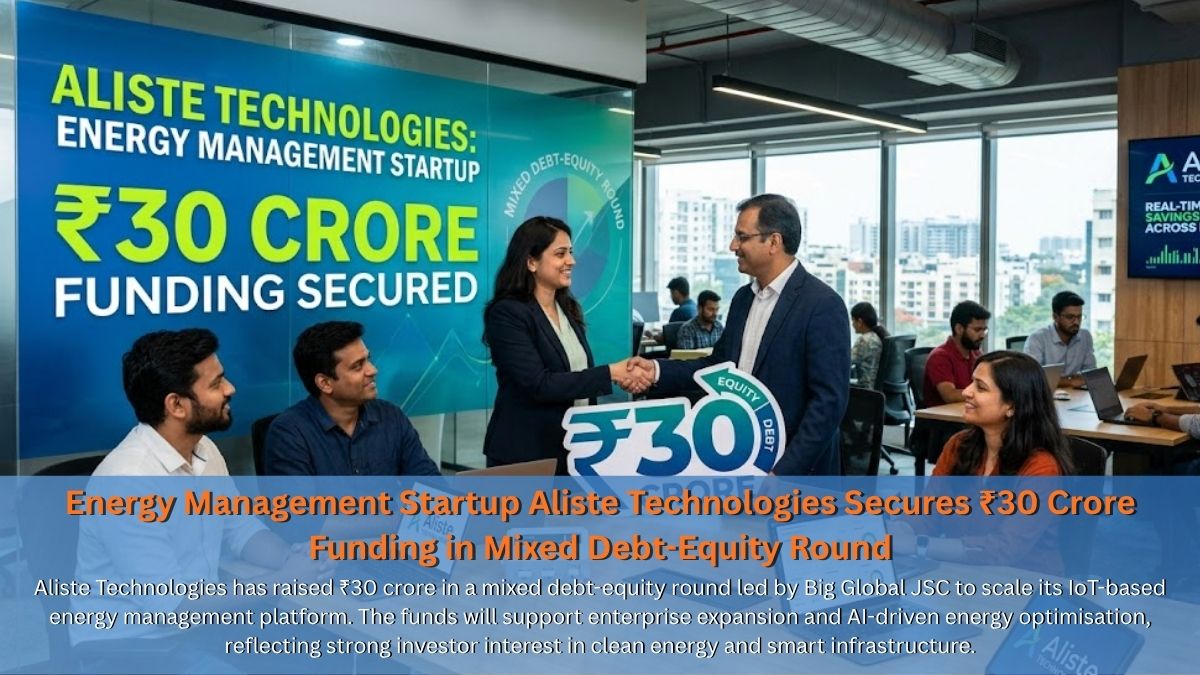
News Summary
Aliste Technologies has secured ₹30 crore in a mixed debt-equity funding round, marking a major milestone in India’s fast-growing energy management and IoT solutions space. The round was led by Big Global JSC, along with participation from existing and strategic investors focused on sustainability, smart infrastructure, and enterprise technology.
The funding highlights rising investor confidence in clean energy, smart building systems, and enterprise energy optimisation platforms. According to startup ecosystem reports and industry coverage, the capital will help Aliste Technologies expand its enterprise energy management solutions, improve IoT-based automation systems, and scale deployments across commercial and industrial buildings. Aliste Technologies operates in the energy management and IoT-driven efficiency sector. The startup builds technology solutions that help businesses monitor, control, and reduce energy consumption. With rising electricity costs and global sustainability targets, demand for such platforms is increasing rapidly across India and international markets.
The ₹30 crore investment comes at a time when venture capital activity in climate tech, clean energy, and deep tech startups is rising sharply. Investors are focusing on startups that offer measurable cost savings and environmental impact reduction. Aliste Technologies fits directly into this trend due to its enterprise-focused energy optimisation model. Furthermore, the funding strengthens India’s position in the global smart energy technology ecosystem. As industries shift toward automation and sustainability, startups like Aliste Technologies are becoming critical enablers of energy efficiency transformation. It also signals growing momentum in the IoT-driven clean energy startup ecosystem.
1. Introduction: Aliste Technologies Funding and Market Impact
1.1 Overview of the Funding Round
The ₹30 crore mixed debt-equity round raised by Aliste Technologies is not just a financial milestone, it reflects a deeper shift in how investors are evaluating energy-focused startups in India. What makes this funding significant is the balance between debt and equity, which shows a dual layer of confidence. Equity signals belief in long-term scalability, while debt indicates that investors also trust the startup’s near-term cash flow discipline and operational strength. This combination is not very common in early-stage tech startups unless there is strong conviction in both the product and the market demand.
At a broader level, this funding highlights how energy efficiency is moving from the sidelines into core investment conversations. Rising electricity costs, increasing pressure on commercial infrastructure, and stricter sustainability expectations are forcing companies to rethink how they consume power. In that environment, Aliste Technologies is not pitching a futuristic idea, but solving a very immediate and very expensive problem. That urgency is what likely pushed investor interest beyond curiosity into commitment. The funding round, in that sense, becomes less about capital infusion and more about validation of a category that is now being seen as essential infrastructure for modern enterprises.
1.2 The timing of this investment also says a lot about where the market is heading
The timing of this investment also says a lot about where the market is heading. Clean energy and efficiency technologies are no longer viewed as optional ESG add-ons. They are becoming operational necessities for businesses trying to stay competitive. Investors are increasingly looking at startups that reduce real-world waste, generate measurable savings, and integrate directly into business operations. Aliste Technologies fits into this shift very naturally, which is why the funding carries weight beyond its numerical value.
In a way, this round reflects a growing maturity in the Indian startup ecosystem itself. Capital is no longer chasing only consumer-scale growth stories. It is also flowing into infrastructure-level innovation that quietly improves how entire industries function. Energy management sits right in that category, and Aliste Technologies is one of the companies benefiting from that structural change.
1.3 Role in the Startup Ecosystem
India’s startup ecosystem has been evolving rapidly, but the last few years have marked a clear transition from surface-level innovation to deeper, system-level problem solving. Earlier, most attention was focused on consumer apps, digital marketplaces, and quick-scaling platforms. Today, there is a noticeable shift toward AI-driven infrastructure, industrial automation, and clean technology solutions that address fundamental inefficiencies in how industries operate.
Energy management sits at the center of this shift, even if it often does not get the same visibility as flashier sectors. Every industrial unit, commercial building, hospital, data center, and retail chain depends heavily on uninterrupted energy consumption. Yet, in most cases, energy usage is still managed in a reactive manner. Bills arrive at the end of the month, consumption patterns are reviewed superficially, and inefficiencies are often discovered too late to meaningfully correct them. This creates a silent but massive drain on operational budgets across sectors.
1.4 Startups like Aliste Technologies are stepping into this gap
Startups like Aliste Technologies are stepping into this gap with a more proactive and intelligence-driven approach. Instead of treating energy as a fixed utility cost, they are turning it into a measurable, optimizable system. This shift is important because it changes how businesses think about efficiency itself. It is no longer about reducing usage blindly, but about understanding when, where, and why energy is being consumed, and then acting on that intelligence in real time.
At an ecosystem level, investors are increasingly drawn to such “invisible problem” solutions because their impact scales quietly but significantly. Unlike consumer apps that depend on user behavior, energy optimization delivers value regardless of market trends or user adoption cycles. Once integrated, it becomes part of the operational backbone of a business, which makes it both sticky and defensible.
Another major factor strengthening this ecosystem shift is sustainability pressure. Companies are now expected to report energy consumption, reduce carbon footprints, and align with global environmental standards. This has turned energy efficiency from a cost-saving measure into a compliance and reputation requirement. As a result, startups in this space are no longer niche players, they are becoming essential enablers of modern enterprise operations.
2. About Aliste Technologies and Its Working Model
2.1 Core Business Model
At its foundation, Aliste Technologies is built around a very simple but powerful principle: inefficiency exists because visibility is missing. Most organizations do not intentionally waste energy, but they often lack the tools to see exactly how it is being used in real time. Aliste’s model addresses this gap by embedding intelligence directly into energy infrastructure through IoT-enabled systems that continuously monitor consumption at a granular level.
In practical terms, the system transforms passive energy usage into an active data stream. Every connected device, circuit, or load becomes a source of real-time information. This data is then structured into meaningful insights that facility managers can actually use, not just interpret. Instead of overwhelming teams with raw technical readings, the platform highlights patterns such as unusual consumption spikes, equipment running outside scheduled hours, or systems drawing excess power compared to expected benchmarks.
The real strength of this model lies in how it translates observation into financial impact. When inefficiencies are identified clearly, organizations can take immediate corrective action. Over time, this leads to a measurable reduction in operational expenses. For large facilities, even small percentage improvements in energy efficiency can translate into significant annual savings, which is where the business value becomes very tangible.
What makes this model even more effective is its continuous feedback loop. As systems adjust and optimize, the platform keeps learning and refining its understanding of consumption behavior. This creates a cycle where energy usage becomes progressively more efficient without requiring constant manual oversight. It is not just monitoring, it is ongoing optimization embedded into daily operations.
2.2 How the Technology Works
The technology behind Aliste Technologies operates through a layered architecture that combines hardware, software, and automation. The first layer is data capture, where IoT sensors are installed across electrical systems to track real-time usage. These sensors collect detailed information such as load distribution, voltage fluctuations, and consumption cycles. This level of granularity is critical because many inefficiencies occur in short bursts that traditional billing systems completely miss.
Once collected, this data flows into a cloud-based analytics engine, which forms the second layer. Here, raw electrical data is transformed into structured insights. The system identifies patterns, detects anomalies, and compares current usage against historical behavior. For example, it can flag situations where equipment is consuming more power than normal under similar operating conditions or when systems are running during idle hours without necessity.
The third layer is automation and control, which is where the system moves from analysis to action. Based on predefined rules and learned behavior, it can trigger automated responses such as shutting down unused loads, optimizing operating schedules, or adjusting system behavior during peak demand periods. This reduces the need for manual intervention and ensures that inefficiencies are corrected in real time rather than after the fact.
In real-world environments, this creates a noticeable transformation. Facilities begin to operate more smoothly, energy spikes reduce, and operational teams gain clearer visibility into their infrastructure. Over time, this leads not only to cost savings but also to more predictable and stable energy consumption patterns, which is extremely valuable for industries with tight operational margins.
2.3 Business Positioning
Aliste Technologies occupies a rare intersection where multiple high-growth trends converge at once. It sits between IoT infrastructure, artificial intelligence, industrial automation, and the global shift toward sustainability. This positioning gives it exposure to several expanding markets simultaneously, rather than relying on a single industry cycle for growth.
On a practical level, the company is addressing one of the most persistent challenges in industrial and commercial operations: uncontrolled energy expenditure. Businesses across sectors often struggle not because they lack resources, but because they lack visibility into how those resources are being consumed. Aliste’s positioning directly addresses this gap by turning energy usage into a measurable and optimizable asset rather than a fixed cost.
The deeper strength of this positioning lies in its embedded nature. Once installed, these systems become part of a company’s operational infrastructure. They are not external tools used occasionally, but continuous systems that influence daily decision-making. This creates long-term dependency, high switching costs, and consistent engagement, all of which are strong indicators of sustainable business models.
At the same time, regulatory and environmental pressures are adding further momentum to this category. Companies are being pushed to reduce carbon emissions, improve energy transparency, and align with global sustainability frameworks. This means that solutions like Aliste Technologies are not just optional efficiency tools anymore, they are becoming essential components of modern enterprise compliance and operational strategy. In that sense, the company is not just positioned in a growing market. It is positioned inside a structural shift in how industries think about energy itself. That is what gives it both relevance today and resilience for the future.
3. Revenue Model of Aliste Technologies
3.1 Subscription-Based Model
At the heart of Aliste Technologies’ revenue engine is a subscription-based software model that reflects how modern enterprise SaaS companies are built. Businesses do not simply “buy” the platform once. Instead, they subscribe to continuous access, which includes real-time energy monitoring, analytics dashboards, reporting tools, and ongoing system intelligence updates. This recurring structure is important because energy optimization is not a one-time fix. It is an ongoing process that evolves as usage patterns, equipment loads, and operational conditions change inside a facility.
What makes this model powerful in real-world settings is its predictability. For companies managing large buildings or industrial spaces, energy costs fluctuate constantly. Having a system that continuously tracks, analyzes, and optimizes consumption becomes less of a software tool and more of an operational necessity. Over time, the subscription fee is often justified internally through direct savings on electricity bills, which makes renewal decisions relatively natural. This creates a strong alignment between value delivered and revenue earned, which is one of the healthiest dynamics in a SaaS-driven business.
There is also a psychological layer to this model. Once organizations begin seeing measurable reductions in energy waste, the platform stops feeling like an expense and starts feeling like a control system. Facility teams become dependent on the insights it provides because it gives them clarity they never had before. That dependency naturally strengthens retention, making the subscription model more stable and scalable over time.
3.2 Hardware and IoT Integration Revenue
Beyond software, Aliste Technologies also generates significant revenue through IoT hardware deployment and integration services. This includes installing sensors, smart meters, and monitoring devices across electrical systems in client facilities. Unlike traditional software companies that operate purely in the digital space, Aliste has a physical footprint inside buildings, which adds both complexity and strength to its revenue model.
In practical terms, this hardware layer is what makes the entire system function. Without accurate data collection at the source, energy optimization would remain theoretical. These devices capture real-time electrical behavior at a granular level, which is then fed into the platform for analysis. Because every facility has different electrical layouts, installation is often customized, involving engineering assessment, deployment planning, and system calibration.
This creates a meaningful revenue stream upfront, especially during onboarding of new enterprise clients. However, the real long-term value is not just in selling devices, but in creating a tightly integrated ecosystem where hardware and software work together continuously. Once installed, these systems are not easily replaced, which increases operational stickiness and reduces churn. It also means that hardware revenue often acts as an entry point, while software subscriptions generate sustained lifetime value.
There is also a human reality behind this model that often gets overlooked. Installing IoT systems in active industrial or commercial environments requires coordination, trust, and precision. Teams often work during non-peak hours, ensure minimal disruption, and fine-tune systems based on real operating conditions. This hands-on implementation creates strong client relationships, which further strengthens long-term business continuity.
3.3 Enterprise Contracts
Enterprise contracts form the most stable and strategically important layer of Aliste Technologies’ revenue structure. These are long-term agreements with large organizations such as corporate offices, manufacturing units, retail chains, or infrastructure operators who require continuous energy optimization across multiple sites. Unlike smaller clients, enterprises are not just looking for monitoring tools. They are looking for guaranteed outcomes in terms of cost reduction, efficiency improvements, and compliance reporting.
These contracts are typically structured over extended periods, often with clearly defined performance metrics tied to energy savings or efficiency benchmarks. This outcome-driven approach shifts the relationship from being transactional to deeply operational. In many cases, Aliste Technologies becomes embedded into the daily functioning of facility management teams, influencing decisions related to load management, equipment usage, and energy budgeting.
From a business standpoint, this is where revenue becomes highly predictable and scalable. Enterprise contracts reduce volatility and provide a strong foundation for long-term planning. They also open doors to multi-location expansion within the same client organization, which means a single successful deployment can lead to multiple additional rollouts across different facilities.
What makes this particularly powerful is the trust factor. Energy management is a sensitive operational area, and enterprises do not switch providers easily once a system is integrated into their infrastructure. Over time, this creates deep retention and expands contract value organically as the organization scales or upgrades its infrastructure.
4. Funding Details and Investment Structure
4.1 Mixed Debt-Equity Structure
The ₹30 crore funding round structured as a mix of debt and equity reflects a very intentional financial strategy rather than a simple capital raise. Equity investment shows that investors believe in the long-term upside of Aliste Technologies, while debt introduces discipline and accountability into how that capital is deployed. This hybrid structure is often used when a business has both strong growth potential and relatively stable underlying cash flows.
In practical terms, this structure allows the company to scale without over-diluting ownership while still accessing significant capital for expansion. It also signals maturity in the business model. Pure equity funding is often associated with early-stage uncertainty, while mixed structures are more common in startups that already have working systems, paying customers, and predictable revenue streams. In this case, it suggests that Aliste Technologies is transitioning from early validation to structured scale.
There is also a strategic advantage here. Debt capital can be used for specific operational expansions such as hardware deployment, infrastructure scaling, or geographic rollout, while equity can be directed toward innovation and product development. This separation of purpose ensures that growth is both aggressive and controlled, which is critical in hardware-plus-software businesses.
4.2 Investor Participation
The round being led by Big Global JSC, along with participation from other strategic investors focused on sustainability and technology, adds more than just financial weight. It brings credibility, network access, and potential global expansion pathways. Investors in this space are not just passive funders. They often bring industry connections, enterprise introductions, and operational expertise that can significantly accelerate adoption.
What stands out is the alignment between investors and the nature of the business itself. Energy management is a global concern, not limited to one geography. Having investors who understand sustainability markets and enterprise infrastructure gives Aliste Technologies an advantage when expanding beyond local markets. It also signals that the company is being viewed not as a small regional solution, but as a scalable platform with international relevance.
On a deeper level, this kind of investor participation often validates the seriousness of the problem being solved. When global-focused funds enter a deal, it usually indicates that the solution has cross-border applicability and long-term demand visibility. That kind of backing tends to strengthen confidence among future clients as well, especially large enterprises that prefer working with well-supported vendors.
4.3 Use of Funds
The capital raised is expected to be deployed across three major areas: product development, talent expansion, and international scaling. Each of these areas plays a critical role in moving Aliste Technologies from a strong domestic player to a globally competitive platform. Product development will likely focus on improving AI-driven analytics, making predictions more accurate, and enhancing automation capabilities so that energy optimization becomes more autonomous over time.
Hiring expansion is equally important because building and deploying IoT-based systems requires multidisciplinary teams. Engineers, data scientists, field technicians, and enterprise solution specialists all play a role in delivering the product effectively. Scaling such operations requires not just hiring more people, but building structured teams that can handle deployment across multiple client environments without compromising quality.
International scaling represents the most ambitious part of the roadmap. Energy inefficiency is a global issue, especially in rapidly urbanizing economies and industrial hubs. However, each region has its own regulatory frameworks, infrastructure constraints, and operational behaviors. The funds will likely support adaptation of the platform to different markets, ensuring it can integrate seamlessly with diverse energy systems.
A significant portion of investment will also strengthen AI capabilities, which is where the future of the platform lies. As systems become more intelligent, the goal is not just to report inefficiencies, but to predict and prevent them before they occur. That shift from reactive monitoring to proactive optimization is what will define the next stage of growth.
5. Founders and Startup Background
5.1 Founding Vision
Aliste Technologies was founded with a vision rooted in a very practical frustration: energy waste is everywhere, but almost no one can see it clearly enough to act on it. The founders recognized that most organizations operate in the dark when it comes to real-time energy consumption. Bills arrive after the fact, audits happen periodically, and inefficiencies often go unnoticed for long periods. The vision was to change that entirely by making energy usage visible, measurable, and controllable in real time.
This vision is not just technical, it is deeply operational. It is about giving organizations the ability to understand how their systems behave at every moment, not just in hindsight. The emotional core of this idea lies in control. Businesses want control over their costs, their operations, and their efficiency, but energy has traditionally been one of the least controllable inputs. Aliste Technologies aims to fix that gap by turning energy into something that can be actively managed rather than passively consumed.
Over time, this vision has evolved into a broader mission of sustainability and efficiency. It is not just about saving money anymore. It is about reducing unnecessary waste at scale, which has both financial and environmental impact. That dual outcome is what gives the founding vision its long-term relevance.
5.2 Early Journey
In its early days, Aliste Technologies focused primarily on IoT-based monitoring solutions for small commercial spaces. The initial phase was heavily experimental, involving rapid prototyping, field testing, and iterative improvements based on real-world feedback. Early deployments often revealed unexpected challenges, such as inconsistent electrical infrastructure, varied usage patterns, and resistance from facility teams who were not used to granular monitoring.
These early struggles played a crucial role in shaping the product. Instead of staying a pure hardware monitoring solution, the team gradually realized that data alone was not enough. Clients needed interpretation, guidance, and actionable insights. This realization shifted the product direction from simple tracking devices to an integrated intelligence system that could actively support decision-making.
As the company gained experience, it began expanding beyond small installations into larger enterprise environments. This transition was not just about scale, but about complexity. Larger facilities brought more variables, more systems, and higher stakes. Successfully navigating this phase helped the startup refine its technology, strengthen its deployment processes, and build credibility in the enterprise segment.
5.3 Growth Evolution
The evolution of Aliste Technologies reflects a broader trend seen in many successful deep-tech startups: moving from hardware-first thinking to platform-first intelligence. Initially, the focus was on building reliable IoT systems that could capture energy data accurately. However, as the product matured, it became clear that the real value was not in data collection, but in interpretation and action.
This led to a strategic shift toward a full-stack energy intelligence platform. Instead of just showing energy consumption, the system began analyzing patterns, predicting inefficiencies, and enabling automated corrections. This transformation significantly increased the value proposition because it reduced the burden on human operators while increasing the accuracy of optimization.
This evolution also aligns with global trends in AI and clean technology. The industry is moving away from static monitoring tools and toward adaptive systems that learn, respond, and improve continuously. Aliste Technologies fits directly into this shift, positioning itself not just as a service provider, but as an infrastructure layer for intelligent energy management.
6. Products and Services Offered
6.1 Energy Management Platform
The core offering of Aliste Technologies is its cloud-based energy management platform, designed to provide real-time visibility into electricity consumption across different systems and locations. This platform acts as the central control hub where all data from IoT devices is aggregated, analyzed, and presented in a structured, usable format. For facility managers, this becomes the single source of truth for understanding how energy flows through their infrastructure.
In real-world usage, the platform transforms how decisions are made. Instead of relying on monthly reports or manual audits, teams can see live consumption patterns and respond immediately to inefficiencies. This real-time visibility often leads to behavioral changes inside organizations, where energy usage becomes more intentional and controlled. Over time, this creates a culture of efficiency that extends beyond just technology adoption.
6.2 IoT Hardware Systems
The IoT hardware layer is what enables the entire system to function at ground level. These devices are installed across electrical panels, machinery, and distribution systems to continuously capture energy usage data. The accuracy and consistency of this data are critical because even small gaps can lead to incorrect insights or missed inefficiencies.
From a deployment perspective, installing these systems requires careful planning and coordination with on-site teams. Each facility has its own electrical architecture, which means installations are often customized rather than standardized. Once installed, however, these systems operate continuously in the background, feeding the platform with real-time data without disrupting daily operations.
6.3 Automation Solutions
The automation layer is where Aliste Technologies moves beyond observation into action. These systems are designed to automatically reduce energy wastage by controlling usage patterns, optimizing schedules, and shutting down unnecessary loads when conditions are detected. The goal is to reduce dependency on manual intervention and ensure efficiency even when human oversight is limited.
In practice, this creates a significant shift in how facilities operate. Instead of reacting to inefficiencies after they occur, the system actively prevents them from happening. Over time, this leads to more stable energy consumption, lower operational costs, and improved predictability. For many organizations, this is where the real value becomes visible, because savings are no longer theoretical but continuously generated in the background.te by controlling lighting, cooling, and electrical systems intelligently.
7. Problems Solved by Aliste Technologies
7.1 High Energy Costs
Rising electricity costs are one of those silent pressures that slowly eat into business margins without always being noticed in time. For most industries, energy is not a strategic discussion point until the monthly bill becomes too large to ignore. Manufacturing units, commercial buildings, logistics hubs, and data-heavy operations often accept energy costs as a fixed burden, even when a significant portion of that expense is actually avoidable. The real problem is not just high consumption, but uncontrolled consumption that goes unmeasured in real time.
Aliste Technologies addresses this by turning energy usage into something measurable, trackable, and ultimately optimizable. When businesses can actually see where power is being consumed, patterns begin to emerge. Machines running longer than needed, systems operating during idle hours, or inefficient load distribution suddenly become visible. Once that visibility is created, cost reduction stops being theoretical and becomes actionable. Over time, organizations often discover that a meaningful portion of their energy bill was never tied to productivity in the first place, but to inefficiencies that simply went unchecked.
The impact is not just financial on paper. In real operations, facility managers start making different decisions. They begin scheduling equipment more intelligently, reducing unnecessary peak-time usage, and responding faster to anomalies. The result is a gradual but steady decline in waste, which directly reflects in operating margins. For many businesses, this shift feels less like a software upgrade and more like finally gaining control over a cost they had learned to tolerate for years.
7.2 Energy Waste in Buildings
Energy waste inside buildings is often invisible because it happens in small, repeated patterns rather than large, obvious failures. Lights left on in unused zones, HVAC systems running at full capacity in partially occupied spaces, or machinery operating inefficiently due to outdated schedules all contribute to a slow but consistent drain. The frustrating part is that most of this waste goes unnoticed because there is no continuous monitoring system in place to capture it in real time.
Aliste Technologies solves this by introducing a layer of constant awareness inside the building’s electrical ecosystem. Through IoT-enabled monitoring, every significant energy-consuming system becomes visible on a live dashboard. This changes how buildings are managed. Instead of reacting after the fact, teams begin responding in the moment. A system that is drawing excess power or running outside its intended schedule can be identified immediately and corrected before it causes long-term inefficiency.
In real-world usage, this often leads to surprising discoveries. Many organizations initially assume they are already operating efficiently, only to realize that small inefficiencies across multiple systems add up to substantial waste. Once these patterns are exposed, corrective actions become more structured and consistent. Over time, the building itself starts operating more intelligently, almost like it is learning to reduce waste automatically through better control and visibility.
7.3 Lack of Visibility
One of the most persistent challenges in energy management is not the lack of solutions, but the lack of clarity. Most organizations do not truly know how energy flows through their systems. They rely on aggregated bills, periodic audits, or manual checks that only provide a snapshot view. This creates a situation where decisions are made with incomplete information, and inefficiencies remain hidden for long periods.
Aliste Technologies addresses this gap by turning fragmented energy data into structured, real-time intelligence. Instead of waiting for monthly reports, organizations can see live consumption patterns across different systems, departments, or locations. This visibility changes the decision-making process at a fundamental level. Managers are no longer guessing where inefficiencies might be; they can see exactly where they are happening and how they are evolving over time.
The emotional impact of this shift is often underestimated. For facility teams, gaining this level of clarity feels like moving from darkness into light. Problems that once felt vague suddenly become specific and solvable. Over time, this improves not only operational efficiency but also confidence in decision-making. Teams stop reacting defensively to high energy bills and start actively managing performance with data-backed precision.
8. Industry Growth Trends and Market Opportunity
8.1 Clean Energy Expansion
Clean energy is no longer a niche movement driven by environmental discussions alone. It has become a global economic shift influenced by cost efficiency, regulatory pressure, and long-term sustainability planning. Governments, corporations, and investors are all aligning toward reducing carbon footprints while improving operational efficiency. This dual pressure is accelerating adoption across industries, especially in sectors with high energy consumption.
In this environment, energy optimization tools like those developed by Aliste Technologies are becoming increasingly essential. Clean energy generation alone is not enough if consumption remains inefficient. Businesses are realizing that reducing waste is just as important as sourcing cleaner energy. This creates a powerful demand for systems that can monitor, analyze, and optimize energy usage in real time.
On the ground, this trend is already visible in how companies are structuring their sustainability goals. Instead of broad commitments, they are now focusing on measurable reductions in consumption and emissions. That shift creates a natural market for technologies that can provide accurate data and actionable insights, making energy intelligence platforms an integral part of the clean energy ecosystem.
8.2 IoT and Smart Infrastructure Growth
The rapid expansion of IoT and smart infrastructure is quietly reshaping how industries operate. Buildings, factories, and logistics systems are increasingly being embedded with connected devices that collect and transmit real-time data. This transformation is not just about automation, but about building environments that can sense, respond, and optimize themselves continuously.
Aliste Technologies fits directly into this shift because energy systems are one of the most critical layers of infrastructure. As IoT adoption grows, the ability to integrate energy monitoring into broader smart systems becomes more valuable. Facilities are no longer looking for isolated tools; they want interconnected ecosystems where energy, operations, and maintenance work together seamlessly.
In practical terms, this means that energy management is becoming part of a larger conversation around smart infrastructure. Buildings are evolving into intelligent systems that can self-regulate and improve efficiency over time. This creates a strong tailwind for companies operating at the intersection of IoT and energy optimization, as demand is driven not just by cost concerns but by the broader push toward automation and digital infrastructure modernization.
8.3 Startup Ecosystem Expansion
India’s startup ecosystem is undergoing a deep transformation, moving beyond consumer-focused innovation into infrastructure-level problem solving. AI startups, fintech platforms, and clean energy ventures are gaining significant attention from both domestic and global investors. This shift reflects a broader maturity in the ecosystem, where capital is increasingly being directed toward businesses that solve large-scale, real-world problems.
Energy management startups benefit directly from this evolution because they sit at the intersection of technology and essential infrastructure. Unlike sectors that depend heavily on user behavior or market trends, energy optimization addresses a universal and continuous need. Every business consumes energy, and every business is under pressure to optimize costs and improve sustainability metrics.
As a result, startups like Aliste Technologies are positioned in a category that is both defensive and scalable. They are solving problems that will not disappear with economic cycles, and their solutions become more valuable as infrastructure becomes more complex. This alignment between market need and technological capability is what makes this segment one of the most promising areas within the broader startup landscape.
9. Competitors in the Market
9.1 Direct Competitors
Direct competitors in the energy management and IoT space include companies that offer similar real-time monitoring, analytics, and optimization platforms. These players operate across both Indian and global markets, targeting enterprise clients who need visibility into energy consumption and operational efficiency. The competition is not just about technology, but also about accuracy, reliability, and ease of integration into complex industrial environments.
In practice, what differentiates players in this space is not only the data they collect but how effectively they convert that data into actionable outcomes. Many platforms can show energy usage, but fewer can consistently translate insights into measurable cost savings. This creates a competitive environment where execution quality matters more than feature lists. For Aliste Technologies, competing in this space means continuously improving both hardware precision and software intelligence to stay relevant in a rapidly evolving market.
9.2 Indirect Competitors
Indirect competition comes from traditional energy consultants and legacy facility management systems that have been used for years by large organizations. These providers often rely on manual audits, periodic reporting, and static recommendations rather than real-time monitoring. While they may lack technological sophistication, they still hold influence because of long-standing client relationships and established trust within enterprise environments.
The challenge for modern platforms is not just technological superiority, but behavioral change. Many organizations are accustomed to traditional consulting models and may be hesitant to shift toward continuous digital monitoring systems. Overcoming this requires not only better technology but also clear demonstration of value through consistent savings and operational improvements.
9.3 Emerging Global Competition
Globally, the energy optimization space is becoming increasingly competitive as startups and established tech companies expand into smart infrastructure and sustainability solutions. International players are building advanced AI-driven platforms that integrate energy monitoring with broader building management systems, creating end-to-end smart facility ecosystems.
This global competition raises the bar for innovation and scalability. It is no longer enough to operate at a regional level; companies need to build systems that can adapt to different markets, regulatory environments, and infrastructure standards. For Aliste Technologies, this creates both a challenge and an opportunity. The challenge lies in competing with globally funded players, while the opportunity lies in leveraging India’s large, fast-growing industrial base as a strong foundation for expansion.
10. Journey and Background of Aliste Technologies
10.1 Early Development Stage
In its earliest phase, Aliste Technologies began with a narrow but important focus: building IoT-based monitoring systems for small-scale energy tracking. At this stage, the product was primarily about capturing data and giving users basic visibility into consumption patterns. The goal was simple but foundational, which was to understand how energy was being used at a granular level inside small commercial setups.
However, early deployments quickly revealed the complexity of real-world environments. Electrical systems were not standardized, usage patterns varied widely, and many users struggled to interpret raw data effectively. These challenges forced the team to rethink the product beyond simple monitoring and move toward more intelligent interpretation of energy behavior.
10.2 Expansion into Enterprise Market
As the product matured, Aliste Technologies began expanding into larger enterprise environments, which significantly increased both complexity and opportunity. Unlike small setups, enterprise clients required scalable solutions that could handle multiple sites, diverse systems, and strict operational requirements. This shift required not only stronger technology but also more structured deployment processes and support systems.
In real-world terms, this phase marked a turning point. The company was no longer just building a product; it was delivering a complete operational solution. Enterprise clients demanded measurable outcomes, integration with existing infrastructure, and long-term reliability. Meeting these expectations helped the startup refine its platform and build credibility in a more demanding segment of the market.
10.3 Current Growth Stage
With fresh funding and increasing market demand, Aliste Technologies is now in a scale-up phase focused on expansion and deeper technological advancement. The company is working toward improving AI-driven analytics, expanding deployment capabilities, and strengthening its presence in larger and potentially international markets.
At this stage, the focus is not just on building more systems, but on making those systems smarter and more autonomous. The goal is to move from reactive monitoring to predictive and preventive energy management. This evolution represents a shift from being a tool provider to becoming an infrastructure intelligence platform that continuously optimizes how energy is consumed across industries.
11. Startup Ecosystem and Funding Trends
11.1 Rise of Venture Capital in Clean Energy
Venture capital interest in clean energy and deep tech startups has grown significantly as investors recognize the long-term structural importance of sustainability. Energy is no longer seen as a static utility market but as a dynamic innovation space where technology can unlock large-scale efficiency gains.
This shift is driven by both financial and environmental considerations. Investors are looking for sectors where demand is not cyclical but essential, and energy optimization fits this criterion perfectly. As a result, startups in this space are increasingly receiving funding not just for growth, but for their potential to reshape core infrastructure systems.
11.2 Growth of Tech Innovation Startups
Across the startup ecosystem, there is a noticeable rise in companies focused on AI, automation, and system-level optimization. These startups are not just building applications; they are building underlying intelligence layers that improve how industries function. This trend reflects a broader move toward efficiency-driven innovation rather than purely consumer-facing disruption.
Energy management platforms fit naturally into this category because they combine hardware, software, and intelligence into a unified system. This hybrid nature makes them particularly attractive to investors who are looking for long-term defensibility and real-world impact.
11.3 Global Startup Market Expansion
The startup landscape is increasingly global, with Indian and international companies competing in the same categories across sustainability, AI, and industrial automation. This global convergence is pushing companies to think beyond local markets and build solutions that can scale across geographies.
For energy-focused startups, this means designing systems that can adapt to different infrastructure standards, regulatory environments, and operational behaviors. The opportunity is significant because energy efficiency is a universal need, but the execution must be localized. This balance between global demand and local adaptation defines the next phase of growth for companies like Aliste Technologies.
12. Learning for Startups and Entrepreneurs
The journey of Aliste Technologies offers a grounded lesson in how deep-tech startups actually scale. One of the most important takeaways is that solving real, persistent industrial problems creates far more durable value than chasing short-term trends. Energy inefficiency is not a new issue, but addressing it with modern technology unlocks entirely new layers of opportunity.
Another key insight is the importance of combining IoT and AI in a way that produces measurable outcomes rather than just technical sophistication. Technology alone is not enough unless it translates into visible improvements in cost, efficiency, or operational control. In the case of Aliste Technologies, the value becomes real when businesses see direct reductions in energy waste and improved decision-making clarity.
Finally, the funding and growth trajectory of such startups shows that venture capital becomes more confident when results are measurable. Investors are increasingly drawn to models where impact can be quantified, especially in sectors like clean energy. For entrepreneurs, this reinforces a critical principle: clarity of value and proof of outcomes matter more than complexity of technology.
At the same time, success in this space requires patience. Enterprise adoption is slower, integration is deeper, and trust takes time to build. But once established, these relationships are extremely stable and long-lasting. This makes clean energy and industrial tech startups uniquely positioned for sustainable, long-term growth when executed with discipline and clarity.
About foundlanes.com
foundlanes.com is India’s leading startup idea discovery platform. It helps entrepreneurs find actionable startup opportunities, market insights, and industry-specific guidance to turn ideas into real businesses. With deep research and practical resources, foundlanes supports founders at every stage, from idea validation to launch and growth.