News Summary
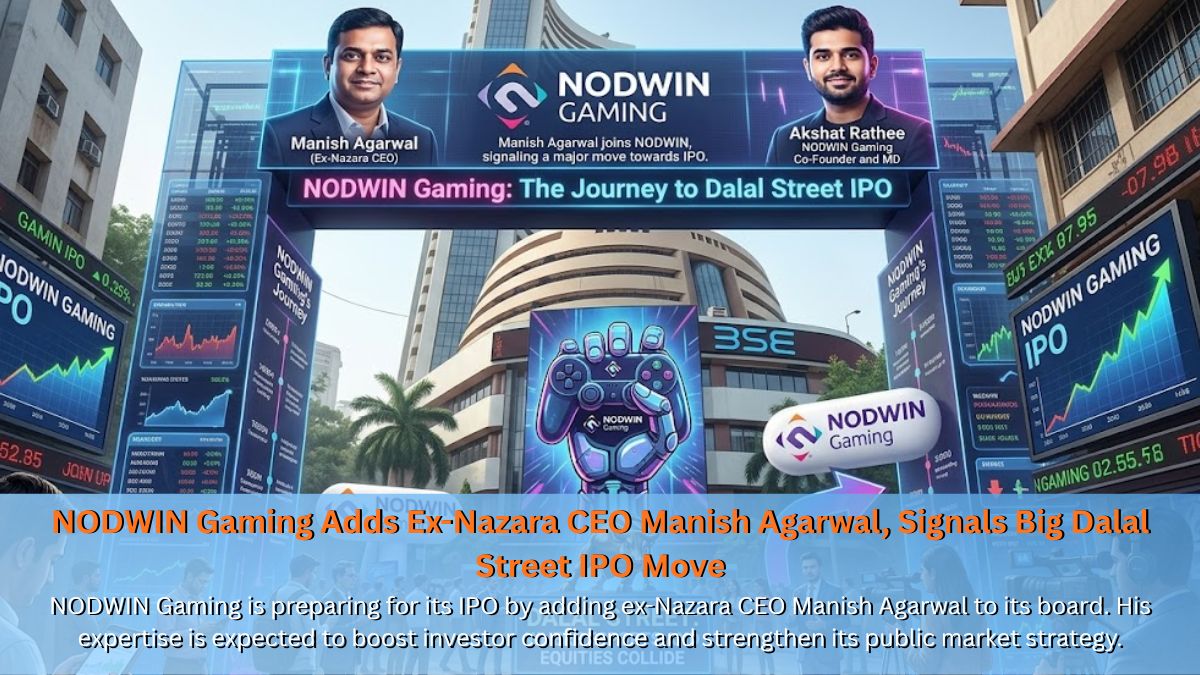
NODWIN Gaming, one of India’s fastest-growing esports and gaming companies, has taken a major strategic step by onboarding former Nazara Technologies CEO Manish Agarwal to its board. This move comes at a crucial time when the company is actively preparing for a potential IPO on Dalal Street. The development signals strong intent from NODWIN Gaming to strengthen its leadership and governance ahead of entering public markets.
Manish Agarwal is widely known for playing a key role in Nazara Technologies’ IPO journey, which made it one of India’s first publicly listed gaming companies. His experience in scaling gaming businesses and navigating regulatory and investor expectations is expected to give NODWIN Gaming a significant advantage. Industry experts believe that his presence will help the company refine its financial strategy, improve investor confidence, and position itself strongly for a public listing.
NODWIN Gaming has been aggressively expanding its footprint across esports, content, and youth entertainment. Backed by Nazara Technologies, the company has built a strong presence not only in India but also in global markets. Its growing portfolio includes esports tournaments, gaming content, influencer collaborations, and brand partnerships. With the gaming and esports industry in India witnessing rapid growth, the timing of this IPO push appears strategic. Moreover, this move reflects a broader trend in the startup ecosystem where venture-backed startups are preparing for IPOs to unlock value and scale further. As investor interest in gaming, digital entertainment, and tech innovations rises, NODWIN Gaming’s public market entry could become a landmark event for the Indian startup ecosystem.
1. Introduction to NODWIN Gaming’s IPO Move
1.1 Strategic Leadership Addition
If you’ve been even slightly plugged into startup news lately, this one probably caught your eye. NODWIN Gaming bringing in Manish Agarwal isn’t just another executive hire you scroll past and forget. It feels different. More intentional. Like something bigger is quietly taking shape behind the scenes.
Think about it for a second. Companies don’t suddenly decide to onboard someone with deep IPO experience unless they’re heading in that direction. It’s not a casual decision. It usually happens when internal conversations have already shifted from “how do we grow?” to “how do we present ourselves to the public market?” And that shift is huge.
Because preparing for an IPO is not just about numbers. It’s about discipline. It’s about cleaning up processes, tightening financial storytelling, and being ready for a level of scrutiny most startups never face. Bringing in someone who has already lived through that pressure? That’s not just smart. It’s almost necessary. What stands out here is the timing. NODWIN Gaming could have waited. Continued growing. Raised another round. But instead, they’ve chosen to strengthen leadership now. That tells you one thing very clearly. They’re not just thinking about the next quarter. They’re thinking years ahead.
1.2 Why This Move Matters
There’s a quiet shift happening in the Indian startup ecosystem, and you can feel it if you pay attention. A few years ago, the focus was simple. Raise capital. Grow fast. Chase valuation. That was the playbook. Now? It’s changing. Startups are talking about sustainability, profitability, and IPO updates more seriously than ever. The excitement hasn’t disappeared, but it’s matured. There’s a sense that building something real matters more than just building something big.
And that’s exactly where NODWIN Gaming fits into the picture. By bringing in someone like Manish Agarwal, the company is sending a subtle but powerful message. Not just to investors, but to the entire market. It’s saying, “We’re preparing for the long game.” Investors notice these things. They always have. A strong leadership addition before an IPO reduces uncertainty. It adds credibility. It shows that the company understands what lies ahead and isn’t walking into it blindly. Also, let’s be honest. Public markets are unforgiving. They don’t reward hype. They reward clarity, consistency, and performance. Moves like this help build that foundation early, before the spotlight turns on.
2. Background of NODWIN Gaming
2.1 Founding Story and Vision
To really understand where NODWIN Gaming is today, you have to go back to when esports in India was still… well, barely a thing. Gaming existed, of course. People played. Communities were there. But it wasn’t structured. It wasn’t seen as a business opportunity. Most people didn’t take it seriously. That’s what makes the early vision behind NODWIN Gaming so interesting. The founders weren’t chasing an obvious trend. They were betting on behavior. Young people were spending more time online, more time gaming, more time watching others play. That shift was subtle, but powerful. And instead of waiting for the market to mature, they jumped in early.
It probably didn’t feel glamorous at the time. Convincing brands to sponsor gaming events when esports wasn’t mainstream? That’s a tough sell. Building something in a space where revenue models aren’t clear? Even tougher. But sometimes, the best opportunities don’t look obvious at the start. They look uncertain. Messy. A little risky. That’s exactly what this was.
2.2 Growth Journey
Growth didn’t explode overnight. There was no sudden moment where everything just clicked. It was slower. Gradual. And honestly, probably frustrating at times. In the early days, it was about doing the basics right. Hosting tournaments. Building communities. Showing up consistently. Even when the audience was small. Then things started to change. Internet penetration improved. Smartphones became cheaper. Streaming platforms gained popularity. Suddenly, gaming wasn’t just a hobby. It was content. It was entertainment. culture. And NODWIN Gaming was already there, right in the middle of it. From there, the expansion felt more natural. They moved into content creation. Then into influencer marketing. Then deeper brand collaborations. Each step built on the last. Nothing felt forced.
What’s interesting is how they didn’t stay limited to one market. They started exploring global opportunities as well. That’s not easy. Different audiences, different expectations, different challenges. But it also shows confidence. Today, when people talk about fastest-growing startups in the esports space, NODWIN Gaming isn’t just part of the conversation. It’s one of the names that comes up repeatedly. And if you trace that journey back, it’s clear. This wasn’t luck. It was timing, yes. But also persistence.
3. Business Model of NODWIN Gaming
3.1 How the Company Works
At a surface level, esports might look straightforward. Organize a tournament, bring in players, stream it, and you’re done. But once you look closely, you realize how layered it actually is. And that’s where NODWIN Gaming has built something quite interesting. They don’t operate like a one-dimensional company. They’ve built an ecosystem. On one side, you have tournaments. These are the big, visible moments. The competitions that draw attention and bring the community together. But that’s just one piece.
There’s also content. Constant, ongoing, always evolving. Streams, videos, stories. This is what keeps the audience engaged even when there’s no event happening. It’s what builds loyalty. Then there’s the brand side. This is where things get tricky. Brands want access to young audiences. Gamers represent that audience. But connecting the two without making it feel forced? That’s the challenge. Because today’s audience is sharp. They can tell when something feels like an ad. And they switch off instantly. So the real work lies in making those collaborations feel natural. Authentic. Almost invisible. That’s where NODWIN Gaming adds value. It understands both sides. The brand expectations and the audience behavior. And bridging that gap is not easy.
3.2 Revenue Model
Now, when you look at how the company actually makes money, it’s clear they’ve avoided putting all their eggs in one basket. Sponsorships are a big part of the revenue. Brands pay to be part of tournaments, content, and campaigns. Then there are media rights. As viewership grows, so does the value of broadcasting those events.
Advertising adds another layer. Whether it’s integrated content or in-stream placements, there are multiple ways to monetize attention. And then there’s event management. Large-scale gaming events are not just about visibility. They generate revenue directly. What’s interesting is how interconnected all of this is. A successful tournament boosts content viewership. Higher viewership attracts better sponsors. Better sponsors improve overall revenue. It’s a cycle. And when it works, it works really well. But it also requires balance. If one part slows down, the impact spreads. That’s why managing this model isn’t just about growth. It’s about maintaining rhythm.
4. Role of Manish Agarwal in IPO Strategy
4.1 Experience from Nazara Technologies
There’s a difference between knowing about IPOs and actually going through one. The latter changes how you think completely. Manish Agarwal brings that kind of experience. His time at Nazara Technologies wasn’t just about running operations. He was part of a journey that took a gaming company into the public markets. That means dealing with regulations, investor expectations, disclosures, and constant scrutiny.
And let’s not underestimate this. IPOs are intense. Every number gets questioned. Every projection gets analyzed. There’s no room for guesswork. Having someone who has already navigated that process is like having a map in unfamiliar territory. You still have to walk the path, but at least you know where the turns are.
4.2 Expected Impact on NODWIN Gaming
So what changes now for NODWIN Gaming? Not everything will be visible immediately. And that’s the point. The biggest changes during IPO preparation often happen quietly. Financial processes become tighter. Reporting becomes more structured. Decisions go through deeper scrutiny. It might even slow things down slightly, but in a good way. Internally, teams start thinking differently. There’s a shift from “move fast” to “move right.” That balance becomes important.
Externally, investors take note. They see a company preparing seriously. Not just talking about growth, but building the systems needed to sustain it. And over time, that builds confidence. Because at the end of the day, an IPO is not just about raising money. It’s about trust. Trust from the market, from investors, from stakeholders. Right now, it feels like NODWIN Gaming is quietly building that trust. Step by step. Move by move.
5. Funding and Investment Landscape
5.1 Backing by Nazara Technologies
If you look closely at NODWIN Gaming, one thing becomes clear almost instantly. It didn’t grow in isolation. Having the backing of Nazara Technologies changed the game in ways that aren’t always visible from the outside. There’s something different about being supported by a listed company. It’s not just about money flowing in. It’s about structure, discipline, and a certain level of accountability that quietly shapes how decisions are made. When your parent company is already answerable to public markets, that mindset trickles down. You start thinking long-term, not just in terms of growth, but in terms of sustainability.
And then there’s credibility. Let’s be honest, in the startup world, perception matters more than people admit. When investors or partners see that NODWIN Gaming is backed by Nazara, it removes a layer of doubt instantly. Conversations become easier. Trust builds faster. It’s like walking into a room with someone respected already vouching for you. At the same time, this kind of backing comes with its own pressure. Expectations are higher. There’s less room for careless experimentation. Every move is watched more closely. But that pressure, if handled well, sharpens execution. It forces clarity. And over time, that’s what separates companies that scale from those that stall.
5.2 Venture Capital and Growth
Now step back and look at the bigger picture. The gaming industry is no longer a niche corner of the internet. It’s front and center. Investors know it. Founders know it. Even traditional businesses are starting to pay attention. Venture capital has been pouring into digital entertainment for a reason. The audience is massive, engagement is deep, and monetization models are evolving faster than most industries. Gaming, content, and community are blending into something much bigger. And investors don’t want to miss that wave.
This is exactly where NODWIN Gaming fits in naturally. It’s not trying to force itself into a trend. It’s already part of it. In fact, it helped build that trend in India. That gives it a kind of authenticity that investors value. It’s one thing to enter a booming sector. It’s another to have been there before it boomed. But growth capital isn’t just about chasing expansion. It comes with expectations. Scale faster. Capture more market share. Build defensibility. And that’s where things get interesting.
Because while money accelerates growth, it also amplifies mistakes if the foundation isn’t strong. The companies that survive are the ones that balance ambition with discipline. From the outside, it looks like NODWIN Gaming understands that balance. And that’s probably why it continues to stay relevant in conversations around global startups and evolving tech ecosystems.
6. Products and Services Offered
6.1 Esports and Gaming Events
If you’ve ever watched a well-produced esports tournament, you know it’s not just about gameplay. It feels like an event. There’s energy, storytelling, anticipation. And behind all of that is a lot of invisible work. This is where NODWIN Gaming has built serious strength. Their tournaments aren’t just competitions. They’re experiences. From production quality to audience engagement, everything is designed to pull viewers in and keep them there. And that matters. Because in a world full of distractions, attention is the hardest thing to earn.
What’s fascinating is how these events have evolved. Earlier, they were niche gatherings for hardcore gamers. Today, they attract millions of viewers. Not just players, but fans, casual viewers, even brands trying to understand this space. And brands, once they see that kind of engagement, start paying attention in a different way. Suddenly, esports isn’t experimental anymore. It’s strategic. That’s why these events have become such a strong revenue driver. They bring visibility, sponsorships, and media value together in one place. But more importantly, they build community. And community is what keeps everything else alive.
6.2 Content and Influencer Ecosystem
Now here’s where things get even more interesting. Events are powerful, but they’re temporary. They come and go. Content, on the other hand, stays. It builds relationships over time. And NODWIN Gaming seems to understand that deeply. Their move into content and influencer collaboration wasn’t accidental. It was necessary. Gamers today don’t just watch tournaments. They follow creators. Engage with personalities. They care about stories. And this shift has completely changed how the ecosystem works.
By working with influencers and creators, NODWIN Gaming taps into something more personal. It’s not just broadcasting content. It’s participating in conversations. And that’s a different level of engagement altogether. You’ll notice something else here. The lines between gaming, entertainment, and even tech are starting to blur. Content ecosystems are indirectly supporting areas like AI startups, digital platforms, and even new media formats. It’s all connected.
And while it might not look obvious at first, this interconnected ecosystem creates long-term value. It keeps audiences engaged even when there’s no major event happening. It keeps brands visible without feeling intrusive. In simple terms, it builds continuity. And in today’s attention economy, continuity is everything.
7. Problem Solved by NODWIN Gaming
7.1 Bridging the Gaming Ecosystem
A few years ago, if you were a gamer in India, the path forward wasn’t very clear. You could play. You could get good. But then what? There wasn’t a structured ecosystem to support growth. That gap was real. And it held the entire space back. Brands didn’t know how to enter gaming. Gamers didn’t know how to monetize. Audiences didn’t have organized content to follow. Everyone existed, but they were disconnected. This is the gap NODWIN Gaming stepped into.
Instead of focusing on just one piece, they started connecting the dots. Tournaments brought players together. Content brought audiences in. Brand collaborations brought money into the system. Slowly, the ecosystem started taking shape. And once that structure exists, everything changes. Opportunities grow. Careers become possible. Conversations become more serious. What was once seen as a hobby starts being seen as an industry. That’s not a small shift. That’s foundational.
7.2 Monetization for Gamers
Let’s talk about something very real. Talent without income doesn’t last. No matter how passionate someone is, at some point, they need sustainability. For a long time, gamers struggled with this. You could be incredibly skilled, but if there was no way to earn consistently, it became difficult to justify the time and effort. Many talented players simply dropped off. Not because they lacked ability, but because the system didn’t support them.
This is where NODWIN Gaming made a meaningful difference. Through tournaments, sponsorships, and partnerships, they created real earning opportunities. Not overnight riches, but something more important. A pathway. A sense that if you stick with it, there’s a future here. And once people start seeing that possibility, participation increases. More players enter. More content gets created. audiences engage. It becomes a cycle of growth. Interestingly, this also feeds into the broader digital economy. New kinds of startup jobs emerge. Careers that didn’t exist a decade ago suddenly become viable. And that ripple effect goes far beyond gaming.
8. Industry Growth Trends
8.1 Rise of Gaming and Esports in India
If you look at India today, the growth of gaming feels almost inevitable. Cheap data, affordable smartphones, and a young population. It’s the perfect mix. But growth like this doesn’t just happen automatically. It builds over time. Initially, gaming was casual. Time-pass. Something you did in between things. Then slowly, it became more immersive. Competitive. Social. And now, it’s part of everyday life for millions.
Esports, in particular, has taken an interesting path. What started as small competitions is now turning into a serious industry. Prize pools are growing. Viewership is increasing. Brands are investing more confidently. And with that comes opportunity. For emerging startups, this space is full of potential. Not just in gaming itself, but in everything around it. Content, analytics, community platforms, merchandise, even education. NODWIN Gaming sits right at the center of this shift. And that positioning matters. Because when an industry grows, the companies already embedded in it often benefit the most.
8.2 Global Trends
Now zoom out a bit. Globally, gaming is already massive. We’re talking billions in revenue, millions of active users, and a level of engagement most industries can only dream of. And what’s driving this growth? It’s not just better games. It’s better ecosystems. Streaming platforms, creator economies, virtual communities. Everything is becoming more connected. And investors are paying close attention.
Angel investors, venture-backed startups, even large institutions are exploring this space. Not because it’s trendy, but because the fundamentals are strong. High engagement. Repeat usage. Scalable models. For NODWIN Gaming, this global momentum creates both opportunity and pressure. Opportunity, because the market is expanding. Pressure, because competition is intensifying. Global players are entering. Expectations are rising. But here’s the thing. Being early in a market like India gives you an edge. You understand the audience. You understand the behavior. And that insight is hard to replicate.
9. Competitive Landscape
9.1 Direct Competitors
No space grows without competition. And esports is no exception. There are multiple players, both in India and globally, trying to capture this market. Some focus purely on tournaments. Others lean heavily into content. A few are building platforms that aim to own the entire ecosystem. So where does NODWIN Gaming stand in all of this?
Its biggest strength lies in integration. Instead of choosing one vertical, it operates across multiple. Events, content, brand partnerships. This creates a kind of interconnected system that’s harder to disrupt. If one area slows down, others can compensate. But competition still matters. Because competitors push you to improve. They challenge assumptions. They force innovation. And in fast-moving industries, that pressure is actually a good thing.
9.2 Indirect Competitors
Now here’s where things get a bit more subtle. Not all competition is obvious. Social media platforms, streaming apps, content platforms. They’re not direct esports competitors, but they compete for the same thing. Attention. And attention is limited. A user deciding between watching a gaming stream or scrolling through short videos is making a choice.
That choice impacts engagement, which eventually impacts revenue. This is why the broader content ecosystem matters so much. NODWIN Gaming seems to understand this. Its focus isn’t just on gaming as a category, but on how gaming fits into the larger digital behavior of users. That awareness is important. Because in today’s world, you’re not just competing within your industry. You’re competing with everything that can capture your audience’s time.
10. IPO Plans and Market Strategy
10.1 Preparing for Public Listing
There’s a certain moment in a startup’s journey when everything starts to feel… heavier. Not in a bad way, but in a more serious, deliberate sense. Decisions slow down. Conversations get deeper. The focus shifts from chasing growth to proving it. That’s usually when IPO discussions stop being theoretical and start becoming real. For NODWIN Gaming, bringing in someone like Manish Agarwal feels like that moment. Because let’s be honest, companies don’t prepare for a public listing overnight. It’s not a switch you flip. It’s a long, sometimes uncomfortable process. Financials need to be cleaned up. Reporting standards get stricter. Internal systems that once worked fine suddenly feel inadequate. And then there’s scrutiny. Endless scrutiny.
I’ve seen teams go through this phase, and it changes the culture. Suddenly, every number matters more. Every projection needs to be defensible. There’s less room for “we’ll figure it out later.” Everything has to make sense now. That’s where experience becomes invaluable. Someone who has already been through an IPO understands the invisible pressure. The kind that doesn’t show up in presentations but shapes every decision behind the scenes. They know what investors ask. They know what regulators expect. More importantly, they know where companies usually make mistakes.
And those mistakes can be costly. For NODWIN Gaming, this isn’t just about entering public markets. It’s about entering prepared. There’s a big difference. Many startups rush into IPOs riding momentum, only to struggle afterward. The ones that take time, build discipline, and strengthen leadership beforehand tend to hold up better. Right now, it feels like the company is choosing the second path. And honestly, that’s the harder one. But also the smarter one.
10.2 Market Positioning
Now, let’s talk about how NODWIN Gaming wants to be seen. Because positioning matters more than people think, especially when you’re stepping into public markets. You’re not just telling your story anymore. You’re being compared. Constantly. Against other gaming companies. Against media businesses. Even against tech platforms. Investors will look at growth rates, revenue models, scalability, and ask a simple question: “Where does this company fit?” And the answer needs to be clear.
From what it looks like, NODWIN Gaming is not trying to position itself narrowly as just an esports organizer. That would be limiting. Instead, it’s leaning into a broader identity. Something closer to a digital entertainment and gaming ecosystem player. That shift is important. Because esports alone, while growing, can feel niche to some investors. But when you expand the narrative to include content, influencer ecosystems, brand partnerships, and community engagement, the story becomes much bigger. Suddenly, you’re not just talking about tournaments. You’re talking about attention, culture, and audience ownership.And that’s attractive.
Retail investors look for relatable stories. Something they understand and believe in. Institutional investors, on the other hand, look for scalability and long-term value. The challenge is to appeal to both without losing clarity. If done right, this positioning can work in NODWIN Gaming’s favor. But it’s a delicate balance. Overpromise, and expectations become unrealistic. Undersell, and the opportunity feels smaller than it actually is. The companies that get this right usually spend a lot of time refining their narrative before stepping into the spotlight. And right now, it feels like NODWIN Gaming is still shaping that story carefully.
11. Learning for Startups and Entrepreneurs
11.1 Importance of Strategic Hiring
There’s a common mistake a lot of startups make. They hire for the present, not for the future. It makes sense at first. You need people who can solve immediate problems. But somewhere along the way, if you don’t start thinking ahead, growth hits a ceiling. What NODWIN Gaming has done here is a great reminder of timing. They didn’t wait until the IPO was around the corner to bring in experienced leadership. They did it early enough for that person to actually influence the journey, not just manage the outcome. And that’s a big difference.
Because leadership at that level isn’t about execution alone. It’s about perspective. It’s about asking questions others might not even think of yet. I’ve seen startups bring in senior hires too late. By then, the systems are already messy, the culture is already set, and fixing things becomes harder. On the flip side, bringing in the right people at the right time can completely change direction. It’s not always comfortable, though.
Experienced leaders often challenge existing ways of working. They question decisions. They slow things down when needed. And that can feel frustrating in fast-moving environments. But over time, that friction usually leads to better outcomes. That’s the real takeaway here. Hiring is not just about filling roles. It’s about preparing for the next stage, even before you fully reach it.
11.2 Preparing for Scale
Scaling sounds exciting when you say it out loud. More users. More revenue. Bigger reach. But what people don’t talk about enough is what happens behind the scenes. Because scaling without preparation is chaotic. Systems that worked for a small team start breaking. Communication gets messy. Decision-making slows down. And suddenly, growth starts feeling like a problem instead of an achievement. This is where preparation matters.
For a company like NODWIN Gaming, moving toward public markets means stepping into a completely different level of accountability. Governance isn’t optional anymore. Transparency isn’t negotiable. Every process needs to be tight. And that doesn’t happen overnight. It takes time to build financial discipline. It takes effort to create reporting structures that actually make sense. Takes patience to align teams around a more structured way of working. From the outside, it might look like nothing is changing. But internally, everything is evolving. For founders and entrepreneurs, this is an important lesson. Don’t wait for scale to happen before preparing for it. Build systems early. Even if they feel unnecessary at the time. Because when growth comes, it rarely gives you time to fix things.
11.3 Leveraging Industry Trends
One of the biggest advantages a startup can have is timing. You can have a great idea, a strong team, even decent funding. But if the timing is off, progress becomes slow and painful. On the other hand, when you align with a growing industry, everything accelerates. That’s what makes sectors like gaming, AI startups, and digital platforms so interesting right now. The demand is already there. User behavior is already shifting. The question is not whether these industries will grow, but how fast. NODWIN Gaming didn’t just enter gaming. It stayed aligned with how the industry evolved. From tournaments to content, from local focus to global expansion. Each move followed a larger trend. And that’s something many startups miss.
They either chase trends too late or ignore them completely. The real skill lies in recognizing patterns early and adapting before the shift becomes obvious. It’s not about jumping on every new wave. That rarely works. It’s about understanding which trends actually connect with your core business and then leaning into them. For entrepreneurs, this is worth thinking about. Ask yourself: are you building in isolation, or are you building alongside a growing trend? Because the difference between the two can define how fast, and how far, you go.
About foundlanes.com
foundlanes.com is India’s leading startup idea discovery platform. It helps entrepreneurs find actionable startup opportunities, market insights, and industry-specific guidance to turn ideas into real businesses. With deep research and practical resources, foundlanes supports founders at every stage, from idea validation to launch and growth.