News Summary
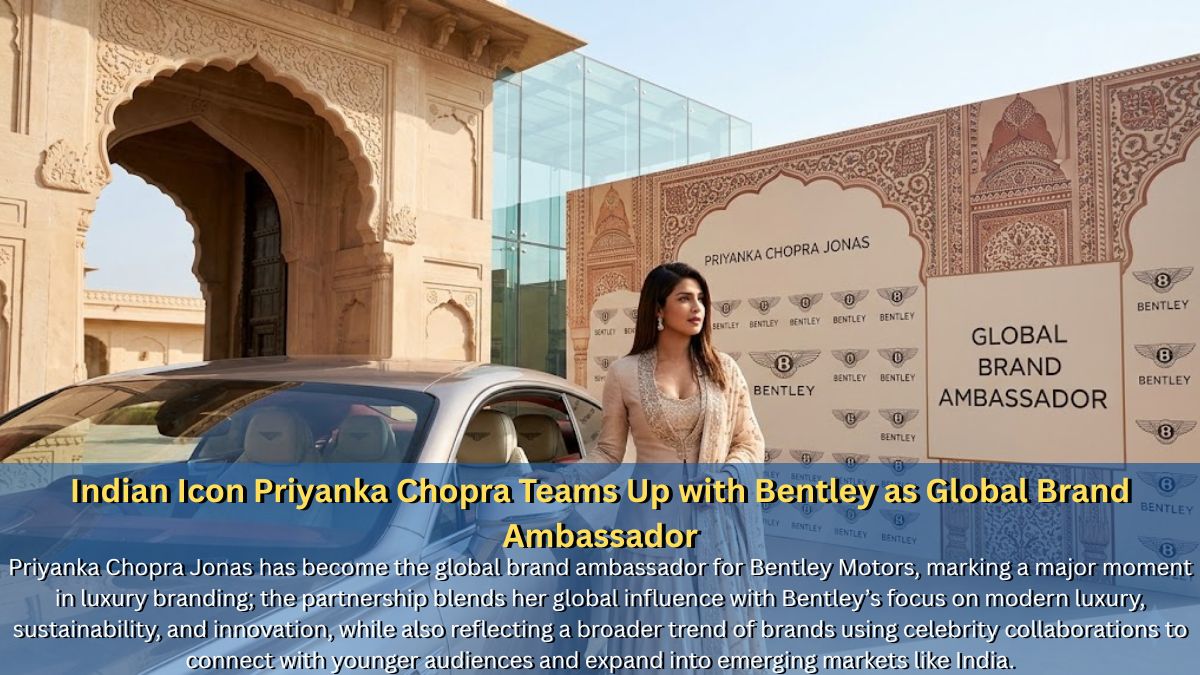
Priyanka Chopra Jonas has officially stepped into a new global role as she partners with Bentley Motors, marking a major moment in luxury branding and celebrity collaborations. The announcement confirms that Priyanka Chopra Teams Up with Bentley as its global brand ambassador, reinforcing the automaker’s shift toward modern luxury storytelling and global audience engagement.
This partnership highlights a strong alignment between Chopra’s international appeal and Bentley’s legacy of craftsmanship, sustainability, and innovation. Known for her presence in Hollywood and global advocacy, Chopra represents a new generation of influential voices shaping brand narratives. Bentley, on the other hand, continues to position itself as a forward-thinking luxury automotive brand, especially as it transitions toward electrification and sustainable mobility. The collaboration debuted with a high-profile campaign featuring Chopra in elegant styling, emphasizing sophistication, individuality, and progressive luxury. The visuals, widely shared across digital platforms including social media, reflect a blend of heritage and modernity. The announcement also gained traction across lifestyle, fashion, and automotive sectors, signaling strong cross-industry impact.
From a business perspective, this move mirrors broader industry trends where global brands are investing in celebrity partnerships to expand into emerging markets like India. It also reflects how luxury companies are adapting to changing consumer expectations, especially among younger, aspirational audiences. As Priyanka Chopra Teams Up with Bentley, the partnership is expected to influence branding strategies, luxury marketing, and global positioning in the automotive sector. The move also opens conversations about India’s growing influence in global luxury markets and the increasing role of Indian celebrities in international brand ecosystems.
1. Introduction to Priyanka Chopra Teams Up with Bentley
1.1 A Landmark Collaboration in Global Branding
When Priyanka Chopra Jonas teams up with Bentley Motors, it doesn’t feel like just another celebrity endorsement. It feels intentional. Thought through. Almost symbolic of where global branding is headed. This is not about putting a famous face next to a luxury car and calling it a campaign. It’s about aligning two identities that have been built over time with consistency, ambition, and a clear sense of direction. On one side, you have Bentley, a brand that has spent over a century refining what luxury means. On the other, you have Priyanka, someone who has constantly reinvented herself without losing her core identity. When those two narratives come together, it creates something that feels real, not forced.
There’s also an emotional layer to this collaboration that’s hard to ignore. Priyanka represents aspiration for millions, especially in India. She’s someone who didn’t just succeed in one industry but crossed boundaries, cultures, and expectations. Bentley, in its own way, represents a similar journey. It has evolved from being a traditional luxury car brand to one that is now thinking about sustainability, innovation, and the future of mobility. So when they collaborate, it’s not just about luxury anymore. It’s about progress. It’s about showing that legacy and evolution can exist together. And that’s what makes this partnership feel meaningful rather than transactional.
1.2 Why This Partnership Matters Today
We’re living in a time where attention is the most valuable currency. Every brand, whether it’s a startup, a tech company, or a luxury label, is fighting to stay relevant in a crowded space. Traditional marketing is no longer enough. People don’t just want to see products. They want to connect with stories, with personalities, with something that feels human. That’s where collaborations like this start to matter. They cut through the noise not because they are loud, but because they feel authentic.
There’s also a deeper strategic angle here, especially when you look at India’s growing influence. The country is no longer just a consumer market. It’s a cultural force. Global brands understand that if they want to stay relevant in the long term, they need to connect with Indian audiences in a way that feels genuine. Partnering with someone like Priyanka is not just about visibility. It’s about trust. It’s about tapping into a voice that already resonates with millions across different demographics. And when that trust meets a brand like Bentley, which is trying to redefine luxury in a modern, sustainable way, it creates a narrative that feels both current and future-focused.
2. Background Story: Bentley Motors
2.1 The Journey of Bentley Motors
Bentley Motors began its journey in 1919, but its story isn’t just about cars. It’s about obsession with detail, with performance, with creating something that feels timeless. In its early years, Bentley was deeply connected to motorsports, pushing the limits of engineering and performance. Those racing roots shaped the brand’s identity. Even today, when you look at a Bentley, you don’t just see luxury. You feel power, precision, and a kind of quiet confidence that comes from decades of refinement.
Over the years, the brand has gone through transformations, ownership changes, and shifts in strategy. Becoming part of the Volkswagen Group gave Bentley the stability and resources to scale globally while continuing to innovate. But what’s impressive is how it has managed to evolve without losing its essence. Today, Bentley stands at an interesting crossroads. It’s still a symbol of elite luxury, but it’s also stepping into a future where sustainability and electrification are no longer optional. That balance between heritage and innovation is not easy to maintain, and yet, Bentley seems to be navigating it with clarity.
2.2 Business Model of Bentley
Bentley’s business model is built on a simple but powerful principle: focus on value, not volume. Unlike mass-market car manufacturers, Bentley doesn’t aim to sell millions of units. Instead, it focuses on creating fewer cars, but each one crafted with an extraordinary level of detail and personalization. This approach allows the brand to maintain exclusivity while also ensuring high profit margins.
What makes this model sustainable is the emotional connection it creates with customers. When someone buys a Bentley, they are not just buying a car. They are buying an experience, a statement, a reflection of their identity. The customization options alone can transform a vehicle into something deeply personal. This level of personalization builds loyalty in a way that traditional mass production never can. It’s not just a transaction. It’s a relationship between the brand and the customer.
2.2.1 Revenue Model
Bentley’s revenue streams go beyond just selling vehicles. Yes, the core business is luxury car sales, but a significant portion of its revenue comes from bespoke customization. Customers often spend a considerable amount tailoring their cars, from interior materials to unique design elements. This not only increases revenue per unit but also enhances the overall customer experience.
Additionally, after-sales services play a crucial role. Maintenance, servicing, and long-term care ensure that customers remain connected to the brand even after the purchase. This creates a continuous revenue cycle while also strengthening brand loyalty. It’s a model that prioritizes depth over scale, and that’s exactly what makes it effective in the luxury segment.
2.2.2 Innovation and Sustainability
In recent years, Bentley has made it clear that its future is electric. Its Beyond100 strategy is not just a corporate announcement. It’s a commitment to completely transform how the brand operates by 2030. Moving toward full electrification is a bold step, especially for a brand so deeply rooted in traditional engineering.
But this shift reflects a larger reality. Luxury today is no longer just about comfort and performance. It’s also about responsibility. Customers are becoming more conscious, and brands are expected to adapt. Bentley’s investment in electric vehicles and sustainable practices shows that it understands this shift. It’s not abandoning its legacy. It’s evolving it. And that evolution is what keeps it relevant in a rapidly changing world.
3. Background Story: Priyanka Chopra Jonas
3.1 From Bollywood to Global Stardom
Priyanka Chopra Jonas didn’t follow a predictable path. Her journey started in India, where winning Miss World 2000 opened the first door. From there, she built a strong career in Bollywood, delivering performances that made her one of the most recognized faces in the industry. But what sets her apart is not just success. It’s her willingness to step into unfamiliar territory.
Moving to Hollywood wasn’t easy. It meant starting over in a new industry, facing different expectations, and proving herself all over again. But she did it. Slowly, consistently, she built a presence through television, films, and global appearances. That journey wasn’t just about career growth. It was about breaking barriers. And for many people watching her from the outside, it became a source of inspiration. It showed that it’s possible to think beyond boundaries and still succeed.
3.2 Entrepreneurial Ventures
What often gets overlooked is how deeply Priyanka is involved in business beyond entertainment. She’s not just endorsing brands. She’s building and investing in them. From beauty ventures to wellness brands and tech startups, her portfolio reflects a clear understanding of where consumer trends are heading. She’s not randomly choosing projects. There’s intent behind her decisions.
This entrepreneurial side is what makes her particularly relevant in today’s ecosystem. She understands branding, market positioning, and audience connection at a deeper level. That’s why collaborations like the one with Bentley Motors feel natural. She’s not just lending her face to a campaign. She’s contributing to a narrative. A narrative that blends luxury with modern values, global appeal with personal authenticity. And that’s what gives this partnership its real strength.
4. Campaign Launch and Brand Strategy
4.1 Visual Identity and Messaging
When Priyanka Chopra Jonas appeared in the campaign for Bentley Motors, the visual language immediately felt different from typical luxury ads. It wasn’t loud or overly dramatic. It was controlled, refined, and deeply intentional. Every frame seemed to communicate a quiet confidence rather than an aggressive display of wealth. The focus wasn’t just on the car. It was on the feeling the car represents. Elegance that doesn’t need validation. Luxury that doesn’t need to prove itself.
But what really stands out is how the messaging connects with today’s audience. It speaks to individuality, to people who don’t just want to own something expensive but want it to reflect who they are. There’s a subtle emotional pull in the way the campaign is crafted. It doesn’t sell features. It sells identity. And that’s where modern branding is headed. The heavy use of digital platforms also shows a clear understanding of how attention works today. Instead of relying on traditional formats, the campaign meets the audience where they already are, scrolling, watching, engaging. It feels less like advertising and more like a story unfolding in real time.
4.2 Social Media and Global Reach
The moment the campaign went live, the response was almost immediate. Platforms like Instagram became the primary stage, and within hours, millions had already seen, liked, and shared the content. That kind of speed is something traditional advertising could never achieve. It shows how powerful a well-aligned collaboration can be when it taps into an existing audience that already trusts and follows the personality involved.
What’s interesting is not just the reach, but the quality of engagement. People weren’t just passively viewing the campaign. They were reacting, discussing, sharing their own interpretations. That level of interaction is what brands are chasing today. And it comes from authenticity. When audiences feel that a collaboration makes sense, they respond naturally. This is why celebrity-led campaigns, when done right, don’t feel like ads. They feel like moments. And those moments travel faster, deeper, and with far more impact than any paid placement ever could.
5. Industry Analysis: Luxury Meets Startup Thinking
5.1 Changing Consumer Behavior
Consumers today are not the same as they were even five years ago. They are more aware, more selective, and far less impressed by surface-level branding. Owning something expensive is no longer enough. People want to understand what a brand stands for. They want to know how it’s made, what values it represents, and whether it aligns with their own beliefs. This shift has forced even legacy luxury brands to rethink how they communicate.
In many ways, this mirrors what’s happening in the startup world. Startups don’t succeed just because they have a product. They succeed because they tell a story that people connect with. They solve problems in a way that feels relevant and meaningful. Luxury brands like Bentley Motors are now adopting a similar mindset. They are blending heritage with purpose, craftsmanship with sustainability, and exclusivity with emotional connection. It’s no longer just about what you sell. It’s about why it matters.
5.2 Role of Celebrity Branding in Business Growth
Celebrity partnerships have evolved far beyond simple endorsements. Today, they function almost like growth engines. When a personality like Priyanka Chopra Jonas aligns with a brand, it brings instant visibility, but more importantly, it brings credibility. People trust individuals more than they trust corporations. And that trust can significantly shorten the time it takes for a campaign to gain traction.
This strategy is no longer limited to luxury brands. Even early-stage startups are applying the same thinking. Founders collaborate with influencers, creators, and niche personalities to build awareness quickly. It’s a more human approach to marketing. Instead of pushing messages, brands are building relationships. And when those relationships feel genuine, they translate into faster growth, stronger engagement, and deeper brand loyalty.
6. Startup Ecosystem Perspective
6.1 Lessons from Luxury Branding for Startups
There’s a lot that startups can learn from how luxury brands operate, especially when you look closely at the strategy behind Bentley Motors. One of the biggest lessons is the importance of a clear brand identity. Bentley doesn’t try to be everything for everyone. It knows exactly who its audience is and builds everything around that understanding. For startups, this is crucial. Trying to appeal to everyone often leads to diluted messaging and weak positioning.
Another powerful takeaway is storytelling. Luxury brands invest heavily in narratives that create emotional connections. Startups often focus too much on features and forget the story behind what they’re building. But in reality, people connect with stories first and products second. Finally, there’s the idea of targeting niche audiences. Bentley doesn’t chase mass markets. It focuses on a specific segment and serves it exceptionally well. Startups in areas like fintech, AI, or even blockchain can benefit from this approach by going deep into a niche before trying to scale broadly.
6.2 Funding and Market Expansion
Behind every strong luxury brand is a solid financial foundation. In the case of Bentley Motors, the backing of Volkswagen Group provides the stability needed to invest in innovation, research, and long-term strategies like electrification. This kind of support allows Bentley to think beyond short-term gains and focus on future growth.
The startup world operates in a similar way, just at a different scale. Venture capital, angel investors, and funding rounds play a critical role in helping startups grow and expand into new markets. But funding is not just about money. It’s about belief. It’s about having partners who understand the vision and are willing to support it through uncertainty. Whether it’s a global luxury brand or an early-stage startup, the principle remains the same. Strong backing creates the freedom to build something meaningful and sustainable.
7. Competitor Analysis
7.1 Direct Competitors
In the ultra-luxury segment, Bentley Motors operates alongside some of the most iconic names in the industry. Brands like Rolls-Royce Motor Cars, Mercedes-Maybach, and Aston Martin are not just competitors. They represent different interpretations of luxury. Each has its own identity, its own design philosophy, and its own way of connecting with customers.
What’s interesting is how all of these brands are now embracing modern marketing strategies, including celebrity collaborations. But the effectiveness of these campaigns depends on alignment. It’s not about choosing the biggest name. It’s about choosing the right one. The kind that fits naturally with the brand’s identity. And that’s where Bentley’s collaboration with Priyanka stands out. It feels consistent with the brand’s evolution rather than a forced attempt to stay relevant.
7.2 Indirect Competitors
Beyond traditional luxury car makers, there’s a new category of competitors emerging. Brands like Tesla, Porsche, and high-end SUV manufacturers are redefining what luxury means in the modern era. It’s no longer just about craftsmanship and heritage. It’s about technology, performance, and sustainability.
These companies are attracting a new generation of buyers who value innovation as much as they value design. This creates an interesting dynamic in the market. Traditional luxury brands are being pushed to innovate faster, while newer players are learning to incorporate elements of classic luxury. The result is a space where competition drives evolution. And in that environment, collaborations, storytelling, and brand positioning become even more important. Because in the end, it’s not just about building a great product. It’s about making people feel something when they experience it.
8. Industry Trends and Growth Insights
8.1 Rise of Global Luxury Markets
Over the past few years, India has quietly transformed into one of the most important markets for global luxury brands. This shift didn’t happen overnight. It’s the result of rising incomes, a growing base of successful entrepreneurs, and a new generation that is far more open to spending on experiences and premium products. What’s interesting is how this demand is no longer limited to metro cities. It’s spreading. You now see aspiration building in smaller cities as well, driven by exposure, digital access, and the visibility of success stories across industries.
For brands like Bentley Motors, this creates both an opportunity and a responsibility. The opportunity is obvious, a rapidly expanding audience that is ready to engage with global luxury. But the responsibility lies in understanding this audience deeply. Indian consumers today are not just buying for status. They are buying for meaning, for identity, for the feeling that a product represents something bigger than itself. That’s why the way a brand enters this market matters as much as the product it offers. And this is where thoughtful collaborations start to play a crucial role.
8.2 Influence of Indian Celebrities
The role of Indian celebrities on the global stage has changed dramatically. They are no longer limited to regional influence. Personalities like Priyanka Chopra Jonas have built a presence that cuts across industries, cultures, and geographies. They are not just entertainers anymore. They are entrepreneurs, investors, and cultural bridges connecting India with the rest of the world.
This shift has made them incredibly valuable for global brands. When a celebrity like Priyanka associates with a brand, it’s not just about visibility. It’s about credibility across markets. It sends a signal that the brand understands the cultural moment. It understands where attention is moving. And more importantly, it respects the audience it is trying to connect with. This growing influence is also tied to the rise of global startups and funding networks, where Indian founders and creators are becoming more visible and impactful. The lines between entertainment, business, and technology are blurring, and celebrities are right at the center of that transformation.
9. What Problems Does This Strategy Solve?
9.1 Brand Relevance
One of the biggest challenges for any legacy brand is staying relevant without losing its identity. It’s a delicate balance. Move too slowly, and you risk becoming outdated. Move too fast, and you risk losing what made you special in the first place. For luxury brands, this challenge is even more intense because their value is deeply tied to perception.
Collaborations like the one between Bentley Motors and Priyanka Chopra Jonas help solve this problem in a very human way. Instead of trying to reinvent themselves from scratch, brands borrow cultural relevance through people who already have it. This allows them to connect with younger audiences who might not have grown up with the brand but are willing to engage with it through a familiar face. And when done right, it doesn’t feel forced. It feels like a natural evolution.
9.2 Market Expansion
Entering new markets is never just about distribution or pricing. It’s about understanding culture, behavior, and expectations. For a brand like Bentley, expanding deeper into emerging markets like India requires more than just opening showrooms. It requires building trust. It requires creating a connection that goes beyond the product.
This is where partnerships become strategic tools rather than marketing tactics. By collaborating with someone who already resonates with the local audience, Bentley reduces the distance between the brand and the consumer. It makes the brand feel more accessible without compromising its exclusivity. And over time, this approach doesn’t just increase visibility. It builds familiarity. It creates a sense of belonging. And that’s what ultimately drives long-term growth in new markets.
10. The Startups News Perspective
10.1 The Startups News and Industry Coverage
From a platform like TheStartupsNews.com, collaborations like this are more than just entertainment headlines. They are signals of how industries are evolving. When a legacy brand starts behaving with the agility of a startup, it tells you something important about the direction of the market. It shows that even the most established companies are adapting to a world where speed, storytelling, and digital presence matter more than ever.
What stands out in this case is how closely the strategy mirrors startup thinking. The use of digital platforms, the focus on narrative, the emphasis on community engagement, all of these are principles that startups have been using for years to grow quickly. Now, luxury brands are adopting the same approach, not because it’s trendy, but because it works. For Indian startups, this becomes a powerful reference point. It shows that growth is not just about building a product. It’s about building a story that people want to be part of.
11. Learning for Startups and Entrepreneurs
11.1 Key Takeaways
If you step back and look at this collaboration from a founder’s perspective, there are some very real lessons hidden within it. The first is the importance of identity. Whether you’re building a startup or a global brand, clarity about who you are and what you stand for makes everything else easier. Without that clarity, even the best marketing strategies fall flat because they lack direction.
The second lesson is about emotional connection. People don’t just buy products. They connect with stories, with values, with experiences. Startups that understand this early tend to build stronger brands over time. Then there’s the role of digital platforms. Growth today happens where attention exists, and attention is largely online. Knowing how to use these platforms effectively can make a huge difference, especially in the early stages. Finally, there’s the idea of thinking globally from the start. The world is more connected than ever, and startups that design with a global mindset often scale faster and more sustainably.
12. Conclusion: Priyanka Chopra Teams Up with Bentley
The announcement that Priyanka Chopra Jonas teams up with Bentley Motors is not just another collaboration. It reflects a deeper shift in how brands think, how they grow, and how they connect with people. It brings together luxury, innovation, and cultural influence in a way that feels relevant to today’s world.
More importantly, it highlights India’s growing importance in the global landscape. This is no longer just a market to enter. It’s a space that shapes trends, influences decisions, and drives conversations. As brands continue to evolve, partnerships like this will become more common, but only the ones that feel authentic will truly stand out. And in that sense, this collaboration is not just about today. It’s a glimpse into the future of branding itself.or startups and entrepreneurs, this is a reminder that storytelling, strategy, and collaboration drive long-term success.
About foundlanes.com
foundlanes.com is India’s leading startup idea discovery platform. It helps entrepreneurs find actionable startup opportunities, market insights, and industry-specific guidance to turn ideas into real businesses. With deep research and practical resources, foundlanes supports founders at every stage, from idea validation to launch and growth.