News Summary
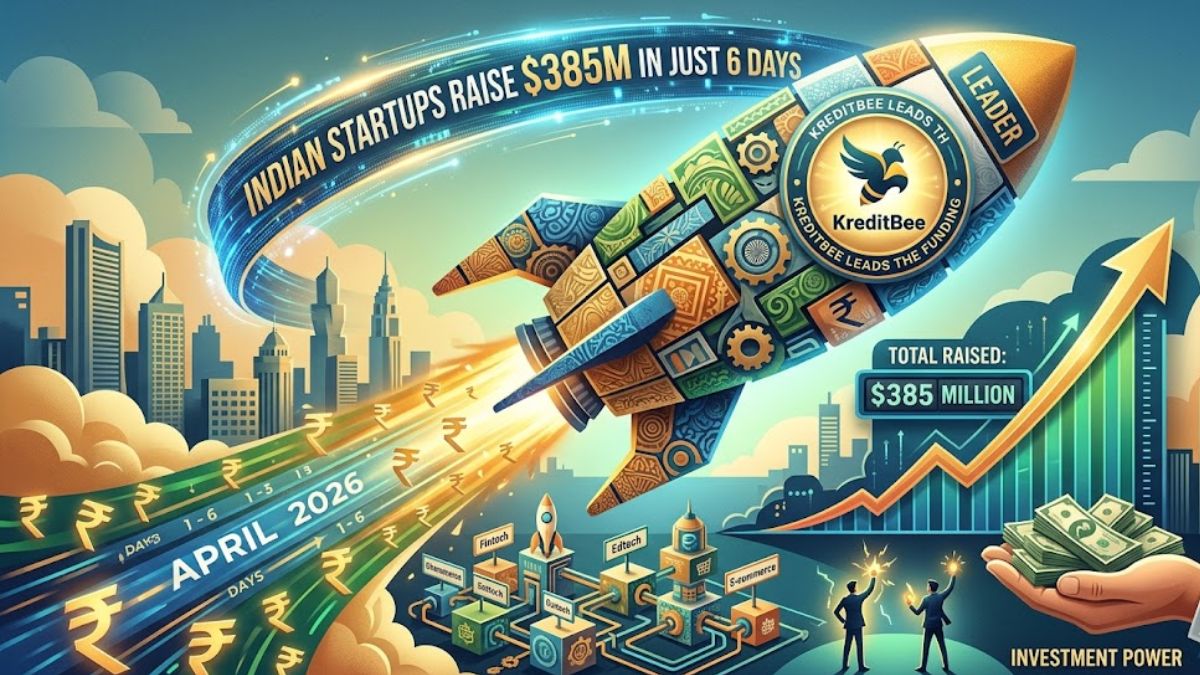
Indian Startups Raise a massive $385 million between April 6 and April 11, 2026, marking one of the most active funding weeks in recent months. The surge highlights renewed investor confidence in the Indian startup ecosystem after a relatively cautious start to the year. Leading this momentum is fintech player KreditBee, which secured $280 million in a fresh funding round, pushing its valuation to $1.5 billion and officially entering the unicorn club. The funding activity reflects a broader shift in venture capital sentiment. Investors are now backing startups with strong revenue models, clear profitability paths, and scalable business strategies. Fintech, SaaS, and AI-driven startups dominated the funding charts during this period, showing where capital is flowing.
KreditBee’s latest round stands out not only for its size but also for its strategic timing. The company is now positioning itself for an IPO by early 2027, signaling maturity in India’s fintech landscape. Other startups across sectors also raised capital, but none matched the scale and impact of KreditBee’s round.
The development comes at a time when global funding trends remain mixed. While international startups face valuation corrections, Indian startups are witnessing selective but strong investments. This indicates that India continues to be a high-growth market for venture-backed startups. Overall, the funding surge reinforces India’s position as one of the most dynamic startup ecosystems globally. For founders, investors, and industry watchers, this week signals a clear message: capital is still available, but only for startups with solid fundamentals and scalable growth potential.
1. Indian Startups Raise Fresh Capital Amid Renewed Investor Confidence
There’s something quietly reassuring about the way funding activity has picked up again. For a while, the narrative around startups felt uncertain. Conversations were filled with caution, layoffs, and tightening capital. But this week tells a different story. Indian startups raise nearly $385 million, and it’s not just about the number. It’s about what that number represents. Confidence is coming back, but in a more mature, grounded way. Investors are still writing checks, but they’re asking sharper questions. They want clarity, not just ambition. They want sustainability, not just speed.
And honestly, that shift feels necessary. The era of chasing growth at any cost has left its lessons. Now, there’s a noticeable change in how venture capital flows. Startups that show discipline, strong unit economics, and a clear path to revenue are getting attention. It’s less about hype and more about substance. This week’s funding activity reflects that mindset. It shows an ecosystem that is not slowing down, but evolving. And right at the center of this momentum is KreditBee, whose funding round didn’t just dominate headlines, it set the tone for what investors are now looking for.
1.1 KreditBee Enters Unicorn Club with $280M Funding
When KreditBee raised $280 million in its Series E round, it wasn’t just another funding announcement. It was a moment of validation. The kind that tells you a company has moved beyond potential and is now being recognized for its execution. With a valuation of $1.5 billion, KreditBee officially entered the unicorn club, but what’s more important is how it got there. This wasn’t overnight success. It was built step by step, through consistent growth, careful expansion, and a deep understanding of its users.
What makes this round particularly interesting is its structure. It included both primary and secondary investments, which means early investors were able to partially exit while still staying invested in the company’s future. That’s a strong signal. It shows confidence not just from new investors coming in, but also from those who have been part of the journey for years. And then there’s the forward-looking angle. KreditBee is already preparing for an IPO, potentially by 2027. That kind of planning reflects maturity. It shows that the company is not just focused on raising capital, but on building a long-term, sustainable business that can stand in public markets.
1.2 Broader Funding Landscape in April 2026
While KreditBee grabbed most of the spotlight, the broader funding landscape tells an equally important story. Capital is flowing across sectors, from fintech to AI startups to digital platforms. This diversification matters because it shows that innovation in India is not concentrated in one space. It’s spreading. Different industries are evolving at the same time, each solving its own set of problems, each attracting its own set of investors.
There’s also a healthy mix of funding stages being supported. Early-stage startups are getting backing from angel investors who are willing to take risks on new ideas, while late-stage companies continue to attract large rounds from venture capital firms. This balance is crucial. It ensures that the pipeline of innovation remains strong, from the first idea to full-scale execution. And if you look closely, you can see a pattern emerging. Investors are not just betting on markets anymore. They are betting on founders who understand their users deeply and can build products that actually solve real problems.
2. KreditBee: Business Model, Services, and Growth Story
2.1 What KreditBee Does
At its core, KreditBee is solving a problem that millions of Indians face but rarely talk about openly, access to credit. For a large part of the population, especially young professionals and first-time borrowers, getting a loan from traditional banks is not easy. The system is built around credit history, documentation, and rigid processes that exclude more people than they include.
KreditBee steps into that gap with a very practical approach. It uses technology to simplify lending. Instead of relying only on traditional credit scores, it looks at alternative data points to understand a user’s financial behavior. This allows it to offer quick loan approvals, often in situations where banks would simply say no. And for the user, that speed and accessibility make a real difference. It’s not just about getting a loan. It’s about feeling seen by a financial system that often ignores you.
2.2 Revenue Model and Monetization
The revenue model behind KreditBee is straightforward, but its strength lies in how effectively it scales. The company earns primarily through interest on the loans it provides, along with processing fees and other service charges. On the surface, it might seem like a standard lending model. But when you look deeper, the real advantage comes from volume and efficiency.
As more users come onto the platform and loan disbursements increase, revenue grows in a predictable, recurring way. This creates stability, something investors value highly in today’s environment. At the same time, the rise of digital adoption in India is acting as a tailwind. With more people using smartphones and becoming comfortable with online financial services, the demand for digital lending continues to rise. KreditBee is positioned right at the intersection of this trend, and that’s what makes its model not just viable, but scalable.
2.3 Founders and Journey
Behind every successful startup is a journey that rarely looks smooth from the inside. The story of KreditBee is no different. It began with a simple focus, small-ticket loans for a very specific audience. At that stage, the goal wasn’t to become a unicorn. It was to solve one problem well. And that focus made all the difference.
Over time, as the team gained more insights into user behavior and market needs, the company expanded its offerings. Larger loan amounts, more financial products, better technology. Each step was a response to what users actually needed, not just what looked good on paper. This kind of evolution is what separates startups that survive from those that grow. It’s not about having the perfect plan from day one. It’s about listening, adapting, and improving continuously.
3. Problem Statement: Why KreditBee Matters
3.1 Financial Inclusion Gap in India
India’s financial system has made significant progress over the years, but there’s still a large gap when it comes to inclusion. Millions of people remain outside the formal credit system. Not because they are unreliable, but because they don’t fit into traditional criteria. No credit history, irregular income, lack of documentation, these factors often lead to rejection from banks.
And when formal options are not available, people turn to informal sources. These often come with high interest rates and little protection, creating a cycle that is difficult to break. This is not just a financial issue. It’s a social one. It affects how people plan their lives, handle emergencies, and pursue opportunities. Access to credit is not just about money. It’s about possibility.
3.2 KreditBee’s Solution
This is where KreditBee makes a real impact. By using technology to assess creditworthiness in a more inclusive way, it opens doors for people who have traditionally been excluded. Instead of relying solely on past financial history, it looks at present behavior and potential. That shift in perspective is powerful.
For users, it means faster approvals, easier access, and a sense of financial inclusion that was missing before. For the broader ecosystem, it means progress toward a more inclusive financial system. And for investors, it represents a business model that combines impact with scalability. This alignment of purpose and profitability is what makes KreditBee stand out. It’s not just solving a problem. It’s doing it in a way that can grow, sustain, and create long-term value.
4. Industry Trends Driving the Funding Surge
4.1 Rise of Fintech and Digital Lending
If you look closely at where the real momentum is building in India’s startup ecosystem, fintech continues to stand out. But even within fintech, digital lending has carved out its own space. It’s not just growing, it’s becoming essential. The reason is simple. Millions of people are coming online for the first time, getting comfortable with digital payments, and slowly trusting platforms with their financial needs. That shift creates a natural demand for faster, more accessible credit. And that’s exactly where companies like KreditBee step in.
What makes this growth feel real is how it connects to everyday life. A young professional needing a quick loan before payday. A first-time borrower trying to build financial credibility. These are not abstract use cases. They’re real situations, happening every day. And when a platform solves these problems quickly and reliably, adoption follows naturally. That’s why digital lending isn’t just a trend. It’s becoming part of how modern financial systems function. And as internet penetration and smartphone usage continue to rise, this space is only going to deepen, not slow down.
4.2 Venture Capital Trends
There’s been a noticeable shift in how venture capital operates today. A couple of years ago, funding rounds were often driven by speed and competition. Investors didn’t want to miss out, so decisions were made quickly, sometimes without enough scrutiny. That phase has passed. What we’re seeing now is a more thoughtful approach. Investors are still active, but they are asking harder questions. They want to understand how a startup makes money, how efficiently it grows, and whether it can survive tough conditions.
This is exactly why you’re seeing fewer deals, but larger, more meaningful ones. When Indian startups raise capital today, it’s often because they’ve proven something tangible. Strong unit economics, clear demand, and disciplined execution. It’s not easy to reach that stage, but when a startup does, investors are willing to commit significant capital. This shift may feel restrictive at first, especially for early founders, but in the long run, it creates a healthier ecosystem. One where growth is backed by substance, not just optimism.
4.3 Global vs Indian Startup Trends
Globally, the startup ecosystem has been going through a period of caution. Economic uncertainty, rising interest rates, and market corrections have slowed down funding activity in many regions. Investors are pulling back, re-evaluating portfolios, and focusing on stability. But India tells a slightly different story. While it’s not completely immune to global trends, it continues to attract attention. And that’s not by chance.
India offers something that many other markets struggle to match, scale combined with growth potential. A large population, increasing digital adoption, and a rapidly evolving consumer base create opportunities that are hard to ignore. For global investors, this is not just about short-term returns. It’s about long-term positioning. They see India as a market that will continue to grow over the next decade, and they want to be part of that journey early. That’s why, even in a cautious global environment, capital continues to flow into Indian startups.
5. Competitors and Market Position
5.1 Direct Competitors
The space that KreditBee operates in is becoming increasingly competitive. There are several fintech platforms offering similar digital lending services, each trying to capture a share of the same growing market. These competitors focus on personal loans, quick approvals, and targeting users who are underserved by traditional banking systems. On the surface, the offerings may look similar, which makes differentiation more challenging.
But competition in this space is not just about features. It’s about trust and consistency. Users are sharing sensitive financial information, and they expect reliability. A platform that delivers fast approvals but fails on transparency or customer experience won’t retain users for long. This is where companies begin to separate themselves. Not just by what they offer, but by how they deliver it. Over time, small differences in experience, speed, and communication start to matter a lot more than pricing alone.
5.2 Indirect Competitors
Beyond fintech startups, traditional banks and NBFCs still play a major role in the lending ecosystem. They have established credibility, large customer bases, and deep financial expertise. But they also carry legacy systems and processes that can slow them down. For many users, especially younger ones, waiting days for loan approval or dealing with complex documentation feels outdated.
This creates an interesting dynamic. Traditional institutions have strength in stability, while fintech platforms have strength in agility. Users are increasingly leaning toward solutions that are faster and more convenient, even if they are newer. That doesn’t mean banks are becoming irrelevant. It means the definition of competition is evolving. It’s no longer just about who offers credit, but who offers it in a way that fits modern expectations.
5.3 Competitive Advantage
What gives KreditBee an edge is its ability to combine technology with a deep understanding of its target audience. Fast approvals are not just a feature. They are a response to a real need. A user who requires urgent funds cannot afford delays, and KreditBee’s systems are designed to address that urgency.
But beyond speed, there’s also the focus on underserved segments. This is where the real differentiation lies. Instead of competing head-on for already banked customers, KreditBee has built its model around those who are often ignored by traditional systems. This approach not only expands its user base but also creates a stronger emotional connection with customers. When a platform serves you at a time when others don’t, loyalty tends to follow. And in a competitive market, that kind of loyalty is incredibly valuable.
6. Startup Ecosystem Impact
6.1 Signal to Investors
The recent funding surge sends a message that goes beyond numbers. It tells investors that the Indian startup ecosystem is not slowing down, it’s stabilizing. There’s a difference. Instead of chasing rapid, unsustainable growth, startups are focusing on building stronger foundations. And investors are responding positively to that shift.
For those watching from the outside, this creates a sense of confidence. It shows that even in uncertain times, there are opportunities worth backing. And for founders, it reinforces an important idea. Capital is still available, but it flows toward clarity, discipline, and execution. That understanding changes how startups approach growth from day one.
6.2 Boost for Emerging Startups
Momentum at the top of the ecosystem often creates opportunities at the bottom. When large funding rounds happen, they attract attention. They bring more investors into the market, and that eventually trickles down to early-stage startups. Founders who are just starting out find it slightly easier to get meetings, to get noticed, to get a chance.
But there’s also a responsibility that comes with this momentum. Early-stage founders need to be more prepared than ever. Investors may be active, but they are also more selective. Having a strong idea is no longer enough. It needs to be backed by validation, by understanding, by some form of traction. The bar has been raised, and while that makes things harder, it also makes the ecosystem stronger.
6.3 Job Creation and Economic Impact
Behind every funding announcement are real-world outcomes that often don’t get enough attention. When startups raise capital, they hire. They expand teams, invest in new roles, and create opportunities for people across different skill levels. This ripple effect contributes directly to job creation, especially in sectors like technology, operations, and customer support.
But the impact goes beyond employment. Startups drive innovation. They introduce new ways of solving problems, new tools, new systems. Over time, this influences how entire industries operate. And when multiple startups grow simultaneously, the combined effect on the economy becomes significant. It’s not just about individual success stories. It’s about collective progress.
7. IPO Plans and Future Growth
The fact that KreditBee is already planning for an IPO says a lot about where the ecosystem stands today. A few years ago, the focus was almost entirely on private funding and rapid scaling. Now, there’s a visible shift toward long-term sustainability and public market readiness.
Going public is not just a financial milestone. It’s a test of maturity. It requires transparency, consistent performance, and the ability to operate under scrutiny. Startups preparing for IPOs are forced to refine their business models, improve governance, and focus on profitability. This shift is healthy. It signals that the ecosystem is moving from experimentation to stability. And as more companies take this path, it sets new benchmarks for what success looks like.
8. Learning for Startups and Entrepreneurs
There’s a lot to take away from everything that’s happening right now. The first lesson is simple but important. Strong fundamentals matter. In a market where investors are more careful, clarity around revenue, costs, and growth becomes non-negotiable. Startups that understand their numbers deeply are the ones that stand out. The second lesson is about scalability. It’s not enough to build something that works. It needs to grow efficiently. Investors are looking for models that can expand without breaking under pressure. Then comes innovation. Not the kind that looks impressive on paper, but the kind that solves real problems. Startups that focus on genuine user needs tend to build stronger, more sustainable businesses.
And finally, timing. Sometimes, being early or late can make a big difference. Entering the market when conditions align, when demand exists, when investors are actively looking, can change the trajectory of a startup. But timing alone is not enough. It needs to be backed by preparation. Because when the opportunity comes, you need to be ready to take it.
About foundlanes.com
foundlanes.com is India’s leading startup idea discovery platform. It helps entrepreneurs find actionable startup opportunities, market insights, and industry-specific guidance to turn ideas into real businesses. With deep research and practical resources, foundlanes supports founders at every stage, from idea validation to launch and growth.