
News Summary
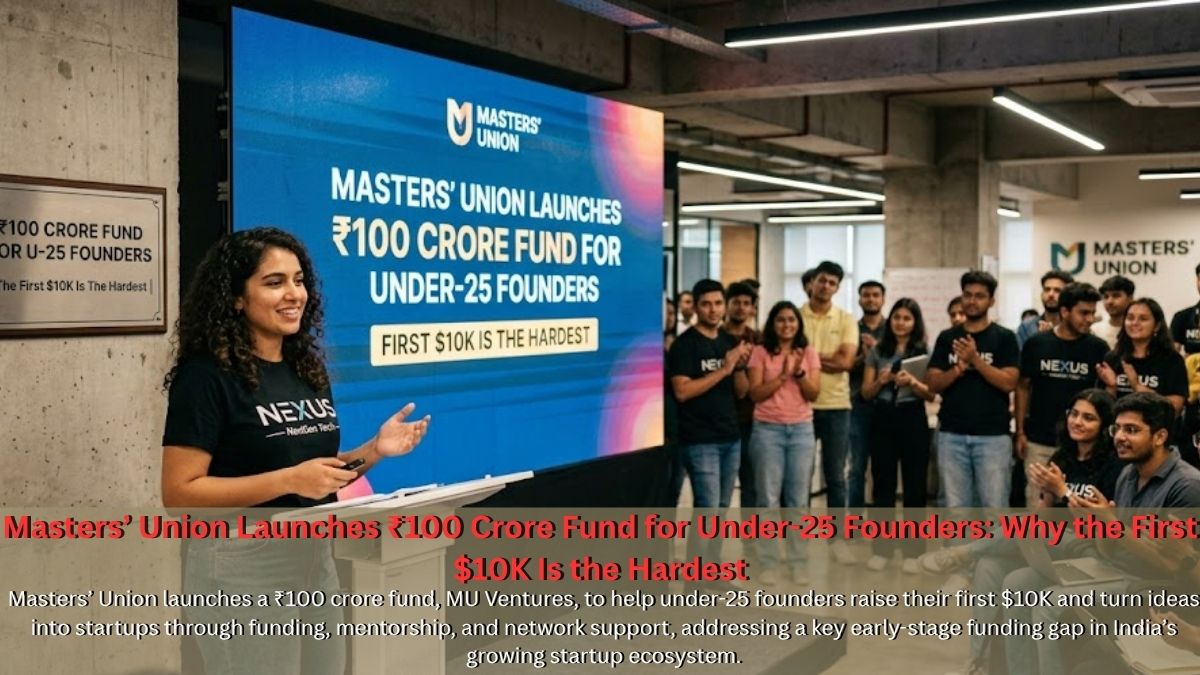
Masters’ Union launches a ₹100 crore early-stage investment fund aimed at backing founders under the age of 25. This initiative focuses on solving one of the most critical challenges in the startup ecosystem: raising the first $10,000. The institution believes that while venture capital and business funding are available at later stages, early-stage founders often struggle to secure initial capital to validate their ideas. The newly introduced fund, often referred to as MU Ventures, will support young entrepreneurs with capital, mentorship, and access to a strong startup network. According to reports, the fund will invest in early-stage startups, particularly those in ideation or prototype stages. This makes it different from traditional venture capital firms that typically invest after traction is visible.
Masters’ Union also highlights that the first $10K is the hardest to raise because most angel investors and venture-backed startups prefer validated business models. As a result, many promising startup ideas fail before they even begin. This fund aims to bridge that gap. The initiative comes at a time when Indian startups are seeing rapid growth in sectors like fintech, AI startups, and clean energy. However, access to seed funding remains uneven. By targeting under-25 founders, Masters’ Union is also promoting innovation among young entrepreneurs and students.
This move reflects a broader shift in the startup ecosystem, where institutions are stepping in to support emerging startups at the earliest stages. It also strengthens India’s position in global startup markets by nurturing the next generation of startup founders.
1. Masters’ Union Launches ₹100 Crore Fund: A New Era for Young Founders
1.1 Understanding the Announcement
When the headline “Masters’ Union Launches” a ₹100 crore fund started gaining attention, it immediately stood out from typical startup news. This was not just another venture capital announcement focused on scaling companies that already show traction. Instead, it addressed a deeper issue that many founders silently struggle with. Young entrepreneurs often have bold ideas, but they lack access to even the smallest amount of early capital. This initiative directly targets that gap. It recognizes that innovation does not begin with revenue charts or user metrics. It begins with belief, curiosity, and the willingness to take a risk before anyone else does.
Moreover, the structure of this fund shows a clear shift in how early-stage investing is being viewed. By focusing on pre-seed and seed-stage startups, Masters’ Union is stepping into the most uncertain phase of the startup journey. At this point, founders are still testing assumptions and learning through trial and error. Therefore, the support required is not just financial. It is emotional and strategic as well. This announcement reflects a deeper understanding of how startups actually begin. It shows that backing raw potential, even before validation, can unlock a wave of innovation that traditional funding models often overlook.
1.2 Why the First $10K Matters
The idea that the first $10K is the hardest to raise is not just a theory. It is a reality that most founders experience firsthand. At this stage, there are no growth metrics to showcase. There is no product-market fit to prove. Founders are often working with just an idea, a rough plan, and a lot of uncertainty. Investors, on the other hand, are trained to look for signals of success. This mismatch creates a gap where promising ideas struggle to find support. As a result, many startups never move beyond the idea stage, not because they lack potential, but because they lack initial backing.
At a deeper level, the first $10K represents much more than money. It represents validation. When someone invests at this stage, it tells the founder that their idea is worth pursuing. That single moment can change the entire mindset of a founder. It replaces doubt with confidence. It creates momentum where there was hesitation. With even a small amount of capital, founders can build prototypes, test ideas, and engage with real users. This early progress often becomes the foundation for future funding rounds. Therefore, by solving this one problem, the initiative is unlocking a much larger chain of opportunities for emerging startups.
2. Background Story of Masters’ Union
2.1 Founding and Vision
Masters’ Union was built on a simple but bold idea that traditional education often fails to prepare students for real-world challenges. Instead of focusing only on theory, it chose to bring industry experience into the learning process. This approach naturally attracted students who were not just looking for stable careers but were curious about building something of their own. Over time, the institution developed a culture where experimentation was encouraged. Students were not afraid to test ideas, fail, and learn quickly. This mindset became the foundation of its entrepreneurial ecosystem.
As this culture evolved, a pattern started to emerge. Many students had strong startup ideas and the drive to execute them. However, they consistently faced the same barrier. They could not access early-stage funding. This gap between ambition and opportunity became impossible to ignore. Masters’ Union realized that if it truly wanted to support entrepreneurship, it had to go beyond education. It had to actively participate in the startup journey. This realization eventually led to the creation of the fund. It is not just an investment initiative. It is a natural extension of its vision to empower builders from day one.
2.2 Journey into Startup Ecosystem
Over the years, Masters’ Union gradually built deep connections within the startup ecosystem. It engaged with venture capital firms, angel investors, startup incubators, and experienced founders. These were not just formal partnerships. They were active collaborations where ideas, feedback, and insights were exchanged regularly. Students benefited from direct exposure to people who had already navigated the startup journey. This created a strong bridge between learning and real-world execution. As a result, the institution became more than just a place of education. It became a gateway into the startup world.
However, despite these strong connections, one critical gap remained. Early-stage funding was still difficult to access for young founders. While later-stage investors were open to backing startups with traction, very few were willing to take risks at the idea stage. This is where Masters’ Union identified its opportunity. When “Masters’ Union Launches” this fund, it is stepping into a space that aligns perfectly with its strengths. It understands the mindset of young founders. It understands the challenges they face. Therefore, it is in a unique position to support them in a way that traditional investors often cannot.
3. Understanding MU Ventures Fund Structure
3.1 Working Model of the Fund
MU Ventures operates with a clear focus on early-stage founders who are still in the process of shaping their ideas. Unlike traditional venture capital firms that prioritize traction and proven models, this fund looks at intent, clarity, and potential. The process begins by identifying founders who show strong conviction and a willingness to solve real problems. These may not always be polished entrepreneurs. In many cases, they are students or first-time founders who are still learning. However, what sets them apart is their drive to build something meaningful.
Once selected, the support goes far beyond just providing capital. Founders gain access to mentorship from experienced entrepreneurs who have faced similar challenges. They also become part of a network that includes investors, operators, and other founders. This environment plays a crucial role in shaping their journey. It reduces the feeling of isolation that many early-stage founders experience. It also accelerates learning by providing real-world insights. In practical terms, this model increases the chances of survival for startups during their most vulnerable phase.
3.2 Investment Strategy
The investment strategy reflects a deep understanding of where innovation truly begins. By focusing on pre-seed startups, the fund is entering at a stage where ideas are still raw and untested. This is a high-risk approach, but it is also where the highest potential lies. Many of the world’s most successful startups started as uncertain ideas that did not initially attract mainstream investors. By supporting such ideas early, the fund is positioning itself at the very beginning of the value creation cycle.
Another important aspect of the strategy is its focus on first-time and student founders. These individuals often lack experience but bring fresh perspectives. They are not limited by traditional thinking. This allows them to explore unconventional solutions and challenge existing business models. By backing these founders, the fund is encouraging a new wave of innovation. It is also aligning itself with global startup trends where young entrepreneurs are driving significant change. This approach may carry risk, but it also has the potential to create breakthrough success stories.
4. Revenue Model and Sustainability
4.1 How the Fund Generates Returns
Despite its strong focus on supporting founders, the fund operates within a structured financial framework. MU Ventures follows a traditional venture capital model where it invests in startups in exchange for equity. This means the fund’s success depends on the long-term growth of the companies it backs. As these startups scale, their valuations increase. This creates opportunities for returns through acquisitions, secondary sales, or public listings. However, early-stage investing comes with uncertainty. Not every startup will succeed, and that is an accepted part of the model.
What makes this approach sustainable is the portfolio strategy. The fund invests in multiple startups, understanding that only a few will achieve significant success. These successful ventures generate returns that compensate for the failures. This model has been widely used in global venture capital and has proven effective over time. However, it requires patience and a long-term vision. Returns do not come immediately. They take years to materialize. Therefore, the fund must balance its mission of supporting founders with the discipline of managing risk.
4.2 Long-Term Vision
The long-term vision of this initiative goes beyond financial returns. Masters’ Union aims to build a strong ecosystem where young founders can grow, succeed, and eventually give back. Over time, some of these founders may build successful companies. They may become mentors or even investors themselves. This creates a cycle of support that strengthens the entire startup ecosystem. It ensures that knowledge, capital, and experience continue to flow within the community.
From a broader perspective, this vision aligns with how strong startup ecosystems evolve globally. They are not built overnight. They grow through continuous cycles of learning, failure, and success. By investing at the earliest stage, Masters’ Union is positioning itself at the foundation of this cycle. It is helping create the next generation of founders who will shape the future of innovation. This makes the initiative not just impactful in the present, but also highly relevant for the long term.
5. Services and Support Offered
5.1 Beyond Funding
When people hear that “Masters’ Union Launches” a ₹100 crore fund, the first thing that comes to mind is capital. However, anyone who has actually tried building a startup knows that money alone rarely solves the real problems. In the early days, founders are not just short on funds. They are short on clarity, direction, and sometimes even confidence. This is exactly where the deeper value of this initiative begins to show. It goes beyond writing cheques. It focuses on building people.
Mentorship, in this context, is not a buzzword. It is often the difference between giving up and pushing forward. A young founder sitting alone with an idea can easily get lost in overthinking. However, one conversation with someone who has already walked that path can change everything. It can simplify decisions, reduce fear, and bring focus. Networking also plays a similar role. Access to the right people at the right time can unlock opportunities that are otherwise invisible. Whether it is finding a co-founder, hiring the first team member, or getting introduced to the next investor, these connections matter more than most founders realize in the beginning.
Another important layer is access to accelerators and structured programs. These environments create pressure in a positive way. They push founders to move faster, validate quicker, and stay accountable. Many early-stage founders struggle because they operate without structure. Days pass, ideas keep changing, and progress feels slow. However, when they enter a system that demands regular updates, milestones, and feedback, things start moving. In real terms, this means fewer wasted months and more focused execution. That shift can be the difference between a startup that fades away and one that finds its footing.
5.2 Startup Resources and Mentorship
The real strength of this initiative lies in how it combines multiple layers of support into one ecosystem. Founders are not just given advice. They are surrounded by people and systems that continuously push them forward. Access to industry mentors means founders can learn from real experiences instead of theoretical frameworks. These mentors have faced hiring struggles, product failures, investor rejections, and scaling challenges. So when they guide a young founder, the advice is practical, not idealistic. That kind of learning saves time and prevents costly mistakes.
Startup incubators add another dimension to this journey. They create a safe space where founders can experiment without fear of immediate failure. At the same time, they provide structure, which many early-stage founders lack. Business strategy guidance ensures that founders are not just building products but also thinking about sustainability, revenue models, and market positioning. Tech innovation support becomes crucial, especially for founders who may not have deep technical backgrounds but are trying to build digital products. When all these elements come together, something powerful happens. Founders stop feeling lost. They start feeling supported.
From real-world observation, startups rarely fail because of a single big mistake. They fail due to a series of small, avoidable errors. Lack of clarity, poor decision-making, wrong hiring choices, or delayed execution slowly add up. This is where a strong support system changes outcomes. It reduces those small errors. It accelerates learning. And most importantly, it gives founders the confidence to keep going even when things feel uncertain. That emotional support, combined with practical guidance, is what truly increases the chances of success.
6. Problems This Initiative Solves
6.1 Funding Gap in Early Stages
One of the most painful realities in the startup ecosystem is that the earliest stage is often the most ignored. Everyone talks about funding rounds worth millions, but very few talk about the struggle to raise the first few thousand dollars. This is where most founders get stuck. They have ideas, sometimes even strong ones, but no way to test them. The gap between having an idea and building something real feels huge when there is no financial support.
This initiative directly steps into that gap. It recognizes that early-stage funding is not just about capital. It is about giving ideas a chance to exist. When founders receive that initial support, they can move from thinking to doing. They can build prototypes, talk to users, and start validating assumptions. This early movement is critical. Without it, ideas remain ideas. With it, they start becoming businesses. In practical terms, this means more startups entering the ecosystem and more innovation being tested in the real world.
There is also a psychological shift that happens when this gap is addressed. Founders stop feeling stuck. They stop waiting for the perfect moment. Instead, they begin acting. That shift in mindset is powerful because it creates momentum. And in startups, momentum is everything. Once things start moving, even slowly, opportunities begin to open up. Future investors become more interested. Users start giving feedback. The journey, which once felt impossible, starts to feel real.
6.2 Lack of Mentorship
Funding alone cannot guide a founder through the chaos of building a startup. One of the most underestimated challenges is the lack of mentorship. Young founders often operate in isolation. They do not know what the right decisions look like because they have never faced these situations before. Every choice feels uncertain. Every mistake feels costly. Over time, this uncertainty can become overwhelming.
This is where structured mentorship becomes invaluable. When founders have access to experienced mentors, they gain perspective. They learn that challenges are normal. They understand that failure is part of the process, not the end of it. More importantly, they get practical advice on how to handle real situations. Whether it is pricing a product, negotiating with a partner, or deciding when to pivot, these insights make a huge difference.
From experience across the startup world, many founders say that one good mentor can save months of confusion. It is not just about getting answers. It is about asking the right questions. Mentors help founders think clearly. They challenge assumptions. They push founders to improve. This kind of support builds not just better startups, but stronger founders. And in the long run, it is the founder’s mindset that determines success more than anything else.
6.3 Risk Aversion in Venture Capital
Traditional venture capital has its own logic. It focuses on minimizing risk and maximizing returns. This often leads to a preference for startups that already show traction. While this approach makes sense from an investment perspective, it creates a blind spot. Truly innovative ideas often look risky in the beginning. They do not fit into existing patterns. They challenge assumptions. As a result, they are often overlooked.
This is where initiatives like this play a crucial role. By being willing to take risks at an early stage, they open the door for unconventional ideas. They give space to founders who think differently. This is important because many breakthroughs come from ideas that initially seem uncertain. If the ecosystem only supports safe bets, innovation slows down.
Encouraging risk-taking does not mean ignoring discipline. It means understanding that early-stage innovation requires a different mindset. It requires patience and belief. When founders feel that someone is willing to take a chance on them, they become more willing to experiment. They push boundaries. They explore new solutions. This is how disruptive tech emerges. And over time, this is what drives real change in the startup ecosystem.
7. Industry Trends and Growth Insights
7.1 Rise of Young Entrepreneurs
There is a noticeable shift happening in the startup ecosystem. More young people are choosing to build startups instead of following traditional career paths. This is not just a trend. It reflects a deeper change in mindset. Access to information, exposure to global startup stories, and the rise of digital platforms have made entrepreneurship feel more achievable. In India, this shift is especially strong. Young founders are entering sectors like AI startups, fintech, and blockchain with fresh ideas. They are not afraid to challenge existing systems. They are comfortable experimenting with new technologies. This energy is driving a new wave of innovation. It is also making the startup ecosystem more dynamic and competitive.
However, this rise also brings challenges. Young founders often lack experience. They face uncertainty at every step. This is where structured support becomes essential. When the right guidance and resources are available, this energy can be channelled into meaningful outcomes. Otherwise, many promising ideas may never reach their full potential.
7.2 Growth in Early-Stage Funding
While there is a lot of capital flowing into the startup ecosystem, most of it is concentrated in later stages. Startups that already show traction find it easier to raise funds. However, those at the idea stage still struggle. This imbalance creates a bottleneck. Many startups never reach the stage where they can attract larger investments.
This is why early-stage funding is becoming increasingly important. It acts as the foundation for the entire ecosystem. Without it, the pipeline of future startups weakens. Funds like MU Ventures are addressing this gap. They are ensuring that more ideas get the chance to develop into viable businesses. From a broader perspective, this shift can have long-term impact. As more early-stage startups receive support, the number of successful startups increases. This strengthens the ecosystem as a whole. It creates more innovation, more jobs, and more opportunities for growth.
7.3 Global Startup Trends
Globally, there is a growing focus on supporting student entrepreneurs and first-time founders. Universities and institutions are no longer limited to education. They are becoming active participants in the startup ecosystem. They are launching funds, incubators, and accelerator programs to support early-stage innovation.
Masters’ Union aligns closely with this global trend. By launching its own fund, it is positioning itself as more than just an educational institution. It is becoming a platform for building startups. This approach reflects how the role of institutions is evolving. In the long run, this trend could reshape how startups are created. Instead of struggling alone, founders may start their journeys within supportive ecosystems. This can significantly improve success rates and reduce early-stage failures.
8. Competitor Analysis
8.1 Direct Competitors
At first glance, MU Ventures may seem like just another player in the early-stage funding space. However, when you look closely, the competition is both strong and deeply established. Early-stage venture capital firms and angel investors have been operating in this domain for years. They have capital, networks, and experience. They also have a structured way of evaluating startups. But here is the reality that most founders quietly experience. Even these early-stage investors often expect some level of validation. They look for signals like user traction, early revenue, or a working prototype. For a 20-year-old founder with just an idea, that bar still feels out of reach.
This is where the difference becomes very real. MU Ventures is not just competing on capital. It is competing on mindset. While traditional investors often ask, “What have you already built?”, this model is willing to ask, “What are you trying to build, and why does it matter?” That shift may sound small, but it changes everything for a young founder. It creates space for ideas that are still forming. It allows imperfect beginnings. And from experience, that is exactly where many great startups start. So while venture capital firms and angel investors remain strong competitors, MU Ventures is quietly redefining what early-stage support can look like.
Startup incubators and accelerators also sit in this competitive landscape. They provide structure, mentorship, and sometimes small grants. However, many founders who have gone through such programs will tell you something honestly. Not all incubators go deep enough. Some provide surface-level guidance, but when real problems arise, founders still feel alone. MU Ventures has an opportunity here to stand apart by going deeper into the founder journey. If it truly combines funding with hands-on mentorship and real accountability, it can offer something that many accelerators promise but rarely deliver fully. That is where the real competition lies, not just in services, but in execution.
8.2 Indirect Competitors
The indirect competition is more complex and, in many ways, more fragmented. University-led startup programs have grown rapidly in recent years. Many institutions now offer incubation, mentorship, and even seed funding. On paper, this looks similar. However, the experience often varies widely. Some programs are highly active and founder-focused, while others remain limited to workshops and occasional guidance. For a young founder, this inconsistency creates confusion. They do not always know where they will get real support and where they will just get theoretical advice.
Government startup schemes are another major player in this space. Initiatives under Startup India and various state programs aim to support early-stage founders. They provide grants, subsidies, and sometimes access to infrastructure. However, the challenge here is speed and accessibility. Many founders struggle with long processes, documentation, and uncertainty around approvals. When you are in the early stage of a startup, time matters more than anything. Delays can kill momentum. So while government support is valuable, it does not always match the urgency that founders feel on the ground.
Private accelerators also add to the competition. Some of them are extremely strong and have helped build successful startups. However, they are often selective and cohort-based. Founders have to wait for specific intake cycles. They also need to fit certain criteria. This again creates a gap for those who are just starting out and do not yet meet those standards. MU Ventures sits right in this gap. It has the chance to become a more accessible, continuous support system rather than a selective, time-bound program. And from a founder’s perspective, that accessibility can make a world of difference.
9. Impact of Masters’ Union Launches Fund
9.1 Boost to Indian Startups
When “Masters’ Union Launches” this fund, the immediate impact is not loud or dramatic. You will not see overnight unicorns or massive headlines. Instead, the impact is quiet but powerful. More ideas will move from notebooks to reality. More founders will take their first step. And that is where real change begins. In the Indian startup ecosystem, the biggest gap has always been at the very beginning. Once a startup gains traction, support starts flowing in. But reaching that first milestone is where most journeys end.
This initiative changes that starting point. It gives founders a chance to begin. And when more founders begin, the entire ecosystem becomes more active. Over time, this leads to a stronger pipeline of startups. Some will fail, and that is natural. But some will succeed. And those successes will inspire the next wave of founders. This is how ecosystems grow, not through isolated wins, but through consistent participation at the grassroots level. In that sense, the real boost is not just economic. It is cultural. It makes entrepreneurship feel more possible.
9.2 Encouraging Startup Ideas
There is something deeply personal about deciding to pursue a startup idea. It often goes against expectations. Family members may not understand it. Friends may question it. Society, in many cases, still values stability over risk. So when a young founder decides to build something, they are already carrying a lot of internal pressure. What they need at that moment is reassurance that they are not alone.
This is where the emotional impact of this fund becomes clear. When founders see that there is a system willing to support them at such an early stage, it changes how they think. They stop second-guessing themselves so much. They start taking their own ideas more seriously. That confidence is not easy to measure, but it is incredibly powerful. It leads to action. It leads to experimentation. And most importantly, it keeps founders going when things get difficult.
From real-world experience, many founders say that the hardest part is not building the product. It is deciding to start. By lowering that barrier, this initiative is unlocking a wave of creativity that might otherwise remain hidden. And that is where true innovation begins.
9.3 Strengthening Startup Ecosystem
A startup ecosystem is not built only on funding or success stories. It is built on cycles. Founders start companies, some succeed, some fail, and then they share their learnings. They mentor others. They invest back into the ecosystem. Over time, this creates a strong, self-sustaining network. However, this cycle can only exist if enough people are able to enter it in the first place.
By supporting early-stage founders, this fund is strengthening the very foundation of the ecosystem. It is increasing participation. It is encouraging experimentation. And it is creating more opportunities for learning. Even failed startups contribute to this system. They produce experienced founders who understand what went wrong and can do better next time. In the long run, this kind of support creates depth in the ecosystem. It moves beyond a few success stories and builds a broader base of capable entrepreneurs. That is what makes an ecosystem truly strong. And that is the kind of impact that grows slowly but lasts for decades.
10. Future Outlook
10.1 Expansion Plans
Looking ahead, the potential for this initiative to grow is significant. If the early results show promise, there is a strong case for expanding the fund. This could mean increasing the capital pool, supporting more founders, or even creating specialized tracks for different industries like fintech, AI, or clean energy. As the portfolio grows, the fund will also gain deeper insights into what works and what does not. These learnings can be used to refine the approach and improve outcomes.
There is also a strong possibility of global collaboration. As startups become more interconnected, founders are no longer limited to local markets. Partnering with international investors and ecosystems can open new doors. It can help founders scale faster and access global opportunities. For MU Ventures, this could be a natural next step. Building bridges between Indian startups and global markets can create a powerful advantage for the founders it supports.
10.2 Long-Term Industry Impact
Over time, this initiative could do more than just support individual startups. It could influence how early-stage funding is approached across the industry. If it proves successful, other institutions may start adopting similar models. This could lead to a more balanced funding ecosystem where support is available at every stage, not just after validation.
This shift would have a ripple effect. More early-stage funding would lead to more startups. More startups would lead to more innovation. And more innovation would drive economic growth. It could also change how society views entrepreneurship. Instead of being seen as a risky alternative, it could become a more accepted and supported career path. In that sense, the long-term impact is not just about business. It is about mindset. It is about creating a culture where building something new is encouraged, supported, and respected.
11. Learning for Startups and Entrepreneurs
11.1 Key Lessons
One of the clearest lessons from this initiative is that early support matters more than most people think. Many founders spend years waiting for the “right time” or the “perfect conditions.” But in reality, progress often begins with small steps. That first bit of funding, that first mentor conversation, or that first prototype can change everything. It creates movement. And once movement begins, things start to fall into place.
Another important lesson is the value of mentorship. No founder succeeds alone. Behind every successful startup, there are people who guided, challenged, and supported the founder along the way. Learning from others’ experiences can save time, reduce mistakes, and improve decision-making. At the same time, founders must embrace risk. Innovation does not come from playing safe. It comes from trying something new, even when the outcome is uncertain. Young founders, in particular, have the advantage of time and flexibility. They can experiment more freely, and that is a powerful edge.
11.2 Strategic Insights
From a strategic perspective, founders need to focus on building strong foundations. This means understanding the problem deeply, creating a clear value proposition, and thinking about sustainability from the beginning. It is easy to get excited about ideas, but execution is what matters in the long run. Having access to the right resources can accelerate this process, but the responsibility still lies with the founder.
At the same time, founders should not underestimate the importance of community. Being part of a network where people share knowledge and experiences can make the journey less lonely and more productive. It also opens doors to opportunities that may not be visible otherwise. Most importantly, founders need to keep moving forward. There will always be uncertainty. There will always be challenges. But those who continue to learn, adapt, and persist are the ones who eventually succeed.
About foundlanes.com
foundlanes.com is India’s leading startup idea discovery platform. It helps entrepreneurs find actionable startup opportunities, market insights, and industry-specific guidance to turn ideas into real businesses. With deep research and practical resources, foundlanes supports founders at every stage, from idea validation to launch and growth.