
News Summary
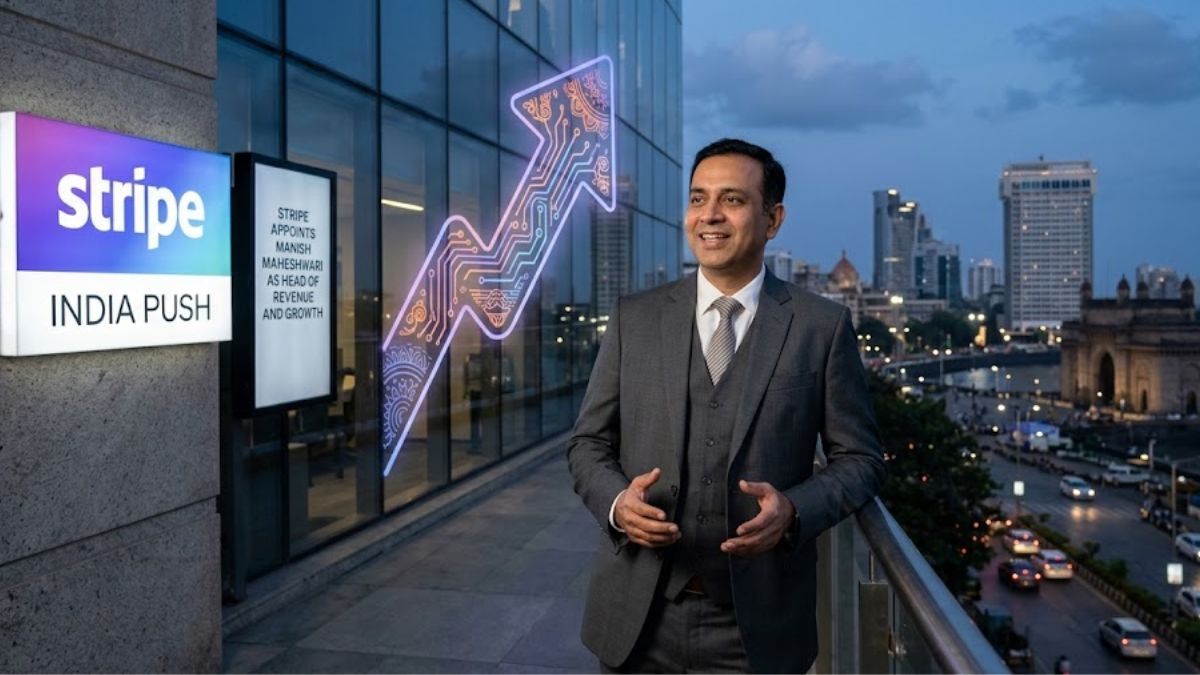
The global payments giant Stripe has strengthened its India leadership team by appointing Manish Maheshwari as the Head of Revenue and Growth for India. This strategic move comes as part of a broader effort tied to Stripe Expands India Push, reflecting the company’s increasing focus on one of the world’s fastest-growing digital payment markets. According to multiple reports, Maheshwari will be responsible for leading Stripe’s revenue strategy, expanding enterprise adoption, and accelerating growth across India’s fintech ecosystem. He will also focus on strengthening partnerships with startups, digital-first companies, and large enterprises that are rapidly adopting online payment infrastructure.
This leadership appointment signals Stripe’s deeper commitment to India’s booming digital economy, where demand for seamless payment gateways, cross-border transactions, and developer-first financial tools continues to rise. India’s startup ecosystem has seen strong growth in fintech, SaaS, and digital commerce, making it a critical market for global payment infrastructure companies like Stripe. The announcement aligns with the company’s long-term strategy of expanding its footprint in Asia while supporting AI-driven and internet-first businesses globally. With increasing competition in the payments space, Stripe is reinforcing its leadership team to capture more enterprise clients and strengthen its positioning against both global and domestic rivals.
The Stripe Expands India Push initiative highlights the company’s focus on scaling operations in India through experienced leadership. Maheshwari’s appointment is expected to bring strategic depth in revenue expansion and market development. This move also reflects Stripe’s ambition to support India’s rapidly evolving digital-first economy, where fintech innovation, startup funding, and digital transformation are accelerating at a fast pace.
1. Introduction: Stripe’s Deepening India Push in a Rapidly Evolving Digital Economy
Stripe’s expanding focus on India is not just another regional expansion story. It reflects a much deeper shift happening inside global fintech itself, where emerging markets are no longer treated as secondary opportunities but as core growth engines. India sits at the center of this shift. The country is not only adding new internet users at scale but also building one of the most advanced digital payment ecosystems in the world. This combination of scale and sophistication makes India unusually important for companies like Stripe that depend on transaction volume and developer-driven adoption.
Manish Maheshwari’s appointment strengthens this direction in a very practical way. Leadership in a market like India is not just about strategy decks or corporate positioning. It is about understanding how businesses actually behave when they move online, how payment friction affects conversion, and how enterprises think about scaling across platforms. The Stripe Expands India Push therefore represents more than a hiring decision. It reflects a shift toward building deeper operational presence in a market where digital payments are not just growing, but becoming the default language of commerce.
2. About Stripe and Its Global Business Model
2.1 Company Overview
Stripe has built its identity as a global financial infrastructure layer rather than just a payment company. At its core, it enables businesses to accept money online, but what makes it powerful is how invisible and seamless that process feels to both merchants and end users. Startups, enterprises, and platforms rely on Stripe not just for payments, but for the entire financial plumbing that sits underneath digital commerce.
What makes Stripe particularly interesting in real-world usage is that most users never “see” Stripe directly. They experience it indirectly when payments just work, subscriptions renew smoothly, or refunds are processed without friction. That invisible reliability is what has allowed Stripe to scale globally across more than 40 countries. It has essentially become part of the hidden infrastructure that powers modern internet businesses, quietly sitting behind millions of transactions every day.
2.2 Working Model of Stripe
Stripe’s working model is built on a developer-first, API-driven architecture. Instead of traditional banking interfaces, Stripe provides clean, programmable tools that developers can integrate directly into applications and websites. This means a startup can go from idea to accepting payments globally without building complex financial infrastructure from scratch.
In real implementation, this model drastically reduces the emotional and operational stress of launching a digital business. Founders no longer need to negotiate with banks, worry about cross-border payment systems, or build fraud detection engines internally. Stripe handles these layers in the background, allowing businesses to focus on product and growth. However, the complexity does not disappear; it is simply abstracted. Behind the simple APIs lies a highly sophisticated system managing compliance, risk, currency conversion, and fraud prevention at global scale. That balance of simplicity on the surface and complexity underneath is what makes Stripe’s model so effective.
2.3 Revenue Model
Stripe earns primarily through transaction-based fees, which means its revenue is directly tied to the success of its users. Every time a business successfully processes a payment, Stripe earns a small percentage. This creates a naturally aligned ecosystem where Stripe grows when its customers grow, which is a powerful long-term incentive structure.
Over time, Stripe has expanded into additional revenue streams such as billing infrastructure, subscription management tools, fraud prevention services, and enterprise financial solutions. These services are especially important for larger companies that need more than basic payment processing. In practice, this means Stripe is no longer just a payment gateway; it is becoming a full-stack financial operating system for internet businesses. The more deeply a company integrates Stripe, the harder it becomes to replace, which strengthens long-term retention and revenue stability.
3. Stripe Expands India Push: Strategic Importance of the India Market
3.1 India as a Growth Engine
India’s role in Stripe’s global strategy is becoming increasingly central, and for good reason. The country has one of the fastest-growing digital economies in the world, driven by rapid smartphone adoption, affordable internet access, and a massive shift toward online commerce. What makes India unique is not just the number of users, but the speed at which digital behavior is changing. Payments that once required cash or cards are now happening instantly through digital systems that feel almost frictionless.
In everyday experience, this shift is visible everywhere. Small merchants who once depended entirely on cash now run their businesses through QR codes. Online platforms are seeing higher conversion rates because payment friction has reduced significantly. The growth of UPI has fundamentally changed how money moves in India, creating an environment where digital payments are no longer a feature but a default expectation. For Stripe, this represents a massive opportunity to plug into a system that is already moving at scale, while also serving businesses that want to expand beyond domestic boundaries into global markets.
3.2 Startup Ecosystem Integration
India’s startup ecosystem is one of the strongest drivers of Stripe’s expansion strategy. Thousands of startups across fintech, SaaS, D2C, and digital services require reliable, scalable payment infrastructure from day one. As these companies grow, their payment needs become more complex, involving subscriptions, international transactions, compliance layers, and enterprise-level financial operations.
The Stripe Expands India Push is designed to directly address this demand. In practical terms, it means providing startups with tools that scale alongside their growth without forcing them to rebuild financial systems repeatedly. Many founders in India experience a common challenge: early-stage payment solutions work well, but break under scale when transaction volume increases or when global expansion begins. Stripe positions itself as a long-term partner in that journey, ensuring that as startups grow from early traction to enterprise scale, their payment infrastructure does not become a bottleneck.
What makes this even more significant is the emotional reality of founders building in India. Cash flow uncertainty, scaling pressure, and global competition create constant stress. Having a stable, trusted payment infrastructure reduces one major layer of operational risk. In many ways, Stripe becomes part of the invisible support system that allows startups to focus on building products instead of worrying about financial complexity.
4. Manish Maheshwari’s Role in Stripe India Strategy
4.1 Leadership Mandate
Manish Maheshwari stepping into a senior growth role at Stripe India signals a very deliberate shift from “market entry thinking” to “market ownership thinking.” This is not a symbolic appointment. It is an operational decision aimed at accelerating how Stripe integrates into India’s fast-moving digital economy. His mandate sits directly on three pressure points that define success in India: revenue acceleration, enterprise trust-building, and large-scale adoption across fragmented business segments.
In practical terms, this role is not about managing a stable business. It is about building one in a market that is still evolving in real time. India’s fintech environment behaves differently from mature Western markets. Payment preferences change quickly, regulatory expectations evolve, and enterprise needs vary widely across sectors. Placing a dedicated leader at the center of this complexity means Stripe is preparing for deep execution, not surface-level expansion. The Stripe Expands India Push essentially positions him as the bridge between global product infrastructure and India’s highly localized business realities.
4.2 Expected Impact
The expected impact of this leadership change goes far beyond incremental growth. In a market like India, penetration is not just about acquiring customers, it is about earning trust at scale. Enterprises here do not switch payment infrastructure lightly. Once a system is integrated into billing, subscriptions, and customer transactions, switching costs become extremely high. This means early positioning and relationship strength matter more than aggressive marketing.
With stronger leadership on the ground, Stripe is expected to deepen its relationships with high-growth startups and large enterprises that are scaling globally. The real impact will likely be seen in improved onboarding speed, better enterprise alignment, and stronger adaptation to India-specific payment behaviors. Over time, this can translate into higher transaction volumes, more embedded integrations, and deeper dependency on Stripe’s ecosystem. In simple terms, success here is not just about gaining users, but becoming part of how businesses fundamentally operate.
5. Services and Products Offered by Stripe
5.1 Payment Infrastructure
Stripe’s core strength lies in its payment infrastructure layer, which supports a wide range of transaction types including cards, wallets, and cross-border payments. On the surface, it looks simple, a checkout system that processes payments. But underneath, it is a highly complex global network that manages currency conversion, fraud detection, banking regulations, and settlement processes in real time.
From a real business perspective, this infrastructure removes one of the most stressful parts of building an online company. Founders do not have to worry about integrating multiple banking systems or negotiating individual payment partnerships in each market. Instead, they plug into a unified system and immediately gain access to global payment capabilities. This simplicity on the outside hides deep engineering sophistication on the inside, which is what makes Stripe extremely valuable for fast-scaling companies.
5.2 Billing and Subscription Tools
Stripe’s billing and subscription systems are designed for businesses that rely on recurring revenue models, especially SaaS and digital platforms. These tools automate complex workflows such as recurring charges, invoice generation, upgrades, downgrades, and proration logic. Without such systems, companies often struggle to maintain accuracy and consistency as customer bases grow.
In real-world usage, this becomes critical during scale phases. A startup with a few hundred users can manage subscriptions manually or through simple tools. But once it grows to tens or hundreds of thousands of users, billing complexity increases dramatically. Even small errors in billing cycles can lead to revenue leakage or customer dissatisfaction. Stripe’s system helps reduce this operational burden by standardizing billing logic and ensuring financial consistency across large customer bases. This reliability is one of the key reasons companies trust Stripe at enterprise scale.
5.3 Fraud Prevention and Security
Fraud prevention is one of the most invisible yet important parts of Stripe’s ecosystem. The platform uses machine learning models and behavioral analysis to detect suspicious transactions in real time. This includes identifying unusual payment patterns, preventing unauthorized access, and reducing chargebacks for businesses.
From an operational standpoint, this layer acts like a silent protection system running in the background. Most businesses only realize its importance when fraud incidents occur, and without strong systems, financial losses can escalate quickly. Stripe’s approach reduces this risk by continuously learning from global transaction data and improving its detection accuracy over time. In a market like India, where digital payments are growing rapidly and fraud patterns are also evolving, this capability becomes even more critical for maintaining trust between businesses and customers.
6. Problems Stripe Solves in the Digital Economy
6.1 Payment Complexity
One of the biggest challenges businesses face today is fragmentation in payment systems. Different regions, banks, wallets, and card networks often require separate integrations, which creates operational complexity and slows down product development. Stripe solves this by offering a single unified API that abstracts away this complexity and allows businesses to focus on their core product instead of backend financial systems.
In real usage, this simplification has a major psychological impact on founders and developers. Instead of spending weeks or months building payment infrastructure, they can launch in days. This speed changes business outcomes. Faster launches mean faster feedback, quicker iteration, and ultimately better product-market fit. Stripe effectively reduces friction at one of the most critical stages of digital business building, which is monetization.
6.2 Global Transaction Barriers
Cross-border payments have traditionally been one of the most painful areas in global commerce. Currency conversions, regulatory compliance, settlement delays, and banking restrictions often make international expansion difficult for startups. Stripe addresses this by providing infrastructure that allows businesses to accept payments globally without building separate systems for each country.
In practical terms, this enables even small companies in India to think globally from day one. A SaaS startup in Bangalore can sell to customers in Europe or the US without building local payment partnerships in each region. This fundamentally changes ambition levels. It removes one of the biggest structural barriers to global expansion and allows startups to compete on a much larger stage much earlier in their lifecycle.
6.3 Security and Compliance
Financial security and compliance are often underestimated until something goes wrong. Managing sensitive payment data, meeting regulatory requirements, and ensuring transaction safety are complex tasks that require constant attention. Stripe helps businesses handle this layer by embedding compliance and security protocols directly into its infrastructure.
From a real-world standpoint, this reduces both operational burden and risk exposure for businesses. Instead of building internal compliance teams early on, companies can rely on Stripe’s infrastructure to handle a large part of this complexity. This is especially important in fast-growing markets like India, where regulatory frameworks evolve and digital transaction volumes are increasing rapidly. The result is a safer, more stable foundation for scaling digital commerce.
7. Industry Growth Trends and Market Opportunity
The global fintech landscape is expanding at a pace that reflects a deeper shift in how money moves digitally. Fintech is no longer a niche sector; it is becoming the backbone of modern commerce. AI integration, automation, and embedded finance are reshaping how financial systems are designed and used. Instead of standalone payment tools, businesses now expect financial infrastructure to be fully integrated into their product experience.
India stands out as one of the most dynamic contributors to this global shift. The combination of UPI adoption, startup growth, SaaS expansion, and venture capital inflows has created an ecosystem where financial innovation is happening at multiple layers simultaneously. The Stripe Expands India Push aligns directly with these trends, positioning the company to serve not just payments, but the entire lifecycle of digital business growth. As AI-powered financial tools become more common, the demand for scalable and intelligent infrastructure will only continue to rise, making this market even more strategically important.
8. Competitors in the Payments Space
8.1 Direct Competitors
Stripe operates in a highly competitive global environment where players like PayPal, Adyen, and Square are continuously competing for market share in digital payments. Each of these companies has strong infrastructure, deep global networks, and established enterprise relationships. The competition is not just about features, but about reliability, trust, and ecosystem depth. Even small differences in performance or integration experience can influence long-term adoption decisions by businesses.
What makes this competition even more intense is that switching costs are extremely high in payment infrastructure. Once a company integrates a system into its core financial workflows, changing providers becomes complex and risky. This means the real competition happens at the early stage of adoption, where trust and developer experience determine long-term outcomes.
8.2 Indirect Competitors
In India, Stripe also faces strong indirect competition from local fintech leaders like Razorpay, PayU, and Cashfree. These companies have deep understanding of local payment behavior, regulatory nuances, and merchant needs. They are already embedded into India’s digital commerce ecosystem, which gives them a strong home advantage.
However, the competition is evolving beyond traditional payment processing. The real battleground is now AI-driven optimization, global scalability, and embedded financial services. The Stripe Expands India Push is designed to position the company not just as a payment gateway, but as a global financial infrastructure platform that can compete across multiple layers of the fintech stack. In this environment, success depends on how well companies combine global technology strength with local market sensitivity.
9. Startup Ecosystem and Growth Strategy
Stripe has quietly become one of the most important enablers of startup growth globally, not because it is always visible, but because it sits at the exact point where ambition turns into revenue. For early-stage startups, the ability to accept payments quickly is often the difference between momentum and stagnation. For scaling startups, the ability to handle millions of transactions without breaking becomes even more critical. Stripe operates across both ends of this journey, which is why it has become deeply embedded in modern startup infrastructure.
In India, this role becomes even more meaningful because the startup ecosystem is expanding at a pace that is both exciting and unforgiving. Venture capital is flowing into fintech, SaaS, D2C, and AI-driven companies, but investors now expect faster execution and clearer revenue paths. In this environment, startups cannot afford friction in their payment systems. The Stripe Expands India Push reflects this reality by positioning Stripe as a long-term infrastructure partner for companies that are expected to scale rapidly, often across multiple markets at the same time. The collaboration between fintech providers and venture-backed startups is no longer optional; it is becoming a structural requirement for growth.
What is happening on the ground is simple but powerful. Founders are no longer just building products, they are building global-ready businesses from day one. And in that journey, payment infrastructure becomes as important as the product itself. A smooth transaction experience can directly influence conversion rates, customer trust, and revenue consistency. That is why Stripe’s role in the startup ecosystem is not just technical, it is deeply tied to how startups survive and grow emotionally and financially in high-pressure environments.
10. Journey and Background of Stripe Expansion
Stripe’s journey started with a very focused mission, remove the friction from online payments so developers can build without worrying about financial complexity. What began as a simple API for accepting payments has gradually evolved into one of the most powerful financial infrastructure platforms in the world. This evolution did not happen overnight. It came through years of solving extremely complex problems quietly in the background while staying simple on the surface for users.
As Stripe expanded globally, its strategy became clearer. It does not just enter markets; it embeds itself into the digital foundation of those markets. Its expansion into India is a continuation of that philosophy, but with even greater significance. India is not just another geography; it is one of the fastest-changing digital economies in the world. High transaction volume, rapid startup growth, and deep fintech adoption make it a natural long-term focus area for global infrastructure players.
The Stripe Expands India Push reflects this long-term commitment in a very visible way. It is not a short-term experiment or a surface-level expansion. It is a structural investment into leadership, market understanding, and ecosystem integration. By strengthening its presence in India, Stripe is signaling that emerging markets are no longer secondary opportunities. They are central to the future of global digital commerce. This is where the next generation of internet businesses will be built, and Stripe wants to be part of that foundation from the beginning, not as a late entrant.
11. Learning for Startups and Entrepreneurs
One of the most important lessons from the Stripe Expands India Push is that timing is not just important, it is everything. Markets move in waves, and companies that recognize those waves early often gain disproportionate advantage. Stripe’s focus on India shows how global companies identify high-growth ecosystems early and commit to them before they fully mature. For startups, the same principle applies at a smaller scale. Choosing the right market at the right time can define the entire trajectory of a business.
Another critical takeaway is the importance of building scalable infrastructure from the beginning. Many startups make the mistake of optimizing only for early-stage convenience, without thinking about long-term scalability. Stripe’s success demonstrates the opposite approach. It builds systems that are developer-first, API-driven, and designed to scale seamlessly from small startups to global enterprises. This is why companies built on strong infrastructure tend to grow faster and face fewer operational breakdowns during scale phases. The foundation matters as much as the product itself.
Finally, leadership hiring is not just an HR decision, it is a growth strategy. The appointment of experienced leaders like Manish Maheshwari shows how seriously companies take market expansion when entering complex ecosystems like India. Strong leadership can accelerate decision-making, improve market understanding, and build trust with enterprise clients much faster than strategy alone. For entrepreneurs, this is a powerful reminder that growth is not just about ideas or funding. It is about surrounding those ideas with the right people who can execute under pressure and adapt to rapidly changing market realities.
About foundlanes.com
foundlanes.com is India’s leading startup idea discovery platform. It helps entrepreneurs find actionable startup opportunities, market insights, and industry-specific guidance to turn ideas into real businesses. With deep research and practical resources, foundlanes supports founders at every stage, from idea validation to launch and growth.