News Summary
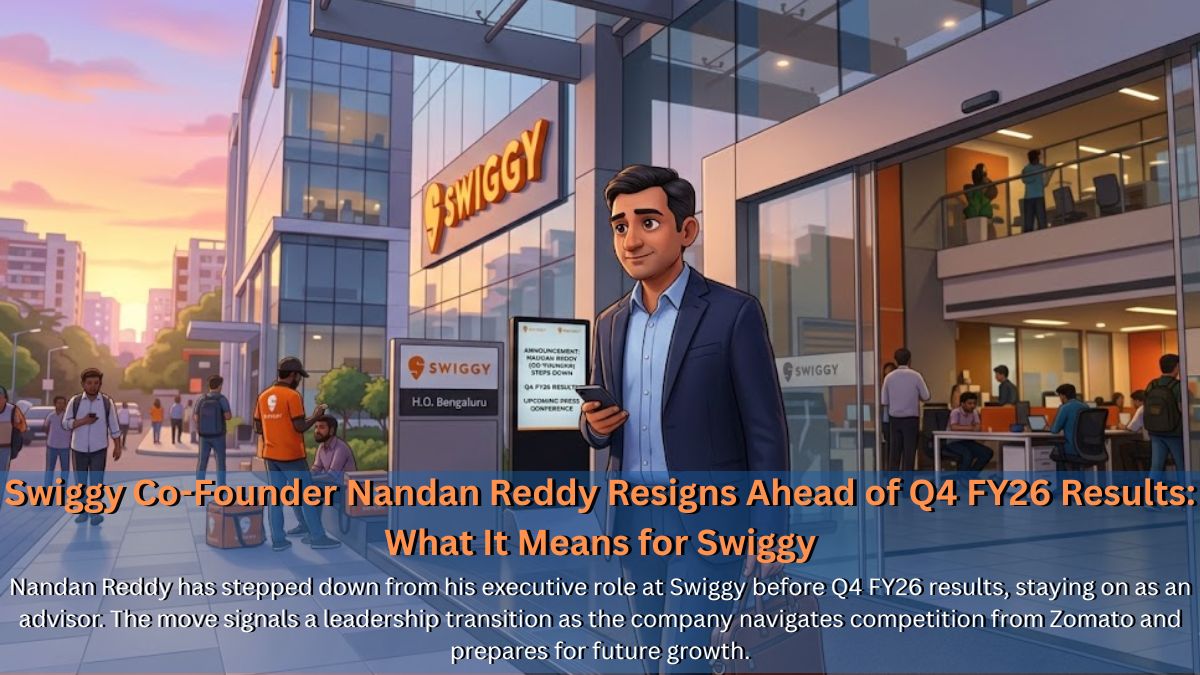
Nandan Reddy has stepped down from his executive role at Swiggy just ahead of the company’s Q4 FY26 financial results. Co-Founder Nandan Reddy Resigns, marking a major leadership shift at one of India’s fastest-growing startups. The move comes during a broader board-level reshuffle and signals a possible transition phase for the company. Swiggy confirmed that Reddy will continue to remain associated in an advisory capacity. However, his exit from day-to-day operations raises important questions about the company’s future direction, leadership structure, and growth strategy. Reports suggest that Reddy may explore new entrepreneurial ventures, indicating his continued interest in the startup ecosystem.
The timing of the resignation is crucial. Swiggy is preparing to announce its quarterly financial results, which are expected to reflect strong competition, rising operational costs, and evolving business strategies. Therefore, leadership changes at this stage could influence investor sentiment and internal operations. Swiggy has been a key player in India’s startup ecosystem, especially in food delivery and quick commerce. It competes directly with major players like Zomato and emerging quick commerce startups. Over the years, the company has attracted significant venture capital funding and has expanded its services beyond food delivery.
This leadership transition also reflects a broader trend in Indian startups where founders step back after scaling the business to maturity. As Swiggy moves closer to profitability and potential IPO plans, such changes may indicate a shift toward a more structured corporate governance model.
1. Swiggy Co-Founder Nandan Reddy Resigns: A Major Leadership Shift
1.1 Understanding the Resignation
The moment the headline “Swiggy Co-Founder Nandan Reddy Resigns” started circulating, it did not feel like just another corporate update. It felt like the end of a chapter that many people in the startup ecosystem had quietly followed for years. When a founder steps away, especially from a company they helped build from the ground up, it carries emotional weight. It is not just a role change. It is a transition from being deeply involved in every decision to watching the company move forward from a distance.
In reality, such exits rarely happen overnight. They are often the result of months, sometimes years, of internal reflection and planning. Reports suggest that this resignation is part of a structured leadership transition. That matters because it shows maturity. In the early days, founders are everything. They are the product managers, the operators, the problem solvers. But as the company grows, the role changes. Systems replace instincts. Teams replace individual hustle. At that stage, stepping back is not a sign of weakness. It is a sign that the company has reached a point where it can operate beyond its founders.
For anyone who has built or tried to build something, this moment is deeply relatable. There comes a time when holding on too tightly can slow things down. Letting go, even partially, becomes necessary. That is what makes this resignation more than just news. It reflects the natural evolution of a startup into a structured organization.
1.2 Timing Before Q4 FY26 Results
The timing of this move adds another layer of complexity. Swiggy is preparing to announce its Q4 FY26 results, and leadership changes at such a moment are never neutral. They send signals, whether intended or not. Investors, analysts, and even employees start reading between the lines. They ask questions about stability, direction, and future plans.
From a strategic perspective, this timing could be intentional. Leadership transitions often happen before major milestones so that the new structure can take ownership of what comes next. If Swiggy is moving toward profitability goals, restructuring, or even long-term IPO planning, aligning leadership early makes sense. It allows the company to present a more stable and forward-looking narrative to investors.
At the same time, there is a human side to this. Internally, teams feel these changes. Founders often carry a certain energy that defines the culture. When they step back, there is always a moment of adjustment. People wonder what will change and what will stay the same. However, if managed well, such transitions can actually bring clarity. They can create space for new leadership styles and sharper execution. In many ways, this moment is both uncertain and full of possibility. It reflects a company that is no longer just trying to survive, but trying to evolve.
2. Background Story of Swiggy and Its Founders
2.1 Founding Journey
To understand the weight of this moment, you have to go back to where it all started. Swiggy was founded in 2014 by Sriharsha Majety, Nandan Reddy, and Rahul Jaimini at a time when India’s food delivery space was still unstructured and unreliable. Ordering food online was not seamless. Deliveries were delayed, logistics were weak, and customer trust was low.
What made Swiggy different was its decision to solve the hardest part first. Instead of depending entirely on restaurants for delivery, it built its own logistics network. This was not easy. It required hiring delivery partners, managing operations at scale, and investing heavily in technology. But this decision became its biggest advantage. In the early days, the work was intense and often chaotic. Building a logistics network from scratch meant dealing with constant challenges. Orders would fail. Systems would break. Customers would complain. But each problem pushed the team to improve. Over time, this persistence started showing results. Deliveries became faster. Reliability improved. Customer trust grew.
From a real-world perspective, this is what separates successful startups from the rest. It is not just the idea. It is the willingness to solve difficult problems consistently. Swiggy’s journey reflects that grind. It was not built overnight. It was built through small improvements, repeated every day.
2.2 Role of Nandan Reddy
Nandan Reddy was not just a co-founder in title. He was deeply involved in shaping how Swiggy operated during its most critical years. While each founder had their own strengths, Reddy played a key role in building operational systems and ensuring that the company could scale without losing efficiency.
In the early stages, operations are everything. A great idea means little if execution fails. Reddy’s contribution was in making sure that execution did not break as the company grew. He was part of the process of turning a small startup into a structured organization capable of handling millions of orders. Beyond operations, founders also shape culture. They define how decisions are made, how teams work, and how challenges are approached. Reddy’s influence was part of that foundation. As Swiggy expanded across cities, hired thousands of employees, and built a massive delivery network, that early culture played a crucial role.
Now, with “Swiggy Co-Founder Nandan Reddy Resigns,” it marks more than a role change. It marks the transition of a company from its founding phase into a more institutional phase. For those who have followed Swiggy’s journey, it feels like watching a story evolve. The foundation has been laid. The next chapter will be built on it.
3. Swiggy’s Business Model Explained
3.1 Working Model
At its core, Swiggy operates on a simple idea. It connects people who want food with restaurants that can provide it. But behind this simplicity lies a complex system that runs in real time. Every order triggers a chain of events. The app processes the request, assigns it to a restaurant, finds a delivery partner, and ensures the food reaches the customer within a short window. What makes this model powerful is control. Swiggy does not leave delivery entirely to restaurants. It manages its own fleet of delivery partners. This allows it to maintain consistency in service. It also enables faster deliveries and better customer experience.
From a ground-level perspective, this model requires constant coordination. Traffic conditions change. Order volumes fluctuate. Delivery partners need to be allocated efficiently. Technology plays a huge role here. Algorithms decide which delivery partner gets which order. Routes are optimized in real time. Small improvements in these systems can lead to massive efficiency gains. For users, the experience feels smooth. But behind the scenes, it is a continuous process of problem-solving. That is what makes the model sustainable. It is not static. It evolves with data and experience.
3.2 Revenue Model
Swiggy’s revenue model is built on multiple streams, which is essential for long-term sustainability. The primary source is the commission charged to restaurants on each order. This creates a direct link between order volume and revenue. As more people order, the company earns more.
Another key component is delivery charges paid by customers. While these charges may seem small individually, they add up significantly at scale. Subscription services like Swiggy One bring in recurring revenue. They also increase customer loyalty by offering benefits like free delivery. Advertising and promotional listings provide another layer of income. Restaurants pay to be featured more prominently on the platform. This creates a marketplace dynamic where visibility can be monetized.
Quick commerce through Instamart adds a new dimension. It moves beyond food delivery into groceries and essentials. This diversification is important because it reduces dependency on a single segment. From a strategic point of view, this multi-layered revenue model is necessary. The food delivery business alone often struggles with margins. By adding new revenue streams, Swiggy improves its chances of reaching profitability.
4. Funding and Financial Growth
4.1 Venture Capital and Funding Rounds
Swiggy’s growth would not have been possible without strong backing from global investors. Over the years, it has raised billions in funding from firms like SoftBank, Prosus, and Accel. These investments allowed the company to scale rapidly, enter new markets, and invest in technology.
In the startup world, funding is not just about money. It is about trust. When major investors back a company, it signals confidence in its potential. For Swiggy, these funding rounds played a crucial role in establishing its position as a market leader. However, funding also brings expectations. Investors look for growth, efficiency, and eventually profitability. This creates pressure on the company to perform. Balancing growth with sustainability becomes a constant challenge.
4.2 Unicorn Status and Growth
Swiggy’s valuation crossing $10 billion placed it among India’s unicorn startups. This milestone reflects not just financial growth but also market dominance. It shows that the company has built a strong brand and a large customer base. At the same time, being a unicorn comes with its own challenges. High valuation creates high expectations. Profitability becomes a key focus. Rising operational costs, competition, and changing market dynamics add to the pressure. From a realistic perspective, this is where many startups struggle. Scaling is one challenge. Sustaining that scale is another. Swiggy is now at a stage where efficiency matters as much as growth.
5. Services and Product Expansion
5.1 Core Offerings
Swiggy started as a food delivery platform, but it did not stop there. Over time, it expanded into multiple services to stay relevant and competitive. Swiggy Instamart brought quick commerce into the picture, allowing users to order groceries and essentials within minutes. This move aligned with changing consumer behavior, where speed and convenience became priorities.
Swiggy Genie added another layer by offering pick-up and drop services. This turned Swiggy into more than just a food platform. It became a logistics solution for everyday needs. The integration of Dineout further expanded its presence in the dining ecosystem, connecting online discovery with offline experiences. This expansion reflects a clear strategy. Instead of staying limited to one category, Swiggy is building a broader ecosystem. This increases user engagement and creates multiple revenue streams.
5.2 Innovation and Tech Integration
Technology is at the heart of everything Swiggy does. From route optimization to demand forecasting, data plays a critical role. AI and analytics help improve efficiency, reduce delivery times, and enhance customer experience.
In real terms, this means fewer delays, better recommendations, and smoother operations. For a company operating at such scale, even small improvements can have a big impact. This focus on innovation is what keeps Swiggy competitive. In a market where customer expectations are constantly rising, staying ahead requires continuous improvement. And that is exactly what technology enables.
6. Problems Swiggy Solves
6.1 Customer Convenience
At a surface level, it may seem like Swiggy is just delivering food. But if you look closer, it is solving something much deeper. It is solving time. In today’s fast-moving lives, people are constantly balancing work, family, and personal needs. Cooking is not always possible. Going out is not always convenient. This is where Swiggy steps in, quietly becoming part of daily life without people even realizing how dependent they have become on it.
The real value lies in simplicity. A few taps on a phone, and food from dozens of restaurants becomes accessible. There is no need to call, no need to wait in queues, no uncertainty about availability. Everything is visible, trackable, and predictable. For someone who has experienced the older system of ordering food, the difference feels almost dramatic. What once took effort now feels effortless. And that shift in experience is what builds long-term user loyalty.
There is also an emotional angle here that often goes unnoticed. Food is not just a necessity. It is comfort. It is celebration. sometimes the only break in a stressful day. When a platform makes that comfort easily accessible, it becomes more than a service. It becomes part of people’s routines. That is the real problem Swiggy solves. Not just delivery, but making life a little easier, one order at a time.
6.2 Logistics Challenges
If there is one problem that defined the early days of food delivery in India, it was logistics. Restaurants were good at cooking, but not at delivering. Orders would get delayed, misplaced, or cancelled. Customers would lose trust, and restaurants would lose business. This gap between food preparation and delivery was massive, and very few companies were willing to solve it properly.
Swiggy took a bold approach by building its own logistics network. This was not an easy decision. It required hiring delivery partners, building systems to manage them, and constantly optimizing routes and efficiency. In the beginning, this likely felt overwhelming. Every new city meant starting from scratch. Every increase in order volume meant more pressure on the system. But over time, this investment started paying off.
From a real-world standpoint, this is where Swiggy built its strongest moat. By controlling delivery, it controlled the customer experience. It reduced dependency on restaurants and created consistency. Even today, this logistics backbone is what allows Swiggy to scale. It is also what enables new services like quick commerce. Without solving logistics at a deep level, none of this expansion would have been possible.
6.3 Employment Opportunities
One of the most visible impacts of Swiggy is the scale of employment it has created. Thousands of delivery partners work with the platform across cities. For many, this is more than just a job. It is a flexible source of income. It allows people to work on their own schedules, earn based on effort, and support their families.
However, the reality is layered. Gig work comes with both opportunities and challenges. On one hand, it opens doors for people who may not have access to traditional employment. On the other hand, it brings concerns around income stability and long-term security. Swiggy operates within this complex space, where it must balance efficiency with responsibility.
From a broader perspective, platforms like Swiggy have reshaped the startup jobs market. They have created a new category of work that did not exist at this scale before. This has had a ripple effect on the economy. It has increased participation, enabled income generation, and supported millions of daily transactions. While debates around gig work will continue, there is no denying the role Swiggy has played in creating opportunities at scale.
7. Industry Trends and Market Growth
7.1 Growth of Food Delivery Market
The rise of food delivery in India is not accidental. It is the result of multiple shifts happening at the same time. Smartphone usage has increased rapidly. Internet access has become more affordable. Digital payments have made transactions seamless. Together, these factors have created an environment where ordering food online feels natural. At the same time, urban lifestyles have changed. People are working longer hours. Nuclear families are more common. Eating out or ordering in has become part of daily routines rather than occasional indulgence. This behavioral shift is what drives demand. And platforms like Swiggy have positioned themselves right at the center of this change.
From experience, once users get comfortable with this convenience, they rarely go back. It becomes a habit. And habits are what drive long-term growth. This is why the food delivery market continues to expand, even in competitive conditions. It is not just about supply. It is about deeply embedded user behavior.
7.2 Quick Commerce Boom
If food delivery was the first wave, quick commerce is the next. The idea of getting groceries and essentials delivered within minutes has changed expectations completely. People no longer plan purchases days in advance. They expect instant availability. This shift has created a new competitive space where speed becomes the biggest differentiator. Swiggy Instamart is part of this race. Competing in quick commerce is not easy. It requires dense logistics networks, local warehouses, and precise demand forecasting. Every delay affects user trust. Every inefficiency affects margins. But the potential is huge. If executed well, it can become a daily-use service with high engagement.
Globally, this trend reflects a larger pattern. Consumers are moving toward instant gratification. They value time more than ever. Companies that can deliver faster, more reliably, and at scale are gaining an edge. Swiggy’s entry into this space shows its intent to stay relevant as consumer expectations evolve.
8. Competitors Analysis
8.1 Direct Competitors
In India’s food delivery space, the competition is intense, but one name stands out alongside Swiggy, and that is Zomato. Both companies have spent years building their platforms, expanding their networks, and competing for the same set of customers. This rivalry has shaped the entire industry. From a user perspective, the competition has been beneficial. It has led to better service, faster deliveries, and frequent discounts. However, from a business standpoint, it has created pressure on margins. Both companies are constantly balancing growth with profitability. Every decision, whether it is pricing, expansion, or marketing, is influenced by what the competitor is doing.
This kind of competition is not just about market share. It is about survival and leadership. Over time, both companies have evolved, learned from each other, and adapted their strategies. This dynamic has pushed the industry forward, making it more efficient and more customer-focused.
8.2 Indirect Competitors
Beyond direct competition, Swiggy faces pressure from players operating in adjacent spaces. In quick commerce, Blinkit has emerged as a strong competitor. It focuses heavily on ultra-fast delivery of groceries and essentials, setting high expectations for speed. Similarly, Zepto has gained attention for its rapid delivery model and aggressive expansion. Dunzo operates in a slightly broader space, offering hyperlocal delivery services that overlap with Swiggy’s offerings.
These players increase competition not just in pricing but also in execution. They push Swiggy to improve its logistics, expand its services, and innovate continuously. From a strategic perspective, this competition is healthy. It forces companies to stay sharp. But it also makes the path to profitability more challenging.
9. What Swiggy Co-Founder Nandan Reddy Resigns Means for the Company
9.1 Leadership Transition
When “Swiggy Co-Founder Nandan Reddy Resigns,” it signals more than just a change in leadership. It reflects a deeper transition in the company’s lifecycle. Startups often begin with founder-driven energy. Decisions are quick, instincts play a big role, and the focus is on survival and growth. However, as companies scale, this model starts to evolve.
Professional management structures begin to take over. Processes replace instincts. Teams handle responsibilities that founders once managed directly. This transition is not easy, but it is necessary for long-term sustainability. In many ways, it shows that the company has grown beyond its early stage. From a human perspective, this is also a moment of reflection. Founders invest years of effort into building something. Stepping back requires a shift in identity. It is not just about leaving a role. It is about trusting the system that has been built.
9.2 Impact on Investors
Investor sentiment during such transitions is always mixed. On one hand, a planned leadership change can be seen as a positive sign. It suggests that the company is moving toward stronger governance and long-term stability. Investors often prefer structured organizations over founder-dependent ones, especially when companies approach profitability or public listing stages.
On the other hand, uncertainty is natural. Investors may wonder how the change will affect execution. They may look for signals in upcoming financial results. Short-term reactions can vary, but long-term confidence depends on how smoothly the transition is managed. From experience in the startup ecosystem, what matters most is clarity. When companies communicate their vision clearly and show consistent performance, investor confidence stabilizes. The leadership change then becomes just one part of a larger growth story.
9.3 Strategic Direction
This resignation also opens up questions about Swiggy’s future direction. It could indicate a stronger focus on profitability, which has become a key priority for many startups. After years of aggressive growth, the focus often shifts toward efficiency and sustainable margins. There is also the possibility of IPO preparation. As companies move closer to public markets, leadership structures often become more formal. Governance, transparency, and financial discipline become critical. This transition could be part of that preparation.
Organizational restructuring is another likely factor. As companies grow, they need to realign teams, processes, and strategies. Leadership changes often accompany such shifts. While these transitions can feel uncertain in the short term, they often lead to stronger foundations in the long run. In the end, this moment is not just about one person stepping back. It is about a company stepping into its next phase. And like every transition, it carries both challenges and opportunities.
10.10. Startup Ecosystem Perspective
10.1 Founder Exits Trend
When people read that a founder has stepped down, the first reaction is often surprise. Sometimes even concern. But if you look closely at how startups evolve, this pattern is not unusual at all. In fact, it is becoming more common, not just in India but across global startup ecosystems. Founders build companies from zero to scale, and then, at a certain point, their role naturally begins to change.
In the early days, a startup is deeply personal. Founders are involved in everything. They take product decisions, handle operations, solve customer issues, and even manage hiring directly. It is intense, emotional, and often exhausting. But as the company grows, this level of involvement becomes unsustainable. Systems need to replace instincts. Teams need to take ownership. Processes need to become stronger than individuals. This is where the shift begins.
10.2 From real-world experience
From real-world experience, many founders reach a point where they ask themselves a difficult question. “Am I still the right person to lead this company at this stage?” That question is not easy. It requires honesty and maturity. Some founders choose to stay and evolve into professional leaders. Others step back, allowing new leadership to take over. Neither choice is right or wrong. It depends on the situation.
Globally, we have seen this happen in many successful startups. Founder exits or role transitions often signal that the company has moved beyond its initial phase. It has grown into something larger, something that requires a different kind of leadership. While the headlines may focus on the exit, the deeper story is about evolution. It is about a startup becoming an institution.
There is also an emotional layer that rarely gets discussed. Letting go of something you built is not easy. It involves trust. Trust in the team, in the systems, and in the future of the company. For founders, this moment is both proud and difficult. It marks the success of what they created, but also the end of their day-to-day involvement. That dual feeling is what makes founder exits so significant.
10.3 Role of Venture Capital
Venture capital plays a quiet but powerful role in shaping how startups evolve. In the beginning, investors back founders because of their vision, energy, and ability to execute under uncertainty. At that stage, the company is fragile. Decisions are quick. Risks are high. And the founder’s personality often defines the entire organization.
However, as the company grows and raises more funding, expectations start to shift. Investors begin to focus not just on growth, but also on governance, efficiency, and long-term sustainability. They want to see structured leadership, clear reporting systems, and predictable performance. This is especially true when a company starts moving toward profitability or considers public listing. This is where leadership transitions often come into play. Venture-backed startups gradually move from founder-led models to professionally managed organizations. This does not mean founders lose importance. It simply means their role evolves. They may focus more on vision, strategy, or new initiatives, while operational control shifts to experienced executives.
From a practical standpoint, this transition helps companies scale more effectively. Large organizations require specialization. They need leaders who can manage complexity, handle large teams, and maintain consistency across operations. Venture capital encourages this shift because it reduces risk and improves long-term outcomes. At the same time, there is always a balance to maintain. Too much structure can slow down innovation. Too little structure can create chaos. The best companies find a middle ground. They retain the founder’s vision while building strong systems around it. In many ways, venture capital does not just fund startups. It shapes how they grow, how they are managed, and how they transition into mature businesses. And leadership changes are often a reflection of that journey.
11. Future Plans and Speculations
11.1 Nandan Reddy’s Next Move
Whenever a founder steps away, one question naturally follows. What comes next? In the case of Nandan Reddy, there is already speculation that he may start a new venture. And if that happens, it would not be surprising at all. Founders rarely stop building. It is not just a profession for them. It is a mindset. After spending years building a company like Swiggy, the learning curve becomes incredibly deep. Founders understand operations, scaling, hiring, fundraising, and market dynamics at a level that few others do. This experience becomes a powerful asset. When they start something new, they do so with clarity and confidence that only experience can bring.
There is also an emotional aspect to this. Building a startup is intense. It becomes a part of your identity. Stepping away creates space, but it also creates a sense of emptiness. Many founders feel the urge to build again, to solve new problems, to explore new ideas. That cycle of creation is what drives innovation in the startup ecosystem. From a broader perspective, this is how ecosystems evolve. Founders build companies, exit or step back, and then start again. Each cycle brings more experience, better execution, and stronger outcomes. If Reddy does launch a new venture, it will likely carry the lessons of his journey at Swiggy. And those lessons can make a significant difference.
11.2 Swiggy’s Road Ahead
For Swiggy, the road ahead is both challenging and full of opportunity. The company has already achieved scale. It has built a strong brand, a large user base, and a powerful logistics network. But the next phase requires a different focus. Growth alone is no longer enough. Efficiency and profitability have become critical.
Improving profitability will likely be a key priority. Food delivery, by nature, operates on thin margins. Costs related to logistics, discounts, and operations can quickly add up. To address this, Swiggy may focus on optimizing delivery efficiency, reducing costs, and increasing order value. These changes may not always be visible to users, but they are essential for long-term sustainability. Market expansion is another important area. While Swiggy already operates in many cities, there is still room to grow, especially in smaller towns. Expanding into new markets brings new users but also new challenges. Each city has different demand patterns, infrastructure, and competition levels. Managing this complexity requires careful planning and execution.
Quick commerce will continue to play a major role in Swiggy’s strategy. Services like Instamart are not just extensions. They represent the future of how people shop. However, this space is highly competitive and capital-intensive. Success will depend on speed, efficiency, and customer experience. From a realistic perspective, Swiggy is entering a phase where every decision matters more. The margin for error is smaller. The expectations are higher. But at the same time, the foundation is strong. If managed well, this phase can define the company’s long-term success.
12. Learning for Startups and Entrepreneurs
12.1 Key Takeaways
One of the most important lessons from this entire situation is that the role of a founder is not fixed. It evolves with the company. In the beginning, founders do everything. But as the company grows, they must learn to delegate, trust, and sometimes step back. This is not easy, but it is necessary for scaling. Another key takeaway is the importance of building a strong business model. Growth attracts attention, but sustainability attracts investment. Startups that focus only on expansion often struggle later. Those that build solid foundations are better prepared for long-term success.
Innovation remains at the heart of everything. Markets change. Competition increases. Customer expectations evolve. The only way to stay relevant is to keep innovating. This does not always mean big changes. Sometimes, small improvements can create significant impact. Leadership changes are also a natural part of growth. They should not always be seen as negative. In many cases, they reflect maturity. They show that the company is ready to move to the next level.
12.2 Strategic Insights
For entrepreneurs, the biggest insight is the importance of thinking long term. It is easy to get caught up in short-term goals, funding rounds, or rapid growth. But real success comes from building something that lasts. This requires patience, discipline, and clarity. Building a strong team is equally important. No founder can scale a company alone. Surrounding yourself with the right people makes a huge difference. A strong team brings diverse perspectives, better decision-making, and shared responsibility.
Another important aspect is adaptability. The startup journey is unpredictable. Plans change. Markets shift. Challenges appear unexpectedly. Entrepreneurs who can adapt quickly are more likely to succeed. This requires a mindset that is open to learning and willing to evolve. Finally, there is a human lesson in all of this. Building a startup is not just about business. It is about resilience. It is about handling uncertainty, dealing with failures, and continuing despite doubts. Those who embrace this journey fully, with all its ups and downs, are the ones who create something truly meaningful.
About foundlanes.com
foundlanes.com is India’s leading startup idea discovery platform. It helps entrepreneurs find actionable startup opportunities, market insights, and industry-specific guidance to turn ideas into real businesses. With deep research and practical resources, foundlanes supports founders at every stage, from idea validation to launch and growth.