
News Summary
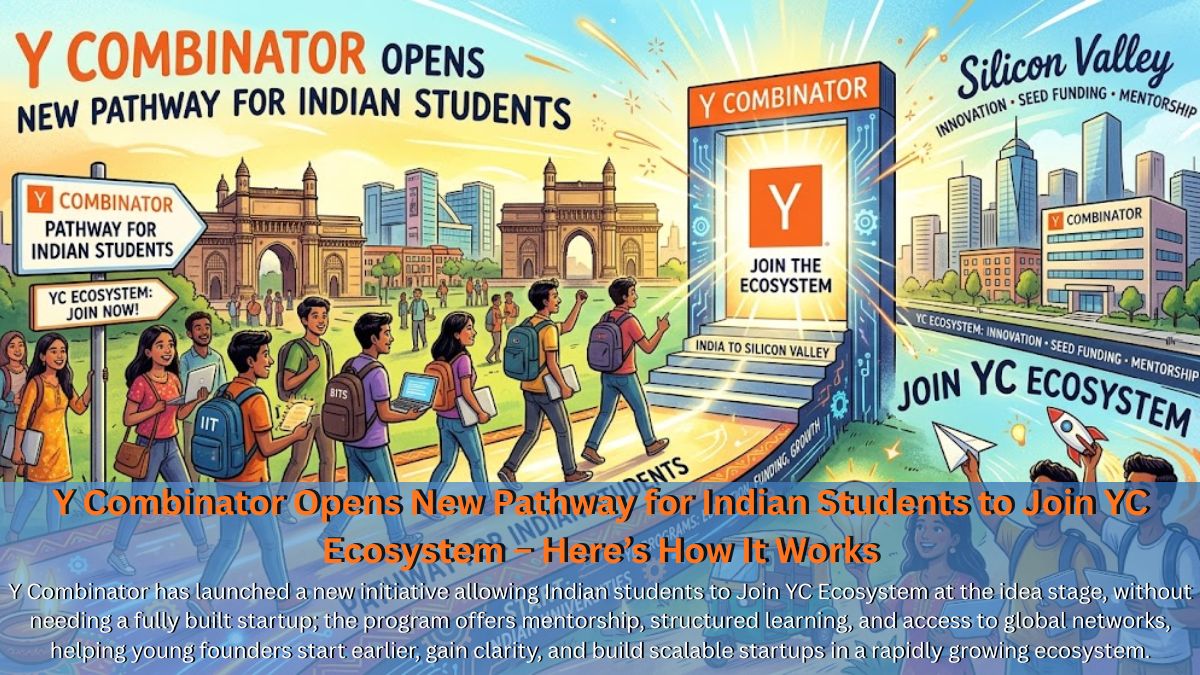
Y Combinator has introduced a new initiative aimed at helping Indian students Join YC Ecosystem, marking a significant shift in how global startup accelerators engage with early-stage talent. This move is designed to lower entry barriers for young founders, especially students who may not yet have fully developed startups but show strong potential. The new pathway focuses on education, mentorship, and structured exposure to startup building. It allows students to access YC’s vast network, resources, and guidance without needing a fully operational company. As a result, more Indian students can now explore entrepreneurship earlier in their careers.
This development comes at a time when India’s startup ecosystem is expanding rapidly. With increasing venture capital activity, rising angel investment, and growing interest in AI startups and fintech, the demand for structured startup education is higher than ever. YC’s move directly addresses this gap. The program includes startup school initiatives, mentorship from experienced founders, and access to global startup communities. It also connects participants to potential investors and future funding opportunities. Moreover, it aligns with broader global trends where accelerators focus on nurturing talent before formal company creation.
For Indian students, this is a major opportunity to build global startups from day one. It also reflects YC’s confidence in India as a key market for innovation and tech disruption. As more students Join YC Ecosystem, the long-term impact could reshape startup trends, funding patterns, and entrepreneurial growth in India.
1. Introduction to the “Join YC Ecosystem” Initiative
1.1 A New Era for Indian Student Founders
For a long time, getting into Y Combinator felt like something reserved for a different league of founders. You needed traction, numbers, maybe even investors already backing you. For a college student sitting with just an idea and a lot of doubt, it almost felt like the door was never meant for them. That gap between “having an idea” and “being taken seriously” was real, and honestly, it stopped a lot of potential founders before they even began.
This new pathway changes that emotional barrier more than anything else. It tells students that their starting point is valid, even if it’s messy, even if it’s unclear. Instead of demanding proof, it offers support. And that shift creates something powerful. When a student knows that they don’t have to be perfect to begin, they stop overthinking and start building. It’s not just about access to YC. It’s about permission to try, to fail early, and to learn without the pressure of already having it all figured out.
1.2 Why This Move Matters in Startup News
India has no shortage of ideas. Walk into any college campus and you’ll find people talking about startups, side hustles, or “something big” they want to build. But most of those conversations never turn into execution. Not because the ideas lack potential, but because the ecosystem around those early ideas is weak. There’s no structured guidance, no consistent mentorship, and most importantly, no environment where beginners feel safe experimenting without judgment.
This initiative directly addresses that silent gap. By bringing Indian students into a global ecosystem early, it gives them exposure that was previously out of reach. It also changes how they think. Instead of building small, local-first ideas, they begin to think in terms of scalability, global relevance, and long-term impact. Over time, this doesn’t just help individual founders. It strengthens India’s overall startup culture, making it more confident, more experimental, and far more connected to the global stage.
2. Background Story of Y Combinator
2.1 Founding and Early Journey
When Paul Graham started Y Combinator back in 2005, the vision wasn’t to create a massive global brand. It was much simpler. The idea was to help people with potential turn their ideas into something real. At that time, startups weren’t as mainstream as they are today. There was uncertainty, risk, and very little structured support for early founders. YC stepped into that gap with a model that focused less on perfection and more on potential.
What made YC different was its belief in people over polished plans. Instead of asking founders to present perfect business strategies, it encouraged them to build quickly, test constantly, and learn from real users. That approach changed how startups were built. Over time, YC became more than just an accelerator. It became a mindset. A place where founders learned to embrace uncertainty instead of fearing it, and where progress mattered more than perfection.
2.2 Notable Success Stories
When you look at companies like Airbnb, Dropbox, and Stripe, it’s easy to assume they were always destined for success. But that’s not how their stories started. In the beginning, they were just ideas that sounded uncertain, even risky. Founders faced rejection, confusion, and moments where nothing seemed to be working.
What changed their trajectory wasn’t just funding. It was guidance, feedback, and the ability to iterate quickly without losing direction. YC played a role in shaping that journey by giving founders clarity when things felt chaotic. That’s why these success stories matter. Not because they are big companies today, but because they remind new founders that every successful startup once looked like an unfinished idea. And that’s exactly where most students are right now.
3. How the New Pathway Works
3.1 Structure of the Program
The structure of this new pathway is designed to meet founders exactly where they are. It doesn’t assume prior experience or technical expertise. Instead, it focuses on building a strong foundation. Through guided learning modules, students begin to understand how real startups function. They learn how to identify problems worth solving, how to validate whether people actually care about their idea, and how to avoid common beginner mistakes that can waste months of effort.
But the real value goes beyond structured content. It comes from interaction. Mentorship sessions bring in real-world perspectives, where experienced founders share not just their wins, but also their failures. Community discussions create a space where students realize they are not alone in their struggles. And slowly, that isolation fades. Instead of feeling stuck, they start moving. Instead of waiting for the “perfect idea,” they start improving the one they already have.
3.2 Entry Requirements and Process
One of the most refreshing aspects of this initiative is how simple the entry barrier is. You don’t need a registered company, a team, or even a fully developed product. All you need is an idea and the willingness to explore it seriously. That simplicity removes a huge amount of pressure. It allows students to focus on thinking and building, rather than worrying about formalities and expectations.
At the same time, this freedom comes with responsibility. Without structure, it’s easy to lose direction. That’s where the program steps in. It provides just enough guidance to keep founders moving forward without restricting their creativity. The journey still involves confusion, trial and error, and moments of doubt. But now, those moments are part of a guided process rather than a lonely struggle. And that makes all the difference between giving up early and actually building something meaningful.res.
4. Working Model of Y Combinator
4.1 Accelerator Model Explained
At its core, Y Combinator runs on a very simple but deeply effective idea. Find people who are curious, driven, and slightly obsessed with solving a problem, and give them just enough capital and guidance to move faster than they ever could alone. It’s not about building companies for founders. It’s about putting them in an environment where they are forced to think clearly, execute quickly, and face reality early. YC doesn’t sit on the sidelines. It pushes founders to talk to users, launch faster than they’re comfortable with, and confront whether their idea actually works in the real world.
What makes this model powerful is how human it feels when you’re inside it. Founders often start confused, sometimes even insecure about whether they’re on the right path. But within weeks, something shifts. The constant feedback, the pressure to show progress, and the exposure to other founders going through the same struggle creates momentum. You stop waiting for certainty. You start acting despite uncertainty. That’s the real accelerator effect. It’s not just about speeding up business growth. It’s about transforming how a founder thinks and responds to challenges.
4.2 Revenue Model
YC’s revenue model is straightforward on paper but deeply aligned in practice. It takes equity in the startups it invests in, which means its success is directly tied to the founder’s success. There are no shortcuts here. If the startup fails, YC doesn’t win. If the startup grows, raises funding, or eventually goes public, that’s when YC benefits. This creates a relationship that feels less transactional and more like a long-term partnership.
From a founder’s perspective, this alignment matters more than it seems at first. You’re not dealing with someone who is just offering advice from a distance. You’re working with an ecosystem that is genuinely invested in your outcome. Over time, as startups raise larger rounds or achieve exits, YC’s returns come from those equity stakes. But behind that financial model is something more meaningful. It creates trust. Founders know that the guidance they’re receiving isn’t generic. It’s rooted in a shared goal of building something that actually works and lasts.
5. Funding and Investment Strategy
5.1 Standard Investment Structure
YC’s standard investment structure, which typically includes around $500,000, might sound like just another funding number from the outside. But for an early-stage founder, especially a student, it can completely change the trajectory of their journey. This funding is designed to remove immediate pressure. It gives founders breathing room. Time to experiment, to build, to make mistakes without the constant fear of running out of money.
A part of this investment often comes through SAFE (Simple Agreement for Future Equity), which is intentionally designed to keep things simple at an early stage. Instead of getting lost in complex legal structures, founders can focus on what actually matters: building a product people want. And when you talk to founders who’ve been through this process, a common theme comes up. It’s not just the money that helps. It’s what the money represents. It’s validation. It’s someone saying, “We believe this idea is worth pursuing.” And that belief can be incredibly powerful in the early days when self-doubt is at its peak.
5.2 Role of Venture Capital and Angel Investors
One of the biggest advantages of being part of the YC ecosystem is the access it unlocks. Startups don’t just receive funding from YC. They are introduced to a network of some of the most active venture capital firms and angel investors in the world. This changes how fundraising works for founders. Instead of chasing investors blindly, they enter conversations with credibility already established.
For students and first-time founders, this exposure can feel overwhelming at first. Sitting in front of investors, explaining your idea, answering tough questions. It’s not easy. But it’s also where growth happens the fastest. YC prepares founders for these moments, helping them refine how they communicate, how they think about their business, and how they handle pressure. Over time, these interactions stop feeling intimidating and start feeling like opportunities. And as more students from India step into this ecosystem, they’re not just building startups. They’re building relationships that can shape their entire entrepreneurial journey.
6. Services and Resources Offered
6.1 Mentorship and Guidance
If there’s one thing that consistently stands out about YC, it’s the quality of mentorship. This isn’t surface-level advice or generic startup tips. It comes from people who have actually built companies, faced failure, and figured things out the hard way. When founders interact with mentors, they’re not just getting answers. They’re learning how to think. How to break down problems. How to make decisions when there’s no clear path forward.
For someone at the idea stage, this kind of guidance can feel like a turning point. Instead of second-guessing every move, they start gaining clarity. They understand what matters and what doesn’t. They stop chasing distractions and focus on real progress. And emotionally, it creates a sense of support that’s hard to describe. Knowing that someone experienced is watching your journey, challenging you, and pushing you to do better, it builds confidence in a way that no online course or book ever can.
6.2 Startup Resources and Tools
Beyond mentorship, YC provides a toolkit that quietly removes many of the friction points founders usually struggle with. Legal templates, hiring frameworks, product development guidance, these might sound like small things, but when you’re starting from scratch, they save an enormous amount of time and confusion. Instead of figuring everything out alone, founders get access to systems that have already worked for others.
What makes these resources truly valuable is how practical they are. They are not theoretical concepts. They are tools shaped by real startup experiences. Founders use them to make faster decisions, avoid common mistakes, and build more structured businesses from the beginning. Over time, this creates a ripple effect. Instead of constantly reacting to problems, founders start operating with more clarity and control. And that shift is what allows small ideas to grow into scalable businesses.
7. Problems This Initiative Solves
7.1 Lack of Early-Stage Support
One of the biggest struggles for student founders in India has always been the lack of early-stage support. Not funding, not recognition, but guidance. Most ideas don’t fail because they are bad. They fail because they are never tested properly. Founders get stuck in their own heads, unsure whether to move forward or drop the idea altogether. That uncertainty kills momentum before anything meaningful can happen.
This initiative directly addresses that pain point. It creates a structured starting point where ideas can be explored without judgment. Founders are encouraged to test quickly, learn from feedback, and keep moving forward. Over time, this builds a habit of action. Instead of waiting for perfect conditions, they start working with what they have. And that mindset shift is often the difference between someone who keeps thinking about startups and someone who actually builds one.
7.2 Limited Access to Global Networks
For a long time, access to global startup networks felt distant for most Indian students. You could read about global founders, watch their interviews, maybe even follow them online, but actually interacting with that ecosystem felt out of reach. This created a kind of invisible barrier where talented founders remained local, not because they lacked ambition, but because they lacked exposure.
Now, that barrier is slowly breaking. By allowing students to step into the YC ecosystem early, this initiative connects them to a global community from day one. They get to see how founders in different parts of the world think, build, and solve problems. They learn faster because they are not limited by their immediate environment. And most importantly, they start believing that they belong in that global conversation. That sense of belonging changes everything. It expands their vision, strengthens their confidence, and pushes them to build not just for a local market, but for the world.
8. Industry Trends and Growth Insights
8.1 Rise of Indian Startups
Over the last decade, something remarkable has happened in India’s startup landscape. What once felt like a space dominated by a handful of tech hubs has now spread across cities, towns, and even small campuses. The number of unicorns crossing the 100 mark isn’t just a statistic. It’s a reflection of a mindset shift. Founders are no longer asking, “Can this work in India?” They’re asking, “How big can this become?” That change in thinking has quietly reshaped the entire ecosystem.
But behind these success stories is a deeper truth that often gets missed. Every unicorn you see today started as a fragile idea at some point. There were moments of doubt, near shutdowns, pivots that felt risky, and decisions that could have gone either way. When students look at these companies now, they see scale and success. What they don’t see is the uncertainty that existed in the early days. That’s why initiatives connecting students to ecosystems like Y Combinator matter so much. They expose founders to the reality behind growth, not just the outcome. And once you understand that growth is messy and non-linear, it becomes much easier to take the first step.
8.2 Increasing Interest in Tech Innovations
There’s also a noticeable shift in what students are choosing to build. A few years ago, many ideas were centered around basic services or small-scale improvements. Today, the conversation has evolved. Students are actively exploring areas like artificial intelligence, blockchain, and fintech, not just because they are trending, but because they see real-world problems that can be solved through technology. The curiosity has become sharper, more intentional.
What’s interesting is how this curiosity turns into action when the right support exists. A student experimenting with an AI idea in isolation might give up after hitting a few roadblocks. But place that same student in an environment with mentorship, feedback, and exposure to global trends, and their approach changes completely. They start thinking in terms of scalability, usability, and impact. They begin to understand that innovation isn’t about chasing buzzwords. It’s about solving problems in a way that actually works. And that realization is often the moment where a casual idea turns into a serious startup journey.
9. Competitor Analysis
9.1 Direct Competitors
While Y Combinator is often seen as the gold standard, it’s not operating in isolation. Accelerators like Techstars, 500 Global, and Sequoia Surge are also playing a significant role in shaping early-stage startups. Each of them offers funding, mentorship, and access to networks, but their approaches differ slightly in terms of focus, geography, and scale.
From a founder’s perspective, this competition is actually a good thing. It creates options. It allows startups to choose environments that align with their vision and stage. But there’s also a subtle difference that many founders who’ve experienced these ecosystems talk about. YC tends to emphasize clarity of thought and speed of execution in a very intense way. It pushes founders to confront reality quickly, sometimes uncomfortably so. That intensity isn’t for everyone, but for those who embrace it, it often leads to faster learning and sharper decision-making.
9.2 Indirect Competitors
Beyond global accelerators, there’s another layer of support systems that often go unnoticed but play an important role. University incubators, government-backed startup programs, and private incubators have become increasingly active in nurturing early-stage ideas. They provide infrastructure, initial funding, and sometimes even mentorship. For many students, these are the first stepping stones into the startup world.
However, the experience within these systems can vary widely. Some offer strong guidance and community support, while others struggle with consistency and real-world relevance. This is where global ecosystems stand out. They bring a level of exposure and pressure that pushes founders beyond their comfort zones. It’s not about replacing local support systems, but complementing them. When a founder moves from a local incubator to a global platform, the shift in perspective can be transformative. Suddenly, the benchmark changes. The questions become tougher. And the learning becomes deeper.
10. Impact on Indian Startup Ecosystem
10.1 Boost for Emerging Startups
When more students gain early access to structured ecosystems, the ripple effect is hard to ignore. You don’t just get more startups. You get better-prepared founders. People who understand how to validate ideas, how to listen to users, and how to adapt when things don’t go as planned. Over time, this leads to a healthier startup environment where fewer ideas die prematurely and more of them evolve into something meaningful.
There’s also a very human side to this impact. Startups create jobs, yes, but they also create confidence within communities. When someone from a small town builds something that gains traction, it changes how others around them think. It makes entrepreneurship feel possible, not distant. And that psychological shift is often the beginning of long-term ecosystem growth. It’s not just about numbers. It’s about belief spreading from one founder to another.
10.2 Strengthening Global Presence
As more Indian students step into global ecosystems, the perception of Indian founders begins to evolve. They are no longer seen as participants in a local market. They are seen as contributors to global innovation. This shift doesn’t happen overnight, but it builds gradually as more founders launch products that cater to international audiences and solve problems at scale.
What’s even more powerful is how this exposure shapes the founder’s mindset. When you’re part of a global community, you naturally start thinking bigger. You benchmark yourself against the best, not just the nearest. And that pushes you to improve continuously. Over time, this creates a generation of founders who are not just building companies, but building them with a global standard in mind. And that’s where real transformation happens.
12. Learning for Startups and Entrepreneurs
12.1 Key Takeaways
If there’s one thing that stands out from all of this, it’s that timing matters less than action. Many aspiring founders spend months, sometimes years, waiting for the “right idea” or the “right moment.” But the reality is, clarity comes from doing, not thinking. Starting early, even with an imperfect idea, teaches you more than endless planning ever will. You begin to understand users, markets, and challenges in a way that theory can never replicate.
At the same time, no founder succeeds in isolation. Seeking mentorship, building relationships, and learning from others who have walked the path before you can save you from costly mistakes. Strong networks don’t just open doors to funding. They open doors to perspective. And when you combine that with a focus on building scalable solutions and learning from global ecosystems like Y Combinator, you start to see the bigger picture. Entrepreneurship stops being a gamble and starts becoming a disciplined journey of learning, adapting, and growing.
About foundlanes.com
foundlanes.com is India’s leading startup idea discovery platform. It helps entrepreneurs find actionable startup opportunities, market insights, and industry-specific guidance to turn ideas into real businesses. With deep research and practical resources, foundlanes supports founders at every stage, from idea validation to launch and growth.